Showing posts with label Shakespeare. Show all posts

Wednesday, April 16, 2025

"The Fiddler" ascribed to Melville in THE CHURCHMAN, edited by Henry Norman Hudson with a regular department of "LITERATURE" supervised by Evert A. Duyckinck

Henry Norman Hudson (1814-1886)
via The New York Public Library Digital Collections
Herman Melville's short story "The Fiddler" first appeared, uncredited as usual for magazine fiction of the time, in the September 1854 issue of Harper's New Monthly Magazine.

Melville's narrator in The Fiddler is Helmstone, a proud classicist and poet. Helmstone seems appealingly earnest though self-absorbed and over-ambitious, at first, of critical acclaim and "immortal fame." Distraught by bad reviews of his last poem, Helmstone bumps into a friend named Standard on Broadway. There they meet Standard's acquaintance Hautboy, happily on his way to the circus to see a renowned clown. Hautboy is a grown man, fortyish, but joys in the circus performance like a child. After the show they join "crowds of others" at the fabulous Taylor's Saloon, downing "stews and punches" while seated "at one of the small marble tables." Although moved by the "clear honest cheeriness" that Hautboy exhibited at the circus, Helmstone doubts his ability to do more than laugh and clap. Clearly he's no genius, this Hautboy. So thinks Helmstone before hearing Hautboy play his "dented old fiddle." And says out loud during Hautboy's absence from their table at Taylor's. In response, Standard mysteriously alludes to "Master Betty," the once-famous child actor William Henry West Betty. Helmstone is baffled by his friend's reference to the celebrated British virtuoso until he actually hears Hautboy (at Hautboy's home, off Broadway) doing "Yankee Doodle" and other popular tunes with "the bow of an enchanter," like "an Orpheus." Through Standard, the narrator learns Hautboy's true identity and humble occupation, teaching music "from house to house." Helmstone instantly recognizes the real name of Hautboy (whispered in his ear by Standard) as a favorite entertainer whom he had enthusiastically cheered and applauded "in the theater" as a boy. Thus chastened, the narrator ditches his poems in manuscript and buys a fiddle. Instead of writing, Helmstone will take lessons from Hautboy and let go his dreams of literary glory.

William H. Gilman in Melville's Early Life and Redburn (New York University Press and Oxford University Press, 1951) at page 316, note 148 identified Joseph Burke (1815-1902) as the likeliest real-life model for Melville's fictional fiddler, Hautboy. As a child in the early 1830's Melville could have seen "Master Burke" perform in Albany, New York and, like his narrator Helmstone in "The Fiddler," made himself "hoarse" from yelling and "applauding that name in the theatre."

MASTER BURKE as ROMEO.
via The New York Public Library Digital Collections
Later in the last century, John M. J. Gretchko began a provocative essay on sexually suggestive wordplay and germane historical contexts in "The Fiddler" by calling attention to the anonymity that Melville might have expected and indeed preferred; see "Fiddling with Melville's 'Fiddler'" in Melville Society Extracts Number 104 (March 1996) pages 20-23 at page 20. Citing Merton M. Sealts, Jr., Did Melville Write "The Fiddler"? Harvard Library Bulletin 26 (January 1978) pages 77-80, Gretchko observed that the story's original anonymity in some measure appears to have encouraged the later, false attribution of "The Fiddler" to Fitz-James O'Brien. As demonstrated by Sealts, and duly affirmed in the 1987 Northwestern-Newberry Edition of The Piazza Tales and Other Prose Pieces, 1839-1860, edited by G. Thomas Tanselle, Harrison Hayford and Hershel Parker, strong external evidence for Melville's authorship of "The Fiddler" is supplied by Melville's wife Elizabeth Shaw Melville, who 

listed "The Fiddler" in her memoranda of her husband's periodical pieces and kept a copy of it in her collection of his magazine stories. -- Northwestern-Newberry Piazza Tales and Other Prose Pieces, Editorial Appendix, Notes on "The Fiddler," page 692.

What's new on Melvilliana is my discovery of an early and explicit attribution of "The Fiddler" to Herman Melville in the New York Churchman of September 9, 1854, contemporary with the story's first, anonymous publication in Harper's magazine. 

New York Churchman - September 9, 1854

Harper's Magazine for September opens with an illustrated paper on the old Dutch times of Manhattan from the competent resources of LOSSING; has a sketch, "The Fiddler," by MELVILLE, showing how an author, as the world goes, may be reconciled to the failure of his volume; and TAYLER LEWIS throws out some conservative suggestions on the topic of the Unity of the Human Race.  -- The Churchman, September 9, 1854

"The Fiddler" was seldom referenced in newspaper roundups of periodical literature and, except in the Churchman, never linked to Herman Melville. Despite the rarity of any notice at all, the Churchman  discloses Melville's authorship of "The Fiddler" positively and rather casually, not so much as breaking news but as a matter of fact, familiar to insiders in New York City. Accompanied by a line of plot summary, this so-far unique contemporary attribution of "The Fiddler" to Herman Melville appeared in the last issue of the Churchman to be edited by H. N. Hudson. 

Middlebury Vermont Register - January 5, 1853
via genealogybank.com

A Vermonter by birth, Henry Norman Hudson was already well known for his trenchant literary criticism and popular lectures on Shakespeare. As shown by Mark Bayer, "Hudson was a prolific scholar, editor, and educator" whose influence on Shakespeare studies in the United States deserves fuller appreciation and respect. 

Hudson abruptly quit his position as editor of the Churchman, alleging undue interference from the owner, John Hecker:

Whether Hudson was too impractical or too temperamental, or whether the proprietor was a little impatient, we can not be sure. That friction arose is entirely certain and that Hudson was firmly determined to have no more of it is equally plain. He resigned, he announced in THE CHURCHMAN (September 9, 1854), because the proprietor was setting "the editorial department at strife and controversy with itself" by engaging outside writers without consulting the editor.  -- Clifton H. Brewer on "The History of The Churchman: Some Old-Time Editors" in The Churchman Volume 132 (November 28, 1925) pages 10-11. 

On Hudson's last day at work, September 9, 1854, the "Literature" department contained notices of two contributions by Melville in different magazines, "The Fiddler" in Harper's and several chapters of "Israel Potter" in Putnam's. In "Harper's Magazine for September" the Churchman acknowledges only three items. Ignored altogether are three new chapters from Thackeray's new novel, The Newcomes. Instead, the Churchman notices

a sketch, "The Fiddler," by MELVILLE, showing how an author, as the world goes, may be reconciled to the failure of his volume....

Brief as it is, this treatment of "The Fiddler" in the Churchman features a handy summary of the story's moral along with a remarkably casual attribution to Melville. Both the commentary and the attribution are unparalleled. In the selective survey of Harper's for September, the notice of "The Fiddler" appears in between mentions of an "illustrated paper on the old Dutch times of Manhattan" (uncredited in Harper's but knowingly associated here with "the competent resources" of Benson John Lossing) and Tayler Lewis on the "Unity of the Human Race" (sole topic of the unsigned essay taking up the whole "Editor's Table" that month, starting with the question, "IS THE HUMAN RACE ONE OR MANY?"). 

In the same column of the Churchman, surveying the contents of another prominent American journal, the reviewer went on to notice the latest installment of Melville's Israel Potter, as serialized in the September 1854 issue of Putnam's Monthly Magazine:

Putnam's Monthly has an elaborate article, clearly written, on the "Parties and Politics" of the country, past and present; several interesting descriptive papers of American nature; a continuation of Israel Potter's Fifty Years of Exile, the main incidents of which are founded on fact. POTTER was wounded at Bunker Hill, was captured by the British in an attempt to cut off their supplies in Boston harbour, and was carried to England. He was actually employed by FRANKLIN, as represented by MELVILLE in this embellished account of his career, the interest of which is well developed in the present number. 

These remarkably well-informed and favorable notices of Herman Melville's contributions to Harper's and Putnam's coincided with the tenure of Melville's good friend Evert A. Duyckinck as literary editor of the Churchman. Duyckinck's role as head of the regular "Department of Literature" was formally announced by owner John Hecker and editor H. N. Hudson in the Prospectus for volume 24, reprinted in the Churchman on March 4, 1854. 

The Churchman - March 4, 1854
via newspapers.com

"Arrangements have also been made for keeping up statedly a Department of Literature. This department is placed under the entire charge and control of EVERT A. DUYCKINCK, Esq., late Editor of the Literary World, whose name is deemed a sufficient guaranty of whatsoever attractions, both in matter and style, such a department is ordinarily capable of furnishing."

A "neat discriminating & appreciative" review of Thomas De Quincey's Essays on Philosophical Writers and Other Men of Letters in the Churchman, Vol. 23 (February 11, 1854) is ascribed to Duyckinck in a letter from William Gilmore Simms; collected in The Letters of William Gilmore Simms Volume 3, 1850-1857, edited by Mary C. Simms Oliphant and T. C. Duncan Eaves (University of South Carolina Press, 1954) page 280. In Volume 24 the new Literature department of the Churchman opened with a lavish two-part review (March 4 and 11, 1854) of The U. S. Grinnell Expedition in search of Sir John Franklin by Elisha Kent Kane (Harper & Brothers, 1854). I'm not sure why or how Evert A. Duyckinck decided to review that particular title, but he definitely knew a guy with expertise in the genre of nautical exploration and adventure. 🤔 Did he dare ask Herman Melville for help? 

At present the online archive at Newspapers.com has digital images of The Churchman for two years only, 1854 (10 months, March through December) and 1855 (two months, January and February), generously furnished by the Brooklyn Public Library. Hopefully, future searches in other digital and print archives will uncover additional references to Herman Melville's magazine fiction. It would be wonderful to find some notice of Bartleby, for instance, in November or December 1853; or "COCK-A-DOODLE-DOO!" which first appeared in the December 1853 issue of Harper's New Monthly Magazine Magazine. 

For now I can offer three additional Melville items that appeared in the "Literature" section of the New York Churchman when conducted by Evert A. Duyckinck. In the Churchman for March 11, 1854, Duyckinck favorably noticed the opening sketch of "The Encantadas" in Putnam's Monthly. 

New York Churchman - March 11, 1854
Putnam's Monthly for March has the commencement of a series of papers by HERMAN MELVILLE, sketches of the barren islands of the Gallapagos, under the equator, on the Pacific. His opening sentence shows his graphic hand,-- "Take five-and-twenty heaps of cinders dumped here and there in an outside city lot; imagine some of them magnified into mountains, and the vacant lot the sea; and you will have a fit idea of the general aspect of the Encantadas or Enchanted Isles."
On April 22, 1854 Duyckinck observed that "Putnam's Monthly for April continues Mr. MELVILLE"S Encantadas...."

Also while "under the entire charge and control" of Evert Duyckinck, the Literature department of the Churchman (May 6, 1854) gave a shout-out to Melville in the long review of George W. Peck's Melbourne, and the Chincha Islands; with Sketches of Lima, and a Voyage round the World (New York: Charles Scribner, 1854).

New York Churchman - May 6, 1854
But we turn to more agreeable incidents. A sailor's dinner is a thing to be relished all the world over. Who does not remember, in Mr. MELVILLE'S capital book "Redburn," the achievements of that young gentleman on his first voyage when, at Liverpool, "he goes to supper at the sign of the 'Baltimore Clipper'," and the ardent company "wrapt themselves in hot jackets of beef-steaks." This is the kind of thing to give a wholesome shock to the dyspeptic. Would you know what appetite really is, of what this admirable structure is capable, flee Delmonico's and the St. Nicholas, the jaded tables of the Fifth avenue, and place yourself alongside of a potent skipper of the seas in DORAN's modest mansion, which rises amidst the incense of fiery oyster sacrifices in the very heart of the Fulton Market--or, for the same number of shillings, you may enjoy Mr. PECK's hardly less substantial feast at Melbourne.  
Reviewing Peck, Duyckinck directly quotes from Redburn Chapter 28.

As shown already, H. N. Hudson resigned his position as chief editor in September 1854. High quality book reviews, many concerned with non-fiction narratives of travel and exploration, continued to appear in the Churchman under the editorial watch of Hudson's successor, Thomas Ramsay. Apparently Evert Duyckinck stayed on for much if not all of 1855 as head of the Literature department. 

The Churchman for June 5, 1856 featured a favorable review of The Piazza Tales; reprinted by Brian Higgins and Hershel Parker in their great collection Herman Melville: The Contemporary Reviews (Cambridge University Press, 1995; paperback 2009) at pages 475-476. The Contemporary Reviews volume (see page 500) also has the brief notice of The Confidence-Man: His Masquerade in the New York Churchman for April 30, 1857. 

Also reprinted in Contemporary Reviews, at pages 394-395, the review of Moby-Dick; Or, The Whale that appeared in the Churchman for December 6, 1851. Back then, William Walton edited the Churchman. On Walton's watch, the Churchman had appreciated the "character of the monomaniac Captain Ahab" as "a novelty, and powerfully drawn," but found it "pitiable to see so much talent perverted to sneers at revealed religion and the burlesquing of sacred passages of Holy Writ."

New York Daily Times - November 13, 1852
Cleaning up now with the aim of good housekeeping, I would suggest that the otherwise unidentified "Mr. Hudson" on page 249 in the first volume of Jay Leyda's good old Melville Log (New York: Harcourt, Brace and Company, 1951) could well be Henry Norman Hudson, then a resident of Boston and well known for his lectures on Shakespeare. Leyda thus quotes Ida Russell in a letter dated July 8, 1847 to her cousin Richard Henry Dana, Jr.:
"Mr. Herman Melville is expected to take tea with us tomorrow which is Friday afternoon he would like to meet you . . . If you see Mr. Hudson will you be so kind as to extend the invitation to him.  
I intend only to ask a few Dr. Vinton among others. If any other members of your family are in town I wish they would come."
Possibly Melville got to meet Dana and "Mr. Hudson" the next day on Friday, July 9, 1847, at tea with Ida Russell. In any event, Henry Norman Hudson's presence in Boston is definitely established by extant letters to Evert A. Duyckinck, accessible courtesy of the New York Public Library Digital Collections. Most relevant there is Hudson's newsy 3-page letter from Boston dated March 27, 1847. Citation:
Manuscripts and Archives Division, The New York Public Library. "Hudson, Henry Norman (1814-86)" New York Public Library Digital Collections. Accessed April 16, 2025. https://digitalcollections.nypl.org/items/9462eaa0-69fc-0133-794f-00505686a51c

Looking further into the identity of Ida Russell's "Mr. Hudson," I just learned that Roma Rosen nominated Henry Norman Hudson 63 years ago in Melville's Uses of Shakespeare's Plays (PhD dissertation, Northwestern University, 1962). As Rosen reasons, 

"There is a possibility that the "Mr. Hudson" mentioned in Miss Russell's invitation was the Shakespearean critic and that Melville met him, too, on this occasion." (pages 183-184)

Rosen makes a great case for the influence of Hudson's negative view of Polonius in Lectures on Shakespeare Volume 2 (New York: Baker and Scribner, 1848) pages 119-121 on the equally salty commentary of Charlie in the Confidence-Man Chapter 30. 

In the first two months of 1847, Henry Norman Hudson made a hit with his two-part review of Philip James Bailey's Festus, A Poem in the American Whig Review: 
"This book has come to us, wafted on a perfect gale of puffery."

Hudson's 1847 review of Festus very likely influenced Melville's critique of Transcendentalism in Pierre (1852), as James Duban argues in Melville's Major Fiction: Politics, Theology, and Imagination (Northern Illinois University Press, 1983) at pages 172-176. John Stafford in The Literary Criticism of Young America (University of California Press, 1952) at page 102 recalls how

"Henry Norman Hudson thoroughly dissected P. J. Bailey's Festus for the Whig Review, objecting to its liberal and transcendental philosophy, its liberal and democratic politics.

At page 127 of the same book, Stafford pairs Hudson and George Washington Peck as New England "farm boys," both of whom became "conservative supporters of the Establishment party," more or less in opposition to democratic Young Americans and their Manhattan champion, Evert A. Duyckinck. 

Hudson's two-volume work, Lectures on Shakespeare (Baker and Scribner, 1848) is Number 376 in Melville's Sources by Mary  K. Bercaw (Northwestern University Press, 1987). Listed there on page 92, citing H. J. Lang who had proposed Hudson's 1848 Lectures on Shakespeare as a source for "Benito Cereno" and Billy Budd in "Poe in Melville's 'Benito Cereno,'" English Studies Today, Fifth Series (1973) pages 405-429. 

From the obituary of Henry Norman Hudson, "the well known Shakespearian scholar," as published in the Boston Evening Transcript on January 18, 1886: 

... Personally Mr. Hudson was said to be a man of marked peculiarities. He cared little for the opinions of others where they were at variance with his own, and would not have been troubled if he had had to stand against the world. He had the courage of his convictions almost more than any other man of his time. In appearance he was thought to resemble Carlyle. His life work had been primarily the study of the one great subject of Shakespeare, and his English text-books were a vigorous protest "against putting young students through a course of mere nibbles and snatches from a multitude of authors, where they cannot stay long enough with any one to develop any real taste for him or derive any solid benefit from him." In 1852 he married Emily S., the oldest daughter of the late Henry Bright of Northampton. His son is a merchant in Omaha. 

Also published in the year of Hudson's death, Jeremiah Eames Rankin's public address The Shakespeare Interpreter (Middlebury, Vermont, 1886), concluding with a fine memorial tribute to Henry Norman Hudson on pages 29-42. 

For more in the way of 19th century biography, see the entry for HENRY NORMAN HUDSON in the Cyclopædia of American Literature, Volume 2, edited by Evert A. Duyckinck and George L. Duyckinck (New York: Charles Scribner, 1856) pages 597-599. A later, more succinct treatment may be found in the New International Encyclopædia, Volume 9, edited by Daniel Coit Gilman, Harry Thurston Peck, and Frank Moore Colby (New York: Dodd, Mead and Company, 1903) at page 630. 


HUDSON, HENRY NORMAN (1814-86). An American Shakespearean scholar and editor, born at Cornwall, Addison Co., Vt. In early life he worked as a baker and a wheelwright. He graduated from Middlebury College, Vermont, in 1840, and then taught school in Kentucky and Alabama. He presently became an authority of considerable note on Shakespeare, lectured widely on his works, and was appointed a professor in Boston University. Among his works in this field are: Lectures on Shakespeare ( 2 vols., 1848); a valuable annotated edition (11 vols.,1851-56); and Shakespeare: His Life, Art, and Characters (2 vols., 1872). Having entered the priesthood of the Protestant Episcopal Church, he was for some years editor of the Churchman; was rector at Litchfield, Conn., 1859-60, and served as chaplain in the Union Army during the Civil War. On his return he published A Chaplain's Campaign with General Butler (1865). He was author also of Sermons (1874); Studies in Wordsworth (1884); Essays in Education (1884); and other works. 


Related posts 

Wednesday, June 12, 2024

Helen Melville in Boston, November 1843

Mr. Macready as Macbeth
London, England: Published by M. & B. Skelt [between 1840 and 1850]
Folger Shakespeare Library - Digital Collections - Folger Imaging Department

While Herman Melville was at sea in 1841-1844, his sister Helen Melville enjoyed long visits with Judge Lemuel Shaw and family in Boston. Over time Helen became good friends with Shaw's daughter Elizabeth aka "Lizzie," Herman's future wife Elizabeth Knapp Shaw Melville. The New York Public Library has six of Helen's letters from Boston in the Augusta Melville papers. Not counting one from Lansingburgh dated October 10, 1841 with news about the grand time she and her brother Gansevoort had in Lenox, Berkshire County, Massachusetts partying with the Sedgwicks, Shaws, and Charles C. Ingham the portrait painter; and two from Lansingburgh on January 24 and 28, 1843. Lizzie in turn made multiple visits to the Melville family in Lansingburgh, New York. 

Helen Melville's six letters from Boston in the Augusta Melville papers at NYPL are dated

  • January 24, 1842
  • February 16, 1842
  • March 7, 1842
  • November 27, 1843
  • December 1, 1843
  • January 14, 1844
Below is my transcription of the 4-page letter Helen wrote Augusta from Boston on November 27, 1843. I chose this one for the unique reminiscence of "poor Herman" and his mimicry of the witches in Shakespeare's Macbeth; for the interesting allusions to Fanny Elssler (Helen spelled the Austrian surname "Ellsler") and her Boston disciple Fanny Jones; and to verify Helen's mentions of another "Miss Shaw" in the house, not her friend Lizzie. Also I wanted to double-check Helen's reference to the character of Ophelia after I found it given as "lonely Ophelia" by John Bryant in the second volume of Herman Melville: A Half Known Life (Wiley Blackwell, 2021) at page 1139. 


At first glance it might look like "lonely" but Helen's word can only be lovely. The third letter is "v." Giving due credit to the "enormously fat, red necked, red armed, and red faced" Mrs. Anderson as a "good actress" and believable Lady Macbeth, Helen viewed her matronly physical appearance as disqualifying for the role familiarly known as "lovely Ophelia." (Then again, Mrs. Anderson, daughter of manager William Pelby and actress-artist Rosalie French Pelby, would always be Ophelia since that was her first name!)

Helen and company saw Macready and Mrs. Ophelia Pelby Anderson in Macbeth, and Fanny Jones the ballet dancer, at the National Theatre, then located on the corner of Portland and Traverse streets in the West End. The Tremont Theatre where Fanny Jones used to perform had been sold to Boston Baptists and would be converted into a church known as Tremont Temple. The final dramatic performance at the Tremont Theatre had taken place in June 1843, as recalled in The Bostonian Volume 1 (Boston: 1894-5). 

Hershel Parker tells about Helen and her developing intimacy with the Shaw family in chapter 15 of Herman Melville: A Biography Volume 1, 1819-1851 (Johns Hopkins University Press, 1996). See page 302 for specific quotes and discussion of the letter transcribed herein. 

Comments and corrections are welcome any time! 

Citation

Manuscripts and Archives Division, The New York Public Library. "Melville (Griggs), Helen" The New York Public Library Digital Collections. 1835 - 1863. https://digitalcollections.nypl.org/items/92011730-5d32-0136-4373-099142fea98d

***
Boston, Nov. 27th 1843.

Dear Gus,

I received your letter duly, a day or two after it was written, and was delighted to hear from home, for it was so long since I had had tidings from our little village. Your first two pages were very interesting to me, and Lizzie too, for she wanted very much to know how our two cavaliers bore the intelligence of our sudden departure. As to writing Jeanie, I don't know what to think about it; ask Mama what she would advise me to do. 

Macready the tragedian is has been here for a fortnight. The first night he played "Macbeth", and Mrs. Shaw sent out and bought tickets for all the young folks of the house including Miss Shaw who was to matronise us, and George Nourse who was to be our escort. We went in great spirits, all the first people of the town were there and Macready's performance was admirable. I have not been to the theatre since Fanny Kemble performed in Albany, so it had all the charm of novelty added to its other attractions, and I passed a delightful evening. The next evening we went to a small party at Mrs Dow's, Lizzie's Aunt, had dancing, a pretty little supper, oysters, ice-cream, and West India fruits, some fine music, and though there were not more than fifteen of us, we never got home until nearly twelve o'clock.

The next day Lizzie was taken with a dreadful toothache, and we were obliged to decline an invitation for the evening, as I did not wish to go alone. On Saturday morning of the same week, Kate Minot called and invited and invited us to a small party there; but the weather was very stormy. Lizzie was confined to her chamber, Miss Shaw was at Cambridge and the Judge & his lady, could not go on account of the recent death of a cousin. So I wrote a little note to Kitty in the afternoon, setting forth my numerous reasons for changing my mind, and staid at home to comfort Lizzie. 

On Monday morning Miss Mary Bigolo [Bigelow] called to know if I would come and take tea with them very sociably. I went and passed a delightful evening. There were three other young ladies, all with  their fancy work, around the table. I like Mrs. Bigolo, better than her daughters; the eldest one is the picture of Kate Yates. I never saw two people so much alike not only in person, but in mind and manners & disposition, too from what I can see. 

The same morning I arrived a pretty note from Miss Catharine Scholl Scollay, inviting me to meet the family party there, on Thanksgiving evening. No one but the large family circle, and "she looked upon me as a member of the family." As the invitation was given nearly a fortnight beforehand, she must have been desirous that I should accept it. I have had another since from Madam Heyward and may have still another before the day comes. Am I not in request?

On Wednesday evening of last week, Lizzie & I attended a party at Mr. Wales in Winter Street, and the next morning as she was threatened with another siege of toothache, I prevailed upon her to have it taken out. I had some difficulty in persuading her to "screw her courage to the sticking place", but at last succeeded, and she has felt quite happy since. The same evening Judge Shaw & his wife went out to make a long call upon some friend, and Lizzie and I sat in her room, where she preferred remaining for fear of taking cold in the "aching void", which the dentist had left in her mouth: when I was summoned down stairs to receive a gentleman, in about ten minutes another entered, and then still another, until Mr. Dow (Lizzie's Uncle) a very agreeable man, and Lemuel, I had five gentleman to entertain, all alone, but I flatter myself I did the honours of the house, to the satisfaction of all. They all laughed a great deal the next day, at the "gentleman's levee", I had held. 

One of the gentlemen was the Mr. Curtis who had called with Guert, he came with Guert's compliments to appoint another day for our navy yard expedition. We had fixed upon one the week before, but Mrs. Shaw lost a cousin & her funeral came upon the same day & hour; I could not bear the idea of going, especially as Mrs. Shaw disapproved of Lizzie going at that time; so I sat down the day before, and wrote Guert a very cousinly epistle, setting forth my reason for postponing our appointment, and hoping it would make no difference to him. We went this morning, & have just returned, Lizzie & I escorted by Mr. Thornton & Lemuel Shaw, but the particulars must be reserved for the next letter, for as Lizzie said we had a "most felicitous time". Guert came over with a Man of War's boat, five pr of oars only think! & Mr. Curtis. And Guert was as kind and polite as possible. 

On Friday morning early, I received a sweet note from Mrs Charles P. Curtis, saying that they were going to procure tickets for the Theatre that evening, and would be happy to see me at dinner at 5 o'clock.  
Boston Daily Atlas - Friday, November 24, 1843
via genealogybank.com
I accepted the invitation, you may be sure very gladly, went about half past four, dined by candle light, and rode to the Theatre, saw Macready again and was as much delighted as the first time; he is a most splendid actor. Unfortunately, the Manager of the Theatre, will not allow Miss Cushman, a distinguished tragic actress who accompanies him, to support the female characters, for fear it should injure his own daughter Mrs. Anderson. She is rather a good actress, but is an enormously fat, red necked, red armed, and red faced matron, who does very well as the stately Lady Macbeth, but makes a ridiculous figure as the "gentle Desdemona" or "lovely Ophelia". Her neck is as fat and red as a pulpit cushion, and the last time we sat in the box next to the stage, I had a full view of her, and in the most exciting parts, her complexion became so pitiably suffused, that I could not bear to look at her. The witch scenes were admirably got up, and when dancing about the "cauldron of hell-broth," one of the horrid creatures, puts in some terrible contribution, and enjoins it "to make the gruel thick & slab", I could not help thinking of poor Herman, who made it a favorite quotation, and talked about the "pilot's thumb, wrecked as homeward he did come", "eye of newt, toe of frog", &c.

The Witches in Macbeth
Alexandre-Gabriel Decamps (1803-1860)
Image Credit: The Wallace Collection

Mrs Curtis is a very sweet woman, and her husband is so intelligent & agreeable, that I quite like to go there. Aunt Scollay is very kind to me, and so is Miss Catharine. They are a delightful family.

Macready has a companion, a Mr. Ryder of Drury Lane, London, who takes the second characters. As MacDuff in the last scene, he and Macready go through a fencing match, and the former runs the latter his sword most furiously--under the latters arm, and deals him his deathblow. It is a most thrilling affair, and I was glad when the curtain dropped and my wearied eyes had rest. In the box opposite to us sat the Minots & Miss Sedgwick, who had arrived that afternoon. After the play, "Fanny Jones", a famous danseuse, who was attached to the Tremont Theatre came out upon the stage, danced one of Fanny Ellsler's dances, and beautifully, too, she took lessons of the "divine Fanny", when she was here. And she is grace itself. "Though 'sooth to say", now that my curiosity has been gratified, I never desire to see another public dancer, for it is most certainly an unfeminine display and I blushed for my sex, when I saw her with petticoats so brief, that they scarcely covered her knees, performing all kind of impossible feats and capers, for the amusement of a pit crowded with men, and the boxes with gaping spectators. Now dear Gus, I must stop for I have promised Lizzie a small space, and all the rest of my news I must postpone until the next letter. Guert says he is going to Waterford in about a week and will take my commands. I received a long letter from Gansevoort last week, & answered it immediately as he desired. All our Aunts send love to Mama & the girls, and believe me dear Gus, with love to dear Mama and all at home your own loving and devoted sister

Helen.

 My dear Gus,

I can only add a few lines to Helens already lengthened epistle to inform you of the universal propriety & decorum with which she conducts herself, to the admiration of all beholders, except myself, and I laugh in my sleeve whenever mother holds her up as a pattern which I am to endeavor to imitate, for I think to myself it is easy enough to be a pattern when you have no temptation to do evil. Oh dear! Helen has not left me half room enough. With love to all believe me yours with Love, Lizzie. 

My letters are terribly egotistical, but I somehow cannot help it. Give my love to Mr. Peebles and the Knickerbackers, and Mrs. Ives. Tell dear Mother I will write to her next.

I have half a thousand calls to return to day, so excuse the haste with which this is written.

* * * 

Letter from Helen Melville to Augusta Melville - November 27, 1843 - page 3 of 4
via NYPL Digital Collections

Related posts:

  • Pantomime with mock pier mirrors seen by Helen Melville at the Boston Museum
    https://melvilliana.blogspot.com/2024/06/pantomime-with-mock-pier-mirrors-seen.html

Saturday, October 31, 2020

Tell Truth and shame the Devil


Tell Truth & shame the Devil

Herman Melville

March 2d 1882
Via invaluable

Or is it Devel? Either way, score this one for the Maestro Hershel Parker who correctly identified Hotspur's line from Shakespeare's Henry IV Part I long ago, without seeing the actual autograph book that contained it. Blindfolded, you might say. Henry A. Murray had misread Melville's inscription or heard it misreported as "Tell Truth and shame the dead." But Murray accepted Parker's better-informed guess and rightly predicted it would be confirmed some day, as revealed on pages 136-7 in Melville Biography: An Inside Narrative (Northwestern University Press, 2012). Parker thought Melville's contribution had been collected with autographs of other Berkshire celebrities in the 1850's, when Melville lived in Pittsfield. However, as shown above, Melville's inscription is dated March 2, 1882 in the autograph album of Lafayette Cornwell--offered at auction by Lion Heart Autographs just last week. 

James Barron in the New York Times (October 18, 2020) portrays Cornwell as a somewhat elusive and mysterious autograph hound. Born in Saratoga Springs and schooled in Troy NY, Lafayette Cornwell found professional employment as a jeweler, watchmaker, railroad telegrapher and inspector. He moved west, then returned to New York from Canon City, Colorado in 1879. Cornwell began gathering autographs for his album in December 1880. From the "Item Overview" of Cornwell's unique collection on invaluable.com:
... Melville’s signature on page 114, and dated March 2, 1882, was written the same day as the signature of Edward Stiles Stokes, a notorious oilman who, in a jealous rage, murdered his business partner, “Diamond” Jim Fisk, but at the time was the well-respected proprietor of the fashionable Hoffman House hotel. Stokes’ signature, however, appears 12 pages after Melville’s and not on the same page as one would expect if the album had been assembled in chronological order. Did Cornwell meet the author of America’s greatest novel, “Moby Dick,” then eking out a living as a U.S. Customs inspector living on Manhattan’s East 26th Street, and then walk over to the nearby Hoffman House on Broadway between 24th and 25th streets and ask Stokes for his autograph? Or, perhaps, Melville was dining at the hotel and Cornwell recognized him?

-- Most Remarkable Autograph Album Ever Offered 

Wed, Sep 15, 1926 – 1 · The Yonkers Herald (Yonkers, New York) · Newspapers.com


Tuesday, July 9, 2019

Literature on the Ohio


Manuscripts and Archives Division, The New York Public Library. "“Hawthorne and his mosses”"
The New York Public Library Digital Collections
. 1850.
http://digitalcollections.nypl.org/items/24fa15e0-184f-0133-8bf9-58d385a7bbd0
As reviewed in our last, Herman Melville either initiated or acquiesced to the un-naming of Mr. Cutlets, just a friend in the 1856 book version of Bartleby. Such changes are treated as dubious and occasionally dispensable "instances of toning down" in the 1987 Northwestern-Newberry edition of The Piazza Tales. More examples occur in the extant manuscript of "Hawthorne and His Mosses (copied by Melville's wife Elizabeth). Here is the unfiltered version of Melville's patriotic take-down of bardolatry as fundamentally un-American:
You must believe in Shakespeare or quit the country. But what sort of a belief is this for an American, a man who is bound to carry republican progressiveness into Literature, as well as into Life? Believe me, my friends, that Shakespeares are this day being born on the banks of the Ohio. And the day will come, when you shall say who reads a book by an Englishman?
The Northwestern-Newberry text keeps one instance of toning down in Melville's added qualifier, "that is a modern." Specifying "modern" makes the assertion more reasonable (since well-educated world-citizens must always read Chaucer and Milton, for example) but softens the parody of Sydney Smith's query, "who reads an American book?" The rawest version of the passage would omit three qualifying clauses--all added in revision, all printed in the Literary World on August 17, 1850.
  • "Shakespeare's inapproachability" instead of Shakespeare
  • "men not very much inferior to Shakesepare" instead of Shakespeare
  • "that is a modern" qualifying "Englishman"

Hawthorne and His Mosses
Literary World - August 17, 1850
https://books.google.com/books?id=VTsZAAAAYAAJ&pg=PA126&dq#v=onepage&q&f=false

Toned-down:
... men, not very much inferior to Shakespeare, are this day being born on the banks of the Ohio.
Amped-up:
Shakespeares are this day being born on the banks of the Ohio.
Cincinnati in 1841 via NYPL Digital Collections
The Miriam and Ira D. Wallach Division of Art, Prints and Photographs: Print Collection, The New York Public Library. "Cincinnati in 1841." The New York Public Library Digital Collections. 1841. http://digitalcollections.nypl.org/items/510d47d9-7c6d-a3d9-e040-e00a18064a99

Related post

Friday, June 22, 2018

James F. Otis aka Gemotice

Some while back I was wondering who covered Shakespeare for the New York Express in May 1849, during the Astor Place riots. As explained in a couple of earlier posts
contemporary reports in the Express, conflated in the 20th century by Percy Hammond, placed--well, may have placed--Herman Melville at Macready's first performance in the company of Henry J. Raymond, Richard Grant White, and Washington Irving.

So, the unnamed "correspondent" in newspaper accounts quoted or paraphrased by Hammond might have been James Frederick Otis (1808-1867), aka "Gemotice" (= Jim Otis). In any event, James F. Otis was definitely the chief music and theater critic for The New York Express c. 1843-1853.


We learn that Mr. James F. Otis, formerly an editor of the Brother Jonathan, and recently a Washington Correspondent of the Commercial Advertiser, is engaged as a musical and dramatic critic in the New-York Express. We hope this gentleman will not fail to favor the public at large with his opinion on two points of considerable interest, viz: the architectural pretensions of the new façade of the Park Theatre and the guilt of Hamlet's mother.  --The New World, September 30, 1843
The Great Metropolis, or, New-York Almanac for 1851 names James F. Otis as "musical and dramatic" editor of The New-York Express, immediately after "Principal Editors, James and Erastus Brooks."
 In the days of Jenny Lind, Parodi, and Catherine Hayes there was a very influential critical trio, who controlled, to a certain extent, the concerts and operas. These were C. B. Burchardt, Jim Otis and Jottic, the music seller and publisher of Broadway. Jim Otis (whose nom de plume was Gemotice) was the musical critic of the Express, and hand in glove with all the writers and bohemians of the press. Their favorite rendezvous was Windust's tavern, on Park Row, or Albert Maretzek's restaurant, in Broadway, just above Grand street. --The Art Collector
Augustin Daly succeeded as
"dramatic reviewer for The Express, a position the late James Otis ("Gemotice") had filled with marked ability for many a year. That position on The Express in which Otis was so honored has always been richer in remote opportunities than in immediate cash...."  --New York Clipper, September 22, 1877
In New York Naked (1850) George G. Foster identifies James F. Otis as a third "principal editor of the Express":
Beside the two Messrs. Brooks, the other principal editor of the Express, is James F. Otis, formerly a poet of considerable distinction, and now an indefatigable, sprightly paragraphist, reporter and general critic. He is one of the most popular out-door editors we have in New York; is always "about " whenever there is anything going on, and for his lively qualities in social life is sought for on all occasions of good companionship. His incessant occupations on the innumerable editions of the journal to which he is attached, renders all serious and continuous effort of his mind hopeless, and he is one of a thousand instances of a fine genius being wasted, frittered, and squandered, for want of time, opportunity, and compensation, to justify its higher exercise. Like the great body of us poor scribblers, he is obliged to eke out his salary by contributions of hasty value to all sorts of papers, and by any kind of temporary literary labor that turns up. But he is always in a good humor, and always apparently contented with himself, the world, and everybody around him.
From a chapter on New York critics in Squints through an Opera Glass (1850):
That rough-looking customer whom we saw to-day at Mercer's, in an immense drab pea-jacket, which he had evidently borrowed of a New Jersey pilot, is "Gemotice," of the Spirit of the Times, and Jim Otis, of the Express. The public know him as James F. Otis, a poet of some standing; but his principal labors have been for some years past devoted to the Express, where he has employed himself alternately in every department of the paper. He is not a musician; but his keen appreciation and long experience as listener and writer, make up in a great measure for the want of professional knowledge, and his judgment on musical matters, is generally just and genial. We miss him this winter from the Express, whose musical notices betray a malicious ignorance as awkwardly manifested as it is harmless. We do not know who is Mr. Otis's successor—nor can we say that we very greatly desire to make that accession to our list of friends.
James F. Otis (born Tristram Coffin Otis in Newburyport, Massachusetts on August 18, 1808) was the son of Elizabeth Coffin and Samuel Allyne Otis, and thus a nephew of Samuel's brother Harrison Gray Otis. James was an early admirer of Whittier, and an abolitionist. Extant letters to William Lloyd Garrison show the enthusiasm Otis had for the anti-slavery cause in the 1830's, as a young lawyer in Portland, Maine. In 1833 Otis published A sketch of the character and defence of the principles of William Lloyd Garrison. Five years later, his disavowal of abolitionism after a trip to Virginia earned Otis a bitter rebuke in the Herald of Freedom, reprinted in The Liberator (September 14, 1838). Circumstances and politics of his public withdrawal from the Abolition Society are criticized in the September 1835 Extra Globe.

As "Gemotice" James F. Otis contributed regularly in the latter 1840's to The Spirit of the Times, edited by his friend William T. Porter.

In 1853 Otis joined the New Orleans Picayune as associate editor. In March 13, 1864 a New York correspondent of the New Orleans Daily True Delta reported that Otis was back in New York City, "flourishing at the 'Express' office." He soon returned to New Orleans though, finally leaving in November 1866 in hopes of restoring his health. Otis died in Boston on the first day of February 1867. The Boston Journal obit of February 2, 1867 remembered him as "a gentleman of kindly feelings and most courteous bearing."

Boston Journal - February 2, 1867

Monday, April 9, 2018

Passionate shepherds in Poughkeepsie

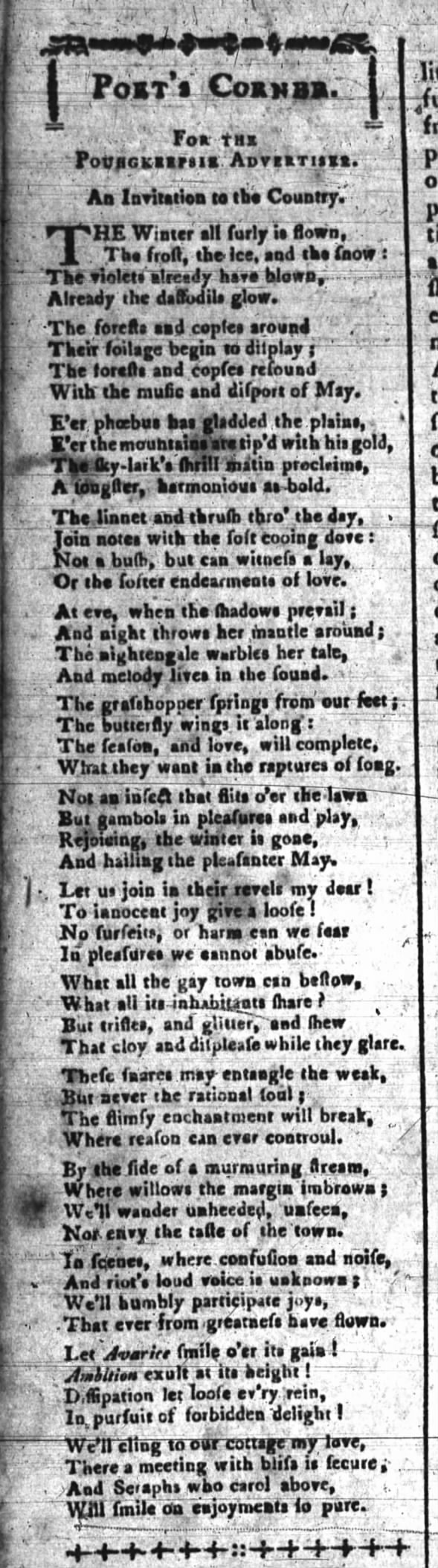
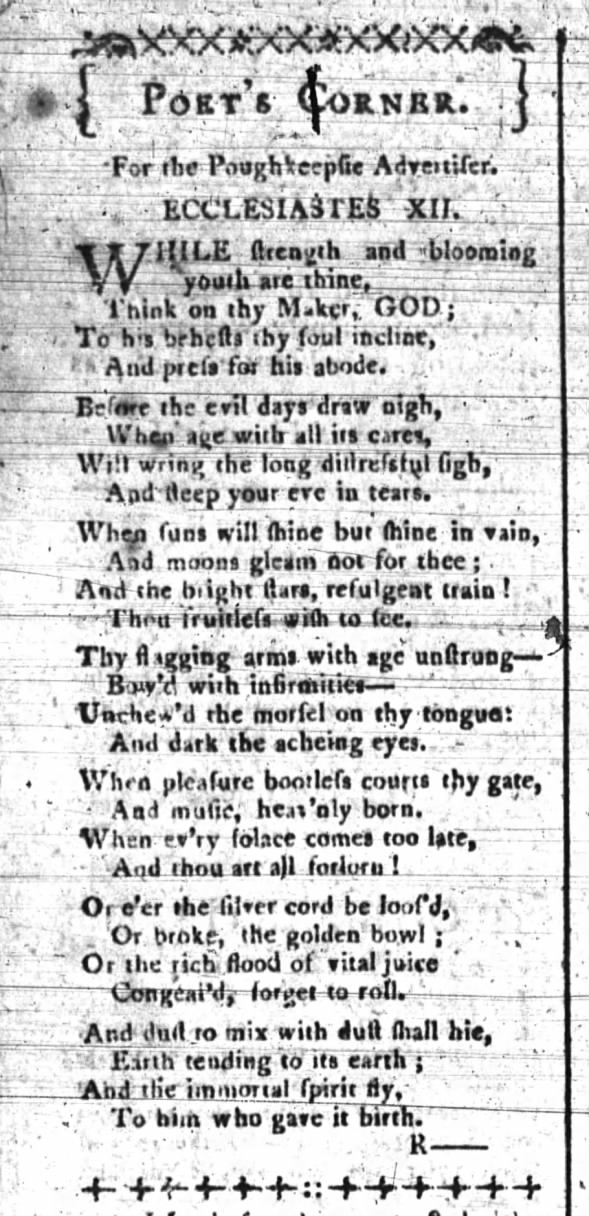
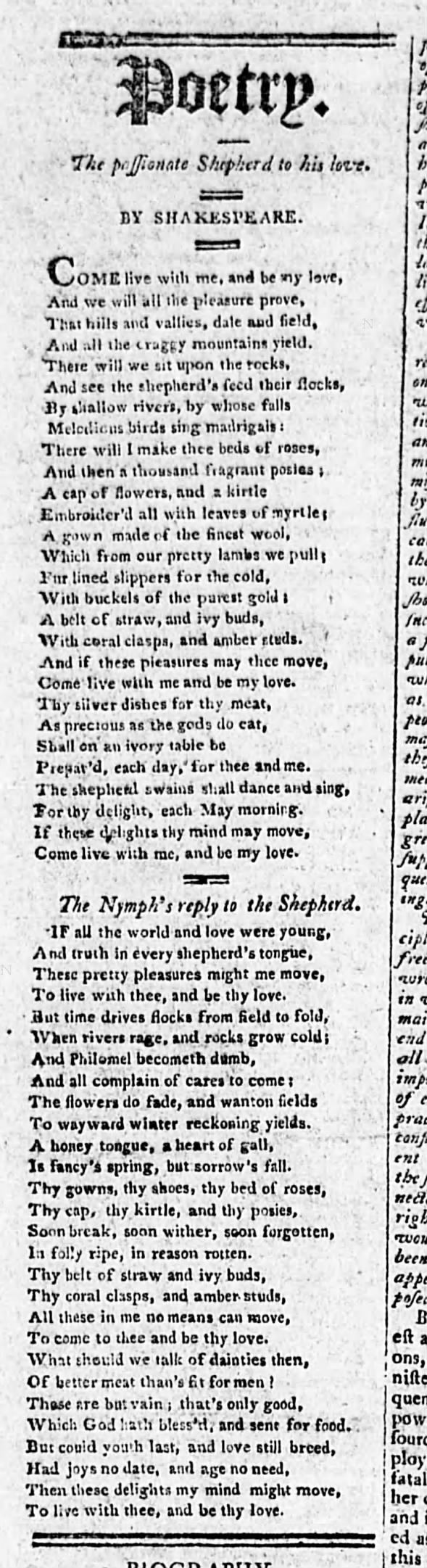
In 1786, at least four verse pieces attributable to Henry Livingston Jr. appeared in The Country Journal and The Poughkeepsie Advertiser:
· Thu, Jan 19, 1786 – Page 4 · Poughkeepsie Journal (Poughkeepsie, New York) · Newspapers.com

· Thu, Mar 23, 1786 – Page 4 · Poughkeepsie Journal (Poughkeepsie, New York) · Newspapers.com

Two of the four 1786 poems, "Invitation to the Country" and "Vine and Oak" appeared anonymously; two are subscribed "R——." Versions of three (all except "Eccleisastes XII") in the handwriting of Henry Livingston, Jr. appear in Livingston's manuscript book of poetry, accessible online via the Henry Livingston website created by Mary S. Van Deusen.

"Invitation to the Country" is early, only the third poem in Livingston's manuscript book. The first, titled "Easter," is dated 1784 and may have appeared in a newspaper that is no longer extant.

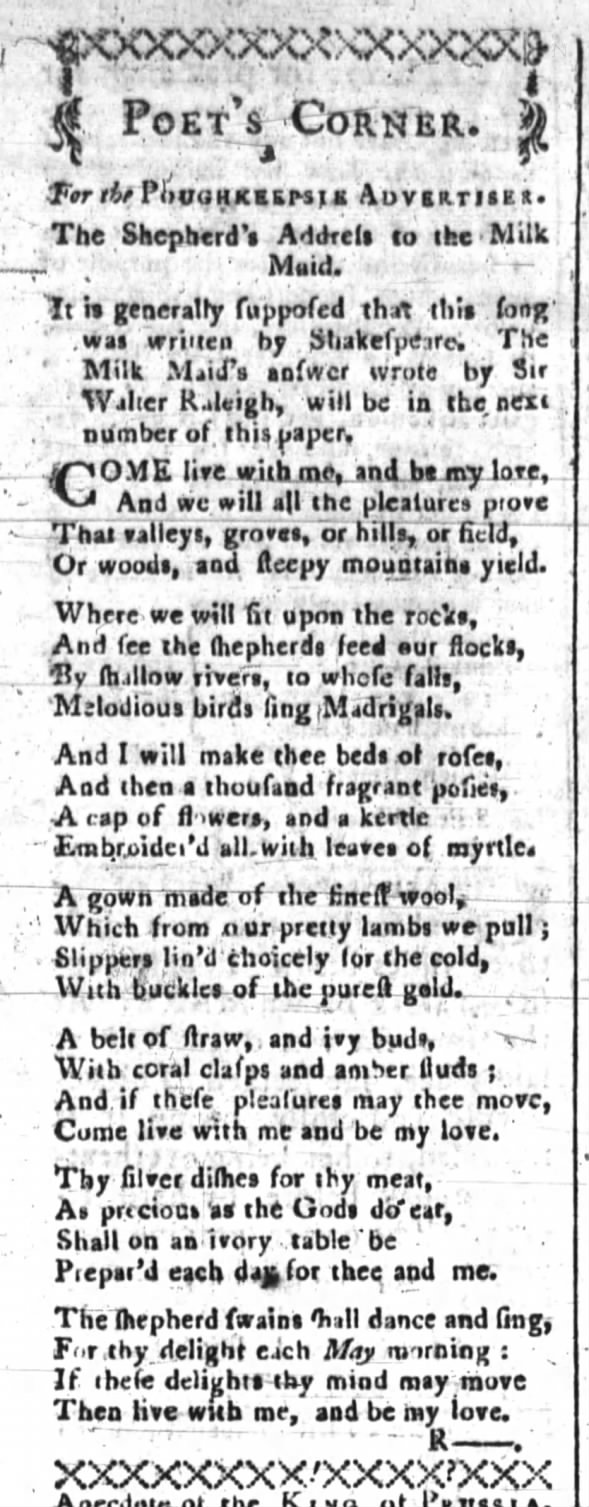
On January 24, 1787 The Country Journal and the Poughkeepsie Advertiser published a version of Christopher Marlowe's Passionate Shepherd under the title "The Shepherd's Address to the Milk Maid." The poem appeared without any mention of Marlowe in the regular "Poet's Corner" column, submitted "For the POUGHKEEPSIE ADVERTISER" by "R——." A brief headnote names Shakespeare as the widely accepted author of The Shepherd's Address, and promises to give Walter Ralegh's answering poem "in the next number of this paper." The attribution of "The Shepherd's Address" to Shakespeare follows Warburton, cited for instance by Samuel Johnson in a footnote to The Merry Wives of Windsor (where Shakespeare in Act 3 Scene 1 makes Sir Hugh Evans sing bits from the second and third stanzas of Marlowe's poem). The certainty with which the second poem is scheduled to appear in print, indicates the headnote may have been added by the editor rather than the contributor "R——."

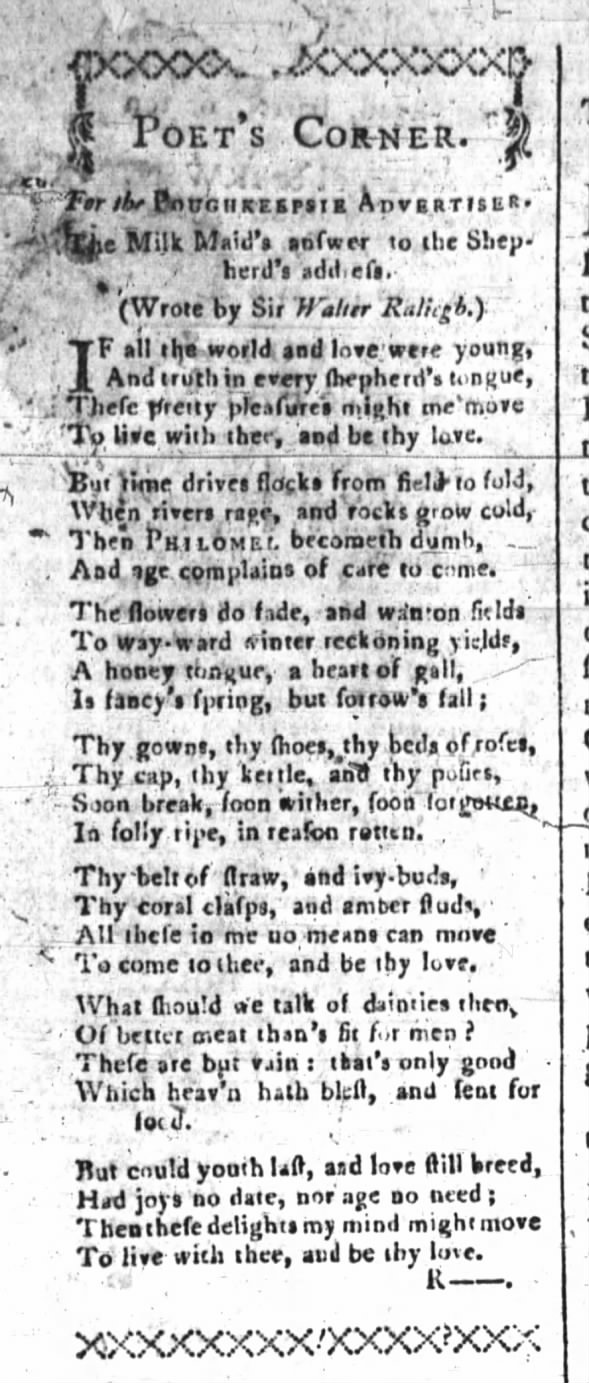
During the previous year the Poughkeepsie newspaper published four poems that appear in Livingston's book of manuscript poetry, two signed "R——." The year before that (October 13, 1785), prose advice To the Farmers, evincing Livingston's style of writing and passion for agriculture, was published over the same signature, "R——." Perhaps not coincidentally, Henry Livingston's interest in poetry and specifically in pastoral love poetry coincides with the latter years of bachelorhood he experienced as a widower, before his second marriage in 1793 to Jane McLean Patterson. The choice of "R" remains unexplained. Nevertheless, in view of demonstrable connections between Livingston's manuscript book and published items from "R" in the years from 1785 to 1790 or so, it seems likely that Henry Livingston, Jr. contributed "Ecclesiastes XII" in March 1786 and, early in 1787, both the "Shepherd's Address" and "Milk Maid's Answer" for the "Poet's Corner" of the Country Journal and the Poughkeepsie Advertiser. Livingston deserves credit for supplying texts reproduced in these early (maybe even the first?) American printings of the "Passionate Shepherd" and "Nymph's Reply."

· Wed, Jan 24, 1787 – Page 4 · Poughkeepsie Journal (Poughkeepsie, New York) · Newspapers.com

As promised, "The Milk Maid's Answer to the Shepherd's address" aka The Nymphs Reply did in fact appear the following week, also submitted by "R——." In parentheses, somebody--either "R——." or the editor--correctly ascribed the poem to Walter Ralegh, here spelling it Raliegh.

· Wed, Jan 31, 1787 – Page 4 · Poughkeepsie Journal (Poughkeepsie, New York) · Newspapers.com

Both poems were published together in the "Poetry" column of the Poughkeepsie Journal on December 6, 1803. The titles have been standardized as "The passionate Shepherd to his love" and "The Nymphs reply to the Shepherd," losing the milkmaids referenced in the headnotes to the 1787 versions. But as in 1787, Marlowe's "Passionate Shepherd" is still attributed to Shakespeare.

· Tue, Dec 6, 1803 – Page 4 · Poughkeepsie Journal (Poughkeepsie, New York) · Newspapers.com

Sunday, August 6, 2017

Ellis Henry Roberts protests "ferocious diatribe" against Melville and Pierre (1852) in the Whig Review

Ellis Henry Roberts
Men of Mark Publishing, Washington DC, Public domain, via Wikimedia Commons
Known as "a leading Whig journal of central New York" (Men of Mark in America), the Oneida Herald was edited and published in Utica from 1851 to 1889 or later by Ellis Henry Roberts. Roberts had worked his way through Yale as a professional printer and compositor. After a year as principal of the Utica Academy, he took over the Morning Herald from Richard Updike Sherman. At Yale, Roberts
took prizes including the Townsend prize in English composition in his senior year; he was chosen by his classmates in his junior year first editor of the "Yale Literary Magazine." --Men of Mark in America
In print, Roberts continued the friendly treatment of Herman Melville displayed in the Utica Morning Herald by former editors Richard U. Sherman and Erastus Clark. Transcribed below, the Whig editor's complaint about the "ferocious diatribe" in the November 1852 American Whig Review is important as a rare public defense of Melville when he really needed it. The pro-Melville protest went against the current of popular criticism in which Melville's latest book, Pierre, had been generally damned. Melville's own publishers started the rumor that he was crazy, as Hershel Parker demonstrates in the second volume of Herman Melville: A Biography (page 125); and revealingly elaborates in Melville Biography: An Inside Narrative (page 409).

Oneida Weekly Herald - October 26, 1852
WHIG REVIEW.— The November number is already at hand. It is embellished by a portrait of Hon. Truman Smith. The articles entitled "The Prospect" and "General Scott an his Assailants" should be read by every voter, Whig and Democrat. The other articles, with the exception of a most ferocious diatribe on Herman Melville—which is by far the most unjust specimen of criticism we have read during the past five years—are of more than ordinary merit.
Roberts does not name names, but Melville scholars now attribute the notably "ferocious" and "unjust" review to George Washington Peck.

The American Whig Review - November 1852
"A BAD book! Affected in dialect, unnatural in conception, repulsive in plot, and inartistic in construction. Such is Mr. Melville's worst and latest work."
Parker memorably calls him "Melville's perverse alcoholic nemesis" (Herman Melville: A Biography, V2.142). With good reason, as the published complaint in the Oneida Weekly Herald, a prominent Whig newspaper, serves to confirm (accepting the usual attribution of the very very nasty review to G. W. Peck). I wonder though: as Pierre bombed, who besides Ellis Henry Roberts (Whig or Democrat) ever called attention to the extraordinary meanness of the criticism in the American Whig Review? Not Samuel Bowles and J. G. Holland, friendly editors of the Springfield Republican and then practically in Melville's back yard.

Springfield Republican - October 25, 1852
"The American Whig Review, for November, has a very fine portrait of Truman Smith, and is well filled with sterling literary and political articles. It can be found at Bessey's."
--Springfield Republican, October 25, 1852
G. W. Peck's correspondence with Evert A. Duyckinck included, besides desperate offers of his writing to pay for rent and food, several manuscript pages of autobiography. The autobiographical sketch and a few surviving letters and notes received by Duyckinck are now available online, courtesy of The New York Public Library Digital Collections.

Peck's manuscript autobiography was incorporated in the 1856 Cyclopaedia of American Literature, edited by Evert and his brother George L. Duyckinck. The entry for G. W. Peck appears in Volume 2 between entries for Cornelius Mathews and J. Ross Browne.
"Mr. Peck is a well read literary critic of insight and acumen, and a writer of freshness and originality."  --Cyclopaedia of American Literature, 
A condensed and posthumously published entry in Appleton's Cyclopaedia informs readers that the Atlantic Monthly published something by G. W. Peck shortly before his death on June 6, 1859, part of a longer "essay on Shakespeare." Peck's contribution may be the unsigned article titled "Shakespeare's Art," published in the June 1859 issue of The Atlantic Monthly. Peck is credited as the author of "Shakespeare's Art" in the bibliography of "Shakespeariana" published in the 1878 Catalogue of the Works of William Shakespeare by James Mascarene Hubbard.

Other sources credit Herman Melville's friend and future Customs House colleague Richard Grant White as author of the same essay on "Shakespeare's Art" in the June 1859 Atlantic Monthly.

More information about the life and career of Ellis Henry Roberts may be found in the 1918 edition of American Biography: A New Cyclopedia, Volume 2, offering an extended treatment of Roberts as an exceptionally influential "molder of the thought of Central New York, politically and socially."

Related posts: