Showing posts with label London Morning Herald. Show all posts

Wednesday, June 23, 2021

Forced to fly: Dryden's hind and Melville's doe

John Dryden, Public domain, via Wikimedia Commons

The unique thing about the review of The Whale in the London Morning Herald on November 17, 1851 is the quote from The Hind and the Panther by John Dryden. Describing Ahab and his mad quest for revenge on Moby Dick, the anonymous reviewer imaginatively associates Melville's white whale with Dryden's milk-white hind:
The principal character is that of the captain, an old weather-beaten whaler. The points in his peculiar disposition are strongly painted. He is afflicted with a species of monomania, and having lost one of his legs in a conflict with a white whale of enormous size and tremendous power, he registers a vow of vengeance against this particular fish, which thus 
"Was doomed to death, but fated not to die."
In the pursuit of this absurd species of vengeance, the captain, Ahab, at length meets with his old antagonist, well known from its having “a milky white head and hump, all crows feet and wrinkles, and harpoons sticking in near his starboard fin.” He encounters this formidable enemy, and loses his life in the attack, and the whale, after staving in the bows of the ship, escapes, leaving the vessel to founder at sea with all hands. 

Like Dryden's allegorical deer, Melville's immortal monster of a whale "Was doomed to death, but [though] fated not to die." For context, here is the longer passage via Bartleby.com:

A MILK-WHITE Hind, immortal and unchanged,
Fed on the lawns and in the forest ranged;
Without unspotted, innocent within,
She feared no danger, for she knew no sin.
Yet had she oft been chased with horns and hounds, 
And Scythian shafts, and many wingèd wounds
Aimed at her heart; was often forced to fly,
And doomed to death, though fated not to die.  

Dryden's fable of true faith, all three parts of it, graced the compendium of Select British Poets, Or, New Elegant Extracts from Chaucer to the Present, edited by William Hazlitt (London, 1824). 

As shown previously on Melvilliana, the 1837 Catalogue of Books in the Library of the Young Men's Association of the City of Albany listed "Hazlett's Select British Poets" on page 14, under "H." Hazlitt's 1824 volume supplemented the works of older poets like Dryden with new "extracts" by contemporary Romantic poets. This edition of Hazlitt's Select British Poets was available in Albany, New York bookstores by late 1826, four years before Herman Melville moved there from New York City with his family. In 1835-7 Melville belonged to the Albany Young Men's Association where Hazlitt's anthology was available in the library along with two different sets of "British Poets," numbered 1112 (12 vols.) and 1390 (11 vols.) in the 1837 Catalogue. The 1828 Catalogue of Books in the Albany Library lists a four-volume set of "Dryden's Poems" in addition to "Dryden's Virgil" in three volumes.

Dryden's "immortal" white doe ("She") represents the Roman Catholic Church; the panther stands for the protestant Church of England. That alliterative phrase "forced to fly" (or "forc'd to fly" in early versions) verbally links Dryden's doe to Melville's in the 1850 review essay Hawthorne and His Mosses. There Melville famously painted Truth as a shy white doe, sacred or just scared.

For in this world of lies, Truth is forced to fly like a scared white doe in the woodlands ; and only by cunning glimpses will she reveal herself, as in Shakspeare and other masters of the great Art of Telling the Truth, — even though it be covertly and by snatches. 
-- "Hawthorne and His Mosses," Literary World vol. 7 - August 17, 1850 page 126.

Justifying his emendation to "sacred white doe," Hershel Parker cites Dryden's poem along with Wordsworth's White Doe of Rylstone as influential analogues:

Mrs. Melville wrote "scared." In Herman Melville: A Biography (1.756) Parker introduced the emendation of "sacred white doe" instead of "scared white doe" on the analogy of John Dryden's "milk-white Hind" in "The Hind and the Panther" (1687) and William Wordsworth's "White Doe of Rylstone" (1807).... --Third Norton Critical Edition of Moby-Dick, edited by Hershel Parker (W. W. Norton & Company, 2018) page 551 note 9.

In the same footnote Parker calls attention to the manuscript correction of "Truth is found," as the scribe Melville's wife Elizabeth Melville first wrote, to "Truth is forced." Let's look now since images of the manuscript version in Mrs. Melville's hand, mostly, are so easy to access courtesy of NYPL Digital Collections.

Manuscripts and Archives Division, The New York Public Library. "“Hawthorne and his mosses”" The New York Public Library Digital Collections. 1850. https://digitalcollections.nypl.org/items/23ebb010-184f-0133-f66c-58d385a7bbd0

Sure enough there's found, canceled and replaced by "forced" to give the correct reading

forced to fly.

In a wicked world, Melville's Truth-doe is "forced to fly" like Dryden's Church of Rome, allegorized as a hunted white hind or female deer. The glimpse of Dryden's sacred white doe in the Morning Herald shows that one London reviewer recognized Melville's white whale as equally elusive and immortal. 


Related posts:

Tuesday, June 22, 2021

Hot Off The Press – New Titles This Week

Hot Off The Press – New Titles This Week

"Another noteworthy addition of the week is the nearly 40,000 pages we have added to the Morning Herald (London)an early London daily newspaper, now including the last year of its publication, 1868."  

London Morning Herald notices of The Whale


Previously unrecorded notices of The Whale, as the first British edition of Herman Melville's Moby-Dick; or, The Whale was titled, are now accessible on The British Newspaper Archive among pages of the London Morning Herald that were only digitized in this very month of June 2021. Digitized or digitised literally yesterday, some of them. 

New items transcribed below include an earlier printing of the long-undiscovered paragraph that also appeared in the London Globe and Traveller, known for half a century only by a blurb ascribed in publisher's ads to an otherwise unidentified "Evening Paper." Another new item is the review of The Whale on November 17, 1851, not collected in Herman Melville: The Contemporary Reviews, edited by Brian Higgins and Hershel Parker (Cambridge University Press, 1995; paperback 2009). The likely existence of this later and longer review in the Morning Herald was demonstrated in two previous posts on Melvilliana:
First, the paragraph of praise for Melville's Whale that later appeared in the London Globe on October 20, 1851. This from the London Morning Herald on October 17, 1851:
All honour and praise to Fenimore Cooper, whose memory will never be suffered to die whilst the English language endures. That great and lamented genius was one of the most forcible delineators of sea-life that ever made old ocean and his familiars his peculiar study. But he has left a worthy successor (we know how much we say when we assert this) in the person of Herman Melville, whose new work, "The Whale," is perhaps the raciest thing of the kind that was ever produced. Melville does not merely skim the surface, he dives into the deep unfathomed main. We smell and taste the brine in every page. His ink must be the black liquor of the cuttle-fish, and his pen drawn from the wing of the albatross. "The Whale" is a very great performance.  --London Morning Herald, 17 October 1851.
Transcribed below from the London Morning Herald of October 20, 1851 is the notice of The Whale previously collected in Herman Melville: The Contemporary Reviews, page 353:
HERMAN MELVILLE is on the right track now. His “Omoo,” “Typee,” and “White-jacket,” gave evidence of great and peculiar powers; but the audacity of youthful genius impelled him to throw off these performances with “a too much vigour,” as Dryden has it, which sometimes goes near to defeat its own end. But in “The Whale,” his new work, just published, we see a concentration of the whole powers of the man. Resolutely discarding all that does not bear directly on the matter in hand, he has succeeded in painting such a picture—now lurid, now a blaze with splendour—of sea life, in its most arduous and exciting form, as for vigour, originality, and interest, has never been surpassed.
From the London Morning Herald, October 27, 1851; excerpted from the London Morning Advertiser review on October 24, 1851:
“THE WHALE.” —Of this new work, by the very popular author of “Typee” and “Omoo,” the Morning Advertiser says,— "To convey an adequate idea of a book of such various merits as that which Mr. Melville has here placed before the reading public is impossible in the scope of a review. High philosophy, liberal feeling, abstruse metaphysics popularly phrased, soaring speculation, a style as many-coloured as the theme, yet always good and often admirable; fertile fancy, ingenious construction, playful learning, and an unusual power of enchaining the interest and rising to the verge of the sublime—all these are possessed by Herman Melville, and exemplified in his new work. As a sample of Herman Melville’s learning, we may refer to the chapter headed ‘Cetology,’ in the second volume; and that we have not over-rated his dramatic ability for producing a prose poem, read the chapter on the ‘Whiteness of the whale,’ and the scene where Ahab nails the doubloon to the mast, as an earnest of the reward he will give to the seaman who first ‘sights’ ‘Moby Dick,’ the white whale, the object of his burning and unappeasable revenge Then come whale adventures wild as dreams, and powerful in their cumulated horrors. Now we have a Carlylism of phrase, then a quaintness reminding us of Sir Thomas Browne, and anon a heap of curious out-of-the-way learning, after the fashion of the Burton who ‘anatomised melancholy.’ Mingled with all this are bustle, adventure, battle, and the breeze. In brief, the interest never palls. We can only, in conclusion, refer the reader to these volumes, than which three more honourable to American literature have not yet reflected credit on the country of Washington Irving, Fenimore Cooper, Dana, Sigourney, Bryant, Longfellow, and Prescott.”  --London Morning Herald, 27 October 1851.

Next item is from the London Morning Herald of November 3, 1851; reprinted with different punctuation and without credit to the London Morning Post where the same notice had appeared on October 20, 1851, as reported here on Melvilliana: 

  • Melville is a star
    https://melvilliana.blogspot.com/2016/04/melville-is-star-notice-of-whale-in.html

"THE WHALE," by Herman Melville, just published, is perhaps the most extraordinary work that has appeared in England for a very great many years. The novelty of the materials that constitute the interest, the novelty of the manner of dealing with them—the poetical, combined with the practical, nature of the author—the rare power with which he knits us to every character in succession—the wild, impetuous grandeur of his scenes, the impulsive force and vigour of his language—these together make up one of the most fascinating books that was ever read. Captain Ahab is a character which few men could have conceived, and how few could have drawn with such marvellous earnestness and strength; and his pertinacious pursuit of the great white whale (Moby Dick) is executed in the true spirit and with the full force of great original genius. Melville is a star, and of no ordinary magnitude, in the literary firmament. --as reprinted in the London Morning Herald, 3 November 1851. 

Transcribed below is the later, longer review of Melville's Whale that appeared in the London Morning Herald on November 17, 1851. I'm adding this also to the tally of favorable reviews in the Melvilliana post

LITERATURE. 

BOOKS RECENTLY PUBLISHED. 

The Whale. By Herman Melville, Author of “Typee,” &c. Three Vols. Richard Bentley.— 
In this novel Mr. Melville has exceeded what he has hitherto written, in all that regards the conception of the plot and the drawing of the characters. The hardships and perils of the whale fishery are delineated with much detail, and all the appearance of rigid truth; indeed it is difficult to conceive that an author could give so minute and exact a description of this hazardous calling unless he had acted a part in the scenes he so vividly paints. To constitute a novel, a connected plot, contrast of character, and situations more or less striking are required, and, though it must be allowed that the greater portion of these volumes is occupied with didactic and scientific matter, yet this is so interwoven with a romantic story that all readers are likely to take a strong interest in it. The principal character is that of the captain, an old weather-beaten whaler. The points in his peculiar disposition are strongly painted. He is afflicted with a species of monomania, and having lost one of his legs in a conflict with a white whale of enormous size and tremendous power, he registers a vow of vengeance against this particular fish, which thus
“Was doomed to death, but fated not to die.”
In the pursuit of this absurd species of vengeance, the captain, Ahab, at length meets with his old antagonist, well known from its having “a milky white head and hump, all crows feet and wrinkles, and harpoons sticking in near his starboard fin.” He encounters this formidable enemy, and loses his life in the attack, and the whale, after staving in the bows of the ship, escapes, leaving the vessel to founder at sea with all hands. 
Such is a rough outline of the main incident of this remarkable novel, which, though based on an improbability, is nevertheless read with great delight. There is a certain wild grandeur in the arrangements of the actors and accessories, a great vigour in the delineation of character, and the language throughout is forcible, though sometimes a little inflated, and sometimes descending rather too much into technicality. There are several animated descriptions, among which may be particularly mentioned the accounts of New Bedford and Nantucket, the shipping of the hands on board the Pelog, several engagements with the whales, and an amazingly effective scene of a storm at sea with lightning. The novel is unquestionably the production of no ordinary mind.
--London Morning Herald, 17 November 1851; digitized in June 2021 and accessible on The British Newspaper Archive. https://www.britishnewspaperarchive.co.uk/

Related post:

Monday, June 21, 2021

London Morning Herald notice, White-Jacket

From the London Morning Herald of March 4, 1850; now accessible on The British Newspaper Archive with pages recently digitized in this very month of June 2021.  

LITERATURE.

 BOOKS RECENTLY PUBLISHED.

 ...

White Jacket; or, The World in a Man of War. By Herman Melville, Author of “Redburn,” “Typee,” &c. Two Vols. R. Bentley.— A cruise in an American man of war is the subject of this novel, which conveys a lively and, no doubt, accurate description of the mode of life on board vessels of that class. The author served as a common sailor in the American navy for more than a year, and his reflections arising from personal experience are incorporated in these volumes. He offers many suggestions for improving the internal economy of vessels of war and for bettering the condition of the sailor, without impairing the efficiency of the service. He expatiates particularly on the subject of flogging in the navy, which he conceives might be much abated, if not altogether relinquished. The novel is very entertaining, and full of such information as could only be afforded by one who has served before the mast.  
--London Morning Herald, 4 March 1850.


Related post:

Tuesday, March 3, 2020

More evidence for another London Morning Herald review of THE WHALE

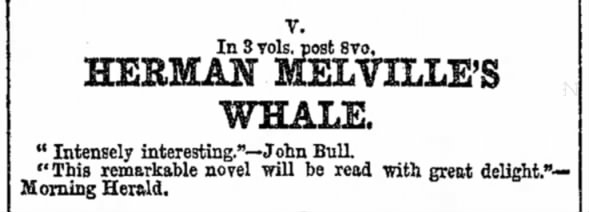
In the earlier post on Looking for another Whale review, I guessed there might be another and perhaps more substantial review of Melville's novel The Whale, as the First British edition of Moby-Dick was titled. Here's more evidence of the still-unlocated review from the advertisement by Melville's publisher Richard Bentley in the London Globe on November 26, 1851. Bentley's ad in the London Globe gives another quotation from the "Morning Herald," praising Melville's Whale as
"Unquestionably the production of no ordinary mind."
That makes two differently worded endorsements of The Whale in the London Morning Herald, neither of which appears in the early notice of October 20, 1851. As shown previously, another Bentley ad supplied a different text:
"This remarkable novel will be read with great delight."
Again, neither quotation that Bentley ascribes to the Morning Herald appears in the one review we already knew about, transcribed on page 353 in Herman Melville: The Contemporary Reviews, edited by Brian Higgins and Hershel Parker (Cambridge University Press, 1995; paperback 2009).

Found online at The British Newspaper Archive <https://www.britishnewspaperarchive.co.uk/>. Image © THE BRITISH LIBRARY BOARD. ALL RIGHTS RESERVED.
London Globe - November 26, 1851

NEW PUBLICATIONS.

NEW WORK by the AUTHOR of "TYPEE," &c.
In Three Vols, post 8vo. 
THE WHALE. By HERMAN MELVILLE. 
IS NOW READY AT ALL THE LIBRARIES. 
"Contains graphic descriptions such as we do not remember to have met with before in marine literature." --Athenaeum. 
"A work of great power and beauty." --Morning Post. 
"Unquestionably the production of no ordinary mind." --Morning Herald. 
"Intensely interesting. It is not a mere tale of adventure, but a whole philosophy of life that it unfolds." --John Bull. 
"A singular novel. The satire is biting and reckless." --Spectator. 
"Displays an unusual power of enchaining the interest." --Morning Advertiser. 
"The raciest thing of the kind that was ever produced." --Evening Paper. 
"A most extraordinary work." --Britannia 
"Melville's greatest effort." --Atlas.
Richard Bentley, New Burlington-street. 
The same quotation from the London Morning Herald occurs as the last of eight blurbs in Bentley's ad in the Morning Post on November 18, 1851. So then, the yet-to-be-found Morning Herald review of The Whale was evidently published after October 20 and before November 18, 1851. Most likely after November 8, 1851, the date of the Britannia review also quoted in Bentley's ads. The Britannia quotation got added to Bentley's list of newspaper blurbs by November 11th, before anything from the Morning Herald. Best guess for now, around the 14th of November 1851.

We will see, hopefully. Scans of the 1851 microfilm now ordered from The British Library - Digitisation Services.

Tue, Nov 18, 1851 – 1 · The Morning Post (London, Greater London, England) · Newspapers.com
Related posts, lost
 and found!

Saturday, February 29, 2020

Looking for another Whale review in the London Morning Herald


Publisher's ads for The Whale quote the London Morning Herald as predicting,
"This remarkable novel will be read with great delight." 
Thu, Dec 18, 1851 – 8 · The Morning Chronicle (London, Greater London, England) · Newspapers.com
Attributed to the "Morning Herald," the endorsement of Melville's Whale as a "remarkable novel" that "will be read with great delight" was reprinted in the London Morning Post (December 17, 1851) and Morning Chronicle (December 18, 1851); and two days later in the Athenaeum, Spectator, and Examiner.


But nothing close to this sentence appears in the one collected notice of The Whale in the Morning Herald for October 20, 1851. Included as a then-recent find in Hugh W. Hetherington, Melville's Reviewers, British and American, 1846-1891 (University of North Carolina Press, 1961) page 191, the notice of October 20 in the Morning Herald happens to be the earliest known review of The Whale. It's still the first one transcribed in the Moby-Dick section of Herman Melville: The Contemporary Reviews, edited by Brian Higgins and Hershel Parker (Cambridge University Press, 1995; paperback 2009).

Unless Richard Bentley invented the quotation, it seems there was another notice of The Whale in the London Morning Herald, maybe later (and longer?) than the exceptionally early one we already know about. The other quotation, "intensely interesting," comes from the review in John Bull on October 25, 1851:
We are unwilling to part with a book so intensely interesting without placing before our readers at least a leaf or two from the sketch-book of "Ishmael," the spinner of this wonderful whale yarn. 
Not yet digitized, or digitised, apparently, but The British Library does have the right microfilm reel of the London Morning Herald.
General Reference Collection 1851 Microform. MFM.M74744-7
Well, Hershel Parker just the other day was saying there could be more to discover about the "wonderful appreciation of HM's genius in London." Obviously I would love to make reservations for London. Before going that far in distance and debt, I really need to learn if any fine library closer to Minnesota has microfilm of the London Morning Herald for 1851. Anybody know?

Update 03/04/2020: I just ordered grayscale scans of the 1851 reel from The British Library, Digitisation Services. Here's to Hope, and Patience...
"Imaging Services are currently experiencing a high volume of work which may also impact on the completion times of order."  

Still later... Received and FOUND in the London Morning Herald of 17 November 1851; transcribed here:

https://melvilliana.blogspot.com/2021/06/london-morning-herald-notices-of-whale.html

Related posts