Showing posts with label Norton Critical Editions. Show all posts

Saturday, April 16, 2022

Peter Wagner and others on David's THE OATH OF THE HORATII and MOBY-DICK chapter 36

The noblest and most promising attempt at scholarship in the March 2022 Leviathan is the essay by Elizabeth Adams on the likely influence of David's famous painting on the theatrical oath-taking scene in Moby-Dick, chapter 36

... Melville's oath-taking vignette in "The Quarter-Deck"—a scene emphasized in Huston's film but otherwise overlooked by scholarship. I argue that this oath-taking scene proves a previously unnoted ekphrastic passage in which Melville draws from Jacques-Louis David's well-known Neoclassical history painting Oath of the Horatii (1784) in order to depict Ahab's induction of the three mates, and then the three harpooners, into his quest for revenge upon the white whale.

Citation: 

Adams, Elizabeth. "The Oath of the PequodMoby-Dick, Jacques-Louis David's Oath of the Horatii, and the Aesthetic of the Distinct." Leviathan 24, no. 1 (2022): pages 3-23 at page 4.  muse.jhu.edu/article/852658.

It's a great connection, here provoking an interesting take from Adams on Melville's "aesthetic of the distinct." Which to me does not easily or obviously reduce down to realism, but no matter. Once you see it, the painting wonderfully illuminates the Quarter-Deck scene in Moby-Dick. For a start. While worthy of closer examination, certainly, Melville's debt to David's Oath of the Horatii has not exactly been ignored or "unnoted" in previous scholarship. Indeed, a footnote in the 2nd Norton Critical Edition (listed without comment by Adams among Works Cited) concisely points to the painting and the medium in which Melville would most likely have encountered it: 

2nd Norton Critical Edition (2002), ed. Hershel Parker and Harrison Hayford, page 141:
"Melville knew this ritual from Shakespeare (Hamlet makes Horatio and Marcellus swear on his sword in Hamlet, 1.5.146), but he could have seen it elsewhere, perhaps in a print of the 1784 painting, The Oath of the Horatii by Jacques Louis David (1748-1825).
3rd Norton Critical Edition (2017), ed. Hershel Parker, page 134:

"Melville knew an oath-taking ritual from Shakespeare (Hamlet makes Horatio and Marcellus swear on his sword in Hamlet, 1.5.146), but he could have seen it elsewhere, perhaps in a print of Jacques Louis David's 1784 painting, The Oath of the Horatii.

 https://wwnorton.com/books/9780393285000

Unfortunately, Adams has also overlooked prior and directly relevant work by Peter Wagner on David's painting as exemplary "iconotext" in Moby-Dick. Engaging the highest priests of postmodern lit-crit AND the Melville Society, Wagner has written and published on David's famous painting and Melville's famous oath-taking scene in English:

In Herman Melville's mighty Moby-Dick, or, The Whale (1851), art and artists constantly interfere in the text--and so do the fictional readers or observers of art works... One of the more intriguing examples occurs when, in Chapter 36, Ahab first nails the golden doubloon to the mast, and then, as the English of Shakespeare and the Elizabethan revenge tragedy blends with the powerful prose of the Bible and Milton's lofty verse (and many other pre-texts), forces his crew to unite in an "indissoluble league." ... The scene is obviously inspired by two major pretexts (or subtexts), one verbal and the other visual: Shakespeare's Hamlet and Jacques Louis David's Le serment des Horaces (colour plate I). David's painting--and its highly ambiguous, contradictory, socio-political implications--are integrated into Melville's text. The dramatic scene relies for its meaning on the reading of David's canvas and all the sources behind it, including the classical story of the Horatius family...." (9-10)

 "Let us now leave ekphrasis for a while and turn to the second provocative term, iconotext, which I applied to the implicit allusion to David's Le serment des Horaces in Chapter 36 of Moby-Dick." (15)

... footnote 39:  "... The study of the role of art works in Melville's novel is, as can be expected, still at the "correspondences of the arts" stage, with most critical works exploring text and paintings (evoked in the text) apart. See, for instance, Sten: Savage Eye, and Wallace: Melville and Turner, which are, alas, no exception to the rule." (15)

Peter Wagner, "Introduction: Ekphrasis, Iconotexts, and Intermediality -- the State(s) of the Art(s)" in Icons - Texts - Iconotexts: Essays on Ekphrasis and Intermediality, ed. Peter Wagner. Berlin: Walter de Gruyter, 1996, pages 9-10 and 15.

https://books.google.com/books?id=VtsgAAAAQBAJ&pg=PA9&dq#v=onepage&q&f=false

and German, a whole chapter on the subject in German:

Hans-Peter Wagner, "Herman Melvilles Moby-Dick und Jacques-Louis Davids  Le serment des Horaces" in Literaturen der Welt: Zugänge, Modelle, Analysen eines Konzepts im Übergang (pages 269-284). Ed. Patricia A Gwozdz and Markus A Lenz. Heidelberg: Universitätsverlag Winter, 2018.

 https://www.winter-verlag.de/en/detail/978-3-8253-6794-7/Gwozdz_Lenz_Hg_Literaturen_der_Welt/

Wagner credits Harold Beaver for being the first commentator to identify David's painting as the iconographic source for the oath-taking scene, citing the 1972 Penguin edition of Moby-Dick.

Wagner's use of the "implicit allusion" to The Oath of the Horatii in Moby-Dick to exemplify the term iconotext is quoted by Thomas F. Heck in the first chapter of Picturing Performance: The Iconography of the Performing Arts in Concept and Practice (University of Rochester Press, 1999) at page 37.

https://books.google.com/books?id=qI-pOaRFcbUC&pg=PA37&lpg=PA37&dq#v=onepage&q&f=false

Here in the blogosphere, Charles Matthews called attention to David's painting in his discussion of Moby-Dick chapter 36, back in 2010:

Then he [Ahab] has the three mates extend their lances and "he grasped the three level, radiating lances at their crossed centre." He glances "intently from Starbuck to Stubb; from Stubb to Flask. It seemed as though, by some nameless, interior volition, he would fain have shocked them into the same fiery emotion accumulated within the Leyden jar of his own magnetic life." The image is somewhat reminiscent of Jacques-Louis David's painting Oath of the Horatii:

But the effect isn't what Ahab hopes for: "Stubb and Flask looked sideways from him; the honest eye of Starbuck fell downright." Ahab resigns himself that if they had taken "the full-forced shock, then mine own electric thing, that had perhaps expired from out me. Perhaps, too, it would have dropped ye dead." He orders the three mates to act as "cupbearers to my three pagan kinsmen there -- yon three most honorable gentlemen and noblemen, my valiant harpooneers." He has the harpooners detach the metal heads from their harpoons. "Forthwith, slowly going from one officer to the other, he brimmed the harpoon sockets with the fiery waters from the pewter." Each officer gives the harpoon-cups to his harpooner.

"Drink, ye harpooneers; drink and swear, ye men that man the deathful whaleboat's bow -- Death to Moby Dick! God hunt us all, if we do not hunt Moby Dick to his death!" The long, barbed steel goblets were lifted; and to cries and maledictions against the white whale, the spirits were simultaneously quaffed down with a hiss. Starbuck paled, and turned, and shivered.

It's a great, theatrical, melodramatic scene.  

-- Charles Matthews, "The Journal of a Compulsive Reader" 6. Moby-Dick, by Herman Melville, pp. 129-165. Link below:

http://tenpagesormore.blogspot.com/2010/12/6-moby-dick-by-herman-melville-pp-129.html

Bottom line: fine find, well deserving of further exploration, but not really "overlooked" or "unnoted."

Saturday, August 28, 2021

Phantom Yankee found

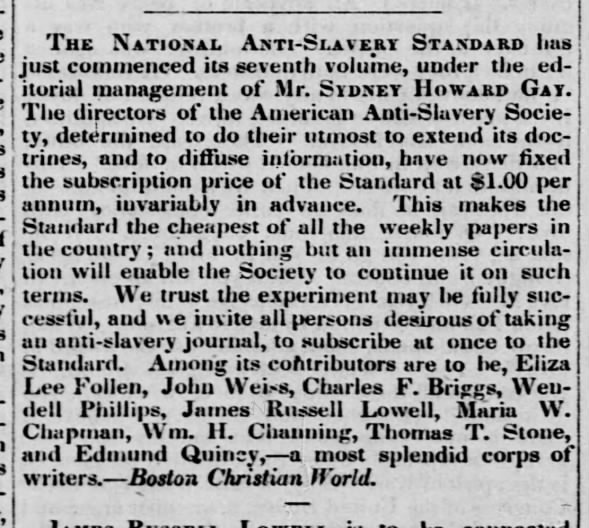
 "Typee" proved the most successful hit in book-making, since the publication of Stephens's first book of Travels. An English critic said it was "Yankee all over." By which he meant that it was entirely new, fresh, and devil-may-care; free from the dry, stale, and wearisome conventionalities of trained literature. It was a book of itself, not made up of pickings from other books, but from the personal observations and individualities of the author.... 
--Charles Frederick Briggs, review of Omoo in the National Anti-Slavery Standard for May 27, 1847.

A footnote in the third Norton Critical Edition of Moby-Dick calls attention to the quoted expression "Yankee all over" in remarks by "B." on Melville's first two books in the New York National Anti-Slavery Standard. As first identified by Robert K. Wallace in Douglass and Melville: Anchored Together in Neighborly Style (Spinner, 2005), this "B." who then reviewed books for the Anti-Slavery Standard was Charles Frederick Briggs

03 Jul 1846, Fri The Liberator (Boston, Massachusetts) Newspapers.com
According to Briggs, an unnamed "English critic" had characterized Typee as "Yankee all over," meaning "new, fresh, and devil-may-care." Norton editor Hershel Parker thinks "this reference may yet be discovered" and so it will be, herein. 

In the review-hunting game, searching for stray quotes most definitely can yield new, that is, previously unidentified or unlocated reviews from whence they came. Blurb-searching works. The trick is to search for different combinations of key terms in the blurb or stray quote. I call it the Mrs. Bennett play, in honor of the “luckiest and most ingenious benefactress” of MOBY-DICK as Doubloon (W. W. Norton, 1970). As acknowledged by the editors of that landmark compendium of criticism on Melville’s masterpiece, the enterprising Mrs. David Bennett (aka Lee Bennett) located a marvelous and previously unknown review of The Whale in the London Morning Advertiser (October 24, 1851) after seeing it quoted in an advertisement in the Morning Post (14 November 1851). The Morning Post ad that Mrs. Bennett found at the British Library quoted six different reviews of The Whale. Of those six, two were then unknown to Melville scholars. Mrs. Bennett found the one in the Morning Advertiser and kindly left the other for me to find, fifty years later. As announced on Melvilliana, the other unidentified quote came from a paragraph of early and uniquely colorful praise in the London Globe and Traveller
and before that, in the London Morning Herald
Here on Melvilliana, the Mrs. Bennett play also resulted in discovery of a longer, highly favorable and previously unknown review of The Whale in the London Morning Herald

Back to our missing Yank. Outside of the National Anti-Slavery Standard, "Yankee all over" does not appear in any review of Typee, British or American. To find this one you have to do a reverse-Mrs-Bennett, by re-examining previously known reviews. No Yankee there either. What to do? Leave him alone and focus on the "all over" part. 

Voilà! Melville's style in Typee is "New World all over" according to the London Athenaeum. Most likely, Briggs substituted "Yankee" for "New World," either misquoting from memory or paraphrasing. In context, either term means "American." The London critic's view of Typee as "New World all over" was prominently featured in Harper & Brothers ads for Omoo, for example this one in the New York Literary World on April 17, 1846:
A book full of fresh and richly coloured matter. Mr. Melville's manner is New World all over.

Briggs could have found Typee described as "New World all over" in numerous places:

  1. The original review of Typee in the London Athenaeum


  2. Reprints of the London review in the New York Anglo American on April 4, 1846; and  Littell's Living Age volume 9 on April 11, 1846. 

  3. With excerpts of favorable "NOTICES OF THE ENGLISH PRESS" bound into copies of Omoo (1847). 

    https://hdl.handle.net/2027/uc2.ark:/13960/t3kw57w1s?urlappend=%3Bseq=407 

  4. Harper & Brothers advertisements in New York newspapers and journals.

Glossing the "epithet" New World as a synonym for American, the English critic referenced "Stephens, the foremost among American pilgrims." In the National Anti-Slavery Standard, Charles F. Briggs similarly compares Melville's debut to that of John Lloyd Stephens, calling Typee "the most successful hit in book-making, since the publication of Stephens's first book of Travels." 

Stephens's first big hit was the 1837 book Incidents of Travel in Egypt, Arabia Petraea, and the Holy Land

BY AN AMERICAN.

Monday, May 25, 2020

Sops for hell-hounds in PIERRE

Aeneas and the Sibyl in the Underworld
Arnold Houbraken (1660–1719) via The Metropolitan Museum of Art

This post aims to help readers achieve a better grasp of metaphorical language in Herman Melville's seventh book, Pierre; Or, The Ambiguities (New York, 1852). The need for such help may be seen in a few misleading footnotes for the 2017 Norton Critical Edition, edited by Robert S. Levine and Cindy Weinstein, that occasionally miss the boat, so to speak. Students, take heart. Faulty footnotes like the one on steamers as clams, discussed in a previous post, show that even highly trained professionals have trouble understanding what Melville wrote.

Another bit of editorial misdirection occurs in Book 25 (Lucy, Isabel, and Pierre. Pierre at His Book. Enceladus) at pages 331-2 of the NCE. Context: Pierre is a struggling author, having fled to the Big City with his pretend-wife (and alleged half-sister) Isabel, along with their farmgirl-friend Delly. Out of the blue, Pierre's angelical ex-fiancée Lucy Tartan has joined them. Lucy's brother Fred and her rejected suitor Glen Stanly have attempted one intervention already, a failure. Since Fred and Glen vowed "swift retribution," Pierre has every reason to expect intolerable public shaming of some kind, either a violent physical attack or a lawsuit. Granting the noble "manliness" of his sworn enemies, Pierre figures correctly that legal action will not satisfy Fred and Glen as "gentlemen of spirit":
... so invincible is the natural, untamable, latent spirit of a courageous manliness in man, that though now socially educated for thousands of years in an arbitrary homage to the Law, as the one only appointed redress for every injured person; yet immemorially and universally, among all gentlemen of spirit, once to have uttered independent personal threats of personal vengeance against your foe, and then, after that, to fall back slinking into a court, and hire with sops a pack of yelping pettifoggers to fight the battle so valiantly proclaimed; this, on the surface, is ever deemed very decorous, and very prudent—a most wise second thought; but, at bottom, a miserably ignoble thing.
 https://books.google.com/books?id=JXK7HN62EcQC&pg=PA457&lpg=PA457&dq#v=onepage&q&f=false
The NCE editors rightly gloss Melville's word pettifoggers as "Inferior or disreputable lawyers" but mistakenly equate sops with "fools." In context, the plural noun sops can't mean "fools." Fops are fools, and saps, but sops are what you might pay lowlife lawyers with. Grose's 1785 Classical Dictionary of the Vulgar Tongue defines SOP as
"a bribe. A sop for Cerberus, a bribe for a porter, turnkey, or gaoler."
https://books.google.com/books?id=LXMKAAAAIAAJ&pg=RA18-PA7&dq#v=onepage&q&f=false
In a word, sop means bribe. Literally a piece of bread soaked in liquor, sop by extension may designate "anything given to pacify" according to Samuel Johnson's Dictionary of the English Language:
"SOP, sop, n. s. what is sopped; any thing steeped in liquor, commonly to be eaten; any thing given to pacify, from the sop given to Cerberus."
Webster likewise invokes Cerberus, the monstrous three-headed dog that guards Hades:
 SOP, n.
... Any thing given to pacify; so called from the sop given to Cerberus, in mythology.
--A Dictionary of the English Language Volume 2 (London, 1832). 
Cerberus-Blake

In the best dictionaries of Melville's day, the word "sops" itself calls out Cerberus. In Book 6 of The Aeneid, the Sybil of Cumae pacifies Cerberus with drugged honey-cake. Dryden translates:
The prudent Sibyl had before prepar'd
A sop, in honey steep'd, to charm the guard;
Which, mix'd with pow'rful drugs, she cast before
His greedy grinning jaws, just op'd to roar.
With three enormous mouths he gapes; and straight,
With hunger press'd, devours the pleasing bait.
In Pierre, Melville extends the allusion to Cerberus with an image of hungry curs, seemingly primed for attack. Literally a team of legal hacks, Melville's "pettifoggers" are depicted in figurative language as an aggressive "pack" of "yelping" animals--paid off like Virgil's Cerberus, in "sops." Signifying, in this context, bribes.

Metaphorically then, Melville represents unscrupulous lawyers as dogs or Hounds of Hades. To sic litigious hell-hounds on Pierre would be the prudent way of exacting revenge. "We'll see you in court." However, as Pierre rightly calculates, his cousin Glendinning Stanly and Frederic Tartan are too noble for that course of action. Instead the cousins meet in the street, with tragic results you can read about in the Norton Critical Edition; the 1852 first edition; the 1949 Hendricks House edition; the 1971 Northwestern-Newberrry Edition; or Hershel Parker's Kraken Edition (Harper Collins, 1995), illustrated by Maurice Sendak.

Related posts

  • Melville's illy
    https://melvilliana.blogspot.com/2019/01/melvilles-illy.html 

Tuesday, July 16, 2019

Ebenezer Knight, 1811-1853

The First Voyage by H. C. K.
The Child's Paper - March 1854
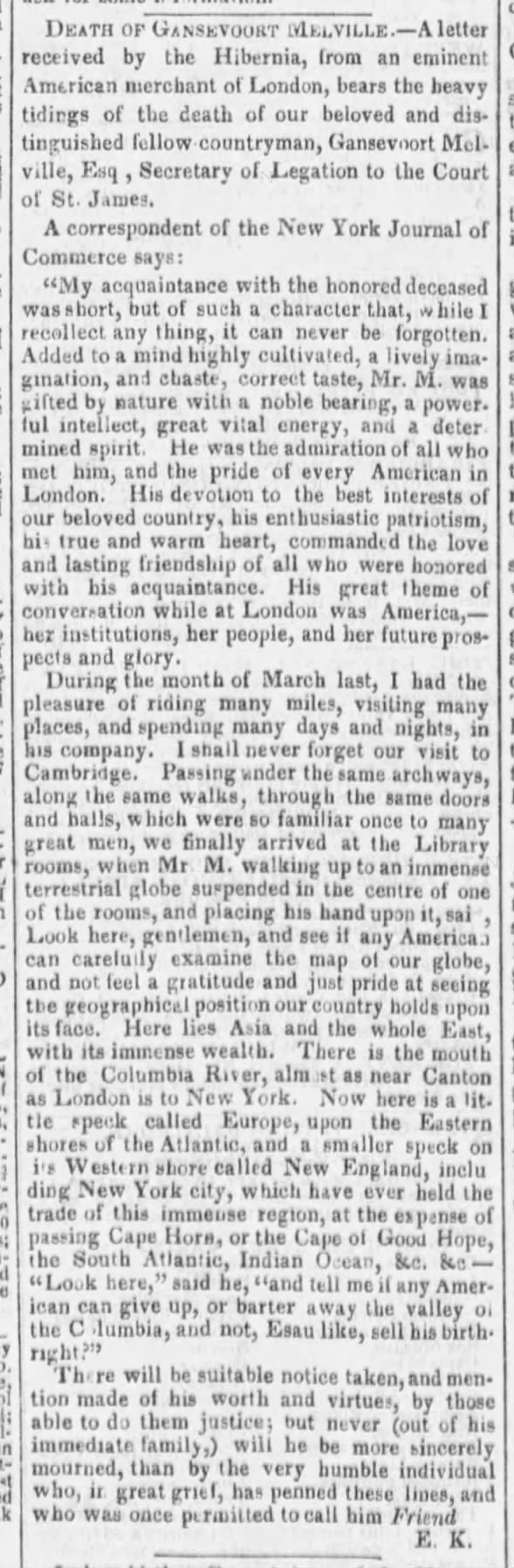
The 3rd Norton Critical Edition of Moby-Dick, edited by Hershel Parker, excerpts the vivid 1846 reminiscence of Gansevoort Melville by Captain E. Knight (page 464). Captain Knight had accompanied Gansevoort with two others on a visit to Cambridge, England. The entry for Saturday, March 14th in Gansevoort's 1846 London Journal, edited by Hershel Parker (The New York Public Library, 1966), records their trip by 2nd class rail which included a tour of Trinity College Library. No mention there of any globe, large or small. According to Knight, however, Gansevoort made dramatic use of "an immense terrestrial globe suspended in the centre of one of the rooms," invoking the biblical story of Jacob and Esau to claim Oregon and California as America's "birthright."

Reminiscence of Gansevoort Melville (Herman's older brother) in Cambridge, England.Reminiscence of Gansevoort Melville (Herman's older brother) in Cambridge, England. Fri, Jun 5, 1846 – 1 · The Baltimore Sun (Baltimore, Maryland) · Newspapers.com
DEATH OF GANSEVOORT MELVILLE.-- A letter received by the Hibernia, from an eminent American merchant of London, bears the heavy tidings of the death of our beloved and distinguished fellow countryman, Gansevoort Melville, Esq, Secretary of Legation to the Court of St. James.

A correspondent of the New York Journal of Commerce says :

"My acquaintance with the honored deceased was short, but of such a character that, while I recollect any thing, it can never be forgotten. Added to a mind highly cultivated, a lively imagination, and chaste, correct taste, Mr. M. was gifted by nature with a noble bearing, a powerful intellect, great vital energy, and a determined spirit. He was the admiration of all who met him, and the pride of every American in London. His devotion to the best interests of our beloved country, his enthusiastic patriotism, his true and warm heart, commanded the love and lasting friendship of all who were honored with his acquaintance. His great theme of conversation while at London was America,-- her institutions, her people, and her future prospects and glory. 
During the month of March last, I had the pleasure of riding many miles, visiting many places, and spending many days and nights, in his company. I shall never forget our visit to Cambridge. Passing under the same archways, along the same walks, through the same doors and halls, which were so familiar once to many great men, we finally arrived at the Library rooms, when Mr M. walking up to an immense terrestrial globe suspended in the centre of one of the rooms, and placing his hand upon it, said, Look here, gentlemen, and see if any American can carefully examine the map of our globe, and not feel a gratitude and just pride at seeing the geographical position our country holds upon its face. Here lies Asia and the whole East, with its immense wealth. There is the mouth of the Columbia River, almost as near Canton as London is to New York. Now here is a little speck called Europe, upon the Eastern shores of the Atlantic, and a smaller speck on its Western shore called New England, including New York city, which have ever held the trade of this immense region, at the expense of passing Cape Horn, or the Cape of Good Hope, the South Atlantic, Indian Ocean, &c. &c-- "Look here," said he, "and tell me if any American can give up, or barter away the valley of the Columbia, and not, Esau like, sell his birthright?" 
There will be suitable notice taken, and mention made of his worth and virtues, by those able to do them justice; but never (out of his immediate family,) will he be more sincerely mourned, than by the very humble individual who, in great grief, has penned these lines, and who was once permitted to call him Friend
E. K.
Originally signed "E. K." and published in the New York Journal of Commerce, Knight's tribute to Herman Melville's older brother Gansevoort was reprinted in the Albany Argus on June 4, 1846; and the day after that in the Baltimore Sun. A condensed version appeared in the Boston Evening Transcript on June 5, 1846.

Encountering the Baltimore Sun version, I wondered about that "immense terrestrial globe" (where is it now?) and Captain Knight's first name (E for Earnest? Edward? Evert?). I don't know about the globe, but Captain E. Knight is Ebenezer Knight,1811-1853. Sometimes spelled Ebinezer. Aka "Eben" Knight according to the online memorial at Find A Grave.
  •  https://www.findagrave.com/memorial/151674190
Ebenezer Knight was born on July 2, 1811 in Corinth, Vermont to Hannah Hale and Joseph Knight. As published in the Columbian Centinel on June 27, 1835, Captain Ebenezer Knight married Anzolette Hussey (1812-1895) in Portsmouth, NH.

Anzolette Hussey's Sampler
National Museum of American History - Smithsonian Institution 
The fullest family tree on Ancestry.com names five daughters of Eben and Ann: Mary Anzolette Knight (1836-1851); Ariadne (Annie) Knight (1838-1874); Hannah E. Knight (1842-1848); Sarah K. Knight (1846-1847); and Abby M. Knight (1850?-1918). Abby is Abigail Maria, later Abby Knight McLane. (In 1887 Abby married Allan McLane, widowed husband of her sister Ariadne.)
  • https://www.ancestry.com/family-tree/person/tree/3069096/person/24210140278//facts
  •  https://sites.rootsweb.com/~knight57/direct/knight/aqwg1385.htm
New York Herald - February 3, 1845
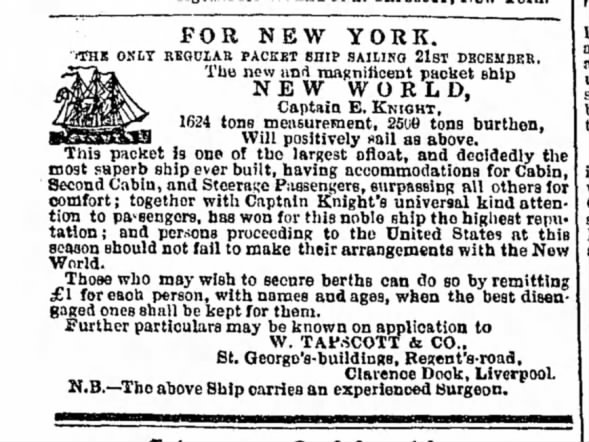
Known for his "gentlemanly" conduct, Knight was a popular captain of the Switzerland and other packet ships to London and Liverpool.

Fri, Dec 17, 1847 – 4 · Liverpool Mercury, etc. (Liverpool, Merseyside, England) · Newspapers.com

When his tribute to Gansevoort appeared in New York newspapers, Captain E. Knight's "Excellent" portrait (No. 238) by G. W. J. was on exhibit at the National Academy (New York Farmer and Mechanic, June 25, 1846).

In 1850-1851, Knight successfully agitated for repeal of the ban on fires and lights aboard ships in Liverpool docks (Honolulu Friend, July 2, 1852). In San Francisco he served for three years as agent of the Pacific Mail Steamship Company. Captain Eben Knight was long remembered by evangelical Christians for arranging that Pacific Mail steamers would not depart on the Sabbath.
No sooner had Captain Knight entered his office here, than he saw what havoc the sailing of steamers made of the Sabbath, when that happened to be the sailing-day. All early Californians know what "steamer-day" meant in those days. It put everybody to work. The steamship-office was besieged from morning till night. Express-offices were crowded, and their messengers and teams were running in hot haste all day. All banks were open, doing a rushing business, with merchants calling for bills of exchange, and miners depositing their bags of gold-dust and taking their certificates; passengers about leaving, hurrying to get their "last things" for the voyage, and going early aboard to receive there the " good-by calls" of friends; everybody writing letters home, and crowding them into the post-office up to the last moment; newsboys crying their "steamer papers" for sale all about the streets; while merchants and clerks were closing their final dispatches to go by Wells and Fargo; and then, at the hour of sailing, the crowd of passengers on the steamer's deck answer to the noisy farewells of the still larger crowds gathered on the wharf, and the great ship glides out into the bay, — and that "steamer day's" excitement is over. Captain Knight at once determined that "steamer day" should not occur on Sunday.  --Samuel Hopkins Willey, The History of the First Pastorate of the Howard Presbyterian Church, San Francisco (San Francisco: The Whitaker and Ray Company, 1900), pages 78-79.
"Eben" Knight died on October 11, 1853 at the age of 42. As also reported by Samuel H. Willey, Knight's eulogy by the business community of San Francisco highlights "noble" qualities of character like those that "E. K." appreciated from a brief acquaintance with Gansevoort Melville.
The high respect and honor in which he was held by the bankers and merchants is touchingly expressed in resolutions adopted at a meeting held by them soon after his death, one of which was as follows: —

"Resolved, That Captain Knight combined in his character in an eminent degree those noble, manly qualities which entitled him not only to the respect and confidence but to the affectionate regard of all who knew him best. 
"With a firm integrity of purpose which never faltered, with a keen sense of honor which scorned an evasion, with a straightforward honesty which resorted to no subterfuges, he combined with simplicity of heart a frankness of demeanor which commanded the respect whilst it secured the affectionate esteem of all with whom he was brought into contact. Scrupulously just in his business relations, generous almost to a fault when his sympathies were appealed to, gentle and confiding in his temper, always ready to forgive a fault in others, he judged harshly only of his own imperfections."

That characterization, be it remembered, was drawn by the business men of San Francisco, not especially his personal friends,— but who could have drawn his character more true to life? Knowing him well, I bear witness to its accuracy in every particular. 
-- The History of the First Pastorate of the Howard Presbyterian Church, San Francisco, page 81. <https://books.google.com/books?id=8XMUAAAAYAAJ&pg=PA81&dq#v=onepage&q&f=false>
Portsmouth Journal of Literature and Politics - December 3, 1853

Monday, May 13, 2019

Clams, boats, and footnotes in PIERRE

via The New York Public Library Digital Collections
BOOK XXVI.
A WALK; A FOREIGN PORTRAIT; A SAIL; AND THE END.
I.
"Come, Isabel, come, Lucy; we have not had a single walk together yet. It is cold, but clear; and once out of the city, we shall find it sunny. Come: get ready now, and away for a stroll down to the wharf, and then for some of the steamers on the bay. No doubt, Lucy, you will find in the bay scenery some hints for that secret sketch you are so busily occupied with—ere real living sitters do come—and which you so devotedly work at, all alone and behind closed doors."  --Pierre, Book 26
The passage quoted above occurs near the start of the last "Book" (XXVI) of Herman Melville's Pierre; or, The Ambiguities. In a footnote to this passage, the editors of the 2017 Norton Critical Edition of Pierre inform their target audience of undergraduate readers that Melville's word steamers means "Clams" (page 344).

Clams or boats? Does it matter? Sometimes I think nobody really gives a flip about footnotes except me and one or two librarians in the basement annex. Not to alarm my fellow sub-subs, but it has occurred to me before now that scholarly footnotes--especially the short informative kind, as distinct from more luxurious interpretive and argumentative varieties--may already be obsolete in the era of smartphones, like print yellow pages and street-maps.

City of New York by Charles Parsons, 1856
via Library of Congress
Consider the merits of Melville's alternative title: The Ambiguities. On reflection, I wish Pierre had treated his dear companions Lucy and Isabel to a bucket of steamed clams, after their walk to the wharf. If only they had stopped to eat some delicious "steamers" instead of boarding one on the bay. Lunch over, the ill-starred trio might have returned sooner to their rooms in the "Church of the Apostles." With proper nourishment, Pierre could finally have finished his "vile" Inferno of a novel. Who knows, Lucy might soon have found customers for her portrait sketches; Isabel guitar students. In this half-baked alternative scenario, perhaps the killing of Pierre's cousin Glen and the awful tragic ending might have been averted.

Cape Cod Steamers via WeNeedaVacation.com
Steamer clams or "steamers" are "a specialty of New England," as Elise Bauer informs in How to Cook and Eat Steamer Clams on Simply Recipes. Here on the prairie, "steamers" conjure pleasant thoughts of Cape Cod and Chesapeake Bay. But Edible Long Island will tell you that New York clamologists know plenty about soft shell clams (aka piss clams, longnecks or Ipswich clams) too.

Indeed, Eater NY has a whole article on
Commenters there dispute the notion that steamers are "more of a Boston thing." In the category of "Oddities," Sietsema mentions that
 Off the Hook in Astoria, Queens, presents pots of steamed softshell clams, known as "steamers," and so does London Lennie’s in Woodhaven, Queens.
In chapter 15 of Moby-Dick, Ishmael and Queequeg enjoyed two kinds of chowder at the Try Pots on Nantucket island, one with clams. New York connoisseurs rave about the steamer clams at Pearl Oyster Bar, located at 18 Cornelia Street in Manhattan's West Village. Steamers on Cornelia get us to the right place, after all, since the unnamed "city" in Melville's Pierre is modeled on Manhattan.

Right place but wrong century I guess for steamers to mean clams. Melville's "steamers on the bay" are vessels in New York Harbor, ferry boats and ocean steamers. For context, here's a relevant description from 1853 by Cyrus Redding, writing for the London New Monthly Magazine under the pseudonym "J. W. Hengiston":


The waters are covered by their small ferry steamers, running in all directions—over to Jersey on one side, or over to Long Island on the other —while the larger ones up the Hudson, or East River, dash through the water like floating palaces, and at a speed beyond all others in the world; while to and from the Atlantic, the great ocean steamers, along their own shores or to Europe, join all the best qualities of sea-going ships to increased size and beauty of form; but it is their numbers which are still more astonishing. The waters and the wharves are alive with them; and the stir, the crowds, the cargoes, and loads, and stacks of merchandise for ever piled on the slips, loading and unloading by thousands of carts and drays, which are darting in every direction, which gives one so overwhelming an idea of the magnitude of the commerce and riches of the States—even our city, and our wharves, and our docks, are sleep and idle in the comparison. This swarming scene borders the city, on both sides, for two miles; on the East River side lie all the fine sailing ships by hundreds; on the Hudson side the steamers most; but both sides are crammed and jammed in by both sorts at every slip, so full, that the schooners, sloops, smacks, fishing-boats, &c., can often hardly find room to poke their noses in. The slips on both sides, towards the Battery, are reserved for passage steamers, and ferry ditto, canal boats, and coasting craft. It is curious to see the tug-steamers start up the Hudson with a flock of canal-boats fast to her, like a hen and chickens, for Albany, where they take the Erie canal.  --J. W. Hengiston [Cyrus Redding] on "New York—Its Hotels, Waterworks, and Things in General" in The New Monthly Magazine Vol. 97 (London, 1853) page 87
Back in Book 26 of Pierre, a detour brings Pierre, Isabel, and Lucy to an upstairs art gallery. Unfortunately, nobody mentions stopping for clams afterward. Instead, they get on a ferry boat quite like those encountered at "slips on both sides, towards the Battery" by Redding/Hengiston.
In the midst of all these mental confusions they arrived at the wharf; and selecting the most inviting of the various boats which lay about them in three or four adjacent ferry-slips, and one which was bound for a half-hour's sail across the wide beauty of that glorious bay; they soon found themselves afloat and in swift gliding motion.
As Henry A. Murray observed seventy years ago in one of the "Explanatory Notes" for the 1949 Hendricks House Pierre:
"It seems that Pierre and his companions are at the Battery, New York City, and have selected a Staten Island ferry boat for a ride across the harbor."

Related posts

  • Melville's illy
    https://melvilliana.blogspot.com/2019/01/melvilles-illy.html

Monday, January 8, 2018

Pantagruelising and Plato in a letter to Hawthorne

A remarkable letter from Herman Melville to Nathaniel Hawthorne appears in the current Critic. It would fill two columns of the Speaker. Here is the most characteristic paragraph—quoted rather because it is addressed to Hawthorne than because it was written by Melville :—
"If ever, my dear Hawthorne, in the eternal times that are to come, you and I shall sit down in Paradise, in some little shady corner by ourselves, and if we shall by any means be able to smuggle a basket of champagne there (I won't believe in a temperance Heaven), and if we shall then cross our celestial legs in the celestial grass that is for ever tropical, and strike our glasses and our heads together till both musically ring in concert, then, O my dear fellow-mortal, how shall we pleasantly discourse of all the things manifold which now so distress us—when all the earth shall be but a reminiscence—yea, in its final dissolution in antiquity. Thus shall songs be composed as when wars are over—humorous, comic songs: 'Oh, when I lived in that queer little hole called the world'; or, 'Oh, when I toiled and sweated below'; or, 'Oh, when I knocked, and was knocked in the fight'—yea, let us look forward to such things."
This is Pantagruelising in a high key. The Paradise is that of the religious world of Plato's day, taken less seriously than it was by either his contemporaries or himself.
Published in London, The Speaker was a weekly Review of Politics, Letters, Science, and the Arts, edited by T. Wemyss Reid. "Panatgruelising" means, besides reading Rabelais,
"drinking stiffly to your own Heart's desire"  --The Life of Gargantua and of Pantagruel.
Raymond Weaver's article on The Centennial of Herman Melville in The Nation (August 2, 1919) opens with the same now famous image of Melville's "shady corner" in Paradise with Hawthorne.
The Speaker got it from Mr. Stoddard on Herman Melville in The Critic for November 14, 1891; which The Critic got from Richard Henry Stoddard's signed memorial tribute in the New York Mail and Express (October 8, 1891). Following Stoddard, The Critic gave the whole letter as first printed in Julian Hawthorne's biography, Nathaniel Hawthorne and His Wife (1884).

Melville's letter appears of course in the scholarly Northwestern-Newberry edition of Melville's Correspondence (there dated June 1? 1851). Re-dated by Hershel Parker to "Early May 1851," the complete letter is conveniently available with excerpts from other Melville letters in the back of the 3rd Norton Critical Edition of Moby-Dick

Related post