Showing posts with label Richard Henry Stoddard. Show all posts

Monday, January 8, 2018

Pantagruelising and Plato in a letter to Hawthorne

A remarkable letter from Herman Melville to Nathaniel Hawthorne appears in the current Critic. It would fill two columns of the Speaker. Here is the most characteristic paragraph—quoted rather because it is addressed to Hawthorne than because it was written by Melville :—
"If ever, my dear Hawthorne, in the eternal times that are to come, you and I shall sit down in Paradise, in some little shady corner by ourselves, and if we shall by any means be able to smuggle a basket of champagne there (I won't believe in a temperance Heaven), and if we shall then cross our celestial legs in the celestial grass that is for ever tropical, and strike our glasses and our heads together till both musically ring in concert, then, O my dear fellow-mortal, how shall we pleasantly discourse of all the things manifold which now so distress us—when all the earth shall be but a reminiscence—yea, in its final dissolution in antiquity. Thus shall songs be composed as when wars are over—humorous, comic songs: 'Oh, when I lived in that queer little hole called the world'; or, 'Oh, when I toiled and sweated below'; or, 'Oh, when I knocked, and was knocked in the fight'—yea, let us look forward to such things."
This is Pantagruelising in a high key. The Paradise is that of the religious world of Plato's day, taken less seriously than it was by either his contemporaries or himself.
Published in London, The Speaker was a weekly Review of Politics, Letters, Science, and the Arts, edited by T. Wemyss Reid. "Panatgruelising" means, besides reading Rabelais,
"drinking stiffly to your own Heart's desire"  --The Life of Gargantua and of Pantagruel.
Raymond Weaver's article on The Centennial of Herman Melville in The Nation (August 2, 1919) opens with the same now famous image of Melville's "shady corner" in Paradise with Hawthorne.
The Speaker got it from Mr. Stoddard on Herman Melville in The Critic for November 14, 1891; which The Critic got from Richard Henry Stoddard's signed memorial tribute in the New York Mail and Express (October 8, 1891). Following Stoddard, The Critic gave the whole letter as first printed in Julian Hawthorne's biography, Nathaniel Hawthorne and His Wife (1884).

Melville's letter appears of course in the scholarly Northwestern-Newberry edition of Melville's Correspondence (there dated June 1? 1851). Re-dated by Hershel Parker to "Early May 1851," the complete letter is conveniently available with excerpts from other Melville letters in the back of the 3rd Norton Critical Edition of Moby-Dick. 

Related post

Monday, February 8, 2016

Identifying the good fellows with Herman Melville at "Lorry" Graham's, March 1866

The previous post found Herman Melville partying at the Manhattan residence of James Lorimer Graham, Jr. (as the 1865 Trow's NYC Directory indicates, JLG Jr. had moved back to his father uncle JLG Sr.'s place at 21 Washington Square North) on the evening of March 26, 1866. 

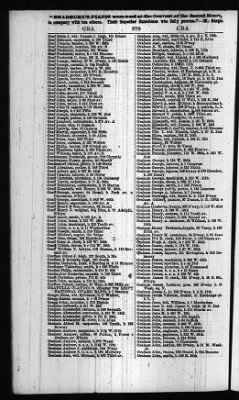
UPDATE: But wait, Fold3 and NYPL Digital Collections come through with images from the better source here, Trow's New York City Directory "For the Year Ending May 1, 1866":


A-ha. Now Trow's gives the address for James Lorimer Graham, jr. as "3 E. 17th." That's the address Bayard Taylor remembers in his 1876 obit. Most likely the March 26, 1866 gathering happened here, at 3 East Seventeenth Street.

Fold3: Military Records

Melville would count as one of the "invited guests," I'm guessing, rather than an official member of "The Wanderer's Club." Possibly the newspaper notice should say "Wanderers,'" plural. This Wanderers' Club resembles the "Travellers" who likewise met on Monday nights, as we know from the invitation Bayard Taylor sent to Melville on February 24, 1865. In that 1865 letter Taylor identified two fellow Travellers (Darley and Bierstadt) who also would be named as guests of James Lorimer Graham, Jr. on Monday night, March 26, 1866. Hershel Parker muses about the mutual interests of this bunch in Melville Biography: An Inside Narrative.

By late March 1866, Melville was a confirmed New Yorker, again, as well as a working and (at last!) published poet. Two Civil War poems from his forthcoming volume Battle-Pieces were already out in Harper's (with a third, "Sheridan at Cedar Creek," soon to appear under the title "Philip" in the April 1866 issue), but Melville had not yet written the prose "Supplement." So he could hold his head up among the poets there at "Lorry" Graham's soiree: William Cullen Bryant, Henry T. Tuckerman, Bayard Taylor, and Richard Henry Stoddard. At least two of Melville's fellow guests (Richard Henry Stoddard and "Barry Gray") would soon enough be his co-workers at the New York Custom House. A fine time for socializing, though deep griefs awaited Melville and his family the very next year--his wife Elizabeth contemplated leaving him by May 1867, then in September their eldest son Malcolm killed himself.

The Wanderer's Club. 

The members of the "Wanderer's Club," together with invited guests, were pleasantly entertained last evening at the residence of Mr. James Lorimer Graham, Jr. The gathering was of a social character, and allowed a free and agreeable interchange of thought among the guests. The many rare and curious books, old engravings, valuable autograph letters and articles of vertu, to be found in Mr. Graham's library, were a source of unfailing interest and enjoyment to every one present. Among the guests were Messrs. Bryant, Bancroft, Tuckerman, Herman Melville, Bayard Taylor, Ripley, Duyckinck, Stoddard, Savage, "Barry Gray," W. T. Blodgett, John Van Buren, Leutze, Kensett, Gifford, Bierstadt, Laing, H. P. Gray, Launt Thompson, Darley, Ehninger, Hunt, Key, Baron Osten Sacken, Gilman, and others.  --New York Evening Post, Tuesday, March 27, 1866
Let's go through the list and try to identify the good fellows at Lorrie Graham's party:
  • Savage = probably the Irish-American journalist and poet John Savage (1828-1888). Contributed to the satirical weekly magazine, The Lantern.
  • John Van Buren (1810-1866): Albany lawyer and politico, second son of President Martin Van Buren. JVB must have known Herman's brother Gansevoort in the old days.
In the late 1840s he joined his father in opposing the spread of slavery as a member of the Free Soil Party. John Van Buren, nicknamed "Prince John" by the press, was a highly regarded trial lawyer, famed nationwide for his tall, commanding appearance and his eloquence. He was Chairman of the New York Democratic Party in 1862, and was the party's unsuccessful candidate for state Attorney General in 1865. During the Civil War he continued his opposition to slavery by organizing "Union League" clubs of Democrats and Republicans loyal to the United States. He was known to alternate between periods of overwork followed by periods of dissolution, including excessive drinking and gambling that often left him in financial distress. He died at sea of kidney failure while traveling from Liverpool to New York.  
-- Bill McKern - Find A Grave  

A Storm in the Rocky Mountains, Mt. Rosalie
Albert Bierstadt, Public domain, via Wikimedia Commons
After writers and critics, the Evening Post names many artists in attendance. Shades, intimations perhaps of the departed artists and their dialogue in Melville's poem "At the Hostelry" (text available in John Bryant's edition of Tales Poems and Other Writings, and in the 1963 Russell & Russell issue of Melville's Works, volume 16 at the HathiTrust Digital Library). As mentioned already in the previous post, their radiant patron James Lorimer Graham, Jr. was a lot like Melville's conception of the Marquis de Grandvin.

  • Launt Thompson = Launt Thompson (1833-1894), Irish-American sculptor, protege of Erastus Dow Palmer and close friend of Edwin Booth, 
  • Ehninger = John Whetten Ehninger (1827-1889). Aka John Whetton Ehninger, portrait painter and etcher--1847 graduate of Columbia University, with European training.
Last but not least, a brace of academic diplomatists, or diplomatic academics:
  • Gilman = ?? Only problem is having so many distinguished Gilmans to worry over...how about Daniel Coit Gilman (1831-1908), the Yale librarian, scholar, professor, and future first president of Johns Hopkins University. Gilman's early diplomatic experience "as attaché of the United States legation at St. Petersburg, Russia from 1853 to 1855" (Wikipedia) would seem to intersect somehow with that of Russian general consul in NYC and former secretary to the Russian legation, Baron Osten Sacken--which may be why the two names appear together at the end of the guest-list.
Lots here to absorb and ponder. For one thing, was the writer one of the persons listed in the Evening Post report, or a different, unnamed guest? Parke Godwin?

The University of Virginia Library has a manuscript poem to James Lorimer Graham dated November 16, 1866--the night of the honorary dinner at Delmonico's referenced by Edmund Clarence Stedman in the 1894 Century Club memorial. I'm trying to get a scan or other image of the
"Poetic tribute to Graham by an unidentified writer"
who might be Stoddard or Taylor or Stedman, or another of the select company.


And speaking of good fellows, what happened to that precious manuscript book, listed in the Century Club memorial to James Lorimer Graham, Jr. as
Ye Booke of ye Goode Fellowes
 Does The Century Association still have "Ye Booke of ye Goode Fellowes" in the archives?

Related melvilliana post:

Friday, November 27, 2015

Melville's cameo role in Nation-Famous New York Murders (1914) by Alfred Henry Lewis

Image Credit: Ron Scheer - Buddies in the Saddle
Among other things eastern journalist, muckraker, biographer, and western storyteller Alfred Henry Lewis wrote fictionalized tales of real-life crime. One of Lewis's supposedly true crime stories, originally published in the March 1913 issue of Pearson's Magazine, features a brief but fascinating appearance by Herman Melville. I don't remember seeing any notice in Melville scholarship of Melville's cameo role in Nation-Famous New York Murders (published in book form by the G. W. Dillingham Company in 1914). Another melvilliana exclusive? I stumbled over it while hunting up published mentions of Melville's Civil War poem, "Sheridan at Cedar Creek."

In his dramatic account of the Harvey Burdell murder case, Lewis definitely gets his facts mixed up about Herman Melville. Essentially Lewis has magically transported the 1880's Melville thirty years back in time, to Manhattan on a cold winter's day in early 1857. Specifically (as clarified in the revised book version), January 28, 1857. Impossible for Melville really to have been there, since most of that month he spent in Jerusalem and Lebanon on his 1856-7 Mediterranean tour. Melville's The Confidence-Man would be published in April 1857. The year before, Melville (still living in Pittsfield) was composing "The Piazza" to induce his forthcoming volume of magazine stories titled The Piazza Tales. Lewis's Melville, however, is already a curmudgeonly New Yorker, another frustrated writer employed in the Custom House. Lewis misquotes the line from "Sheridan at Cedar Creek" and miscalls it (as did Stoddard in his published Recollections) by the title of Buchanan Read's poem "Sheridan's Ride."

Some facts of Melville's life Lewis might have got from the biographical introduction to Typee by Arthur Stedman, son of Edmund Clarence Stedman who is also a character in the Burdell chapter of Nation-Famous New York Murders. As shown below, however, the most interesting factual details are reworked from the autobiography of Richard Henry Stoddard. When Melville shows up for dinner at the brand new Metropolitan Hotel, he joins the table of fellow writers Stoddard, Bayard Taylor, and George Henry Boker. Stedman sits at a nearby table with fellow lawyers David Dudley Field and Charles O'Connor. Lewis seats Fitz-James O'Brien at another table with Frederick Swartwout Cozzens (both fresh from Pfaff's beer cellar) along with Walt Whitman. At one point in the literary table-talk, Melville's gloomy looks remind O'Brien of Hamlet, "the melancholy Dane." Lewis makes O'Brien laughably ignorant of Melville and his reputation ("Never heard of him."). One year after the events recorded by Lewis, O'Brien would critically survey Melville's entire career to date in the April 1857 issue of Putnam's Monthly Magazine.

Excepting Stoddard, the literati at the Metropolitan as described by Alfred Henry Lewis are mostly Pfaff's regulars.

Despite his numerous factual errors, Lewis does seem to know something about Melville and other literary New Yorkers in the 1870's and 1880's especially. He knows, for instance, about the Century Club, about Stoddard's job at the Custom House and Stoddard's Echo Club. Much if not all this knowledge derives from Stoddard's Recollections, Personal and Literary. For example, Stoddard remembers that Bayard Taylor "had learned by heart" the "Opium Fantasy" poem by Lowell's wife. And when Lewis makes Cozzens say
 "Stoddard insists that next to Emerson he's the great American mystic."
the words of Stoddard are quoted verbatim from Stoddard's 1903 book, Recollections, Personal and Literary.

Intentionally or not, Melville's unfriendly critique of Mrs. Lowell's poetry as "privately published" for good reason is heavily ironic given Melville's later choice to privately publish two volumes of his own poetry, John Marr and Timoleon in limited edtions of 25 copies each. Below, Lewis's fictionalized glimpse of Herman Melville at the Metropolitan Hotel with links to the magazine and book versions of Nation-Famous New York Murders:
While waiting for the coming of Officer Matzell, with his word about Burdell, suppose we look about the room. It should be as good a way of killing time as any other.

Over near a window are Bayard Taylor, the poet Stoddard, and Boker who wrote Francisca da Rimini in which Miss Julia Dean is playing at Wallack's.

The sepulchral Herman Melville enters, and saunters funereally across to Taylor, Stoddard and Boker.

Beyond them sits Edmund Clarence Stedman, with lawyers David Dudley Field and Charles O'Connor.

The second table from the door is taken by "Sparrow Grass" Cozzens and Fitz-James O'Brien, who have adjourned from Pfaff's beer cellar near Leonard street where, under the Broadway sidewalk, they were quaffing lager, and getting up an appetite for dinner on onions, pretzels and cheese. They have with them Walt Whitman, who, silently and wholly wanting jn that "barbaric yawp," is distinguished by what William Dean Howells—ever slopping over in his phrase-making—will one day speak of as his "branching beard and Jovian hair."
...
"By the way, I've got a treasure," exclaims Taylor; "it's a copy of Mrs. Lowell's poems. They were privately printed, you know."

"May I see it?" asks the sepulchral Melville.

"It's in my desk at the Tribune office. There's one poem in it, An Opium Fantasy, which struck me greatly. It runs like this:
Oh, it is but a little owl,
The smallest of its kin,
That sits beneath the midnight cowl.
And makes its airy din.
"'And makes its airy din,'" repeats the lugubrious Melville, more sepulchral than ever. "I can understand why it was printed privately."'

Melville, soured by several failures, is inclined to cynicism in the presence of the poems of others. He has not yet written, you must remember, his Sheridan's Ride, which will begin, "Oh, shoe the horse with silver which bore him to the fray."

Taylor pays the bill, and he and the others depart for Stoddard's house in Third street, where their Echo Club is to have a meeting.

"Who's the melancholy Dane?" demands O'Brien, as the trio go talking themselves into Broadway.

"That's Melville," says "Sparrow Grass." "Thought you knew him. Works with Dick Stoddard in the Custom House."

"Never heard of him," returns the case-hardened O'Brien.

"Never heard of him? You amaze me! Why, he's written Typee, and Omoo and Mardi. Stoddard insists that next to Emerson he's the great American mystic."

O'Brien receives this with a Celtic grunt. "He looks as if he were," says he.

There is Matzell now; the broad, thick, stocky personage with the police expression of face. Wood greets him with the off-hand manner practised by New York mayors when they deal with members of the police.
--Pearson's Magazine Volume 29 - March 1913; and

--The Bond Street Mystery in Nation-Famous New York Murders
Other chapters of special interest to Melville fans deal with riots from the perspective of New York City police officers: one on the 1863 Draft Riots (subject of "The House-Top" in Battle-Pieces) and another on the 1849 Astor Place riots (before which Melville had co-signed a published letter backing Macready). The book version of the Burdell chapter gives Melville extra lines of dialogue that are not present in the magazine version. In the book, Lewis introduces Bayard Taylor's recitation of  Maria White Lowell's "An Opium Fantasy" by having Melville ask forlornly:
“You’ve been up to Cambridge?” put in Melville, glancing gloomily across at Taylor. “You’ve seen Lowell and the Atlantic Monthly crowd ?”
Maria White Lowell via Digital Commonwealth