Showing posts with label San Francisco. Show all posts

Wednesday, April 14, 2021

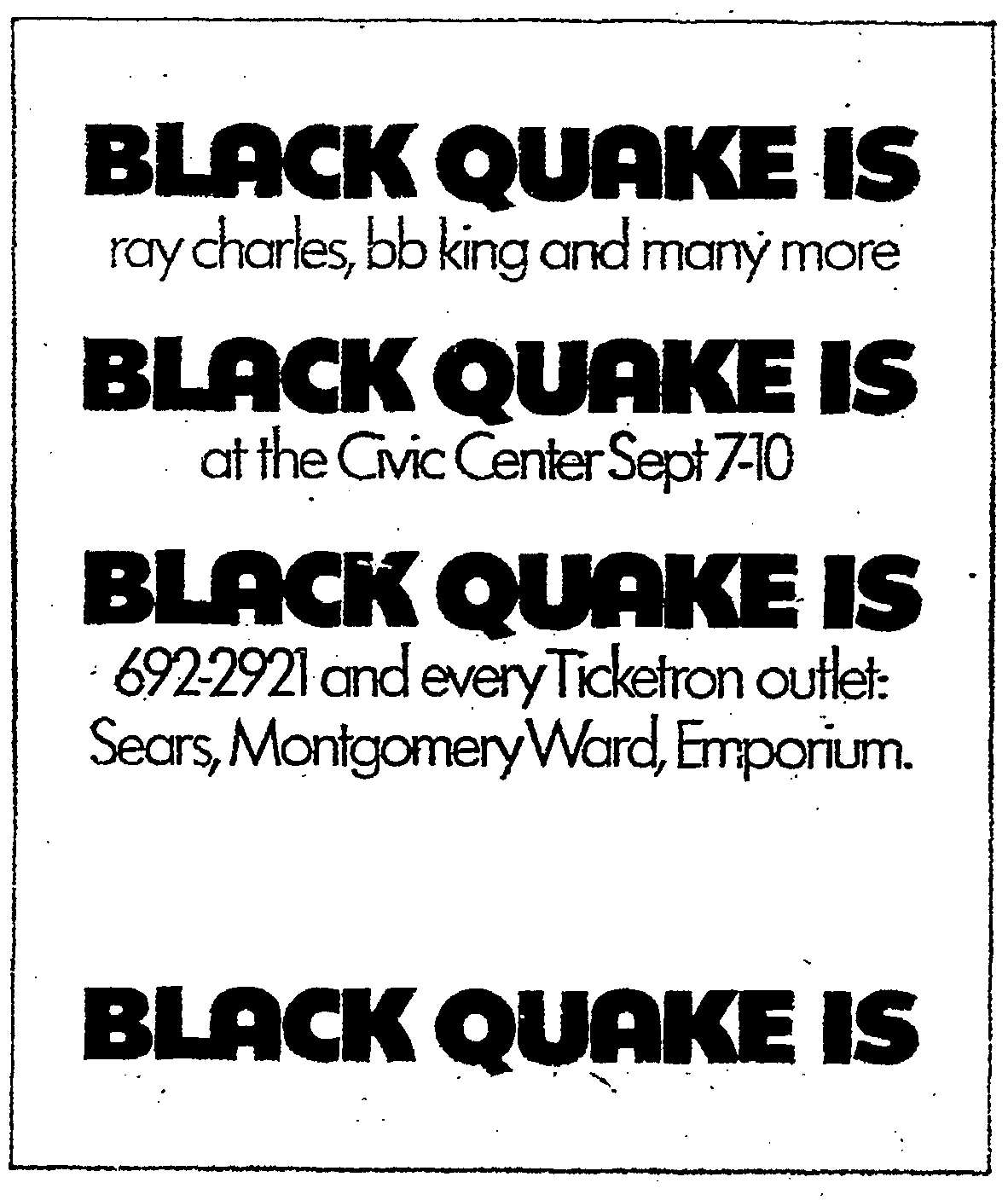
Bay Area Black Quake

San Francisco Chronicle - September 6, 1972 via Genealogy Bank
Black Quake was the name of an amazing cultural exposition that took place almost (update: more than) fifty years ago in San Francisco. Also known as Black Expo. As announced in the San Francisco Chronicle on September 3, 1972, the event included “live performances by black singers, musicians, poets, dancers, and theatrical companies and exhibitions of the works of black sculptors and painters." Ray Charles and B. B. King headlined at the Civic Center! Of the advertised big names in music, only Gladys Knight was a no-show (San Francisco Examiner, 11 September 1972).

Much of the poetry was radical and openly racist according to Christ Savaria in the University of San Francisco Foghorn (15 September 1972):
“The underlying theme of the poetry presented was strongly anti-white and expressive of black rebellion.” 

And Gordon Parks, director of Shaft, got heckled at the film festival by militants from Los Angeles (William Zakariasen, "Militants Shout Down Gordon Parks," S.F. Examiner, 11 September 1972). In such "polarized times," business and organization exhibits demonstrated wonderful diversity:

There’s a Marine booth AND a Black Muslim booth (selling bean pies) AND a Bank of America booth AND a booth where they sell coloring books aimed at black children. 
-- San Francisco Chronicle, 10 September 1972. 

Black Quake returned the next year when headliners included Buddy Miles, Barry White, and Richard Pryor. Founder Ray Taliaferro called the 1973 event "An infusion of positivism for the whole Bay Area" (Chronicle, 2 November 1973). But attendance in the second year was disappointing, especially for a jazz program featuring Donald Byrd that "should have sold out the Civic" (Examiner, 10 November 1973).

Perhaps misreading Augusta Melville's handwriting, Hershel Parker in Herman Melville: A Biography Volume 1 gave the name Black Quake to Sarah Morewood's unfortunate horse--that "fine young colt" injured in a railway accident, as Herman Melville reported from Arrowhead farm in a December 1850 letter to Evert Duyckinck. It's not really a name you would give a horse back then, if ever. More likely, as suggested previously on Melvilliana, the colt's name was "Black Snake." There's a real horse's name! 

Greenleaf's New York Journal and Patriotic Register - March 21, 1795
via Genealogy Bank

Looking further into this interesting and influential misnomer, I see both of the Bay Area Black Quakes happened when Hershel Parker was Professor of English at USC, 1970-1979. I'm guessing Parker would have been way too busy prepping for fall classes to travel so far north. The sacrifices of tenured college professors--who can tell? I mean, think of missing Ray Charles, B. B. King, Sonny Rollins, Bobby Womack and all at the '72 Black Quake. And yet, I can't help wondering if a tremor or two from that glorious California expo snuck into Parker's later transcription "Black Quake" from Augusta Melville's letter of December 21, 1850 to her and Herman's sister Helen. The letter in question is part of the Augusta Melville papers, only discovered in 1983 and now accessible online courtesy of The New York Public Library Digital Collections.

Manuscripts and Archives Division, The New York Public Library. "Letters sent, notebooks and keepsakes" The New York Public Library Digital Collections. 1841 - 1854. https://digitalcollections.nypl.org/items/752fe150-5889-0136-238d-3dcc24fb54fc

In Melville in Love (HarperCollins, 2016) Michael Shelden took Parker's re-christening for gospel and ran with it. Shelden painted Black Quake as "a rambunctious horse with a name that suggested the thudding force of its galloping speed." A missed opportunity there, if the horse's true name could somehow have been implicated in the romance of Melville's involvement with his vivacious neighbor. 

Missiskoui Standard [Frelighsburg, Québec, Canada] - March 21, 1837

Through the magic of YouTube, here's The Genius Ray Charles in Copenhagen only a month after the first Bay Area Black Quake. (A commenter has corrected the Denmark concert date to October 10, 1972.) 


Related posts

Tuesday, July 16, 2019

Ebenezer Knight, 1811-1853

The First Voyage by H. C. K.
The Child's Paper - March 1854
The 3rd Norton Critical Edition of Moby-Dick, edited by Hershel Parker, excerpts the vivid 1846 reminiscence of Gansevoort Melville by Captain E. Knight (page 464). Captain Knight had accompanied Gansevoort with two others on a visit to Cambridge, England. The entry for Saturday, March 14th in Gansevoort's 1846 London Journal, edited by Hershel Parker (The New York Public Library, 1966), records their trip by 2nd class rail which included a tour of Trinity College Library. No mention there of any globe, large or small. According to Knight, however, Gansevoort made dramatic use of "an immense terrestrial globe suspended in the centre of one of the rooms," invoking the biblical story of Jacob and Esau to claim Oregon and California as America's "birthright."
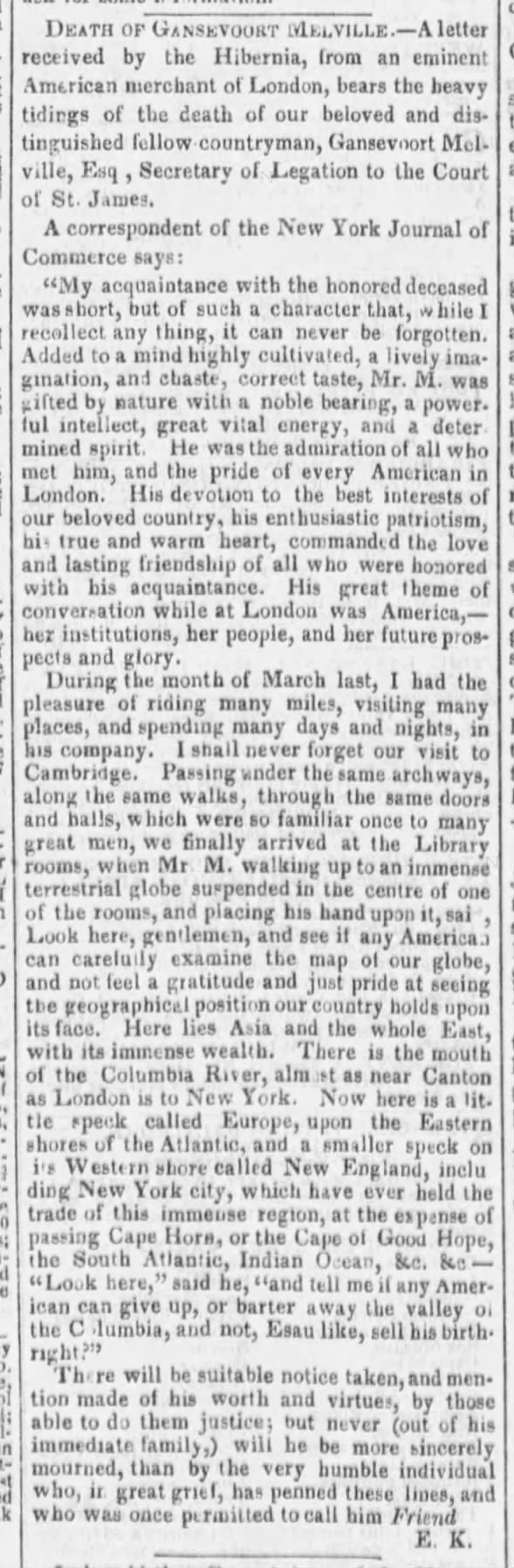
Reminiscence of Gansevoort Melville (Herman's older brother) in Cambridge, England.Reminiscence of Gansevoort Melville (Herman's older brother) in Cambridge, England. Fri, Jun 5, 1846 – 1 · The Baltimore Sun (Baltimore, Maryland) · Newspapers.com
DEATH OF GANSEVOORT MELVILLE.-- A letter received by the Hibernia, from an eminent American merchant of London, bears the heavy tidings of the death of our beloved and distinguished fellow countryman, Gansevoort Melville, Esq, Secretary of Legation to the Court of St. James.

A correspondent of the New York Journal of Commerce says :

"My acquaintance with the honored deceased was short, but of such a character that, while I recollect any thing, it can never be forgotten. Added to a mind highly cultivated, a lively imagination, and chaste, correct taste, Mr. M. was gifted by nature with a noble bearing, a powerful intellect, great vital energy, and a determined spirit. He was the admiration of all who met him, and the pride of every American in London. His devotion to the best interests of our beloved country, his enthusiastic patriotism, his true and warm heart, commanded the love and lasting friendship of all who were honored with his acquaintance. His great theme of conversation while at London was America,-- her institutions, her people, and her future prospects and glory. 
During the month of March last, I had the pleasure of riding many miles, visiting many places, and spending many days and nights, in his company. I shall never forget our visit to Cambridge. Passing under the same archways, along the same walks, through the same doors and halls, which were so familiar once to many great men, we finally arrived at the Library rooms, when Mr M. walking up to an immense terrestrial globe suspended in the centre of one of the rooms, and placing his hand upon it, said, Look here, gentlemen, and see if any American can carefully examine the map of our globe, and not feel a gratitude and just pride at seeing the geographical position our country holds upon its face. Here lies Asia and the whole East, with its immense wealth. There is the mouth of the Columbia River, almost as near Canton as London is to New York. Now here is a little speck called Europe, upon the Eastern shores of the Atlantic, and a smaller speck on its Western shore called New England, including New York city, which have ever held the trade of this immense region, at the expense of passing Cape Horn, or the Cape of Good Hope, the South Atlantic, Indian Ocean, &c. &c-- "Look here," said he, "and tell me if any American can give up, or barter away the valley of the Columbia, and not, Esau like, sell his birthright?" 
There will be suitable notice taken, and mention made of his worth and virtues, by those able to do them justice; but never (out of his immediate family,) will he be more sincerely mourned, than by the very humble individual who, in great grief, has penned these lines, and who was once permitted to call him Friend
E. K.
Originally signed "E. K." and published in the New York Journal of Commerce, Knight's tribute to Herman Melville's older brother Gansevoort was reprinted in the Albany Argus on June 4, 1846; and the day after that in the Baltimore Sun. A condensed version appeared in the Boston Evening Transcript on June 5, 1846.

Encountering the Baltimore Sun version, I wondered about that "immense terrestrial globe" (where is it now?) and Captain Knight's first name (E for Earnest? Edward? Evert?). I don't know about the globe, but Captain E. Knight is Ebenezer Knight,1811-1853. Sometimes spelled Ebinezer. Aka "Eben" Knight according to the online memorial at Find A Grave.
  •  https://www.findagrave.com/memorial/151674190
Ebenezer Knight was born on July 2, 1811 in Corinth, Vermont to Hannah Hale and Joseph Knight. As published in the Columbian Centinel on June 27, 1835, Captain Ebenezer Knight married Anzolette Hussey (1812-1895) in Portsmouth, NH.

Anzolette Hussey's Sampler
National Museum of American History - Smithsonian Institution 
The fullest family tree on Ancestry.com names five daughters of Eben and Ann: Mary Anzolette Knight (1836-1851); Ariadne (Annie) Knight (1838-1874); Hannah E. Knight (1842-1848); Sarah K. Knight (1846-1847); and Abby M. Knight (1850?-1918). Abby is Abigail Maria, later Abby Knight McLane. (In 1887 Abby married Allan McLane, widowed husband of her sister Ariadne.)
  • https://www.ancestry.com/family-tree/person/tree/3069096/person/24210140278//facts
  •  https://sites.rootsweb.com/~knight57/direct/knight/aqwg1385.htm
New York Herald - February 3, 1845
Known for his "gentlemanly" conduct, Knight was a popular captain of the Switzerland and other packet ships to London and Liverpool.
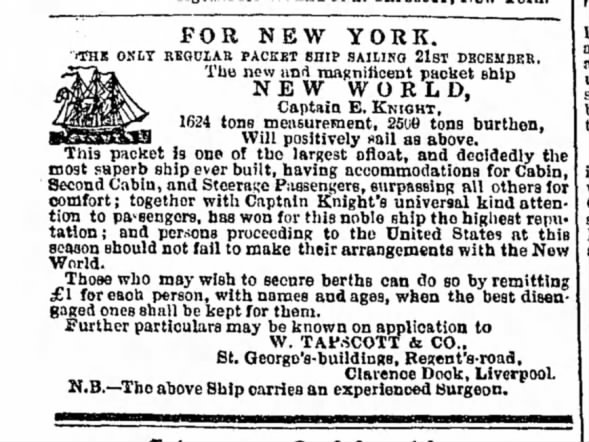
Fri, Dec 17, 1847 – 4 · Liverpool Mercury, etc. (Liverpool, Merseyside, England) · Newspapers.com

When his tribute to Gansevoort appeared in New York newspapers, Captain E. Knight's "Excellent" portrait (No. 238) by G. W. J. was on exhibit at the National Academy (New York Farmer and Mechanic, June 25, 1846).

In 1850-1851, Knight successfully agitated for repeal of the ban on fires and lights aboard ships in Liverpool docks (Honolulu Friend, July 2, 1852). In San Francisco he served for three years as agent of the Pacific Mail Steamship Company. Captain Eben Knight was long remembered by evangelical Christians for arranging that Pacific Mail steamers would not depart on the Sabbath.
No sooner had Captain Knight entered his office here, than he saw what havoc the sailing of steamers made of the Sabbath, when that happened to be the sailing-day. All early Californians know what "steamer-day" meant in those days. It put everybody to work. The steamship-office was besieged from morning till night. Express-offices were crowded, and their messengers and teams were running in hot haste all day. All banks were open, doing a rushing business, with merchants calling for bills of exchange, and miners depositing their bags of gold-dust and taking their certificates; passengers about leaving, hurrying to get their "last things" for the voyage, and going early aboard to receive there the " good-by calls" of friends; everybody writing letters home, and crowding them into the post-office up to the last moment; newsboys crying their "steamer papers" for sale all about the streets; while merchants and clerks were closing their final dispatches to go by Wells and Fargo; and then, at the hour of sailing, the crowd of passengers on the steamer's deck answer to the noisy farewells of the still larger crowds gathered on the wharf, and the great ship glides out into the bay, — and that "steamer day's" excitement is over. Captain Knight at once determined that "steamer day" should not occur on Sunday.  --Samuel Hopkins Willey, The History of the First Pastorate of the Howard Presbyterian Church, San Francisco (San Francisco: The Whitaker and Ray Company, 1900), pages 78-79.
"Eben" Knight died on October 11, 1853 at the age of 42. As also reported by Samuel H. Willey, Knight's eulogy by the business community of San Francisco highlights "noble" qualities of character like those that "E. K." appreciated from a brief acquaintance with Gansevoort Melville.
The high respect and honor in which he was held by the bankers and merchants is touchingly expressed in resolutions adopted at a meeting held by them soon after his death, one of which was as follows: —

"Resolved, That Captain Knight combined in his character in an eminent degree those noble, manly qualities which entitled him not only to the respect and confidence but to the affectionate regard of all who knew him best. 
"With a firm integrity of purpose which never faltered, with a keen sense of honor which scorned an evasion, with a straightforward honesty which resorted to no subterfuges, he combined with simplicity of heart a frankness of demeanor which commanded the respect whilst it secured the affectionate esteem of all with whom he was brought into contact. Scrupulously just in his business relations, generous almost to a fault when his sympathies were appealed to, gentle and confiding in his temper, always ready to forgive a fault in others, he judged harshly only of his own imperfections."

That characterization, be it remembered, was drawn by the business men of San Francisco, not especially his personal friends,— but who could have drawn his character more true to life? Knowing him well, I bear witness to its accuracy in every particular. 
-- The History of the First Pastorate of the Howard Presbyterian Church, San Francisco, page 81. <https://books.google.com/books?id=8XMUAAAAYAAJ&pg=PA81&dq#v=onepage&q&f=false>
Portsmouth Journal of Literature and Politics - December 3, 1853

Monday, April 7, 2014

Herman Melville, seven of his works, his wife, and and both lawyer brothers remembered in California, 1854


Here are two items from the short-lived Daily Placer Times and Transcript of San Francisco, California. Both are available in the Newspaper Archives at GenealogyBank. Adding a few new errors along the way, the Times and Transcript took some delight in correcting the comically inept reporting of a rival paper.

From the Daily Placer Times and Transcript, Thursday, November 16, 1854:
THE RIP VAN WINKLE OF THE PRESS—The News, last evening treated its readers with the following astounding announcement:
Among the arrivals by the Golden Gate, we notice that of S. Ross Browne, of Washington City, well known to literateurs as the author of “Typee, or a Voyage Thither,” “The Howadji, or Travels in Syria and Egypt,” “Two Years before the Mast,” etc., and will be recollected by old Californians as the official reporter of the Convention that drafted the existing constitution of our State. For the past two years Mr. B. has been engaged as chief clerk in one of the Departments at Washington. Of the object of his visit here at the present time we are not advised, but take the liberty to express the wish that he may be induced to give to the reading public his impressions of California as she presents herself to the tourist in 1854.
The reliability of the news we had considered unimpeachable, but this out Herods all newsmonger’s gossip we ever met with. Mr. J. Ross Browne did not arrive by the Golden Gate, nor is he the author of any of the works mentioned above, and the object of his presence is well known. Mr. Browne has been in the country since July last, in his capacity of Government Fiscal Agent, examining the accounts of civil, naval, military, land and Indian office officials on the Pacific coast, and as such has visited Oregon, and nearly all the posts in our State. Mr. J. Ross Browne is well and favorably known as “Yusuf” in the literary world, and stands in the same niche of popular estimation as Mr. Herman Melville, the author of “Typee,” Mr. Curtis, the “Howardje,” and the Rev. Mr. Dana, the author of “Two Years Before the Mast.”
However gratifying it may be to Mr. Browne to be classed as the source of such distinguished literary effort, we feel justified from his proverbial modesty, in setting our neighbor correct on this point. Mr. J. Ross Browne arrived in the Goltah from a visit to the Indian Reserve at Tejou, with the affairs of which we are gratified to learn he felt much pleased. That Mr. Browne will give the world his impressions of the American possessions on the Pacific we feel a certainty, and to none more able could such a task be committed.
Below is the follow up article, also from the Daily Placer Times and Transcript, Friday, November 17, 1854:
RIP VAN WINKLE IN SEARCH OF INFORMATION.—To relieve the “intense anxiety” expressed by the News, in regard to our remarks on the distinguished literary honors it bestowed on Mr. J. Ross Browne, and the queries it levels at us, we would state that Herman Melville is the bona fide baptismal and paternal appellation of a distinguished son of the State of New York, he having been born in Duchess county, of a staid and respectable Knickerbocker family. He is, we believe, the second of three brothers, all of whom have become men of note. Actuated by a roving disposition, after his collegiate education, he ran away from home and made a voyage in a whaler round the world, and on his return gave to the reading public his impressions of travel in “Typee” which, from its peculiar style, was accepted by the literary world as an ideal composition presented under an assumed name. His eldest brother, Gansevoort Melville, died in London whilst filling the position of Secretary of the U. S. Legation, under the Hon. Louis McClane, to which place he was appointed by President Tyler. His remaining brother is a lawyer of considerable repute as a chamber practitioner, whose “shingle” we have seen on the fan-light of No. 14 Wall street, New York. With both gentlemen we are happy to be acquainted. So far as regards Melville being a “nom de plume,” it is nowhere disputed that Mr. H. M. did write Typee, Omoo, Mardi, Redburn, White-Jacket and Bartleby the Scrivener; and moreover he is the author of the admired serial novel now in course of publication in Putnam’s Monthly, entitled “Israel Potter, or Fifty Years of Exile,” a national tale of the early days of our confederacy, written in an entirely different style from any of his previous works. Mr. M. now resides on his farm at Berkshire, Massachusetts, with his family, his wife having been a Boston belle, in company with G. P. R. James, Rev. H. Ward Beecher, and like kindred coterie, as neighbors.
Mr. Curtis, the “Howadji,” is the author of those widely read satire known as the “Potiphar Papers,” and as such the public were made acquainted with his physiognomy by means of an admirably executed steel engraving, which adorned a late number of Putnam’s Monthly. He is also a newspaper man, being one of the New York Tribune’s host of contributors. Mr. Richard H. Dana, Jr., the author of “Two Years before the Mast,” is a lawyer of Boston, who has rendered himself conspicuous in the late slave case in that city.
Having satisfied the News as to the gentleman, we need scarcely remark, that the error in spelling “Howadji,” and the prefixture of Rev. for Rich., were merely typographical errors, and would not, with others, have appeared but for an incidental omission of proof reading.
About the typos, maybe so--but President Polk appointed Gansevoort Melville, not Tyler. Also the writer neglects to mention Herman Melville's younger brother Thomas, and does not know that Herman was born in New York City. And wait, what happened to Moby-Dick and Pierre?

Still, the November 17th item provides a friendly and knowing treatment--and you gotta love the rare mention of Bartleby, the Scrivener by somebody who remembered 14 Wall Street.