Just published in the June 2026 Leviathan, this important essay by Steven Olsen-Smith
"introduces a newly identified Civil War-era flag inscribed by Herman Melville with his name and New York City address, a material artifact that expands our understanding of the author’s commitment to national identity....Melville acquired the flag no later than the period surrounding the outbreak of war, flying it at Arrowhead before relocating to New York, where he added the ink inscription and continued to use it."
"We'd like to do... Everybody want to stand up this time; everybody must stand up, because "we's all Americans," so forth and so on. We are Americans: you can do this, you can do that. This is for everybody together, that action. We'd like to do the American anthem the way it really is in the air which you breathe every day, the way it really sounds."
-- Jimi Hendrix, May 30, 1970 Live at Berkeley, 2nd show 10 p.m.
Link below to a gem in the latest Leviathan with exciting news of recovered markings and marginalia in Melville's set of Boswell's Life of Samuel Johnson. By Christopher Ohge and Brandon Hurst who are also taking the editorial reins at Melville's Marginalia Online.
🙏🙏Thanks to Founding Editors Steven Olsen-Smith and Peter Norberg and every contributor to https://melvillesmarginalia.org/ for a monumental job well done! 👍👍
... Melville's oath-taking vignette in "The Quarter-Deck"—a scene emphasized in Huston's film but otherwise overlooked by scholarship. I argue that this oath-taking scene proves a previously unnoted ekphrastic passage in which Melville draws from Jacques-Louis David's well-known Neoclassical history painting Oath of the Horatii (1784) in order to depict Ahab's induction of the three mates, and then the three harpooners, into his quest for revenge upon the white whale.
Citation:
Adams, Elizabeth. "The Oath of the Pequod: Moby-Dick, Jacques-Louis David's Oath of the Horatii, and the Aesthetic of the Distinct." Leviathan 24, no. 1 (2022): pages 3-23 at page 4. muse.jhu.edu/article/852658.
Oath of the Horatii Jacques-Louis David, Public domain, via Wikimedia Commons
It's a great connection, here provoking an interesting take from Adams on Melville's "aesthetic of the distinct." Which to me does not easily or obviously reduce down to realism, but no matter. Once you see it, the painting wonderfully illuminates the Quarter-Deck scene in Moby-Dick. For a start. While worthy of closer examination, certainly, Melville's debt to David's Oath of the Horatii has not exactly been ignored or "unnoted" in previous scholarship. Indeed, a footnote in the 2nd Norton Critical Edition (listed without comment by Adams among Works Cited) concisely points to the painting and the medium in which Melville would most likely have encountered it:
2nd Norton Critical Edition (2002), ed. Hershel Parker and Harrison Hayford, page 141:
"Melville knew this ritual from Shakespeare (Hamlet makes Horatio and Marcellus swear on his sword in Hamlet, 1.5.146), but he could have seen it elsewhere, perhaps in a print of the 1784 painting, The Oath of the Horatii by Jacques Louis David (1748-1825).
"Melville knew an oath-taking ritual from Shakespeare (Hamlet makes Horatio and Marcellus swear on his sword in Hamlet, 1.5.146), but he could have seen it elsewhere, perhaps in a print of Jacques Louis David's 1784 painting, The Oath of the Horatii."
Unfortunately, Adams has also overlooked prior and directly relevant work by Peter Wagner on David's painting as exemplary "iconotext" in Moby-Dick. Engaging the highest priests of postmodern lit-crit AND the Melville Society, Wagner has written and published on David's famous painting and Melville's famous oath-taking scene in English:
In Herman Melville's mighty Moby-Dick, or, The Whale (1851), art and artists constantly interfere in the text--and so do the fictional readers or observers of art works... One of the more intriguing examples occurs when, in Chapter 36, Ahab first nails the golden doubloon to the mast, and then, as the English of Shakespeare and the Elizabethan revenge tragedy blends with the powerful prose of the Bible and Milton's lofty verse (and many other pre-texts), forces his crew to unite in an "indissoluble league." ... The scene is obviously inspired by two major pretexts (or subtexts), one verbal and the other visual: Shakespeare's Hamlet and Jacques Louis David's Le serment des Horaces (colour plate I). David's painting--and its highly ambiguous, contradictory, socio-political implications--are integrated into Melville's text. The dramatic scene relies for its meaning on the reading of David's canvas and all the sources behind it, including the classical story of the Horatius family...." (9-10)
"Let us now leave ekphrasis for a while and turn to the second provocative term, iconotext, which I applied to the implicit allusion to David's Le serment des Horaces in Chapter 36 of Moby-Dick."(15)
... footnote 39: "... The study of the role of art works in Melville's novel is, as can be expected, still at the "correspondences of the arts" stage, with most critical works exploring text and paintings (evoked in the text) apart. See, for instance, Sten: Savage Eye, and Wallace: Melville and Turner, which are, alas, no exception to the rule." (15)
Peter Wagner, "Introduction: Ekphrasis, Iconotexts, and Intermediality -- the State(s) of the Art(s)" in Icons - Texts - Iconotexts: Essays on Ekphrasis and Intermediality, ed. Peter Wagner. Berlin: Walter de Gruyter, 1996, pages 9-10 and 15.
and German, a whole chapter on the subject in German:
Hans-Peter Wagner, "Herman Melvilles Moby-Dick und Jacques-Louis Davids Le serment des Horaces"in Literaturen der Welt: Zugänge, Modelle, Analysen eines Konzepts im Übergang (pages 269-284). Ed. Patricia A Gwozdz and Markus A Lenz. Heidelberg: Universitätsverlag Winter, 2018.
Wagner credits Harold Beaver for being the first commentator to identify David's painting as the iconographic source for the oath-taking scene, citing the 1972 Penguin edition of Moby-Dick.
Wagner's use of the "implicit allusion" to The Oath of the Horatii in Moby-Dick to exemplify the term iconotext is quoted by Thomas F. Heck in the first chapter of Picturing Performance: The Iconography of the Performing Arts in Concept and Practice (University of Rochester Press, 1999) at page 37.
Here in the blogosphere, Charles Matthews called attention to David's painting in his discussion of Moby-Dick chapter 36, back in 2010:
Then he [Ahab] has the three mates extend their lances and "he grasped the three level, radiating lances at their crossed centre." He glances "intently from Starbuck to Stubb; from Stubb to Flask. It seemed as though, by some nameless, interior volition, he would fain have shocked them into the same fiery emotion accumulated within the Leyden jar of his own magnetic life." The image is somewhat reminiscent of Jacques-Louis David's painting Oath of the Horatii:
But the effect isn't what Ahab hopes for: "Stubb and Flask looked sideways from him; the honest eye of Starbuck fell downright." Ahab resigns himself that if they had taken "the full-forced shock, then mine own electric thing, that had perhaps expired from out me. Perhaps, too, it would have dropped ye dead." He orders the three mates to act as "cupbearers to my three pagan kinsmen there -- yon three most honorable gentlemen and noblemen, my valiant harpooneers." He has the harpooners detach the metal heads from their harpoons. "Forthwith, slowly going from one officer to the other, he brimmed the harpoon sockets with the fiery waters from the pewter." Each officer gives the harpoon-cups to his harpooner.
"Drink, ye harpooneers; drink and swear, ye men that man the deathful whaleboat's bow -- Death to Moby Dick! God hunt us all, if we do not hunt Moby Dick to his death!" The long, barbed steel goblets were lifted; and to cries and maledictions against the white whale, the spirits were simultaneously quaffed down with a hiss. Starbuck paled, and turned, and shivered.
It's a great, theatrical, melodramatic scene.
-- Charles Matthews, "The Journal of a Compulsive Reader" 6. Moby-Dick, by Herman Melville, pp. 129-165. Link below:
... And Dillingham pointed us in the right direction by calling attention to the dialogic structure of Melville’s story, most essentially a conversation developed through a “great number of questions and answers.”
As recognized more recently by Joshua Matthews, the script for the salesman’s part in the dramatized conversation derives from a set of “safety instructions”:
“His performance, intended to produce anxiety in his potential customer, acts out the safety instructions he advises the narrator to take.”10
The Hymn in Moby-Dick: Melville's Adaptation of "Psalm 18": In 'The Sermon,' Chapter 9 of Moby-Dick, the hymn sung by the congregation of Whaleman’s Chapel contributes pointedly to Herman Melville’s realistic depiction of organized worship and to the thematic coherence of both chapter and work. As David H. Battenfeld first discovered, Melville’s source for the hymn is the first part of a rhymed version of the 18th Psalm (subtitled 'Deliverance from despair'), printed in The Psalms and Hymns of the Reformed Protestant Dutch Church in North America. This is the psalter and hymnal authorized by the church of Melville's mother, Maria Gansevoort Melville, in which he was baptized.1 Noting the book was first published 'in 1789, and was expanded in 1830 and 1846,' Battenfeld took his copy-text from an 1854 printing of Psalms and Hymns, apparently assuming 'Psalm 18' remained unaltered from the 1789 edition up to and beyond the publication of Moby-Dick in 1851. Moreover, Battenfelds analysis addressed only the ways Melville changed the hymn 'to fit the specific reference to the story of Jonah' (574); he made no effort to examine Melville’s alterations in light of ideas and images that inform Moby-Dick as a whole. But the actual setting of “Psalm 18” that Melville adopted was, in fact, not the version included in Psalms and Hymns until the book was expanded for the first time, after the synods of 1812 and 1813, and the text of this setting was altered for editions following...
The most thorough critical study of Herman Melville's 1839 "Fragments from a Writing Desk" is still the one by William Henry Gilman in Melville's Early Life and Redburn (New York University Press, 1951) pages 108-122. While admitting the limitations of Melville's first known fictions as "distinctly amateurish compositions," Gilman argues that the two numbered newspaper "Fragments"
offer clues about his personality, outline his intellectual life, and foreshadow his later literary techniques. --Melville's Early Life, page 109
After close readings of each sketch Gilman concludes, in part:
It is lamentable that no other writings survive from Melville's early period to study for Byronic influences. But Melville's first compositions owe much to Byron, not only in direct and indirect references, but also in the extravagant expression, in the disposition to project one's self or one's dreams into one's literary creations, as Byron did in Childe Harold, and in the sting of disillusion with which the second "Fragment" ends.
In the final analysis Melville's first writings tell us a good deal about their enthusiastic but untutored author. In his twentieth year, despite the dismal days on which he had fallen, he could write with good humor and spontaneity, welling up out of an undeniable urge to self-expression. His attitude toward life is lusty and bumptious. The suggestions of romantic revolt against his refined and thoroughly proper background are strong. If his enthusiasms are somewhat youthful, they still evidence zest for the life of experience as well as for art and literature, both classical and modern. He could indulge in the wildest of romantic effusions, as in the first "Fragment," and much of the second. However, he could also subdue them with humor, ridicule, and disenchantment.
His literary style has the faults common to beginners--verbal and imaginative extravagance, self-consciousness, undue length. Yet in many ways his first works anticipate the style of his best period. He learned very early to fill out his story with a wealth of allusion, literary, historical, and artistic. The Second "Fragment" begins with an exclamation as do Typee and Mardi; its abruptness is repeated in Redburn, White-Jacket, and Moby-Dick. The suspense secured by deliberately delaying the ending and the dramatic climax itself are repeated in Typee and Mardi and worked out in Wagnerian form in Moby-Dick. Of profound significance is the fact that the "Fragment" tells the story of a frustrated quest. The pattern of this adolescent experiment with the marvelous is the essential pattern of Mardi, Moby-Dick, and Pierre. Here Melville's hero pursues the trivial end of sensuous perfection. At the very end he is suddenly disappointed. In the works of Melville's greatest period his characters wander over the entire globe and the infinite world of the mind and in the pursuit of ultimate beauty, or of power over nature and evil, or of truth and justice. All of them--Taji, Ahab, and Pierre--are the losers in their quests. The ending of the second "Fragment" shows that as early as his twentieth year Melville's mind had formulated, however crudely, the concept that pursuit of the ideal is foredoomed to disillusion and defeat.
-- William H.Gilman, Melville's Early Life, pages 119-120.
The best edited texts of Melville's two "Fragments from a Writing Desk" are printed with "Uncollected Pieces" in the scholarly edition of The Piazza Tales: And Other Prose Pieces, 1839-1860, edited by Harrison Hayford, Alma A. MacDougall, G. Thomas Tanselle and others (Northwestern University Press and The Newberry Library, 1987) on pages 191-204. "Fragments" originally appeared in two numbered installments, each published over the enigmatic signature "L. A. V." in the Lansingburgh NY Democratic Press, and Lansingburgh Advertiser for May 4 and 18, 1839. The pseudonymous author was then 19 years old. The joke at the sudden end of Fragment No. 2 is on the narrator who finds out to his horror that his Oriental dream girl is "DUMB AND DEAF!" physically unable to speak or hear. What an idiot! The narrator I mean, so devoted to his ideal of feminine perfection that he runs away from Real Love the instant he finds it.
Even with due allowance for the exuberance and stupidity of youth, the premise of the "atrocious anticlimax" (Gilman's apt tag, page 113) that finishes off Melville's second Fragment is hard to comprehend. His mystery-girl ain't nothing but fine fine fine. How is her being deaf-and-dumb a dealbreaker? Omnia vincit amor, all the poets say so. Muddy Waters said she moves me, man. Jimmy Reed said if you find true love in this wicked world, sign her to a contract. Chuck Berry said C'est la vie, you never can tell. Big Maybelle said why not take all of me. Obviously Melville never saw Marlee Matlin in Children of a Lesser God. Reject that sexy enchantress? Not hardly.
Explicating the "extraordinary dénouement" and abrupt ending of the second Fragment, Dorothee Metlitsky Finkelstein agrees with Gilman. Melville's Fragment 2
"has been appropriately called the first of his variations on the theme of a frustrated quest. The final anticlimax is the earliest demonstration of his irresistible impulse to prick the rosy bubble of romance and to reveal its terrible core of tragic reality." -- Finkelstein, Melville's Orienda (Yale University Press, 1961; reprinted Octagon Books, 1971) page 31.
Confronting the same essential puzzlement, Peter Norberg explains that the narrator's "asking to seal their love not with a kiss but with her voice shows he is more interested in a rhetorical exchange than an exchange of sexual favors" (page 76).
Norberg, Peter. "Congreve and Akenside: Two Poetic Allusions in Melville's "Fragments from a Writing Desk"." Leviathan, vol. 10 no. 3, 2008, p. 71-80. Project MUSEmuse.jhu.edu/article/492877.
Failure to communicate in Fragments 2 thus anticipates the predicaments of Bartleby, Babo, and Billy Budd. Invoking Lyotard and Fish, Norberg explains how the abortive conclusion highlights Melville's "persistent interest in moments of discursive disjunction—moments of
miscommunication, or non-communication that occur when one person
fails to recognize the conventions of discourse being spoken by
another" (page 72).
Discursive disjunction! So, not dreadful misogyny? No prospective violation of the Americans with Disabilities Act? Norberg would absolve teenage Melville of misogyny in No. 2 by emphasizing the extended satire on hyper-romanticism:
"the deliberate manner in which Melville directs readers’ attention back to the narrator’s overblown rhetoric makes his rhetorical posturing, not women, the butt of the joke."
Similarly excused as a literary device, the narrator's heartless rejection of a disabled woman after the big reveal. Call it a metaphor, rather than obvious ableism. The shocking silence of Inamorata figuratively represents
"the romantic movement’s failure to propose an alternative to the cultural order of things it ostensibly challenged" (page 76).
Maybe, but my own research, particularly my deep reading in National Lampoon, teaches me that premium adolescent humor revels in misogyny, along with gross outrageous satire of everything under the sun. Not excluding the most vulnerable of our fellow mortals with disabilities. Also, as a committed feminist I refuse to bar women from any exposé of posturing and butts, however academic or adolescent. No More Separate Spheres! Speaking of which, the contribution by Elizabeth Renker to that seminal volume offers probably the best analysis ever of the literary figurations in Melville's Fragments:
The virgin whiteness thematized in these sketches under the sign of the female is metonymically the whiteness of paper and is ultimately figured as a blankness or dumbness that terrifies the narrator/writer.... (pages 104-105)
In the confrontation with the dumb white face that concludes sketch 2, then, the writing debut of sketch 1 ultimately gives way to a terrifying scene of writing anxiety.” (pages 105-106)
Reprinted there from Renker's 1994 article in American Literature
Renker, Elizabeth. “Herman Melville, Wife Beating, and the Written Page.” American Literature, vol. 66, no. 1, 1994, pp. 123–150. JSTOR, www.jstor.org/stable/2927436.
and reprised in Strike Through the Mask (Johns Hopkins University Press, 1996), pages 59-60.
Renker's biography-based reading of Fragments has the added virtue of accounting for violence associated with women and scenes of writing in later texts like Pierre; or, The Ambiguities (1852) and The Tartarus of Maids (April 1855), even if you would acquit Melville on the unproven criminal charge of physically abusing his spouse.
Norberg footnoted Gilman but not Renker or Metlitsky Finkelstein. In due course, Norberg is now ignored along with Gilman, Renker, and Metlitsky Finkelstein in the recent Leviathan essay by Daniel Diez Couch and Michael Anthony Nicholson.
Couch, Daniel Diez and Michael Anthony Nicholson. "Silent Eloquence: Literary Extracts, the Aesthetics of Disability, and Melville’s “Fragments”." Leviathan, vol. 23 no. 1, 2021, p. 7-23. Project MUSE, doi:10.1353/lvn.2021.0001.
In this particular quaternity of academic neglect, the women get the worst of it. Renker, instead of receiving credit for her most original and provocative and directly relevant work, gets cited with the late Douglas Robillard for a minor and easily dismissible reference to "Fragments from a Writing Desk" in their introductory essay on Melville and Poetry in the October 2007 Leviathan. Amnesia has definite advantages here. You could not very well acknowledge Renker on Melville's "Fragments" in American Literature or No Separate Spheres! or Strike through the Mask and still claim that critics have dismissed it. Best forget her, and suppress the terrifying realization that Leviathan and The Melville Society are just nothing but cultural monuments to gender-based violence and misogyny, not to mention white supremacy. As predicted in another post, Melville is bound to be cancelled and soon.
Renker's dangerous take is bravely rescued by Michael D. Snediker, riffing on Fragment 2 in the preface of his latest book, Contingent Figure: Chronic Pain and Queer Embodiment (University of Minnesota Press, 2021). On Melville's alleged abuse of his wife, Snediker accepts the guilty verdict rendered by Renker as "well documented." Reverential and creepy invocations of Foucault, especially his refiguring of the Cheshire cat's disembodied grin, are not similarly qualified by any reference to the French philosopher's sexual abuse of children in Tunisia. Better-evidenced by eyewitness testimony which is more compelling than the documented rumor and hearsay in Melville's case. However, breaking news of Foucault's abuse of North African boys only emerged in March 2021, months too late for Snediker to have confronted it in Contingent Figure.
Snediker seems the rarest of postmodern theorists in that he has not forgotten how to read. Closely reading and re-reading Fragment 2 in the wake of Renker and the 2006 introductory essay by Samuel Otter to a special issue of Leviathan on Melville and Disability, Snediker frames the big critical question
“How, then, to cull from the invectively capitalized last words of Melville’s text some sense of his profound and provoking explorations of disability?
but realizes, as a reader, you don't. Melville's Inamorata is, after all, imaginary. A fictional character, and barely that in Snediker's view:
“Conceiving Inamorata as a woman treated like an object asks,
however, that we suspend our readerly disbelief regarding her elaborate textual flatness.” -- Michael D. Snediker, preface to Contingent Figure.
As Snediker suggests, the personality of Inamorata gets lost in the oriental opulence of her surroundings. The felt "flatness" of Melville's representation betrays her essence which is literary and thus unreal. Considering the skill with which Couch and Nicholson dissect Melville's first Fragment as a generic collection of literary "beauties," it is strange to find them ignoring literary antecedents of Inamorata in Byron's The Bride of Abydos, Moore's Lalla Rookh, and The Arabian Nights. Metlitsky Finkelstein surveyed those and more sixty years ago, discovering along the way
an American model for Melville's story which has not been previously noted. The subject of the deaf and dumb mistress is the theme of Amir Khan, a popular Oriental verse romance by a young American poet, Lucretia Maria Davidson, who died in 1825 at the age of sixteen....
Like the Inamorata of Melville's Fragment, Amreta, the heroine, is deaf and dumband is characterized by "long dark lashes" and an appropriately amorous name. The passionate ardor of Amir Khan meets no response in the beauteous damsel. But Amir Khan finally resorts to a ruse. With the help of a magic herb, he pretends to be dead and succeeds in evoking speech in his mistress. Unlike Melville's Fragment, the story ends happily.
... Miss Davidson was inspired by the Arabian Nights and even more by Thomas Moore, the Western prophet of Oriental romance. One cannot help feeling that Amir Khan may have given Melville a special impetus for his "hoax."
With Amir Khan before us, Inamorata looks a lot like Davidson's disabled heroine, Amreta. When Melville's narrator begs Inamorata,
Speak! Tell me, thou cruel! Does thy heart send forth vital fluid like my own? Am I loved,--even wildly, madly, as I love?
he echoes Amir Khan's plea to Amreta:
"Oh speak! Amreta--but one word! Let one soft sigh confess I'm heard."
Davidson's models were Melville's, too. As pointed out in a contemporary review, Davidson's poems
“are to be estimated by the age of the writer, and by the subjects of imitation before her—Byron and Moore; from whom all our young poets and poetesses have more or less made their sketches. And why not,—if the sketches be tolerable? " -- New York Spectator, June 2, 1829.
Peter A. Obuchowski takes Fragments as Melville's satire of Edgar Allan Poe and his ornate stylings, especially as manifested in the 1838 short story Ligeia.
In "Fragment 2," he continues the satire of the idealization of women in popular romantic fiction begun, and put in contrasting perspective, by "Fragment 1." The absurdly saccharine and lace-edged female portraits of "Fragment 1" evolve in "Fragment 2" into a mysterious lady who, much to the narrator-hero's chagrin, turns out to be deaf and dumb....
... The main joke of the piece centers on Poe's preoccupation with mysterious women of ethereal beauty and perfection. In "Fragment 2," the narrator's quest does not lead to a great transcending love that transports him to a vision of Poe's Other-World but to the hard reality (presented as black humor) that the loved one, very much of this earth, is deaf and dumb. The satire may cut deeper to suggest that her dress, surroundings, and general appearance disguise her defects, or even deeper to suggest ironically that if she is a supernatural emissary she can neither hear man's petitions nor speak any wisdom or comfort to him. But the general tone of the "Fragment" is light and humorous, and highly serious thematic interpretations probably should not be pushed too far.
Obuchowski, Peter A. "Melville's first short story: a parody of Poe." Studies in American Fiction, vol. 21, no. 1, 1993, p. 97+. Gale Academic OneFile, link.gale.com/apps/doc/A13926333/AONE?u=nypl&sid=AONE&xid=9008082d.
For Obuchowski, Melville's 1839 parody of Poe revealed a talent for literary satire that would be developed and exploited throughout Melville's career as a prose writer, most brilliantly in The Confidence-Man.
Obuchowski is out with the rest in 2021, but Couch and Nicholson, like Snediker, do recognize Samuel Otter for pointing the way forward in Melville's Anatomies (University of California Press, 1999) and the aforementioned essay on Melville and Disability. However, the existence of the 2006 effort in print further erodes their supposition of "scant scholarly attention." Introducing a special issue of Leviathan all about Melville and Disability, Otter anatomized and for the occasion literalized both Fragments with particular attention to No. 2. Flipping the script on the disillusioned narrator, Otter pointed out that "the fancies of Inamorata, too, are thwarted." When boy meets deaf girl, both are disappointed and "the final scene depicts a mutual shock."
Otter, Samuel. "Introduction: Melville and Disability." Leviathan, vol. 8 no. 1, 2006, p. 7-16. Project MUSEmuse.jhu.edu/article/492743.
Taking the hint, Couch and Nicholson extend Otter's argument by placing Melville's Inamorata at the moral and aesthetic center of Melville's Fragments (regarded as one story in two parts). Good! That is, if you can forgive and forget the silencing of Metlitsky Finkelstein and Renker, the disability angle looks promising and almost new with respect to Melville's Inamorata. In developing their case for a deaf female character as hero of creative expression and activism, Couch and Nicholson situate Fragments in the interesting and clearly relevant context of "emergent deaf American communities, institutions, and forms of expression." As they show, literary landmarks of deaf culture, overlooked in previous scholarship on Melville's Fragments, include "literary works by an array of deaf and hearing writers from James Nack and John R. Burnet to Washington Irving and Sarah Josepha Hale." Excellent!!! Especially interesting to me are the examples of Hale's 1828 story The Deaf Girl and Irving's narrative of The Little White Lady in The Crayon Miscellany (1835).
Fascinating in their own right, these two texts supply analogues and possible sources that might illuminate Melville's teenage treatment of deafness. The amazing and accomplished Sarah J. Hale was future editor of Godey's Lady's Magazine where "Deaf Girl" would be reprinted in October 1852, with the revised title "The Deaf Beauty." Her protagonist is Marianne Willis, a bright and beautiful young lady deceived by the romantic attentions of her callous suitor, Captain Hall of the U. S. Navy. Unfortunately, Marianne never rebounds from her disappointment: "She had worshipped truth—she found the world false—her spirit was not formed to endure it."
Hale's pathetic tale of Marianne Willis is an American fiction. Couch and Nicholson dump Irving's "Little White Lady" into the same category, fiction. Granted, with Irving it's good to be on your guard, otherwise you might mistake Diedrich Knickerbocker for a real person, and his famous book for a veritable History of New York. Another of Irving's pseudonyms is Geoffrey Crayon, putative author of The Sketch Book and The Crayon Miscellany. Nevertheless, when Irving in the literary guise of Geoffrey Crayon, Gent. presents the sketch of "The Little White Lady" as "a little tale of real life" (page 203), he's not lying. Irving's 1835 sketch of The Little White Lady is a true story about real people and events at Newstead Abbey in Nottinghamshire, England. Irving's first informant was Byron's former schoolfellow Thomas Wildman who had purchased the estate from Byron. In 1831, Colonel Wildman and his wife Louisa hosted Irving for several weeks at Newstead Abbey. From Thomas and Louisa Wildman and others, Irving learned all about the Byron-obsessed deaf lady who haunted the Abbey like a ghost, often habited (like Melville's Inamorata) in white.
Manuscript notes on Newstead Abbey are preserved in the Washington Irving Collection Accession 6256-a, Special Collections Department, University of Virginia Library. Transcripts (and some originals, apparently) of letters from the eccentric subject of Irving's sketch are now held there with Irving's Correspondence, as indicated in the online Finding Aid. Independent confirmation may be found in the manuscript autobiography of Mrs. Rebekah Heath (1797-1870), as reproduced in J. H. Beardsmore's History of Hucknall Torkard and transcribed on Nottinghamshire History:
As described by Irving, locals at the farm house where the White Lady stayed courtesy of Colonel Wildman did not know the name of their troubled and troublesome guest. But Irving learned it eventually and does not leave her "nameless" as implied by Couch and Nicholson. In Irving's plain words, "Her name was Sophia Hyatt."
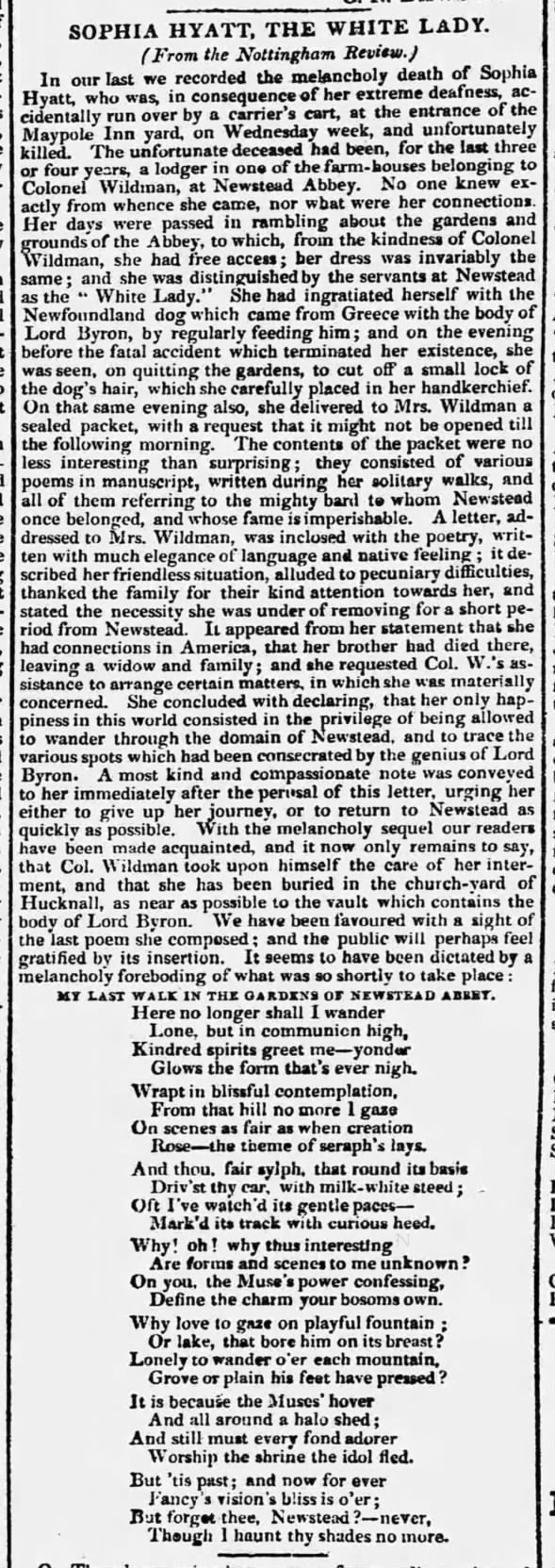
In 1825 the circumstances of Sophia Hyatt's difficult life, eccentric and intensely romantic personality, and accidental death were communicated in a newspaper article for the Nottingham Review. The richly detailed mortuary notice in the Nottingham Review circulated immediately and widely in British newspapers and journals.
In our time neo-racists masked as anti-racists like to project their own racist fantasies onto unoffending waitresses and truck drivers, cooks and clerks, farmers, merchants, and tradesmen, police officers and other emergency responders, schoolchildren and college students, mothers and fathers, sisters and brothers, friends and neighbors who build and grow and fix things for a living. The morally equivalent crime in disability studies must be ableism. When the victim of ableism is a woman, tack on an extra charge of anti-feminism. Unfortunately for Wokademia, between the Oriental fantasies of teenage Melville and varying psycho-sexual responses of sympathetic readers, there should be more than enough isms to go around. Like I said before in the post on Memory-holes in the Broadview Benito Cereno, Melville will have to be cancelled along with Dr. Seuss. Exile the White Whale to Mulberrry Street where he belongs! Obvious problem, you absolutely can't publish in Leviathan or patronize the Melville Society, once Melville has been exposed as the misogynist and ableist upholder of systemic racism and apologist for white-whale supremacy that he most certainly and demonstrably was.
Solution, re-imagine teenage Melville as the Greta Thunberg of disability rights advocacy:
"Melville's active, signing women serve as a rejoinder to Hale and Irving, whose objectifying fictions combine ableism and antifeminism." -- Couch and Nicholson on Melville and Disability, page 17.
Hahaha.
Objectifying fictions? Personally, I live for objectifying fictions.
Peeping from beneath the envious skirts of her mantle, and almost buried in the downy quishion on which it reposed, lay revealed the prettiest little foot you can imagine; cased in a satin slipper, which clung to the fairy-like member by means of a diamond clasp.
Talk about active signing. Baby, you know what I like. Do that sign with the downy quishion.
Sorry, all that peeping and hiding and clasping and clinging around Inamorata's pretty little foot, not to mention the feather cushion, made me dazed and confused. For a moment I forgot who's getting cancelled for composing objectifying fictions. NOT teenage Melville in Fragment 2 for turning Lucretia M. Davidson's deaf fairy princess into a monster of cosmic silence. PAY NO ATTENTION TO THE DOWNY QUISHION! Focus instead on politically incorrect stories about talented deaf women by Washington Irving and Sarah Josepha Hale, fatally flawed by ableism and antifeminism.
How can that be? Sarah J. Hale, blessed co-author of Mary Had a Little Lamb with Buddy Guy and Jimmie Vaughan's kid brother, a vicious ableist and antifeminist?
Mary had a little lamb, His fleece was black as coal.... -- Stevie Ray Vaughan
So they say: "Melville's active, signing women serve as a rejoinder to Hale and Irving, whose objectifying fictions combine ableism and antifeminism." Melville's fake deaf lady rights all wrongs, even those committed by real 19th century women. To clinch their case against Hale, Couch and Nicholson use the popular technique of lying with ellipses. This is also a favorite trick of media propagandists.
Melville's active, signing women serve as a rejoinder to Hale and Irving, whose objectifying fictions combine ableism and antifeminism: as Hale writes, "a beauty who cannot speak, is no more . . . than a statue" (226).
Great God! As presented in Leviathan, the severed quote makes Hale sound like the ultimate ice-queen, mean and evil enough to categorically deny human dignity to non-speaking persons. Case closed. Anybody who would cruelly marginalize disabled people by calling them statues could probably dash off five or six ableist fictions before breakfast. But that only happens in pseudo-reality. In the real world of verifiable facts, here's what Hale actually wrote:
But a beauty who cannot speak, is no more to our intellectual beaux than a statue. And yet, where is the great advantage in having the faculty of speech, if it be only employed in lisping nonsense?
Deleting the key phrase "to our intellectual beaux" dramatically changes the sense of Hale's words in their original context. For Hale's narrative purposes this is exposition, early on, establishing in a general way the ignoble motivations of--
Who? Uh, men. Young men if you want to be particular. Alright, highly educated (rather, over-educated or mis-educated, as Hale digressively dares to theorize) "intellectual" young men, "beaux" who idolize young women for their most superficial attributes. Important plot point for the romance underway, since Marianne's apparent suitor Captain Hall turns out to be one those beaux with bad intentions. Far from endorsing the sophomoric view of non-speaking persons as statues, Hale's narrator endows her deaf beauty with lively features, a "soul-beaming smile" and "laughing eyes." Marianne lacked for nothing:
"She was as happy as she seemed, as happy as she was innocent—she had never known a single sorrow, or privation." (Deaf Girl, page 227)
Marianne's caller the Navy officer is described as generous and gallant, but "thoughtless." The Captain admires her beauty and pities her misfortune, so regarded, of being unable to speak. However charming, he's no Romeo. Hale's Captain Hall is more like Austen's Willoughby, dashing but undependable suitor of Marianne Dashwood in Sense and Sensibility. Both Marianne's are deceived then eventually undeceived. True, Hall's Marianne Willis never recovers from her disappointment. That's melodrama for you. Pity her misfortune! Marianne Dashwood was just luckier, maybe, in catching Colonel Brandon. In reality, the heartless endorsement of ableism and antifeminism that Couch and Nicholson re-assign to Sarah J. Hale (by taking words out of her mouth) is according to Hale the normal view of over-educated young men. True enough. But you can't fault the co-creator of Mary Had a Little Lamb for that.
With mangled texts for their only evidence, Couch and Nicholson similarly convict Washington Irving of perpetrating an objectifying fiction titled "Little White Lady" in Crayon's Miscellany. In our time, even minor literary crimes, or sins, may have severe social and cultural penalties. The code-phrase "objectifying fiction" probably means the writer is done, de-platformed, exiled. Banished from the canon of American Literature. Canceled! like poor Bartleby's dead letters. (Dear Reader, beware. You could be next.) Normal use of conventional language is no excuse. For college professors turned inquisitors, it's bad enough that Irving described the physical and mental condition of his protagonist in negative terms of "defective organization" and "morbid sensibility." The clincher, "Irving's deaf female poet" incriminates herself by complaining of her social isolation.
Reality check: this is victim-blaming with a vengeance, by critics who can't distinguish fact from fiction. Irving quoted her own words, transcribing from real letters and real verses by a real person. Say her name:
Sophia Hyatt
In their reality-denying rebuke of Irving's "Little White Lady," privileged literary critics Daniel Diez Couch and Michael Anthony Nicholson combine ableism and antifeminism by reductively dismissing the traumatic lived experience and creative legacy of Sophia Hyatt, the accomplished deaf female poet, early disciple of Byron, and trailblazer of self-advocacy, as "objectifying fiction."
Sophia Hyatt, "The White Lady of Newstead" in real life and Gothic legend is the focus of a chapter by David Herbert in The Gothic Byron, ed. Peter Cochran (Cambridge Scholars Publishing, 2009) pages 159-164.
For more groundbreaking work on the real life and poems of Sophia Hyatt, and varied mediations thereof including Irving's in "The Little White Lady," see the recent article by Jessica Roberson, Remembrance and Remediation, in the Spring 2020 issue of Studies in Romanticism. Valuable for original archival finds and appreciative readings, despite the oppressive and practically worthless ideology and jargon inherent in academic disability studies. Roberson does not engage or cite Herbert's chapter in Gothic Byron.
Roberson, Jessica. "Remembrance and Remediation: Mediating Disability and Literary Tourism in the Romantic Archive." Studies in Romanticism, vol. 59, no. 1, 2020, p. 85+. Gale Academic OneFile, link.gale.com/apps/doc/A625498000/AONE?u=nypl&sid=AONE&xid=9fe2e60c. Accessed 11 May 2021.
2 + 2 = 4-fold exegesis for hardcore medievalists
1. Literal.
Melville's 1839 newspaper story "Fragments from a Writing Desk No. 2" is about the pursuit of a mysterious Lalla Rookhish enchantress who turns out to be deaf and dumb, stunning with silence her over-educated wooer who experiences something like what Lowell George of Little Feat called Teenage Nervous Breakdown. Academic criticism on Melville's adolescent Fragments abounds, for example in published studies by William H. Gilman, Dorothee Metlitsky Finkelstein, Peter A. Obuchowski, Elizabeth Renker, Samuel Otter, and Peter Norberg; now usefully and entertainingly augmented by Michael D. Snediker, and Daniel Diez Couch and Michael Anthony Nicholson.
2. Allegorical.
As first suggested by Gilman, the figure of Inamorata foreshadows Melville's later representations of the frustrated seeker's dream girl or fish or god or rock or brick-wall as awfully and fearfully silent. Presto! In Fragment 2, teenage Melville turns Amreta, the deaf fairy princess of Lucretia Maria Davidson's Amir Khan, into a monster of cosmic indifference.
3. Moral.
The recent contribution by Couch and Nicholson in Leviathan signals the upside-down state of academia, herein dubbed Wokademia, a clown show devoted mainly to constructions of pseudo-reality and accusing others of heretical thinking and doing. Academia is dead. Long live Wokademia! Until the Dragon comes for Melville and thee, which it inexorably will.
4. Anagogical - Spiritual.
When Life or Leviathan gives you lemons, make lemonade! Melvilliana refreshes with yet another exclusive, this time spiked with the recovered text of "To Insensibility," a long-lost poem by Sophia Hyatt.
Enjoy!
Years before Irving's account, supporting evidence of Hyatt's background and creative artistry was supplied by a letter from "E. B." to the editor of the London Morning Chronicle, printed there on October 6, 1825. Notice of Sophia Hyatt's death in the London Morning Chronicle (October 3, 1825) prompted this personal reminiscence of the "eccentric & romantic" deaf lady, followed by her original and before now unrecorded sonnet "To Insensibility." Who knew she was Irish?
Transcribed below, the letter to the editor signed "E. B." appeared in the Morning Chronicle on October 6, 1825; found on British Newspaper Archive <www.britishnewspaperarchive.co.uk>. Reprinted in the Baltimore Gazette and Daily Advertiser on January 5, 1826.
Mr. EDITOR, – The notice of the deceased Sophia Hyatt, “the White Lady,” which appeared in your Paper a few days since, having met my eye, I beg to inclose you a little piece from the pen of that unfortunate, but interesting female. It is now, perhaps, about 30 years since I met with her at the house of a lady in Hoxton. Miss Hyatt was a native of Ireland: she had received a liberal education, and was possessed of a small annuity. Her deafness and other bodily afflictions were occasioned by fits; and those afflictions, with the eccentric & romantic turn of mind that she possessed, rendered her an object of great interest to those to whom she happened to be known. Among such she distributed her poetical effusions: the sonnet to “Insensibility” is that with which she favoured me. From the kind attention paid to the unfortunate subject of this letter by the family of Colonel Wildman, I have some hope that the Poems committed to them by the deceased, will be suffered to meet the public eye.— And am, Sir, your humble servant,
E. B. Walworth, October 6.
TO INSENSIBILITY.
Thou foe profess’d to joy, grief, hope, despair, With all the ills that from those sources flow, Insensibility! Oh hear my pray’r, And give a bless’d oblivion to my woe.
What though, confess’d, joy brightens not thy mien, Nor pleasure sparkles in thy vacant eye, No pang can reach that bosom’s calm serene, Arm’d with thy shield, Insensibility!
What though the foe of ev’ry Muse divine; Nor where thou art can Fancy’s radiance beam; What is the Muses—Fancy’s bliss to thine? Thine—undisturb'd repose—theirs, a perturbed dream!
Come, then, thou truest, only friend to peace, Possess my soul, and bid its sorrows cease.
-- London Morning Chronicle, October 6, 1825; reprinted in the Baltimore, MD Gazette and Daily Advertiser, January 5, 1826.
In their reality-denying rebuke of Washington Irving's "Little White Lady," privileged literary critics Daniel Diez Couch and Michael Anthony Nicholson combine ableism and antifeminism by reductively dismissing the traumatic lived experience and creative legacy of Sophia Hyatt, the accomplished deaf female poet, early disciple of Byron, and trailblazer of self-advocacy, as "objectifying fiction."
-- Teenage Nervous Breakdown; or, Melville's deaf monster and the critics.
Today is the birthday of Herman Melville's wife Elizabeth S. Melville aka Lizzie, born Elizabeth Knapp Shaw in Boston on June 13, 1822. Herman married the daughter of Lemuel Shaw on August 4, 1847. From "Boston As It Is" by "Falconbridge," Correspondence of the Philadelphia Saturday Courier, August 14, 1847:
Philadelphia Saturday Courier - August 14, 1847 via GenealogyBank
Herman Melville, the renowned author of those two lucky books, Typee and Omoo, was last week united to the daughter of old Chief Justice Shaw, of this city. That, I guess, will stop his whaling business and revels with the nymphs of the South Sea.... FALCONBRIDGE.
Falconbridge was a pseudonym of journalist Jonathan Falconbridge Kelly (1817-1855).
Here's a link to my 2009 letter in Leviathan on the significance of the melting mood in Melville's prose dedication "To Winnefred," usually read as addressing his wife.
Melville’s use of the melting mood offers no grounds for presumptively and exceptionally characterizing Melville’s wife as “imperceptive” of literary irony, and no grounds for excluding her from the class of “alert” readers…. Given her long experience with Melville’s development as poet, including her vital role in the collaborative effort (a failure, ultimately) in 1860 to publish “Poems by Herman Melville,” Elizabeth is unlikely to have misperceived Herman’s use of stock literary devices such as verbal or situational irony and metaphors of human mortality.
Footnote 4 cites Laurie Robertson-Lorant on the formal education of Elizabeth Shaw Melville in Melville and Women, edited by Elizabeth Schultz and Haskell Springer (Kent State University Press, 2006).
Thinking of Winnie-Lizzie as dedicatee reminds me that Hershel Parker gives her the last word in Herman Melville: A Biography Volume 2, 1851-1891 (Johns Hopkins University Press, 2002; paperback 2005).
Description Melville, Herman, 1819-1891. Unpublished poems : autograph manuscript, undated. Herman Melville papers, 1761-1964. MS Am 188 (369.1). Houghton Library, Harvard University, Cambridge, Mass. Folder 5. Weeds & wildings with a rose or two.
Page sheet 4 (seq. 151)
Repository Houghton Library
Institution Harvard University
Accessed 13 June 2020
In print, the best reading text of "To Winnefred" is available with the rest of "Weeds and Wildings" in the 2017 Northwestern-Newberry Edition of Billy Budd, Sailor and Other Uncompleted Writings. A printed text of "To Winnefred" also graces Volume 16 of The Works of Herman Melville (London: Constable, 1924), pages 303-4; digitized copies are accessible online courtesy of HathiTrust Digital Library. The 1924 Constable volume with "To Winnefred" via Google Books:
Explicating Melville's published poem Bridegroom Dick, Juana Celia Djelal suggests the speaker's wife Joan may be based on Elizabeth Melville, the poet's "wife and transcriber of his writings." See Djelal on “Melville's Bridal Apostrophe: Rhetorical Conventions of the Connubium” in Melville Society Extracts 110 (1997) pages 1-5.