|
| Aeneas and the Sibyl in the Underworld Arnold Houbraken (1660–1719) via The Metropolitan Museum of Art |
This post aims to help readers achieve a better grasp of metaphorical language in Herman Melville's seventh book, Pierre; Or, The Ambiguities (New York, 1852). The need for such help may be seen in a few misleading footnotes for the 2017 Norton Critical Edition, edited by Robert S. Levine and Cindy Weinstein, that occasionally miss the boat, so to speak. Students, take heart. Faulty footnotes like the one on steamers as clams, discussed in a previous post, show that even highly trained professionals have trouble understanding what Melville wrote.
Another bit of editorial misdirection occurs in Book 25 (Lucy, Isabel, and Pierre. Pierre at His Book. Enceladus) at pages 331-2 of the NCE. Context: Pierre is a struggling author, having fled to the Big City with his pretend-wife (and alleged half-sister) Isabel, along with their farmgirl-friend Delly. Out of the blue, Pierre's angelical ex-fiancée Lucy Tartan has joined them. Lucy's brother Fred and her rejected suitor Glen Stanly have attempted one intervention already, a failure. Since Fred and Glen vowed "swift retribution," Pierre has every reason to expect intolerable public shaming of some kind, either a violent physical attack or a lawsuit. Granting the noble "manliness" of his sworn enemies, Pierre figures correctly that legal action will not satisfy Fred and Glen as "gentlemen of spirit":
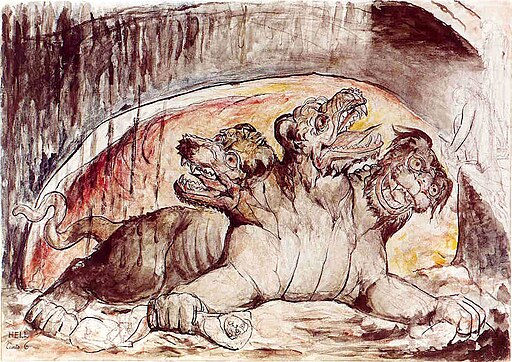
In the best dictionaries of Melville's day, the word "sops" itself calls out Cerberus. In Book 6 of The Aeneid, the Sybil of Cumae pacifies Cerberus with drugged honey-cake. Dryden translates:
Metaphorically then, Melville represents unscrupulous lawyers as dogs or Hounds of Hades. To sic litigious hell-hounds on Pierre would be the prudent way of exacting revenge. "We'll see you in court." However, as Pierre rightly calculates, his cousin Glendinning Stanly and Frederic Tartan are too noble for that course of action. Instead the cousins meet in the street, with tragic results you can read about in the Norton Critical Edition; the 1852 first edition; the 1949 Hendricks House edition; the 1971 Northwestern-Newberrry Edition; or Hershel Parker's Kraken Edition (Harper Collins, 1995), illustrated by Maurice Sendak.
Another bit of editorial misdirection occurs in Book 25 (Lucy, Isabel, and Pierre. Pierre at His Book. Enceladus) at pages 331-2 of the NCE. Context: Pierre is a struggling author, having fled to the Big City with his pretend-wife (and alleged half-sister) Isabel, along with their farmgirl-friend Delly. Out of the blue, Pierre's angelical ex-fiancée Lucy Tartan has joined them. Lucy's brother Fred and her rejected suitor Glen Stanly have attempted one intervention already, a failure. Since Fred and Glen vowed "swift retribution," Pierre has every reason to expect intolerable public shaming of some kind, either a violent physical attack or a lawsuit. Granting the noble "manliness" of his sworn enemies, Pierre figures correctly that legal action will not satisfy Fred and Glen as "gentlemen of spirit":
... so invincible is the natural, untamable, latent spirit of a courageous manliness in man, that though now socially educated for thousands of years in an arbitrary homage to the Law, as the one only appointed redress for every injured person; yet immemorially and universally, among all gentlemen of spirit, once to have uttered independent personal threats of personal vengeance against your foe, and then, after that, to fall back slinking into a court, and hire with sops a pack of yelping pettifoggers to fight the battle so valiantly proclaimed; this, on the surface, is ever deemed very decorous, and very prudent—a most wise second thought; but, at bottom, a miserably ignoble thing.
https://books.google.com/books?id=JXK7HN62EcQC&pg=PA457&lpg=PA457&dq#v=onepage&q&f=falseThe NCE editors rightly gloss Melville's word pettifoggers as "Inferior or disreputable lawyers" but mistakenly equate sops with "fools." In context, the plural noun sops can't mean "fools." Fops are fools, and saps, but sops are what you might pay lowlife lawyers with. Grose's 1785 Classical Dictionary of the Vulgar Tongue defines SOP as
"a bribe. A sop for Cerberus, a bribe for a porter, turnkey, or gaoler."
https://books.google.com/books?id=LXMKAAAAIAAJ&pg=RA18-PA7&dq#v=onepage&q&f=falseIn a word, sop means bribe. Literally a piece of bread soaked in liquor, sop by extension may designate "anything given to pacify" according to Samuel Johnson's Dictionary of the English Language:
"SOP, sop, n. s. what is sopped; any thing steeped in liquor, commonly to be eaten; any thing given to pacify, from the sop given to Cerberus."Webster likewise invokes Cerberus, the monstrous three-headed dog that guards Hades:
SOP, n.
... Any thing given to pacify; so called from the sop given to Cerberus, in mythology.
--A Dictionary of the English Language Volume 2 (London, 1832).

In the best dictionaries of Melville's day, the word "sops" itself calls out Cerberus. In Book 6 of The Aeneid, the Sybil of Cumae pacifies Cerberus with drugged honey-cake. Dryden translates:
The prudent Sibyl had before prepar'dIn Pierre, Melville extends the allusion to Cerberus with an image of hungry curs, seemingly primed for attack. Literally a team of legal hacks, Melville's "pettifoggers" are depicted in figurative language as an aggressive "pack" of "yelping" animals--paid off like Virgil's Cerberus, in "sops." Signifying, in this context, bribes.
A sop, in honey steep'd, to charm the guard;
Which, mix'd with pow'rful drugs, she cast before
His greedy grinning jaws, just op'd to roar.
With three enormous mouths he gapes; and straight,
With hunger press'd, devours the pleasing bait.
Metaphorically then, Melville represents unscrupulous lawyers as dogs or Hounds of Hades. To sic litigious hell-hounds on Pierre would be the prudent way of exacting revenge. "We'll see you in court." However, as Pierre rightly calculates, his cousin Glendinning Stanly and Frederic Tartan are too noble for that course of action. Instead the cousins meet in the street, with tragic results you can read about in the Norton Critical Edition; the 1852 first edition; the 1949 Hendricks House edition; the 1971 Northwestern-Newberrry Edition; or Hershel Parker's Kraken Edition (Harper Collins, 1995), illustrated by Maurice Sendak.
Related posts
- Clams, boats, and footnotes in Pierre
https://melvilliana.blogspot.com/2019/05/clams-boats-and-footnotes-in-pierre.html
- Where Pierre shot Glen Stanly
https://melvilliana.blogspot.com/2020/05/where-pierre-shot-glen-stanly.html
- Melville's illy
https://melvilliana.blogspot.com/2019/01/melvilles-illy.html