Showing posts with label Charles F Briggs. Show all posts

Saturday, August 28, 2021

Phantom Yankee found

 "Typee" proved the most successful hit in book-making, since the publication of Stephens's first book of Travels. An English critic said it was "Yankee all over." By which he meant that it was entirely new, fresh, and devil-may-care; free from the dry, stale, and wearisome conventionalities of trained literature. It was a book of itself, not made up of pickings from other books, but from the personal observations and individualities of the author.... 
--Charles Frederick Briggs, review of Omoo in the National Anti-Slavery Standard for May 27, 1847.

A footnote in the third Norton Critical Edition of Moby-Dick calls attention to the quoted expression "Yankee all over" in remarks by "B." on Melville's first two books in the New York National Anti-Slavery Standard. As first identified by Robert K. Wallace in Douglass and Melville: Anchored Together in Neighborly Style (Spinner, 2005), this "B." who then reviewed books for the Anti-Slavery Standard was Charles Frederick Briggs. 
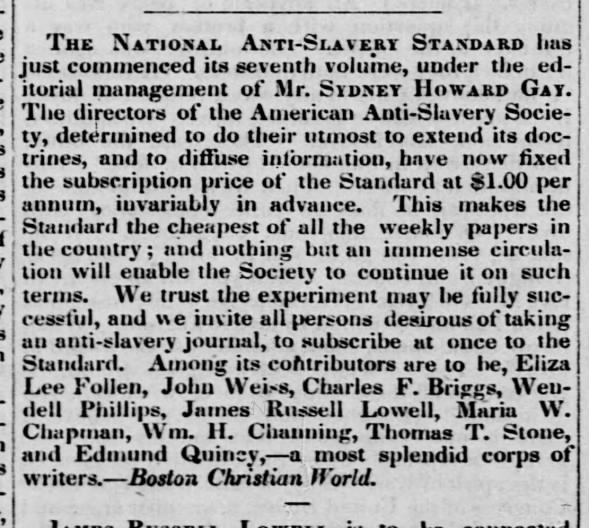
03 Jul 1846, Fri The Liberator (Boston, Massachusetts) Newspapers.com
According to Briggs, an unnamed "English critic" had characterized Typee as "Yankee all over," meaning "new, fresh, and devil-may-care." Norton editor Hershel Parker thinks "this reference may yet be discovered" and so it will be, herein. 

In the review-hunting game, searching for stray quotes most definitely can yield new, that is, previously unidentified or unlocated reviews from whence they came. Blurb-searching works. The trick is to search for different combinations of key terms in the blurb or stray quote. I call it the Mrs. Bennett play, in honor of the “luckiest and most ingenious benefactress” of MOBY-DICK as Doubloon (W. W. Norton, 1970). As acknowledged by the editors of that landmark compendium of criticism on Melville’s masterpiece, the enterprising Mrs. David Bennett (aka Lee Bennett) located a marvelous and previously unknown review of The Whale in the London Morning Advertiser (October 24, 1851) after seeing it quoted in an advertisement in the Morning Post (14 November 1851). The Morning Post ad that Mrs. Bennett found at the British Library quoted six different reviews of The Whale. Of those six, two were then unknown to Melville scholars. Mrs. Bennett found the one in the Morning Advertiser and kindly left the other for me to find, fifty years later. As announced on Melvilliana, the other unidentified quote came from a paragraph of early and uniquely colorful praise in the London Globe and Traveller
and before that, in the London Morning Herald
Here on Melvilliana, the Mrs. Bennett play also resulted in discovery of a longer, highly favorable and previously unknown review of The Whale in the London Morning Herald. 

Back to our missing Yank. Outside of the National Anti-Slavery Standard, "Yankee all over" does not appear in any review of Typee, British or American. To find this one you have to do a reverse-Mrs-Bennett, by re-examining previously known reviews. No Yankee there either. What to do? Leave him alone and focus on the "all over" part. 

Voilà! Melville's style in Typee is "New World all over" according to the London Athenaeum. Most likely, Briggs substituted "Yankee" for "New World," either misquoting from memory or paraphrasing. In context, either term means "American." The London critic's view of Typee as "New World all over" was prominently featured in Harper & Brothers ads for Omoo, for example this one in the New York Literary World on April 17, 1846:
A book full of fresh and richly coloured matter. Mr. Melville's manner is New World all over.

Briggs could have found Typee described as "New World all over" in numerous places:

  1. The original review of Typee in the London Athenaeum. 


  2. Reprints of the London review in the New York Anglo American on April 4, 1846; and  Littell's Living Age volume 9 on April 11, 1846. 

  3. With excerpts of favorable "NOTICES OF THE ENGLISH PRESS" bound into copies of Omoo (1847). 

    https://hdl.handle.net/2027/uc2.ark:/13960/t3kw57w1s?urlappend=%3Bseq=407 

  4. Harper & Brothers advertisements in New York newspapers and journals.

Glossing the "epithet" New World as a synonym for American, the English critic referenced "Stephens, the foremost among American pilgrims." In the National Anti-Slavery Standard, Charles F. Briggs similarly compares Melville's debut to that of John Lloyd Stephens, calling Typee "the most successful hit in book-making, since the publication of Stephens's first book of Travels." 

Stephens's first big hit was the 1837 book Incidents of Travel in Egypt, Arabia Petraea, and the Holy Land

BY AN AMERICAN.

Wednesday, April 9, 2014

Briggs wanted Melville's portrait for Putnam's

If somebody gave me $35,000 right now I would happily grab this 1854 Melville letter offered at Biblioctopus. 


In the 1993 Northwestern-Newberry Edition of Melville's Correspondence, Lynn Horth gives the necessary context (apparently Melville's submission of the rejected magazine piece,"The Two Temples"), without however listing this particular item. Where has it been all these years?  Aha, I see John Gretchko wondered the same thing back in November 2010, in a post to the Google Group Ishmailites, back in November 2010.

Now, Biblioctopus gives a delightfully juicy description of the letter which alas! tries hard to hype its significance as a witness to "the critical turning point in Melville's career." That stuff about Melville's "departure from literature" and dying in poverty is legendary, of course, but stuff. Hey it's a genuine Melville letter written from Arrowhead with highly pertinent content from his career as a magazinist. More than enough significance for me!  (As soon as my unknown benefactor sends me that 35 grand.)

It looks like they might need help reading the handwriting of Charles F. Briggs at the top of the page. Biblioctopus gives the first part of Briggs's note, covering the rest with ellipses: 
“Melville wants the MS sent to his brother Allan. I have written to him and I think you had better write to him… B.”
Over on Booktryst, Stephen J. Gertz offered a more complete transcription:
“Melville wants the MS sent to his brother Allan. I have written to him and I think you had better write to him, and get […] to […] Curtis. It will be the best one for his public and the Maga. B.”
 Here's what I see from the image online: 
“Melville wants the Ms. sent to his brother Allan. I have written to him, and, I think you had better write to him, and get his portrait to follow Curtis's [or Curtis ' ?]. It will be the best one for the public and the Maga. B.”
Briggs wanted Melville's portrait to appear in Putnam's Magazine, after that of George W. Curtis. As prompted by Briggs, George P. Putnam himself duly wrote Melville on May 13, 1854:
We wish very much to have your head as one of our series of portraits. Curtis will be in the July No. Have you not some drawing or daguerreotype that you can lend us? -- Or can you oblige us by having a daguerreotype taken in Pittsfield & let us know the cost, which will be remitted at once? (Letters Received, Correspondence 637)
Do send us your portrait for the magazine--and, oh yes, "We hope you will give us some more of your good things." What a lovely rejection!

Well we also know Melville preferred not to oblige Putnam with his head. Something more might be made of that. Especially considering the earlier wrangling with Evert Duyckinck, over the same request, leading to that great line in Pierre; Or, The Ambiguities (New York: Harper & Brothers, 1852): 
"To the devil with you and your daguerreotype!"  
But to Putnam, Melville politely excused himself as just a country farmer:
"About the Daguerreotype, I don't know a good artist in this rural neighborhood."
(Letter to George P. Putnam, 16 May 1854, Correspondence 261)