Showing posts with label Dante. Show all posts

Monday, April 20, 2026

Polysensuum in MARDI and the PENNY CYCLOPAEDIA


Tuesday, October 28, 2025

Melville's "Dilletante" reader of Dante in PIERRE

Likely inspired by negative mentions of "literary Dilettanti" and "Dilletantism" in the preface to John Aitken Carlyle's prose translation of Dante's INFERNO 

Illustration of Dante's Inferno Canto 6 by Giovanni Stradano, 1587.
Stradanus aka Jan van der Straet, Public Domain, via Wikimedia Commons
In Book IX of Pierre; Or, The Ambiguities (1852) Herman Melville alludes to "horrible allegorical meanings" in Dante's Inferno as something beyond the ken of a nameless hypothetical reader, clueless but happy, whom Melville or his narrator labels "the Dilletante in Literature": 
"Fortunately for the felicity of the Dilletante in Literature, the horrible allegorical meanings of the Inferno, lie not on the surface...."
In a similar contrast between naive and knowing readers, the "deeper significances" of Hamlet are said to elude "all but the rarest adepts." Melville fans will recognize in this section of Pierre a version of the contrast in Hawthorne and His Mosses between the "superficial skimmer" and a more discerning "eagle-eyed reader." In the "Mosses" essay, as here in Pierre, the thing supposedly missed by insufficiently attentive readers concerns the problem of evil. The "mystery of iniquity" is a major theme of Melville's later writings, too, especially his epic religious poem Clarel and the uncompleted novella, Billy Budd. 

The terrible truth, as Melville understands it, is the presence of evil in the very fabric of creation, which makes sin and misery ineradicable as well as universal. In this view, only by way of the darkest visions and doctrines--of Original Sin as conceived by Calvinists, of the creator as malicious demiurge according to Gnostics, of the Hindu goddess Kali, consort of Shiva the destroyer--may the truth about the elemental nature of evil be apprehended.

Otherwise, with respect to Dante's Inferno one would think the literal content is bad enough. It's literally Hell. What could possibly be more disturbing or "horrible" than graphic depictions of torture inflicted forever on the lost souls of human beings in nine successively worse Circles of Hell? In the most horrifying scene of all (Dante's Inferno Cantos 32-23), the shade of traitor Count Ugolino gnaws on the back of his betrayer's skull while both souls are hemmed in the same ice-hole. You have to wonder what business a dilettante would have with Dante in the first place. 

Tracing the influence of Dante in Mardi and Pierre, Dennis Berthold in American Risorgimento: Herman Melville and the Cultural Politics of Italy (Ohio State University Press, 2009) finds in Pierre a satire of the naive hero's "literary pretensions" and, more broadly, of the 19th century "Dante revival" in America, "which undoubtedly had its share of dilettantes" (page 138). Here Berthold called attention to cultural resonances evoked by "the Dilletante in literature," but the focus in American Risorgimento on Henry F. Cary's verse translation as Melville's source-text did not allow for consideration of any more precise borrowing. No form of dilettante occurs anywhere in Cary's Dante. More context, including previously unidentified textual prompts for Melville's dismissive handling of the literary "Dilletante," may help to explicate the main idea of this interesting passage.

Henry A. Murray in the 1949 Hendricks House edition at page 198 printed "Dilettante," correcting Melville's nonstandard spelling "Dilletante." Dr. Murray made no further editorial comment, except to observe in a professional way how deep-seated hostilities against the world may be interpreted as psychological "projections" by either the author or his fictional hero, or both (Introduction, xciii). Ignoring the emended form "Dilettante" adopted by Murray and others before him (in, for example, the 1923 Constable edition) the 1971 Northwestern-Newberry volume edited by Harrison Hayford, Hershel Parker, and G. Thomas Tanselle retained Melville's spelling "Dilletante" as an acceptable variant. 

Dilettante means "An admirer or lover of the fine arts" according to Noah Webster, An American Dictionary of the English Language (Harper & Brothers, 1848) page 295. The word occurs infrequently in Melville's writings. In the second volume of Mardi: And a Voyage Thitherthe antiquary "Oh-Oh" is comically depicted as a “dilettante in things old and marvelous.” Oh-Oh's name reflects his irrepressible enthusiasm for the arts, and artifacts. As representative dilettante, however, his passion for great rarities is that of a collector who is merely a collector, having little knowledge or even interest in their real meanings, or expressions of truth and beauty. Keeping in character, he overvalues numerous pieces of trashy ephemera, but lets Babbalanja have a priceless manuscript on how to achieve "A Happy Life" (by the Polynesian Seneca, hence loaded with stoic wisdom) for nothing. 

To much the same effect, Melville's 1857-8 lecture on "Statues in Rome" began by contrasting the "technical" expertise of "the dilettante" with deeper, more personal and penetrating responses to great works of art:
"True, the dilettante may employ his technical terms; but ignorance of these prevents not due feeling for Art, in any mind naturally alive to beauty or grandeur."  
-- quoted here from the reconstructed text by Merton M. Sealts, Jr. in The Piazza Tales, and Other Prose Pieces, edited by Harrison Hayford, Alma A. MacDougall, G. Thomas Tanselle, and others (Northwestern University Press, 1987) page 398. 
Dilettante here is employed in the sense of "acknowledged expert," rather than "amateur" or "dabbler." Alternatively, "professional critic or connoisseur" as reported in several 19th century newspapers. A couple of published reviews have Melville using the plural form, dilettanti, still meaning something like "Art experts." 

In Mardi, Melville's comic portrayal of Oh-Oh as "an extraordinary old antiquary" draws on negative associations of dilettante with superficiality, frivolity, and indifference to marks of deep, enduring value. In Pierre Book IX the hypothetical "Dilletante" has an equally shallow understanding of great world literature, according to the narrator. Likely prompts for Melville's invocation of the literary "Dilletante" in Pierre may be found in the preface to a book Melville definitely owned or had access to, Dante’s Divine Comedy: The Inferno. A literal prose translation (New York: Harper & Brothers, 1849) by Dr. John Aitken Carlyle, younger brother of Thomas Carlyle. Digital versions are accessible online courtesy of HathiTrust Digital Library; and also via the Internet Archive: 
John A. Carlyle’s prose translation of Dante’s Divine Comedy: The Inferno is Sealts Number 173a in the searchable “Catalog of Books and Documents Owned, Borrowed and Consulted by Herman Melville” at Melville’s Marginalia OnlineAs there noted, we know Melville read at least part of it because he quoted “John Carlyle‘s version” of Canto 3, line 26 (“And sounds of hands among them”) in one of his annotations to Henry Francis Cary’s verse translation (Sealts Number 174). If Melville's ironic slight of "the Dilletante in literature" in Pierre were at all inspired by mentions of "literary Dilettanti" and "dilettantism" in Carlyle's preface, then Melville must have had either the 1849 first edition (English, by Chapman and Hall in London? or American, by the Harpers in New York?) or the 1851 reissue of Dante's Divine Comedy: The Inferno. A literal prose translation by John A. Carlyle, M.D. As in Melville's usage "Dilletante," occurrences of "Dilettanti" and "Dilettantism" capitalize the initial "D" in both the English and American editions. However, only Harper & Brothers give the spelling "Dilletantism" (page xxii). The closer parallel to Melville's spelling of the base word "Dilletante" would seem to favor the American edition as the one Melville consulted. 

Here below are four passages from the preface to John A. Carlyle's prose translation that individually or collectively might have influenced Melville's conception of "the Dilletante in Literature." Each example features a form of the base word dilettante

  1. "In the year 1831, being called to Italy by other duties, I first studied the Divina Commedia, under guidance of the most noted literary Dilettanti of Rome and other places. I heard them read it with wondrous gestures and declamation, and talk of it in the usual superlatives." -- John A. Carlyle, Preface to Dante's Divine Comedy: The Inferno, page iv

  2. "During the seven years which followed, I often studied it again, at leisure hours, along with the other works of Dante; and got intimately acquainted with various Italians of different ranks, who, without making any pretensions to literature, or troubling themselves with conflicting commentaries, knew all the best passages, and would recite them in a plain, sober, quiet tone—now rapid, now slow, but always with real warmth—like people who felt the meaning, and were sure of its effect. To them the Divina Commedia had become a kind of Bible, and given expression and expansion to what was highest in their minds. The difference between them and the Dilettanti seemed infinite, and was all the more impressive from the gradual way in which it had been remarked." Carlyle, Preface, v

  3. "But to return. Having thus acquired a clearer idea of the Poem, and got fairly beneath the thick encumbrances of Dilettantism and other encumbrances, which hide its meaning, I began to be convinced that the quantity of commentary, necessary to make the substance and texture of it intelligible, might be compressed into a much smaller space than had been anticipated." Carlyle, Preface, vii


  4. It is impossible to mention all the other commentaries of the 18th century. That of Lombardi, which appeared in 1791, is such as could be written by the honest effort of a whole life, amid the "dark wood" of Dilletantism produced by a host of idle writers; and one feels a real respect for the worthy Friar, though at times he is surprisingly naïve, or perhaps dull.... Most of the old commentaries on Dante are written with a kind of large complacency, and genuine though long-winded enthusiasm, which makes them very interesting at first sight ; but on closer inspection, they are found to contain a surprising quantity of worn-out rubbish, and extremely little real information.

    Preface, "Comments and Translations" pages xxi - xxii. As noted above, only the American edition by Harper & Brothers gives the spelling "Dilletantism" here. London editions in the same place (page xxx) make it "Dilettantism." 
The context in John A. Carlyle's preface could hardly be more relevant to Book IX of Pierre. Dr. Carlyle's concern with the problem of rightly interpreting Dante is nearly identical with that of Melville, or Melville's narrator. To be sure, Carlyle's "Dilettanti" do not come across as mere amateurs or dabblers of the type often implicated in usages that rely on negative connotations of the term dilettante. Rather, as Carlyle describes them, "literary Dilettanti" for the most part are Dante Experts of high repute. Their deficiency lies in attending more to boring minutia than meaning. Or in their enthusiasm for comparatively superficial matters of form, technique, and special poetic effects. According to Carlyle, readers with a deeper appreciation of Dante have zero literary expertise or "pretensions to literature." Along with a shared seriousness, the best readers of Dante take the Divine Comedy for "a kind of Bible." Such readers unaffectedly treasure Dante's great work as an expression of the highest classical values of truth, goodness, and beauty. 

With Dr. Carlyle, Melville in full truth-seeking mode presumably would prefer the interpretations of grounded, reality-based readers on the lookout for meaning and wisdom, and hopefully believing in the promise of salvation. Unfortunately, no fine insights into the true meaning of Dante avail the tragic hero of Melville's novel. Poor Pierre! He can't avoid his fate, once challenged to do right by Isabel Banford, allegedly his half-sister. Melville (as Berthold points out) withholds from his fictional hero any hope or even knowledge of Dante's journey through Purgatory to Paradise. Crusading for justice to Isabel, Pierre will abandon the Beatrice he already has in Lucy Tartan, his blonde-haired and blue-eyed sweetheart. (Lucy rebounds and heroically rejoins Pierre in the second half of Melville's novel, too late to save Pierre, his fake wife Isabel, or herself.) Back in Book IX, for now betrothed to Lucy but stuck between Dante's Hell and Shakespeare's Hamlet, Pierre experiences a psychic meltdown that leaves him "dabbling in the vomit of his loathed identity." 

More extensive debts to Dante in Pierre have been examined by G. Giovanni

 Giovannini, G. “Melville’s Pierre and Dante’s Inferno.” PMLA, vol. 64, no. 1, 1949, pp. 70–78. JSTOR, https://doi.org/10.2307/459670. Accessed 28 Oct. 2025.  

Giovannini, G. “Melville and Dante.” PMLA, vol. 65, no. 2, 1950, pp. 329–329. JSTOR, https://doi.org/10.2307/45947.

and Nathalia Wright 

Wright, Nathalia. “Pierre: Herman Melville’s Inferno.” American Literature, vol. 32, no. 2, 1960, pp. 167–81. JSTOR, https://doi.org/10.2307/2922675. 

G. Giovanni most helpfully connects the problem of interpreting Dante's profounder "allegorical meanings," as raised by the narrator in Book IX, with the "melodramatic violence" displayed by Pierre when "trampling on the torn pages of the Inferno." As Giovanni shows, the hero's behavioral and mental health crisis is precipitated by his new awareness of evil, beginning with the sins of his own father lately disclosed through Isabel's claim of shared paternity. 

Pierre's frustration on the sudden discovery of moral disorder is here roughly equated with Hamlet's; its ultimate source is the universalization of his father's moral lapse through "the horrible allegorical meanings of the Inferno." Limited in his experiential knowledge of the world, Pierre finds the form and generic significance of his particular perception of evil in the Inferno allegorically construed as a picture of life itself. The Inferno initiates Pierre into "that darker though truer aspect of things. 
"Melville's Pierre and Dante's Inferno," pages 75-76
... These references to the Inferno in first half of the novel, from the time when Pierre first sees Isabel to his pretended marriage and departure with her for the city, are closely coordinated with Pierre's development towards a realization of the ubiquity and universality of evil. Melville conceives Pierre's development within the sequence of his confrontations of the Inferno, and sees the poem metaphorically as an index of a naive idealism resentful of the existence of evil."  
"Melville's Pierre and Dante's Inferno," page 77

The effect of reading Dante and Shakespeare on poor Pierre, augmenting his new personal knowledge of worldly wickedness, is well summarized by Giovanni:

"...The fragments from the poets bring into focus a reality larger than Pierre's particular experience and central to the tragedy: evil is an integral part of existence, and the attempt to eradicate it must lead to tragic failure." 
"Melville's Pierre and Dante's Inferno," page 76

In Herman Melville: A Biography Volume 2, 1851-1891 (Johns Hopkins University Press, 2002) at page 435, Hershel Parker made reference to the "variant rendering of a line by John Carlyle" that Melville inscribed in his volume of Cary's Dante. Parker added, "in this case there is no other evidence that he had further knowledge of Carlyle's translation." Now, more than twenty years on, I am glad to offer multiple mentions of "Dilettanti" and "Dilettantism" or (as spelled on page xxii in the American edition by Harper & Brothers) "Dilletantism" as pretty good evidence that Melville read attentively in John Aitken Carlyle's preface--some time before the Harpers brought out Pierre in the summer of 1852. 

Worcester MA Spy - August 5, 1852

Wednesday, October 8, 2025

As a sailor might say

As a sailor might say by Scott Norsworthy

DRAGOONED: Writing, talking, and rewriting like Herman Melville in "Scenes Beyond the Western Border" (1851-1853). No. 3.

Read on Substack 


Monday, May 25, 2020

Sops for hell-hounds in PIERRE

Aeneas and the Sibyl in the Underworld
Arnold Houbraken (1660–1719) via The Metropolitan Museum of Art

This post aims to help readers achieve a better grasp of metaphorical language in Herman Melville's seventh book, Pierre; Or, The Ambiguities (New York, 1852). The need for such help may be seen in a few misleading footnotes for the 2017 Norton Critical Edition, edited by Robert S. Levine and Cindy Weinstein, that occasionally miss the boat, so to speak. Students, take heart. Faulty footnotes like the one on steamers as clams, discussed in a previous post, show that even highly trained professionals have trouble understanding what Melville wrote.

Another bit of editorial misdirection occurs in Book 25 (Lucy, Isabel, and Pierre. Pierre at His Book. Enceladus) at pages 331-2 of the NCE. Context: Pierre is a struggling author, having fled to the Big City with his pretend-wife (and alleged half-sister) Isabel, along with their farmgirl-friend Delly. Out of the blue, Pierre's angelical ex-fiancée Lucy Tartan has joined them. Lucy's brother Fred and her rejected suitor Glen Stanly have attempted one intervention already, a failure. Since Fred and Glen vowed "swift retribution," Pierre has every reason to expect intolerable public shaming of some kind, either a violent physical attack or a lawsuit. Granting the noble "manliness" of his sworn enemies, Pierre figures correctly that legal action will not satisfy Fred and Glen as "gentlemen of spirit":
... so invincible is the natural, untamable, latent spirit of a courageous manliness in man, that though now socially educated for thousands of years in an arbitrary homage to the Law, as the one only appointed redress for every injured person; yet immemorially and universally, among all gentlemen of spirit, once to have uttered independent personal threats of personal vengeance against your foe, and then, after that, to fall back slinking into a court, and hire with sops a pack of yelping pettifoggers to fight the battle so valiantly proclaimed; this, on the surface, is ever deemed very decorous, and very prudent—a most wise second thought; but, at bottom, a miserably ignoble thing.
 https://books.google.com/books?id=JXK7HN62EcQC&pg=PA457&lpg=PA457&dq#v=onepage&q&f=false
The NCE editors rightly gloss Melville's word pettifoggers as "Inferior or disreputable lawyers" but mistakenly equate sops with "fools." In context, the plural noun sops can't mean "fools." Fops are fools, and saps, but sops are what you might pay lowlife lawyers with. Grose's 1785 Classical Dictionary of the Vulgar Tongue defines SOP as
"a bribe. A sop for Cerberus, a bribe for a porter, turnkey, or gaoler."
https://books.google.com/books?id=LXMKAAAAIAAJ&pg=RA18-PA7&dq#v=onepage&q&f=false
In a word, sop means bribe. Literally a piece of bread soaked in liquor, sop by extension may designate "anything given to pacify" according to Samuel Johnson's Dictionary of the English Language:
"SOP, sop, n. s. what is sopped; any thing steeped in liquor, commonly to be eaten; any thing given to pacify, from the sop given to Cerberus."
Webster likewise invokes Cerberus, the monstrous three-headed dog that guards Hades:
 SOP, n.
... Any thing given to pacify; so called from the sop given to Cerberus, in mythology.
--A Dictionary of the English Language Volume 2 (London, 1832). 
Cerberus-Blake

In the best dictionaries of Melville's day, the word "sops" itself calls out Cerberus. In Book 6 of The Aeneid, the Sybil of Cumae pacifies Cerberus with drugged honey-cake. Dryden translates:
The prudent Sibyl had before prepar'd
A sop, in honey steep'd, to charm the guard;
Which, mix'd with pow'rful drugs, she cast before
His greedy grinning jaws, just op'd to roar.
With three enormous mouths he gapes; and straight,
With hunger press'd, devours the pleasing bait.
In Pierre, Melville extends the allusion to Cerberus with an image of hungry curs, seemingly primed for attack. Literally a team of legal hacks, Melville's "pettifoggers" are depicted in figurative language as an aggressive "pack" of "yelping" animals--paid off like Virgil's Cerberus, in "sops." Signifying, in this context, bribes.

Metaphorically then, Melville represents unscrupulous lawyers as dogs or Hounds of Hades. To sic litigious hell-hounds on Pierre would be the prudent way of exacting revenge. "We'll see you in court." However, as Pierre rightly calculates, his cousin Glendinning Stanly and Frederic Tartan are too noble for that course of action. Instead the cousins meet in the street, with tragic results you can read about in the Norton Critical Edition; the 1852 first edition; the 1949 Hendricks House edition; the 1971 Northwestern-Newberrry Edition; or Hershel Parker's Kraken Edition (Harper Collins, 1995), illustrated by Maurice Sendak.

Related posts

  • Melville's illy
    https://melvilliana.blogspot.com/2019/01/melvilles-illy.html 

Wednesday, August 15, 2018

To Daniel Shepherd

TO DANIEL SHEPHERD

Come, Shepherd, come and visit me:
Come, we'll make it A[r]cady:
Come, if but for charity.
Sure, with such a pastoral name,
Thee the city should not claim.
Come, then, Shepherd, come away,
Thy sheep in bordering pastures stray.
Come, Daniel, come and visit me:
I'm lost in many a quandary:
I've dreamed, like Bab’lon’s Majesty:
Prophet, come expound for me. —
I dreamed I saw a laurel grove,
Claimed for his by the bird of love,
Who, elate with such dominion,
Oft cuffed the boughs with haughty pinion.
Indignantly the trees complain,
Accusing his afflictive reign.
Their plaints the chivalry excite
Of chanticleers, a plucky host:
They battle with the bird of light.
Beaten, he wings his northward flight,
No more his laurel realm to boast,
Where now, to crow, the cocks alight,
And — break down all the branches quite!
Such a weight of friendship pure
The grateful trees could not endure.
This dream, it still disturbeth me:
Seer, foreshows it Italy?
But other visions stir my head;
No poet-problems, fancy-fed —
Domestic prose of board and bed.
I marvel oft how guest unwined
Will to this farm-house be resigned.
Not a pint of ruby claret
     Cooleth in our cellar-bin;
And ripening in our sultry garret,
     Otard glows no flask within.
(Claret and otard here I name
Because each is your fav’rite flame:
Placed ’tween the two decanters, you,
Like Alexander, your dear charmers view,
And both so fair you find, you neither can eschew: —
That’s what they call an Alexandrine; }
Don’t you think it very damn’d fine?  }
— Brackets serve to fence this prattle,
Pound for episodic cattle. —
I said that me the Fates do cripple
In matter of a wholesome ‘tipple” —
Now, is it for oft cursing gold,
     For lucre vile,
The Hags do thus from me withhold
     Sweet Bacchus’ smile?
Smile, that like other smiles as mellow,
Not often greets Truth’s simple fellow: —
For why? Not his the magic dollar?
You should know, you Wall-Street scholar! —
Of Bourbon that is rather new
I brag a fat black bottle or two. —
Shepherd, is this such Mountain-Dew
As one might fitly offer you?
Yet if cold water will content ye
My word, of that ye shall have plenty.
Thanks to late floods, our spring, it brims, —
Will’t mind a crush * of goblet-rims?
I've told some doubts that sadly pose me:
Come then now straight resolve me.
Come, these matters sagely read,
Daniel, of the prophet breed.
Daniel Shepherd, come and rove —
     Freely rove the fairy dells;
The one the Housatonic clove,
     And that where genial friendship dwells.

Pittsfield July 6th 1859
 [--Herman Melville, as first published in Willard Thorp, Herman Melville: Representative Selections (American Book Company, 1938), pages 346-8.]
*The MS. may read “a crunch.” [Thorp's note.]
Where Thorp reads "bird of love," the 1993 Northwestern-Newberry Edition of Melville's Correspondence edited by Lynn Horth has "bird of Jove." Of old the Roman Eagle, as in Dante:
... Never fire,
With so swift motion, forth a stormy cloud
Leap'd downward from the welkin's furthest bound,
As I beheld the bird of Jove descend
Down through the tree; and, as he rush'd, the rind
Disparting crush beneath him; buds much more,
And leaflets.
--Purgatory Canto 32, trans. Henry Francis Cary (not marked in Melville's copy of The Vision, accessible via Melville's Marginalia Online).
But here in the poem "To Daniel Shepherd," Melville's "bird of Jove" signifies the Austrian Empire with its adopted symbol of the double-headed eagle, as as Dennis Berthold points out in American Risorgimento (Columbus, OH: Ohio State University Press, 2009), page 190.


According to the memorial at Find A Grave, Daniel Shepherd (1820-1870) was born on July 22, 1820 and died on the same day and month fifty years later. Thorp says that Shepherd returned to Saratoga Springs, New York in 1861. Confirmed, along with the coincidence of Shepherd's death on "his fiftieth birthday," by the obituary published in The Saratogian on Thursday, July 28, 1870.

The Saratogian (Saratoga Springs, New York) - July 28, 1870

Death of Daniel Shepherd.

It is our sad duty to record the death of DANIEL SHEPHERD, Esq., of this village, which occurred on Friday morning—his fiftieth birthday. Mr. Shepherd was a native of this county, a son of Hon. William Shepherd of Clifton Park, and inherited superior ability. He was a graduate of Union College, and distinguished for his literary attainments. After his graduation he came to this village, and studied law with Hon. W. A. Beach, and subsequently became connected with him in the practice of his profession. About this time he married Miss Mary R. White, a step-daughter of Dr. John Clarke, of the Congress Spring, and soon after formed a co-partnership with Hon. Chesseldon Ellis, of Waterford, at the close of that gentleman's career in Congress, and they removed to New York to engage in the legal profession. He resided in New York, continuing his legal practice, something less than fifteen years, and returned to Saratoga in the spring of 1861, since which time he has lived among us.

Mr. Shepherd was no ordinary man. His abilities were of a high order. He was a fine scholar, and a learned and able lawyer; but his tastes and culture were more distinctly literary than professional, and his energies were largely devoted to literary work. He was a successful writer of newspaper stories, and achieved considerable distinction as the author of a work entitled "Saratoga; a tale of 1787," in which he delineated frontier life with a masterly hand. He possessed a fine personal presence, was eminently social and genial in his nature, and with his bright and polished intellect he combined advantages which few young men possess in so high degree. But unfortunately, while in New York, he embarked in business enterprises that failed to realize his expectations, and involved him in difficulties, which proved too much for his sensitive nature, exerting a depressing influence upon his mind, and he has been almost entirely withdrawn from active life since his return to Saratoga. He has left a wife and four children (three sons and a daughter,) and a large number of relatives and personal friends, to mourn his death.
--The Saratogian (Saratoga Springs, New York), July 28, 1870 via Fulton History.
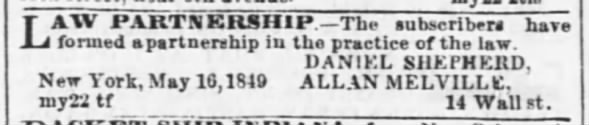
The Harvard copy of Saratoga: A Story of 1787 by Allan Melville's law partner and Herman's friend Daniel Shepherd is accessible online via Google Books:
  • https://books.google.com/books?id=s1wUAAAAYAAJ
This particular volume was inscribed by the author to S. D. Tillman. Also available online courtesy of HathiTrust Digital Library.

Another Google-digitized volume, this one evidently from Stanford, is accessible via The Internet Archive: