Showing posts with label London. Show all posts

Tuesday, July 16, 2019

Ebenezer Knight, 1811-1853

The First Voyage by H. C. K.
The Child's Paper - March 1854
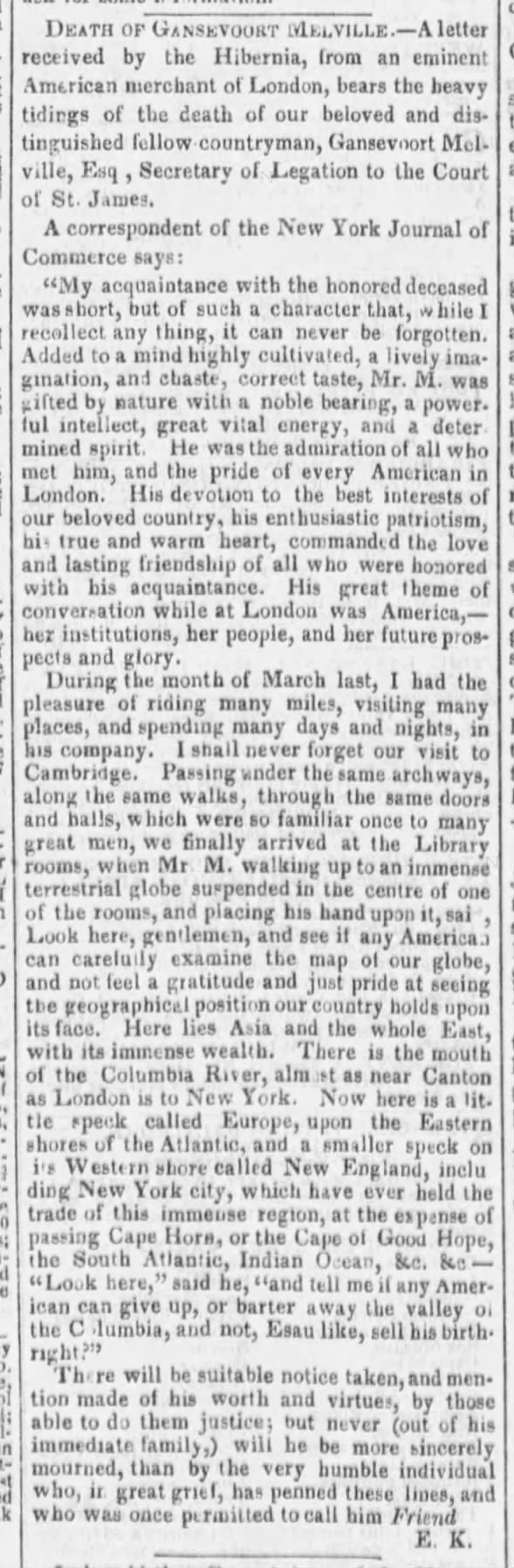
The 3rd Norton Critical Edition of Moby-Dick, edited by Hershel Parker, excerpts the vivid 1846 reminiscence of Gansevoort Melville by Captain E. Knight (page 464). Captain Knight had accompanied Gansevoort with two others on a visit to Cambridge, England. The entry for Saturday, March 14th in Gansevoort's 1846 London Journal, edited by Hershel Parker (The New York Public Library, 1966), records their trip by 2nd class rail which included a tour of Trinity College Library. No mention there of any globe, large or small. According to Knight, however, Gansevoort made dramatic use of "an immense terrestrial globe suspended in the centre of one of the rooms," invoking the biblical story of Jacob and Esau to claim Oregon and California as America's "birthright."

Reminiscence of Gansevoort Melville (Herman's older brother) in Cambridge, England.Reminiscence of Gansevoort Melville (Herman's older brother) in Cambridge, England. Fri, Jun 5, 1846 – 1 · The Baltimore Sun (Baltimore, Maryland) · Newspapers.com
DEATH OF GANSEVOORT MELVILLE.-- A letter received by the Hibernia, from an eminent American merchant of London, bears the heavy tidings of the death of our beloved and distinguished fellow countryman, Gansevoort Melville, Esq, Secretary of Legation to the Court of St. James.

A correspondent of the New York Journal of Commerce says :

"My acquaintance with the honored deceased was short, but of such a character that, while I recollect any thing, it can never be forgotten. Added to a mind highly cultivated, a lively imagination, and chaste, correct taste, Mr. M. was gifted by nature with a noble bearing, a powerful intellect, great vital energy, and a determined spirit. He was the admiration of all who met him, and the pride of every American in London. His devotion to the best interests of our beloved country, his enthusiastic patriotism, his true and warm heart, commanded the love and lasting friendship of all who were honored with his acquaintance. His great theme of conversation while at London was America,-- her institutions, her people, and her future prospects and glory. 
During the month of March last, I had the pleasure of riding many miles, visiting many places, and spending many days and nights, in his company. I shall never forget our visit to Cambridge. Passing under the same archways, along the same walks, through the same doors and halls, which were so familiar once to many great men, we finally arrived at the Library rooms, when Mr M. walking up to an immense terrestrial globe suspended in the centre of one of the rooms, and placing his hand upon it, said, Look here, gentlemen, and see if any American can carefully examine the map of our globe, and not feel a gratitude and just pride at seeing the geographical position our country holds upon its face. Here lies Asia and the whole East, with its immense wealth. There is the mouth of the Columbia River, almost as near Canton as London is to New York. Now here is a little speck called Europe, upon the Eastern shores of the Atlantic, and a smaller speck on its Western shore called New England, including New York city, which have ever held the trade of this immense region, at the expense of passing Cape Horn, or the Cape of Good Hope, the South Atlantic, Indian Ocean, &c. &c-- "Look here," said he, "and tell me if any American can give up, or barter away the valley of the Columbia, and not, Esau like, sell his birthright?" 
There will be suitable notice taken, and mention made of his worth and virtues, by those able to do them justice; but never (out of his immediate family,) will he be more sincerely mourned, than by the very humble individual who, in great grief, has penned these lines, and who was once permitted to call him Friend
E. K.
Originally signed "E. K." and published in the New York Journal of Commerce, Knight's tribute to Herman Melville's older brother Gansevoort was reprinted in the Albany Argus on June 4, 1846; and the day after that in the Baltimore Sun. A condensed version appeared in the Boston Evening Transcript on June 5, 1846.

Encountering the Baltimore Sun version, I wondered about that "immense terrestrial globe" (where is it now?) and Captain Knight's first name (E for Earnest? Edward? Evert?). I don't know about the globe, but Captain E. Knight is Ebenezer Knight,1811-1853. Sometimes spelled Ebinezer. Aka "Eben" Knight according to the online memorial at Find A Grave.
  •  https://www.findagrave.com/memorial/151674190
Ebenezer Knight was born on July 2, 1811 in Corinth, Vermont to Hannah Hale and Joseph Knight. As published in the Columbian Centinel on June 27, 1835, Captain Ebenezer Knight married Anzolette Hussey (1812-1895) in Portsmouth, NH.

Anzolette Hussey's Sampler
National Museum of American History - Smithsonian Institution 
The fullest family tree on Ancestry.com names five daughters of Eben and Ann: Mary Anzolette Knight (1836-1851); Ariadne (Annie) Knight (1838-1874); Hannah E. Knight (1842-1848); Sarah K. Knight (1846-1847); and Abby M. Knight (1850?-1918). Abby is Abigail Maria, later Abby Knight McLane. (In 1887 Abby married Allan McLane, widowed husband of her sister Ariadne.)
  • https://www.ancestry.com/family-tree/person/tree/3069096/person/24210140278//facts
  •  https://sites.rootsweb.com/~knight57/direct/knight/aqwg1385.htm
New York Herald - February 3, 1845
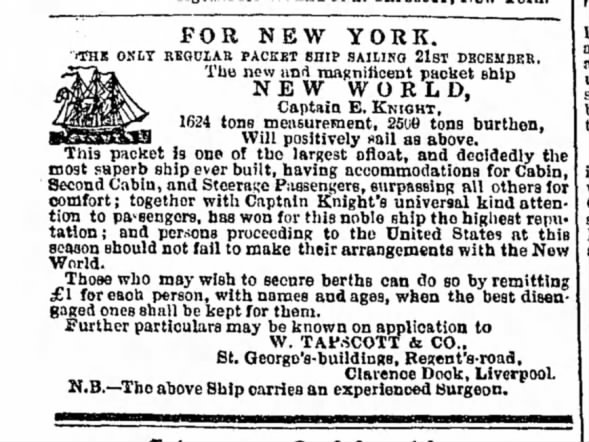
Known for his "gentlemanly" conduct, Knight was a popular captain of the Switzerland and other packet ships to London and Liverpool.

Fri, Dec 17, 1847 – 4 · Liverpool Mercury, etc. (Liverpool, Merseyside, England) · Newspapers.com

When his tribute to Gansevoort appeared in New York newspapers, Captain E. Knight's "Excellent" portrait (No. 238) by G. W. J. was on exhibit at the National Academy (New York Farmer and Mechanic, June 25, 1846).

In 1850-1851, Knight successfully agitated for repeal of the ban on fires and lights aboard ships in Liverpool docks (Honolulu Friend, July 2, 1852). In San Francisco he served for three years as agent of the Pacific Mail Steamship Company. Captain Eben Knight was long remembered by evangelical Christians for arranging that Pacific Mail steamers would not depart on the Sabbath.
No sooner had Captain Knight entered his office here, than he saw what havoc the sailing of steamers made of the Sabbath, when that happened to be the sailing-day. All early Californians know what "steamer-day" meant in those days. It put everybody to work. The steamship-office was besieged from morning till night. Express-offices were crowded, and their messengers and teams were running in hot haste all day. All banks were open, doing a rushing business, with merchants calling for bills of exchange, and miners depositing their bags of gold-dust and taking their certificates; passengers about leaving, hurrying to get their "last things" for the voyage, and going early aboard to receive there the " good-by calls" of friends; everybody writing letters home, and crowding them into the post-office up to the last moment; newsboys crying their "steamer papers" for sale all about the streets; while merchants and clerks were closing their final dispatches to go by Wells and Fargo; and then, at the hour of sailing, the crowd of passengers on the steamer's deck answer to the noisy farewells of the still larger crowds gathered on the wharf, and the great ship glides out into the bay, — and that "steamer day's" excitement is over. Captain Knight at once determined that "steamer day" should not occur on Sunday.  --Samuel Hopkins Willey, The History of the First Pastorate of the Howard Presbyterian Church, San Francisco (San Francisco: The Whitaker and Ray Company, 1900), pages 78-79.
"Eben" Knight died on October 11, 1853 at the age of 42. As also reported by Samuel H. Willey, Knight's eulogy by the business community of San Francisco highlights "noble" qualities of character like those that "E. K." appreciated from a brief acquaintance with Gansevoort Melville.
The high respect and honor in which he was held by the bankers and merchants is touchingly expressed in resolutions adopted at a meeting held by them soon after his death, one of which was as follows: —

"Resolved, That Captain Knight combined in his character in an eminent degree those noble, manly qualities which entitled him not only to the respect and confidence but to the affectionate regard of all who knew him best. 
"With a firm integrity of purpose which never faltered, with a keen sense of honor which scorned an evasion, with a straightforward honesty which resorted to no subterfuges, he combined with simplicity of heart a frankness of demeanor which commanded the respect whilst it secured the affectionate esteem of all with whom he was brought into contact. Scrupulously just in his business relations, generous almost to a fault when his sympathies were appealed to, gentle and confiding in his temper, always ready to forgive a fault in others, he judged harshly only of his own imperfections."

That characterization, be it remembered, was drawn by the business men of San Francisco, not especially his personal friends,— but who could have drawn his character more true to life? Knowing him well, I bear witness to its accuracy in every particular. 
-- The History of the First Pastorate of the Howard Presbyterian Church, San Francisco, page 81. <https://books.google.com/books?id=8XMUAAAAYAAJ&pg=PA81&dq#v=onepage&q&f=false>
Portsmouth Journal of Literature and Politics - December 3, 1853

Monday, December 28, 2015

Amy Strachey and her mother Mary Charlotte Mair ("Minnie") Senior on Melville's London fan club

Mary Charlotte ('Minnie') Senior, 1856-7 by George Frederick Watts
In Melville Biography: An Inside Narrative, Hershel Parker cites the "tantalizing but unverified" report by John St. Loe Strachey of a Melville fan club in England during the late 1840's and early 1850's. As Professor Parker indicates, Strachey was quoting one of Melville's female devotees, an otherwise unidentified "lady of letters" who told Strachey:
"I can't tell you how enthusiastic we all were, young and old, at the end of the 'forties and beginning of the 'fifties, over Typee, Omoo, and Moby-Dick. There was quite a furore over Melville in those days. All the young people worshipped him."  --John St. Loe Strachey in The Spectator, 6 May 1922
This by the way is the peach of a review in which John St Loe Strachey marks the apparent "spiritual influence" of Balzac and calls Melville "an uncanny throw-forward." Strachey's unnamed "lady of letters" must have been his mother-in-law. A month before the May 6, 1922 Spectator review by Strachey, his wife Amy Simpson Strachey (1866-1957) had scooped him in her own mini-review of Raymond Weaver's Melville biography. Amy Strachey's earlier comments on Weaver and Melville appeared in the Literary Review, published by the New York Evening Post on April 8, 1922. Besides identifying her mother as an early Melville fan, Amy Strachey quoted her recollection of the Melville "furore," the telling word that connects her source to her husband's as one and the same person. As John St Loe Strachey did in his later Spectator review, Amy Strachey in her 1922 "London Letter" corrects Weaver on Melville's reception in England:
"A series of books which creates a furore in the fifties and is revived in the nineties cannot be called unknown or unnoticed."  --Amy Strachey
In addition to the biography of her husband John St Loe Strachey, Henrietta Mary Amy (Simpson) Strachey wrote a novel called The Frozen Heart (1935) and a 1940 account of evacuation in wartime, Borrowed Children. As Horst Shroeder shows, her 1888 article on "The Child-Players of the Elizabethan Age" was later plagiarized by her editor Oscar Wilde in The Portrait of Mr. W. H.

From "A London Letter" by Mrs. St. Loe Strachey in the Literary Review of the New York Evening Post, April 8, 1922
New York NY Evening Post 1922 Grayscale - 1831.pdf
We have also been reading “Herman Melville, Mariner and Mystic” by Mr. Raymond M. Weaver, published in New York, and reissued here by the Oxford University Press. I should like to say one word as regards a misapprehension which the author of this book seems to suffer from as to the literary position of Herman Melville over here. The last revival of his work was, as we are accurately told, some thirty years ago, and was incited by Robert Louis Stevenson’s stories of the South Seas. I remember that my husband wrote enthusiastic reviews of the then reprints of the novels, and my mother, who had known the literary London of the fifties, told us of the furore which the books had excited on their first appearance. Nothing was talked of but “Omoo” and “Typee” at the London dinner parties of that date, and she was therefore specially interested in the reappearance of her old favorites. A series of books which creates a furore in the fifties and is revived in the nineties cannot be called unknown or unnoticed. I see that Mr. Weaver takes as illustrations some of the drawings done by William Hodges, who accompanied Capt. Cook in his voyages to the Pacific. The original water-color sketches for these pictures were bought by my grandfather, Nassau Senior, and are now hanging in my hall. The finished pictures are at Admirality House, now occupied, as every one knows, by Lord Lee of Farnham, the First Lord of the Admirality. It is a curious coincidence that these pictures should be hanging in the official home of the Minister who recently in Washington played so great a part in the discussions as to the difficult problems of the Pacific.
Engraving of 'The Fleet of Otaheite Assembled at Oparee'
Engraving of The Fleet of Otaheite Assembled at Oparee
by William Woollett after William Hodges, via Wikimedia Commons
Who was John St. Loe Strachey's "lady of letters"?

His wife Amy Strachey (1866-1957) was the daughter of Charles Turner Simpson (1819-1902) and Simpson's second wife, Mary Charlotte Mair Senior (1825-1909),
"only daughter of Nassau William Senior, master in chancery and professor of Political Economy at Oxford."  --The Eagle Volume 23, obituary of Charles Turner Simpson
So the Melville "furore" witnessed by Amy Strachey's mother belongs to the period before her marriage in 1865 to Simpson.
"Nassau John Senior's sister, Mary Charlotte Senior (b. 1825), married Charles Simpson, a barrister, in 1865 and their daughter, Henrietta Mary Amy ('Amy') Simpson, married John St. Loe Strachey (b 9 Feb 1860), son of Sir Edward Strachey of Sutton Court, Stowey, Somerset. Their daughter, Mary Amabel Nassau Strachey (b 10 May 1894), married Sir Clough Williams-Ellis (1883-1978), founder of Portmeirion."
-- A Richer Dust - The Descent of Hughes via peerage.org
Minnie's mother sister-in-law Mrs. Nassau John Senior is the subject of a biography by Sybil Oldfield, Jeanie, an 'army of One.' Her father Nassau William Senior in 1821-1857 contributed essays on Scott, Bulwer Lytton, Harriet Beecher Stowe and other fiction writers to various British journals including the Quarterly Review, Edinburgh Review, London Review and North British Review. Many of these (excluding one on the recently deceased Thackeray) are collected in Essays on Fiction (1864) which features a prefatory note by daughter Mary Charlotte Mair ("Minnie") Senior.

Truly "a lady of letters," as her son-in-law called her, M. C. M. Simpson herself wrote three novels: A Long Summer's Day (1873); Winnie's History (1877); and Geraldine and her Suitors (1880). 
 In addition to these works of fiction she
"was a translator and editor who edited works by Guizot and Tocqueville."  --Online Library of Liberty
In 1887 Mary Charlotte Mair Simpson compiled Letters and Recollections of Julius and Mary Mohl.
Her own memoir appeared the next year, Many Memories of Many People, centered in the intricate political and social life of her father, a friend of Alexis de Tocqueville and adviser to Jenny Lind. I don't see Melville mentioned in either volume.

Mary Charlotte Mair ("Minnie") Senior was 21 when Typee was first published in London.

Obviously, more study will be needed to illuminate one or more literary circles or salons associated with "Minnie" Senior where Melville was "worshipped." Considering her interesting French connections and continental travel with her father Nassau W. Senior, I'm thinking the previously unknown devotion to Melville on the part of Minnie Senior could involve Melville's reception in Paris, too.