Showing posts with label philosophy. Show all posts

Monday, October 1, 2018

Hobbes's Leviathan, from the library of Herman Melville

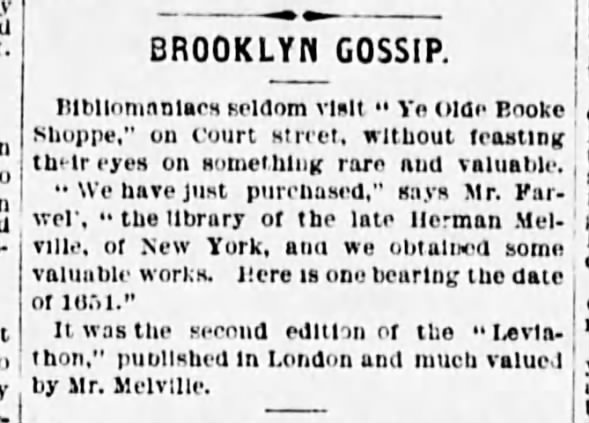
Early in 1892, as Merton M. Sealts, Jr. relates in Melville's Reading (University of Wisconsin Press, 1966) and Pursuing Melville, 1940-1980 (University of Wisconsin Press, 1982), Brooklyn bookman Alfred Francis Farnell (1835-1908) bought a lot of the late Herman Melville's books for $120. Among the most valuable was a rare 1651 edition of Hobbes's Leviathan, according  to this bit of "Brooklyn Gossip" in the New York Evening World for March 19, 1892. Found at GenealogyBank among items added "within 3 months."

New York Evening World - March 19, 1892
via GenealogyBank

BROOKLYN GOSSIP.

Bibliomaniacs seldom visit "Ye Olde Booke Shoppe," on Court street, without feasting their eyes on something rare and valuable.

"We have just purchased," says Mr. Farwell [A. F. Farnell], "the library of the late Herman Melville, of New York, and we obtained some valuable works. Here is one bearing the date of 1651."

It was the second edition of the "Leviathon," [Leviathan] published in London and much valued by Mr. Melville.
Obituary of Alfred F. Farnell in the Brooklyn Daily Standard Union, May 14, 1908:

ALFRED F. FARNELL.
Alfred Francis Farnell, bookseller, of 46 Court street, died Tuesday [May 12, 1908] of heart disease at his home, 96 Garfield place. Mr. Farnell established the Court street business known as A. F. Farnell & Sons in 1880. He was born in Yorkshire, England, June 5, 1835, and went to New Haven, Conn., in 1865, where for a number of years he conducted a circulating library. he is survived by two sons, Fred W. and Henry A., a daughter, Maude M., and a sister, Mrs. A. Blair, of Montgomery, Ala. Mr. Farnell was a member of the Second Unitarian Church, and the Rev. C. S. S. Dutton conducted funeral services this afternoon. Buried in Greenwood Cemetery.
Brooklyn Daily Standard Union - May 14, 1908
via Fulton History
The Leviathan by Thomas Hobbes is #358 in Melville's Sources (Northwestern University Press, 1987) by Mary K. Bercaw Edwards; not currently listed in "The Online Catalog of Books and Documents Owned, Borrowed and Consulted by Herman Melville" at Melville's Marginalia Online.

Below, another image of the "Brooklyn Gossip" item in the New York Evening World, via Newspapers.com

Sat, Mar 19, 1892 – Page 4 · The Evening World (New York, New York, New York, United States of America) · Newspapers.com

Related posts

Saturday, September 20, 2014

Marginalia in Melville's lost Seneca (1620 second edition, not 1614?)


Looking for lost notes in a burned-up book? Leyda's grand old Log to the rescue, once again! VOLUME ONE gives the following marginalia in that lost volume of Seneca--the one Carl Haverlin used to have. In 1951 it was still in Haverlin's collection. And hold up, Leyda identifies this book as the second "Newly Inlarged and Corrected" edition of 1620. But as listed in the catalog at Melville's Marginalia Online, Sealts #457 is the 1614 first edition. Which is it? Or which was it? What fun it was to see the 1614 edition at Hathi Trust Digital Library, but maybe that's the wrong one. No luck yet turning up the1620 edition. Bauman Rare Books had the second edition for sale, but unfortunately somebody beat us to it. Anyway, Leyda assigns these markings and comments to the year 1848, reporting them as Melville's additions to very early annotations in this very old book:
On Epistle XIII M comments:
What a glorious confidance of Fame!
But how many have thought thus, yea written thus, & have been belied by the Future.

In the margin of the following page M comments:
Surely, if these things were recorded in Holy Writ, what force they would carry. It is indeed undeniable, that in Seneca & other of the old philosophers, we meet with maxims of actual life, & lessons of practical wisdom which not only equal but exceed any thing in the Scriptures.—But behold the force of example, & its omnipotence over mere precepts however lofty. Seneca's life belied his philosophy; But that of Christ went beyond his own teachings.

In "Of Providence," Chapter III M checks & scores the passage beginning:
There is nothing, saith [Demetrius the Stoick], more vnhappie then that man that hath neuer beene touched with aduersitie: for he hath not had the means to know himselfe.
M's comment: Glorious.

At the beginning of Chapter IV M scores:
Prosperitie falleth into the hands of the common sort, & betideth those of basest spirit: but to yoake and master calamities and mortall terrours, is the propertie of a great man.
M's comment on this has been cut from the page.
--The Melville Log, Volume 1 [285]
Searching at AbeBooks.com I see Old Erie Street Bookstore in Cleveland is offering the 1620 second edition of Seneca's Works in good condition for $1,950. Hesperia Libros of Zaragoza (Spain) has one for US $1,176.03.
Related post:

Friday, August 29, 2014

Herman Melville's burned-up Seneca

UPDATE 2: Check out the later Melvilliana post on marginalia in Melville's lost Seneca, as reported by Jay Leyda in vol. 1 of The Melville Log. Leyda described this volume of Seneca's Workes from the collection of Carl Haverlin as the 1620 second edition, not the 1614 edition.

Two volumes of Seneca, old (London, 1746) and older (1614!), are listed in the catalog at Melville's Marginalia Online. One survives in the NYPL Gansevoort-Lansing collection: the 1746 London edition of Seneca's Morals (Sealts 458). That's the volume Herman inscribed to his brother Tom:
"Thomas Melville from Herman Melville"; "My Dear Tom, This is a round-of-beef where all hands may cut & come again. Jan: 26th 1854. Pittsfield. Mass:"
Yow! For more on the book that does exist still in the physical world, see the update at the end, please. Ishmael definitely knew his Seneca:
"What matters it how many masters we have, when it is but one slavery?"
--
Seneca's Morals: By Way of Abstract
The 1614 volume (Sealts 457) most likely burned up in a fire. Reportedly it contained Melville's annotations as well as markings:
This copy of Seneca's Works was described to Merton M. Sealts, Jr., by Carl Haverlin, whose library in California was destroyed by fire on 4 January 1954. Among the contents of this 1614 edition of Seneca's Works is "The Life of Lucius Annaeus Seneca Scribed by Iustus Lipsius." --Melville's Marginalia Online
That lost, probably incinerated 1614 volume was published in London by William Stansby. First, let's see if we can find it. No luck just yet at Google Books. How about trusty Hathi Trust? Bingo! And what a treasure! Now that we have in a way rescued Seneca (not Melville's annotated copy you understand, but the same edition he had) from oblivion, let's check and see if this precious volume has Seneca's Letters from a Stoic.


His Epistles I see listed second in the Contents. Would those include Letter 47 on masters and slaves? I want to know, being lately re-interested in Seneca as perhaps the guiding spirit behind Ishmael's interrogative challenge, "Who aint a slave? Tell me that" in the first chapter of Moby-Dick.

Yes, that letter XLVII is here.

Only in this volume Seneca's servus "slave" is translated servant. So the whole letter deals with the right treatment of and relation to "servants" which is to say, slaves:
Is hee a servant? But happily a free man in minde. Is he a servant? Shall this hurt him? Shew one that is not. One serveth his lust, another his avarice, another ambition, another feare. I will shew you a man that hath beene Consul, serving an old woman. I will let you see a rich man serving a poore maid: I will shew you the noblest yong men, the very bond-slaves of Players. There is no servitude more foule, then that which is voluntarie. For which cause, thou hast no reason that these disdainfull fellowes should deterre thee from shewing thy selfe affable to thy servants, and not proudly superiour. --The workes of Lvcius Annaevs Seneca p238
But later the more usual translation of servus is "slave," thus:
Is he a slave? His mind may yet be free: is he a slave? Why should this prejudice you against him? Shew me the man who is not a slave. One is a slave to lust; another to covetousness; another to ambition; and all to fear. I can shew you a man of consular dignity, a slave to an old woman; a very rich man a slave to his handmaid; and many a young nobleman, who are the very bond-slaves of players. No slavery is more infamous than that which is voluntary: there is no reason, therefore, that some over-nice persons should deter you from shewing yourself affable and good-humour'd to your servants; instead of carrying yourself proudly as their superior. --The epistles of Lucius Annaeus Seneca
As Ishmael's subtext, Seneca aint no stretch. In the paragraph immediately before the one where Ishmael asks "Who aint a slave?" Ishmael invokes the Roman Stoic by name, presenting his brand of moral philosophy as the most consoling one around for downwardly mobile intellectuals:
The transition is a keen one, I assure you, from a schoolmaster to a sailor, and requires a strong decoction of Seneca and the Stoics to enable you to grin and bear it. --Moby-Dick, Loomings
Well, you can see why Melville liked old books. There's so much to marvel over in the 900-plus pages of this rich and rare old book, The Workes of Lucius Annaeus Seneca, both Morrall and Naturall. Translated, I almost forgot to mention, by Thomas Lodge.

More later--time to read.

UPDATE 1: Great news! that one surviving volume of Seneca from Melville's library (Sealts 458), the one he gave to his brother Tom in January 1854, also has the letter on masters and slaves. Numbered 17 for some reason--EPISTLE XVII.--, not the usual 47.

So let's cut again, now from the book Melville lovingly bestowed, Seneca's Morals: By Way of Abstract. Though not from his fifteenth edition which I don't yet see online. This passage I take to be the classical basis not only of Ishmael's "Who aint a slave?" challenge, but also Melville's critique of elitism in Francis Parkman's Oregon Trail:
When we affect to contemn savages, we should remember that by so doing we asperse our own progenitors; for they were savages also. Who can swear, that among the naked British barbarians sent to Rome to be stared at more than 1500 years ago, the ancestor of Bacon might not have been found? Why, among the very Thugs of India, or the bloody Dyaks of Borneo, exists the germ of all that is intellectually elevated and grand. We are all of us—Anglo-Saxons, Dyaks, and Indians—sprung from one head, and made in one image. --Melville's review Mr. Parkman's Tour
Here you go, Seneca on virtue as the true nobility, in this 1806 edition printed by John Prentiss under the headings, "We are all equal by blood" and "Tenderness to servants":
. . . The original of all mankind was the same, and it is only a clear conscience that makes any man noble: for that derives even from heaven itself. It is the saying of a great man, that, If we could trace our descents, we should find all slaves to come from princes, and all princes from slaves: but fortune has turned all things topsy turvy, in a long story of revolutions. It is most certain, that our beginning had nothing before it, and our ancestors were some of them splendid, others sordid, as it happened. We have lost the memorials of our extraction; and, in reality, it matters not whence we came, but whither we go. Nor is it any more to our honor the glory of our predecessors, than it is to their shame the wickedness of their posterity. We are all of us composed of the same elements; why should we then value ourselves upon our nobility of blood, as if we were not all of us equal, if we could but recover our evidence?

. . . It is worthy of observation, that the most imperious masters over their own servants are, at the same time, the most abject slaves to the servants of other masters. I will not distinguish a servant by his office, but by his manners. The one is the work of fortune, the other of virtue. But we look only to his quality, and not to his merit. Why should not a brave action rather dignify the condition of a servant, than the condition of a servant lessen a brave action? I would not value a man for his cloathes, or degree, any more than I would do a horse for his trapping. What though he be a servant! Shew me any man that is not so, to his lusts, his avarice, his ambition, his palate, to his mistress; nay, to other men's servants; and we are all of us servants to fear: insolent we are, many of us at home; servile and despised abroad; and none are more liable to be trampled upon than those that have gotten a habit of giving affronts by suffering them. What matters it how many masters we have, when it is but one slavery? and whosoever despises that is perfectly free, let his masters be never so many. --Seneca's Morals: By Way of Abstract, 1806 ed.
Related post:

Thursday, August 28, 2014

Dana's 1869 N-words

Harpers' Family Library, Public domain
 via Wikimedia Commons

For the first of two epigraphs to the chapter on White-Jacket in The New Cambridge Companion to Herman Melville, Jeannine Marie DeLombard chooses a vivid passage on flogging from Dana's Two Years Before the Mast featuring two exclamatory uses of the N-word, the second in all capital letters.

In parentheses, DeLombard gives the date as 1840, thus presenting the doubly loaded epigraph as a quotation from the first edition of Two Years Before the Mast.

This date is important for historically grounding the ensuing argument, as DeLombard makes sure to point out early on, at the start of the second paragraph:
"My epigraphs indicate antislavery rhetoric's pervasive influence on antebellum culture." --"White-Jacket: Telling Who Is--and Aint--a Slave" in The New Cambridge Companion to Herman Melville, ed. Robert S. Levine (Cambridge University Press, 2014) page 51.
Maybe so for the second epigraph from Moby-Dick, although a case can be made for Seneca as the inspiration for Melville's philosophical question "Who aint a slave?"
"He is a slave." His soul, however, may be that of a freeman. "He is a slave." But shall that stand in his way? Show me a man who is not a slave; one is a slave to lust, another to greed, another to ambition, and all men are slaves to fear. I will name you an ex-consul who is slave to an old hag, a millionaire who is slave to a serving-maid; I will show you youths of the noblest birth in serfdom to pantomime players! No servitude is more disgraceful than that which is self-imposed. --Seneca, EPISTLE XLVII
Plato, Seneca, and Aristotle
Devotional and Philosophical Writings, MS Hunter 231 (U.3.4), page 276
Special Collections, University of Glasgow Library

But that first epigraph from Dana's book rather exemplifies the rhetoric of postbellum culture. At any rate, the Dana epigraph is not taken from any publication in 1840 or any year before the Civil War. It really comes from 1869 and after. Dana's 1840 edition reads as follows:

"You see your condition! You see where I've got you all, and you know what to expect!"—"You've been mistaken in me—you didn't know what I was! Now you know what I am!"—"I'll make you toe the mark, every soul of you, or I'll flog you all, fore and aft, from the boy, up!"—"You've got a driver over you! Yes, a slave-drivera negro-driver! I'll see who'll tell me he is n't a negro slave!" --1840 Two years before the mast
This same passage with "negro-diver" and "negro" instead of the capitalized N-word was quoted in the October 1840 review in the New York Knickerbocker.

Now perhaps Dana in 1869 was aiming to restore the sadistic captain's offensive language as he originally heard it, not as first printed in 1840. OK but even so, you would need to explain that line of reasoning. You can't give 1840 as the publication date of a text first published in 1869. Well you can, it turns out, but you shouldn't. For comparison, Hathi Trust digital library also has the 1869 revised edition with the passage that DeLombard excerpts for her epigraph.

You could say the vocabulary does not matter a bit for DeLombard's argument, that either way, in either version, Dana's sailors are explicitly compared to and treated as slaves. Yes indeed! So why bother at all with the anachronistic (in a discussion focused on Melville's 1850 White-Jacket and antebellum culture) and for us in our time gratuitously offensive 1869 version?

The crazy thing is, on page 284 of her book In the Shadow of the Gallows (University of Pennsylvania Press, 2012), DeLombard did accurately quote the 1840 passage from the 1981 Penguin edition (where editor Thomas Philbrick followed "the text of the original Harper edition"). And as in the New Cambridge Companion, DeLombard juxtaposed Dana with Ishmael.

https://books.google.com/books?id=zEH8Rjmwi-EC&pg=PA284&dq#v=onepage&q&f=false

What's going on?