Showing posts with label Leon Howard. Show all posts

Saturday, June 18, 2022

Ulysses in WHITE-JACKET

Ulysses defying the Cyclops
via The New York Public Library Digital Collections

In White-Jacket (1850) and the poem In a Bye-Canal, Melville refers to Homer's Odysseus as Ulysses. In choosing to call him Ulysses, Melville was guided by then-standard English translations of the Iliad and Odyssey. In his own copy of Chapman's Homer (Sealts number 277), a gift from George Duyckinck in 1858, Melville's annotation to The Iliads of Homer Book 3 (page 69, lines 230-232) reads

"Ulysses sat tall."

-- Melville's Marginalia Online  

In March 1849 Melville bought the three-volume set of Alexander Pope's Homer in the Harpers Classical Library (Sealts number 275c). Melville's set is lost, but that Odyssey was also all about Ulysses, as Pope makes clear in his plot summary: 

"Ulysses also, after innumerable troubles by sea and land, at last returned to safety in Ithaca, which is the subject of Homer's Odyssey." 

Thanks in part to influential verse translations in English (by William Cowper, too, along with Pope and Chapman) Melville and his contemporaries knew Odysseus, the ingenious hero of Greek story and myth, as Ulysses.

More generally, William Cullen Bryant explained his use of Latin-based names as best practice when translating Greek into English:

I make no apology for employing in my version the names Jupiter, Juno, Venus, and others of Latin origin, for Zeus, Here, Aphrodite, and other Greek names of the deities of whom Homer speaks. The names which I have adopted have been naturalized in our language for centuries, and some of them, as Mercury, Vulcan, and Dian, have even been provided with English terminations. I was translating from Greek into English, and I therefore translated the names of the gods, as well as the other parts of the poem.  -- Preface, The Iliad of Homer, translated into English blank verse (Boston, 1870).
Academicians howled, apparently, but the old poet stuck to his guns

"The names of Latin origin are naturalized; the others are aliens and strangers."

and Homer's hero remains Ulysses all through Bryant's translation of The Odyssey.

Early in White-Jacket (1850), Ulysses is named with other exemplary heroes of literature familiar to Jack Chase, Melville's great-hearted captain of the maintop: 

Jack had read all the verses of Byron, and all the romances of Scott. He talked of Rob Roy, Don Juan, and Pelham; Macbeth and Ulysses; but, above all things, was an ardent admirer of Camoens. Parts of the Lusiad, he could recite in the original. -- White-Jacket chapter 4, Jack Chase 

In this initial survey of Jack Chase's impressive reading, Ulysses ranks with other leading literary characters whom Jack Chase knows familiarly, well enough to talk about as fellow men. Melville biographer Leon Howard definitely grasped that Melville here meant to designate men as much or more than the titles of works in which they appear:

"... [Melville's Jack Chase] was a master of languages who could recite long passages from Camoëns' sailors' epic, The Lusiad, in the original Portuguese, and talk in English of Rob Roy and Don Juan, Macbeth and Ulysses, and Bulwer's Pelham." -- Herman Melville: A Biography (University of California Press, 1951) page 74.

Howard's careful paraphrase of the passage from chapter 4 of White-Jacket gives only The Lusiad in italics. "Ulysses" to Howard plainly denotes the hero of Homer's Odyssey. Confirmed by looking for "Homer" in the Index:

"Homer, Odysseus, 74."

Paraphrasing the same passage as Howard, John Bryant wrongly puts Macbeth in italics and Ulysses in quotes to reinforce his bad take through punctuation. 

Melville describes Jack Chase as having read all of Byron, Scott, and Camoens's Lusiad (which he recites in the original Portuguese) as well as Macbeth and "Ulysses." Chase's recital of the last work is impossible because Tennyson's 1842 "Ulysses" had only just been published." -- Herman Melville: A Half Known Life volume 2 (Wiley Blackwell, 2021) page 1057.

Fear not! If you made the same mistake by reading the name "Ulysses" as Melville's ineptly managed reference to Tennyson's poem Ulysses, just keep reading. Our matchless Jack will set you straight in chapter 65, A Man-of-War Race

How many great men have been sailors, White Jacket! They say Homer himself was once a tar, even as his hero, Ulysses, was both a sailor and a shipwright. I'll swear Shakespeare was once a captain of the forecastle. Do you mind the first scene in The Tempest, White Jacket?  


Ulysses is Homer's hero. According to Jack Chase anyway, who thus rescues Melville from the false charge of perpetrating an anachronism with an "impossible" reference to Tennyson's version of the archetypal wanderer.

Not that you absolutely have to stay with Homer. Sympathetic readers (for whom Ulysses lives) might freely associate Jack Chase's Homeric hero with Virgil's, or Dante's, or Shakespeare's or Tennyson's or Joyce's version of Ulysses. Unlikely as it sounds, I'm convinced that at least one reference to Ulysses in White-Jacket alludes to George Clooney


Fragments from a Writing Desk: Leon Howard is a major character in my MELVILLE BI...

Great memorial piece by Richard Lehan, posted in 2013 by Hershel Parker:

Fragments from a Writing Desk: Leon Howard is a major character in my MELVILLE BI...: Leon Howard, English: Los Angeles 1903-1982 Professor Emeritus Leon Howard was born on November 8,...

Monday, November 8, 2021

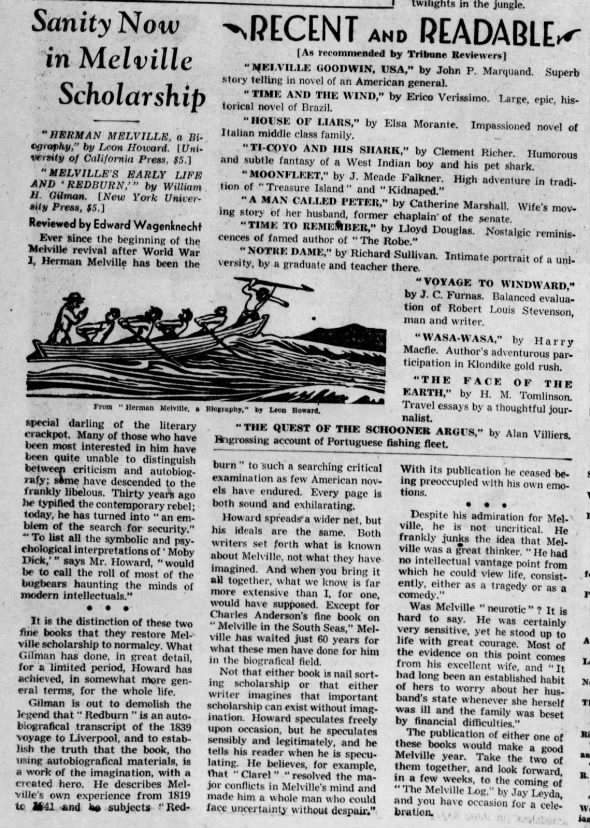
Sanity regained

"It is the distinction of these two fine books that they restore Melville scholarship to normalcy."  

-- Edward Wagenknecht, reviewing Herman Melville, a Biography by Leon Howard and Melville's Early Life and Redburn by William H. Gilman for the Chicago Sunday Tribune, October 21, 1951.

21 Oct 1951, Sun Chicago Tribune (Chicago, Illinois) Newspapers.com

Thursday, February 14, 2013

Agatha and Hunilla, beginnings of a bibliography


Many commentators have noticed thematic and other parallels between representations of Agatha in Melville's Agatha letters to Hawthorne and Hunilla in the eighth sketch of The Encantadas. In his 1951 biography, Leon Howard observed that
"Through the character of Hunilla, in the eighth of his sketches, Melville at last managed to get his admiration for a strong patient widow into print."
--Leon Howard - Herman Melville, page 210
Howard went on to wonder if "Melville had hoped to let the Hunilla story carry the narrative burden of his book." That question in 1951 appeared "impossible to determine," but it is remarkable that Howard even ventured to raise the conjecture that Hunilla, like Agatha, might once have been envisioned as the heroine of a book-length work.

This of course was decades before Hershel Parker's momentous find in the NYPL Augusta Papers of two 1853 references to "Isle of the Cross" in letters from Herman Melville's cousin Priscilla to his sister Augusta.

Below, the start of a bibliography of published criticism linking the Agatha and Hunilla stories...

Agatha and Hunilla

 
Bergmann, Hans. God in the Street: New York Writing from the Penny Press to Melville. Philadelpha: Temple University Press, 1995. From Bergmann's discussion of "The Chola Widow" in Chapter 7 ("Key: 'Bartleby, the Scrivner'") pages 174-5:
One cannot help thinking that whatever the fate of "The Isle of the Cross," Melville's "Agatha" writing may have been part of what became "The Encantadas; or, Enchanted Isles," published in Putnam's in March, April, and May 1854.... "Sketch Eighth" of "The Encantadas," "Norfolk Isle and the Chola Widow," is most easily imagined as part of "The Isle of the Cross" project in that the principal image for Norfolk Island is the "rude cross" (155) that the Chola Widow has put up as memorial for her dead husband Felipe....
... What the "Agatha" story suggests, and the "Norfolk Isle and the Chola Widow" enacts, is the theme that "uncomplaining submission" is the admirable human reaction to the horror of a world in which God is silent.

Bickley, R. Bruce, Jr. The Method of Melville's Short Fiction. Durham, North Carolina: Duke University Press, 1975. See 18; and 115-116.

Dillingham, William B. Melville's Short Fiction, 1853-1856.  Athens, Georgia: University of Georgia Press, 1977.
"Like all else in 'The Encantadas,' the story of Agatha—warmly humane and basically optimistic in outlook—was metamorphosed in the crucible of Melville’s suffering into dark and barren tragedy." --William B. Dillingham, Melville's Short Fiction - page 101
Ekner, Reidar.  "The Encantadas and Benito Cereno: On Sources and Imagination in Melville."  Moderna Språk 60.3 (1966): 258-273.

Fredricks, Nancy. "Melville and the Woman's Story." Studies in American Fiction
Volume 19, Number 1, Spring 1991. Reprinted in Herman Melville: New Edition, ed. Harold Bloom (Infobase Publishing, 2008).
"It is not clear whether Melville ever did write Agatha's story. A variant of the tale appears in "The Encantadas" in the story of Hunilla, the Chola woman and turtle hunter who witnesses the drowning of her husband and survives alone for years on a remote, uninhabited island."  --Nancy Fredricks, Melville and the Woman's Story in Harold Bloom, ed., Herman Melville: A New Edition, page 116. A revised version of this passage appears in chapter 9 of Nancy Fredricks' book Melville's Art of Democracy (University of Georgia Press, 1995), with "turtle hunter" deleted.
Hayford, Harrison. "The Significance of Melville's 'Agatha' Letters."  ELH 13.4 (December 1946): 299-310.  In a footnote, Hayford makes the connection to Hunilla:
“It is possible that Agatha would have belonged not with Billy Budd but rather with Bartleby and Hunilla, creations of the following year…”  (304 fn 13)
Howard, Leon.  Herman Melville: A Biography. Berkeley and Los Angeles: University of California Press, 1951. 210.

Hoyle, Norman E. "Melville as a Magazinist." Unpublished doctoral dissertation. Duke University, 1960. See pp. 107-108 for prescient discussion of Agatha and Hunilla.

Kelley, Wyn. Herman Melville: An Introduction. Blackwell Publishing, 2008. 108-110.

Lacy, Patricia. The Agatha Theme in Melville's Stories. The University of Texas Studies in English 35 (1956): 96-105.

Lee, A. Robert. "Voices Off and On: Melville's Piazza and Other Stories." In The Nineteenth-Century  American Short Story.  London and Totowa, N.J.:  Barnes and Noble, 1986.  76-102; see 89.

López Liquete, Maria Felisa. "When Silence Speaks: The Chola Widow"  In Melville and Women, ed. Elizabeth Schultz and Haskell Springer.  Kent, Ohio: Kent State University Press, 2006.  213-228.
"The Harpers also supposedly rejected 'The Agatha Story,' which relates directly to Sketch Eighth, as well as 'The Tortoise Hunters,' which relates to 'The Encantadas.'"
(227, fn8)
Ra'ad, Basem L. "'The Encantadas' and 'The Isle of the Cross': Melvillean Dubieties, 1853-54. American Literature 63 (June 1991): 316-323.

Robertson-Lorant, Laurie. Melville: A Biography. Amherst: University of Massachusetts Press, 1996. 338.
This sketch ["Norfolk Isle and the Chola Widow"] seems to incorporate both the Agatha story and "The Isle of the Cross."  (338)
Sattelmeyer, Robert, and James Barbour. "The Sources and Genesis of Melville's 'Norfolk Isle and the Chola Widow.'" American Literature 50 (November 1978): 398-417. Sattelmeyer and Barbour introduce and discuss newspaper accounts from late 1853 concerning a "Female Robinson Crusoe"; as hinted here, Sattelmeyer and Barbour do not mention an even earlier report of the same "Female Crusoe" (before she was "found" again in 1853), originally published in the Boston Atlas and reprinted in Littell's Living Age 12 (March 27, 1847): 594-595. The 1847 and 1853 stories are different reports, I now realize, about the same woman on the same island of Saint or San Nicholas--elusive with no wish to leave the island in 1847, but lately discovered and "rescued" in 1853. More on all that later, hopefully. For the earlier newspaper account, see this Melvilliana exclusive
See also the post on early sources for Melville's Chola Widow sketch for more thoughts on the Sattelmeyer and Barbour article.

Sealts, Merton M., Jr. "Historical Note" in Melville's The Piazza Tales and Other Prose Pieces, 1839-1860.  Ed. Harrison Hayford, Alma A. MacDougall, and G. Thomas Tanselle. Evanston and Chicago: Northwestern University Press and The Newberry Library, 1987. Sealts observes
"echoes of the 'patience, & endurance, & resignedness' Melville associated with Agatha in much of the fiction he was to write over the next three years" including "above all, Hunilla...." (483)

"Security in tortoises."  http://melvilliana.blogspot.com/2013/02/security-in-tortoises.html

Smith, Herbert F. "Melville's Master in Chancery and His Recalcitrant Clerk." American Quarterly 17 (Winter 1965): 734-741.

Watson, Charles N., Jr. “Melville’s Agatha and Hunilla: A Literary Reincarnation.” English Language Notes 6 (December 1968): 114-118. 

Wheeler, K. M. 'The Half Shall Remain Untold': Hunilla of Melville's Encantadas. Journal of the Short Story in English 52 (Spring 2009).

Related posts: