Showing posts with label Melville's reading. Show all posts

Wednesday, April 1, 2026

Amigo Mio! #8 in my open investigation, DRAGOONED: Writing, talking, and rewriting like Herman Melville in "Scenes Beyond the Western Border" (1851-1853)

Amigo mio! by Scott Norsworthy

Didn't you desert me on the eve of a snowstorm?

Read on Substack


Related posts on Substack

  • DRAGOONED #7: After Supper
    https://melvilliana.substack.com/p/after-supper
  • DRAGOONED #8: Amigo Mio!
    https://melvilliana.substack.com/p/amigo-mio 

Friday, March 27, 2026

Project MUSE - A Third Update on Books Owned, Borrowed, and Consulted by Herman Melville

Link below to a gem in the latest Leviathan with exciting news of recovered markings and marginalia in Melville's set of Boswell's Life of Samuel Johnson. By Christopher Ohge and Brandon Hurst who are also taking the editorial reins at Melville's Marginalia Online.


πŸ™πŸ™Thanks to Founding Editors Steven Olsen-Smith and Peter Norberg and every contributor to https://melvillesmarginalia.org/ for a monumental job well done! πŸ‘πŸ‘

Monday, March 23, 2026

Kant's head on the larboard


Monday, February 16, 2026

Falling harpooners per Scoresby and Melville


Tuesday, October 28, 2025

Melville's "Dilletante" reader of Dante in PIERRE

Likely inspired by negative mentions of "literary Dilettanti" and "Dilletantism" in the preface to John Aitken Carlyle's prose translation of Dante's INFERNO 

Illustration of Dante's Inferno Canto 6 by Giovanni Stradano, 1587.
Stradanus aka Jan van der Straet, Public Domain, via Wikimedia Commons
In Book IX of Pierre; Or, The Ambiguities (1852) Herman Melville alludes to "horrible allegorical meanings" in Dante's Inferno as something beyond the ken of a nameless hypothetical reader, clueless but happy, whom Melville or his narrator labels "the Dilletante in Literature": 
"Fortunately for the felicity of the Dilletante in Literature, the horrible allegorical meanings of the Inferno, lie not on the surface...."
In a similar contrast between naive and knowing readers, the "deeper significances" of Hamlet are said to elude "all but the rarest adepts." Melville fans will recognize in this section of Pierre a version of the contrast in Hawthorne and His Mosses between the "superficial skimmer" and a more discerning "eagle-eyed reader." In the "Mosses" essay, as here in Pierre, the thing supposedly missed by insufficiently attentive readers concerns the problem of evil. The "mystery of iniquity" is a major theme of Melville's later writings, too, especially his epic religious poem Clarel and the uncompleted novella, Billy Budd. 

The terrible truth, as Melville understands it, is the presence of evil in the very fabric of creation, which makes sin and misery ineradicable as well as universal. In this view, only by way of the darkest visions and doctrines--of Original Sin as conceived by Calvinists, of the creator as malicious demiurge according to Gnostics, of the Hindu goddess Kali, consort of Shiva the destroyer--may the truth about the elemental nature of evil be apprehended.

Otherwise, with respect to Dante's Inferno one would think the literal content is bad enough. It's literally Hell. What could possibly be more disturbing or "horrible" than graphic depictions of torture inflicted forever on the lost souls of human beings in nine successively worse Circles of Hell? In the most horrifying scene of all (Dante's Inferno Cantos 32-23), the shade of traitor Count Ugolino gnaws on the back of his betrayer's skull while both souls are hemmed in the same ice-hole. You have to wonder what business a dilettante would have with Dante in the first place. 

Tracing the influence of Dante in Mardi and Pierre, Dennis Berthold in American Risorgimento: Herman Melville and the Cultural Politics of Italy (Ohio State University Press, 2009) finds in Pierre a satire of the naive hero's "literary pretensions" and, more broadly, of the 19th century "Dante revival" in America, "which undoubtedly had its share of dilettantes" (page 138). Here Berthold called attention to cultural resonances evoked by "the Dilletante in literature," but the focus in American Risorgimento on Henry F. Cary's verse translation as Melville's source-text did not allow for consideration of any more precise borrowing. No form of dilettante occurs anywhere in Cary's Dante. More context, including previously unidentified textual prompts for Melville's dismissive handling of the literary "Dilletante," may help to explicate the main idea of this interesting passage.

Henry A. Murray in the 1949 Hendricks House edition at page 198 printed "Dilettante," correcting Melville's nonstandard spelling "Dilletante." Dr. Murray made no further editorial comment, except to observe in a professional way how deep-seated hostilities against the world may be interpreted as psychological "projections" by either the author or his fictional hero, or both (Introduction, xciii). Ignoring the emended form "Dilettante" adopted by Murray and others before him (in, for example, the 1923 Constable edition) the 1971 Northwestern-Newberry volume edited by Harrison Hayford, Hershel Parker, and G. Thomas Tanselle retained Melville's spelling "Dilletante" as an acceptable variant. 

Dilettante means "An admirer or lover of the fine arts" according to Noah Webster, An American Dictionary of the English Language (Harper & Brothers, 1848) page 295. The word occurs infrequently in Melville's writings. In the second volume of Mardi: And a Voyage Thitherthe antiquary "Oh-Oh" is comically depicted as a “dilettante in things old and marvelous.” Oh-Oh's name reflects his irrepressible enthusiasm for the arts, and artifacts. As representative dilettante, however, his passion for great rarities is that of a collector who is merely a collector, having little knowledge or even interest in their real meanings, or expressions of truth and beauty. Keeping in character, he overvalues numerous pieces of trashy ephemera, but lets Babbalanja have a priceless manuscript on how to achieve "A Happy Life" (by the Polynesian Seneca, hence loaded with stoic wisdom) for nothing. 

To much the same effect, Melville's 1857-8 lecture on "Statues in Rome" began by contrasting the "technical" expertise of "the dilettante" with deeper, more personal and penetrating responses to great works of art:
"True, the dilettante may employ his technical terms; but ignorance of these prevents not due feeling for Art, in any mind naturally alive to beauty or grandeur."  
-- quoted here from the reconstructed text by Merton M. Sealts, Jr. in The Piazza Tales, and Other Prose Pieces, edited by Harrison Hayford, Alma A. MacDougall, G. Thomas Tanselle, and others (Northwestern University Press, 1987) page 398. 
Dilettante here is employed in the sense of "acknowledged expert," rather than "amateur" or "dabbler." Alternatively, "professional critic or connoisseur" as reported in several 19th century newspapers. A couple of published reviews have Melville using the plural form, dilettanti, still meaning something like "Art experts." 

In Mardi, Melville's comic portrayal of Oh-Oh as "an extraordinary old antiquary" draws on negative associations of dilettante with superficiality, frivolity, and indifference to marks of deep, enduring value. In Pierre Book IX the hypothetical "Dilletante" has an equally shallow understanding of great world literature, according to the narrator. Likely prompts for Melville's invocation of the literary "Dilletante" in Pierre may be found in the preface to a book Melville definitely owned or had access to, Dante’s Divine Comedy: The Inferno. A literal prose translation (New York: Harper & Brothers, 1849) by Dr. John Aitken Carlyle, younger brother of Thomas Carlyle. Digital versions are accessible online courtesy of HathiTrust Digital Library; and also via the Internet Archive: 
John A. Carlyle’s prose translation of Dante’s Divine Comedy: The Inferno is Sealts Number 173a in the searchable “Catalog of Books and Documents Owned, Borrowed and Consulted by Herman Melville” at Melville’s Marginalia OnlineAs there noted, we know Melville read at least part of it because he quoted “John Carlyle‘s version” of Canto 3, line 26 (“And sounds of hands among them”) in one of his annotations to Henry Francis Cary’s verse translation (Sealts Number 174). If Melville's ironic slight of "the Dilletante in literature" in Pierre were at all inspired by mentions of "literary Dilettanti" and "dilettantism" in Carlyle's preface, then Melville must have had either the 1849 first edition (English, by Chapman and Hall in London? or American, by the Harpers in New York?) or the 1851 reissue of Dante's Divine Comedy: The Inferno. A literal prose translation by John A. Carlyle, M.D. As in Melville's usage "Dilletante," occurrences of "Dilettanti" and "Dilettantism" capitalize the initial "D" in both the English and American editions. However, only Harper & Brothers give the spelling "Dilletantism" (page xxii). The closer parallel to Melville's spelling of the base word "Dilletante" would seem to favor the American edition as the one Melville consulted. 

Here below are four passages from the preface to John A. Carlyle's prose translation that individually or collectively might have influenced Melville's conception of "the Dilletante in Literature." Each example features a form of the base word dilettante

  1. "In the year 1831, being called to Italy by other duties, I first studied the Divina Commedia, under guidance of the most noted literary Dilettanti of Rome and other places. I heard them read it with wondrous gestures and declamation, and talk of it in the usual superlatives." -- John A. Carlyle, Preface to Dante's Divine Comedy: The Inferno, page iv

  2. "During the seven years which followed, I often studied it again, at leisure hours, along with the other works of Dante; and got intimately acquainted with various Italians of different ranks, who, without making any pretensions to literature, or troubling themselves with conflicting commentaries, knew all the best passages, and would recite them in a plain, sober, quiet tone—now rapid, now slow, but always with real warmth—like people who felt the meaning, and were sure of its effect. To them the Divina Commedia had become a kind of Bible, and given expression and expansion to what was highest in their minds. The difference between them and the Dilettanti seemed infinite, and was all the more impressive from the gradual way in which it had been remarked." Carlyle, Preface, v

  3. "But to return. Having thus acquired a clearer idea of the Poem, and got fairly beneath the thick encumbrances of Dilettantism and other encumbrances, which hide its meaning, I began to be convinced that the quantity of commentary, necessary to make the substance and texture of it intelligible, might be compressed into a much smaller space than had been anticipated." Carlyle, Preface, vii


  4. It is impossible to mention all the other commentaries of the 18th century. That of Lombardi, which appeared in 1791, is such as could be written by the honest effort of a whole life, amid the "dark wood" of Dilletantism produced by a host of idle writers; and one feels a real respect for the worthy Friar, though at times he is surprisingly naΓ―ve, or perhaps dull.... Most of the old commentaries on Dante are written with a kind of large complacency, and genuine though long-winded enthusiasm, which makes them very interesting at first sight ; but on closer inspection, they are found to contain a surprising quantity of worn-out rubbish, and extremely little real information.

    Preface, "Comments and Translations" pages xxi - xxii. As noted above, only the American edition by Harper & Brothers gives the spelling "Dilletantism" here. London editions in the same place (page xxx) make it "Dilettantism." 
The context in John A. Carlyle's preface could hardly be more relevant to Book IX of Pierre. Dr. Carlyle's concern with the problem of rightly interpreting Dante is nearly identical with that of Melville, or Melville's narrator. To be sure, Carlyle's "Dilettanti" do not come across as mere amateurs or dabblers of the type often implicated in usages that rely on negative connotations of the term dilettante. Rather, as Carlyle describes them, "literary Dilettanti" for the most part are Dante Experts of high repute. Their deficiency lies in attending more to boring minutia than meaning. Or in their enthusiasm for comparatively superficial matters of form, technique, and special poetic effects. According to Carlyle, readers with a deeper appreciation of Dante have zero literary expertise or "pretensions to literature." Along with a shared seriousness, the best readers of Dante take the Divine Comedy for "a kind of Bible." Such readers unaffectedly treasure Dante's great work as an expression of the highest classical values of truth, goodness, and beauty. 

With Dr. Carlyle, Melville in full truth-seeking mode presumably would prefer the interpretations of grounded, reality-based readers on the lookout for meaning and wisdom, and hopefully believing in the promise of salvation. Unfortunately, no fine insights into the true meaning of Dante avail the tragic hero of Melville's novel. Poor Pierre! He can't avoid his fate, once challenged to do right by Isabel Banford, allegedly his half-sister. Melville (as Berthold points out) withholds from his fictional hero any hope or even knowledge of Dante's journey through Purgatory to Paradise. Crusading for justice to Isabel, Pierre will abandon the Beatrice he already has in Lucy Tartan, his blonde-haired and blue-eyed sweetheart. (Lucy rebounds and heroically rejoins Pierre in the second half of Melville's novel, too late to save Pierre, his fake wife Isabel, or herself.) Back in Book IX, for now betrothed to Lucy but stuck between Dante's Hell and Shakespeare's Hamlet, Pierre experiences a psychic meltdown that leaves him "dabbling in the vomit of his loathed identity." 

More extensive debts to Dante in Pierre have been examined by G. Giovanni

 Giovannini, G. “Melville’s Pierre and Dante’s Inferno.” PMLA, vol. 64, no. 1, 1949, pp. 70–78. JSTOR, https://doi.org/10.2307/459670. Accessed 28 Oct. 2025.  

Giovannini, G. “Melville and Dante.” PMLA, vol. 65, no. 2, 1950, pp. 329–329. JSTOR, https://doi.org/10.2307/45947.

and Nathalia Wright 

Wright, Nathalia. “Pierre: Herman Melville’s Inferno.” American Literature, vol. 32, no. 2, 1960, pp. 167–81. JSTOR, https://doi.org/10.2307/2922675. 

G. Giovanni most helpfully connects the problem of interpreting Dante's profounder "allegorical meanings," as raised by the narrator in Book IX, with the "melodramatic violence" displayed by Pierre when "trampling on the torn pages of the Inferno." As Giovanni shows, the hero's behavioral and mental health crisis is precipitated by his new awareness of evil, beginning with the sins of his own father lately disclosed through Isabel's claim of shared paternity. 

Pierre's frustration on the sudden discovery of moral disorder is here roughly equated with Hamlet's; its ultimate source is the universalization of his father's moral lapse through "the horrible allegorical meanings of the Inferno." Limited in his experiential knowledge of the world, Pierre finds the form and generic significance of his particular perception of evil in the Inferno allegorically construed as a picture of life itself. The Inferno initiates Pierre into "that darker though truer aspect of things. 
"Melville's Pierre and Dante's Inferno," pages 75-76
... These references to the Inferno in first half of the novel, from the time when Pierre first sees Isabel to his pretended marriage and departure with her for the city, are closely coordinated with Pierre's development towards a realization of the ubiquity and universality of evil. Melville conceives Pierre's development within the sequence of his confrontations of the Inferno, and sees the poem metaphorically as an index of a naive idealism resentful of the existence of evil."  
"Melville's Pierre and Dante's Inferno," page 77

The effect of reading Dante and Shakespeare on poor Pierre, augmenting his new personal knowledge of worldly wickedness, is well summarized by Giovanni:

"...The fragments from the poets bring into focus a reality larger than Pierre's particular experience and central to the tragedy: evil is an integral part of existence, and the attempt to eradicate it must lead to tragic failure." 
"Melville's Pierre and Dante's Inferno," page 76

In Herman Melville: A Biography Volume 2, 1851-1891 (Johns Hopkins University Press, 2002) at page 435, Hershel Parker made reference to the "variant rendering of a line by John Carlyle" that Melville inscribed in his volume of Cary's Dante. Parker added, "in this case there is no other evidence that he had further knowledge of Carlyle's translation." Now, more than twenty years on, I am glad to offer multiple mentions of "Dilettanti" and "Dilettantism" or (as spelled on page xxii in the American edition by Harper & Brothers) "Dilletantism" as pretty good evidence that Melville read attentively in John Aitken Carlyle's preface--some time before the Harpers brought out Pierre in the summer of 1852. 

Worcester MA Spy - August 5, 1852

Monday, December 30, 2024

Ten YUGE WINS for Melvilliana in 2024

Greetings from the Minnesota bank of beautiful Lake Pepin, otherwise known as the Mississippi River.

πŸ† #1. As you probably heard by now, November of the present year 2024 came with a bang of a W = WIN for Melvilliana and the free world. I'm talking, obviously, about the exciting discovery of the long-lost Chilton copy of A Visit from St. Nicholas ("'Twas the night before Christmas....") in the handwriting of its author, Clement C. Moore. The very existence of this rare and valuable manuscript had been forgotten when I called attention, five years ago, to the facsimile reproduction of the first page in the January 1875 issue of St. Nicholas: A Monthly Magazine for Boys and Girls

Recovery of the Chilton copy brings the total number of extant manuscripts (that we know about) to five. Only four were generally acknowledged at the time of my blog post back in December 2019. 

I was thrilled to learn from Peter Klarnet, Senior Specialist for manuscript and printed Americana at Christie's, that the Chilton copy turned up this year in excellent condition, along with a signed note from Moore and supporting documents that definitively establish the provenance of this particular manuscript version. As reported in the New York Times and on Spectrum News NY1, the Chilton copy was acquired by distinguished collector Adrian Van Sinderen before his death in 1963, and since then has been held by family members. 

Now offered for private sale by Christie's, the newly discovered Chilton copy of "A Visit from St. Nicholas" is presented with fine images and enticing descriptive details, here:
For me, the unexpected and highly gratifying discovery or re-discovery of the Chilton manuscript has to be the biggest win for Melvilliana in 2024. And to think I almost deleted my original 2019 post about it, after being told the 1875 facsimile in St. Nicholas was most likely a poor reproduction of the known copy owned by the Huntington Library

Listed below are nine more YUGE WINS racked up on Melvilliana this year, so many wins you might get tired of all the winning before the ball drops at midnight. πŸ†πŸ†πŸ†πŸ†πŸ†πŸ†πŸ†πŸ†πŸ†

πŸ† #2 is my discovery that James Clarke Welling took over the regular column of "Notes on New Books" in the Washington National Intelligencer in late 1850 or early 1851 which means that Welling wrote the splendid review of Moby-Dick long and wrongly attributed in previous Melville scholarship to William Allen Butler. Friends, do you know how hard it is to legit correct Hugh Hetherington, Perry Miller, AND Hershel Parker on a matter of fact?!
Wait, there's more! Number two comes with a bonus win at no extra charge. Although Butler in reality never reviewed Moby-Dick, he did contribute the friendly notice of Hawthorne's House of the Seven Gables, not counted in the published inventory by Gary Scharnhorst, Nathaniel Hawthorne: An Annotated Bibliography of Comment and Criticism Before 1900 (Scarecrow Press, Inc., 1988). 

πŸ† #3 is my highly satisfying find of the Cincinnati Daily Times review of Melville's 1858 lecture on "Statues in Rome."
In the 1950's Merton M. Sealts, Jr. and professional librarians duly searched then-available archives but never found it. Not recorded in the 1987 Northwestern-Newberry edition Piazza Tales and Other Prose Pieces, 1839-1860, edited by Harrison Hayford, Alma A. MacDougall, G. Thomas Tanselle, and others. To my mind, the coolest thing here is the unique record of something Melville said about the sculpted visage of Tiberius. Only this one review of "Statues in Rome" in the Cincinnati Daily Times finds Melville drawing directly from his journal, word-for-word, in the descriptive phrase "intellect without manliness."

πŸ† #4 began with my humble attempt to compose a requested footnote on pelican-beach and ended up disclosing the probable source-text for Melville's Civil War poem "In the Prison Pen (1864)." So what? So the pitiable meagreness exhibited by Melville's prisoner does not necessarily indicate his physical death, but rather his severely emaciated condition as one of the "living skeletons" released from rebel prisons, so described by the U. S. Sanitary Commission in the 1864 Narrative of Privations and Sufferings.
πŸ† #5 broke new ground with a cluster of posts on the newspaper syndication of Herman Melville's poem "The Admiral of the White" in 1885. As uncovered on Melvilliana, Allen Thorndike Rice arranged for the simultaneous publication of Melville's poem in more U. S. newspapers than we knew, including the Cincinnati Times-Star and St. Paul Sunday Pioneer Press
πŸ† #6. Hershel Parker in a footnote for the 3rd Norton Critical Edition of Moby-Dick correctly if a bit vaguely identified "the carved Roman slave" referenced in Chapter 126, The Life-Buoy as that
"famous statue, which is in the Tribune of the Uffizi Museum, in Florence, Italy."
More specifically named L'Arrotino, the Knife-Grinder, as discussed in this blog post from February 2024:
Besides the added precision, what makes #6 really great is my discovery of another, formerly popular but now forgotten name for this famous work of art.
The other name of the Knife-Grinder perfectly explains Melville's choice of words in the Life-Buoy chapter, when Ishmael depicts startled sailors as "transfixedly listening" and then compares them in that regard to the statue of a Roman slave known as THE LISTENING SLAVE. 

As I write this on New Year's Eve 2024 the Melville Electronic Library still misidentifies "the carved Roman slave" of chapter 126 The Life-Buoy as the famous “Dying Gaul” or “Dying Gladiator." Let's hope they read this and get it right in 2025!

πŸ† #7 potentially adds another illustrated book of travel and adventure in the Middle East by William Henry Bartlett to the three already listed in the catalog of books owned and borrowed by Herman Melville at Melville's Marginalia Online. That would be Footsteps of Our Lord and His Apostles, “From the library of Herman Melville,” offered by bookseller Noah Farnham Morrison of "Noah's Ark" in Elizabeth, New Jersey the year before Allan Melville's daughters (Mrs. Maria G. Morewood and Katherine G. Melville) sold Arrowhead and unspecified books from Herman Melville's library in 1927.
πŸ† #8 reveals the exact date (February 16, 1868) and place (the regimental armory then located on the corner of Hall Place and Seventh street) Herman Melville gifted "a beautiful portrait of the late private" Malcolm Melville to the New York State Militia unit in which his deceased son had proudly served.
Strong finishers who persevere to the end of #8 are rewarded with this fun fact not down in Jay Leyda's great Melville Log or any Melville biography, yet nonetheless true: Malcolm Melville's good friend and fellow member of Company B, George O. Starr later became world-famous as the managing director of Barnum & Bailey's Greatest Show on Earth.

πŸ† #9 locates a late, casual allusion to Moby-Dick in Charles G. Whiting's newspaper tribute to Louis Moreau Gottschalk, published shortly after Gottschalk's death in Rio de Janeiro. Signed "C. G. W." the reminiscence in the Springfield MA Daily Republican (January 29, 1870) refers specifically to Chapter 54: The Town-Ho's Story. After the Civil War and rumors of a scandalous romance in San Francisco, the brilliant New Orleans-born pianist had left the United States for South America, touring in Peru, Chile, Uruguay, Argentina and Brazil. As Whiting chose to put it, echoing one of Ishmael's supposed listeners/drinking companions at the "Golden Inn" in Lima, Peru, Gottschalk

"found more luxurious rest in the city of the Incas, whose wickedness has become a proverb,--"Corrupt as Lima,"--or among the orange groves around Rio Janeiro."
Although widely regarded as an invented proverb, something Melville made up, the repeated expression "Corrupt as Lima" in Moby-Dick derives from one of Melville's earliest source-books, A Visit to the South Seas Volume 1 (New York: John P. Haven, 1831) by Charles S. Stewart:
"Lima is said to be the most corrupt city on the continent—so much so that along the whole coast, I am told, the name alone is a proverb of sin."
πŸ† #10 corrects an exceedingly rare misreading by Herman Melville's best biographer Hershel Parker in his published transcription of the letter that Herman's older sister Helen Melville wrote from Lansingburgh, New York to younger sister Augusta Melville (then in Bath, a town in Steuben County, New York) on October 10, 1841. 
Helen tells of socializing with Lemuel Shaw and family in Lenox, Berkshire County, Massachusetts. As triumphantly shown in this the tenth major WIN for Melvilliana in 2024, Charles Cromwell Ingham not Henry Inman was "the portrait painter" then making "a professional visit" to the Sedgwicks in Lenox. 

Skeptical readers who harbor any doubts about its being all that YUGE of a win are invited to transcribe one or more letters in the awesome collection of Augusta Melville papers, digitized and accessible online courtesy of The New York Public Library Digital Collections. And to ponder the remarkable fact that right before the arrival of 1841, the same year in which Herman Melville's sister Helen and brother Gansevoort partied with "the portrait painter" C. C. Ingham, this very same artist had drawn St. Nicholas coming down the chimney. On New Year's Eve! 


The New York Mirror of January 2, 1841 featured an amazing engraving based on Ingham's commissioned portrait of St. Nicholas at his work. Printer and publisher Daniel Fanshaw explained how it came about:
"... having a very great reverence for the good old Saint who so often made our hearts jump with joy when we were boys, we prevailed upon our friend Ingham to give us a sketch of him, just as he saw him one bright, frosty, moonlight night, as he was returning home late from a party of friends."
So much winning! If you're not yet sick of it, truck on by Melvilliana on Substack and check out the second chapter of my work in progress:
Thank you for reading and Happy New Year everyone!!!! πŸ₯³πŸŽ‰πŸΎ

Tuesday, November 26, 2024

Ovid's influence in "After the Pleasure Party"


CORRECTION

Walter Sutton wrote the article titled "Melville's 'Pleasure Party' and the Art of Concealment" in Philological Quarterly Volume 30 Issue 3 (July 1951) pages 316-327. 

https://archive.org/details/sim_philological-quarterly_1951-07_30_3/page/316/mode/2up

WALTER not William. 

Sunday, November 3, 2024

Meandering through the meads in MARDI and Bartram's TRAVELS


Wednesday, October 2, 2024

Prompt behind Melville's invented proverb "Corrupt as Lima" in Stewart's VISIT TO THE SOUTH SEAS Volume 1


Wednesday, May 15, 2024

W. H. Bartlett's FOOTSTEPS OF OUR LORD AND HIS APOSTLES from the library of Herman Melville

Footsteps of Our Lord & His Apostles, Title-page with
engraving, "The Holy Sycamore"  © The Trustees of the British Museum

Looks like another illustrated book of travel and adventure in the Middle East by William Henry Bartlett can be added to the three already listed in the catalog of books owned and borrowed by Herman Melville at Melville's Marginalia Online. Merton M. Sealts, Jr. included three of Bartlett's works in Melville's Reading: A Check-List of Books Owned and Borrowed (University of Wisconsin Press, 1966; Revised and Enlarged Edition, University of South Carolina Press, 1988):

  • Forty Days in the Desert, on the Track of the Israelites (Sealts Number 48)
  • The Nile-Boat; or, Glimpses of the Land of Egypt (Sealts Number 49)
  • Walks about the City and Environs of Jerusalem (Sealts Number 50)

Melville mined each of these works in the writing of his epic religious poem Clarel (1876) as demonstrated by Walter E. Bezanson in the 1960 Hendricks House edition of Clarel: A Poem and Pilgrimage in the Holy Land; and Dorothee Metlitsky Finkelstein in Melville's Orienda (Yale University Press, 1961). Bartlett's works and the groundbreaking scholarship on Melville's use of them by Bezanson and Metlitsky Finkelstein are duly registered by Mary  K. Bercaw in Melville's Sources (Northwestern University Press, 1987).

A fourth title by Bartlett, Footsteps of Our Lord and His Apostles in Syria, Greece, and Italy, was offered by rare book dealer Noah Farnham Morrison (1863-1950) of Elizabeth, New Jersey in his 1926 Catalog of Miscellaneous Literature No. 209, listed there on page 12. 

Noah Farnham Morrison, Catalog No. 209 - 1926

2257. BARTLETT (W. H.). Footsteps of our Lord and his apostles. 12mo, pp. 248, morocco, map and ills., gilt edges. N. Y., n. d. 3.50
From the library  of Herman Melville.

As indicated in Morrison's catalog description, this particular copy was a New York edition with no date given, acquired "From the library of Herman Melville." Price: $3.50, minus the 25% discount on all items in Catalog No. 209, as stipulated on the front cover. Morrison explained, 

"I am specializing in Americana and need the room for that stock."

The proprietor of "The Ark" aka "The Sign of the Ark" or "Noah's Ark" in Elizabeth, NJ had a longstanding interest in Melville's own writings, as shown by his advertisement in the Books Wanted section of Publishers' Weekly No. 1209, March 30, 1895. Based at that time in Newark, Noah Farnham Morrison was seeking 

"Herman Melville's Works, any, state publisher and date." (page 540)

Noah Farnham Morrison retired in 1943 and died on October 4, 1950 at the age of 87. From the notice of his passing in the Antiquarian Bookman:

"A specialist in Americana, he had opened his first book store in Newark in 1893. For over 40 years his Elizabeth store, Noah's Ark, was famous on West Jersey Street, until he retired in 1943. His stock of Americana was sold in six sessions by Swann's Auction Galleries in 1945-6."
Detail, front cover of Morrison's Catalog Number 216 - 1927

The full title of Bartlett's work is Footsteps of Our Lord and His apostles in Syria, Greece, and Italy: a succession of visits to the scenes of New Testament narrative. In his Catalog Number 209, Morrison gave the short title of Melville's copy as Footsteps of Our Lord and his apostles, without specifying the edition or publisher. However, Morrison did note the place of publication, N. Y. = New York, and the absence of a publication date on the title-page. Similarly, Melville's copies of Forty Days in the Desert (Sealts Number 48) and The Nile-Boat (Sealts Number 49) were also American editions, published in New York with no date indicated on the title-pages. Both volumes owned by Melville, Forty Days in the Desert and The Nile-Boat, were Fifth Editions published in New York by Charles Scribner and Company. Although Melville's copy of Bartlett's Footsteps of our Lord is now lost or (more hopefully) unlocated, it may have been Scribner's 5th edition. 

All three titles were advertised together by Scribner & Company. Bartlett's popular works headed the list of "SUPERBLY ILLUSTRATED ENGLISH BOOKS FOR THE HOLIDAYS, 1865-6" in the American Literary Gazette and Publishers' Circular (Philadelphia, PA) for November 1, 1865. Listed first: Footsteps of Our Lord and his Apostles in Syria, Greece, and Italy: a succession of visits to the scenes of New Testament Narrative featuring "47 exquisite Illustrations on steel and wood." 

As advertised in the Philadelphia American Literary Gazette, these holiday gift books were "Crown 8vo" in size which would make them smaller than the usual octavo--possibly close to the 12mo or duodecimo size of the book from Melville's library according to Noah Farnham Morrison. The advertised price of each volume in "Cloth extra, gilt" was $4, exactly one day's pay for a customs inspector at the Port of New York as Melville officially would become on December 5, 1866. As described in Morrison's 1926 catalog, Melville's copy of Footsteps of our Lord and His Apostles was bound in morocco leather which normally would have upped the purchase price by about two dollars.

Melville could have acquired the Footsteps volume when the 5th edition was issued for the holidays by Scribner and Company in 1865-6, or later. As indicated by Sealts in Melville's Reading, Melville's Forty Days in the Desert (like Footsteps in the 1865 ad shown above, a Fifth Edition published in New York by Scribner) was inscribed by Melville in New York City on January 31, 1870.

Melville's other copies of Bartlett's works are held by the New York Public Library in the Gansevoort-Lansing collection. Arranged by Sealts Number, the two Scribner editions, Forty Days in the Desert (Sealts 48) and The Nile-Boat (Sealts 49) are located in the Gansevoort-Lansing family library, box 329. As recorded in the relevant catalog entries at Melville's Marginalia Online, these two volumes were given by Melville's daughter Frances to Caroline W. Stewart. Sealts Number 50, the London edition of Bartlett's Walks about the City and Environs of Jerusalem, was a Christmas gift from Herman to his wife Elizabeth Melville. Also located in the New York Public Library, Manuscripts and Archives Division, Gansevoort-Lansing Box 329 according to the catalog entry at Melville's Marginalia Online.

Not Melville's actual book but still a boon to researchers, Scribner's undated Fifth Edition of Footsteps of our Lord and His Apostles by William Henry Bartlett is also at The New York Public Library, now located in the Schwarzman Building M2 - General Research Room 315. I checked, it has the same number of pages, 248, as the one at Noah's Ark. Google-digitized images from the physical volume at NYPL are available online courtesy of HathiTrust Digital Library:

Possibly Melville borrowed something in Clarel (and perhaps in other writings) from somewhere in Bartlett's Footsteps of Our Lord and His Apostles. What remains to be seen. 


Wednesday, March 30, 2022

Melville's source for "ill-ventilated warmth" in "Poor Man's Pudding"

Here's a sample of my latest effort on Substack, documenting formerly unrecognized literary debts to some version of E. C. Brewer's pop-science guidebook in another 1854 short fiction by Herman Melville, Poor Man's Pudding and Rich Man's Crumbs. The borrowings identified so far all occur in "Poor Man's Pudding," the first of these paired sketches. Evidently Melville, having successfully ventriloquized Dr. Brewer on familiar science in "Poor Man's Pudding," kept his guidebook handy for the more extensive series of creative appropriations just uncovered in The Lightning-Rod Man.

As shown below, a closer look at the mechanics of Melville's rewriting reveals his penchant for parallelism. Further investigation, of the sort I hope to continue on Substack, may reveal other instances where Melville forges new parallel structures from the raw material of a source-text.

Near the close of “Poor Man’s Pudding,” the narrator records his observation of the oppressively “damp” and “heavy” air in the Coulters’ home, and then generalizes about the badly ventilated rooms that poor people too often inhabit, especially in winter. Invoking some imaginary abuser (maybe Malthus) of the poor and their alleged “instinct” for “ill-ventilation,” Melville’s narrator protests in their defense that stale indoor air has one great advantage “to any shiverer” in being warmer than air circulated and cooled through ventilation.

This ill-ventilation in winter of the rooms of the poor⁠—a thing, too, so stubbornly persisted in⁠—is usually charged upon them as their disgraceful neglect of the most simple means to health. But the instinct of the poor is wiser than we think. The air which ventilates, likewise cools. And to any shiverer, ill-ventilated warmth is better than well-ventilated cold.

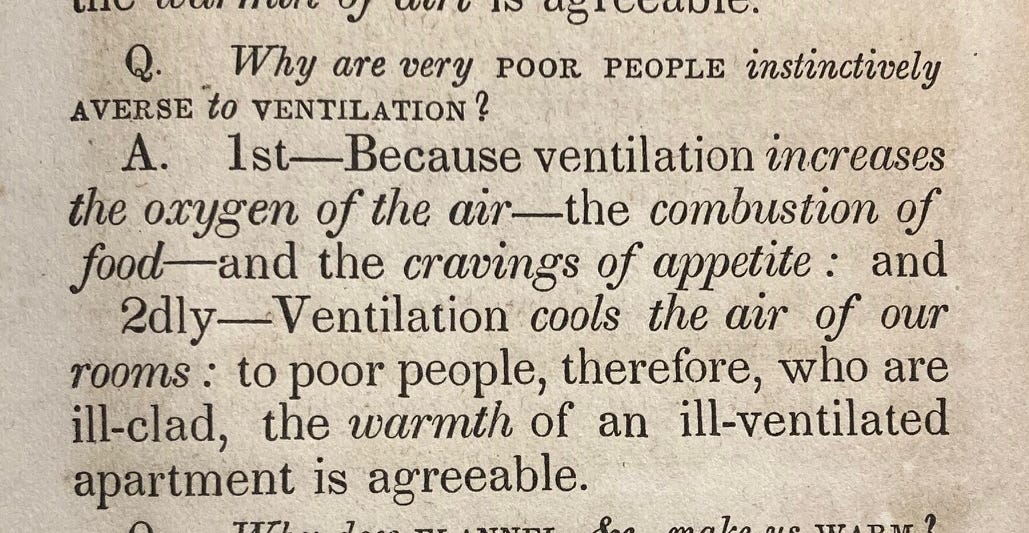
Rather than evincing habitual neglect of good health, as ostensibly alleged by unnamed critics, the observed preference for bad ventilation in winter results from the natural human “instinct” to keep warm. Thus reasons Melville’s compassionate narrator, who takes his theme directly from Dr. Brewer’s section on “Animal Heat,” #1115 in Peterson’s Familiar Science. Image below reproduces the same Q-and-A as it appears on page 93 of A Guide to the Scientific Knowledge of Things Familiar (New York: C. S. Francis & Co. and Boston: Crosby, Nichols & Co., 1854).

Q. Why are very POOR PEOPLE instinctively AVERSE to VENTILATION ?

A. 1st–Because ventilation increases the oxygen of the air—the combustion of food and the cravings of appetite : and

2dly—Ventilation cools the air of our rooms : to poor people, therefore, who are ill-clad, the warmth of an ill-ventilated apartment is agreeable.

In paraphrasing his source-text near the end of “Poor Man’s Pudding,” Melville has disregarded the first part of Dr. Brewer’s answer. Instead of bothering about scientific processes of oxygenation and combustion, Melville keys on the second part, about ventilation. As the latter part of the answer in Familiar Science #1115 explains, “poor people” without adequate clothing to wear actually prefer rooms without good air circulation for their relative warmth, in contrast to rooms that are better ventilated and therefore colder.

FAMILIAR SCIENCE #1115
Ventilation cools the air of our rooms :

MELVILLE
The air which ventilates, likewise cools.

Melville’s rewrite turns Brewer’s word ventilation into a verb, making the grammar of “ventilates” parallel to that of “cools.” Both the original and Melville’s rewrite have the word cools in italics.

The rest of the paraphrase features another parallelism created through revision of Melville’s source-text. Melville copied “ill-ventilated” from his source in Brewer’s Guide page 93 or Familiar Science #1115, and added “well-ventilated” to yield contrasting, parallel descriptors. He strengthened the parallelism through antithesis by copying the noun “warmth” and adding “cold” to sharpen the contrast in fresh, perfectly parallel phrases: “ill-ventilated warmth” vs. “well-ventilated cold.”

FAMILIAR SCIENCE #1115
… to poor people, therefore, who are ill-clad, the warmth of an ill-ventilated apartment is agreeable.

MELVILLE
And to any shiverer, ill-ventilated warmth is better than well-ventilated cold.

Another addition is the figure of “any shiverer,” one of the best changes Melville made to his source-text in some version of Dr. Brewer’s handy guidebook of popular science. When creatively rewriting source material, Melville often gravitates to the concrete and personal. In this case, where his source generalized about the predicament of “ill-clad” poor people. Melville individualizes the point of view, changing the perspective from that of “poor people” in the abstract to that of “any shiverer.” At the same, the construction invites empathy by appealing to a relatable experience of common humanity. In the image of “any shiverer,” Melville has visualized how any person, not excluding any reader, might feel and act in a cold apartment, with no winter clothes. 

https://melvilliana.substack.com/p/blessings-of-snow-and-bad-ventilation?r=n51cr&s=w&utm_campaign=post&utm_medium=web

Related posts: