HAPPY 250TH AMERICA!!!! pic.twitter.com/eJvTAbOVUA
— The White House (@WhiteHouse) July 4, 2026

Original research and riffs on Herman Melville, authorship, and nineteenth-century American literature.
HAPPY 250TH AMERICA!!!! pic.twitter.com/eJvTAbOVUA
— The White House (@WhiteHouse) July 4, 2026
William H. Gilman on patriotic Albany NY and "its joy in being American and free" in the 1830's:
— Scott Norsworthy 🇺🇸 (@Melvilliana) June 25, 2024
🇺🇸🇺🇸🇺🇸"Like most communities of the times, Albany was actively, even noisily, patriotic. School children, early indoctrinated with love of their country and veneration for its…
 |
| Fourth of July drawing by F. O. C. Darley NYPL Digital Collections |
Manuscripts and Archives Division, The New York Public Library. "Darley, Felix Octavius Carr (1822-1888)" The New York Public Library Digital Collections. 1848 - 1851. https://digitalcollections.nypl.org/items/cd0cf7b0-4465-0133-97f7-00505686a51cShown in detail above, an original drawing by the gifted and popular 19th century artist Felix Darley from the close of Darley's Fourth of July note to Evert A. Duyckinck. Darley's 1857 caricature represents a patriotic fellow-American celebrating Independence Day in the great American way, with his gun blazing, flag waving, and plenty of gin on hand.
Claymont July 4th
1857
My dear Duyckinck,
I send you by Express two more designs for the Poets of the 19th Century with a portion of the text which you sent me. I will send you the rest with the remaining drawings in a few days. One of them will be for Poe’s Raven and the other for Simms’ poem.
The glorious 4th is likely I fear to be a damp one—innumerable spit devils and other patriotic explosions of gunpowder will be nipped in the bud. I have occasionally a reminiscence of Brandywine in a distant pop from some juvenile cracker in the neighborhood which greatly assists my fancy being engaged at present on designs for Irving’s Washington.
Permit me to express in outline my true appreciation in common with my fellow countrymen of this great day in an elaborate illustration which I enclose and believe meYours ever
F. O. C. Darley
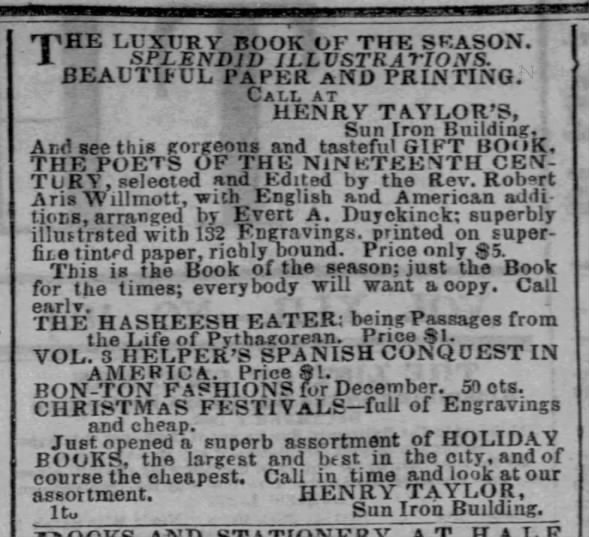
Evert Duyckinck edited the Americanized volume of Willmot's Poets of the Nineteenth Century, expanded with "liberal space" for "American authors, illustrated by American artists," published in 1858 by Harper & Brothers. Darley's illustration for Blessings on Children by William Gilmore Simms appears there on page 416; the one for Poe's The Raven on page 466. American additions included Clement C. Moore's A Visit from St Nicholas, also illustrated by Darley. With these treasures and more, the volume made a "gorgeous and tasteful GIFT BOOK" that was already available in bookstores by December 1857.
F. O. C. Darley of course had many friends among the literati including Herman Melville. In the summer of 1853 Darley visited Melville at his Arrowhead farm near Pittsfield. With "a party of gentlemen" they explored the Dome of Taconic (Jay Leyda, The Melville Log Volume 1 page 478; and Hershel Parker, Herman Melville: A Biography Volume 2, 1851-1891 pages 173-4). On another Berkshire adventure, Darley and Maunsell B. Field joined Melville for dinner with Oliver Wendell Holmes. As Field remembered it, they did not get around to eating but Field "never chanced to hear better talking" as that between Holmes and Melville on "East India religions and mythologies."
And this reminds me of a little excursion which DARLEY, the artist, and myself once made together from Stockbridge. We started in a buggy to call upon MELVILLE, intending to go from there to Dr. HOLMES's, then to the hotel at Pittsfield to dine, and thence home. We found MELVILLE, whom I had always known as the most silent man of my acquaintance, sitting on the porch in front of his door. He took us to a particular spot on his place to show us some superb trees. He told me that he spent much time there patting them upon the back. When we were about to start for Dr. HOLMES's, we invited MELVILLE to accompany us, and he accepted. We found the poet-physician, to whom I was presented for the first time, at home, and he took us into a room at the back of his house, which overlooked the mountains. For some time the talk, in which all tried to participate, dragged, and I feared that our visit would only result in boring our host, if not ourselves. At length, somehow, the conversation drifted to East India religions and mythologies, and soon there arose a discussion between HOLMES and MELVILLE, which was conducted with the most amazing skill and brilliancy on both sides. It lasted for hours, and DARLEY and I had nothing to do but to listen. I never chanced to hear better talking in my life. It was so absorbing that we took no note of time, and the Doctor lost his dinner, as we lost ours. We took tea at Pittsfield, instead of dining there, and reached home late in the evening.
-- Memories of Many Men and of Some Women (New York, 1875) pages 201-202.
In other great 4th of July news, it turns out I'm not the only one who quits singin' along every time they play a Springsteen song...
 |
| Ashley Lake Loop Trail - Photo by Kimberly Kaigle |
interrupting the flattered author who sat thoughtful on a hay tuft—with such phrases as “great” “glorious” “by Jove that’s tremendous” &c.
--Evert A. Duyckinck, letter to his wife Margaret dated August 8, 1851; as quoted in Luther Stearns Mansfield, Glimpses of Herman Melville's Life in Pittsfield, American Literature (March 1937) pages 39-40.
"His memory on Onota's shore,Only that, and nothing more!" --Souvenir Verse and Story
Mrs M had a poet in the company and his poem too a stout MSS of heroic measure, a glorification of the United States in particular with a polite slanging of all other nations in general . . . which H M read with emphasis (interrupting the flattered author who sat thoughtful on a hay tuft--with such phrases as "great glorious" "By Jove, that's tremendous" &c)--but perhaps the most noticeable incident was a gathering of the exiled fowls in a corner who cackled a series of noisy resolutions, levelled at the party. "Turn em out!" was the cry. The author impelled by the honor of his poem charged fearlessly, scattered the critics of the pit, clasping the most obstinate bodily and "rushing" her a rapid descent below." (page xvii)As a graduate student on a mission from Hershel Parker, Olsen-Smith re-examined the manuscript at NYPL and corrected one earlier misreading in the passage above. According to Duyckinck the unruly hens were really "critics of the pit" not "cuties of the pit" as Mansfield and Leyda erroneously had it. Duyckinck pictured those evicted chickens as noisy critics, jeering like the groundlings in Shakespeare's day.
For the holiday, John C. Hoadley pronounces a newly composed poem, "The Union" [later retitled "Destiny"] --The Melville Log Volume 1 - [416]
Leyda's source for this information, cited in volume 2 of the Melville Log, is a manuscript by Hoadley in the New York Public Library Gansevoort-Lansing collection. Looking specifically for Hoadley's 1851 poem "The Union," re-titled "Destiny" according to Jay Leyda, I have contacted NYPL to request more information about Hoadley manuscripts in the Gansevoort-Lansing collection, Box 351. If NYPL has Hoadley's poem THE UNION aka DESTINY and can provide scans, I hope to transcribe the text on Melvilliana.
Corroborative evidence for Melville's reading of John C. Hoadley's "Union" poem exists in the letter Hoadley wrote to Evert Duyckinck on September 9, 1851. I located this item years ago, as reported in the 2016 Melvilliana post
Pittsfield, Sept. 9th. 1851.
E. A. Duyckinck Esq.
Dear Sir,
I received a copy of the Literary World a few days since, containing an interesting account of your excursion to Grey Lock, for which I suppose I have to thank your kindness. I read it with lively pleasure though not without a twinge of selfish regret that I could not be of your party.— "Can a man hold fire in his hand by thinking on the frosty Caucasus?”
The Harpers, to whom I had sent my national poem for publication, decline it, and advise me to send it to D. Appleton & Co. which I have accordingly requested the Messers H. to do.— I can not but desire to have it printed, but have not much hope of it. Melville’s hearty praises give me more hope than anything else.
I am, My Dear Sir,
Very Respectfully,
Yours &c. John C. Hoadley.
Citation:
Manuscripts and Archives Division, The New York Public Library. "Hoadley, John Chipman (1818-1886)" The New York Public Library Digital Collections. 1851. https://digitalcollections.nypl.org/items/d9236f50-693b-0133-a932-00505686d14e
* I am indebted for this Chapter to the kindness of a much esteemed and very clever friend. -- Taghconic chapter 6, Berry Pond.
The author impelled by the honor of his poem charged fearlessly, scattered the critics of the pit, clasping the most obstinate bodily and "rushing" her a rapid descent below. This was the ludicrous side. On the other, the Poet was a thoughtful sensible man and was our pilot to the Ashley Pond or Washington Lake which we reached at last after an endless ascent by the side of steep gorges, on the summit of the Hoosac, looking back to the distant sublimities of cloud & mountain of the Taghconic. -- Melville in His Own Time, page 58
The "Poet" turned "pilot" confidently guided Duyckinck and company to Ashley Pond, a location that Hoadley knew exceptionally well, for the best professional and civic reasons.
As an engineer and engaged citizen of Pittsfield, John C. Hoadley worked hard to bring good water to Pittsfield. Hoadley
was very active in all the efforts to acquire Ashley Lake for water supply and at a public meeting a vote was passed “thanking Messrs. McKay and Hoadley for their public spirited efforts in behalf of supplying the village with pure water." -- Joseph Ward Lewis, quoting Smith's History of Pittsfield page 563 in "Berkshire Men of Worth," Berkshire County Eagle, September 18, 1935.For Hoadley that work began the previous year with his formal report in September 1850 to the Pittsfield Library Association. Presumably the firm of McKay & Hoadley would have been of service in the manufacture and supply of necessary iron pipes. As the town expert, or one of them, Hoadley was assigned to the water-works committee. Coincidentally, the guided trip to Ashley Pond described by Duyckinck in August 1851 might have provided Hoadley with a great opportunity for obtaining another water sample. Regular samples were then being collected for testing by Hoadley's committee, expressly appointed "to make a thorough examination of the quantity and quality of the water of Lake Ashley."
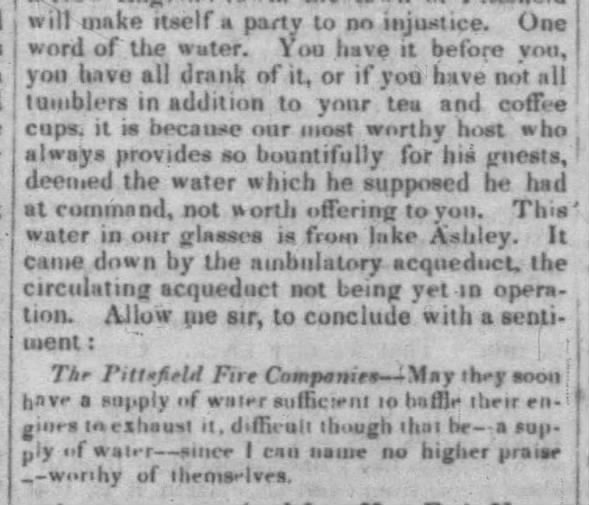
At the big Firemen's banquet or supper or levee on January 15, 1851, reportedly attended by 200 guests, Hoadley spoke at some length on "the great subject of water," specifically the merits of Ashley water:
“The great subject of water, which is exciting a great deal of interest in town just now, is one upon which we have all to form opinions that shall guide us in immediate action, and it is important that we should form wise opinions. About the excellence of the water of Lake Ashley, about its desirableness in our village, I think sir there can be but one opinion. --Pittsfield Sun, January 23, 1851
Knowing Hoadley and his hobby, some in the audience could not have been too surprised by his closing revelation:
"This water in our glasses is from lake Ashley. It came down by the ambulatory aqueduct, the circulating aqueduct not being yet in operation.

Concerning the obvious desirableness of pure drinking water from Ashley, Franklin E. Taylor concurred in this toast To the Pontoosuc Engine Company, No. 2:
"May we all soon have the Ashley Pon-too-suc (Pond-to-suck)."

... The day was also observed by the Young Mens' Association in this city. The exercises were in the Second Presbyterian church. The Declaration of Independence was read, and well read, by Mr. G. MELVILLE. The oration which we learn was a production creditable as well to the author as to the choice of the Association, was pronounced by JOHN DAVIS, esq. The members were out in great numbers with their badges and banner, and of themselves formed a large procession, exclusive of its citizens, with whom the Association continues to be, as it deserves, a favorite as it is a flourishing and valuable institution. --Albany Argus, July 8, 1836; found at GenealogyBankWriting in 1849, Gansevoort's brother Herman Melville imagined the literary freedom Shakespeare might have enjoyed as a great American truth-teller, asserting that "the Declaration of Independence makes a difference."

For I hold it a verity, that even Shakespeare, was not a frank man to the uttermost. And, indeed, who in this intolerant Universe is, or can be? But the Declaration of Independence makes a difference. --letter to Evert A. Duyckinck, March 3, 1849
Citation:
Manuscripts and Archives Division, The New York Public Library. "1846-1849" New York Public Library Digital Collections. Accessed July 4, 2020. http://digitalcollections.nypl.org/items/df49f430-16c2-0133-5bcc-58d385a7bbd0This liberating power in the Declaration of Independence would somehow give Melville the creative freedom he needed to write Moby-Dick (1851).
We will proclaim the ideals of the Declaration of Independence, and we will never surrender the spirit and the courage and the cause of July 4th, 1776.
Upon this ground, we will stand firm and unwavering. In the face of lies meant to divide us, demoralize us, and diminish us, we will show that the story of America unites us, inspires us, includes us all, and makes everyone free.
We must demand that our children are taught once again to see America as did Reverend Martin Luther King, when he said that the Founders had signed “a promissory note” to every future generation. Dr. King saw that the mission of justice required us to fully embrace our founding ideals. Those ideals are so important to us — the founding ideals. He called on his fellow citizens not to rip down their heritage, but to live up to their heritage. (Applause.)
Above all, our children, from every community, must be taught that to be American is to inherit the spirit of the most adventurous and confident people ever to walk the face of the Earth.
Americans are the people who pursued our Manifest Destiny across the ocean, into the uncharted wilderness, over the tallest mountains, and then into the skies and even into the stars.
We are the country of Andrew Jackson, Ulysses S. Grant, and Frederick Douglass. We are the land of Wild Bill Hickock and Buffalo Bill Cody. (Applause.) We are the nation that gave rise to the Wright Brothers, the Tuskegee Airmen — (applause) — Harriet Tubman, Clara Barton, Jesse Owens, George Patton — General George Patton — the great Louie Armstrong, Alan Shepard, Elvis Presley, and Mohammad Ali. (Applause.) And only America could have produced them all. (Applause.) No other place.
-- Remarks by President Trump
<https://trumpwhitehouse.archives.gov/briefings-statements/remarks-president-trump-south-dakotas-2020-mount-rushmore-fireworks-celebration-keystone-south-dakota/>
Somewhere Trump also exalted Mark Twain as the preeminent American story-teller. Wrongly there, as any real Melville aficionado can tell you. Nevertheless, the author of Israel Potter (originally presented in Putnam's magazine as A Fourth of July Story) would have felt the fitness of tributes to western legends like Wild Bill Hickock and Buffalo Bill Cody. According to Melville, "the Western spirit is, or will yet be (for not other is, or can be) the true American one."
| Israel Potter, magazine version |
Here's hoping the proposed National Garden of American Heroes will make room for a statue honoring the author of Moby-Dick and Israel Potter, The Confidence-Man and Clarel. Put him next to Buffalo Bill, or Louis Armstrong."Though born in New England, he exhibited no trace of her character. He was frank, bluff, companionable as a Pagan, convivial, a Roman, hearty as a harvest. His spirit was essentially Western; and herein is his peculiar Americanism; for the Western spirit is, or will yet be (for no other is, or can be), the true American one." --Ethan Allen as described in Herman Melville's Israel Potter: His Fifty Years of Exile (1854-5)
Israel Potter, book version
 |
| via Library of Congress |
 |
A NEW ROMANCE BY TYPEE MELVILLE.--According to the masthead the Atlas was then published by Herrick and Ropes, meaning founder Anson Herrick and John F. Ropes. Herrick and Ropes previously had owned the New York Aurora, edited for a month or so in 1842 by Walt Whitman.
The July number of Putnam's Monthly contains the first part of an original American Romance, from the brilliant pen of Melville, called Israel Potter, a Fourth of July story.
https://hdl.handle.net/2027/umn.31951002805978f?urlappend=%3Bseq=88and Google Books:
https://books.google.com/books?id=pNk6AQAAMAAJ&pg=PA66&dq#v=onepage&q&f=false
Part 1. July 1854 - Putnam's Monthly Magazine 4 (July 1854): 66-75.
Part 2. August 1854 - Putnam's Monthly Magazine 4 (August 1854): 135-146.
Part 3. September 1854 - Putnam's Monthly Magazine 4 (September 1854): 277-290.
Part 4. October 1854 - Putnam's Monthly Magazine 4 (October 1854): 371-378.
Part 5. November 1854 - Putnam's Monthly Magazine 4 (November 1854): 481-491.
Part 6. December 1854 - Putnam's Monthly Magazine 4 (December 1854): 592-601.
Part 7. January 1855 - Putnam's Monthly Magazine 5 (January 1855): 63-71.
Part 8. February 1855 - Putnam's Monthly Magazine 5 (February 1855): 176-182.
Part 9. March 1855 - Putnam's Monthly Magazine 5 (March 1855): 288-294.
https://hdl.handle.net/2027/hvd.32044009684473
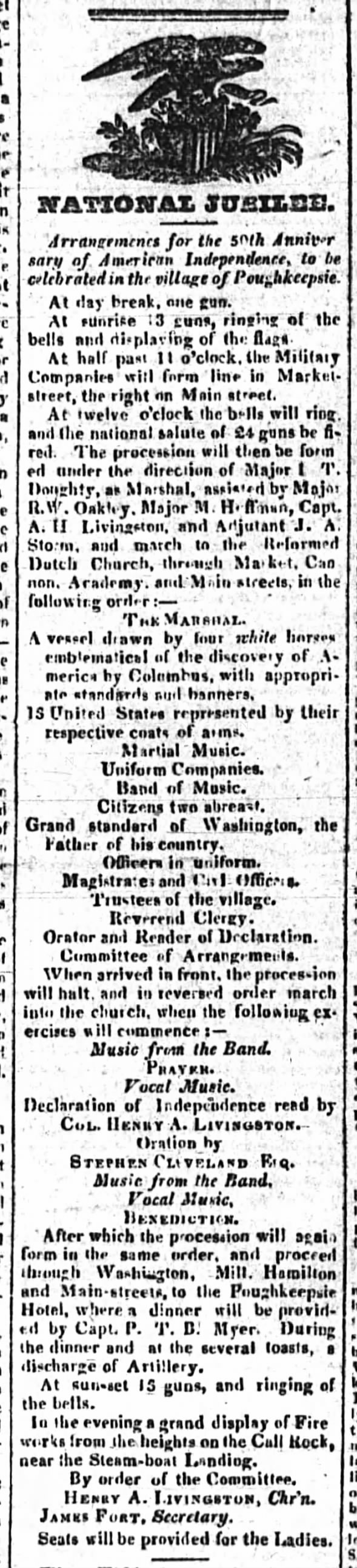
In Poughkeepsie, the day was celebrated with a zeal and hilarity which has never been exceeded. Col. H. A. Livingston read the Declaration. The oration was pronounced by Stephen Cleveland., esq. Col. Livingston presided at the feast, assisted by Clapp Raymond, Joseph Harris, John De La Veigne, John S. Myers and John W. Oakley, esqrs. --Albany Argus, July 18, 1826Henry Alexander Livingston (1776-1849) aka "Colonel Livingston" of Poughkeepsie was the son of Henry Livingston, Jr's older and much better known brother John Henry Livingston. Dutchess County historian Helen Wilkinson Reynolds well describes Henry A. Livingston as "a leading citizen of Poughkeepsie for approximately half a century." If you needed a parade marshal or banquet host, Col. Livingston was your man. When Lafayette landed in Poughkeepsie, Col. Henry A. Livingston made the appropriate welcome speech. Colonel Livingston routinely officiated at Fourth of July celebrations. In 1824 the Poughkeepsie Journal (July 7, 1824) criticized the noise and fireworks that year as ridiculously and dangerously excessive. But two years later a notably grand celebration took place on July 4, 1826--the half-centennial anniversary of American independence. Colonel Henry A. Livingston naturally served as Chairman on the Committee of Arrangements. As in 1824, Col. Livingston had the honor of reading the Declaration of Independence. In between the parade and fireworks, Col. Livingston presided over the dinner and formal toasts which in this extra-special instance were "accompanied by the discharge of cannon, music from the band, and occasional songs."
"It appears the 4th of July is to be celebrated in a novel stile in the land of your nativity. All the boats of the canal are to move in divisions from Utica, Whitesboro, Rome &ct finally, assembling at Salina, then display the Ensigns of festivity & Keep it up"It's hard to tell from the images as reconfigured on the Henry Livingston Jr site, but the letter "R" that appears below many of the toasts in manuscript may be unrelated to Livingston's alleged pseudonym. Repeated assertions of authorship here do not seem necessary or even germane to the process of drafting suitable toasts. Presumably Uncle Henry had little reason to adopt a persona or disguise his identity, which would have been perfectly obvious to his own nephew and all concerned. In the context of toasts to be delivered at a formal dinner banquet, in this case for an unusually elaborate celebration of the "National Jubilee" in 1826, "R" might refer to a planned "Response" of some kind, either in the form of a brief speech, music, song, or--as indicated in the advertised program--a cannon blast.
"During the dinner and at the several toasts, a discharge of Artillery." Poughkeepsie Journal, June 28, 1826.If any surname absolutely had to be associated with the letter "R," we now have that of Clapp Raymond, Col. Livingston's first-named Vice President on the 1826 Committee of Arrangements.
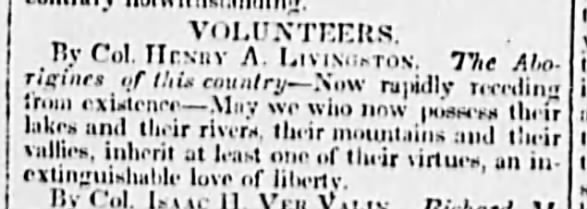 · Wed, Jul 7, 1830 – Page 2 · Poughkeepsie Journal (Poughkeepsie, New York) · Newspapers.com
VOLUNTEERS.The same toast to "Aborigines" had been proposed at the 4th of July dinner in 1826. Two of the seven manuscript toasts transcribed on the Henry Livingston site made it into the local newspaper: one to "The aborigines of this country" and the other to "The army & navy of the Union," reported in print as "The Army and Navy of the United States." From the Poughkeepsie Journal, July 12, 1826:
By Col. HENRY A. LIVINGSTON. The Aborigines of this country--Now rapidly receding from existence--May we who now possess their lakes and their rivers, their mountains and their vallies, inherit at least one of their virtues, an inextinguishable love of liberty.
--Poughkeepsie Journal, July 7, 1830
NATIONAL JUBILEE
POUGHKEEPSIE CELEBRATION.
The Fiftieth Anniversary of American Independence was celebrated in this village in the manner heretofore published by the Committee of Arrangements, and with a zeal and hilarity never exceeded. The dawn of day was announced by a discharge of cannon; at sunrise a national salute was fired and the bells rung. At noon the salute was repeated, and the grand procession was formed under the direction of the Marshalls of the day, escorted by all the uniform companies of the village, with the band from Freedom. The procession passed through our principal street to the Church, where the exercises of the day were performed accompanied by music from the choir and band. A fervent address to the throne of Grace was offered by the Rev. Mr. Cuyler. The Declaration of Independence was eloquently read by Col. Livingston. The appropriate and excellent oration delivered by Stephen Cleveland, Esq. obtained universal approbation, and awakened in the bosoms of the audience emotions congenial to the patriotic sentiments of an address, so ably and so elegantly adapted to the occasion and the theme. The concluding benediction was invoked by the Rev. Dr. Reed.
The procession then again formed and passing through several streets repaired to the Hotel where a dinner was provided by Capt. Myer.
Col. Livingston presided at the table assisted by Clapp Raymond, Joseph Harris, John Delavergne, John S. Myers and John W. Oakley, Esquires as Vice Presidents, and the following toasts were drank, accompanied by the discharge of cannon, music from the band, and occasional songs.
The Day--Half a century ago thousands hailed its birth, millions now join in celebrating the Jubilee and tens of millions in future ages, will plaudit its recurrence.
The Worthies--Who fifty years since signed the charter of our independence and for the support of their declaration pledged to each other their lives, their fortunes, and their sacred honour.
The Memory of Washington--Like the vast pyramids of Egypt, stands towering in the pages of history, uninjured by the waste and lapse of time.
The American Hercules--Fifty years ago, although an infant in the cradle, strangled the viper that assailed him; he is now in the vigor of youth, fond of peace, but will evade no honorable conflict.
The President and Vice President of the United States of America.
The Governor and Lieutenant Governor of the state of New York.
Our beloved country--May it continue to be the land of civil liberty and independence, until century on century shall roll away, and the last Archangel's trump shall sound.
The Militia--Success to that government which prefers armed citizens, to armed slaves.
The Army and Navy of the United States--When the occasion occurs, may the former never lack a Washington, a Fayette, or a Greene, nor the latter a Perry, McDonnough, or a Bainbridge.
The Aborigines of this country now rapidly receding from existence--May we who possess their lakes, and their rivers, their mountains and their valleys, inherit at least one of their virtues--an inextinguishable love of liberty.
The river of our hearts--The magnificent Hudson has reently commingled embraces with the lakes of the west, and of the north, and at an early period, may she as cordially unite with her sister, the Delaware on the west.
May peace be within our gates, plenty within our dwellings, patriotism in our rulers, truth in our statesmen, piety in our preachers, virtue in our senators, and industry and honesty in the people, until time shall be no more.
The Fair Daughters of America.
 |
| Boston Patriot and Daily Chronicle July 14, 1830 |
Celebration at Pittsfield, Mass.--The day was celebrated by the young men of Pittsfield with great spirit. The following were among the toasts: ...
...
By Wm. Southgate--The American Navy--A Melvill gallantly assailed the Tea Ships of Old England: A Melvill stood forth in defence of free trade and sailor's rights; and while his descendant is guardian of our country's flag, its glory will gain additional lustre.
[Midshipman Melvill returned thanks for the complimentary notice of his honored relatives, and the flattering allusion to himself, and begged leave to offer the following sentiment:]
The Young Men of America--Intelligent, brave and patriotic: They well understand the principles upon which the republican institutions of their country are founded:-- Knowing their value, they will promptly obey the signal to defend them, either in the camp, the cabinet, or on the ocean. --Boston Patriot and Daily Chronicle, July 14, 1830Who's William Southgate?