HAPPY 250TH AMERICA!!!! pic.twitter.com/eJvTAbOVUA
— The White House (@WhiteHouse) July 4, 2026

Original research and riffs on Herman Melville, authorship, and nineteenth-century American literature.
HAPPY 250TH AMERICA!!!! pic.twitter.com/eJvTAbOVUA
— The White House (@WhiteHouse) July 4, 2026
 |
| Fourth of July drawing by F. O. C. Darley NYPL Digital Collections |
Manuscripts and Archives Division, The New York Public Library. "Darley, Felix Octavius Carr (1822-1888)" The New York Public Library Digital Collections. 1848 - 1851. https://digitalcollections.nypl.org/items/cd0cf7b0-4465-0133-97f7-00505686a51cShown in detail above, an original drawing by the gifted and popular 19th century artist Felix Darley from the close of Darley's Fourth of July note to Evert A. Duyckinck. Darley's 1857 caricature represents a patriotic fellow-American celebrating Independence Day in the great American way, with his gun blazing, flag waving, and plenty of gin on hand.
Claymont July 4th
1857
My dear Duyckinck,
I send you by Express two more designs for the Poets of the 19th Century with a portion of the text which you sent me. I will send you the rest with the remaining drawings in a few days. One of them will be for Poe’s Raven and the other for Simms’ poem.
The glorious 4th is likely I fear to be a damp one—innumerable spit devils and other patriotic explosions of gunpowder will be nipped in the bud. I have occasionally a reminiscence of Brandywine in a distant pop from some juvenile cracker in the neighborhood which greatly assists my fancy being engaged at present on designs for Irving’s Washington.
Permit me to express in outline my true appreciation in common with my fellow countrymen of this great day in an elaborate illustration which I enclose and believe meYours ever
F. O. C. Darley
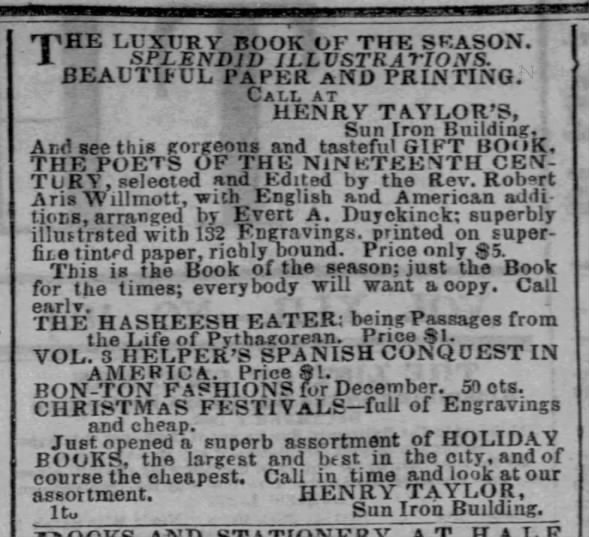
Evert Duyckinck edited the Americanized volume of Willmot's Poets of the Nineteenth Century, expanded with "liberal space" for "American authors, illustrated by American artists," published in 1858 by Harper & Brothers. Darley's illustration for Blessings on Children by William Gilmore Simms appears there on page 416; the one for Poe's The Raven on page 466. American additions included Clement C. Moore's A Visit from St Nicholas, also illustrated by Darley. With these treasures and more, the volume made a "gorgeous and tasteful GIFT BOOK" that was already available in bookstores by December 1857.
F. O. C. Darley of course had many friends among the literati including Herman Melville. In the summer of 1853 Darley visited Melville at his Arrowhead farm near Pittsfield. With "a party of gentlemen" they explored the Dome of Taconic (Jay Leyda, The Melville Log Volume 1 page 478; and Hershel Parker, Herman Melville: A Biography Volume 2, 1851-1891 pages 173-4). On another Berkshire adventure, Darley and Maunsell B. Field joined Melville for dinner with Oliver Wendell Holmes. As Field remembered it, they did not get around to eating but Field "never chanced to hear better talking" as that between Holmes and Melville on "East India religions and mythologies."
And this reminds me of a little excursion which DARLEY, the artist, and myself once made together from Stockbridge. We started in a buggy to call upon MELVILLE, intending to go from there to Dr. HOLMES's, then to the hotel at Pittsfield to dine, and thence home. We found MELVILLE, whom I had always known as the most silent man of my acquaintance, sitting on the porch in front of his door. He took us to a particular spot on his place to show us some superb trees. He told me that he spent much time there patting them upon the back. When we were about to start for Dr. HOLMES's, we invited MELVILLE to accompany us, and he accepted. We found the poet-physician, to whom I was presented for the first time, at home, and he took us into a room at the back of his house, which overlooked the mountains. For some time the talk, in which all tried to participate, dragged, and I feared that our visit would only result in boring our host, if not ourselves. At length, somehow, the conversation drifted to East India religions and mythologies, and soon there arose a discussion between HOLMES and MELVILLE, which was conducted with the most amazing skill and brilliancy on both sides. It lasted for hours, and DARLEY and I had nothing to do but to listen. I never chanced to hear better talking in my life. It was so absorbing that we took no note of time, and the Doctor lost his dinner, as we lost ours. We took tea at Pittsfield, instead of dining there, and reached home late in the evening.
-- Memories of Many Men and of Some Women (New York, 1875) pages 201-202.
In other great 4th of July news, it turns out I'm not the only one who quits singin' along every time they play a Springsteen song...

... The day was also observed by the Young Mens' Association in this city. The exercises were in the Second Presbyterian church. The Declaration of Independence was read, and well read, by Mr. G. MELVILLE. The oration which we learn was a production creditable as well to the author as to the choice of the Association, was pronounced by JOHN DAVIS, esq. The members were out in great numbers with their badges and banner, and of themselves formed a large procession, exclusive of its citizens, with whom the Association continues to be, as it deserves, a favorite as it is a flourishing and valuable institution. --Albany Argus, July 8, 1836; found at GenealogyBankWriting in 1849, Gansevoort's brother Herman Melville imagined the literary freedom Shakespeare might have enjoyed as a great American truth-teller, asserting that "the Declaration of Independence makes a difference."

For I hold it a verity, that even Shakespeare, was not a frank man to the uttermost. And, indeed, who in this intolerant Universe is, or can be? But the Declaration of Independence makes a difference. --letter to Evert A. Duyckinck, March 3, 1849
Citation:
Manuscripts and Archives Division, The New York Public Library. "1846-1849" New York Public Library Digital Collections. Accessed July 4, 2020. http://digitalcollections.nypl.org/items/df49f430-16c2-0133-5bcc-58d385a7bbd0This liberating power in the Declaration of Independence would somehow give Melville the creative freedom he needed to write Moby-Dick (1851).
We will proclaim the ideals of the Declaration of Independence, and we will never surrender the spirit and the courage and the cause of July 4th, 1776.
Upon this ground, we will stand firm and unwavering. In the face of lies meant to divide us, demoralize us, and diminish us, we will show that the story of America unites us, inspires us, includes us all, and makes everyone free.
We must demand that our children are taught once again to see America as did Reverend Martin Luther King, when he said that the Founders had signed “a promissory note” to every future generation. Dr. King saw that the mission of justice required us to fully embrace our founding ideals. Those ideals are so important to us — the founding ideals. He called on his fellow citizens not to rip down their heritage, but to live up to their heritage. (Applause.)
Above all, our children, from every community, must be taught that to be American is to inherit the spirit of the most adventurous and confident people ever to walk the face of the Earth.
Americans are the people who pursued our Manifest Destiny across the ocean, into the uncharted wilderness, over the tallest mountains, and then into the skies and even into the stars.
We are the country of Andrew Jackson, Ulysses S. Grant, and Frederick Douglass. We are the land of Wild Bill Hickock and Buffalo Bill Cody. (Applause.) We are the nation that gave rise to the Wright Brothers, the Tuskegee Airmen — (applause) — Harriet Tubman, Clara Barton, Jesse Owens, George Patton — General George Patton — the great Louie Armstrong, Alan Shepard, Elvis Presley, and Mohammad Ali. (Applause.) And only America could have produced them all. (Applause.) No other place.
-- Remarks by President Trump
<https://trumpwhitehouse.archives.gov/briefings-statements/remarks-president-trump-south-dakotas-2020-mount-rushmore-fireworks-celebration-keystone-south-dakota/>
Somewhere Trump also exalted Mark Twain as the preeminent American story-teller. Wrongly there, as any real Melville aficionado can tell you. Nevertheless, the author of Israel Potter (originally presented in Putnam's magazine as A Fourth of July Story) would have felt the fitness of tributes to western legends like Wild Bill Hickock and Buffalo Bill Cody. According to Melville, "the Western spirit is, or will yet be (for not other is, or can be) the true American one."
| Israel Potter, magazine version |
Here's hoping the proposed National Garden of American Heroes will make room for a statue honoring the author of Moby-Dick and Israel Potter, The Confidence-Man and Clarel. Put him next to Buffalo Bill, or Louis Armstrong."Though born in New England, he exhibited no trace of her character. He was frank, bluff, companionable as a Pagan, convivial, a Roman, hearty as a harvest. His spirit was essentially Western; and herein is his peculiar Americanism; for the Western spirit is, or will yet be (for no other is, or can be), the true American one." --Ethan Allen as described in Herman Melville's Israel Potter: His Fifty Years of Exile (1854-5)
Israel Potter, book version
 |
| via Library of Congress |
 |
| Francis Hopkinson.
The New York Public Library Digital Collections.
1868 - 1869.
http://digitalcollections.nypl.org/items/510d47da-2b48-a3d9-e040-e00a18064a99 |
For the COLUMBIAN MAGAZINE.
A FAIR BARGAIN.
(Written in the year 1782.)
AS Satan was taking an airing one day
Columbia's fair genius fell plump in his way,
Array'd like a goddess, and blooming as May.
Vile monster, said she, you oppose me in vain,
My people shall surely their wishes obtain;
You can but perplex us — and so mark the end on't,
For, sooner or later they'll be independant.
What you say, quoth the fiend, I confess is too true,
But why not allow the poor devil his due?
Give me one of your states, and the rest shall be free
To follow their fate, unmolested by me.
Agreed! said the lady, if that's all you want,
Here take and enjoy it — it is my Vermont.
Oh! ho! exclaim'd Satan, how gen'rous you've grown,
So kindly to give, what's already my own.
So thank you for nothing, fair lady, I trow
The Devil is not to be bamboozled so.
Come — down with your dust — you know what I mean.
I must have at least one of your fav'rite Thirteen.
A tear in her eye, and a sigh from her breast
The doubts and the fears of the genius confest;
But while she was puzzled, unable to find
Which state might with ease be to Satan resign'd,
The Five per cent. impost law popt in her mind.
This settled the point — she look'd up with a smile and
Presented his Fiendship the state of RHODE ISLAND.
He seiz'd the fair prize — cramm'd it into his pocket,
And darted away in a blaze, like a rocket.
H."A Fair Bargain" was widely reprinted from the Columbian Magazine, for example in the Delaware Courant on May 12, 1787; Worcester Magazine Vol. 3, No. 8 (Fourth week in May, 1787), page 95; Country Journal and Poughkeepsie Advertiser, July 4, 1787; and American Museum Vol. 4 (August 1788), page 87.
Throughout his political career Hopkinson wrote poetry and satire on the politically derisive [divisive] issues of the day. He penned a popular and humorous work on the 1787 Constitutional Convention. He was also an accomplished harpsichordist and composer. His work “My Days Have Been So Wondrous Free,” set to the words of Thomas Parnell’s “Love and Innocence,” is the first extant secular song by a native American composer. --Penn University Archives & Records CenterWithout reference to Hopkinson, "A Fair Bargain" is counted with poems that Mary S. Van Deusen would ascribe, tentatively and conjecturally, to her ancestor Henry Livingston, Jr.

