Showing posts with label Thomas Melvill. Show all posts

Wednesday, November 27, 2019

Steamboats Chancellor Livingston and Connecticut

Steamship Chancellor Livingston. 1822 by Richard Varick DeWitt (1800-1868).
Image Credit: Albany Institute of History and Art
The steamboat Chancellor Livingston was under the command of popular river captain Joab Center (1777-1857) when Herman Melville, age 4, rode it to Albany on August 20, 1823:
Allan Melvill's diary:   
Left New York with Mrs. Melvill, five children, Miss Adams & Nurse in the Steam Boat Chancellor Livingston at 4 P M -  
August 21     Arrived at Albany at 11 A M  --as quoted by Jay Leyda in The Melville Log, 2 vols. (New York: Harcourt, Brace and Company, 1951) volume 1, page 15.
Allan Melvill's actual diary is held with Correspondence and miscellaneous manuscripts in the Herman Melville Papers at Houghton Library, Harvard. Citation:
Melville, Allan, 1782-1832.Diary. A.Ms.s.(variously); [v.p.] 1800-1831., 1800-1831. Herman Melville papers, MS Am 188-188.6, MS Am 188, (118). Houghton Library, Harvard College Library. https://id.lib.harvard.edu/ead/c/hou00338c00127/catalog Accessed November 27, 2019
New York National Advocate - August 19, 1823 via GenealogyBank
 In August 1823 the five children of Allan and Maria Gansevoort, were
  • Gansevoort, age 7 (b. December 6, 1815)
  • Helen, 6 (b. August 4, 1817)
  • Augusta, almost 2 (b. August 24, 1821)
  • Herman, 4 (b. August 1, 1819)
  • Allan, 4 months (b. April 7, 1823)
(Catherine/Kate was born on May 21, 1825;  Frances Priscilla/Fanny on August 26, 1827; and Thomas/Tom on January 24, 1830.)

The summer before (August 7, 1822), Herman and family left New York for Providence on the steamboat Connecticut, then commanded by Captain Elihu S. Bunker (1772-1847).
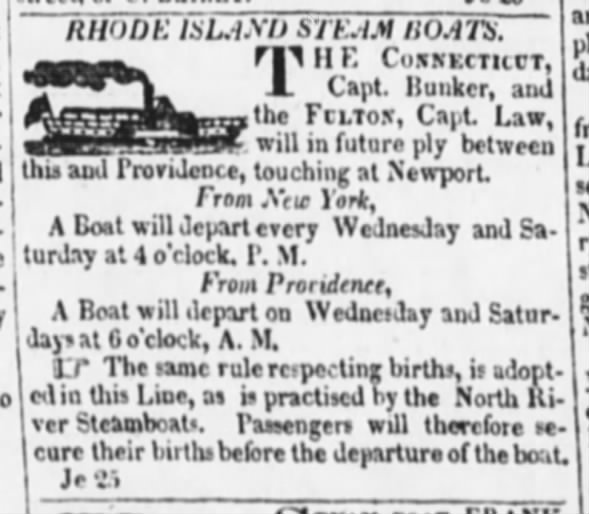
Tue, Aug 6, 1822 – Page 4 · The Evening Post (New York, New York) · Newspapers.com
After a night at Sanford Horton's Globe Tavern aka Golden Ball Inn on the corner of Benefit and South Court Streets they proceeded on to Boston "in a private Carriage" for a long visit with Herman's grandfather Thomas Melvill and family (Melville Log Vol 1, page 11).

Golden Ball Inn, Providence RI via Library of Congress
What Allan Melvill called "Horton's Tavern" in his diary was formerly Chappotin's Tavern, refurbished and re-opened as the Globe Tavern in June 1822 by Sanford Horton.

Rhode Island American - June 28, 1822, page 2
via GenealogyBank
Rhode Island American - June 28, 1822, page 3
via GenealogyBank
On the 1823 trip to Albany, "Miss Adams" was the new family governess hired in late December 1822, as Hershel Parker recounts in Herman Melville: A Biography Volume 1, 1819-1851 (Johns Hopkins University Press, 1996) pages 26-27.

More facts about the steamboat Chancellor Livingston can be found with the drawing by Samuel Ward Stanton in American Steam Vessels (New York, 1895). Accessible online courtesy of HathiTrust Digital Library:

CHANCELLOR LIVINGSTON
https://hdl.handle.net/2027/mdp.39015018442189?urlappend=%3Bseq=24

Related post:

Tuesday, August 13, 2019

1885 auction with 1872 letter from Herman Melville

Portrait drawing of U. S. historian Francis Samuel Drake
Jacques Reich, Public Domain, via Wikimedia Commons
One 1872 letter from Herman Melville is listed in the auction catalogue of Charles F. Libbie & Co., Autographs, Portraits, Broadsides, Historical Manuscripts. Belonging to the Estate of the late Francis S. Drake, Esq. (Boston, 1885), page 58:
 1039 MELVILLE (Herman), author, a. l. s. 2 pages 8vo, 1872;
          -- A. Bronson Alcott, a. l. s. 3 pages 8vo, 1872 (2)
<https://hdl.handle.net/2027/hvd.32044080272198?urlappend=%3Bseq=72>
Francis Samuel Drake the bookman, collector, and historian died in 1885, the year after publication of his memorial collection, Tea Leaves (Boston, 1884). The elaborate biographical introduction in Tea Leaves significantly expands the treatment of Thomas Melvill (Herman's grandfather) by FSD's brother Samuel Adams Drake in Old Landmarks and Historic Personages of Boston (Boston, 1873).

via U. S. Customs and Border Protection
This lot number 1039 possibly has Melville's known letter of 30 April 1872 to Samuel A. Drake, responding to Drake's request for information about Thomas Melvill and his participation in the Boston Tea Party. Now unlocated but transcribed in modern editions: The Letters of Herman Melville, ed. Merrell R. Davis and William H. Gilman (Yale University Press, 1960) pages 238-9; and the 1993 Northewestern-Newberry Edition of Herman Melville's Correspondence, ed. Lynn Horth, page 420.

It looks like Samuel A. Drake gave one or more letters from Herman Melville to his collector-brother Francis S. Drake, at some time between 1872 and early 1885.

Except for the date, it's not clear what if any connection the 1872 letter from Herman Melville had with Bronson Alcott's letter, included with Melville's in lot 1039. I'm guessing both 1872 letters were acquired at auction by Burns & Son with other items from the Drake collection. Burns & Son separately offered 1872 letters from Melville and Alcott that essentially match descriptions in the Libbie catalogue.

Burns & Son offered this Melville item, number 119, in their November 1885 Catalogue of Autograph Letters:
MELVILLE, Herman. Author of Typee, Omoo, etc.
A. L. S. 2pp. 8vo. 1872 . . . . .        75         
Price 75 cents, same as this 3-page letter from Alcott, written in 1872 about Margaret Fuller:
3 ALCOTT, A. Bronson. Author; philosopher.
A. L. S. 3 pp. 8vo. 1872. Account of Margaret Fuller and her works .... 75
Citation:
Catalogue of Autograph Letters, Selected from the Stock of Burns & Son, 744 Broadway, New York.” American Antiquarian: A Quarterly Journal Devoted to the Interests of Collectors of Autographs, Paper Money, Portraits, &c, vol. 4, no. 2, Nov. 1885, pp. 311–316. EBSCOhost, search.ebscohost.com/login.aspx?direct=true&db=eup&AN=66918716&site=ehost-live.
The most expensive item listed in 1885 by Burns & Son is the 1775 document signed by "Revolutionary patriot" Joseph Warren, "killed at Bunker Hill." "Excessively rare" and valued at 25.00. Which might be the commission of Samuel Cobb signed by Warren, lot number 1258 in the Libbie catalogue and similarly described there as "extremely rare."

Burns & Son then had their business at 744 Broadway in New York City.

A later Burns catalogue in the February 1888 number of American Antiquarian offers a one-page Melville letter written in 1860:
191 MELVILLE, Herman. Author.
       A. L. S. 1p. 8vo. 1860 . . . . 1.00
Citation:
“Catalogue of Autograph Letters, Selected from the Stock of Burns & Son, 744 Broadway, New York.” American Antiquarian: A Quarterly Journal Devoted to the Interests of Collectors of Autographs, Paper Money, Portraits, &c, vol. 4, no. 11, Feb. 1888, pp. 428–436. EBSCOhost, search.ebscohost.com/login.aspx?direct=true&db=hss&AN=69644641&site=ehost-live.
Scholarly editions of Herman Melville's correspondence reference two Melville letters offered in earlier Burns catalogues--issued before Charles De F. Burns "put his son George R. in charge" and changed the name of the firm to Burns & Son.

Bookmart - February 20, 1884
"THE best commission bookbuyer we know of in New York, Mr. Charles De F. Burns has secured Room 7 at No. 744 Broadway, and put his son George R., in charge. They will do business under the firm name of Burns & Son and all auction sales in New York, Boston, Philadelphia, and most other important places will be attended, to watch for bargains for their constantly increasing number of patrons.
The December 1878 Catalogue of Autographs, duly cited in the 1993 Northwestern-Newberry Edition of Herman Melville's Correspondence, ed. Lynn Horth, page 282, has one 1856 letter from Herman Melville.

The 1881 Burns catalogue offers a different Melville letter, written in 1858:
362. 1858, no month. 
To ?. Cited in Charles De F. Burns, Catalogue of Autographs (New York, 1881), No. 709: “Melville, Herman. Author of Omoo, etc. A.L.S. 1 p. 8 vo. 1858 . . . $.50."
This unlocated 1858 letter is referenced in the "Check List of Unlocated Letters," The Letters of Herman Melville, ed. Merrell R. Davis and William H. Gilman (Yale University Press, 1960). page 315:
< https://archive.org/details/in.ernet.dli.2015.84865/page/n361>
And the 1993 Northwestern-Newberry Edition of Herman Melville's Correspondence, ed. Lynn Horth, page 322:
<https://books.google.com/books?id=nBeBBc3m4yYC&pg=PA322&lpg#v=onepage&q&f=false>

Friday, July 7, 2017

4th of July toast to the Navy and patriotic Melvills

On the Fourth of July in 1830, Herman Melville's first cousin Thomas Wilson Melvill (formerly Pierre Francois Henry Thomas Wilson Melvill) joined the young men of Pittsfield, Massachusetts in their spirited celebration of the national holiday. Midshipman Melvill had arrived in New York on the U. S. ship Vincennes the previous month, having been gone (as reported everywhere) three years and nine months on a voyage of almost 70,000 miles that included visits to the Marquesas and Sandwich Islands.

According to a newspaper report, William Southgate offered a toast for the occasion that honored three generations of Melvill patriots: the present young midshipman, his locally prominent father Major Thomas Melvill, Jr., who served as Commissary and head of the Pittsfield cantonment during the War of 1812, and his more famous grandfather Thomas Melville, one of the Tea Party "Mohawks."

In response to Southgate's "flattering" toast, Midshipman Melvill graciously proposed his fellows, "The Young Men of America."

Boston Patriot and Daily Chronicle
July 14, 1830
Celebration at Pittsfield, Mass.--The day was celebrated by the young men of Pittsfield with great spirit. The following were among the toasts: ...
 ...
By Wm. Southgate--The American Navy--A Melvill gallantly assailed the Tea Ships of Old England: A Melvill stood forth in defence of free trade and sailor's rights; and while his descendant is guardian of our country's flag, its glory will gain additional lustre. 
[Midshipman Melvill returned thanks for the complimentary notice of his honored relatives, and the flattering allusion to himself, and begged leave to offer the following sentiment:] 
The Young Men of America--Intelligent, brave and patriotic: They well understand the principles upon which the republican institutions of their country are founded:-- Knowing their value, they will promptly obey the signal to defend them, either in the camp, the cabinet, or on the ocean.  --Boston Patriot and Daily Chronicle, July 14, 1830
Who's William Southgate?

Wednesday, August 31, 2016

Philip Hale as "Taverner" in the Boston Post, c. 1890

was engaged by the "Boston Post," in 1890, for which paper he wrote musical criticisms, editorials, and a column called "The Taverner."
In the great Pursuing Melville, 1940-1980, Merton M. Sealts, Jr. identifies "Taverner" as Alexander Young, who died in March 1891. However, ace librarian Charles Ammi Cutter in the Library Journal of September 1891 notes that "Mr. Young was only one of several who wrote in the column over that signature." People evidently assumed that Young was always "Taverner" because so many of his stories wound up in the "Here in Boston" column over that signature. On March 20, 1891 the new "Taverner" Philip Hale mourned the loss of his close friend in gracious terms, crediting Alexander Young as a frequent source of local information and inspiration while disavowing Young's actual authorship.

Found on Newspapers.com

Excerpted in Nathan Haskell Dole's "Boston Letter" dated March 23, 1891, reprinted in The Critic -  March 28, 1891. As later revealed also in the Library Journal, Dole acknowledges multiple authors of the "Here in Boston" column by "Taverner." Alongside Hale's disclosure, Dole honors Young as one member in "a brilliant trinity, quaternity or rather fraternity" of "composite, ubiquitous and genial" men writing over the pseudonym of "Taverner." Besides Alexander Young and Philip Hale, another "contributor to the same column" was Arthur Hooper Dodd (Boston Herald, March 15, 1891).

As corroborated in the National Cyclopaedia of American Biography, Philip Hale by this time had taken over as the reigning "Taverner." Additional support for Hale's authorship may be seen in the clipping above. The "Music" column signed "PHILIP HALE" immediately follows the "Here in Boston" column of March 20, 1891, in which "TAVERNER" eulogizes his friend and regular source, Alexander Young.
HERE IN BOSTON. The death of so old, so highly valued a friend as Alexander Young was a sharp and painful shock to me. I had known him long and intimately, and ever since I began to write my daily paragraphs in the POST I have drawn deeply on his wit, upon his rare stock of reminiscences, upon his notes on men and things here in Boston, upon his fund of literary information. That my name was associated with his, and that “Taverner” by many persons was considered to be no other than Mr. Young himself—this mistake I have always regarded as a great compliment to myself at the expense, perhaps, of my friend. In his way of life, in his character, he presented so close a resemblance to the ideal Taverner that the real Taverner has been led at times almost to doubt his own identity. 
Mr. Young was one of the kindliest of natures. His friendships were strong and enduring. He was a genial companion whose conversation was brilliant and sparkling, and whose wit was spontaneous and mellow, never harsh and biting. He was an ideal club man, a most delightful diner-out, a courteous gentleman of engaging manner, whose acquaintance was a delight, and whose friendship something to be cherished. He took life in a leisurely way, and while interested and in touch with all the activities of the town, he was never hurried or flurried. He was one of the founders of our Papyrus Club, and was active in bringing about the first meeting at which it was formed. It was he who interested the late N. S. Dodge and Frank Underwood in the movement, and at the first dinner at the old Park’s he added greatly to the pleasure of the occasion by his fund of information concerning the literary clubs of the past. 
It was to Dodge that he made, some time after, that witty remark which I quoted not so very long ago, without mentioning names, apropos of something or other, I’ve forgotten just what. Dodge, at the time president of the Papyrus, was sitting at one of the long tables at the Athenaeum talking with a friend. Young came in and stood at Dodge’s side, waiting for him to finish what he was saying. This disconcerted him and he made a little slip in grammar, which he was about to correct, when Young laid his hand upon his shoulder and said: "Dodge, don’t let the inaccuracies of your writing creep into your conversation.” Dodge looked a trifle stern at first, for the quality of his English, which indeed was fine, was a very tender point with him, but in a moment a smile came over his face and he joined the bystanders in the gentle laugh which Young’s remark had raised. Young’s familiarity with the English classics was notable, and his memory of what he had read remarkable. Of old-time Boston he was full of reminiscences, and I hope that the MS. of the book which I am told he was writing on Old Boston Town, is in condition to be printed. I am sure it will be a most agreeable as well as valuable volume.
...
... TAVERNER
The March 20, 1891 declaration of "Taverner" makes it desirable to revisit the attribution of several "Taverner" items exclusively to Alexander Young. Philip Hale is said in the American History and Encyclopaedia of Music to have started at the Boston Post in 1890. Too late to have contributed the 1889 items, perhaps, although Hale we also know came to Boston in 1889. Hale would take over as "Taverner" soon enough, so possibly he had something to do with at least the second of the two important 1889 items discussed by Sealts in Pursuing Melville, 1940-1980 and The Early Lives of Melville. The first Boston Post item focuses on Melville's South Sea adventures more exclusively than is usual for Hale in his later Melville notices. But in the September 13, 1889 article, references by "Taverner" to his "old friend" echo the 1891 acknowledgement of Alexander Young as "so old, so highly valued a friend." That one about Major Thomas Melville and his wife on Green Street must have been written for the Boston Post by some other "Taverner" than Alexander Young, who is surely the writer's (or collaborating writers'?) "old friend" and extremely knowledgeable informant. If Philip Hale is not yet the official "Taverner," at least he's in the area. We'll have to look for more evidence. Hopefully we can learn if this friendship between Alexander Young and Philip Hale is more than hypothetical.
  • Boston Post, September 9, 1889. "Here in Boston" by "Taverner." Calls for re-issue of Omoo and Typee; and a study of Melville's life "in the American Men of Letters series."
Found on Newspapers.com
  • Boston Post, Friday, September 13, 1889. "Here in Boston" by "Taverner." The writer and his informant are two different persons. Alexander Young most likely is the "old friend" who remembers Herman Melville's grandparents and their home on Green Street in Boston.
Found on Newspapers.com

Related melvilliana post: Forty Years of Philip Hale on Melville

Sunday, March 27, 2016

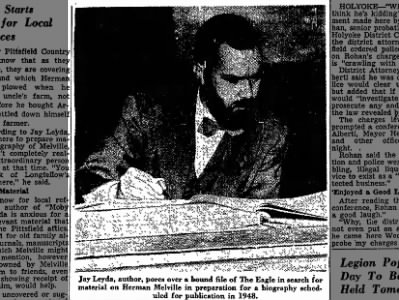
Jay Leyda, Biographer


A friendly view of Jay Leyda at work on The Melville Log ran with the photo above in the Berkshire Eagle, May 16, 1947. Headline:

Have You Any Material On Melville?
Jay Leyda, Biographer, Can Use It

... Any material uncovered or suggestions as to where material might be found may be brought tomorrow before 1 or next week to the basement of the circulation department of The Eagle, where Mr. Leyda is doing research among old volumes of the newspaper. He would like to examine any material uncovered, and possibly purchase it, if the owner is willing.... 
...This week’s research through City Hall records turned up information on a school reform committee which in 1837 came to the conclusion that “our schools are not so good and useful as they ought to be or as they can be.” The committee was headed by Thomas Melvill, Herman’s uncle. (A minor family crisis developed around the argument whether to have the “e” in the family name, the Pittsfield branch keeping with the Scottish influence and Herman’s family assuming the more elegant English ending.) The reform committee said the prime reason was the deficiency of competent teachers, because of which, “our own offspring lack the bread of knowledge.” That was in the spring of the year. By fall, Herman Melville, then 19, was installed as teacher in the Sykes district school here.

Found on Newspapers.com

Sunday, February 9, 2014

Thomas Melville, Mock Mohawk


Celebrated in verse, known around Boston as the "last of the cocked hats," Herman Melville's paternal grandfather was also remembered as a famous fake Indian. Oliver Wendell Holmes said so in later commentary on The Last Leaf:
"He was often pointed at as one of the "Indians" of the famous "Boston Tea-Party" of 1774."
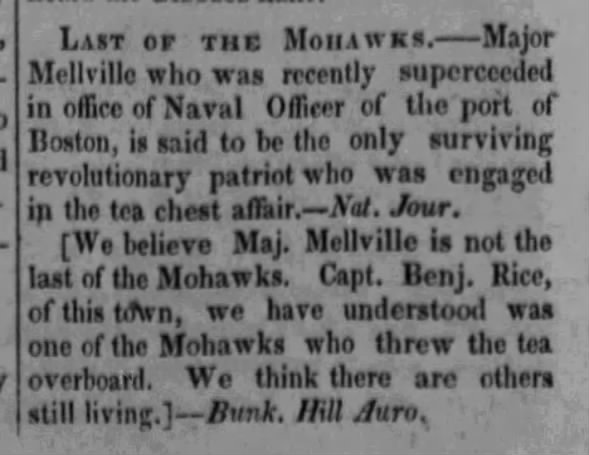
For corroboration see the following item, as reprinted in the New York Spectator from the Washington Daily National Journal:
Major Melville, who was reformed out of the office of Surveyor of the port of Boston, by Gen. Jackson, is said to be the only surviving revolutionary patriot who was engaged in the tea chest affair. This gentleman had signalized himself by his bravery and patriotism during the Revolution. It is said that when he was unceremoniously and causelessly thrown out of the little office he filled, he shed tears, not for the loss of the office, but at the ingratitude of his country. He had looked upon his appointment to the situation as a testimony of the respect in which his last services were held, and was contented with it, although it was humble. The “Hero of two wars,” in contempt of his revolutionary services, unfeelingly threw him out, in order to pay a partisan, and the majority in the Senate, obedient to the imperial mandate, confirmed the nomination of his successor. In the beautiful language of a Senator from Kentucky, “the fine enamel of their sensibilities could not be ruffled” by the cruelty of the act.—Nat. Jonr
--New York Spectator, Tuesday, April 6, 1830; found at GenealogyBank.
Reprinted from the Bunker Hill Aurora in the Manchester, Vermont Horn of the Green Mountains on April 20, 1830. The Aurora disputed the claim, commenting that "Maj. Mellville is not the last of the Mohawks."
Tue, Apr 20, 1830 – 2 · The Horn of the Green Mountains (Manchester, Vermont, United States of America) · Newspapers.com
These published treatments of Thomas Melville as a fake Mohawk, a Mock-Mohawk, call to mind the dastardly Indian chief Mocmohoc in Herman Melville's 1857 book The Confidence-Man.


Who has noted that Mocmohoc = Mock Mohawk?

James P. Kaetz in Melville Society Extracts Volume 79 ("Layers of Fiction," November 1989) summarizes William Ramsey on "The Moot Points of Melville's Indian-Hating," crediting Ramsey with the insight that
"the name of the treacherous Indian Mocmohoc can easily be seen as "mock mohawk" or "fake Indian."
Michael Rogin in Subversive Genealogy is alert to the irony and potential significance of Major Melville's assumed identity:
 “As Mohawks or the conquerors of Mohawks, in the cause of American independence, the Gansevoort and Melvill grandfathers acquired heroic power”
Some years back I quoted Rogin in a message on The Confidence-Man to the Google group Ishmailites. Prompted by an earlier post from Clare Spark, I went on to offer a different way of reading the Mocmohoc episode as a kind of masquerade or upside-down allegory. Here it is again, cut and pasted:
Clare rightly places the “Indian-Hating” chapters in Melville’s Confidence-Man “among the most difficult chapters in a difficult book.” Her reading of the admittedly complex sequence as a critique of Rousseau, the Noble Savage, and associated notions of human goodness and divine benevolence seems plausible enough. More than a few readers take the whole Confidence-Man as a satire on American optimisms, and with good reason. Still, one has to wonder why Melville the deep thinker and gifted writer would take so much trouble merely to affirm a hackneyed Puritan stereotype of Indians as devils and thereby implicitly countenance the practical and historical annihilation of Native Americans with whom, as Clare also rightly allows, Melville on principle must have regarded sympathetically as brothers. The independent-minded and sensitive-souled writer does not, one hopes, so readily embrace commonplaces.

Let me here propose another level of meaning. Not the only level worth considering, obviously, but an important one that is consistent with Melville’s characteristic aesthetic and humanist values, and consistent also, as it turns out, with Clare’s perception of a satire on smooth optimism. Try this out. Perhaps the most atrocious incident of Indian savagery in the entire “Indian-Hating” section is the massacre perpetrated by a devilishly treacherous Indian chief named “Mocmohoc.” The tale is told in chapter 26 by a mysterious stranger (identified later on as Charles Arnold Noble) who has adopted the persona of James Hall, a real-life frontier celebrity in his own right. In brief, Mocmohoc invites his new friends the Wrights and Weavers over for a feast of barbecued bear and then slaughters them. This is too terrible. What monster could be more fiendish than the host who kills his confiding guests?

But who is this Mocmohoc? As others before now have noticed, the name “Mocmohoc” suggests a fake Indian, a Mock Mohawk. Who then are fake Mohawks? The rebellious colonists who dressed up like Indians during the famous “Boston Tea Party,” of whom Herman’s paternal grandfather Thomas Melvill made one. After the Party, ebullient Bostonians chanted “Rally Mohawks! Bring your axes, and tell King George we’ll pay no taxes,” according to Michael Paul Rogin in Subversive Geneaology (p49). Rogin goes on to observe, “As Mohawks or the conquerors of Mohawks, in the cause of American independence, the Gansevoort and Melvill grandfathers acquired heroic power” (49).

Yow! A key, and the bolt turns. The story always felt like allegory anyway, and so it is. In true allegorical fashion, something stands for something else. THIS means THAT. This Mocmohoc stands for those mock Mohawks the white English colonists and revolutionary founders of America. But the mistreated Wrights and Weavers, who are they? The Indians! Consider: the strange backstory of the five cousins allusively recalls the “Five Nations” and the Iroquois Confederacy. The word “covenant” as employed by Mocmohoc suggests the “Covenant Chain” or alliance between the Indians and English colonists. The “Albany Congress” convened in 1754 to repair the chain which Mohawk leader Hendrick had declared was broken in 1753. In the Confidence-Man it is the white prisoner of Mocmohoc who accuses him of breaking “covenant.”

In a larger view, Mocmohoc’s falsely offering to “bury the hatchet, smoke the pipe, and be friends forever” mirrors the long course of treaty making and treaty breaking pursued by the new American government. For a glimpse of Melville on the official mistreatment of Indians, we might go to Typee or, closer to home, the prairie as described in John Marr and Other Sailors:
“The remnant of Indians thereabout—all but exterminated in their recent and final war with regular white troops, a war waged by the Red Men for their native soil and natural rights, had been coerced into the occupancy of wilds not very far beyond the Mississippi...
Melville evidently likes to invert stereotypical attributes of Indians and Whites. He imputes the noblest motives to the Indians, using the noblest words and phrases. Indians are Men, fighting heroically to defend “their native soil and natural rights.” The motives that inspired the great revolutions of Europe and America, the motives that inspired Melville’s grandfathers, likewise inspired the Indians. The allegory of Mocmohoc similarly inverts the usual and expected associations. By way of Judge Hall and Charlie Noble, Melville gives us a remedial lesson in American History by turning it upside down, standing history (as told by the victors) on its head.

To get the true drift, you have to own the whiteness of Mocmohoc, and the Indian-ness of the Wrights and Weavers.  -- Ishmailites 
http://en.wikipedia.org/wiki/Hendrick_Theyanoguin