Showing posts with label Mary Van Deusen. Show all posts

Wednesday, May 2, 2018

1887 letter from Cornelia Griswold Goodrich to Benson J Lossing

Various "witness letters" assembled by Livingston descendant Mary S. Van Deusen supply valuable evidence for the history of the claim that Henry Livingston, Jr. wrote "The Night Before Christmas." For a few family members this claim became a lifelong quest. I'm pleased to contribute to the story of this fascinating family legend by locating and transcribing a letter from Cornelia Griswold Goodrich (1842-1927) to historian Benson J. Lossing. Unrecorded before now, the January 1887 letter is presented here with the kind permission of the Benson John Lossing Collection, Special Collections Research Center, Syracuse University Libraries.

Although Cornelia Griswold Goodrich  does not give the year, her letter of "Jan 1st" to Benson J. Lossing was certainly written, or rather begun (since her postscript is dated January 4th) on New Year's Day, 1887. The year 1887 can be established with certainty on internal evidence, since Goodrich refers to known details of her previous correspondence with Lossing. Specifically, the mention of "much prized contents" in the first line refers to enclosures in the December 6, 1886 letter from Lossing, including a manuscript letter from Arthur Breese to Henry Livingston, Jr.

Two letters from Lossing to Goodrich dated November 25, 1886 and December 6, 1886 are held by the Dutchess County Historical Society with other Henry Livingston Papers.
  • https://dchsny.org/wp-content/uploads/2017/03/livingston_henry_papers.pdf
Transcriptions of both letters from Benson J. Lossing to Cornelia Griswold Goodrich are available on Mary Van Deusen's Henry Livingston website:
The January 1887 reply by Cornelia Griswold Goodrich is transcribed below from scans of the original manuscript letter, now held in the Benson John Lossing Collection, Special Collections Research Center, Syracuse University Libraries. For expert help with locating this item I am indebted to Kelly Dwyer, Reference Assistant; and Nicole Westerdahl, Reference and Access Services Librarian. Mistakes are all mine.
13. East 22d Street
Jan 1st [1887]

My dear Mr. Lossing,

I trust you will forgive me for the delay in answering your very kind letter, and acknowledging its much prized contents—but my excuse is, that I have been quite unwell for some time past, & I thought I would wait to get the answers to your questions from my cousin Miss Gertrude Thomas, so as not to trouble you with too many epistles.

I am so sorry I cannot give you proof positive about the poem, of which we so long to have the true authorship established. We have only the moral certainty that it is so— & the voice of many to attest it, without one written line to prove it. The husband father of the lady who writes, Charles Livingston, possessed the original manuscript & the Po’keepsie paper in which it was published & took them with him out West, but a fire in Sandusky, where he was living, completely destroyed these valuable papers, with others. If there was any possibility of getting a paper of that time—all would be made clear. I understand Mrs Judge Gannet has some. I wrote to Platt of the Po’keepsie Eagle for information but he has not deigned a reply.
It must be about the time those other verses were written which I sent you. But I suppose Mrs. Hubbard has forgotten the exact date of the paper.

I wonder what the Moore family would have to say in regard to their claim?

You will notice in the letter from Mrs. H. that she says her Mother knew her Grandpa Henry Livingston even better than her father did. The lady whom he married was a very intimate friend, whose home in those early days was “Russ Plaas”—afterwards Mrs. Smith Thompson’s home (his sister) and now the Burial Cemetary. Communication between the families was constant—daily I presume, as the places were so near— & as Charles Livingston was from home, almost even from his early youth, she of course had knowledge of many every-day matters of interest which he missed.

Mrs. Smith Thompson daughter of Henry Livingston died last year—but I have a letter from her at home, telling very much the ' same as the ' one enclosed.— owing to illness I have not been able to go up for it. but if it is still there when I get back to Southroad will send it to you. Charles Livingston is also dead. Mrs. Gurney, I still hope to hear from & will let you know—she was is a sister of Charles Livingston. My g. g. grandfather Henry had 1. son by his first wife, & one daughter; Henry Livingston; & Catherine, the wife of Arthur Breese, Judge of the Supreme Court— by his second wife, he had 3. Sons, & 4 or 5. daughters Edwin, Charles, Sidney — &c &c.

Thank you so very much for the letter from my great grandfather Arthur Breese. It announced the death, to his father-in-law, of his son Henry Livingston, who was studying law with him in Utica.

In a letter from my cousin Miss Thomas, she says that both of the poems I sent you, were copied from the original manuscripts in her possession. She could not send them to me, as the ' book they are in ' contains private matters—
I shall be most happy some day to make you a sketch of my great. g. grandfather’s house as it stood at Locust Grove in the old days. if you want it for your book of Duchess Co. you will kindly let me know, when I shall send it?

May I ask a great favor of you Mr. Lossing? — You have been so kind in giving me such valuable hints in connection with my Uncle’s memoirs—may I solicit your kind indulgence again, regarding a sketch I have made of a delightful trip we made some 15 years ago through an unfrequented part of the Black Forest? I have a great many sketches of interiors & landscapes, & I would like to know if you think it would merit publication. — If you would let me know, if your time would allow you to do me this favor, when it would be most convenient for you to receive the Mss: I will have the sketches all ready to forward with the manuscript. but I do not quite know if I must do them in pen & ink ready for publication—or simply draw them from the original & leave it to the publisher to find his own draughtsman? I do not wish to be at any expense if I can help it, & do not know what to do in perfecting the sketches. Reversing I do not understand, but if that is not necessary I shall be happy.

If I am taking too great a liberty in asking this favor of you, please do not hesitate to refuse.

We are taking great delight in reading your charming book “Mary & Martha”, & find it most interesting. My mother intends sending ' one as a present to my Aunt Mrs. Morse, in Berlin.

Please accept our heartiest Wishes for the New-Year for yourself & Mrs. Lossing, & believe me

Very Sincerely Yours
Cornelia G. Goodrich

P. S. Jan 4th. I have left my letter open hoping each day, to receive the answer from out West. but will send it later.
C. G. G.
--Transcribed by Scott Norsworthy and posted here with kind permission from the Benson John Lossing Collection, Special Collections Research Center, Syracuse University Libraries.
One of Goodrich's earlier letters to Benson J. Lossing evidently enclosed a "letter from Mrs. H." whom Cornelia Griswold Goodrich also identifies as "Mrs. Hubbard," meaning Jane Patterson Livingston Hubbard (1829-1909), daughter of Henry Livingston's son Charles and Elizabeth Clement Brewer. Lossing's Mary and Martha: the mother and the wife of George Washington was published in 1886 by Harper and Brothers. The second of two letters in the Benson J. Lossing Collection at Syracuse concerns illustrated sketches of travel in Germany that CGG apparently forwarded in manuscript, in hopes that Lossing might be able to arrange their publication. Some of this material eventually found its way into print in "Schloss Bürgeln in the Black Forest" (Woman's Cycle, July 24, 1890). Published in New York City, Woman's Cycle was founded and edited by Jane Cunningham Croly, aka Jennie June.

· Wed, Aug 17, 1927 – Page 1 · Poughkeepsie Eagle-News (Poughkeepsie, New York) · Newspapers.com
Other collections with correspondence of Benson J. Lossing include
  • Rutherford B. Hayes Presidential Center, Gilded Age Collections (GA-28), Benson J. Lossing papers, 1850-1891 - Online guide lists two letters from "Goodrich, Cornelia P." (Cornelia Platt Goodrich, mother of Cornelia Griswold Goodrich.)
Related posts:

Saturday, March 31, 2018

Fourth of July toasts in Poughkeepsie, 1826

 In Poughkeepsie, the day was celebrated with a zeal and hilarity which has never been exceeded. Col. H. A. Livingston read the Declaration. The oration was pronounced by Stephen Cleveland., esq. Col. Livingston presided at the feast, assisted by Clapp Raymond, Joseph Harris, John De La Veigne, John S. Myers and John W. Oakley, esqrs. --Albany Argus, July 18, 1826
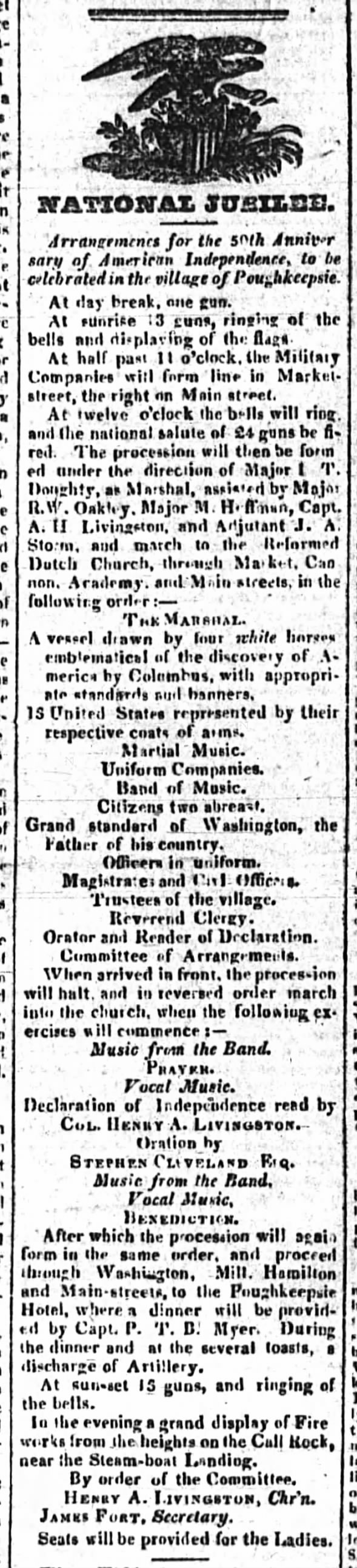
Henry Alexander Livingston (1776-1849) aka "Colonel Livingston" of Poughkeepsie was the son of Henry Livingston, Jr's older and much better known brother John Henry Livingston. Dutchess County historian Helen Wilkinson Reynolds well describes Henry A. Livingston as  "a leading citizen of Poughkeepsie for approximately half a century." If you needed a parade marshal or banquet host, Col. Livingston was your man. When Lafayette landed in Poughkeepsie, Col. Henry A. Livingston made the appropriate welcome speech. Colonel Livingston routinely officiated at Fourth of July celebrations. In 1824 the Poughkeepsie Journal (July 7, 1824) criticized the noise and fireworks that year as ridiculously and dangerously excessive. But two years later a notably grand celebration took place on July 4, 1826--the half-centennial anniversary of American independence. Colonel Henry A. Livingston naturally served as Chairman on the Committee of Arrangements. As in 1824, Col. Livingston had the honor of reading the Declaration of Independence. In between the parade and fireworks, Col. Livingston presided over the dinner and formal toasts which in this extra-special instance were "accompanied by the discharge of cannon, music from the band, and occasional songs."

Some of the toasts were evidently composed by Col. Livingston's uncle Henry Livingston Jr., then 77 years old. On the marvelous Henry Livingston website, Mary S. Van Deusen has transcribed some Scraps from 4th of July toasts which survive in manuscript (on "Livingston Microfilm" at the New York Public Library, exact location not specified). Van Deusen identifies the handwriting as that of Henry Livingston, Jr. Some years earlier, Col. Livingston's uncle Henry had expressed interest in regional 4th of July plans, in a letter to his son-in-law Sidney Breese dated July 2, 1820.
"It appears the 4th of July is to be celebrated in a novel stile in the land of your nativity. All the boats of the canal are to move in divisions from Utica, Whitesboro, Rome &ct finally, assembling at Salina, then display the Ensigns of festivity & Keep it up"
It's hard to tell from the images as reconfigured on the Henry Livingston Jr site, but the letter "R" that appears below many of the toasts in manuscript may be unrelated to Livingston's alleged pseudonym. Repeated assertions of authorship here do not seem necessary or even germane to the process of drafting suitable toasts. Presumably Uncle Henry had little reason to adopt a persona or disguise his identity, which would have been perfectly obvious to his own nephew and all concerned. In the context of toasts to be delivered at a formal dinner banquet, in this case for an unusually elaborate celebration of the "National Jubilee" in 1826, "R" might refer to a planned "Response" of some kind, either in the form of a brief speech, music, song, or--as indicated in the advertised program--a cannon blast.
"During the dinner and at the several toasts, a discharge of Artillery."  Poughkeepsie Journal, June 28, 1826.
If any surname absolutely had to be associated with the letter "R," we now have that of Clapp Raymond, Col. Livingston's first-named Vice President on the 1826 Committee of Arrangements.

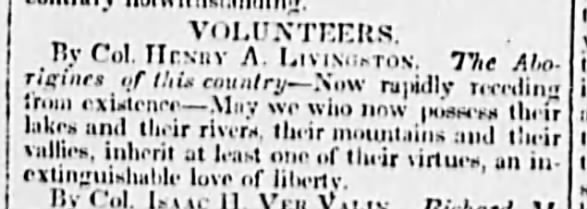
Henry's nephew Colonel Henry A. Livingston apparently did need help with the job of composing toasts with flair. In 1830 Col. Livingston recycled one of his uncle's compositions, the 1826 toast to Indians and their "inextinguishable love of liberty."

· Wed, Jul 7, 1830 – Page 2 · Poughkeepsie Journal (Poughkeepsie, New York) · Newspapers.com
VOLUNTEERS.
By Col. HENRY A. LIVINGSTON. The Aborigines of this country--Now rapidly receding from existence--May we who now possess their lakes and their rivers, their mountains and their vallies, inherit at least one of their virtues, an inextinguishable love of liberty.
 --Poughkeepsie Journal, July 7, 1830
The same toast to "Aborigines" had been proposed at the 4th of July dinner in 1826. Two of the seven manuscript toasts transcribed on the Henry Livingston site made it into the local newspaper: one to "The aborigines of this country" and the other to "The army & navy of the Union," reported in print as "The Army and Navy of the United States." From the Poughkeepsie Journal, July 12, 1826:

NATIONAL JUBILEE

POUGHKEEPSIE CELEBRATION.
The Fiftieth Anniversary of American Independence was celebrated in this village in the manner heretofore published by the Committee of Arrangements, and with a zeal and hilarity never exceeded. The dawn of day was announced by a discharge of cannon; at sunrise a national salute was fired and the bells rung. At noon the salute was repeated, and the grand procession was formed under the direction of the Marshalls of the day, escorted by all the uniform companies of the village, with the band from Freedom. The procession passed through our principal street to the Church, where the exercises of the day were performed accompanied by music from the choir and band. A fervent address to the throne of Grace was offered by the Rev. Mr. Cuyler. The Declaration of Independence was eloquently read by Col. Livingston. The appropriate and excellent oration delivered by Stephen Cleveland, Esq. obtained universal approbation, and awakened in the bosoms of the audience emotions congenial to the patriotic sentiments of an address, so ably and so elegantly adapted to the occasion and the theme. The concluding benediction was invoked by the Rev. Dr. Reed.
The procession then again formed and passing through several streets repaired to the Hotel where a dinner was provided by Capt. Myer.

Col. Livingston presided at the table assisted by Clapp Raymond, Joseph Harris, John Delavergne, John S. Myers and John W. Oakley, Esquires as Vice Presidents, and the following toasts were drank, accompanied by the discharge of cannon, music from the band, and occasional songs.

The Day--Half a century ago thousands hailed its birth, millions now join in celebrating the Jubilee and tens of millions in future ages, will plaudit its recurrence.

The Worthies--Who fifty years since signed the charter of our independence and for the support of their declaration pledged to each other their lives, their fortunes, and their sacred honour.

The Memory of Washington--Like the vast pyramids of Egypt, stands towering in the pages of history, uninjured by the waste and lapse of time.

The American Hercules--Fifty years ago, although an infant in the cradle, strangled the viper that assailed him; he is now in the vigor of youth, fond of peace, but will evade no honorable conflict.

The President and Vice President of the United States of America.

The Governor and Lieutenant Governor of the state of New York.

Our beloved country--May it continue to be the land of civil liberty and independence, until century on century shall roll away, and the last Archangel's trump shall sound.

The Militia--Success to that government which prefers armed citizens, to armed slaves.

The Army and Navy of the United States--When the occasion occurs, may the former never lack a Washington, a Fayette, or a Greene, nor the latter a Perry, McDonnough, or a Bainbridge. 
The Aborigines of this country now rapidly receding from existence--May we who possess their lakes, and their rivers, their mountains and their valleys, inherit at least one of their virtues--an inextinguishable love of liberty.

The river of our hearts--The magnificent Hudson has reently commingled embraces with the lakes of the west, and of the north, and at an early period, may she as cordially unite with her sister, the Delaware on the west.

May peace be within our gates, plenty within our dwellings, patriotism in our rulers, truth in our statesmen, piety in our preachers, virtue in our senators, and industry and honesty in the people, until time shall be no more.

The Fair Daughters of America.


Saturday, April 1, 2017

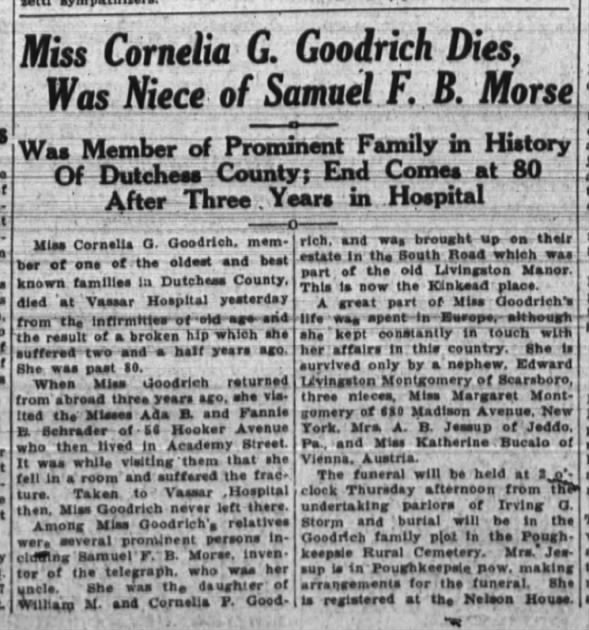
The wisdom and courage of Cornelia Griswold Goodrich

 "Let the dead past bury its dead" as Longfellow says, or as we lesser lights would say "let the old Cat die." --Cornelia Griswold Goodrich
New York City physician William S. Thomas impressed Clement C. Moore's biographer Samuel W. Patterson as "sincere, earnest, indefatigable" in his long "quest" to prove that his great grandfather Henry Livingston, Jr. wrote "A Visit from St. Nicholas" aka "'The Night Before Christmas." Patterson honored the memory of Dr. Thomas by reviewing the Livingston claim in an appendix to his 1956 biography, The Poet of Christmas Eve. In so doing, Moore's biographer was being extraordinarily nice. So, too, was Henry Litchfield West when he characterized Dr. Thomas's three decades of devotion to his idée fixe as "intelligent and unremitting industry."

Livingston descendant Mary S. Van Deusen has mistaken Patterson's kindness for weakness, in the brief critique of Patterson's work on her magnificent Henry Livingston website. In this post I want to offer a different perspective on the obsessive "industry" of Dr. Thomas after WWI, in particular as exemplified in his bullying of Cornelia Griswold Goodrich in May 1920, and her most courageous stand of defiance.

Cornelia Griswold Goodrich (1842-1927) was a great-great granddaughter of Henry Livingston, Jr. and his first wife Sarah Welles. CGG had two younger sisters: Anne Livingston Goodrich (1851-1902); and Mary Willis Goodrich (1859-1918), later Mrs. M. W. Montgomery after her marriage to Edward Livingston Montgomery (1855-1913). Mary S. Van Deusen credits CGG as one of the first persons to delve seriously into the family legend that Henry Livingston, Jr. wrote "A Visit from St. Nicholas." CGG corresponded with distinguished historian Benson J. Lossing. Misreading curiosity and courtesy as shared passion, CGG convinced herself that Lossing had been as enthusiastic for the Livingston cause as she was. In her early excitement, CGG apparently missed the wry humor and cautionary import of Lossing's 1886 reply:
"The circumstantial evidence that your G. G. Grandfather wrote "The Visit of St. Nicholas" seems as conclusive as that which has taken innocent men to the gallows."
--Benson J. Lossing to Cornelia Griswold Goodrich, November 25, 1886
Lossing the methodical historian never got the documentation he asked for in reply to CGG, most crucially the date of the Poughkeepsie newspaper in which "Visit" supposedly first appeared, and written affidavits from kin who allegedly heard Livingston's readings firsthand. The absence of basic, verifiable facts such as those requested by Lossing is the chief reason that so-called witness letters assembled by Van Deusen do not count as evidence that Henry Livingston, Jr. wrote "The Night Before Christmas." To be at all believable, key claims eventually must be backed up with facts. The earliest testimonies are mostly hearsay ("the report of another person's words by a witness") rather than direct, eyewitness reports. Supported by indirect and unreliable evidence, the Livingston claims were destined to be rejected, as indeed they have been. In print, the most thorough and convincing rejection of the Livingston claim appears in the two-part article in Manuscripts (Fall 2002 and Winter 2003) by Joe Nickell, titled "The Case of the Christmas Poem." Online, strong refutations are readily accessible via Seth Kaller's page on The Authorship of The Night Before Christmas; and in the Common-Place article by Stephen Nissenbaum titled There Arose Such a Clatter.

By 1920, Cornelia Griswold Goodrich had almost made herself crazy in the effort to prove her great great grandfather's authorship of the beloved Christmas poem. Her increasingly manic state is reflected in the disjointed letter she wrote on May 21, 1920 to William S. Thomas. Her "Cousin Will" was just then making arrangements with Winthrop P. Tryon for a fresh statement of the Livingston case in The Christian Science Monitor
"Mr. Tryon ought to show the similarity of the metre in the 4th stanza of Nancy Crooke acrostick, & some of grandfather's other poems - * ask the public if there is anything similar in any of Clement Moore's trashy poems - I don't see why we should handle him with kid gloves - there need be no "disrespect" shown him, or said of him, but facts are facts, & justice is justice...."  --Cornelia Griswold Goodrich, May 21, 1920
Although CGG began by cheering her cousin on ("I approve & applaud"), she seems headed for a crash as the letter progresses. This letter breaks off before the end ("last page missing"), but you can guess where she's going in what's left of her last sentence:
"However I say push on - even Home[r] & Shakespeare have..."
It looks to me like CGG was going to say that even Homer and Shakespeare have doubters, or have been exposed as myths by higher criticism. Her example of Shakespeare alludes to well-publicized claims for the authorship of Shakespeare's works by somebody other than William Shakespeare. Francis Bacon was probably the best known alternative candidate. However, J. Thomas Looney had just published Shakespeare Identified (London, 1920). Did Cornelia Griswold Goodrich go on to reference Looney's argument for Edward de Vere, 17th Earl of Oxford, as the true Shakespeare? We'll never know, unless that missing page turns up.

Near the end of May CGG did visit with Dr. William S. Thomas and Winthrop P. Tryon. She was surprised and extremely upset by their "inquisitional questioning" on family history. In her letter of  May 31, 1920 to Dr. Thomas, CGG recalls that Tryon "hardly opened his mouth." Tryon's silence as reported by CGG suggests that the grilling she received and here complains of was mainly conducted by her "dear" but domineering cousin:
Newburgh, N.Y. stationery

please excuse pencil May 31 1920

My dear Cousin Will,

I am writing from my bed- I could not sleep last night in thinking over our conversation with Mr. Tryon I got drawn into this cross-examination which was quite inquisitorial in its nature, Quite unwittingly for I did not realize there was to be such a delving & talking over our past history & genealogy. even to bringing in my parents, sisters, brothers, aunts & Uncles, & eventually having them in the limelight of public criticism, for the problematical authorship of that poem- In thinking it over I got frightened & the issue being very uncertain, the obloquay that would fall upon us by people & press, is more than I could stand-

My health is not good & I have been under the Doctor's orders to lead a very quiet life & that is why I am out of the city & up here. I don't sleep well & am easily distressed & worried over the least thing, and I have many things to worry me

Being very sensitive & tender hearted I really could not stand any publicity, or disagreeable controvery- "Let the dead past bury its dead" as Longfellow says, or as we lesser lights would say "let the old Cat die"

I don't approve of having the ashes of the past relative to two old Colonial gentlemen raked up stainless tho they be one as to a very problematical authorship (as we have no proof positive) & the other to a long reputed claim! It is a very delicate question to handle & I am not at all in favor of a writer for a christian science paper handling it- It ought to be touched on very delicately & by some man of eminent literary attainments- A very charming article can be made on the character of Henry L- by itself, but don't drag in the question of authorship now, wait till you find the fit man to do it- We relatives would only have dirt thrown at us by press & people for C. Moore is a demi-god almost in their eyes! almost a century has this "fetish" been adored & I will not have myself or my family mixed up in it. What inquisitional questioning has frightened me & to tell the truth & I was not prepared for it, & I was not very much impressed by Mr. T- He never gave any plan of operation & hardly opened his mouth! He has a fine subject & theme & probably would enjoy the notoriety it would bring him but it is too delicate a subject to be dragged & raked about except with great tact & reverence- As far as I am concerned & all my family to the 4th and 5th generation concerned, I do not wish them in the limelight of an antagonistic criticism before the public eye Cousin. Wait till you get some one of high literary merit to write about the authorship, we would only be scoffed at & held to derision, & fall back humiliated into our former place- Do not make this of any but a first class writer & let alone a Xian Science one.

Remember you are the grandson of an Episcopal cleryman & it appears to me like a smirch on his fair name to be connected with the other avenue of publication. I advise you to wait awhile & let us talk it over together - this summer quietly- I am not in favor of the scheme as it stands, please remember, dear Cousin Will & if we disapprove Mr. T has no right to xx for I disapprove of myself or any of my family so categorically given away (inadvertently thro enthusiasm for the subject) & talked about up in a Xian Science periodical, by a writer who has no well known name.

Wait, please wait a little longer- I am feeling too unwell & run down to discuss it now, & as others of the family do not quite approve of this publicity either, I say, wait & let the old Cat die, for the present. You as a doctor, & dear relative, do not want to make me feel distressed & make me sleepless- besides I think some of the family feel as I do about publishing this as a controvery-

My head aches badly today & I'm glad to be back in my quiet home- Didn't sleep well in N. York, or last night either. I felt after Mr. Tryon's short hand examination as tho I had been on trial before a jury! so forgive me for now changing my mind for the present- couldn't stand it- & don't let him begin this xx back & I would like to have my article back as it belongs to one of my family- We will confer this summer & don't be angry please.

Your affte Cousin Nellie

SOURCE: New York Historical Society, Thomas Papers
--transcribed by Mary S. Van Deusen
In addition to protesting the surprise "cross-examination" by Thomas and Tryon, CGG twice refers to the "problematical authorship" of the Christmas poem. She emphatically acknowledges the absence of documentary "proof positive" for the Livingston side, alongside the weight of tradition on Moore's. She well appreciates the extent to which undue focus on authorship might detract, unnecessarily, from a just tribute to the life and legacy of Henry Livingston, Jr. She fears being exposed and vulnerable to criticism as a result of airing family legends. More specifically, she expects and fears that any appearance of disrespect towards Clement C. Moore might generate negative press and recriminations.  And she strongly doubts that the Christian Science Monitor is the right venue for a balanced, sympathetic treatment of Henry Livingston, Jr. and the disputed authorship of "The Night Before Christmas." CGG keenly perceives, too, the desirability of obtaining the impartial views of a qualified expert in literary studies, "some one of high literary merit" and "a first class writer."

In short, Cornelia Griswold Goodrich came to her senses. This is no regression or lamentable failure of nerve on her part. Rather, as her letter of May 31, 1920 reveals, Cornelia Griswold Goodrich has wrestled with the dark side of prolonged self-delusion, and won. The most compelling evidence of her moral and psychological victory is the wise advice she gave to her obsessive cousin, Dr. Thomas: "let the old cat die."

Mary S. Van Deusen presents a different take on the 1920 interview and fall-out, focusing on Cornelia's "hysterical" reaction, rather than the merits of her argument, or her eloquent protest of Dr. Thomas's conduct, or her wise advice to "let the old cat die":
Thomas's papers in the New York Historical Society show that he and Mr. Tryon, a gentleman who planned to publish the information in the Christian Science newspaper, came to visit Cornelia in 1920 and try to get a brain dump of her information so that they could look for potentially missed clues. But the interview didn't go as planned. Enthusiastic before the interview and anxious to see Henry identified as the author (The right & truth does not always come out in this life but it surely will in the next, and then woe to Clement Moore!), Cornelia came out of the interview absolutely hysterical with the thought that contradicting an American icon, Clement Clarke Moore, would end up in some material hitting the proverbial fan that would not increase the fragrance of the immediate environment. She begged him not to continue, or to only publicize Henry Livingston for his other writing.  --Chapter 1, The Mouse in the House
As Van Deusen points out elsewhere, CGG was not the only female relative to push back against Dr. Thomas. Helen Thomas Blackwell (emboldened by the neutral and very sensible opinion of her husband, Howard Lane Blackwell) also complained to WST about the projected article by Tryon in the Christian Science Monitor. WST was not about to budge, however. His reply to HTB on May 18, 1920 indicates the intensity and inflexibility of his commitment:
There is no poem in the English or any other language as widely read than the "Night Before Christmas". It is the precious heritage of all children, young and old. Our great-grandfather wrote it and the fact should be known to all the world, and I propose to do my duty toward making it know. Let me bear alone whatever calumny may result; you know that I don't fear a good fight. Only I ask those of our family who shrink from controversy to give me a fair field.  --William Sturges Thomas
In a mostly conciliatory reply on May 20. 1920, Helen Thomas Blackwell still felt the need to reassert the importance of showing respect for Clement C. Moore and his reputation for honesty:
"... the article might well be impaired by what would seem to such a reader a gratuitous aspersion cast upon the truthfulness of Mr. Moore."  --Helen Thomas Blackwell
To the urgent message from Cornelia Griswold Goodrich, WST replied immediately. In his letter of May 31, 1920, WST makes it clear that although he is sorry CGG is upset, he has no intention of putting the brakes on Tryon's Christian Science Monitor article, as CGG begged him to do. CGG is mixed up, WST condescendingly tells her, confused by "mistaken impressions." She herself practically started the whole authorship quest, anyhow, and must not now hinder the investigation.
"Your interest and urgings have, up to now, been one of my chief inspirations. We have our convictions; for the Truth's sake let us stick to them, I beg of you. Have not the fatigue of your journey and its excitement, something to do with your fears? Remember the toil I have put into this thing and your former encouragement, and lend a helping hand, wont you, dear Cousin?   --William Sturges Thomas to Cornelia Griswold Goodrich, May 31, 1920
In his reply of May 31, 1920 William Sturges Thomas never acknowledges the bullying that CGG complained of in her letter of the same date. But CGG could not forget the fierceness of her cousin's interrogation. In her letter of June 9, 1920, CGG reminds WST of his "strenuous cross questioning that day, which frightened me really." Reluctantly, CGG accepts the decision by WST to go ahead with the article. Before the end, she even expresses gratitude to WST for not delivering the "scolding" that she she had expected, and feared.
But I beg you never to send me at any time any more Xian Science papers or tell me about the poem as it progresses. Just now I cannot stand it- I shall hope to write you this summer, for I am going to be in Fishkill for a few weeks to board, & then we can talk it over. --Cornelia Griswold Goodrich to William S. Thomas, June 9, 1920
Mary S. Van Deusen notes on her Henry Livingston site that "Cornelia Griswold Goodrich worked for 40 years to prove Henry's case." The letter of June 9, 1920 is the last one associated with CGG in the index of Witness Letters there. Distraught still, she implores Dr. Thomas to stop bothering her about the poem, begging him "never to send me at any time" news of the crusade. Presumably Dr. Thomas respected her wishes. Cornelia Griswold Goodrich died in 1927. Whether she was able to enjoy some measure of restored physical and emotional health, the witness letters do not say. I would be glad to learn more about Cornelia Griswold Goodrich and her experiences during any year, especially 1920-1927. In any event, her courage in 1920 remains exemplary. Likewise her hard-won wisdom, which is applicable here and now, and not only to deluded heirs of Henry Livingston, Jr.

Related posts

Thursday, February 9, 2017

Recommended fixes for MacDonald P. Jackson's flawed methodology

As I hoped to communicate in the title (the "please try again" part) and introductory paragraphs of my holiday blog-review, I relish the prospect of getting new and interesting statistical data regarding the authorship of "A Visit from St. Nicholas" aka "'Twas the Night Before Christmas." And as I've done my share of special pleading on other authorship questions ("Amen" sayeth the ishmailites), and personally made lots of errors everywhere, I was serious about the value of learning "from our mistakes" and the merits of devising an improved method of gathering and presenting statistical evidence. In the case of "Visit" I honestly don't need any particular outcome, it's just that the ample material evidence for Moore's authorship (even before my discovery of his emphatic and unambiguous 1844 claim) justified and still justifies an educated guess or reasonable expectation that statistical results on the whole will not be inconsistent with Moore's authorship. If internal evidence does look inconsistent with Moore's authorship, then we might have something interesting to talk about and perhaps even debate. For it to be scholarly and helpful, that debate would have to acknowledge somewhere that anomalies can happen without necessarily bearing on authorship, and that probabilities are not the same things as facts or events.

When I take my vehicle in for service the good folks at Luther Brookdale Honda run computerized tests that identify mechanical problems. Believe me, you don't want to break down in a blizzard on Highway 65. In that same spirit of helpfulness, I offer these fixes:
  1. Re-define the databases. More specifically:
    a) enlarge the Moore database to include all of Clement C. Moore's known poetry, unpublished as well as published. I know I said this before, but Jackson's excuse (in his Response to Scott Norsworthy) for his selective exclusion of poems by Moore fails to appreciate the irony of his making aesthetic judgments about what counts as original poetry while almost in the same breath making such a virtue of avoiding subjectivity. Verse "translations" take creative work to achieve. How much creative work depends on the poet, obviously. Also, I'm not yet convinced that usages of articles and other function words are "unconscious" reflexes as Jackson has claimed. If they are, then all the more reason for Jackson to count everything, even translations. Afterthought: this touches on an interesting authorship quandary. If we're after the authorial DNA or thumbprint, why should supposedly unconscious usages (assuming they exist, and also assuming they could accurately be identified as such) be more valuable markers than conscious ones?  Doubtless writing, like most human endeavors, involves a more or less mysterious combination of conscious and unconscious factors. It could be that conscious creative preferences reveal as much or more about a person's unique writing style than mechanical, "unconscious" reflexes. Then, too, the poets I know tend to agonize over the littlest things. If Wilde could spend all day on a comma....
    Anyhow, please note: I have no reason to expect that counting translations will in any way "improve" Moore's numbers. (Well, I had no reason at first, though later on I did stumble on another instance of "brain" in Moore's banned Prometheus translation.) Mainly I want the statistics to be as useful as possible, and to mean something. Jackson's subjective exclusion of translations is a relatively minor issue compared to his sad failure to include "Biography of the heart of Clement C. Moore." Excluding "Biography" barred one hugely telling phrase from any statistical consideration: "the lustre of the day" which suggestively resembles Moore's expression "the lustre of mid-day" in "Visit." The Museum of the City of New York has been unfailingly helpful to researchers. Now that others have done the work of transcribing for him, Jackson can easily include all of "Biography" in his improved database of known Moore poems.
    b) re-scrutinize the database of Henry Livingston's poetry and exclude poems that are not demonstrably his. More work needs to be done on the authorship of all those fascinating Carriers' Addresses. Only the 1787 Carrier's Address appears in Livingston's manuscript book. Given the natural and entirely understandable biases involved, attributions by Gertrude Thomas should be regarded as unsubstantiated claims, not evidentiary proof, of Henry Livingston's authorship. In the absence of more persuasive evidence, the 1803 and 1819 Addresses ought to be excluded from the database of known Livingston poems.
  2. Clean up the re-constituted databases by locating and correcting numerous (how numerous, I don't know) errors of transcription. So far, my hero Mary Van Deusen has done all the work around here. Besides her outstanding research and writing on family history, Mary Van Deusen has made unquestionably valuable and enduring contributions to scholarship on Henry Livingston, Jr. and Clement C. Moore. Now English Professors or their hungry graduate students can help out by finding and fixing the inevitable mistakes of transcription. Random examples: In Beekman Livingston clearly wrote "sempstress" but MVD and MPJ report "seamstress." Moore wrote "The silent snow had clad the ground" but in her online transcription of Moore's Lines Written After a Snow-storm, MVD gives Moore's word "clad" as "glad." See how one simple mistake of transcription = two statistical errors, resulting in one extra "glad" and one less "clad." To clean up this scary problem, Jackson definitely needs to go over every letter of every word of every transcription by Mary Van Deusen. Capitalization and punctuation marks need to be verified, too--especially since Jackson counts "The" and "the" as different words. Which reminds me, I need help understanding why we need to distinguish "And" from "and" and "He" from "he." There must be a good reason, I'm sure, so I won't make combining them a recommended fix. Yet.

  3. Confront and transparently deal with the problem of different versions. I can't think of an easy fix here, but the difficulties should be recognized and discussed. In the first 1824 printing of Moore's Lines Written after a Snow-Storm, the Troy Sentinel printed "ivy bowers," which is probably a copyist's or printer's error for "icy bowers." Should "ivy" be counted anyhow? Maybe not, but then why count "Dunder" and "Blixem," later revised by Moore to "Donder" and "Blitzen"?  If we're determined to count all words printed in early (or say, first) newspaper versions, then "ivy" absolutely does belong, as do other words that would need to be identified after painstaking study of first printings in, for example, the New York Evening Post and A New Translation with Notes of the Third Satire of Juvenal. On the important subject of versions, I heartily recommend John Bryant's groundbreaking study The Fluid Text.

  4. Test for everything. If you want reliable counts of function words and phonemes, fine. But count everything, including all nouns, verbs, adjectives and adverbs. After testing, present the figures for nouns, verbs, adjectives, and adverbs so that others can independently view and evaluate all the internal evidence. Jackson (in his book and recent Response) anticipates endless arguing about the significance of content and context-dependent words, but reliable frequency counts, statistically adjusted for the relatively smaller Livingston corpus, could provide a common ground and mutually acceptable boundaries. Reliable counts and frequency rates potentially could give us a solid statistical foundation for further discussion and analysis of all the internal evidence, including nouns, verbs, adjectives and adverbs. What's not to like about that?
     
  5. When testing for everything, combine Moore's published and unpublished poems in one database. Then present results for the whole database. Informative presentations on Mary Van Deusen's website have moved already in the direction I'm urging here and in #4 above, by giving raw counts of all words in all poems. But the misleading category of Word Frequencies in Divers Poems perpetuates maybe the worst flaw (besides omitting "Biography of the heart  of Clement C. Moore") in Jackson's method which is to isolate some unpublished manuscript poems, effectively (in some places) ignoring them. Notice, the figures for Moore in dark blue only reflect usages in published poems. For example, take the word brains as represented in this table of Word Frequencies. The numbers for "brain" and "brains" offer good evidence of something, but to that dark blue "9" we need to add eight more sky blue instances of brain, singular, from Moore's unpublished poems, as catalogued in the earlier melvilliana post Settle your brains. (The forbidden Prometheus translation supplies yet another instance of "brain.") Notice that Mary Van Deusen's tabulation here presents numbers for Henry+ (comprising verses Henry Livingston may not have written) while leaving out the category of unpublished poems unquestionably by Moore. The absence of Moore's unpublished poems from this key table raises the fundamental question of what database Jackson used to determine his lists of "high frequency" and "medium frequency" words. Jackson's confusing presentation makes this kind of hard to see, but it looks like he began working exclusively with Moore's published poems and only belatedly tackled the unpublished ones, after running numerous tests already, including the crucial determination of "high frequency" and "medium frequency" words. If I'm wrong about this I welcome (here as everywhere) correction and enlightenment. If only derived from Moore's published poems, those essential counts are flawed and seriously inadequate. For maximum utility, the figures for high and medium frequency words would need to be re-calculated using our new and improved and combined database of published and unpublished poems (using corrected transcripts as suggested above), including "Biography of the heart of Clement C. Moore," including also (perhaps) at least some texts of early printed versions. Off the bat, just for instance, imagine what the inclusion of Moore's long narrative poem Charles Elphinstone (corrected or not) would do to Jackson's counts of supposedly distinctive Henry favored words, especially the "high frequency" pronouns "her" and "his"; and the medium frequency pronouns "He," "She" and "His."
After writing the above, I looked more closely at Mary Van Deusen's table of figures for high frequency words. Now I see that her table actually does give counts for thirteen of Moore's manuscript poems. Not Moore's "Biography," of course, AND NOT CHARLES ELPHINSTONE. Likewise, it's the fascinatingly ambitious CHARLES ELPHINSTONE that is most conspicuously absent from the database that produced this table for medium frequency words. Looking again at the recent Response by MacDonald P. Jackson, I see he classifies the "massive" Elphinstone (guess we'd better keep quiet about Melville's Clarel) as
"one of the manuscript poems of 1843–52 that were held back for testing the tests and itself datable to 1851."
Alright then, there's your problem. Granted, it was very wrong of Clement C. Moore in 1851 to be composing long versified allegories of spiritual temptation and victory, however imaginative and potentially revealing. But remember, we're professionals here. Counting is the imperative thing. Aesthetic judgements can come later. Sometimes the dirty work of authorship attribution means analyzing such hopeless failures, no matter how "massive." As scholars we have to hold our noses and add Moore's Charles Elphinstone to the mix. So go ahead, add Elphinstone, along with Biography of the heart of Clement C. Moore and whatever else from Moore's poems, published or unpublished, might have been too-conveniently "held back for testing the tests." Fix all five problems identified here in the Melvilliana shop, and some day we might get somewhere. Then again, no amount of methodological fine tuning will help if we don't recognize compelling historical evidence of authorship when it smacks us upside the head--but that's another department.

Related posts: