
Original research and riffs on Herman Melville, authorship, and nineteenth-century American literature.
Tuesday, February 9, 2016


Monday, February 8, 2016
Identifying the good fellows with Herman Melville at "Lorry" Graham's, March 1866
The previous post found Herman Melville partying at the Manhattan residence of James Lorimer Graham, Jr. (as the 1865 Trow's NYC Directory indicates, JLG Jr. had moved back to his father uncle JLG Sr.'s place at 21 Washington Square North) on the evening of March 26, 1866.

Melville would count as one of the "invited guests," I'm guessing, rather than an official member of "The Wanderer's Club." Possibly the newspaper notice should say "Wanderers,'" plural. This Wanderers' Club resembles the "Travellers" who likewise met on Monday nights, as we know from the invitation Bayard Taylor sent to Melville on February 24, 1865. In that 1865 letter Taylor identified two fellow Travellers (Darley and Bierstadt) who also would be named as guests of James Lorimer Graham, Jr. on Monday night, March 26, 1866. Hershel Parker muses about the mutual interests of this bunch in Melville Biography: An Inside Narrative.
By late March 1866, Melville was a confirmed New Yorker, again, as well as a working and (at last!) published poet. Two Civil War poems from his forthcoming volume Battle-Pieces were already out in Harper's (with a third, "Sheridan at Cedar Creek," soon to appear under the title "Philip" in the April 1866 issue), but Melville had not yet written the prose "Supplement." So he could hold his head up among the poets there at "Lorry" Graham's soiree: William Cullen Bryant, Henry T. Tuckerman, Bayard Taylor, and Richard Henry Stoddard. At least two of Melville's fellow guests (Richard Henry Stoddard and "Barry Gray") would soon enough be his co-workers at the New York Custom House. A fine time for socializing, though deep griefs awaited Melville and his family the very next year--his wife Elizabeth contemplated leaving him by May 1867, then in September their eldest son Malcolm killed himself.
After writers and critics, the Evening Post names many artists in attendance. Shades, intimations perhaps of the departed artists and their dialogue in Melville's poem "At the Hostelry" (text available in John Bryant's edition of Tales Poems and Other Writings, and in the 1963 Russell & Russell issue of Melville's Works, volume 16 at the HathiTrust Digital Library). As mentioned already in the previous post, their radiant patron James Lorimer Graham, Jr. was a lot like Melville's conception of the Marquis de Grandvin.
And speaking of good fellows, what happened to that precious manuscript book, listed in the Century Club memorial to James Lorimer Graham, Jr. as
Related melvilliana post:
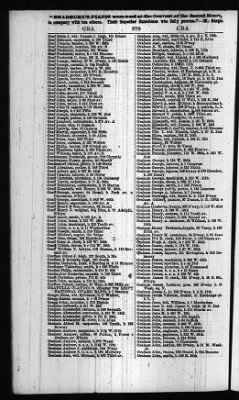
UPDATE: But wait, Fold3 and NYPL Digital Collections come through with images from the better source here, Trow's New York City Directory "For the Year Ending May 1, 1866":

A-ha. Now Trow's gives the address for James Lorimer Graham, jr. as "3 E. 17th." That's the address Bayard Taylor remembers in his 1876 obit. Most likely the March 26, 1866 gathering happened here, at 3 East Seventeenth Street.
Melville would count as one of the "invited guests," I'm guessing, rather than an official member of "The Wanderer's Club." Possibly the newspaper notice should say "Wanderers,'" plural. This Wanderers' Club resembles the "Travellers" who likewise met on Monday nights, as we know from the invitation Bayard Taylor sent to Melville on February 24, 1865. In that 1865 letter Taylor identified two fellow Travellers (Darley and Bierstadt) who also would be named as guests of James Lorimer Graham, Jr. on Monday night, March 26, 1866. Hershel Parker muses about the mutual interests of this bunch in Melville Biography: An Inside Narrative.
By late March 1866, Melville was a confirmed New Yorker, again, as well as a working and (at last!) published poet. Two Civil War poems from his forthcoming volume Battle-Pieces were already out in Harper's (with a third, "Sheridan at Cedar Creek," soon to appear under the title "Philip" in the April 1866 issue), but Melville had not yet written the prose "Supplement." So he could hold his head up among the poets there at "Lorry" Graham's soiree: William Cullen Bryant, Henry T. Tuckerman, Bayard Taylor, and Richard Henry Stoddard. At least two of Melville's fellow guests (Richard Henry Stoddard and "Barry Gray") would soon enough be his co-workers at the New York Custom House. A fine time for socializing, though deep griefs awaited Melville and his family the very next year--his wife Elizabeth contemplated leaving him by May 1867, then in September their eldest son Malcolm killed himself.
The Wanderer's Club.
The members of the "Wanderer's Club," together with invited guests, were pleasantly entertained last evening at the residence of Mr. James Lorimer Graham, Jr. The gathering was of a social character, and allowed a free and agreeable interchange of thought among the guests. The many rare and curious books, old engravings, valuable autograph letters and articles of vertu, to be found in Mr. Graham's library, were a source of unfailing interest and enjoyment to every one present. Among the guests were Messrs. Bryant, Bancroft, Tuckerman, Herman Melville, Bayard Taylor, Ripley, Duyckinck, Stoddard, Savage, "Barry Gray," W. T. Blodgett, John Van Buren, Leutze, Kensett, Gifford, Bierstadt, Laing, H. P. Gray, Launt Thompson, Darley, Ehninger, Hunt, Key, Baron Osten Sacken, Gilman, and others. --New York Evening Post, Tuesday, March 27, 1866Let's go through the list and try to identify the good fellows at Lorrie Graham's party:
- Bryant must be William Cullen Bryant (1794-1878) whose status as living literary giant gets him named first on any properly arranged guest-list.
- Bancroft = the great historian of America George Bancroft (1800-1891).
- Tuckerman = of course Melville's good friend Henry Theodore Tuckerman (1813-1871). Related melvilliana post: H. T. Tuckerman in the Boston Evening Transcript
- Bayard Taylor = none other than Bayard Taylor (1825-1878), poet and travel writer.
- Ripley = who else? reformer, journalist and literary critic George Ripley (1802-1880).
- Duyckinck = Evert Augustus Duyckinck (1816-1878), Melville's old friend, the old rift of 1852 happily repaired.
- Stoddard = Richard Henry Stoddard (1825-1903).
- Savage = probably the Irish-American journalist and poet John Savage (1828-1888). Contributed to the satirical weekly magazine, The Lantern.
- Barry Gray = writer and Home Journal critic Robert Barry Coffin (1826-1886).
- W. T. Blodgett = William Tilden Blodgett (1823-1875) the art connoisseur, future founder and Trustee of the Metropolitan Museum of Art.
- John Van Buren (1810-1866): Albany lawyer and politico, second son of President Martin Van Buren. JVB must have known Herman's brother Gansevoort in the old days.
In the late 1840s he joined his father in opposing the spread of slavery as a member of the Free Soil Party. John Van Buren, nicknamed "Prince John" by the press, was a highly regarded trial lawyer, famed nationwide for his tall, commanding appearance and his eloquence. He was Chairman of the New York Democratic Party in 1862, and was the party's unsuccessful candidate for state Attorney General in 1865. During the Civil War he continued his opposition to slavery by organizing "Union League" clubs of Democrats and Republicans loyal to the United States. He was known to alternate between periods of overwork followed by periods of dissolution, including excessive drinking and gambling that often left him in financial distress. He died at sea of kidney failure while traveling from Liverpool to New York.
-- Bill McKern - Find A Grave
 |
| A Storm in the Rocky Mountains, Mt. Rosalie Albert Bierstadt, Public domain, via Wikimedia Commons |
- Leutze = Emanuel Gottlieb Leutze (1816-1868), famous painter of Washington Crossing the Delaware.
- Kensett = painter John Frederick Kensett (1816-1872), friend of George W. Curtis.
- Gifford = Sanford Robinson Gifford (1823-1880), the artist whose painting A Coming Storm inspired one of Melville's poems in Battle-Pieces, "The Coming Storm."
- Bierstadt = Albert Bierstadt 1830-1902). best known for paintings of the Rocky Mountains and other grand, romantic western scenes.
- Laing = Louis Lang (1814-1893), another accomplished German-American painter.
- H. P. Gray = Henry Peters Gray (1819-1877), student of Daniel Huntington and painter of The Wages of War
- Launt Thompson = Launt Thompson (1833-1894), Irish-American sculptor, protege of Erastus Dow Palmer and close friend of Edwin Booth,
- Darley = Felix Octavius Carr Darley (1822-1888), the Hall-Of-Fame illustrator who visited Melville at Arrowhead in August 1853, as told by Hershel Parker in his Herman Melville: A Biography, V2.174.
- Ehninger = John Whetten Ehninger (1827-1889). Aka John Whetton Ehninger, portrait painter and etcher--1847 graduate of Columbia University, with European training.
- Hunt = Hmmm. Not William Morris Hunt (1824-1879) the American painter, a Vermonter and Bostonian, but his brother Richard Morris Hunt (1827-1895) the great New York architect. Corroborated by Stedman's poetical reference (in the 1994 memorial to James Lorimer Graham, Jr.) to "architraves and friezes" of Hunt and Thompson.
- Key = John Ross Key (1832-1920), American painter and grandson of Francis Scott Key.
Last but not least, a brace of academic diplomatists, or diplomatic academics:
- Baron Osten Sacken = Carl Robert Osten-Sacken (1828-1906), Entomologist and Russian consul general in New York.
- Gilman = ?? Only problem is having so many distinguished Gilmans to worry over...how about Daniel Coit Gilman (1831-1908), the Yale librarian, scholar, professor, and future first president of Johns Hopkins University. Gilman's early diplomatic experience "as attaché of the United States legation at St. Petersburg, Russia from 1853 to 1855" (Wikipedia) would seem to intersect somehow with that of Russian general consul in NYC and former secretary to the Russian legation, Baron Osten Sacken--which may be why the two names appear together at the end of the guest-list.
Lots here to absorb and ponder. For one thing, was the writer one of the persons listed in the Evening Post report, or a different, unnamed guest? Parke Godwin?
The University of Virginia Library has a manuscript poem to James Lorimer Graham dated November 16, 1866--the night of the honorary dinner at Delmonico's referenced by Edmund Clarence Stedman in the 1894 Century Club memorial. I'm trying to get a scan or other image of the
The University of Virginia Library has a manuscript poem to James Lorimer Graham dated November 16, 1866--the night of the honorary dinner at Delmonico's referenced by Edmund Clarence Stedman in the 1894 Century Club memorial. I'm trying to get a scan or other image of the
"Poetic tribute to Graham by an unidentified writer"who might be Stoddard or Taylor or Stedman, or another of the select company.
And speaking of good fellows, what happened to that precious manuscript book, listed in the Century Club memorial to James Lorimer Graham, Jr. as
Ye Booke of ye Goode FellowesDoes The Century Association still have "Ye Booke of ye Goode Fellowes" in the archives?
Related melvilliana post:
Sunday, February 7, 2016
Melville in March 1866, socializing with The Wanderer's Club at the home of James Lorimer Graham, Jr.
 |
| Image Credit: Consulate General of the United States Note: this is the Wall Street broker JLG, NOT James Lorimer Graham, Jr. (1835-1876) |
Monday evening, March 26, 1866 to be exact, according to the report published the next day in the New York Evening Post. The home address of James Lorimer Graham, Jr. (as listed in the 1867 Trow's New York City Directory) was his
UPDATE: Fold3 has the better source here, Trow's New York City Directory "For the Year Ending May 1, 1866." Now Trow's gives the address for James Lorimer Graham, jr. as "3 E. 17th." That's the address Bayard Taylor remembers in his 1876 obit. Most likely the March 26, 1866 gathering happened here, at 3 East Seventeenth Street. Also, James Lorimer Graham, Jr. is the NEPHEW of James Lorimer Graham. Graham, Jr.'s father is Nathan Burr Graham, as explained in the 1869 United States Insurance Gazette and Magazine of Useful Knowledge.
UPDATE #2:
If you thought the photo up top looks too late for the subject of our post, James Lorimer Graham, Jr. (1835-1876), you were right! Naively I had thought the United States Consulate General would know one of their own in Florence, Italy. Alas, they and we had the wrong man. The sharp looking JLG above is of course the Wall Street broker, partner of S. F. Johnson and Charles W. Miller.
S. F. JOHNSON & CO.. Bankers and Brokers, No. 18 Wall Street.— This well-known concern was founded originally in January, 1869, by Johnson & Day, who were succeeded by G wynne, Johnson & Day. and in 1879, Messrs. S. Fisher Johnson and Charles W. Miller formed a partnership under the present firm title. Both are thoroughly experienced men, and devote their close attention to the wants of their patrons. In 1892 Mr. James Lorimer Graham, who has been connected with the house ever since its inception, was admitted into the firm, with no change of title. They deal in all kinds of bonds, stocks, securities, etc., on commission only, for cash or on margin, and, as they are members of the New York Stock Exchange, all their transactions for patrons are governed by the strict rules controlling that honorable and reliable organization. They also do a general banking business.... --New York, 1894 IllustratedSo like the U. S. Consulate General in Florence, Italy, we're still in want of any photo of the real James Lorimer Graham, Jr. (1835-1876).
Well! Just the sort of enticements to draw out Melville as we know him in the second volume of Hershel Parker's biography: books, engravings, and heady talk with good fellows like Tuckerman, Duyckinck. and Darley. From the New York Evening Post, Tuesday, March 27, 1866; found in the online Newspaper Archives at Genealogy Bank.
First order of business will be to identify all concerned, if we can, starting in this post with the host: James Lorimer Graham, Jr. (1835-1876), familiarly known as "Lorrie" Graham. Below are links to the 1894 memorial and the catalog of his library, both published by the Century Association:
New York Evening Post, Tuesday, March 27, 1866 The Wanderer's Club.
The members of the "Wanderer's Club," together with invited guests, were pleasantly entertained last evening at the residence of Mr. James Lorimer Graham, Jr. The gathering was of a social character, and allowed a free and agreeable interchange of thought among the guests. The many rare and curious books, old engravings, valuable autograph letters and articles of vertu, to be found in Mr. Graham's library, were a source of unfailing interest and enjoyment to every one present. Among the guests were Messrs. Bryant, Bancroft, Tuckerman, Herman Melville, Bayard Taylor, Ripley, Duyckinck, Stoddard, Savage, "Barry Gray," W. T. Blodgett, John Van Buren, Leutze, Kensett, Gifford, Bierstadt, Laing, H. P. Gray, Launt Thompson, Darley, Ehninger, Hunt, Key, Baron Osten Sacken, Gilman, and others.

- James Lorimer Graham, Jr. (at Google Books);
and also available at the Internet Archive:
- A Catalogue of the James Lorimer Graham Library at Google Books;
- A Catalogue of the James Lorimer Graham Library at the Internet Archive
One of the most distinguished of his literary friends, who is with us to-night, is reported, at a dinner of literary and kindred spirits not long ago, to have offered the following toast to the memory of Lorrie Graham:In another passage from the 1894 memorial, Edmund Clarence Stedman recalled the dinner for Graham at Delmonico's on November 16, 1866 as a "unique and unforgettable" evening. The honorary "Supper" was
"Here's to Graham! Let us keep his memory green; for when we poor fellows lived on hard tack all the week, we knew that there were always champagne and oysters for us at Graham's whenever we chose to go there."
given to Lorimer Graham before his departure for Europe. This came off at Delmonico's, Fourteenth Street, on the 16th of November, 1866. From twenty to twenty-five gentlemen were there, nearly all of them Centurions, the Committee in charge being Messrs. William Bond, C. P. Cranch, Bayard Taylor, R. H. Stoddard, Launt Thompson, and the present speaker. In addition to the lyrics in hand, poems were also contributed by Cranch and Boker, but these were not so available for reproduction after the interval of twenty-eight years. Brief speeches in affectionate honor of Mr. Graham were made by the other guests. The evening was in some respects unique, and unforgetable.The night before, J. Lorimer Graham had served as honorary President of one of the tables at the lavish banquet for Cyrus W. Field. Sponsored by the New York Chamber of Commerce, the Field affair took place in the great hall of the Metropolitan Hotel. The much more intimate dinner for Graham happened at Delmonico's, which provides the setting for At the Hostelry, one of Melville's Burgundy Club poems. Melville, however, is not named as one of the select twenty-five, most of whom belonged to the Century Club.
HathiTrust Digital Library has the 1963 re-issue by Russell & Russell of the 1922-24 Constable edition of Melville's works with The Marquis De Grandvin and Jack Gentian sketches in the thirteenth volume. Admittedly, there's no getting around the fact that Melville's Marquis de Grandvin is a Frenchman,
"a countryman of Lafayette and Frédéric Auguste Bartholdi." --Herman Melville: A Biography, V2.833But good lord! look what the American Consulate in Florence, Italy has to say about former U. S, Consul James Lorimer Graham, Jr. :
"During his sojourn abroad he became a proficient French scholar and retained his fluency and perfect accent all his life. As such, he was often mistaken for a Frenchman." --U.S. Consulate - FlorenceLikewise the Appleton's Encylcopedia entry offers a number of suggestive points of comparison with Melville's convivial de Grandvin, in particular his being "widely known through his taste for art and literature and his brilliant conversational talents." (Later note: the entry below is copied nearly verbatim from the obituary by Bayard Taylor in the New York Tribune, May 2, 1876.)
Graham's diplomatic service in Italy seems transferred in Melville's Burgundy Club material to Major Jack Gentian--a disciple of the Marquis de Grandvin whom Melville imagines as the appointed American consul in Naples.James Lorimer Graham
GRAHAM, James Lorimer, consul, born in New York City in January, 1835; died in Florence, Italy, 30 April, 1876. He was partly educated at Amiens, France, where, on account of his precocious literary talent, he was selected to deliver a poetical address of welcome to Lamartine when the latter visited the school in 1848. Mr. Graham lived for a time in Rio Janeiro, and, after returning to New York, was a passenger in the steamer '" San Francisco," which foundered in a gale off Cape Hatteras. His experience in this wreck injured his health and hastened his death. In 1856 he married and settled in New York, where he became widely known through his taste for art and literature and his brilliant conversational talents. As a member of the Century club, the Geographical society, and kindred institutions, he made the acquaintance of many artists and authors. He spent the years 1862-'3 in Europe, and after remaining in New York until 1866 again went abroad. Meantime he had been busily engaged in acquiring whatever curiosities he had found in his travels, until he had large collections of coins, autographs, drawings, and books. Some time after his return to Europe, Mr. Graham was appointed United States consul-general for Italy, and resided in Florence. When the capital was transferred to Rome, he preferred to accept the office of a simple consul rather than change his home. --Famous Americans - James Lorimer Graham
Andrew M. Kavalecs writes informatively of Graham as "Fosterer of American-German Literary Relations" through his correspondence with Adolf Strodtmann.
A helpful biography by Jeffrey Begeal is available online at The Florin Website. The online biography lists a title by Mr. Begeal that would be lovely to have, if I could only find it:
- Begeal, Jeffrey. James Lorimer Graham, Jr. c. 1832-1876. Biography of an American Savant. Villa de Bella Silva Press: Smithfield, NC. 2004.
How much of "Lorrie" Graham and the wonderful Wanderer's Club do we find memorialized in Melville's uncompleted writing about the Burgundy Club?
Related melvilliana post:
Publisher's Ad for Clarel, June 1876
So G. P. Putnam's Son's issued Clarel, Melville's great poem of spiritual searching, on the same day as the "richly bound" and illustrated edition of Chiushingura; or, The Loyal League. This "Japanese Romance" was the tale of the Forty-seven Ronin, translated by Frederick V. Dickins.
It's also interesting to see Israel Potter (published by Putnam in 1855) boldly named first as the most memorable of Melville's books in 1876, ahead of Typee and Omoo. And what a cool font they use for the publisher's name and address!
From the New York Evening Post, Wednesday, June 7, 1876:

Saturday, February 6, 2016
Notice of The Piazza Tales, Lowell Daily Citizen and News

From the Lowell [Massachusetts] Daily Citizen and News, Tuesday, June 3, 1856:
THE PIAZZA TALES, by Herman Melville, author of "TYpe," "Omoo," &c. New York: Dix & Edwards.
This neat volume contains five of Melville's tales, mostly nautical, written in his piazza in Berkshire--a piazza which astonished every old settler because it was on the north side of the house. The materials for these stories are mostly Spanish. (Sold by Joshua Merrill.) --found in the online Newspaper Archives at Genealogy Bank
Tuesday, February 2, 2016
"I cannot pretend to judge of their 'piety'": Professor Clement C. Moore, speaking of his students in reply to inquisitors
 |
| Image Credit; Daytonian in Manhattan |
As Seth Kaller shows in his excellent article on the authorship of The Night Before Christmas, and as Stephen Nissenbaum expertly confirms in his January 2001 essay at Common Place, Don Foster woefully misrepresented the character and abilities of Clement C. Moore. Foster's mudslinging in Author Unknown carried plenty of argumentative weight, or tried to: it's easier for readers to deprive Moore of due credit for authorship of the classic Christmas poem when he's made to resemble a nasty combination of Scrooge and Grinch.
One of several false charges in the Christmas chapter of Foster's Author Unknown is that on Christmas Eve 1844, Moore turned "theological inquisitor" and very likely ruined the life of a poor seminary student named Wattson. If Foster and this WorldCat entry are right, Moore miscalled the student Joshua (possibly confusing Wattson with another student then under scrutiny) but his name was Joseph Newton Wattson. Here as elsewhere, Foster ignores vital context. Moore's General Theological Seminary was just then the focal point of conflict in the Episcopal Church following a controversial ordination (in 1843, of Arthur Carey) and sensational accusations against Bishop Onderdonk. Evangelical or "low church" opponents of Onderdonk suspected undue influence of the Oxford Movement among professors and students. The great fear of Charles P. McIlvaine and like-minded evangelicals was encroaching Romanism. Clarence Augustus Walworth, a classmate of Wattson's who eventually dropped out, converted to Catholicism and became a priest, retold the story in his memoir--significantly titled The Oxford Movement in America. As Walworth tells it another man acted the part of inquisitor, Professor of Ecclesiastical History John D. Ogilby:
He [Professor Ogilby] took it into his head that there was an organized party both in the seminary and outside, including clergy, whose object was to Romanize the Episcopalian Church.
One day near the close of December, 1844, Professor Ogilby sent for one of the students named Wattson, of the middle class, and accused him and several other students of being engaged in this conspiracy. The manner in which this suspicion arose I never knew until lately. The particulars have been furnished me by Wattson's own son, the Rev. Lewis Wattson, of Kingston, N. Y., with permission to use his communication freely. His father, Joseph N. Wattson, one day jokingly said to Prescott, who subsequently became a member of the English Society of St. John the Evangelist, known in the Anglican Church as the Cowley Fathers: "Don't you know, Prescott, that there is a number of Jesuit students in disguise here at the General, and that when they have made all the converts they can, they are going openly to Rome themselves?" Prescott took the joke in dead earnest and reported it to the dean. Upon this Wattson was called up before the dean. In due course of time he, and another student named Donnelly, of the same class, namely, that of 1846, were publicly tried upon charges founded upon this misconception. They were acquitted for want of sufficient proofs, but for all that they were quietly dismissed. --The Oxford Movement in AmericaFar from being remembered as a ruthless tormentor of budding campus Catholics, Moore gets special and highly complimentary mention from the start of Walworth's memoir:
Santa Claus himself could not be more welcome to children than was this odd and genial man upon his appearance in the Hebrew class. He was very particular in his ways; but one great feature of his peculiarity was, that he was utterly unartificial. He was droll, but unconsciously so. He never joked in the class, but always something made the classroom seem merry when he was in it. He was a true scholar in Hebrew. His knowledge of Hebrew words did not seem to be derived from the dictionary alone. He knew each word familiarly, and remembered all the different places where it occurred in the Hebrew Bible, and so could prove its significance in one place by the meaning which necessarily attached to it elsewhere. --Walworth, The Oxford Movement in AmericaIn Beyond the Road to Rome, Wattson's son gives further details of the seminary inquest, without reference to Clement C. Moore. Further information on the whole episode is available in the article by Scott MacDougall titled Hidden Jesuits?: "Romanizing" and Inquest at the General Theological Seminary, 1845--originally published in the March 2007 issue of Anglican and Episcopal History.
MacDougall, Scott. “Hidden Jesuits?: ‘Romanizing’ and Inquest at the General Theological Seminary, 1845.” Anglican and Episcopal History 76, no. 1 (2007): 89–118. http://www.jstor.org/stable/42613041.
As MacDougall verifies, Wattson's first accusers were fellow students who reported him not to Professor Moore but to Moore's colleague Professor Ogilby. Foster paraphrases a letter signed by Clement C. Moore, giving it as evidence of a personal Christmas Eve vendetta by Moore (what a Scrooge!) against Wattson. But Foster never mentions and may not know that Moore was simply writing to Wattson formally, in his capacity as faculty Secretary. In a poisoned and contentious atmosphere, the seminary faculty as a whole and Moore in particular exerted a moderating influence, as MacDougall explains:
Below is Moore's written response to the Bishops' 43 questions. Most of them he refuses to answer directly, but his decent and dignified reply to #13 essentially answers them all:
 Related posts:
"Showing more restraint, the faculty opted not to speculate on the outcome of the questions and resolved to interview the students. No punishment was specified. The faculty did agree however, to notifying Wattson's and McVickar's parents and their diocesan bishops. They added a further resolution, calling on Ogilby to provide the charges and the list of witnesses to Clement Moore, who, as secretary of the faculty, would send the requisite letters to the accused, their parents, their bishops, and to the witnesses to be called. The date of the inquest was set for 7 January 1845." --Scott MacDougall on "Hidden Jesuits?"As MacDougall reports in his review of faculty minutes, Moore absented himself from several sessions of the January inquest. Moore is also recorded in the minutes as objecting to the charge against student Henry McVickar of "advocating papal supremacy and Anglican reunion with Rome":
"Moore disagreed with the first charge, stating that McVickar had said only that the Pope was the head of the church, in an acceptable sense, but he was outvoted by his colleagues,and the charge stood." --Scott MacDougall on "Hidden Jesuits?"As reported by E. Clowes Chorley in The Oxford Movement in the Seminary, Moore refused to endorse what he called "idle and malicious rumours."
Below is Moore's written response to the Bishops' 43 questions. Most of them he refuses to answer directly, but his decent and dignified reply to #13 essentially answers them all:
To the 13th question I answer, that in my department, I have no reason to complain of want of "diligence" in the majority of the students; that I cannot pretend to judge of their "piety;" that I believe them to be orderly; and that I think the "general tone of their manners and behavior" good. --Clement C. Moore, October 20, 1844Documentary proof (if any is wanted) of honorable conduct by Clement C. Moore in a time of notable stress and conflict at General Theological Seminary:
Monday, February 1, 2016
More testimony from Orville L. Holley for Clement C. Moore's authorship of "A Visit from St. Nicholas," aka "The Night Before Christmas"
 |
| Ontario Repository and Freeman - December 28, 1836 via NYS Historic Newspapers |
"Published anonymously in 1823, "The Night Before Christmas" has traditionally been attributed to Clement Clarke Moore (1779-1863), who included it in his Poems (1844). But descendants of Henry Livingston (1748-1828) claim that he read it to his children as his own creation long before Moore is alleged to have composed it. This book evaluates the opposing arguments and for the first time uses the author-attribution techniques of modern computational stylistics to settle the long-standing controversy. Both writers left substantial bodies of verse, which are analyzed for distinguishing characteristics. Employing a range of tests and introducing a new one-statistical analysis of phonemes-this study identifies the true author and makes a significant contribution to the growing field of attribution studies." --Publisher's BlurbNotwithstanding Don Foster's entertaining take in the Christmassy chapter 6 of Author Unknown: On the Trail of Anonymous (Henry Holt and Company, 2000), all the documentary and historical evidence remains on the side of Clement Clarke Moore. Well there's no glory left in taking down Professor Foster's practice of authorship attribution, not after Brian Vickers (and before Vickers, Richard J. Kennedy on Shaksper) heroically slammed it to the Devil in Counterfeiting Shakespeare.
About the renowned Christmas poem, excellent rebuttals of old and revived claims for Henry Livingston, Jr. may still be found online:
- by Seth Kaller of Seth Kaller, Inc.
https://www.sethkaller.com/about/educational/tnbc/ and by
- Stephen Nissenbaum, author of The Battle for Christmas, at Common Place
https://commonplace.online/article/there-arose-such-a-clatter
Unless more evidence emerges, Moore will remain the acknowledged and celebrated author of “The Night before Christmas.”Stylometry results are always fun to look at. Hard style numbers are especially satisfying to have in conjunction with other kinds of evidence. In this case, if advanced stylometry or "computational stylistics" were to yield evidence for Livingston's authorship, an interesting problem might confront us in the imbalance between documentary evidence and style data.What happens when they don't agree? Can stylistics alone trump recorded history? Prove authorship? Not that I would expect such a dramatic turnaround here. The diction of "The Night Before Christmas" clearly belongs to Moore, as the online comparison of phraseology by Joe Nickell indicates. While we're eagerly waiting for Macdonald P. Jackson to tell us about function words and phonemes, here's another piece of historical evidence for Clement C. Moore. As long known, veteran newspaper editor Orville L. Holley tipped readers to the author's identity in 1829 when he introduced a holiday reprinting of the instant classic as follows:
Five years after the first publication of the legend in the Troy Sentinel, the name of the author was disclosed to the editor of that journal. With considerable delicacy of manner, he disguisedly confessed his knowledge of it on January 20th, 1829, by saying:In the 1836 item below, transcribed from the Ontario Repository and Freeman (Canandaigua, New York), the same editor Orville L. Holley states that he learned of the author's true identity only months, not years, after printing the poem in the Troy Sentinel.
"A few days since the editors of the New York Courier, at the request of a lady, inserted some lines descriptive of one of the Christmas visits of that good old Dutch saint, St. Nicholas, and at the same time applied to our Albany neighbors for information as to the author. That information, we apprehend, the Albany editors cannot give. The lines were first published in this paper. They came to us from a manuscript in possession of a lady in this city. We have been given to understand that the author of them belongs by birth and residence to the city of New York, and that he is a gentleman of more merit as a scholar and a writer than many of more noisy pretensions. We republish the lines in a preceding column just as they originally appeared, because we still think of them as at first, and for the satisfaction of our brethren of the Courier, one of whom, at least, is an Arcadian." --Troy's One Hundred Years
SANTA CLAUS, WITH HIS CHRISTMAS GIFTS.
The following lines appeared in print for the first time—though very often copied since—in the Troy Sentinel of December 23, 1823, which paper we then conducted. They were introduced, on that occasion, with the following remarks; which, as they continue to be a true expression of our opinion of the charming simplicity and cordiality of the lines, as well as of our unchanged feelings toward the little people to whom they are addressed, we repeat them, only observing that although when we first published them, we did not know who wrote them, yet, not many months afterwards we learnt that they came from the pen of a most accomplished scholar and and estimable man, a professor in one of our colleges....
--found at NYS Historic Newspapers. This item was reprinted the following week in the Auburn Journal and Advertiser on Wednesday, January 4, 1837.Herman Melville's future friend Charles Fenno Hoffman identified Clement C. Moore by name as the author of "A Visit from St. Nicholas," when the poem appeared in the collection that Hoffman edited titled The New-York Book of Poetry. Hershel Parker has a good bit on Hoffman's later dealings with Gansevoort Melville and the author of Typee in Herman Melville: A Biography V1.471. The review of Hoffman's edition in the January 1837 American Monthly Magazine described the The New-York Book of Poetry as "a collection of fugitive poetry, selected from the annuals and periodicals, and other sources, intermingled with extracts from the poems of Drake, Sands, Paulding, Leggett, Nack, and others, whose poetical writings have been heretofore published in other forms; all the writers being native New-Yorkers." This review reprinted "A Visit from St. Nicholas" with a few words of introduction:
The lines which follow have been much admired, and have appeared in a variety of publications, but never, we believe, before under the name of the real author—CLEMENT C. MOORE. --American Monthly Magazine, January 1837For anyone craving more Melville, here you go--two fine Santa Claus poems for dessert:
Related posts:
- Clement C. Moore's published letter on his authorship of "A Visit from St. Nicholas"
Subscribe to:
Posts (Atom)