This is the book for any reader on Santa's nice-list who ever cared or wondered who really wrote "A Visit from St. Nicholas," better known as "The Night Before Christmas." More broadly, I imagine The Fight for "The Night" by Tom A. Jerman will appeal to mystery buffs, poetry lovers, holiday traditionalists, fans of children's lit, students of American literary history, 19th century specialists, and the growing number of persons who relish true stories about college English professors behaving badly.
Sick-in-the-head authorship obsessives like me already bought it, probably, but won't object to receiving an extra copy. Meticulously documented yet super enjoyable to read, being refreshingly free of academese, Fight for "The Night" thoroughly examines the disputed authorship of the now famous rhymes that first appeared, anonymously, in the Troy Sentinel on December 23, 1823. The timing of Jerman's follow-up to Santa Claus Worldwide (McFarland & Company, 2020) is perfect since this year marks the 200th anniversary of the classic Christmas poem's debut in Troy.
Non-obsessives I'm told genuinely love to recall 'Twas the night before Christmas and hear it recited in the family circle, year after year, no matter the author. Still, I have to believe that even the happiest and mentally healthiest of my fellow mortals will be pleased to know for sure which guy deserves credit for our present-day notion of Santa as a "right jolly old elf" who lands on lawns and flies to rooftops in a "sleigh full of toys" propelled by eight reindeer. Alright then, who described Santa Claus and his magical mystery "Visit" on Christmas Eve so memorably, going down the chimney "with a bound," then up again and away "like the down of a thistle"? Esteemed Bible scholar Clement C. Moore
Clement C. Moore (1779-1863)
or Poughkeepsie farmer, surveyor, and local magistrate Henry Livingston Jr?
Henry Livingston Jr. (1748-1828)
Before continuing, some necessary disclosures and disclaimers. Transparency here seems all the more desirable in view of Jerman's illuminating comparisons of participants in authorship debates to "corners" in a boxing match and (in a pleasing diversion from the controlling "prize fight" metaphor) "expert witnesses" called by opposing attorneys to testify in court. With respect to authorship of "The Night Before Christmas" I'm squarely in Moore's corner. You can check out my chief reasons in the 2017 post on How we know Clement C. Moore wrote The Night Before Christmas.
I feel honored indeed to have been counted in Tom Jerman's book with Niels H. Sonne, Nancy H. Marshall, Stephen Nissenbaum, Pat Pflieger, Seth Kaller, and Joe Nickell as a public defender of Clement C. Moore and the merits of his longstanding claim to have written the beloved Christmas poem.
Lately, however (and independently of Jerman's Fight) the claim for Henry Livingston, Jr. appears to have lost much of the traction it had in years past. Major Livingston's descendant and most dedicated advocate Mary Van Deusen declared victory in 2016 after the publication by McFarland & Company of MacDonald P. Jackson's monograph, Who Wrote "The Night Before Christmas"? But Van Deusen's great Henry Livingston website has not been updated with fresh authorship-related content for a good while now. In the meantime, here on Melvilliana I have documented a number of discoveries that support the traditional attribution to Clement C. Moore. On their Red-Pilled America podcast, storytellers Patrick Courrielche and Adryana Cortez have incorporated some of my findings in highly entertaining Christmas episodes. Bloomberg Opinion columnist Justin Fox has convincingly defended Moore from the false charges of keeping enslaved persons and endorsing slavery. Link here to the Bloomberg site with his 2021 article A Gift for America's Christmas Poet: Rehabilitation:
More than fittingly, Clement Clarke Moore will be inducted into the New York State Writers Hall of Fame on December 19, 2023. Ceremony to be held at Hoffman Hall of the General Theological Seminary of the Protestant Episcopal Church in the Chelsea neighborhood of Manhattan.
Amidst all this bicentennial buzz, it might be well to note that the "tale of the tape" with regard to the long-running authorship debate has not been fully presented anywhere in any format. Until now, that is. The Fight for "The Night" brings it, with easily the most complete and persuasive account in print of the contest for authorship credit. Of course I'm pleased by the good use made of findings originally posted on Melvilliana. Three prime examples would be
the 1844 letter to the editor of the New York American in which Moore unambiguously claimed authorship of the Christmas verses "not for publication, but to amuse my children" (quoted and discussed by Jerman in Fight, pages 27-28);
the previously overlooked fact that T. W. C. Moore (the fellow who obtained a manuscript copy of the poem for the New York Historical Society in 1862 after a personal interview with Clement C. Moore) was a first cousin of Henry Livingston, Jr (Fight, pages 216-219); and
the anonymous publication in the Troy Sentinel of another poem by Moore, later titled Lines Written after a Snow-Storm on February 20, 1824, just 2 months after "The Night Before Christmas" (Fight, pages 19-20).
I'm very glad also to find my five Livingston "deal-breakers" inventoried on pages 314-316; and naturally gratified by the serious attention given on pages 316 and 351 to my Eight Great favorite expressions of Clement C. Moore which turn out to be more useful than Jackson's relatively dreary set of six for the purpose of distinguishing Moore's verses from Livingston's.
As he did also in his previous book Santa Claus Worldwide, Jerman not only provides a valuable synthesis of published work on his chosen subject, he makes original contributions of his own that significantly enrich our understanding of that subject. There, the history of St. Nicholas and other midwinter gift-bringers; here, authorship of "The Night Before Christmas." For one of many original insights here, check out Jerman's lawyerly explanation for Moore's much-discussed delay in publishing his Christmas poem (Fight, pages 29-32). Jerman reasonably proposes that Moore took the most "prudent course" by waiting until William Gilley's copyright on The Children's Friend (the "Old Santeclaus" poem therein being an obvious literary source for "The Night Before Christmas") expired in 1835 before authorizing its reprinting the following year in The New-York Book of Poetry.
Another highlight for me is the full transcription of Moore's comical poem The Pig and the Rooster, together with the excellent analysis thereof (Fight, 257-265). Jerman takes Moore's lighthearted exercise as "a witty and enjoyable piece," contra haters for the last hundred years. In a fine appreciation of Moore's Seussian verve, Jerman concludes:
The closest analogy to "The Pig and the Rooster," however, is probably "The Big Brag," one of the "other stories" in Yertle the Turtle, about a rabbit and a bear who boast that they are the "best of the beasts" because of the range of their hearing and smelling abilities, respectively. In the course of their obviously bogus brags, they are interrupted by a worm who explains in an utterly condescending tone that he can see so well his vision actually circles the world, allowing him to see the backsides of the rabbit and bear, "the two biggest fools that have ever been seen." In both sound and sense, Moore's "The Pig and the Rooster" is comparable to "The Big Brag" and many other Dr. Seuss stories. (Fight, page 262)
Challenging naive acceptance of hearsay on the Livingston side (by Jackson, for example, in Who Wrote "The Night Before Christmas"? pages 110-112) Jerman develops a strong argument against taking so-called "witness letters" from distant Livingston descendants as evidence of anything bearing on authorship of "The Night Before Christmas," other than beliefs (erroneous and conflicting, often) of the writers. See especially the sections in Chapter 10 of Fight for "The Night" under sub-headings "The Unreliability of the Livingston Witness Letters" at pages 227-229 and "Witness Letters Are Second-, Third-, and Fourth-hand Hearsay" at pages 229-236).
Two punches late in this "literary prize fight" dropped Livingston cold. Delivered in chapters 10 and 11, these particular hits are so devastating to the contender's chances that a more compassionate reader-ref might have stopped the figurative Fight then and there. The first blow exposed a known but insufficiently exploited weakness in the story of Henry Livingston's writing "The Night Before Christmas" years before its main sources were published. Livingston partisans who say their man wrote "The Night Before Christmas" sometime between 1807 and 1809 (roughly guesstimated) fail to account in any satisfactory way for the twin influences of Washington Irving's A History of New-York (1812 ed. or later) and the illustrated poem Old Santeclaus (1821). In Fight for "The Night" Jerman persuasively frames these works as inescapable precedents and literary sources for specific details in "A Visit from St. Nicholas" (pages 209-212; 224-227; and 329).
Other investigators have pointed out the big problem of chronology (awfully hard to credit Livingston with writing a poem around 1808 that is demonstrably indebted to two different literary works not yet printed, hence inaccessible until 1812 and 1821) but none so effectively. Practically regarded, the need of Livingston supporters to make their candidate a time-traveler invalidates the claim. So effectively that I might want to appropriate it some day, if Tom Jerman would let me, for a sixth Livingston "deal breaker."
Same goes for the second heavy blow dealt to the contender in round-chapter 11, pages 273-280. This one also would make a devastating deal-breaker, perhaps the future #7 on my list. Simply put, Clement C. Moore's immediate family and church celebrated Christmas in high style, Livingston's did not. The contender's corner has failed to show that Henry Livingston, Jr. gave a fig for Christmas and related holiday festivities, apart from belatedly wishing his sweetheart and future wife "Happy Christmas" in a letter to Sally Welles dated December 30, 1773. Surprisingly, the Poughkeepsie patriarch represented as the embodiment of pure Christmas joy has never been caught decking the halls, baking Christmas cookies, caroling with the family, or (most tellingly of all) even once acknowledging St. Nicholas, Santa Claus, or any other midwinter gift-giver. In Jerman's words, aptly channeling Theodor Geisel aka Dr. Seuss: "Like the Whos down in Whoville, the Livingston family had no presents, no ribbons, no wrappings, no tags, no tinsel, no trimmings, no trappings, no Christmas pudding, and no Who roast beef" (Fight, page 278). As clarified on the back cover of Fight for "The Night" "Livingston's religion, Dutch Reformed, prohibited celebration of Christmas or veneration of saints whereas Moore, a devout Episcopalian, celebrated in traditional English style and treated St. Nicholas as the Christmas gift-giver."
The middle rounds of Jerman's Fight, chapters 7 ("Basic Principles of Authorship Attribution" and 8 ("Best Practices for Authorship Attribution"), establish ground rules that could and ideally should have governed the contest--when conducted, that is, by highly trained academic "experts." These sections are a wonderful gift to anybody interested in all kinds of authorship questions, not only pertaining to "The Night Before Christmas." Jerman delves into the nitty-gritty of authorship attribution as a distinct field of scholarship. Chapter 7 summarizes important work by Samuel Schoenbaum, Harold Love, Janet Ainsworth, Carole E. Chaski, Patrick Juola, and other leading scholars. Traditional and non-traditional varieties of evidence are weighed and helpfully discussed, along with the virtue of "validity testing" your method. Reviewing best practices, chapter 8 further highlights the good advice of Patrick Juola that "experts in the field 'prevalidate' methods of authorship attribution through the establishment of appropriate, formal protocols" (as distilled by Jerman in Fight, page 173).
Fans of "English Professors Behaving Badly" can skip the ground rules and proceed straight to round-chapter 9 in Fight for the Night, itemizing "Foster's and Jackson's Violations of the Best Practices." I know that Don Foster's meanest and nastiest attacks on the character of Clement C. Moore were convincingly rebutted long ago by Nissenbaum, Kaller, and Nickell. The trouble, as Jerman rightly perceives, was the attempted rescue of Foster's awful arguments by distinguished Shakespeare scholar and authorship expert MacDonald P. Jackson. In postmortems on the Funeral Elegy fiasco, Foster's method of authorship attribution had just become a textbook example of high profile failure when Jackson backed him on the Livingston side. Jackson inadvertently revealed his bias for Livingston throughout Who Wrote "The Night Before Christmas"? despite the posture of cool scientific objectivity that he tried to maintain. As Jerman demonstrates, Jackson like Foster before him employed a seriously flawed methodology. Each expert committed multiple violations of the "best practices" handbook according to Jerman, including failure to test for accuracy (Fight, pages 175-176); use of inaccurate corpora (176-181); failure to use independent researchers (181-185); failure to provide a profile of the likely author (185-187); adopting the role of "hired gun" (187-192); and unacknowledged sources of scholarly bias (192-196).
I'm a little disappointed tbh that (unless I missed it?) Jerman did not mention my favorite exhibit of confirmation bias, the place in Who Wrote where Jackson acknowledged eight instances of the Moore-word "like" then quickly discounted their significance.
Fortunately, however, my trivial loss is more than compensated in Jerman's 13th and final chapter (no more rounds, the "fight" metaphor is exhausted by this point). Don't be fooled by its boring title, "The Use of Nontraditional Analysis." Chapter 13 is way more than a stocking stuffer. It's more like a plain box or carelessly wrapped package that contains your dream-present, something fantastically grand you never really expected to get. Say a first edition of Herman Melville's epic religious poem Clarel: A Poem and Pilgrimage in the Holy Land (New York: G. P. Putnam's Sons, 1876), both volumes; or the smart-remote-key-fob to a new Firecracker Red 2023 Jeep Wrangler Rubicon. Jerman's gift to me and every truth-seeker in the last section of the last chapter of Fight for "The Night" involves "The Use of JGAAP in the Moore-Livingston Dispute." JGAAP stands for the Java Graphical Authorship Attribution Program, described by EVL Labs on evllabs.com as "a Java-based, modular, program for textual analysis, text categorization, and authorship attribution i.e. stylometry / textometry." Jerman really has two surprises in store for the patient and attentive reader. The first would be his discovery of previously unreported results from one earlier trial of Moore v. Livingston using JGAAP.
The second surprise is the good and equally unexpected news that "with some friendly advice from Juola," Tom Jerman was able to perform another series of 17 tests in JGAAP using the same bodies of texts or "corpora" as before. Jerman identifies the clear winner and his Endnotes list categories of specific tests for both trials. Relative numbers and percentages within each test are not provided, and not really needed I suppose by general readers. Here, then, a fine opportunity opens up for further research. Future investigations using JGAAP can confirm if Jerman's findings are repeatable. Even better, researchers could try the same battery of tests with more realistic corpora, minus unsubstantiated attributions to Livingston of some Carriers' Addresses and other poems that should have been rejected as incompatible with best practices.
This line of legitimate research makes a great gift for anybody in the Livingston corner. That would include me, too, since I never had anything against him, personally. Henry Livingston, Jr. did not and could not have written "The Night Before Christmas" but saying so does not make me Anti-Livingston or Anti-anything (excepting bad faith and worse arguments by College English Professors). With the Christmas business finally out of the way, I imagine it could be lots of fun in the coming New Year to tackle new and different authorship problems. For a start, maybe someone will try to determine if Major Livingston of Poughkeepsie ever wrote more than one New Year's Day "Carrier's Address." If he did, then which ones, and how exactly would we know (or even reasonably conjecture) that he wrote them? Until then, many thanks to Tom for the blessing of his excellent new book The Fight for "The Night" and Happy Christmas to all!!!
I'm pleased to find the solid detective work of Joe Nickell cited by Emily A. Kingery in her 2013 PhD Dissertation (Northern Illinois University) titled "A Christmas Canon: Literary Influence and the Anthological Motive." Early in her chapter on “A Visit from St. Nicholas” and the New American Christmas, Dr. Kingery accurately reported the scholarly consensus for Clement C. Moore's authorship, as follows:
14 Some scholars have questioned whether Moore is the author of the poem, usually making a case for its proper attribution to Henry Livingston. Overwhelmingly, though, Moore is accepted as the poem’s author. For a recent discussion of this question of authorship, see Joe Nickell, “The Case of the Christmas Poem,” Manuscripts 54.4 (Fall 2002): 293-308, and his “Part 2” follow-up, Manuscripts 55.1 (Winter 2003): 5-15.
As noted, Nickell's two-part study appeared in the Fall 2002 and Winter 2003 issues of Manuscripts, the quarterly journal of The Manuscript Society.
James Hughes observes in his 2010 article "Those Who Passed Through: Unusual Visits to Unlikely Places" that
"history has long credited the work to Moore, a view that is not likely to change."
--New York History via JSTOR
Literary scholars, when they bother to notice it, will continue to
attribute "A Visit from St. Nicholas" to its rightful author Clement C.
Moore, despite the revival of claims for Henry Livingston, Jr. in
Who Wrote "The Night Before Christmas?" by MacDonald P. Jackson. However, scholars in other fields evidently need the kind of helpful direction from specialists that Dr. Kingery has offered by citing Joe Nickell on Clement C. Moore's authorship of "A Visit from St. Nicholas." Leeman L. Perkins, for example, fulsomely cites Don Foster and the unique "analytical skills" that supposedly enabled him
to restore a correct attribution to the well known celebration of the Yuletide, The Night Before Christmas, removing credit for its authorship from Clement Clarke Moore—who seems to have dishonestly allowed a mistaken attribution to himself to be perpetuated—and restoring it to its rightful creator, the amiable descendent of New York Dutch progenitors, Major Henry Livingston. --Josquin's Qui habitat and the Psalm Motets via JSTOR
Publishing in 2009, the distinguished Columbia musicologist seems unaware of scholarship after Author Unknown that corrected the Vassar professor's errors and exposed serious flaws in his methodology. In 2008, Patrick Juola called Foster's attribution of the Elegy to Shakespeare a "noted failure" (Authorship Attribution, page 12). Before that, Foster's "Funeral Elegy Fiasco" received devastating critiques by Ron Rosenbaum, G. D. Monsarrat, and Brian Vickers.
The traditional attribution of "A Visit from St. Nicholas" (aka "'The Night Before Christmas") to Clement C. Moore is further strengthened by the recent discovery of Moore's February 1844 letter to his friend Charles King, published in King's New York American on March 1, 1844.
New York American - March 1, 1844
In his letter to Charles King dated February 27, 1844, Moore expressly and unambiguously claims authorship of "A Visit from St. Nicholas," adding that he wrote it "not for publication, but to amuse my children." Moore's plain statement of the facts makes it impossible to argue that he passively "allowed" Charles Fenno Hoffman to publish "A Visit from St. Nicholas" under his name in the 1837 New-York Book of Poetry.
Moore included "A Visit from St. Nicholas" with other poems in his 1844 collection, simply titled Poems. As Columbia and Princeton librarian Milton Halsey Thomas pointed out in a letter to the editor of the Chatham Courier (January 23, 1947):
"Moore was simply not the kind of man to claim authorship of something he had not written."--Milton Halsey Thomas
In the estimation of his friend and seminary colleague Samuel H. Turner,
Clement Clarke Moore's "thorough honesty of character has gained for
him the well earned and enviable reputation of an Israelite indeed, in
whom there is no guile." Future Livingston promoters will have to contradict Turner and call Moore a liar and thief, for a start. After that, they would need to explain why "one of the best of men," as Evert Duyckinck remembered him, famous in his lifetime for exemplary personal integrity, would embarrass his friends, hurt his family, and risk his reputation in the effort to own something so ephemeral and (in Moore's typically humble view) of so little "intrinsic value."
LINES TO ST. NICHOLAS.--The following note from our friend C. C. Moore,
the author of those lines which every child among us delights to hear,
about Christmas, and which parents with not less delight recite, brings
to our notice, one of the boldest acts of plagiarism of which we have
any recollection. We ask the National Intelligencer to have the goodness
to insert Mr. Moore's note--and if possible to elucidate the mistake,
if such it be, or fraud attempted in respect of such well known lines.
New York, Feb. 27, 1844
Dear Sir--My attention was, a few days ago, directed to the following
communication, which appears in the National Intelligencer of the 25th
of December last.
"Washington, Dec. 22d, 1843.
Gentlemen--
The enclosed lines were written by Joseph Wood, artist, for the National
Intelligencer, and published in that paper in 1827 or 1828, as you may
perceive from your files. By republishing them, as the composition of
Mr. Wood you will gratify one who has now few sources of pleasure left.
Perhaps you may comply with this request, if it be only for 'auld lang
syne.'"
The above is printed immediately over some lines, describing a visit
from St. Nicholas, which I wrote many years ago, I think somewhere
between 1823 and 1824, not for publication, but to amuse my children.
They, however, found their way, to my great surprise, in the Troy
Sentinel: nor did I know, until lately, how they got there. When "The
New York Book" was about to be published, I was applied to for some
contribution to the work. Accordingly, I gave the publisher several
pieces, among which was the "Visit from St. Nicholas." It was printed
under my name, and has frequently since been republished, in your paper
among others, with my name attached to it.
Under these circumstances, I feel it incumbent on me not to remain
silent, while so bold a claim, as the above quoted, is laid to my
literary property, however small the intrinsic value of that property
may be.
The New York Book was published in 1827 [1837].
Yours, truly and respectfully,
CLEMENT C. MOORE
Chas. King, Esq.
On microfilm the date of publication that
Moore gives for the New-York Book of Poetry reads "1827," apparently a typographical error for
1837.
Now, in German, one of the few words known to uneducated Americans is blitzen, because it forms part of an oath supposed to be a favorite with Hollanders and the Germans. "Donder-and-blixen" used to stand as a popular and jocose synonym for a Dutchman, very much as in Mexico, at the present day, Englishmen and Americans are gravely called Los God-damés. --The Critic - April 23, 1881
Santa's
immediate forebear in America came not from New Amsterdam or New York, but from
German settlements in Pennsylvania. --Phyllis Siefker, Santa Claus, Last of the Wild Men
Dutch and German influences linger, too, in the names of the reindeer Donder and Blitzen (Thunder and Lightning).... As for his vision, it is nothing less than the casting of a secularized and dehistoricized icon of prosperity out of the American melting pot's assorted religious and folk traditions. --Janet Gray on Popular Poetry, Encyclopedia of American Poetry: The Nineteenth Century, ed. Eric L. Haralson (Routledge, 1998).
Run, run Rudolph: Randolph's way too far behind. --Chuck Berry, Run Rudolph Run
In Author Unknown, Don Foster charged that Clement C. Moore's late preference for "Donder and Blitzen" shows he "did not know the original names of his own Dutch reindeer."
Who could forget Dunder and Blixem? That "Dutch reindeer" line provided one of Foster's best sound bites during his golden years of media celebrity, back before his Funeral Elegy fiasco (Ron Rosenbaum's good word for it in The Shakespeare Wars) became a textbook example of high-profile failure. According to Foster, the perceived inability to write "Dunder and Blixem" (as two of Santa's eight reindeer were named in the 1823 first printing) exposed Moore's ignorance of Dutch and therefore his linguistic incapacity to have written "A Visit from St. Nicholas," aka "'Twas the Night Before Christmas."
Foster went wrong from the jump by not recognizing Moore's handwritten change of "Blixem" to "Blitzen" on the printed Sentinel broadside (held by the Museum of the City of New York) as compelling physical evidence of authorial tinkering with at least one reindeer name.
As the documentary evidence of Clement C. Moore's revision or correction clearly shows, Moore could not possibly have been ignorant of "Blixem" as Foster claimed in Author Unknown and subsequently on network television.
Foster's catchy "Dutch reindeer" argument has been revived by MacDonald P. Jackson in Who Wrote "The Night Before Christmas"?
Jackson pays even closer attention to contemporary variants than Foster did, but reaches the same conclusion. To his credit, Jackson recognizes as Foster did not that the Troy Sentinel broadside with Moore's revisions evidently served as a copy-text for "A Visit from St. Nicholas" in Moore's 1844 Poems. Nonetheless, Jackson like Foster before him interprets the revision
history of reindeer names as tangible evidence for Henry Livingston's
authorship of the beloved Christmas classic. How Jackson also went wrong is worth exploring, as a kind of public service to general readers who would never expect so much misinformation and specious reasoning in the published work of an accomplished Shakespeare scholar.
Jackson's first mistake is revealed in his idea that "Dunder and Blixem" in the 1823 Troy Sentinel printing must present an "especially awkward detail for Moore's champions" (Who Wrote, 15).
Using loaded terms like "champions" and "believers" is one way of projecting a false balance, verbally preserving the illusion of equivalency between Moore and Livingston as the two worthiest authorship candidates. They are not equally matched contenders, however, because only Moore claimed authorship, and only Moore published the poem over his name, and only Moore was credited with authorship by knowledgeable contemporaries, including (besides his daughters, the best witnesses of all) such eminent editors and literary critics as Charles King, Charles Fenno Hoffman, William Cullen Bryant, W. A. Jones, John Keese, Evert A. Duyckinck, and Edmund Clarence Stedman. Since numerous verifiable facts corroborate Moore's authorship, and none identifies Henry Livingston, Jr. (who never claimed it anyway) with "A Visit from St. Nicholas," there can be nothing "awkward" presented by any printed text of the poem. The burden of proof has always been on the Livingston side, despite this early attempt by Jackson to shake it off. His authorship controversy or "question" is purely hypothetical. The label "believer" more aptly describes the supporter of a different candidate than Moore. Without evidence, belief in Livingston's authorship of "A Visit from St. Nicholas" is indeed a matter of faith.
To evaluate Jackson's discussion of reindeer names properly, it helps to keep in mind the extent to which the hypothetical authorship question imposes its own agenda. Authorship issues can wait. All kinds of editorial and interpretive problems may be addressed and scrutinized and solved, or not solved, without reference to authorship. Authorship most of the time does not have to be on the table at all. It's only before us here, now, because I'm indulging my own authorship obsession.
We know exactly what happened: the reindeer names "Dunder and Blixem" eventually became "Donder and Blixen" (most notably in The New-York Book of Poetry) and then "Donder and Blitzen" in Moore's 1844 volume of collected Poems. How and why the different versions came to exist are largely matters of conjecture. Some conjectures will be more informed and persuasive than others. Conjectures that require a hypothetical author, someone other than Clement C. Moore, will merit the highest degree of skepticism.
Moore's later revisions of reindeer names supply real, not conjectural evidence of Moore's authorship. If anything, the documented 1837 and 1844 changes suggest that Moore's original preferences may have been altered by one of the copyists referenced in T. W. C. Moore's 1862 letter to the New-York Historical Society. No one disputes the fact that at least two stages of copying preceded the first publication of "A Visit from St. Nicholas" in the Troy Sentinel on December 23, 1823. Maybe "Dunder" and "Blixem" were in Moore's original manuscript, maybe not. Jackson needs it to be "not," and then some. His pro-Livingston argument requires, in addition to the hypothetical existence of a lost exemplar not by Clement C. Moore, authorial spellings Dunder and Blixem therein, as a prerequisite for arguing that the imperfect or near-rhyme of "Blixem" with "Vixen" resembles Livingston's practice and not Moore's, who only did it once. True enough, but in this case once ought to be more than enough, since (Ho ho ho!) the exception Jackson cites occurs in a poem Moore wrote for one of his children in the persona of St. Nicholas:
Good children I always give good things in plenty
How sad to have left your stocking quite empty.
It wasn't empty: St Nick left his lovely "Letter" and most likely will be back in a few days, on New Year's Eve. In happier times, Santa was not so organized and predictable as today. Kids might find their stockings full of presents on New Year's Day, since
Lacking comparable manuscript evidence for Livingston's authorship of "The Night Before Christmas," and without evidence that Livingston ever in his life wrote the words dunder or blixem (or vixen, for that matter), Jackson wants a bridge to reach the tempting near-rhymes that do occur in Livingston's extant poetry, in order to press for their relevance. Needing to introduce otherwise irrelevant near-rhymes by Henry Livingston, Jr. as style evidence, Jackson resorts to supposing the very thing to be argued:
"Dunder/Donder and Blixem/Blixum" were clearly the prevailing forms, so it is natural to suppose that the Sentinel in 1823 preserved the original authorial spellings. --Who Wrote "The Night Before Christmas"? page 16.
By my count that makes four differently spelled forms (Dunder, Donder, Blixem, Blixum), only two of which can possibly be "authorial" in one verse of "Visit." Two at a time, please, only two at a time! Even if these were "prevailing forms" as Jackson claims, he never bothers to explain why the poet, any poet, should be restricted even hypothetically to the commonest variants. Of a cliche, as will be seen. Since Jackson wants to fashion reindeer names into an argument about authorship, his supposition that "Dunder" and "Blixem" are "authorial spellings" here amounts to begging the question. In view of the documented revision history of reindeer names in "The Night Before Christmas," and the poem's unquestioned transmission history involving two copyists, at least, and the undisputed fact that its first publication in a Troy newspaper was unauthorized by the person who composed it, we need more and better reasons for taking "Dunder" and "Blixem" as "original authorial spellings."
Besides the circular logic that aims to fix "Dunder" and Blixem" as "original authorial spellings," Jackson's treatment of reindeer names is ill-informed on three crucial points:
Contrary to the partial facts offered by Jackson, references to Dutch "thunder and lightning" in popular Anglo-American literature featured numerous variants of dunder/donder + blixum/blixem, throughout the period under examination, c. 1800-1844. Different forms were promiscuously employed and included the words blixen and blitzen along with blixum and blixem.
The terms Dutch and German themselves were unstable and for many Americans interchangeable. Our so-called Pennsylvania Dutch are Germans.
It must be remembered, however, that at that period [later 17th century, in colonial Maryland] there was not the same
distinction between the terms Dutch and German that
there is to-day. In fact, the term German was rarely used,
and the appellation Dutchman was indiscriminately applied
to the representatives of all the Teutonic races. --The Pennsylvania-German in the Settlement of Maryland (Lancaster, PA., 1914)
The Dutch language fundamentally is German, of course, as is English. "High Dutch" meant German. The German for "German" still is Deutsch. Jackson oversimplifies with unnecessarily rigid categories of Dutch and German that do not reflect their linguistic kinship and historical intermingling. In particular, Jackson's oversimplified view distorts the complicated settlement history of New York State:
"From first to last the two major elements, known in the old world as "Deutsch" but differentiated as "Hoch Deutsch" and "Nieder Deutsch," mingled here in colonial America most freely, not only on account of common religious sympathies, but also on account of close similarity of languages."
Jackson underestimates pervasive Dutch influence in the Capital Region of upstate New York including Albany and Troy, the county seat of Rensselaer County. The interchangeability of terms for "thunder" and "lightning," illustrated below with numerous examples, means that anybody might have indifferently or mistakenly written "dunder" for "donder," and/or "blixem" for "blixen." Mainly because of the imperfect rhyme with "Vixen," I think (but don't pretend to know) the 1823 reading "Blixem" was a copyist's or printer's error for Moore's first choice, "Blixen." If Clement C. Moore did not write "Dunder and Blixem" as originally printed in the Troy Sentinel on December 23, 1823, any changes were probably accidental, mistakes of transcription or of printing. But if the change to "Dunder" and "Blixem" resulted from deliberate revision, then Troy (formerly Vanderheyden) was one place that a persnickety editor (or typesetter) might have felt extra-empowered to alter the names of Dutch reindeer in accordance with house style. In any case, it remains certain that in 1844 Moore settled on Donder and Blitzen.
Alongside misrepresentation in triplicate, Jackson neglects important evidence of Clement C. Moore's personal involvement in the first book publication of "A Visit from St. Nicholas." Contrary to imaginary scenarios proposed over the last one hundred years by Livingston advocates, Moore himself authorized publication of "A Visit from St. Nicholas" in the 1837 New-York Book of Poetry. As his published letter to Charles King explicitly confirms, Moore contributed the poems that appeared over his name in the 1837 anthology, including "A Visit from St. Nicholas."
New York American - March 1, 1844
Even without the benefit of seeing Moore's letter, published March 1, 1844 in the New York American, biographer Samuel W. Patterson realized in 1956 what the number and selection of poems by Clement C. Moore in the New-York Book of Poetry implied. (Same here, even before I located Moore's 1844 letter in microfilm archives of the New York American at The New York Public Library.) Publisher George Dearborn and editor Charles Fenno Hoffman would never have presumed to select and publish the texts of those particular poems in the 1837 New-York Book of Poetry without Moore's prior advice as well as consent.
One thing he continued to do, well into the forties: write poetry...
Moore contributed several of his pieces to The New-York Book of Poetry, which appeared in 1837. It was in this volume by native New Yorkers that he first acknowledged his authorship of "A Visit from St. Nicholas." Much of his verse had already been published in newspapers and periodicals. --The Poet of Christmas Eve, 112-113.
Patterson's active verbs (contributed, acknowledged) are evidence-based, and may be contrasted with the fantasy that has long circulated among believers in Livingston's authorship of "Visit," that Moore passively "allowed" Charles Fenno Hoffman to publish four poems over his name.
When "The New York Book" was about to be published, I was applied to for some contribution to the work. Accordingly, I gave the publisher several pieces, among which was the "Visit from St. Nicholas." It was printed under my name, and has frequently since been republished, in your paper [Editor Charles King's New York American] among others, with my name attached to it. --Clement C. Moore
As he states in this February 27, 1844 letter to Charles King, in 1837 Moore "gave the publisher several pieces" including "A Visit from St. Nicholas." Moore's 1837 contribution might explain, by the way, why in 1844 he would have needed the 1830 broadsheet for a copy-text of "A Visit from St. Nicholas." Perhaps Moore had to use the Sentinel broadsheet when making a copy for the printer of his 1844 Poems because he had previously forwarded a manuscript version of "Visit" for publication along with three other of his poems in the New-York Book of Poetry. Other advantages of using a previously printed version as copy-text: less work of actual, physical writing, since you don't have to copy the whole thing again by hand, and a correspondingly reduced chance of introducing new errors.
Since Moore "gave the publisher" his poem "A Visit from St. Nicholas" in 1837, the reading there of "Donder and Blixen" should be regarded as authorized and approved by Clement C. Moore himself.
Whatever Moore may have originally written, in 1837 he authorized the correction or revision to "Donder and Blixen." In 1844 he again changed "Blixem," this time to "Blitzen." As shown below, blixen and blitzen could be and were used interchangeably in popular literature. Poets and journalists treated blixen and blitzen as variants of the same Dutch word. Jackson's investigation goes bust, before it ever gets started, on the reindeer names Dunder and Blixem. Here and elsewhere, the manufactured authorship dispute obscures other problems that are worthier of attention by literary critics and scholars. How to twist blixem into an argument for Livingston's authorship is not the right question. Here's a better one posed by the revision history, more interesting and legitimately arguable: What if anything did Moore mean in 1844 by changing Blixen to Blitzen?
And now, welcome to the melting pot...
"Donder and blitzen!" (1835)
From "The Journal of a Student," signed "F." (for Lincoln Sumner Fairfield) North American Magazine - April 1835
Foster's original argument and Jackson's restatement both require a comically precise reading of Dunder and Blixem as proper Dutch (or properly Englished Dutch) for "Thunder" and "Lightning," consistent with what Jackson calls "the prevailing forms" Dunder/Donder and Blixem/Blixum. Jackson accepts Donder and Blixum as allowable variants. Blixen ("The bastard form 'Blixen'") he regards as inherently suspicious and probably unauthorized, something imposed by Charles Fenno Hoffman. German Blitzen is right out. Even granting the questionable assumption and strained reasoning, the phrase "Dunder and Blixem" never appears anywhere in Livingston's known writings, poetry or prose, and therefore offers just nothing in the way of textual support for his supposed authorship of "A Visit from St. Nicholas." Indeed, the "familiar expression" attributed to Henry Livingston, Jr. by Jeanne Hubbard Denig in 1918 is not dunder and blixem but "Donder & Blitzen." Or was it "Dunder"? On March 12, 1917, Jeanne Hubbard Denig had thought her mother said Henry said "Dunder and Blitzen":
"My mother said that her grandfather used the "Dunder & Blitzen" as familiarly as some other people say "Great Scott!" etc etc etc!"
Donder or Dunder? Either way it was Blitzen that Livingston descendants remembered, not Blixem.
Moreover, Jackson's facts are incomplete and therefore misleading. His examples in Table 3.1 purport to show early usage of blitzen in German contexts. According to Jackson's neat chronology, only later (1843 and after) does the word blitzen occur with Dutch rather than German associations. Well, to be fair Jackson does grant one exception (not counting Scott's Guy Mannering):
For the sake of tidiness, apparently, Jackson has omitted telling counter-examples from his published Table 3.1, including instances of blitzen in Guy Mannering (1815) by Sir Walter Scott. (Jackson's note indefensible disclaimer: "The table excludes the instances by Scott mentioned in the text.")
" 'Donder and blitzen! ...' " (1820)
And here's something else Jackson missed: in chapter 4 of the first volume, the 1820 Philadelphia edition of Guy Mannering gives "Donder and blitzen!" in early dialogue by the Dutch smuggler, Dirk Hatteraick.
"Donder and Blitzen" in Scott's Guy Mannering (Philadelphia, 1820)
In the first edition of Guy Mannering (Edinburgh, 1815), the same passage gave Dirk Hatteraick's expression as "Donner and blitzen!"
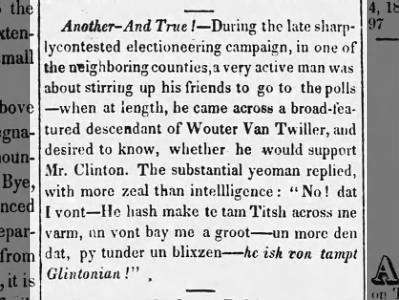
Here as in the case of Happy Christmas, Jackson's over-reliance on the LION database (and on Don Foster) gets him into trouble. "Happy Christmas" turns out to have been commonplace, particularly among devout Protestants for whom the "Happy" part implied "Sober"; and blixem was never the regular or "prevailing" English spelling for Dutch "lightning" in popular literature. Along with the fluid usage of variant spellings, what Foster and Jackson both missed is how commonplace the expression was (requiring zero specialized knowledge beyond the ability to read), and how humorous were its usual contexts when employed as a stereotype of the funny Dutchman. Journalists in the 1820's differed about what constitutes true Dutch. Aiming for realistic Dutch dialogue, a political anecdote in the Black Rock [New York] Gazette on November 9, 1826 made it "tunder un blixzen":
Reprinted with the reading "tunder un blizzen" in the Vergennes, Vermont Aurora on November 23, 1826; and "tunder and blizzen" in the Worcester, Massachusetts Eclipse of the Sun on November 29, 1826.
Vermont Aurora - November 23, 1826
In Fayetteville, North Carolina the Weekly Observer gave the same expression in the same story as "tunder un blitzen."
Carolina Observer (Fayetteville, NC - November 29, 1826
Same 1826 anecdote, same specifically and stereotypically Dutch referent ("a broad featured descendant of Wouter Van Twiller"), three different spellings
blixzen
blizzen
blitzen
and none of them blixem.
Furthermore, usages of blixen rival blixem/blixum all through the first half of the nineteenth century.
... In a little time we shall hear what effect the Manifesto has had on the Dutch; for I imagine it came as unexpectedly upon them as us. Donder & Blexin, Fluuckter, &c.will be exclaimations heard every where amongst them. --Letter to the Editor signed "John Roastbeef" in Lloyd's Evening Post, January 5, 1781.
Between 1785 and 1799
Verse satire issued as a broadside, titled Donder & Blixin: "Attend to my ditty, ye Germans and Dutch...."
Tho' fery creat Men yet he roar'd like a Vixen,
You Scoundrels and Deafsman, ah Donder and Blixin.
By Got, Zur, I say you're the vorst of all foes
You have ruin'd my Face, Zur, you pite of my Nose.
Now stalk'd like a Cyrus the lean dame Van Blixen
Whom Scandal has christen'd a paragon'd vixen....
--"Description of a Dutch Ball at the Cape of Good Hope" By Miss Emily Brittle [from The India Guide by Sir George Dallas]. The European Magazine, and London Review, for March 1786; reprinted in the Weekly Museum, August 18, 1792.
1793
"Donder
and Blixen, Dutchmens see!"
--Opening line of The
Sans Culottes, and the Grand Culottes, a musicalportraying "the principal Events during the Invasion of Holland." Reviewed in The Public Advertiser, April 16, 1793; quoted in Paul F. Rice, British Music and the French Revolution (Newcastle upon Tyne: Cambridge Scholars Publishing, 2010), page 220.
1799
Oh Hell! and dunder and blixen! --"For the Centinel / An Acrostic" [DOCTOR IOHN VAN BLUSTER];Newark, New Jersey Centinel of Freedom, March 12, 1799.
1800
As I find der ish no DONDER AND BLIKSUM in de English Dikshonere I hope youl put both in yours to oblige a Subscrybur
HANS BUBBLEBLOWER. --Philadelphia Gazette of the
United States, June 12, 1800
I endeavored to appease the enraged Dutchman in vain. He told me it was the same dueifels kint that had insulted his master, and clenching his fist swore with a tremendous dunder and blixen that he would have satisfaction….
--Francis Fungus "To Christopher Caustic, Esq. Apothecary, &c." Philadelphia Repertory, September 1, 1810
1824
"Donner and Blitzen," exclaimed she.... --Dame Van Dam, Dutch wife of Mynheer Van Dam in "Job Cook--A Legend," The Atlantic Magazine, July 1824.
[blixum as "German"] ... while an old German,
who was sitting against the capstan with his pipe in his mouth, grumbled
out--"Dunder and blixum, you've broke mine pipe mit your nonsense!" --"Ten Days in the Country," New York Spectator, August 31, 1824
1825
In Reading, Pennsylvania they call Santa's Dutch reindeer Dunder and Blixen.
Berks and Schuylkill Journal [Reading, PA] December 31, 1825
1826
In Philadelphia, Santa's Dutch reindeer are re-named Dunter and Blixen...
The Casket - February 1826
In "The Barber of Gottingen" by Robert Macnish, widely reprinted from the October 1826 number of Blackwood's Edinburgh Magazine,
the barber's fiendish customer (short and "burly" like the stereotypical Dutchman, and dressed accordingly with broad-brimmed hat and trousers with buckles at the knees) shouts both "Donner and blitzen!" and
"Dunder and blixum!" Reprinted widely, for example in the New-York American, November 24, 1826, Macnish's "Barber" influenced Poe's The Devil in the Belfry with its "Donder and Blitzen" (listed and dated 1840 in Jackson's Table 3.1, although not identified there by story title).
1827
… A Dutchman who stood by listening to the conversation, seemed much astonished at what he heard, and throwing his hat on the ground, and clenching his hair with both hands, exclaimed, "Donner and blitzen! If I go id that boat I hold my hair tight!"
--"New Steamboat" anecdote in The Ariel [Natchez, Mississippi] for March 9,
1827
In The Spirit of the Old Dominion (Richmond, 1827), Stephen T. Mitchell's "worthy Dutchman" Carle van Fraunk "swore by 'Donner and Blitzen'":
The Spirit of the Old Dominion (1827) by Stephen T. Mitchell
1828
[Fourth of July toasts in Milledgeville, Georgia]
By James S. Calhoun…. The Dutchman's answer to the enquiry, what are the most attractively beautiful natural objects: "Donder unt blitzden mon, dem dare dings wat var de peddigoats and abrons." -- Southern Recorder, July 12, 1828; reprinted in the Georgia Journal, July 14, 1828
1829
"Donner and blitzen" merely a prelude to "true Dutch wrath":
Indiana Palladiuim (Lawrenceburg, IN) - May 23, 1829
'Donner and blitzen,' or 'tousand deyvils,' were too mild words to act
as safety-valves to Martin's wrath, and after a vain attempt to give
utterance to his feelings, he fairly turned Andrew out of the house, and
that too in no very courteous style. After this explosion of true Dutch
wrath, (which is rather slow to be started, but always means something
when it does come,) Martin was unsociable, testy and uneasy....
--"A Legend of the Law / Martin Van Deinster," excerpted from The New England Galaxy (Boston, Massachusetts) in the Indiana Palladium on May 23, 1829.
"Dunder and blixen," roared one of the party--a Dutchman--dey pe noting put de fox grape! --"The Yankee and The Grape-Vines" from the New York Constellation; frequently reprinted, for example in the Haverhill [Massachusetts] Gazette, February 25, 1832; and Miller's Weekly Messenger [Pendleton, South Carolina], March 21, 1832.
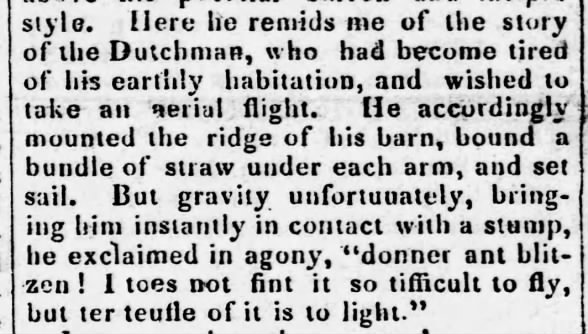
... the story of the Dutchman, who had become tired of his earthly habitation, and wished to take an aerial flight. He accordingly mounted the ridge of his barn, bound a bundle of straw under each arm, and set sail. But gravity unfortunately, bringing him instantly in contact with a stump, he exclaimed in agony, "donner ant blitzen! I toes not fint it so tifficult to fly, but ter teufle of it is to light." --Burlington, Vermont Sentinel and Democrat, July 20, 1832.
1833
The king of the Dutch, like a very great vixen,
Scolds & swears by the powers of 'donner & blitzen' --Carrier's Address, Canton, Ohio Repository, January 4, 1833
Hans Schlaffigkopf the hero of "The Astounded Dutchman" swears by "Donner and blitzen" and "Santa Claus":
Dedham Patriot (Dedham, Massachusetts) January 11, 1833
"Donner and blitzen! Yasu Chrst! Santa Claus! De Tyfel and all! vat ish dat for a shmoke comin de riffer up? Vrouw! Vrouw! come here aus! De riffer is all on a fire!" --as reprinted from the New York Constellation in the Dedham, Massachusetts Patriot on January 11, 1833.
"Dunder und blitzen, said their magistrates..." --"The Red Satchel" inAtkinson's Casket, September 1833 ("From the Saturday Evening Post")
"Dunder and blitzen! exclaimed Johannes [Puterbaugh, "Dutch" patriarch of Rock-Hollow]...." --Cincinnati Mirror, and Western Gazette of Literature - October 5, 1833
The 1833 Anecdote of Two Dutchmen,
widely reprinted in American newspapers and magazines from Chambers'
Edinburgh Journal, gives "Dunder and blitzen" (alternatively, blizen in the Schenectady, New York Cabinet, April 3, 1833) as typically Dutch.
Gloucester [Massachusetts] Telegraph - January 8, 1834
…where's Naso Tremaine, my plebe? Demme if he shan't taste of 4th July in the shape of a genteel swig of donder and blixen just from Amsterdam,and out of a brown Dutch jug. --"Arthur Tremaine" in the Military and Naval Magazine of the United States, July 1834
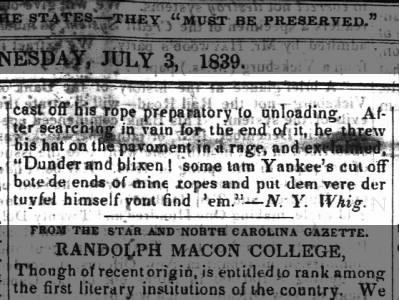
Weekly Standard [Raleigh, North Carolina] - July 3, 1839
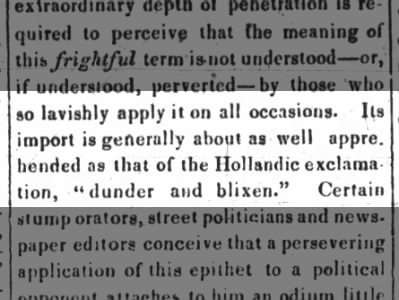
Greensboro Patriot - May 11, 1841
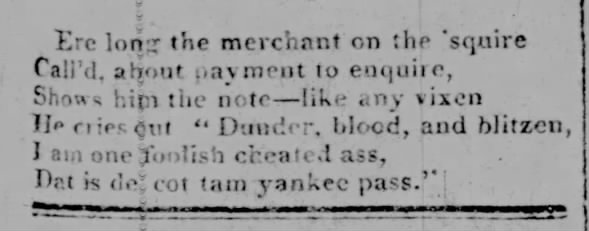
As demonstrated by the examples above, "blixen" appears repeatedly in newspapers and magazines c. 1800-1844, usually with "dunder" but sometimes "donder." Below, a relevant and suggestive instance from the verse burlesque titled "A Yankee Pass," where "blixen" rhymes with "vixen":
Ere long the merchant on the 'Squire
Call'd about payment to inquire, Shows him the note--like any vixen, He cries out "dunder, blood and blixen;
I bees won foolish, cheated ass;
Dat be de Got tam Yankee pass."
--New England Galaxy via The Weekly Miners' Journal [Pottsville Pennsylvania], April 15, 1826
Weekly Miners' Journal (Pottsville, Pennsylvania) - April 15, 1826
Other versions print "A Yankee Pass" with the end-rhyme blixen changed to blitzen:
Shows him the note--like any vixen
He cries out, "Dunder, blood, and blitzen,
I am one fooolish cheated ass,
Dat is de cot tam yankee pass."
--Richmond Whig via Salem [Massachusetts] Gazette, June 17, 1828
· Fri, Jun 12, 1835 – 3 · Liverpool Mercury, etc. (Liverpool, Merseyside, England) · Newspapers.com
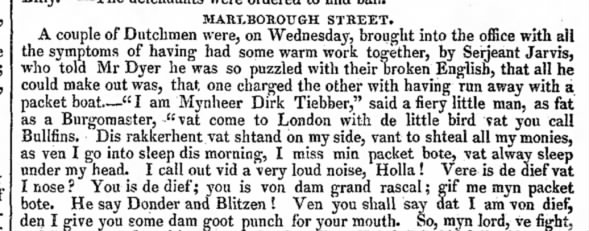
As shown in the warm-up post on A Dutch Quarrel, British newspaper editors in 1835 likewise treated blixen and blitzen as variant spellings of the same Dutch word. The London story, originally titled "Much Ado about Nothing," circulated with alternative forms for the stereotypical Dutch oath, including "Donder on Blixen!" in the London Morning Post, June 4, 1835 and Liverpool Mercury, June 12, 1835; but "Donder and Blitzen!" in the London Examiner on June 7, 1835:
Several Dutchmen were laboring in the field below. A sand-bag bursting to pieces as it struck the earth near them, caused them to raise their eyes, and a shout of "Dunder and Blitzen!" as they saw the teefle, as they verily believed, making a stoop directly upon them.
--"Clayton the Aeronaut," signed "P." in the Boston Transcript via The New York Commercial Advertiser, June 30, 1837
Martin Van Buren "like the little dogged Dutch boy at school at Kinderhook" says "Dunder and Blixen" to Clay and Webster (New York Herald, December 7, 1837).
New York Herald - December 7, 1837
1838-9
Donner and blitzen! exclaimed the bewildered cobbler [Jacob Kats, Dutch "Cobbler of Dort"], as he took the pipe out of his mouth.... --Plattsburgh Republican, March 9, 1839
1840
New York Evening Post - April 7, 1840
"Nothing more profane than donder en blixem should be heard. A Dutchman knows no more wicked oath...." --New York Evening Post, April 7, 1840
Columbia Democrat [Bloomsburg, Pennsylvania] - May 2, 1840
"Nothing more profane than donder and blixen should be heard. A Dutchman knows no more wicked oath...." --Columbia Democrat, May 2, 1840
1841
Over the pseudonym "Verbum Sapienti," the writer of a letter to the editor of the Richmond Whig
alluded to the commonplace expression "dunder and blixen" by way of
correcting another writer's supposed error in using it. For the Richmond
linguist, the most proper "Dutch" forms of the familiar oath were not dunder/donder and blixem/blixum but "donner and blitzen":
"[there are] no such words in Dutch as "dunder and blixen," which he meant, I presume, for the vulgar oath in that language of "donner and blitzen."
-- Richmond Whig, April 20, 1841
As late as 1851, we find Herman Melville indiscriminately lumping Dutch and Germans together as one nation of sailors. In chapter 81 of Moby-Dick, the Pequod meets and then competes for sperm whales against the heretofore unsuccessful Jungfrau or "Virgin." In the heat of the chase, Stubb refers to the Jungfrau
captained by Derick De Deer as both a "Yarman" (German) and "unmannerly
Dutch dogger." As another such personified confusion of Dutch and German
stereotypes, Melville's Dr. Snodhead would relish the looseness and fluidity of Stubb's categories.
As I have urged the WHY of Blitzen as a more fruitful question than WHO (you know who), let me end with three very arguable answers. Why did Clement C. Moore in 1844 choose Blitzen over Blixem, and Blixen?
Moore the over-committed and classically absent-minded professor simply forgot about his previously approved change to "Blixen" and wrote "Blitzen" instead. With the 1830 Sentinel broadsheet before him, the important thing to Moore in 1844 was fixing the imperfect rhyme by revising "Blixem." Blixen and Blitzen were interchangeable rhymes for "Vixen," as the different versions of "A Yankee Pass" in 1826-8 demonstrate.
Moore the Super-Dad and Responsible Family Man was forever haunted by James Kirke Paulding's off-hand dismissal of "blixum" as "little better than swearing." Thinking of the children, Moore hoped against hope that Blitzen would vary the familiar curse just enough to hide it from his kids, and posterity.
Moore the myth-maker and linguist extraordinaire wanted to honor Old World Christmas traditions along with his specifically Dutch Saint. Dutch reindeer? Humbug! Moore's reindeer are who we thought they were, Finns. Dolf and Bärtyly don't jingle so well with Prancer and Vixen, but Blitzen inches closer to the hardy Nordic spirit we're always looking for around the holidays. Despite (rather than in keeping with) the popular notion of Blitzen as Dutch, Moore finally and expertly linked his Nordic reindeer with Christmas trees and other more broadly Germanic rites of December. In so doing, Moore honored the German heritage of his intimate friend Dr. Francis:
—to whom the New Year's festival, as characteristic of his father's Nuremberg home as of Dutch hospitality, and his old friend Clement Moore's household rhymes of Santa Claus, with the annual schnapps and pipes of this local saint, brought such genial inspiration.... --Henry T. Tuckerman, biographical introduction to Old New York by John Wakefield Francis.