Showing posts with label Edmund Clarence Stedman. Show all posts

Thursday, April 27, 2023

Whitman and "Marquesan Melville" in the ALBANY ARGUS

Johannes Hevelius (28 January 1611 – 28 January 1687)
Scanned by Torsten Bronger, 4 April 2003., Public domain, via Wikimedia Commons.
But a week or so ago there passed from earth a strong, virile and poetic mind that met nothing but contempt in America for years.

Notwithstanding the borrowed title "Marquesan Melville," the 1892 article transcribed herein begins with high praise for the late Walt Whitman as "a strong, virile and poetic mind." (Whitman died on March 26, 1892; Herman Melville passed the year before on September 28, 1891.) Previously unrecorded? Not in the Walt Whitman Archive, anyhow. This dual tribute to Whitman and Melville appeared on page 4 of the Albany NY Argus for Sunday morning, April 10, 1892. As indicated in the article, the heading and extensive quotations are taken from Henry S. Salt's long, lavish memorial of "Marquesan Melville" in the March 1892 issue of The Gentleman's Magazine

Herman Melville, despite embarrassing nationwide neglect of his writings, was "a man well known personally" in the Albany area. Nonetheless, criticism of Melville's supposedly ruinous descent into transcendentalism and mysticism follows Salt on "Marquesan Melville." Also from Salt, the cite of John Marr and Other Sailors as privately printed "story" and the closing quotation from Robert Buchanan's poem Socrates in Camden

But the comparison of Melville to The Farthing Poet Richard Hengist Horne, author of Orion: An Epic Poem, seems different and distinctive. Elizabeth Shaw Melville gave Herman's copy of Horne's Exposition of the False Medium and Barriers Excluding Men of Genius to Edmund Clarence Stedman. With markings by Horne and Melville, whereabouts unknown; Horne's Exposition is Sealts Number 284 in the catalog at Melville's Marginalia Online. Number 285 is a volume of three tragedies by Horne, owned by Stedman and borrowed by Melville. Shared interest in Whitman and Horne suggests that E. C. Stedman might have written or otherwise influenced the writing of "Marquesan Melville" as revisited in the Albany Argus.

MARQUESAN MELVILLE.

It is generally conceded that leading traits in the American character are self-esteem and assertiveness. One of the reasons the race has advanced so rapidly and now holds such high place is because of its thorough belief and confidence in itself. We know that our institutions are admirable, and that our natural resources are unlimited. We are certain that our destiny is as grand as that of any of the sons of man. We feel that our past stands in need of no apology. We are tenacious of our repute in the arts and sciences, and proclaim upon the housetops the undying fame of our writers. These general facts standing unchallenged, it is very peculiar that a single one of our master-minds should lack full recognition and appreciation in his own country. But a week or so ago there passed from earth a strong, virile and poetic mind that met nothing but contempt in America for years. It is true that at the last we were shamed into a tardy acceptance of the splendid gifts of Walt Whitman by the generous encouragement of the English people. Without attempting to understand the charm of his utterances, we admitted his genius and soothed his dying bed with sympathy. There were laid upon his bier some eloquent tributes from his countrymen, but these were rather the outpourings of love and sympathy than critical appreciation. It was England that recognized that a strong and original singer had left the earthly choir.

A case very similar to this was that of Herman Melville, a man well known personally in this vicinity. The difference between the two was that Melville had a measure of transient popularity during his early productive period, while at his death he was almost completely forgotten. His very name was unknown to the younger generation of American readers, and the rather perfunctory tributes in a few newspapers, when he died a number of months ago, were read with a mild interest not unmixed with astonishment. Here, again, England had an eye for genius when we were blind. It will surprise many here, even among those who would be critical, to learn that Robert Buchanan classes him as "the one great imaginative writer fit to stand shoulder to shoulder with Whitman on that continent," and that William Morris, Theodore Watts, Robert Louis Stevenson and W. Clark Russell, enroll themselves among the number of his enthusiastic admirers. It may be doubted whether the name of Melville is included among those that figure in the handbooks of American literature. it is certain, at any rate, that he has no following of readers here.

It is not to our credit that the first critical estimate of Melville should appear in England, and yet such is the case. Mr. Henry S. Salt writes an appreciative, discriminating and sympathetic sketch of the writer in the Gentleman's Magazine. He makes no allusion to the fact that Melville was so sadly lacking in appreciation from his own countrymen, and his article has a ring of triumphant admiration with no trace of apology nor pleading. It is impossible to summarize Mr. Salt's estimate, but we can quote a few detached passages. He declares that Melville was a genuine child of nature, a sort of nautical George Borrow, to whom he likens him more than once. Of "Typee," his masterpiece, he says: "Alike in the calm beauty of its descriptive passages and in the intense vividness of its character sketches, it was, and is, and must ever be, a most powerful and fascinating work--indeed, I think I speak within the mark in saying that nothing better of its kind is to be found in English literature, so firm and clear is it in outline, yet so dreamily suggestive in the dim, mystic atmosphere which pervades it." Then turning to his later work, Mr. Melville [rather, Mr. Salt] says: "As 'Typee' is the best production of the earlier and simpler phase of Melville's authorship, so undoubtedly is 'The Whale' the crown and glory of the later phase; less shapely and artistic than 'Typee,' it far surpasses it in immensity of scope and triumphant energy of execution. It is in 'The Whale' that we see Melville casting to the winds all conventional restrictions, and rioting in the prodigality of his imaginative vigor. It is the supreme production of a master mind; let no one presume to pass judgment on American literature until he has read, and re-read, and wonderingly pondered the three mighty volumes of 'The Whale.'"

One more brief quotation may be permitted: "His narratives are as racy and vigorous as those of Defoe, or Smollett, or Marryat; his character sketches are such as only a man of keen observation and as keen a sense of humor could have realized and depicted."

The man was well nigh as interesting as the author. Herman Melville, who, by the way, was a relative of leading Albany families, resided for years in Pittsfield. Here he was the near neighbor of Hawthorne, whose home was at  Lenox. He soon became a transcendentalist, and his beliefs strongly colored his writings. We have noted above the change between his earlier works, as exemplified in "Typee," and his later, as shown in "The Whale." As the mood grew upon him, his style became turgid and his books were filled with mysticism. It was the death blow to his popularity, and the fickleness of the public reacted strongly upon his nature. He became almost a recluse. He would do nothing to keep his name before the public, and in a spirit akin to that which led Hengist Horne to issue his grand epic "Orion" at a farthing, he limited one of the most beautiful of his later stories to twenty-five copies.

It is pleasant to know that the widow of the novelist has just sold the copyrights of her husband's works to an enterprising publisher, and that new editions of them all are to be brought out in America and England. An opportunity will be given us to atone for our neglect of this genius, of whom Buchanan, in his tribute to Whitman, wrote--

"The sea compelling man,
Before whose wand Leviathan
Rose hoary-white upon the deep,
With awful sounds that stirred its sleep;
Melville, whose magic drew Typee,
Radiant as Venus, from the sea."

-- Albany Argus, April 10, 1892. Found on fultonhistory.com; images are also accessible courtesy of New York State Library via NYS Historic Newspapers.

Tuesday, March 7, 2017

Edmund Clarence Stedman on Clement C. Moore and his "sparkling fantasia"


In a long, long inventory of one-hit wonders, Herman Melville's friend E. C. Stedman made sure to honor "'Twas the Night Before Christmas" and its "venerable" author:
But which of all the asteroids that have passed before our vision—whether tinged with a domestic, patriotic, amorous, or sombre light—will be longer or more lovingly regarded than the children's own poem and dearest—" 'Twas the Night before Christmas?" written for them so daintily by a sage college professor, Clement C. Moore, to wit, long time a resident of this old Dutch city, and deceased (peace to his ashes!) hardly more than four or five years ago. "A Visit from St. Nicholas" is dear to the little ones for its exquisite fancies and the annual legend, and to us all for our beautiful memories of childhood and home. It is linked with the natal festival of Christendom, is entirely true to its purpose, and finished as deftly as if the author had been a professional poet. Few of those who were his contemporaries, and who know every word of this sparkling fantasia, have been familiar with the details of his quiet and industrious life. He was born in 1779, and grew up a studious philologist, as his Hebrew and English lexicon, issued in 1809, still attests. Twelve years afterward he was made Professor of Biblical Learning in the New York Episcopal Theological Seminary, and more lately took the chair of Oriental and Greek Literature. Despite all this, and rich besides, he wrote poetry, and a volume of his rhymes appeared in 1844. They were of an ephemeral nature, except the poem which I would have gone far to hear him repeat in his old, old age, and for which my younger readers must always remember his venerable name. 
--The Galaxy Volume 7, January 1869
When Stedman published this magazine piece in 1869, Moore's "sparkling fantasia" was already immortal and counted among the most joyful of Christmas rites.

Monday, February 8, 2016

Identifying the good fellows with Herman Melville at "Lorry" Graham's, March 1866

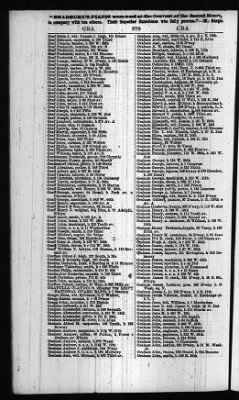
The previous post found Herman Melville partying at the Manhattan residence of James Lorimer Graham, Jr. (as the 1865 Trow's NYC Directory indicates, JLG Jr. had moved back to his father uncle JLG Sr.'s place at 21 Washington Square North) on the evening of March 26, 1866. 

UPDATE: But wait, Fold3 and NYPL Digital Collections come through with images from the better source here, Trow's New York City Directory "For the Year Ending May 1, 1866":


A-ha. Now Trow's gives the address for James Lorimer Graham, jr. as "3 E. 17th." That's the address Bayard Taylor remembers in his 1876 obit. Most likely the March 26, 1866 gathering happened here, at 3 East Seventeenth Street.

Fold3: Military Records

Melville would count as one of the "invited guests," I'm guessing, rather than an official member of "The Wanderer's Club." Possibly the newspaper notice should say "Wanderers,'" plural. This Wanderers' Club resembles the "Travellers" who likewise met on Monday nights, as we know from the invitation Bayard Taylor sent to Melville on February 24, 1865. In that 1865 letter Taylor identified two fellow Travellers (Darley and Bierstadt) who also would be named as guests of James Lorimer Graham, Jr. on Monday night, March 26, 1866. Hershel Parker muses about the mutual interests of this bunch in Melville Biography: An Inside Narrative.

By late March 1866, Melville was a confirmed New Yorker, again, as well as a working and (at last!) published poet. Two Civil War poems from his forthcoming volume Battle-Pieces were already out in Harper's (with a third, "Sheridan at Cedar Creek," soon to appear under the title "Philip" in the April 1866 issue), but Melville had not yet written the prose "Supplement." So he could hold his head up among the poets there at "Lorry" Graham's soiree: William Cullen Bryant, Henry T. Tuckerman, Bayard Taylor, and Richard Henry Stoddard. At least two of Melville's fellow guests (Richard Henry Stoddard and "Barry Gray") would soon enough be his co-workers at the New York Custom House. A fine time for socializing, though deep griefs awaited Melville and his family the very next year--his wife Elizabeth contemplated leaving him by May 1867, then in September their eldest son Malcolm killed himself.

The Wanderer's Club. 

The members of the "Wanderer's Club," together with invited guests, were pleasantly entertained last evening at the residence of Mr. James Lorimer Graham, Jr. The gathering was of a social character, and allowed a free and agreeable interchange of thought among the guests. The many rare and curious books, old engravings, valuable autograph letters and articles of vertu, to be found in Mr. Graham's library, were a source of unfailing interest and enjoyment to every one present. Among the guests were Messrs. Bryant, Bancroft, Tuckerman, Herman Melville, Bayard Taylor, Ripley, Duyckinck, Stoddard, Savage, "Barry Gray," W. T. Blodgett, John Van Buren, Leutze, Kensett, Gifford, Bierstadt, Laing, H. P. Gray, Launt Thompson, Darley, Ehninger, Hunt, Key, Baron Osten Sacken, Gilman, and others.  --New York Evening Post, Tuesday, March 27, 1866
Let's go through the list and try to identify the good fellows at Lorrie Graham's party:
  • Savage = probably the Irish-American journalist and poet John Savage (1828-1888). Contributed to the satirical weekly magazine, The Lantern.
  • John Van Buren (1810-1866): Albany lawyer and politico, second son of President Martin Van Buren. JVB must have known Herman's brother Gansevoort in the old days.
In the late 1840s he joined his father in opposing the spread of slavery as a member of the Free Soil Party. John Van Buren, nicknamed "Prince John" by the press, was a highly regarded trial lawyer, famed nationwide for his tall, commanding appearance and his eloquence. He was Chairman of the New York Democratic Party in 1862, and was the party's unsuccessful candidate for state Attorney General in 1865. During the Civil War he continued his opposition to slavery by organizing "Union League" clubs of Democrats and Republicans loyal to the United States. He was known to alternate between periods of overwork followed by periods of dissolution, including excessive drinking and gambling that often left him in financial distress. He died at sea of kidney failure while traveling from Liverpool to New York.  
-- Bill McKern - Find A Grave  

A Storm in the Rocky Mountains, Mt. Rosalie
Albert Bierstadt, Public domain, via Wikimedia Commons
After writers and critics, the Evening Post names many artists in attendance. Shades, intimations perhaps of the departed artists and their dialogue in Melville's poem "At the Hostelry" (text available in John Bryant's edition of Tales Poems and Other Writings, and in the 1963 Russell & Russell issue of Melville's Works, volume 16 at the HathiTrust Digital Library). As mentioned already in the previous post, their radiant patron James Lorimer Graham, Jr. was a lot like Melville's conception of the Marquis de Grandvin.

  • Launt Thompson = Launt Thompson (1833-1894), Irish-American sculptor, protege of Erastus Dow Palmer and close friend of Edwin Booth, 
  • Ehninger = John Whetten Ehninger (1827-1889). Aka John Whetton Ehninger, portrait painter and etcher--1847 graduate of Columbia University, with European training.
Last but not least, a brace of academic diplomatists, or diplomatic academics:
  • Gilman = ?? Only problem is having so many distinguished Gilmans to worry over...how about Daniel Coit Gilman (1831-1908), the Yale librarian, scholar, professor, and future first president of Johns Hopkins University. Gilman's early diplomatic experience "as attaché of the United States legation at St. Petersburg, Russia from 1853 to 1855" (Wikipedia) would seem to intersect somehow with that of Russian general consul in NYC and former secretary to the Russian legation, Baron Osten Sacken--which may be why the two names appear together at the end of the guest-list.
Lots here to absorb and ponder. For one thing, was the writer one of the persons listed in the Evening Post report, or a different, unnamed guest? Parke Godwin?

The University of Virginia Library has a manuscript poem to James Lorimer Graham dated November 16, 1866--the night of the honorary dinner at Delmonico's referenced by Edmund Clarence Stedman in the 1894 Century Club memorial. I'm trying to get a scan or other image of the
"Poetic tribute to Graham by an unidentified writer"
who might be Stoddard or Taylor or Stedman, or another of the select company.


And speaking of good fellows, what happened to that precious manuscript book, listed in the Century Club memorial to James Lorimer Graham, Jr. as
Ye Booke of ye Goode Fellowes
 Does The Century Association still have "Ye Booke of ye Goode Fellowes" in the archives?

Related melvilliana post:

Friday, November 27, 2015

Melville's cameo role in Nation-Famous New York Murders (1914) by Alfred Henry Lewis

Image Credit: Ron Scheer - Buddies in the Saddle
Among other things eastern journalist, muckraker, biographer, and western storyteller Alfred Henry Lewis wrote fictionalized tales of real-life crime. One of Lewis's supposedly true crime stories, originally published in the March 1913 issue of Pearson's Magazine, features a brief but fascinating appearance by Herman Melville. I don't remember seeing any notice in Melville scholarship of Melville's cameo role in Nation-Famous New York Murders (published in book form by the G. W. Dillingham Company in 1914). Another melvilliana exclusive? I stumbled over it while hunting up published mentions of Melville's Civil War poem, "Sheridan at Cedar Creek."

In his dramatic account of the Harvey Burdell murder case, Lewis definitely gets his facts mixed up about Herman Melville. Essentially Lewis has magically transported the 1880's Melville thirty years back in time, to Manhattan on a cold winter's day in early 1857. Specifically (as clarified in the revised book version), January 28, 1857. Impossible for Melville really to have been there, since most of that month he spent in Jerusalem and Lebanon on his 1856-7 Mediterranean tour. Melville's The Confidence-Man would be published in April 1857. The year before, Melville (still living in Pittsfield) was composing "The Piazza" to induce his forthcoming volume of magazine stories titled The Piazza Tales. Lewis's Melville, however, is already a curmudgeonly New Yorker, another frustrated writer employed in the Custom House. Lewis misquotes the line from "Sheridan at Cedar Creek" and miscalls it (as did Stoddard in his published Recollections) by the title of Buchanan Read's poem "Sheridan's Ride."

Some facts of Melville's life Lewis might have got from the biographical introduction to Typee by Arthur Stedman, son of Edmund Clarence Stedman who is also a character in the Burdell chapter of Nation-Famous New York Murders. As shown below, however, the most interesting factual details are reworked from the autobiography of Richard Henry Stoddard. When Melville shows up for dinner at the brand new Metropolitan Hotel, he joins the table of fellow writers Stoddard, Bayard Taylor, and George Henry Boker. Stedman sits at a nearby table with fellow lawyers David Dudley Field and Charles O'Connor. Lewis seats Fitz-James O'Brien at another table with Frederick Swartwout Cozzens (both fresh from Pfaff's beer cellar) along with Walt Whitman. At one point in the literary table-talk, Melville's gloomy looks remind O'Brien of Hamlet, "the melancholy Dane." Lewis makes O'Brien laughably ignorant of Melville and his reputation ("Never heard of him."). One year after the events recorded by Lewis, O'Brien would critically survey Melville's entire career to date in the April 1857 issue of Putnam's Monthly Magazine.

Excepting Stoddard, the literati at the Metropolitan as described by Alfred Henry Lewis are mostly Pfaff's regulars.

Despite his numerous factual errors, Lewis does seem to know something about Melville and other literary New Yorkers in the 1870's and 1880's especially. He knows, for instance, about the Century Club, about Stoddard's job at the Custom House and Stoddard's Echo Club. Much if not all this knowledge derives from Stoddard's Recollections, Personal and Literary. For example, Stoddard remembers that Bayard Taylor "had learned by heart" the "Opium Fantasy" poem by Lowell's wife. And when Lewis makes Cozzens say
 "Stoddard insists that next to Emerson he's the great American mystic."
the words of Stoddard are quoted verbatim from Stoddard's 1903 book, Recollections, Personal and Literary.

Intentionally or not, Melville's unfriendly critique of Mrs. Lowell's poetry as "privately published" for good reason is heavily ironic given Melville's later choice to privately publish two volumes of his own poetry, John Marr and Timoleon in limited edtions of 25 copies each. Below, Lewis's fictionalized glimpse of Herman Melville at the Metropolitan Hotel with links to the magazine and book versions of Nation-Famous New York Murders:
While waiting for the coming of Officer Matzell, with his word about Burdell, suppose we look about the room. It should be as good a way of killing time as any other.

Over near a window are Bayard Taylor, the poet Stoddard, and Boker who wrote Francisca da Rimini in which Miss Julia Dean is playing at Wallack's.

The sepulchral Herman Melville enters, and saunters funereally across to Taylor, Stoddard and Boker.

Beyond them sits Edmund Clarence Stedman, with lawyers David Dudley Field and Charles O'Connor.

The second table from the door is taken by "Sparrow Grass" Cozzens and Fitz-James O'Brien, who have adjourned from Pfaff's beer cellar near Leonard street where, under the Broadway sidewalk, they were quaffing lager, and getting up an appetite for dinner on onions, pretzels and cheese. They have with them Walt Whitman, who, silently and wholly wanting jn that "barbaric yawp," is distinguished by what William Dean Howells—ever slopping over in his phrase-making—will one day speak of as his "branching beard and Jovian hair."
...
"By the way, I've got a treasure," exclaims Taylor; "it's a copy of Mrs. Lowell's poems. They were privately printed, you know."

"May I see it?" asks the sepulchral Melville.

"It's in my desk at the Tribune office. There's one poem in it, An Opium Fantasy, which struck me greatly. It runs like this:
Oh, it is but a little owl,
The smallest of its kin,
That sits beneath the midnight cowl.
And makes its airy din.
"'And makes its airy din,'" repeats the lugubrious Melville, more sepulchral than ever. "I can understand why it was printed privately."'

Melville, soured by several failures, is inclined to cynicism in the presence of the poems of others. He has not yet written, you must remember, his Sheridan's Ride, which will begin, "Oh, shoe the horse with silver which bore him to the fray."

Taylor pays the bill, and he and the others depart for Stoddard's house in Third street, where their Echo Club is to have a meeting.

"Who's the melancholy Dane?" demands O'Brien, as the trio go talking themselves into Broadway.

"That's Melville," says "Sparrow Grass." "Thought you knew him. Works with Dick Stoddard in the Custom House."

"Never heard of him," returns the case-hardened O'Brien.

"Never heard of him? You amaze me! Why, he's written Typee, and Omoo and Mardi. Stoddard insists that next to Emerson he's the great American mystic."

O'Brien receives this with a Celtic grunt. "He looks as if he were," says he.

There is Matzell now; the broad, thick, stocky personage with the police expression of face. Wood greets him with the off-hand manner practised by New York mayors when they deal with members of the police.
--Pearson's Magazine Volume 29 - March 1913; and

--The Bond Street Mystery in Nation-Famous New York Murders
Other chapters of special interest to Melville fans deal with riots from the perspective of New York City police officers: one on the 1863 Draft Riots (subject of "The House-Top" in Battle-Pieces) and another on the 1849 Astor Place riots (before which Melville had co-signed a published letter backing Macready). The book version of the Burdell chapter gives Melville extra lines of dialogue that are not present in the magazine version. In the book, Lewis introduces Bayard Taylor's recitation of  Maria White Lowell's "An Opium Fantasy" by having Melville ask forlornly:
“You’ve been up to Cambridge?” put in Melville, glancing gloomily across at Taylor. “You’ve seen Lowell and the Atlantic Monthly crowd ?”
Maria White Lowell via Digital Commonwealth