On New Year's Eve 1834, young Francis Prioleau Lee (1814-1847) attended a holiday party and fund-raiser at the Court Room in Morristown, NJ. The future Episcopal minister was visiting friends while on break from classes at General Theological Seminary in NYC. Jolly old St.… pic.twitter.com/wA0HZYA7Oh
In December 1862 you could get the newest edition of A Visit from St.Nicholas with beautiful illustrations by Felix Octavius Carr Darley for 50 cents. "An elegante Christmas trifle for the entire household," as described by Manhattan publisher James G. Gregory in the New York Evening Poston December 22, 1862.
New York Evening Post - December 22, 1862 via Genealogy Bank
"A
VISIT FROM ST. NICHOLAS." The famous poem, " 'Twas the Night Before
Christmas," etc. Illustrated in tints, from drawings by DARLEY, with an
illuminated cover. An elegante Christmas trifle for the entire
household. Price 50 cents.
Darley's joke on the front cover is explained in the New York World notice of December 26th, the day after Christmas:
"The title page is in richly illuminated letter, a carte de visite of Santa Claus having fallen on the first page."
A VISIT FROM ST. NICHOLAS. Illustrated from drawings by F.O.C. DARLEY. James G. Gregory.
This is an elegantly illustrated and printed quarto pamphlet edition of Clement C. Moore's famous Christmas song, " 'Twas the Night before Christmas." The title page is in richly illuminated letter, a carte de visite of Santa Claus having fallen on the first page. The drawings are all by Darley, and are in his happiest style.
What better way to celebrate the 199th Birthday of Santa Claus as we know and love him than this?! Check out the true history of Santa, Sr. as beautifully told on Red Pilled America with Patrick Courrielche and Adryana Cortez.
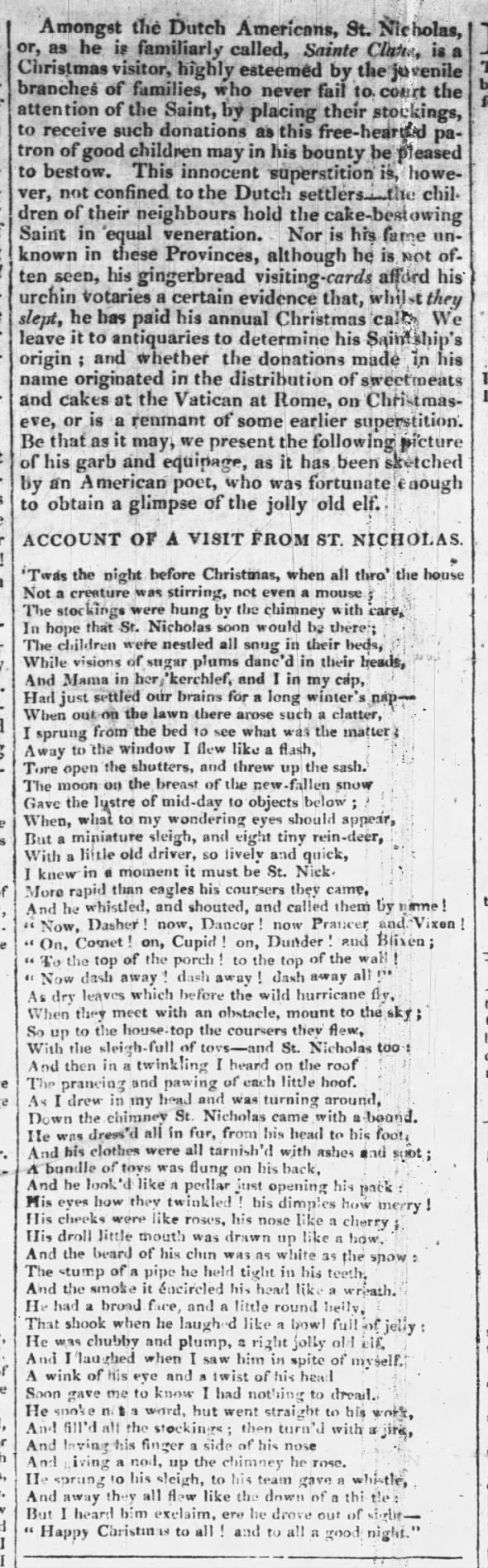
"A Visit from St. Nicholas" was reprinted in the Montreal Gazette on January 4, 1826, with a helpful preface explaining the American Santa Claus to Canadians.
Amongst the Dutch Americans, St. Nicholas, or, as he is familiarly called, Sainte Claus, is a Christmas visitor, highly esteemed by the juvenile branches of families, who never fail to court the attention of the Saint, by placing their stockings, to receive such donations as this free-hearted patron of good children may in his bounty be pleased to bestow. This innocent superstition is, however, not confined to the Dutch settlers--the children of their neighbours hold the cake-bestowing Saint in equal veneration. Nor is his fame unknown in these Provinces, although he is not often seen, his gingerbread visiting-cards afford his urchin votaries a certain evidence that, whilst they slept, he has paid his annual Christmas call. We leave it to antiquaries to determine his Saintship's origin; and whether the donations made in his name originated in the distribution of sweetmeats and cakes at the Vatican at Rome, on Christmas-eve, or is a remnant of some earlier superstition. Be that as it may, we present the following picture of his garb and equipage, as it has been sketched by an American poet, who was fortunate enough to obtain a glimpse of the jolly old elf.
This item is not listed in Nancy H. Marshall, The Night Before Christmas, A Descriptive Bibliography of Clement Clarke Moore's Immortal Poem (Oak Knoll Press, 2002). With interesting exceptions, the text of the still-anonymous poem mostly follows the first printing in the Troy Sentinel on December 23, 1823. Dunder remains Dunder, for example, but Blixem has been re-christened Blixen. Also, the whole roll of reindeer names has been metrically improved by rearranging commas and exclamation marks:
“Now, Dasher! now, Dancer! now Prancer and Vixen! “On, Comet! on, Cupid! on, Dunder! and Blixen...."
Extending to Comet and company in the second line of the couplet, the revisions to punctuation marks around reindeer names in the Montreal Gazette are even more thorough than similar changes in the Charleston Mercury and other 1826 versions. For more on those, check out the earlier post
Another interesting difference is the addition of "which" as a relative pronoun in the distinctive heroic simile that here in this early Canadian version begins
As dry leaves which before the wild hurricane fly.
The 1823 Troy Sentinel version did not supply any word between "leaves" and "before":
As dry leaves before the wild hurricane fly.
Adding "which" makes a regular anapest "which before" in the second metrical foot. In the same line as corrected or revised in the 1844 collection Poems by Clement C. Moore, "that" replaces "which":
As dry leaves that before the wild hurricane fly.
Santa smokes like a chimney wherever he goes, obviously. But here the é with the acute accent, unique to the Montreal Gazette version, tells readers how to say
’Twas the night before Christmas, when all thro’ the house Not a creature was stirring, not even a mouse; The stockings were hung by the chimney with care, In hope that St. Nicholas soon would be there; The children were nestled all snug in their beds, While visions of sugar plums danc’d in their heads, And Mama in her ’kerchief, and I in my cap, Had just settled our brains for a long winter’s nap— When out on the lawn there arose such a clatter, I sprung from the bed to see what was the matter; Away to the window I flew like a flash, Tore open the shutters, and threw up the sash. The moon on the breast of the new-fallen snow Gave the lustre of mid-day to objects below; When, what to my wondering eyes should appear, But a miniature sleigh, and eight tiny rein-deer, With a little old driver, so lively and quick, I knew in a moment it must be St. Nick. More rapid than eagles his coursers they came, And he whistled, and shouted, and called them by name! “Now, Dasher! now, Dancer! now Prancer and Vixen! “On, Comet! on, Cupid! on, Dunder! and Blixen; “To the top of the porch! to the top of the wall! “Now dash away! dash away! dash away all!” As dry leaves which before the wild hurricane fly, When they meet with an obstacle, mount to the sky; So up to the house-top the coursers they flew, With the sleigh full of toys—and St. Nicholas too: And then in a twinkling I heard on the roof The prancing and pawing of each little hoof. As I drew in my head, and was turning around, Down the chimney St. Nicholas came with a bound. He was dress’d all in fur, from his head to his foot, And his clothes were all tarnish’d with ashes and soot; A bundle of toys was flung on his back, And he look’d like a pedlar just opening his pack: His eyes how they twinkled! his dimples how merry! His cheeks were like roses, his nose like a cherry; His droll little mouth was drawn up like a bow, And the beard of his chin was as white as the snow; The stump of a pipe he held tight in his teeth, And the smoke it éncircled his head like a wreath. He had a broad face, and a little round belly That shook when he laughed like a bowl full of jelly: He was chubby and plump, a right jolly old elf, And I laughed when I saw him in spite of myself. A wink of his eye and a twist of his head Soon gave me to know I had nothing to dread. He spoke not a word, but went straight to his work, And fill’d all the stockings; then turn’d with a jirk, And laying his finger a side of his nose And giving a nod, up the chimney he rose. He sprung to his sleigh, to his team gave a whistle, And away they all flew like the down of a thistle: But I heard him exclaim, ere he drove out of sight— "Happy Christmas to all ! and to all a good night."
As indicated by the added subtitle in this 1841 reprinting of "A Visit from St. Nicholas," German immigrants in Baltimore would have recognized the fur-clad elf in Clement C. Moore's classic Christmas poem as an Americanized Pelznickel aka Belsnickle, the furry Nicholas. As explained by Phyllis Siefker in Santa Claus, Last of the Wild Men (McFarland, 1997 and 2006):
"Santa's forefather was the very unsaintlike Furry Nicholas, a major player in winter festivals that have been transplanted from Europe to the rugged backwoods of Pennsylvania."
And Maryland, as shown by the expanded title for the poem as reprinted in the Baltimore Clipper on Christmas Day 1841: "A Visit from Saint Nicholas, or Old Belsnickle."
More recently, Tom A. Jerman in Santa Claus Worldwide (McFarland, 2020) describes Pelznickel as "one of the faux Nicholases created following the Reformation." As furry Nicholas displaced the banned Catholic saint, Pelznickel and similar figures
"assumed the role of a secular gift-giver and disciplinarian whereas the virtuous saint performed only good works and required a satanic assistant to do his dirty work."(Jerman, Santa Claus Worldwide, pages 29-30).
Baltimore Clipper (Baltimore, Maryland) December 25, 1841
via GenealogyBank
A VISIT FROM SAINT NICHOLAS,
OR
OLD BELSNICKLE.
'Twas the night before Christmas, when all through the house
Not a creature was stirring, not even a mouse.
The STOCKINGS were hung by the chimney with care,
In hopes that St. NICHOLAS soon would be there;
The children were nestled all snug in their beds,
While visions of sugar-plums danced through their heads;
And Mamma in her 'kerchief, and I in my cap,
Had just settled our brains for a long winter's nap:
When out on the lawn there arose such a clatter,
I sprang from the bed to see what was the matter:
Away to the window I flew like a flash,
Tore open the shutters and threw up the sash.
The moon, on the breast of the new-fallen snow,
Gave the lustre of mid-day to objects below.
When, what to my wondering eyes should appear,
But a miniature sleigh and eight tiny reindeer,
With a little old driver, so lively and quick,
I knew in a moment it must be St. Nick.
More rapid than eagles his coursers they came,
And he whistled, and shouted, and call'd them by name:
"Now, Dasher! now, Dancer! Now, Prancer! Now, Vixen!
On! Comet, on! Cupid, on! Donder and Blixen--
To the top of the porch! to the top of the wall!
Now, dash away, dash away, dash away all!"
As leaves that before the wild hurricane fly,
When they meet with an obstacle, mount to the sky,
So up to the house-top the coursers they flew,
With the sleigh full of toys--and St. Nicholas too.
And then in a twinkling I heard on the roof
The prancing and pawing of each little hoof.
As I drew in my head, and was turning around,
Down the chimney St. Nicholas came with a bound.
He was dressed all in fur from his head to his foot,
And his clothes were all tarnished with ashes and soot;
A bundle of toys he had flung on his back,
And he look'd like a pedlar just opening his pack.
His eyes, how they twinkled! his dimples, how merry!
His cheeks were like roses, his nose like a cherry;
His droll little mouth was drawn up like a bow,
And the beard on his chin was as white as the snow.
The stump of a pipe he held tight in his teeth,
And the smoke it encircled his head like a wreath.
He had a broad face, and a little round belly,
That shook, when he laugh'd, like a bowl full of jelly.
He was chubby and plump; a right jolly old elf:
And I laugh'd, when I saw him, in spite of myself.
A wink of his eye, and a twist of his head,
Soon gave me to know I had nothing to dread.
He spoke not a word, but went straight to his work,
And fill'd all the stockings; then turn'd with a jerk,
And, laying his finger aside of his nose,
And giving a nod, up the chimney he rose.
He sprang to his sleigh, to his team gave a whistle,
And away they all flew like the down of a thistle;
But I heard him exclaim, ere he drove out of sight,
"Happy Christmas to all, and to all a good night!"
A. Oakey Hall, Cabinet Photo c. 1870 Public domain via Wikimedia Commons
A la Poe in The Raven with a fine closing tribute to Clement C. Moore, author of "A Visit from St. Nicholas," as
"the Bard for joying children."
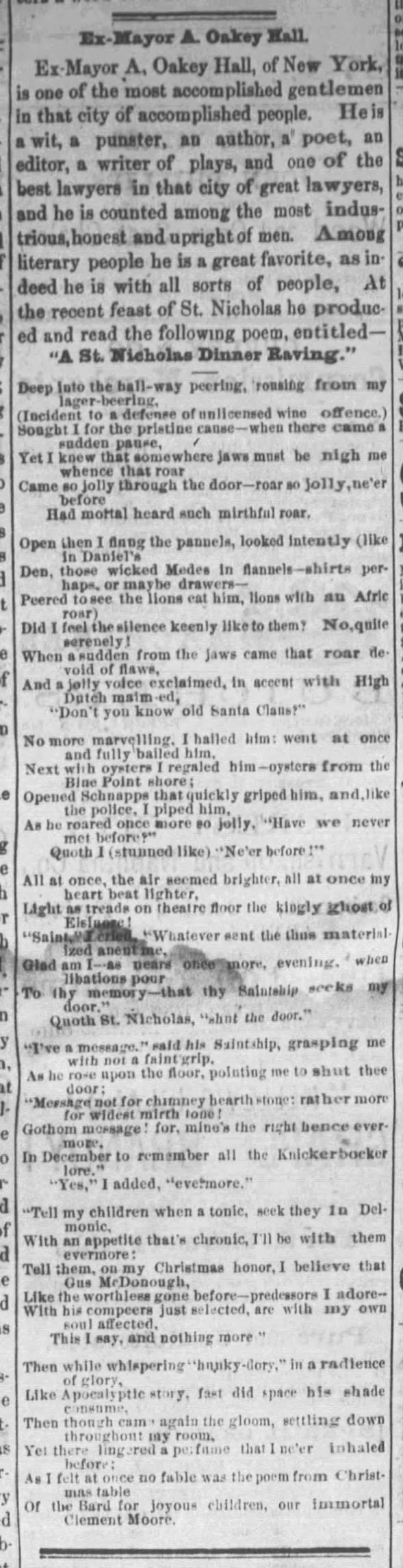
Herman Melville's old friend Abraham Oakey Hall delivered this now forgotten Santa Claus poem before The Saint Nicholas Society at their annual dinner, held on December 7, 1874 at Delmonico's (Fifth Avenue and Fourteenth Street). Monday evening, since the proper Feast of Saint Nicholas day, December 6th, fell on a Sunday that year.
"The dinner, which was served in excellent style, was enlivened by the usual Dutch peculiarities, by the burgomaster-appearance of the President [Augustus R. Macdonough], the orange neckties of many of the guests, and the almost universal smoking of tobacco in long clay pipes." --New York Herald, December 8, 1874
A partial transcription of Hall's poem was included in the account of the dinner published in the New York Herald on December 8, 1874; accessible via Chronicling America: Historic American Newspapers, The Library of Congress.
With minor variations the verse text appeared also in the Rock Island Daily Argus (Rock Island, Illinois) on December 16, 1874; and Providence Evening Express (Providence, Rhode Island) on December 21, 1874.
Not transcribed and so presumably lost are the "few introductory stanzas" read before the one that begins "Deep into the hall-way peering...." The New York Herald gives the title of Hall's poem as "A St. Nicholas Dinner Raving." In the fifth stanza all known versions print "widest mirth" where one might expect "wildest mirth." In the last line, the Herald gives "joying children" which must be right, rather than "joyous children" in the Rock Island Argus version.
New York Herald - December 8, 1874
EX-MAYOR HALL'S POEM.
After the above regular toasts were disposed of ex-Mayor Hall was called upon for a speech. In lieu of a speech he read a poem, which, after a few introductory stanzas, concluded as follows:--
A ST. NICHOLAS DINNER RAVING.
Deep into the hallway peering, rousing from my lager-beering,
(Incident to a defence of unlicensed wine offence),
Sought I for the pristine cause--when there came a sudden pause,
Yet I knew that somewhere jaws must be nigh me whence that roar
Came so jolly through the door--roar so jolly, ne'er before
Had mortal heard such mirthful roar.
Open then I flung the panels, looked intently (like in Daniel's
Den, those wicked Medes in flannels-shirts perhaps, or maybe drawers--
Peered to see the lions eat him, lions with an Afric roar).
Did I feel the silence keenly like to them? No, quite serenely!
When a sudden from the jaws came that roar devoid of flaws,
And a jolly voice exclaim-ed, in accents with High Dutch maim-ed,
Don't you know old Santa Claus?
No more marvelling: I hailed him; went at once and fully bailed him,
Next with oysters I regaled him--oysters from the Blue Point shore;
Opened Schnapps that quickly griped him, and, like the police, I piped him,
As he roared once more so jolly, "Have we never met before?"
Quoth I (stunned like), "Ne'er before!"
All at once the air seemed brighter, all at once my heart beat lighter,
Light as treads on theatre floor the kingly ghost of Elsinore!
"Saint," I cried, "whatever sent thee thus materialized anent me,
"Glad am I--as nears, once more, evening, when libations pour,
To thy memory--that thy Saintship seeks my door."
Quoth St. Nicholas, "shut the door."
"I've a message, said his Saintship," grasping me with not a faint grip,
As he rose upon the floor, pointing me to shut the door;
"Message not for chimney hearthstone, rather more for widest mirth tone!
Gotham message! for, mine's the right hence evermore
In December to remember all the Knickerbocker lore."
"Yes," I added, "evermore."
"Tell my children when a tonic, seek they in the halls Delmonic,
With an appetite that's chronic, I'll be with them evermore;
Tell them, on my Christmas honor, I believe that Gus McDonough,
Like the worthies gone before--predecessors I adore--
With his compeers just selected, are with my own soul affected;
This I say but nothing more."
Then while whispering "hunky-dory," in a radiance of glory,
Like Apocalyptic story, fast did space his shade consume.
Then though came again the gloom, settling down throughout my room,
Yet there lingered a perfume that I ne'er inhaled before;
As I felt at once no fable was the poem from Christmas Table,
Of the Bard for joying children, our immortal Clement Moore.
For now, I see that Oakey Hall's undated "Manhattan Christmas" narrative makes several interesting references to Clement Moore as author of "The Night Before Christmas":
... When [Peter] Minuit departed to pass the remaining Xmasses of his days at home
over which St. Nicholas was presiding as Holland's National Spirit,
Master Van Twiller came with yet more emigrants to celebrate additional
Christmas times. Himself was in aspect no mean double of a Santa Claus:
for he was good natured: & a corpulent wine bibbing Dutchman:
although of looser life than St Nicholas would have tolerated. The
description of Santa Claus given in Clement Moore's Manhattan rhyme
would seem to fit the descriptions & pictures extant of that Merry
Xmas Wouter Van Twiller. He had a chaplain in a Lutheran Dominie
Bogardus: a man of mark & high character whose usual hot temper
never came to the surface on Xmas day. But Santa Claus Van Twiller came
to grief in 1637, being removed for diverting the monies of the
Netherlands corporation to his own private use--Manhattan's original
boodler--& his Christmas of that year was not for him a merry one. --A. Oakey Hall, "Evolution of Olden Manhattan Christmas" manuscript pages 6-7.
From 1775 to 1783 under him a
Merry Christmas seems to have quit New York. Then came another welcome
25th day of a month--the Evacuation day of November 25th. With Peace
Santa Claus regained his Christmas throne & never thereafter has he
quitted it as monarch over juvenility. For did not a Columbia College
professor commemorate Santa Claus in the lyric entitled "The night
before Christmas" that every New York child learns by the time he or she
is seven years old? --A. Oakey Hall, "Evolution of Olden Manhattan Christmas" manuscript pages 23-24.
This is "the first American Santa Claus poem," as Charles W. Jones called it in his much-quoted 1954 essay on the Knickerbocker Santa Claus. Professor Jones found the unattributed lines in the New York Spectator for December 15, 1810, but the poem had appeared a few days earlier in the New York Commercial Advertiser for December 12, 1810. It was also reprinted in the New York Evening Post on December 14, 1810, concluding the elaborate account of the Festival of St. Nicholas as celebrated that year by the New-York Historical Society. Found in the New York Newspaper Archives at Genealogy Bank:
New York Commercial Advertiser - December 12, 1810
A PARAPHRASE OF THE DUTCH HYMN TO SAINT NICHOLAS.
Oh good holy man! whom we Sancte Claus name,
The Nursery forever your praise shall proclaim:
The day of your joyful revisit returns,
When each little bosom with gratitude burns,
For the gifts which at night you so kindly impart
To the girls of your love, and the boys of your heart.
Oh! come with your panniers and pockets well stow'd,
Our stockings shall help you to lighten your load,
As close by the fire-side gaily they swing,
While delighted we dream of the presents you bring.
Oh! bring the bright Orange so juicy and sweet,
Bring Almonds and Raisins to heighten the treat;
Rich Waffles and Dough-Nuts must not be forgot,
Nor Crullers and Oley-Cooks fresh from the pot.
But of all these fine presents your Saintship can find,
Oh! leave not the famous big Cookies! behind.
Or if in your hurry one thing you mislay,
Let that be the Rod—and ah! keep it away.
Then holy Saint Nicholas! all the long year,
Our books we will love, and our parents revere;
From naughty behaviour we'll always refrain,
In hopes that you'll come and reward us again.
The original "Dutch Hymn" was printed by John Pintard in the 1810 broadside for members of the New-York Historical Society, below the illustration of St. Nicholas by Alexander Anderson
Howitt's Journal of Literature and Popular Progress - January 1, 1848
The picture above shows what Santa Claus will look like tonight, around midnight. Santa Claus comes on New Year's Eve, as explained in the 1848 article in Howitt's Journal that accompanies the illustration of Santa Claus "sitting before the empty fire-place of an American house."
In Germany, the servants of tradesmen come for New-Year's gifts, as they do for Christmas-boxes with us; and your baker sends you a large cake, like a couple of great serpents wreathed into two connected circles, perhaps originally intended to represent the old year and the new.
The Dutch, a kindred nation, carried over their national custom to America; but singular enough, one of the chief features of their New Year's-Eve is the arrival of Santa Claus, with gifts for the children, and whose figure as represented by an American artist, and which has been handed to us by an indefatigable American friend we present to our readers at the head of this article.
Howitt's Journal gives Santa a good, practical excuse for
not showing up in the U. S. until New Year's. He's been working hard all month and only made it to northern Europe a couple of weeks before Christmas:
Santa Claus is no other than the Pelz Nickel of Germany and the North; he is in fact, the good Saint Nicholas of Russia, the patron-saint of children; he arrives in Germany about a fortnight before Christmas, but as may be supposed from all the visits he has to pay there, and the length of his voyage, he does not arrive in America, until this eve. Here he is, sitting before the empty fire-place of an American house, with his foot on the old fashioned dog, a little after midnight, all the family having retired to bed to be out of his way, and having hung up the stockings that he may fill them with gifts. Here he sits, smoking his pipe, and delighting himself with the thought of what he shall leave for the children, and of the delight and surprise in the morning. --"New Year's Eve in Different Nations" in Howitt's Journal Volume 3
More testimony for the expected arrival of Santa Claus on New Year's night may be found in the "Address of the Carrier" on New Year's Day 1819, as published in the Weekly Visitor, and Ladies' Museum (January 9, 1819):
While young and old so gay and pleasant
Exchange their New Year's wish and present;
While children round their parents press
With clamor,—anxious to possess
The Stocking, hoped with riches fraught;
Which good Old Santaclaus has brought;
Who yearly down the chimney comes
With Rods and Toys and Sugar-Plums,
And leaves for naughty girls and boys
The whips—but for the good, the toys— --1819 Carrier's Address
To be clear, New Yorkers in the 19th century might expect Santa Claus at Christmas, or New Year's, or both. As a letter signed "Jeptha" in the New York American explained,
"he sometimes comes on New-Year's night to dispose of the refuse of his Christmas luggage." --New-York American for the Country, January 3, 1824.
"A Visit from St. Nicholas" had only just appeared, anonymously, in the Troy Sentinel (December 23, 1823), so the 1824 description of Santa's physical appearance by "Jeptha" offers a nice, detailed view of what Santa looked like before the influence of Moore's "Visit." A similar conception may have influenced the artist Robert Weir, whose 1837 "Santa Claus, or St Nicholas" in part resembles the "little short hump-backed man" depicted in 1824 by "Jeptha":
"... this Saint Nicolas, for that is his proper name, he is the tutelary saint of this city, and chiefly favours the rising generation, to whom, on every Christmas eve, he brings various presents, adapted to the age or capacity of the receiver—he is a little short hump-backed man, with sharp grey eyes buried beneath ponderous black brows, which curve forward to join the sides of a long crooked hawk-bill nose, which overhangs a toothless trench beneath, that serves him for a mouth, though the beaked chin curves up so near the end of the nose, that it is difficult to conceive of any thing passing between without being impaled on the one or the other; his head is immensely large, and sets like a huge extinguisher upon his small body beneath, whose form is concealed by an immense wrapper coat filled with pockets, each stuffed to its limits with cake, almonds, raisins, toys, &c.; his feet are armed with a pair of skates, indicating that he comes from Holland, and, thus accoutred, he skates up and down the nursery chimnies, leaving his largesses behind him in every direction, and there's not a grown person but recollects with pleasure, nor a child but anticipates with delight, the well stuffed stocking of Santa Claus."
Correspondence in Sedgwick Family Papers from the latter 1820's attests to the emerging custom, in western Massachusetts as well as New York, of receiving gifts from Santa on New Year's Day. As documented by Stephen Nissenbaum in The Battle for Christmas, Elizabeth E. Sedgwick wrote to her father William Ellery on January 12, 1828 that
Nothing could exceed the joy of the children on New Year's morning, when awakening with the first dawn of light, they jumped up eagerly to examine their stockings, which, certain of "Santa Claas" bounty, they had had suspended the evening before from the bed post--and which, according to their anticipations were full to overflowing." --quoted in The Battle for Christmas (New York: Alfred A. Knopf, 1996), page 163.
As discussed in another post, one extant letter from Sophia Hawthorne to her daughter Una shows that even as
late as 1852, children could rightfully expect presents from old St Nick on New Year's morning, after his annual visit on New Year's Eve.
"St Nicolas says he cannot put any of his presents into your funny long stocking, & so he asks me to write you a note & put it in, that you may not be disappointed; for he is a very kind old gentleman. So as it is the end of the old year, & in a few hours the new year will begin, I will say a few words of loving counsel...." --Sophia Hawthorne, letter to Una Hawthorne [1852] with a New Year's message from St. Nicholas. Accessible online courtesy of The New York Public Library Digital Collections.
In any event, by New Year's Eve 1832 the various traditions about when Santa Claus comes were pretty well mixed up, even (or rather, especially!) in New York City. Christmas or New Year's? Wait, how about St. Nicholas' Day, December 6th? On New Year's Eve a Philadelphia newspaper reprinted this item, without comment, from the New York Courier:
Poulson's American Daily Advertiser - December 31, 1832
via GenealogyBank
SANTA CLAUS.—A correspondent inquires of us under this signature "whether Santa Claus, with his stocking is not confined in his pretended visits to the eve of the new year and of course his introduction on Christmas eve inappropriate." Santa Claus is Saint Nicholas and his visitations always take place in Holland on Saint Nicholas' day, which falls we believe on the 6th December. How the day came to be celebrated here either at Christmas or on New Year's day we are unable to say.—
The last chapter in The Book of St Nicholas by James Kirke Paulding makes a fractured fairy tale out of "The Ride of Saint Nicholas on New Year's Eve."
In 1844, correspondent "L. P." of the Boston American Traveller described New Year's festivities in upstate New York. "L. P." especially loved the tradition of social visits as then still practiced in Waterford and urged Bostonians to adopt the "glorious" New York mode of celebrating the New Year:
"let us Yankees copy the glorious New Year's hospitality of the New Yorkers, in exchange for the compliment they have paid us in adopting our Thanksgiving."
Waterford, New York still expected presents from "old Santa Claus that honest house-breaker" on New Year's day.
Boston AmericanTraveller - January 9, 1844
"A happy New Year! a happy New Year!" blessings on old Santa Claus that honest housebreaker, braying of penny trumpets and other boisterous mirth of the younger children (we are all children to-day) attests that the good Saint has not been remiss in his annual visits, now comes the display of stuffed stockings which have been duly hung up to receive the old fellow's favors and now you are fairly waked by the clamor, up you jump quickly for New Year's day dawns on no laggard, and you have the busiest day of your life before you." --"L. P." on New Year's Day in Waterford, New York; from the American Traveller [Boston, Massachusetts] January 9, 1844 via GenealogyBank.
Under the heading "New Year's Day," the holiday editorial in the New York Truth-Teller (December 28, 1839) affirms among other things the persistent belief that Santa comes on New Year's night:
"The children will of course have their stockings in the chimney nook, to receive the innumerable bounties of the generous "Santa-Claus" or St. Nicholas, in loading whose huge panniers many a confectionary and toy shop will be stuffed."
22 Dec 1847, Wed The Buffalo Commercial (Buffalo, New York) Newspapers.com
On January 2, 1841 The New York Mirror published an illustration titled ST. NICHOLAS, ON HIS NEW-YEAR'S EVE EXCURSION (AS INGHAM SAW HIM,) IN THE ACT OF DESCENDING A CHIMNEY." Printer and bookseller Daniel Fanshaw wrote the prose essay (signed "D. F.") that was featured along with the front-page picture by "Ingham."
"... we prevailed upon our friend Ingham to give us a sketch of him, just as he saw him one bright, frosty, moonlight night, as he was returning home late from a party of friends. As we had not time for a copper or steel plate engraving, we got our young friend Roberts to do his prettiest on wood, that our subscribers might have an opportunity of becoming familiar with the good-natured countenance of our old patron, who, in these degenerate days, is very seldom seen among us New-Yorkers; and we feel that our friend Ingham has been a very highly favoured mortal in being permitted to see him whom we have so many years longed to get a peep at. St. Nicholas knows how often we have hung up our stockings by the fire, and hied off to bed on New-Year Eve a full hour earlier than usual, lest he might pass our house because we were not yet asleep, and we find our stockings empty in the morning in consequence of our being night spooks. He knows how often we have anxiously and fearfully peeped up the chimney to see if he was not yet there; and yet he has never deigned to show himself to us, but has allowed friend Ingham to have a full and deliberate view...."
"Ingham" by the way is Charles Cromwell Ingham (1796-1863) the Irish-American painter and a founder of the National Academy of Design. On another page in the same issue of the New York Mirror (January 2, 1841), editor George Pope Morris reprinted C. C. Moore's "A Visit from St. Nicholas," altering the first and last lines to make St. Nicholas arrive on New Year's night.
'Twas the night before New-Year, when all through the house
Not a creature was stirring, not even a mouse....
Like Clement C. Moore's little "elf" with his "miniature sleigh" and "tiny reindeer," Herman Melville's Santa Claus is a fairy:
... a wight
More than mortal, with something of man,
Whisking about, an invisible spright,
Almoner blest of Oberon's clan. --Stockings in the Farm-house Chimney
Verbal echoes of Moore's A Visit from St. Nicholas aka "'The Night Before Christmas" in Melville's "Stockings" poem begin in the title with the stockings and chimney. The children are there, of course, only now they have names. (Two boys and two girls, same number and gender as the children Herman and Lizzie had when they lived in Pittsfield, on the farm called "Arrowhead.") Like the children in Moore's poem, Melville's wait "in hope." Moore said "In hopes," and Melville says "in hope" twice, managing through repetition to make them plural.
Melville's Santa gets his sleigh from Moore's St. Nick. And his elvish features, too, borrowed from Moore and amplified by Melville. That habit of "Whisking about" displayed by Melville's Santa imitates the "lively and quick" manner of Moore's St. Nick. Moore's Santa may be "chubby and plump" but he never waddles or dawdles. When Santa moves, he springs. Or flies. And Melville's Santa arrives in triple anapests (the delight / to believe / in a wight), the metrical dress of Moore's Santa.
Melville's invocation of Oberon makes explicit the implied associations in Moore's poem between Santa Claus and the fairy world, particularly as represented by Shakespeare in A Midsummer Night's Dream, and by Michael Drayton in Nymphidia. Drayton's fairy mythology surely influenced the naming of Santa's Reindeer. Associations with Oberon's fairy kingdom are unmistakable by the end of Moore's "Visit," when Santa flies up and away like the down of a thistle--just the stuff that cushions Queen Mab's chariot:
With thistle-down they shod it:
For all her maidens much did fear,
If OBERON had chanc'd to hear,
That MAB his queen should have been there,
He would not have abode it. --Nymphidia: The Court of Fairy
Please don't make me explicate the last stanza of Melville's "Stockings in the Farm-house Chimney." It's Christmas Eve!
Alright, after the kids fall asleep (hahahaha) maybe I'll whisper something like this: when Melville or his appointed speaker says "Stay, Truth, O stay," he or she really means it. Now turn off The Simpsons and go to bed or Santa will never get here.
Happy, believe, this Christmas Eve
Are Willie and Rob and Nellie and May—
Happy in hope! in hope to receive
These stockings well stuffed from Santa Claus' sleigh.
O the delight to believe in a wight
More than mortal, with something of man,
Whisking about, an invisible spright,
Almoner blest of Oberon's clan.
Stay, Truth, O stay in a long delay!
Why should these little ones find you out?
Let them forever with fable play,
Evermore hang the Stocking out! --Herman Melville
As mentioned in a previous melvilliana post, the drawings for the 1862 illustrated edition of Clement C. Moore's A Visit from St. Nicholas are by Herman Melville's
friend Felix Darley. Melville's Christmas Eve poem "Stockings" draws from one or another version of that delightful "Visit." Melville's other Santa poem, next as it should be in Weeds and Wildings, celebrates Christmas Day. "A Dutch Christmas Up the Hudson in the Time of Patroons," looks back to Moore's own source-text in The History of New York by Washington Irving, properly regarded as the genius of invented traditions. For historical background that illuminates Melville's "Dutch Christmas" poem like the Griswold Family Christmas Tree, get The Battle for Christmas by Stephen Nissenbaum. Historian Charles W. Jones made the essential point about the importance of Irving in his entertaining 1954 essay, available online via the St Nicholas Center:
Without Irving there would be no Santa Claus. The History contains no less than twenty-five allusions to him—many of them the most delightful flights of imagination in the volume. Here is the source of the legends about St. Nicholas in New Amsterdam—of the emigrant ship Goede Vrouw, like a Dutch matron as broad as she was long, with a figurehead of St. Nicholas at the prow. Here are the descriptions of festivities on St. Nicholas Day in the colony, and of the church dedicated to him. Here is the description of Santa Claus bringing gifts, parking his horse and wagon on the roof while he slides down the chimney. --Charles W. Jones on the Knickerbocker Santa Claus
And Patrick Browne summarizes Jones and reconsiders the Irving connection in his thoughtful St. Nicholas Day post of a few years back, Santa Claus was Made by Washington Irving.
Here's a pertinent sample of Irving's style and substance there:
The good old Dutch festivals, those periodical demonstrations of an overflowing heart and a thankful spirit, which are falling into sad disuse among my fellow-citizens, were faithfully observed in the mansion of Governor Stuyvesant. New year was truly a day of open-handed liberality, of jocund revelry, and warm-hearted congratulation—when the bosom seemed to swell with genial goodfellowship; and the plenteous table was attended with an unceremonious freedom, and honest broad-mouthed merriment, unknown in these days of degeneracy and refinement. Paas and Pinxter were scrupulously observed throughout his dominions; nor was the day of St. Nicholas suffered to pass by without making presents, hanging the stocking in the chimney, and complying with all its other ceremonies. --History of New York
Being well versed in his Irving, Melville knows and uses details from various works, most obviously the successive Christmas chapters that begin the second volume of The Sketch Book of Geoffrey Crayon. In 1876 these were combined in a separate volume titled Old Christmas, lavishly illustrated by Randolph Caldecott. So the hospitality of Melville's "Dutch Christmas" strongly resembles English hospitality as Irving imagined it at Bracebridge Hall. Melville fuses holiday trappings there, like indoor evergreens, roasted apples, turkey and ale, with situations and characters from elsewhere. The mistletoe "bush" that will lure "our Hans and Cousin Chris" after the dance is a notable enticement of Irving's chapter on Christmas Eve. As Irving explains in his footnote on "misletoe":
The misletoe is still hung up in farm houses and kitchens at Christmas; and the young men have the privilege of kissing the girls under it, plucking each time a berry from the bush. When the berries are all plucked, the privilege ceases. --Christmas Eve
Katrina, however, seems lifted from "The Legend of Sleepy Hollow," as Robert Ryan points out in the notes to his 1967 edition.
In the service of Melville's speaker (some prosperous Dutch farmer, if not the noble old Patroon himself) Santa rides out with mince-pie and pudding for all the prisoners in town (turns out there's only one), and for less fortunate neighbors or dependents. Not poor, we're told, and too proud to accept any gift condescendingly bestowed as charity. Melville's final line affirms the ideal of charity, or love, with a clear conscience. Possibly the poet has been reading in the Epistles of St. Paul:
"Now the end of the commandment is charity out of a pure heart, and of a good conscience, and of faith unfeigned. --1 Timothy 1:5
Considering the day (Christmas) and place (barn or stable), Melville comes close to homilizing on the Nativity with reflections on "the ox, ass, and Babe new-born." Melville we know read and commended Montalembert's Life of St. Elizabeth of Hungary. Did Melville's reading of French Catholics in translation include Prosper Guéranger on The Liturgical Year? Guéranger's paraphrase of Rabanus Maurus similarly links Christmas and conscience, alongside the appropriate references to ox, ass, and Babe in that order:
the pious Rabanus Maurus—who, in a Homily on the Nativity of our Lord, encourages sinners to come and take their place, side by side with the just, in the stable of Bethlehem, where even the ox and the ass recognise their Master in the Babe who lies there.
"I beseech you, dearly beloved Brethren, that you receive with fervent hearts the words our Lord speaks to you, through me, on this most sweet Feast, on which even infidels and sinners are touched with compunction; on which the wicked man is moved to mercy, the contrite heart hopes for pardon, the exile despairs not of returning to his country, and the sick man longs for his cure; on which is born the Lamb who taketh away the sins of the world, that is, Christ, our Saviour. On such a Birth Day, he that has a good conscience, rejoices more than usual; and he whose conscience is guilty, fears with a more useful fear...." --The Liturgical Year: Christmas
The most distinctively Melvillean touch in "Dutch Christmas" might be the speaker's concern for the well-being of other animals (excepting I guess the poor turkey) as his fellow creatures. Horses get extra oats, cows their favorite hay, birds the best crumbs. When Herman Melville lived at Arrowhead, he liked to watch his cow at breakfast, eating her pumpkins:
For the farmer-speaker of Melville's "Dutch Christmas," the fittingest place to go on Christmas
morning is the barn, to visit the cows and take in "their sweet
breath."
A Dutch Christmas Up the Hudson in the Time of Patroons
Over the ruddy hearth, lo, the green bough!
In house of the sickle and home of the plough,
Arbored sit and toast apples now!
Hi, there in barn! have done with the flail.
Worry not the wheat, nor winnow in the gale:
'Tis Christmas and holiday, turkey too and ale!
Creeping round the wainscot of old oak red,
The ground-pine, see — smell the sweet balsam shed!
Leave off, Katrina, to tarry there and scan:
The cream will take its time, girl, to rise in the pan.
Meanwhile here’s a knocking, and the caller it is Van —
Tuenis Van der Blumacher, your merry Christmas man.
Leafless the grove now where birds billed the kiss:
To-night when the fidler wipes his forehead, I wis,
And panting from the dance come our Hans and Cousin Chris,
Yon bush in the window will never be amiss!
But oats have ye heaped, men, for horses in stall?
And for each heifer young and the old mother-cow
Have ye raked down the hay from the aftermath-mow?
The Christmas let come to the creatures one and all!
Though the pedlar, peering in, doubtless deemed it but folly,
The yoke-cattle’s horns did I twine with green holly.
Good to breathe their sweet breath this blest Christmas morn,
Mindful of the ox, ass, and Babe new-born.
The snow drifts and drifts, and the frost it benumbs:
Elsie, pet, scatter to the snow-birds your crumbs.
Sleigh-bells a’ jingle! ’Tis Santa Claus: hail!
Villageward he goes thro’ the spooming of the snows;
Yea, hurrying to round his many errands to a close,
A mince-pie he’s taking to the one man in jail. —
What! drove right out between the gate-posts here?
Well, well, little Sharp-Eyes, blurred panes we must clear!
Our Santa Claus a clever way has and a free:
Gifts from him some will take who would never take from me.
For poor hereabouts there are none: — none so poor
But that pudding for an alms they would spurn from the door.
All the same to all in the world’s wide ways—
Happy harvest of the conscience on many Christmas Days. --Herman Melville
Melville put his two Santa Claus poems in the collection of poetry and prose titled "Weeds and Wildings." The great Houghton Library, Harvard University has the manuscript of Weeds and Wildings in their Herman Melville papers. In a wonderful present to Melville readers the world over, manuscript pages with Santa Claus poems in late stages of drafting are digitized and available online:
The forthcoming Northwestern-Newberry Edition of Melville's uncompleted writings doubtless will provide the best-edited texts of these poems ever. Meanwhile, available printed versions of Melville's Santa Claus poems in posthumously published editions of Weeds and Wildings include:
Santa Claus used to be a good but also kind of scary old saint until Clement C. Moore cut him down to size. The St. Nick of "'Twas the Night before Christmas" is unquestionably an elf, "a right jolly old elf." You know what an elf is, right?
Definition of ELF 1: a small often mischievous fairy. --Merriam-Webster
Older synonyms for elf are "devil" and "dwarf."
John Walker's 1824 Dictionary succinctly defines Elf as "fairy, devil."
The generally devilish nature of elves is why Professor Moore, having turned Santa into one, had to specify "jolly." There are good elves and bad elves, like the witches in Oz. Only Dorothy never heard of such a thing as a good witch until she met Glinda.
Because this Santa looks and acts like a vagabond, and smokes like a chimney, we have to be reassured that there's really "nothing to dread." Grownups can read The Battle for Christmas by Stephen Nissenbaum to learn more about the working-class attributes of Moore's Santa Claus, and the carnival rites of Christmas that Moore's poem has served to domesticate.
The fairy Santa is ridiculously small in stature, which is why he needs "a miniature sleigh" and "tiny reindeer" to pull it.
Few now believe in fairies. Not in little fairies. We need a Santa large enough to handle large presents. And if he's rushed this year, the Big Fella can forget the stockings. But he can't smoke, obviously, or the wife will get really mad.
And nowadays we don't like to mention or allude to the formerly scrambled brains of Mom and Dad. First Lady Michelle Obama and Ryan Seacrest have made this official in their recent, authoritative public reading: the good parents of "The Night Before Christmas" merely "settled down." Whereas, in Clement C. Moore's time Mamma and Papa needed to rest their weary brains, individual and collective:






.jpg)


