Showing posts with label whaling. Show all posts

Monday, March 23, 2026

Kant's head on the larboard


Monday, March 9, 2026

Thursday, September 7, 2023

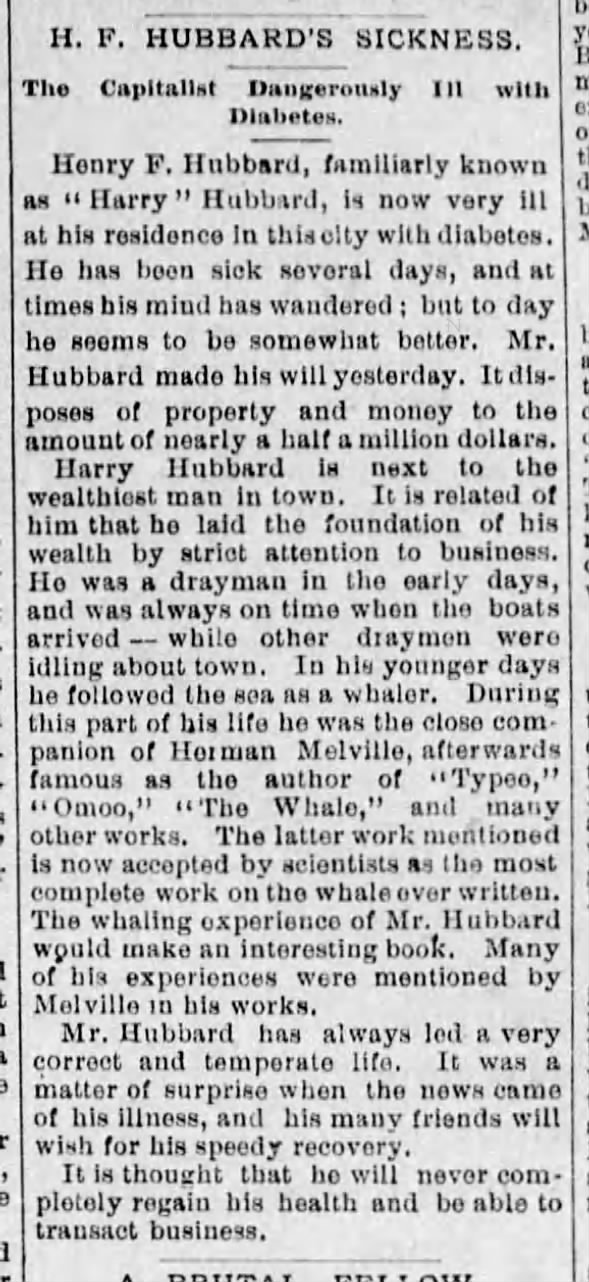
Harry Hubbard in Stockton, 1887 notice of his illness with mentions of Melville and THE WHALE

Stockton
Albertus Del Orient Browere via American Gallery

Henry F. Hubbard (1820-1887) was a "green hand" with Herman Melville on the whaleship Acushnet. Hubbard, just 20 years old, and the future author of Moby-Dick, 21, signed on late in December 1840. On January 3, 1841 they sailed out of Fairhaven, Mass. with Captain Valentine Pease on Melville's (and their ship's) first whaling voyage. Eighteen months later, in June of 1842, Melville and another "green hand" Richard Tobias Greene famously deserted at Nuku Hiva in the Marquesas. Melville and Hubbard would reconnect in the early 1850's when Hubbard visited Pittsfield. On March 23, 1853 Melville inscribed a copy of The Whale to 

"Henry Hubbard from his old shipmate and watchmate on board the good ship Acushnet (Alas, wrecked at last on the Nor'west)"

https://www.lib.uchicago.edu/collex/exhibits/special-collections-special-director/whale-1851/

At some point (then or earlier) Hubbard updated Melville on the fates of former shipmates, as shown by Melville's extant memorandum of What became of the ship's company of the whale-ship "Acushnet" according to Hubbard who came home in her. Melville's memo and Hubbard's inscribed copy of The Whale (with two interesting annotations about real-life counterparts of Stubb and Pip) are presented and fully discussed in the 1988 Northwestern-Newberry Edition of Moby-Dick.

Hubbard made a name and fortune for himself in California. His obituary in the Stockton Evening Mail of March 26, 1887, cited for relevant biographical facts of Hubbard's life by the N-N editors, contains no reference to Moby-Dick or its author. Melville and the British title of his great whale book were both mentioned, however, in a previous notice published by the same newspaper under the heading, "H. F. HUBBARD'S SICKNESS." The writer thought Harry Hubbard's whaling adventures "would make an interesting book" and believed also that

"Many of his experiences were mentioned by Melville in his works."

Transcribed below from the Stockton, California Evening Mail of March 9, 1887. Found on newspapers.com; accessible also via the California Digital Newspaper Collection.


09 Mar 1887, Wed The Evening Mail (Stockton, California) Newspapers.com

H. F. HUBBARD'S SICKNESS.

The Capitalist Dangerously Ill with Diabetes.

Henry F. Hubbard, familiarly known as "Harry" Hubbard, is now very ill at his residence in this city with diabetes. He has been sick several days, and at times his mind has wandered; but to day he seems to be somewhat better. Mr. Hubbard made his will yesterday. It disposes of property and money to the amount of nearly a half a million dollars.

Harry Hubbard is next to the wealthiest man in town. It is related of him that he laid the foundation of his wealth by strict attention to business. He was a drayman in the early days, and was always on time when the boats arrived--while other draymen were idling about town. In his younger days he followed the sea as a whaler. During this part of his life he was the close companion of Herman Melville, afterwards famous as the author of "Typee," "Omoo," "The Whale," and many other works. The latter work mentioned is now accepted by scientists as the most complete work on the whale ever written. The whaling experience of Mr. Hubbard would make an interesting book. Many of his experiences were mentioned by Melville in his works.

Mr. Hubbard has always led a very correct and temperate life. It was a matter of surprise when the news came of his illness, and his many friends will wish for his speedy recovery. It is thought that he will never completely regain his health and be able to transact business. 

Daily Alta California - March 26, 1887

Thursday, April 16, 2020

Lady sailor on whaleship LYDIA, "equal to any man"

This early report of a black woman on the crew of a Nantucket whaleship appeared in the New London Bee (New London, Connecticut) on June 10, 1801, reprinted from the New England Palladium (Boston, Massachusetts) of June 5, 1801. Found in the online Newspaper Archives at GenealogyBank.

The given date "18th May last" means May 1801, indicating completion of the second of two voyages by the Lydia when William Clark (or Clarke, elsewhere) served as captain in 1800-1801. The female sailor went disguised as a man on both voyages, as documented in Alexander Starbuck's History of the American Whale Fishery (Waltham, MA, 1878) pages 195-196:
"One of the crew a disguised female; had been two voyages undetected."
New London, CT Bee - June 10, 1801 via GenealogyBank
On the 18th May last, arrived at the bar off the harbor of Nantucket, the ship Lydia, capt. Clark, belonging to Micajah Coffin & Sons, of that place, from a southern whaling voyage, with her casks full of whale oil. One thing worthy of notice happened in the course of the voyage, which will serve to show that the female form may exist without possessing all the soft and delicate habits so much admired in the sex. On the voyage, one of the blacks belonging to capt. Clark's crew was discovered to be a woman; notwithstanding which, capt. C. informs us, that she has performed all the duties incumbent on a sailor equal to any man he had on board. What induced the young lady to disguise herself and enter into so dangerous and laborious an employment we have not yet been informed.

Palladium -- June 5
Reprinted from a "Boston Paper" in the New York Gazette on June 11, 1801; and Alexandria, VA Times and District of Columbia Daily Advertiser on June 15, 1801. Also reprinted in the Philadelphia, PA Gazette of the United States for June 11, 1801.

Tuesday, August 15, 2017

Romance of whaling, "in the days before petroleum"

"There is no longer any interest in the subject. It was not possible for any one to say anything worth reading or listening to after Herman Melville's yarns. His "Omoo" and "White Jacket" were the last romances of the sea. Richard H. Dana, Jr., exhausted the field of "before the mast," and Melville left nothing for anybody to tell about whaling."
--Review of Nimrod of the Sea, Brooklyn Daily Union, September 8, 1874
 The Brooklyn Daily Union - September 8, 1874
By contrast, and with no thought of Moby-Dick, the Christian Watchman praised Nimrod of the Sea as "a graphically-told narrative of daring exploits" and "a deeply interesting account of the nature and habits of the whale, of the methods employed for his capture, and of the uses which he is made to serve."
A bright boy, in the reading of the book, will not fail to gather a vast deal of new information in respect to the sea and its wondrous forms of life. Scattered through it are many spirited pictures representing the perilous circumstances which surround the intrepid sailors in their attacks upon the whale." --Christian Watchman [Boston], September 10, 1874
The New York Herald (September 28, 1874) described the author William M. Davis as "one of those hardy Long Island mariners who sailed for the whale in the days before petroleum."

Found on Newspapers.com

So far, the 1874 review of Nimrod of the Sea in the Brooklyn Daily Union is the only contemporary notice I have found that recalls Moby-Dick. However, in the same year, the review of "Jules Verne's Romances" in the Wilmington Daily Commercial favorably compares the "vein of poetry and romantic mystery" in Twenty Thousand Leagues Under the Sea with that of Moby-Dick:
But a mere fantasy, an intellectual whim, must not be carried too far, lest in the process of attenuation it should break. M. Verne touches the limit nicely in "Twenty Thousand Leagues," and that book remains his best because in addition to its audacity and wealth of invention it had a vein of poetry and romantic mystery running through it. In those respects it resembled Herman Melville's "Moby Dick," in which the practical details of whale-fishing are relieved by a fine play of the imagination.  --Wilmington [Delaware] Daily Commercial, November 4, 1874
The Nantucket Historical Association has whaling journals by William Morris Davis in 1834-1837. According to the catalog description, Log 354 ("Journal of a man before the mast or on board the Whale Ship Chelsea of New London") was "Used in preparation of William M. Davis 'Nimrod of the Sea or The American Whaleman' (Harper 1874)."

As Caleb Crain has observed, some elements in Davis's description of sperm-squeezing in Nimrod of the Sea resemble Melville's treatment of the same operation in chapter 94 of Moby-Dick. For instance, Melville imagines himself "in a Constantine's bath" of sperm, while Davis experiences a more luxurious "bath" than ever did "Solomon in all  his glory." I would like to know if and how Davis describes the operation of squeezing sperm in manuscript. And everything else, for that matter. It could be a rewarding project to compare manuscript and book versions throughout, to see what kind of rewriting was involved in 1872, and how much. Possibly the style of Moby-Dick in places influenced the editing or rewriting of Nimrod of the Sea. Obviously, Nimrod as published in 1874 could not have influenced Moby-Dick (1851), unless somehow Melville had access to "oil-stained" whaling logs of the Chelsea by William Morris Davis (1815-1891).

Monday, July 25, 2016

Thomas Sweeny (1811-1879) in 1846, Captain Williams's virtual whaling voyage in 1863

The new Leviathan came stuffed with source studies, a kind of Christmas stocking in July. Don't miss the splendid essay by Robert J. O'Hara on Hood's "The Lee Shore" and Moby-Dick

In the same June 2016 volume, Josie Madison identifies Thomas Sweeny as the former House of Refuge bad boy whom B. K. Peirce associated with Melville's South Sea romances in Appleton's Journal for March 18, 1871. I stumbled across that Melville reference in Appleton's years ago but never got anywhere, except for impulsively buying Peirce's 1869 book, A Half Century with Juvenile Delinquents. More wisely and profitably, Josie Madison consulted the Inmate Case Histories in the New York State Archives. Fascinating cat, this Sweeny--a sort of real-life Lem Hardy. Even so, there's no need to discount Melville's long known use of Langsdorff for the characterization of Lem Hardy (and the information "Hardy" provides about tattooing) in Omoo


As observed in the Explanatory Notes for the classic Hendricks House edition of Omoo by Harrison Hayford and Walter Blair (page 355), "Melville had an eye on Langsdorff's full-page engraving of the well-tattooed Frenchman Jean Baptiste Cabri who lived among the Marquesans and gave Langsdorff the information that Lem Hardy purportedly gave Melville." 

From Melville's Omoo, Chapter 7
Let's look again. Yep, Jean Cabri as depicted in Lagsdorff's Voyages and Travels bears a forehead tattoo something like the triangular "blue shark" tattoo which Melville ascribes to Hardy. I can't see shark or fin on Sweeny's face as shown in the photograph posted on Ancestry.com in January 2016 by Douglas Rynkewicz.


Possibly Sweeny was gone to New Zealand by the time Melville got to the Marquesas. I'm not yet clear on the documentary basis for this, but the "Facts" page of the Rynkewicz Family Tree at ancestry has him already in Akaroa by 1840. On the other hand, Melville could have read about Sweeny, spelled Sweeney, in a major New York newspaper like the New York Tribune, or the Evening Post. While writing Omoo even. The article below (reprinted from the Trenton Daily News) appeared in both papers on October 14, 1846.
New York Evening Post / October 14, 1846

AN INTERESTING LABORER.—There is a man, employed at the iron establishment of Mr. Cooper, in South Trenton, who has visited nearly every part of the world—has spent many years among the Indians of the Pacific Ocean—and speaks more Indian languages, probably, than any other man in the state.
Mr. Sweeney, for such is his name, is employed at the scales near the basin, where he weighs all the iron, coal, &c., which is received or sent away; and his business employs him so constantly, that he has little leisure for conversation. He is an American, and we believe was born in New York.

At the age of fifteen, he went to sea, and for sixteen years scarcely visited the United States. He was employed much of his time in the whale fishery among the Pacific islands, and his constant intercourse with the Indians, and his facility in acquiring languages, soon made him master of some thirty different Indian dialects.

At one time, in consequence of severe indisposition from scurvy and other causes, which threatened to prove fatal if he remained on ship-board, he was set ashore on the Marquesas Islands, and was there alone with the Indians between three and four years. Here he mingled with them on the same footing as a native born Indian, and arose, first to be the chief of his tribe, and then the chief of all the tribes in that group of islands, retaining his power and consequence up to the time of his departure.

At this time his arms, legs and body are covered with the tattoos which are customary in the Pacific groups, and their color, he informs us, has not changed a particle since the day that this painful operation was performed, which is now some seven or eight years.

Mr. Sweeney is a steady, industrious man, and has a wife, an English woman, we believe, whom he married in the Pacific. One of his daughters still remains in some of the Pacific Islands, but the rest of his family are with him. He is about thirty-four years of age.—[Trenton Daily News.
The same article in the New York Tribune, October 14, 1846 can be seen at the Library of Congress site, Chronicling America. Fulton History has the same item in the Morning Courier and New York Enquirer for Saturday, October 17, 1846. Also reprinted in the Schenectady Cabinet on November 3, 1846.

More biographical information about Thomas M. Sweeny from the detailed Rynkewicz Family Tree at ancestry:
Birth 11/07/1811 Donegal County, Ireland
Death 05/05/1879 Chambersburg, Mercer, New Jersey, USA
On September 23, 1843 the New Zealand Gazette and Wellington Spectator announced Sweeny's marriage on September 13th to Mary Anne Furminger. In October of 1843 he shows up in court proceedings as a constable for Akaroa.

In 1863 Sweeny was there when Capt. Williams came to town with his traveling exhibition:
Capt. Thomas Sweeney, of this city, an old whaleman, and for many years a resident of the Marquesas, and other cannibal islands in the South Pacific, where he received the highest honors that these savage tribes could confer, will be present at Capt. Williams’ exhibition during this and the other evenings of this week. Capt. Sweeney is thoroughly conversant with the language, manners and customs of the South Sea Islanders. He is tattooed in the highest style of savage art, as a mark of honor and rank. He will describe this operation, and relate many interesting incidents of his adventurous life. This will add a very interesting feature to the stirring and fascinating entertainment of Capt. Williams, which continues to draw crowded houses. --Trenton State Gazette, May 14, 1863
The "Nautical Entertainment" by Williams presented
a lively and vividly interesting description of the enterprise, energy, and perils of the whalemen, the whole illustrated by a splendid panorama of a south-sea voyage, and a practical exemplification of the method of taking whales; a regular whale boat, with crew, harpoons, lances, &c., being brought on the stage and handled in the regular manner. --Trenton State Gazette, May 6, 1863
[Later: This Captain Williams must be Edward C. Williams (1815-1868), author or compiler of Life in the South Seas. Buried in Rochester, New York - Mount Hope Cemetery. ] Here's an advertisement for the Newark stop of Williams's amazing show--a virtual South Sea Whaling Voyage complete with "A REAL WHALE-BOAT":

Newark Daily Advertiser / June 11, 1863
One Boston critic at least remembered Moby-Dick:
“A wonderful entertainment—we can give no higher praise than to say that Herman Melville and J. Ross Brown’s whaling scenes, seemed actually to be carried on before the eyes of the spectators, down to the intense whispers of the commander and the extravagant tactics displayed during the fury of the combat” --Boston Journal, as quoted in the Schenectady Evening Star and Times, Thursday, December 3, 1863
Getting back to Thomas Sweeny in New Jersey, another Trenton item briefly describes his 1854 appearance before the local Philosophical Society, meeting in the Library Room:
Towards the conclusion of the meeting it was mentioned that Thomas Sweeny, who had spent the greater part of his life on the Pacific, and who for some years had been ruler in the Marquesas islands was present by invitation, and would give such information as the society might desire respecting the islands of the Pacific and the whale fisheries. Various questions were answered—The appearance of the natives, their customs, cannibalism, tattooing, and whale fishing occupied the remainder of the evening. That the old chief had been in strange company his elaborably tattooed arm and legs bore witness. These dermoid inscriptions relate to the achievements and honors of the individual who bears them.

After an expression of thanks to Mr. Sweeny for his rare and highly interesting narratives, and a request, that at another time he may continue them, the Society adjourned. --Trenton [New Jersey] State Gazette, Thursday, May 18, 1854
After Sweeny's death on May 5, 1879, the Trenton State Gazette excerpted much of the old "Daily News" report from 1846, as follows:
THE DEATH OF A REMARKABLE MAN.—

Yesterday morning it was announced in Chambersburg that Capt. Thos. Sweeny, an old resident of this city, had died. In the “Daily News” of October 7, 1846, we find a very interesting account of Captain Sweeny. He was at that time employed at the rolling mill as weighmaster, and the article in the “News” says: “He has spent many years among the Indians of the Pacific Ocean, and speaks more Indian languages than any other man in the State. At the age of fifteen years he went to sea, and for sixteen years scarcely visited the United States. He was employed much of his time in the whale fisheries among the Pacific Islands, and his constant intercourse with the Indians and his facility for acquiring language soon made him master of thirty different Indian dialects. At one time from severe indisposition from scurvy and other causes, which threatened to prove fatal if he remained on shipboard, he was set ashore on the Marquesas Islands, and was there alone with the Indians for four years.

“Here he mingled with them on the same footing as a native born Indian, and arose, first, to be the chief of his tribe, and then chief of all the tribes in that group of islands, retaining his power and consequence up to the time of his departure. 

“At this time his arms, legs and body were covered with the tattoos which are customary in the Pacific groups, and their color, he informs us, has not changed a particle since the day that this painful operation was performed, which is now some seven or eight years.”

Mr. Sweeny married an English lady in the Pacific islands, and had one daughter living there, the remainder of his family moving to this city with him. --Trenton State Gazette, Tuesday, May 6, 1879.

Wednesday, February 10, 2016

Fragments from a Writing Desk: The ACUSHNET--Perils of Whaling--December 1847

Image Credit: Brooklyn Museum
At Fragments from a Writing Desk, Hershel Parker has transcribed a sobering news story headed "Perils of Whaling." This May 1848 item relates a fatal encounter with a sperm whale by Melville's old ship Achushnet on December 22, 1847--four years before the publication of Moby-Dick (1851):

Fragments from a Writing Desk: The ACUSHNET--Perils of Whaling--December 1847

Versions of the story circulated widely in May 1848. Found so far, in addition to the May 23, 1848 report in the Louisville Daily Courier:
  • New Bedford Mercury, May 12, 1848
  • New York Evening Express, May 13, 1848
  • New York Herald, May 14, 1848
  • Morning Courier and New York Enquirer, May 15, 1848
  • New York Evening Post, May 15, 1848
  • Boston Herald, May 15, 1848
  • Troy Daily Budget, May 16, 1848 [from the Boston Traveler]
  • New Bedford Whaleman's Shipping List and Merchants' Transcript, May 16, 1848
  • Philadelphia Inquirer, May 16, 1848
  • Salem Register, May 18, 1848
  • Alexandria Gazette, May 18, 1848
  • Portland [Maine] Weekly Advertiser, May 23, 1848
  • Sag Harbor Corrector, May 24, 1848
  • Pittsfield Sun, May 25, 1848
  • Milwaukee Sentinel, May 27, 1848
Below, the story as it appeared in shipping news under the heading "Whalemen," in the New York Herald, May 14, 1848.

"Captain Rogers, of the Acushnet, of Fairhaven, writes from Talcahuano, January 26, that on the 22d of Dec, a boat was stove by a whale, and John Taber, 3d officer, Henry Johnson, boatsteerer, and Manuel Francis, John Pease and John Locket, seamen, either killed or drowned. The A[cushnet] had lost three boats, and had two others badly stove within a month. Would sail on a cruise as soon as the men could be replaced."
And below, the same item as it appeared in the New York Evening Post Marine List (May 15, 1848), under the heading "Disasters. &c.":


Both items identify seamen "John Pease" (instead of John Pearce) and Manuel Francis, who is not named in most "Perils of Whaling" versions of the story.

Tuesday, August 4, 2015

Isaac D. Rose (1811-1890): whaleman and officer, Gay Head farmer, overseer, postmaster, district and town clerk--and Porte Crayon's estimable "Roos"

Writing in the September 1860 Harper's magazine about a visit to Gay Head (now Aquinnah) on Martha's Vineyard, David Hunter Strother (aka "Porte Crayon") describes the home and hospitality of "a very intelligent and well-mannered person" supposedly named "Roos." Strother's fictive narrator Bob Berkeley specifies the occupation of his Gay Head host as "a professional sailor, who had made his last voyage as first mate of a whale-ship." Who is this distinguished whaleman turned farmer? Here is the extended passage which I am prompted to consider after reading Nancy Shoemaker's citations and brief discussion of Strother in her new book Native American Whalemen and the World.
Continuing our walk, we at length met a man in the pathway, whose address indicated some acquaintance with the world; and in answer to our inquiry for dinner, he very politely turned and led us to his house. 
It was a small but regularly finished wooden house, and altogether of a better sort than any we had yet seen. The parlor was respectably furnished, carpeted, and curtained; the mantle- piece and tables decorated with sea-shells, Daguerreotypes, and hooks. Among the latter were some illustrated annuals, but all of them of a moral and religious character.  
Our host, Roos, we found to be a very intelligent and well-mannered person, a professional sailor, who had made his last voyage as first mate of a whale-ship. This is the occupation of most of the men of the reservation, and is the only pursuit followed by civilized men that the Indians or their descendants have shown any aptitude for. It is, in fact, nothing more than their original and natural occupation of fishing, extended and improved by the genius and enterprise of the white man. The few poor garden patches that we observed were doubtless cultivated by the women and children, after the Indian fashion. 
Roos gave us a comfortable dinner, at which he and his wife joined us. After the meal we retired to the parlor, where he spun us some sea yarns, and traded us some pretty shells which had gathered in the Indian seas. The books on his table, he informed us, belonged to the schoolmistress, who was at that time quartered at his house. 
Upon this suggestion we took leave, and wended our way to the Academy, where we found the school in session....  -- A Summer in New England
Critical of Strother's racist view of Gay Head Indians as "a thriftless and inferior people," Professor Shoemaker determines that his facts must be as faulty as his stereotypes:
They said his name was "Roos," but it must have been George Belain, who was at that time the only Gay Head native who fit their description of "a professional sailor, who had made his last voyage as first mate of a whale-ship."  --Native American Whalemen and the World, chapter 10
Wait wait wait. First we need to sort out who's talking and traveling here. Professor Shoemaker finesses "they" as transparently "[a] travel writer" (Strother) and "an illustrator" (Porte Crayon). But the actual writer and artist are one man, Strother, who throughout his "Summer in New England" series employs fictional personae (both Virginians) as a narrative device to achieve a dual perspective. Cecil D. Eby, Jr. explains it well in his 1960 biography of David Hunter Strother:
The narrator is Bob Berkeley, who writes in first person. Accompanying him on his trip is Dick Dashaway, a brainless but generous young Southerner of many love affairs. The guileless, amiable Dick serves the same function as the Chinaman in Goldsmith's Citizen of the World: he is almost painfully naive, but his comments upon the strange manners of the Yankee nation often cut to the heart of the matter. Dick's provincialism is balanced by Bob Berkeley's sophistication. We therefore obtain two interpretations of the events. -- Porte Crayon: The Life of David Hunter Strother, Writer of the Old South (University of North Carolina Press, 1960) page 97.
The New England travelogue complements Strother's previous Harper's series, A Winter in the South. Strother's actual journey to New England took place in 1859. Eby adds in a footnote that the narrator's traveling companion "Dick" is based on Berney Wolff, Strother's brother-in-law.

Without endorsing ugly and always offensive stereotypes, discerning readers will want to keep in mind the formal context, tone (often satirical), and complicated perspective of A Summer in New England. Strother's bigoted southern tourists find faults with Yankees and other New England types, not only among the Wampanoag people of Gay Head (Aquinnah).

Now about this respectable whaleman "Roos" whom Professor Shoemaker believes "must have been" George Belain.

Must have been? Ack. Despite the ploy of fictive tourists called Bob and Dick, Strother names real names of people and places. He gets them wrong sometimes, but not that wrong. His "Deacon Simon" is Simon Johnson. "Hetty Ames" can only be the widow Mehitable Ames, 80 years old in 1860 according to the Indian Census of Gay Head. And look at his sketch of the woman in the rocking chair, identified in the caption as "Jane Wormsley." Sure enough, that's Jane Wamsley. Strother's "Roos" might be harder to figure out, but not impossible. "Belain" for "Roos" can't be right. So we need a different real name closer to "Roos."

In Vital Records of Sudbury Massachusetts we find the spelling "Roos" variously associated with Rooss, Ross, and Rose. Aha, maybe Porte Crayon's "Roos" is "Rose" as in Isaac D. Rose.

In "Appendix A" of the 1849 Bird Report of the Commissioners, Isaac D. Rose (age 37) is listed with his wife Harriet A. (age 27) and infant only 10 days old with other recognized members of the "Gay Head Tribe."

As shown in the Vital Records of Tisbury, Mass., Isaac D. Rose married Harriet A. Wamsely in April 1841:
ROSE, Isaac D., colored, of Gayhead, and Harriet A. Wamsley of Gayhead, Apr. 27, 1841.* [Isaac D. of Gay Head, and Harriet A. Wamsley of Gay Head, C.r.]
Harriet was Isaac's second wife. His first wife was Harriet's sister, Priscilla A. Wamsley, who died October 12, 1838.  Isaac and Priscilla were married in 1837. The name ROSE was entered in the Vital Records of Chilmark as ROWS:
ROWS (see Rose), Isaac of New Bedford, and Priscilla Womsley, int. May 23, 1837.

ISAAC D. ROSE (1811-1890)


According to the New Bedford Family tree at Ancestry.com our Isaac D. Rose was born in Taunton, Massachusetts on November 14, 1811; and he died in Gay Head of an unspecified "heart ailment" in September 1890. No source for date of death given, but the Index to Deaths in Massachusetts 1886-1890 confirms under Rose the 1890 death at Gay Head of "Isaac D (colored)" as recorded in volume 409 page 228. (Where the date of birth comes from escapes me.)

New Bedford City Directories for 1838 and 1839 show Isaac D. Rose with the whaleship Mercury and boarding at "34 Sixth, corner Walnut" street.
New Bedford, 1839 by Granger, via fineartamerica
The 1860 census of Gay Head shows Isaac D. Rose with 12 acres of land just like George Belain. Then "farmer," Isaac D. Rose was or had been a whaleman, too. There he is again in the 1870 federal census, Isaac D. Rose, age 58, occupation "Mariner" with a healthy $700 in real estate and personal estate valued at $250. Daughters at home, Etta H. age 10 and Minola or Mincola or Minneola 17. (Daughter Mineola or "Minnie" would marry an African mariner named John Stevens.) In the 1880 census Isaac D. Rose is "farmer" again, still married to Harriet A., with Etta H. the only daughter still at home, now 20 years old. This younger daughter Etta H. Rose would marry Leonard L. Vanderhoop December 30, 1885.

Isaac and Harriet Rose also had a son, Alfred, born June 1848 in Gay Head. Alfred P. Rose died in battle on July 30, 1864, in Petersburg, Virginia, when he was 16 years old. Serving, as David J. Silverman notes in Faith and Boundaries (Cambridge University Press, 2005) "among the 'colored troops' of Massachusetts."

Crew Lists show Isaac D. Rose as 3rd mate aboard two ships, the Golcoda II in 1841 and Canton II in 1845.

The 1845 record gives his age as 34 and residence as Taunton, Massachusetts--near to Fall River which is Isaac D. Rose’s place of birth according to 1860 census. Both parents of Isaac D. Rose were born in Connecticut according to the 1880 federal census.

A crew list published in the Whaleman's Shipping List August 10, 1852 names Isaac D. Rose as second mate of the whaling bark Clara Bell of Mattapoisett under "Captain David [Daniel] Flanders, of Chilmark, Mass." Isaac D. Rose worked his way up the ranks, from 3rd mate in 1841-5 to 2nd mate in 1852. It would not be surprising then to find him later in the 1850's as 1st mate of a whaler, or acting in the capacity of mate.

In the only reference to Isaac D. Rose in Native American Whalemen, Nancy Shoemaker names him among the town clerks of Gay Head, many of them whalemen. Not only whalemen, at home they were prosperous and capable leaders of the community. Wherever he went on land and sea, Isaac D. Rose proved himself a leader.

As Overseer...
Chap. 30. RESOLVE on the Petition of the Overseers of Gay Head.
Resolved, That for reasons set forth in their petition, that there be allowed and paid, out of the treasury of the Commonwealth, to Isaac D. Rose, Aaron Cooper, 2d, and Samuel
Peters, Overseers of the Indians and people of color at Gay Head, the sum of five hundred and sixty-five dollars, for the purpose of erecting a school-house at Gay Head; and the governor is hereby authorized to draw his warrant for that sum. [Approved April 14, 1857.] --1857 Acts and Resolves
This 1857 evidence of Isaac D. Rose's leadership in securing funds for the new school at Gay Head suggests a strong interest in education, consistent with Strother's observation when visiting "Roos" in 1859, of his host's pride in the community's new school, their teacher, and her books:
The books on his table, he informed us, belonged to the school-mistress, who was at that time quartered at his house. Upon this suggestion we took leave, and wended our way to the Academy, where we found the school in session...  --Strother's Summer in New England
As postmaster...
THE POST OFFICE 
Until 1873 this town was served from the Chilmark office at Squibnocket, and on Feb. 14 of that year Isaac D. Rose was appointed the first postmaster of the newly-established office. He served eleven years, and was succeeded by William A. Vanderhoop, Dec. 11, 1884; Paulina A. Vanderhoop, Nov. 14, 1893, and Mary A. Cleggett Vanderhoop, Aug. 13, 1907, the present incumbent.  --Banks, History of Martha's Vineyard
and District then Town Clerk...

As noted above, Isaac D. Rose married two Wamsley women, Priscilla in 1837 and, several years after her death in 1838, Priscilla's sister Harriet in 1841. Despite his "non-Indian" "non-member" status alleged in the contentious but richly documented 1985 government report cited below, Isaac D. Rose was already included in the 1849 census of Gay Head Indians.
... state records indicate that the first man to hold the important position of town clerk was William D. Vanderhoop, a non-Indian, and that for the period 1873 to 1888, this post was held by Isaac D. Rose, a non-member mulatto who had previously served as an elected overseer and as the district clerk (Mass. State Vital Records 1841-1890). Between 1899 and 1920, five (5) other non-Indians were town officials, including Charles H. Ryan (cranberry agent, 1899-1901), Charles S. Hatch (auditor, 1910), William M. Marden (town clerk, 1921-1922), Merriam C. Hayson (library trustee, 1921-1922), and Harry W. Webster (constable, 1926) (Town of Gay Head 1899-1980). With the exception of Hatch, however, all of these individuals were married to Gay Head women. --Evidence of Proposed Finding Against Federal Acknowledgement
In the divisive 1869-70 controversy over enfranchisement, incorporation and land division, Isaac D. Rose initially seemed to oppose but eventually supported division of common lands--George Belain and others opposed Rose's petition in favor of the proposed "set off" (again borrowing from the historical assessment in Evidence of Proposed Finding p67).

Clearly there's a lot more to find in libraries and historical collections on Martha's Vineyard and in the National Archives in Boston. Oh I would love to visit both places and amplify with more details about the full and distinguished life of Isaac D. Rose. If some other brave researcher gets there first, so much the better.
---
Ha! Talk about your brave researchers. After writing every bit of the above, now I find Dr. Russell G. Handsman way way ahead of me in his brilliant essay on
Some Middle-Range Theory for Archaeological Studies of Wampanoag Indian Whaling
 a revised 2011 conference paper which I happened upon at academia.edu

Dr. Handsman starts and ends critically but fairly with Melville's Tashtego, and along the way confidently identifies the estimable Gay Head whaleman of David Hunter Strother's September 1860 Harper's article as none other than
Isaac Rose!
One of accompanying illustrations shows a detail from an 1858 map of Chilmark & Gayhead with Isaac D. Rose's place labelled what looks to me like I. or J. Rase. Or Rose. Or Ruse? If spelled "Ruse" there or anywhere, well there's your Roos!


Update: 1926 sketch-map by Edward S. Burgess shows the "Isaac Rose site" centrally located along the Old South Road of Gay Head; accessible in the Indian Converts collection via Reed Digital Collections.

Related post:

Thursday, July 30, 2015

Heroic Indians in Fact and Fiction


I'm reading the Kindle version of Native American Whalemen and the World by UConn historian Nancy Shoemaker. It's good to learn about the real and important presence of Indians in the whaling industry. The book introduces and analyzes a staggering number of primary sources like whaling journals and logbooks. Also published narratives of whaling. Most of these sources are new to me, so I'm delighted to know more about them and grateful to the author for her work of investigating them.

Regarding the book I did know something about: Moby-Dick receives what might be called obligatory mentions, delivered with a sigh. As historian, more interested in facts than fiction, Professor Shoemaker has little professional use for Moby-Dick, notwithstanding Melville's heroic Indian harpooneer, Tashtego, and the illustrious name Melville gave to the fated whaleship, Pequod:
"Moby-Dick is full of this sort of typical New England romanticism about Indians...."
--Nancy Shoemaker, interview with Andrew Epstein at 11:08; via UConn Today
Native American Whalemen incorporates much of Shoemaker's earlier article in Journal of the American Republic, the point of which was that unlike Melville's stereotypical noble savage, real-life Tashtegos on American whaleships were frequently mates and boatseerers (official job title of Melville's "harpooneers"). Their professional status entitled real-life Tashtegos to be addressed respectfully as "Mr." Citation:

Shoemaker, Nancy. "Mr. Tashtego: Native American Whalemen in Antebellum New England." Journal of the Early Republic, vol. 33 no. 1, 2013, p. 109-132. Project MUSEhttps://dx.doi.org/10.1353/jer.2013.0017.

And so we're busted. No denying it, Moby-Dick is full of romanticism--about pretty much everything, and strongly influenced by European (not only American) models in Goethe and Byron and Mary Shelley. Fair enough, but it's depressing to encounter romantic as a kind of code word for "bad" (if not "despicably evil") and "worthless." Reminds me in that regard of Cynthia Wachtell's reading of dreadful glory in Melville's Civil War poem, "Inscription for the Slain at Fredericksburgh."

From the start, Professor Shoemaker's enterprise involves a problem of methodology which she acknowledges with admirable candor:
"The absence of a racial category on crew lists has confounded historians investigating race in maritime history."
Yes! Especially when the subjects of their study do not fit neatly into one "racial category" or box. Sure, Melville's "token New England Indian" (as Professor Shoemaker calls Tashtego, p. 37) is a romantic fiction. Back in the real world of nineteenth-century whaling, your Indian whaleman might well be a respected officer, "Mr. Tashtego." And he might also be African-American. Joel G. Jared, the first named of Professor Shoemaker's exemplary Gay Head Indians, was identified as Negro (offensively, using the common slur) in documentary evidence that she defers to chapter 3 on "The Primacy of Rank." Looking online, I see Jared is described as "malatto" in one 1856 Crew List of the Anaconda.

The discussion in chapter 2 on "Race, Nationality, and Gender" works surprisingly hard to define people by race. Varying contemporary identifications of Haskins men as "mulatto," "black," and "Indian" are cited as signs of uncertainty if not incompetence rather than eyewitness evidence:
"Samuel Haskins's own identity was probably not this quixotic." --Native American Whalemen and the World, chapter 2
Really? I wonder what "identity" here even means. Racial identity, it sounds like, but then why not say so. Whatever "identity" means, maybe it is that quixotic, after all. Quixotic to scholars examining racial categories, for a start, since Martha S. Putney names the brothers Amos and Samuel Haskins in her groundbreaking roll of Black Sailors: Afro-American Merchant Seamen and Whalemen Prior to the Civil War.

As if he wanted to make matters more quixotic, Amos Haskins went and married Elizabeth P. Farmer (1824-90)
"the African American daughter of the widow Dianna Farmer, who had lived in New Bedford at least as early as 1826"  --New Bedford Historical Society, Inc.
Let me see if there's anything about Amos Haskins's wife in Native American Whalemen and the World. Yes, though no mention of her being African American which is fine by me but odd in a book fixated on "the Contingency of Race" (as the subtitle has it). One Samuel Haskins of Gay Head we can glimpse for ourselves, thanks to the miracles of Google and Facebook. This Samuel Haskins is reportedly the son of Amos Haskins, according to information provided by Edith Andrews as summarized in the January 2000 Faces of Whaling Oral History Project by the National Parks Service.

Samuel J. Haskins was publicly honored with other Gay Head whalemen for heroic actions during a notable maritime disaster, the 1884 wreck of the City of Columbus at Devil's Bridge.
At about nine o'clock a life-boat was successfully launched by a crew of Gay Head Indians, consisting of Joseph Peters captain, Samuel Haskins, Samuel Anthony, James Cooper, Moses Cooper, and John Vanderhoop. After battling an hour they were able to bring seven men ashore rescued from the rigging. A second crew manned it, all Indians, except the captain, James T. Mosher. They were Leonard L. Vanderhoop, Thomas C. Jeffers, Patrick Divine, Charles Grimes, and Peter Johnson. They had rescued thirteen men when the U. S. Revenue Cutter Dexter arrived to render assistance, having been called to the scene by telegraphic messages.  --Charles Edward Banks, History of Martha's Vineyard
More recently, local historian Thomas Dresser also has published a vivid chronicle of the 1884 shipwreck in his eleventh book, Disaster Off Martha's Vineyard. Pictures of both rescue crews and boats may be found on Facebook. Here's the one showing a "Samuel Haskins" in the first life-boat, second man from the left (according to the caption at Facebook which may be wrong):
Left to Right [or the reverse, Right to Left?]:
 Joseph Peters, Samuel Haskins, Samuel Anthony,
James Cooper, Moses Cooper, John Vanderhoop — 
Photo Credit: Martha's Vineyard Antique Photos via Facebook

Later (8/01/2015): Thomas Dresser reproduces a wonderful group photo showing "Sam Haskins" (bearded?) with other Gay Head heroes, on page 116 of Disaster Off Martha's Vineyard. The "Samuel Haskins" in the Facebook photo above looks more like the man "Tom Cooper" in Dresser's group photograph. Same hat! And the man shown standing in the photo above is the same man identified in Dresser's photo as "Joe Peters." Yes it looks like the intended order of the given names must be Right to Left, making Samuel Haskins the second man from the right--bearded like "Sam Haskins" in Dresser's photograph.

The men of both crews were identified by name and commended as "Gallant Rescuers... all native Indians of Gay Head" in the New York Herald (Monday, January 21, 1884). The Massachusetts Humane Society honored each man with a silver medal and $25.00 award. A similar notice in the rival New York Tribune employed more condescending language (and puzzling, as in the unexplained term "Narves."). It's complicated all right. Spite of the woeful stereotypes, the newspaper's praise for "the heroic islanders" of Gay Head feels real and heartfelt:

New York Tribune (January 21, 1884)

In The Story of Martha's Vineyard, Charles Gilbert Hine reproduces a photo of the medal received by courageous lifesavers:


As related at website of the Wampanoag Tribe of Gay Head, these medals of honor awarded by the Massachusetts Humane Society
"are proudly passed down through the generations from one family member to another."
I don't yet know what happened to Joel G. Jared, but his Gay Head wife Rosanna also figures in the story of the Columbus shipwreck.  Rosanna later married "seaman and farmer" Abram Rodman, identified as "Black" (not "Mulatto" and not "Indian") in the 1880 census. Rosanna Gershom Rodman (the former Rosanna Gershom Jared, born Rosanna Gershom David on April 25, 1839) won public notice during the disaster as one of the island heroes. With other women of Gay Head, Mrs. Rodman (by then a widow, evidently) received $5.00 and a certificate from the Massachusetts Humane Society
"for noble and humane exertions on the occasion of the wreck of the steamer City of Columbus, Gay Head, Jan. 18, 1884."   --Worcester Daily Spy, February 5, 1884
With her husband Abram and others, Rosanna Gershom Rodman is also distinguished in New England history as a petitioner for property and voting rights.

Ironically, the determination to critique supposed exhibits of racism by unenlightened observers gets in the way of appreciating great acts of heroism by people of color. Case in point, Professor Shoemaker's mishandling of a chapter in A Year with a Whaler by Walter Noble Burns, Burns has been called "America’s premier romantic outlaw-lawman mythmaker" but Shoemaker does not even footnote his influential career as historian and romancer of the wild American West. Rather, Burns shows up as a racist stooge for his prose portrait of the third mate, a Cape Verdean named Tomas Mendez, which Professor Shoemaker blasts as
"virulent racism mixed with xenophobia." --Nancy Shoemaker, Native American Whalemen and the World
My take: Burns unaffectedly relates his inexperienced, racially prejudiced view of Mendez as a monster of evil. All that's transparent. What Professor Shoemaker fails to mention is the context--which of course is everything, the whole point. Possibly she did not read far enough. Mendez turns out to be the hero of the chapter which is devoted to him, poetically and evocatively titled, "The Night King." The narrator exaggerates his hatred of Mendez at the beginning to set up the dramatic twist at the end. In a stove whaleboat Mendez heroically cuts the harpoon lines to save his crew:
When the whale crushed the boat—at the very moment, it must have been—the Night King had snatched the knife kept fastened in a sheath on the bow thwart and with one stroke of the razor blade, severed the harpoon lines. He thus released the whale and prevented it from dragging the boat away in its mad race. The Night King's last act had saved the lives of his companions.... 
The qualities that had made him hated when he was indeed the Night King flooded back upon me, but I did not forget the courage of my enemy that had redeemed them all and made him a hero in the hour of death.  --A year with a whaler, The Night King
In a later, emotionally powerful scene (also overlooked by Professor Shoemaker) the brother of Mendez unexpectedly learns of his death:
A pathetic incident grew out of the visit of the captain from the other ship. Tomas Mendez's brother, a boat-steerer, came aboard with the boat's crew. He was a young negro whom all the boat-steerers and officers knew. He came swinging lightly over our rail, laughing and happy over the prospect of seeing his brother. 
"Hello, fellers," he called to the Portuguese officers and boat-steerers who welcomed him. 
"Where's my brudder?" 
"Dead, my boy," said one of the boat-steerers gently. 
"Dead?" echoed Mendez. 
He staggered back. When he had heard the details of his brother's death, he burst into tears. All the time his skipper remained aboard, the poor fellow stood by the cooper's bench and sobbed.
The final chapter of Native American Whalemen and the World counterbalances old negative stereotypes of degradation with the positive theme of respect. If she had not already dismissed Tashtego as Melville's "token New England Indian" Professor Shoemaker might have fittingly cited the last chapter of Moby-Dick as an enduring fictional tribute to the prominence and heroism of Native Americans in the whaling industry. However romanticized, Melville's Tashtego still belongs in the category of respectful treatments of Indians. I almost wrote "the famous last chapter of Moby-Dick" but that could be wishful thinking.

Here's the tableau with Tashtego from chapter 135, THE CHASE — THIRD DAY:
For an instant, the tranced boat's crew stood still; then turned. "The ship? Great God, where is the ship?" Soon they through dim, bewildering mediums saw her sidelong fading phantom, as in the gaseous Fata Morgana; only the uppermost masts out of water; while fixed by infatuation, or fidelity, or fate, to their once lofty perches, the pagan harpooneers still maintained their sinking lookouts on the sea. And now, concentric circles seized the lone boat itself, and all its crew, and each floating oar, and every lance-pole, and spinning, animate and inanimate, all round and round in one vortex, carried the smallest chip of the Pequod out of sight. 
But as the last whelmings intermixingly poured themselves over the sunken head of the Indian at the mainmast, leaving a few inches of the erect spar yet visible, together with long streaming yards of the flag, which calmly undulated, with ironical coincidings, over the destroying billows they almost touched;—at that instant, a red arm and a hammer hovered backwardly uplifted in the open air, in the act of nailing the flag faster and yet faster to the subsiding spar. A sky-hawk that tauntingly had followed the main-truck downwards from its natural home among the stars, pecking at the flag, and incommoding Tashtego there; this bird now chanced to intercept its broad fluttering wing between the hammer and the wood; and simultaneously feeling that etherial thrill, the submerged savage beneath, in his death-gasp, kept his hammer frozen there; and so the bird of heaven, with archangelic shrieks, and his imperial beak thrust upwards, and his whole captive form folded in the flag of Ahab, went down with his ship, which, like Satan, would not sink to hell till she had dragged a living part of heaven along with her, and helmeted herself with it.

Now small fowls flew screaming over the yet yawning gulf; a sullen white surf beat against its steep sides; then all collapsed, and the great shroud of the sea rolled on as it rolled five thousand years ago. --Herman Melville, Moby-Dick; or, The Whale

 Related post

Tuesday, July 28, 2015

The Mistery of Whaling (1841)

This unusually vivid and detailed description of whaling appeared in the Nantucket Inquirer nearly six months after Herman Melville shipped for Cape Horn and the Pacific Ocean in the whaler Acushnet. As reported in Herman Melville's Whaling Years (68-9), the Acushnet would anchor in Santa harbor, Peru ("her first Pacific Ocean anchorage") on Wednesday, June 23, 1841. Transcribed below, the unsigned sketch was first published in the Inquirer on June 12, 1841, then reprinted in numerous other newspapers under the corrected title, "The Mystery of Whaling."

An abbreviated version with more commas and fewer hyphens was published in volume 15 of the Quaker literary magazine, The Friend (Philadelphia, 1842): The Mystery of Whaling in The Friend 15.26 (1842): 203-5. Also published on January 22, 1842 in the Supplement to the Hartford, Connecticut Courant

Perils of Whaling. 
Drawn by Francis Allyn Olmsted. Lithograph of Endicott, N. Y. 
Public domain, via Wikimedia Commons

THE MISTERY OF WHALING.

Several sketches, descriptive of the process of taking whales, and of the operations on board ship connected with that gigantic sport, have from time to time been given to the public, per newspaper and pamphlet. We have seen no one, however, which for minuteness and fidelity of detail, surpasses the following. Its spirited and graphic delineations will not only interest the practical whaler; but is systematic account of the entire process, from beginning to end, will furnish both amusement and instruction to the uninitiated.—We are under obligations to the ingenious and able author, who has manifestly “seen a little service” in this pursuit—sufficient to obtain complete mastery of his subject—for this highly welcome contribution.

Written for the Inquirer.

“There she blows—there she blows—there she blows,” repeated at intervals of half a minute, is a cry often heard, and oftener wished for, from the mast-head of a whale-ship in whaling waters. And quickly is that cry from aloft followed by the question of “where away?” from the deck. “Two points off the lee bow, sir.” “How far off?” “Three miles, sir.” —“What do you call him?" says the captain. “Sperm whale, sir,” roars out the man aloft; and again he gives the cry of “there she blows,” with a noise that wakes the sleepers below, and puts to flight the dreams that have doubtless been coursing through their brains—for most people dream at sea whether they do on shore or not—and many of the dreamers have full faith in them, too, and can tell to a certainty by the dream of the previous night, whether the day will bring forth whales; whether they will be obtained if seen; whether there will be one seen or many, and whether they will behave civilly or show fight. The cry is given, and vivid excitement pervades all on board. But the captain exhibits no hurry. He turns perhaps to the cabin gangway, and says, “steward.” The word is followed at the instant by an emphatic “sir” from below. “Pass up the glass.”—“Ay, ay, sir,” is the response. A second more and the crisped locks of the sable steward emerge from the stairway. He presents the glass, an unequivocal smile separating his lips, and his eyes rolling with joy, though trying to preserve his dignity and imitate the coolness of the captain. With the spyglass on his shoulder the captain goes aloft and looks through his tube, to determine whether it is a sperm whale or some other kind, of which there are several, and although the appearance of their spout is somewhat different, they cannot always be distinguished by even a practised eye at any great distance. If the captain is satisfied of its being a sperm whale, he calls out “get the boats ready.” “Ay, ay, sir,” answers the mate from the deck. The watch below are called up; the boatsteerers look to the boats to see that every thing is in its place; superfluous clothing is thrown aside; belts are buckled on and suspenders thrown off. The cooper must stop working (in some ships) lest the noise should reach the whales and alarm them. The boys are strung out on the lower yards, and have just caught sight of the spout. “There she blows—blows-—blows,” becomes more frequent and less loud. Now they are seen from the deck. A few minutes have elapsed, and the captain is coming down. He passes aft to the quarter deck. The whales are getting near —perhaps within a quarter of a mile. The mate is standing by the captain. The latter speaks. “Let the main-yard come aback, Mr. A.” “Haul the main-yard aback,” says the mate. It is done, and the ship is stationary.—“Stand by the boats.” The crews group about their several boats, ready to jump in. The three mates are in the sterns of their different boats, with a boatsteerer in the head of each. Six men are at the different falls, ready to lower. The captain gives the word— “now lower away gently.” One after the other the boats drop into the water and are cleared from the tackles. The crews tumble in as they may and shove off.

As it is barely possible that there are persons who have never seen a whaleboat when rigged for service, let us occupy a moment in looking at one. A whaleboat is about 25 feet long, 6 feet wide in the centre, sharp at both ends, clinker built, and light. It is pulled (landsmen ignorantly say rowed) by five oars—three on one side, two on the other. It is steered with an oar similar in shape to those used in pulling, but of two or three times the size. A boat's crew consists of six, viz: a boatsteerer, who pulls the first or harpoon oar; one man to pull the next, or bow oar; one at the next, or midship oar, which is the heaviest and requires a strong pair of arms; one at the tub oar which comes next; and one at the after oar, which is the last and lightest, and is generally pulled by the smallest of the crew. The mate has the steering oar and is commander. The boatsteerer, whose title would indicate the steering-oar as his place, does not have charge of it until the whale has been struck with the harpoon, when he changes place with the mate, who finishes the performance with a lance. The person who is steering stands up. There are paddles in the boat to be used when the noise of oars might frighten the whales. There is generally a mast that can be hoisted or taken down at leisure, with a goodly sized sail to aid in propelling the boat; and sometimes two masts and sails, and a jib beside, making three sails. The line, coiled in a tub pierced with augur holes, is placed between the seats or thwarts of the tub and after-oarsman. When the whale is struck and runs out line, the tub-oarsman seizes a small bucket, placed at hand for the purpose, and douses water in the tub to keep the line wet and prevent the rapid friction from causing fire. In the stern of the boat is a keg containing a lantern, a tinder box, matches and candle. A keg of water, one or two buckets, a boat hook, and five paddles are stowed under the seats.—Along the sides are tied up spare harpoons, lances, and a large instrument called a spade. It is used for cutting holes in the whale's head, or elsewhere, when dead, for ropes to pass through. Spare thole-pins are tied to those already in use, to supply the place should any of them break. They form the row-locks for the oars. In the head of the boat are two harpoons ready for immediate use. A hatchet and boat-knife are also there, secured in convenient places to be at hand if needed. The line is passed from the tub round a stout piece of timber near the stern, called the logger-head, and thence forward to a grove in a head called the chocks. A small wooden pin keeps the line from jumping out of the chocks. A sufficient length of line is drawn through and coiled down to throw out with the harpoon. The end is made fast to one iron, (harpoons are so called) and the other attached to the same line by a piece of rope or short warp.

Thus prepared, the sails are hoisted, the oars are peaked, and the men, seated on the sides or gunwale of the boat, add the force of the paddles to the assistance of the wind. Carefully avoiding to pull on the whale's eye, they get directly behind him, taking a wide circuit to do so if necessary, and keep as much so as possible until the head of the boat is nearly up with his flukes (tail.) The mate then sheers out and runs the boat up alongside, calling out at the same time to the boatsteerer, “stand up.”—The boatsteerer drops his paddle and seizes the harpoon. “Dart,” says the mate. The men drop their paddles, jump to their seats, and take the oars. The iron flies —it has fastened— the second iron follows quick as thought—the whale is struck. With a start and lash of his huge tail he makes a hillock of foam. “Stern all” is the word, and the boat is backed off by the oars.

But all this is the work of a moment, and the whale has disappeared. He is going down, and the line is whizzing round the logger-head and through the chocks. The tub-oarsman throws water on the line; the mate goes in the head; the boat-steerer goes aft; the bowman clears away the lance for the mate. The line all this time has been left to run free, but it begins to go out with less velocity. “Take a turn,” says the mate. The boat flies through the water, throwing a sheet of foam from either bow as she follows the course of the whale; for he is now running parallel to the surface of the water though a long way down. He may run in this way a mile or two, but generally comes up sooner. When he first comes to the surface he will very likely flounce and thrash about for a few minutes, and then be quiet before he takes another start. Now is the time to go up to him. “Haul line,” says the mate, “haul hard, boys, there he lays like a log.” By hauling in the line, the boat is drawn up near enough to the whale for the mate to throw a lance in some vital part. Very often the whale is killed with a few well directed lances, or even one; but sometimes it is a more serious affair. To get near enough to reach the whale with a lance, and still to avoid getting hit by him, requires quick work and cool judgment. When the animal is kind, it is easy enough; but when it is an ugly whale, when there is a tossing, broken sea, rendering it difficult to work the boat quick, then it is that strong arms, cool heads, and bold hearts are needed.

Boats are often knocked to pieces by the whale's flukes, or bit in pieces when he is gnashing his teeth in his agony; but comparatively few persons are killed, or even hurt, when such occurrences do take place. Two or three boats will be destroyed, partially or entirely, without an individual being hurt. When a lance has taken much effect, he spouts out blood with his breath. This is a welcome sight to all concerned, and is hailed with noisy manifestations of joy, “There's blood”— “There he spouts thick blood”—“There he rolls it out, thick as tar.” After spouting out an immense quantity of blood, and bleeding from all the lance holes, his giant strength begins to fail.—He breathes slower and lashes the water with less force. Presently he stops blowing, but his strength is suddenly renewed. He starts off with a speed equal to his most successful efforts in his palmiest days of health and strength. He does not go in a straight line, but describes a circle. Now slack line and give him room.—Keep out of his way, for he no longer sees or heeds boat, harpoon, or lance—mate, friend or enemy. Onward he plunges with the energy of delirium. “Slack line—pull out of his way—pull hard—there, let her run, he'll go clear,” are the successive orders of the mate as he puts the sheath on his lance, knowing that its work is done. The whale has circled round once, twice, and perhaps again; but his race is nearly run—he stops—he raises his monstrous head as if trying to escape from his native element—he sinks back and turns upon his side—he shows the corner of his fluke—he is dead.

Glee now takes the place of anxiety in the countenance of the timid, and quiet satisfaction in that of the resolute. Now haul in your slack line and coil down. It comes in merrily. No urging is now needed. The boat is by the whale's head. The spade is cleared away, with which the mate is cutting a hole to pass a rope through. The bow-man is holding the boat up with his boat-hook. The hole being made the rope is passed. “Give us the waif" says the mate briskly. A small flag is handed out and stuck on a pole. It is the signal to those in the ship that the whale is dead.

Let us go to the ship. She is four miles of to windward. The other two boats are within a mile of her, chasing whales, but cannot get up to them. The captain is on the fore-top-gallant-cross-trees with his spyglass. He sees the waif. It is near night. “On deck,” he calls out. “Sir,” answers one on deck. “Run that signal up at the mizen peak.” “Ay, ay, sir,” says the man. The signal halliards are brought in, the flag made fast and run up. It is the signal for the two near boats to come aboard. They see it, and relinquish the chase. They are soon along side and hoisted up; the sails are filled, and the ship is running down to the dead whale. But it is getting dark; the wind is light, and the whale is four miles off.—The captain has lost sight of whale and boat and is running by guess. Presently a small light is seen for an instant on the surface of the water and disappears. It is enough—the boat is there. “Keep off another point" is the order from aloft. “Keep off another point, sir,” is repeated from the deck, and the ship is again headed for the whale. The light of the boat's lantern is visible or hidden as she rises and falls with the swell of the sea. It becomes more and more constant, and soon ceases to disappear.

While the ship is drawing down, preparation is made for securing the whale to the ship. A stout cable is strung along the deck to be passed round his flukes. One end of this cable, or fluke rope, has an eye, formed by unlaying the strands, doubling back, and splicing in; while the other end is whipped up snug to be rove through the eye. A small line with a buoy at one end is fastened by the other end to the eye of the fluke rope. A lead sinker is attached to the line at the distance of two or three fathoms from the buoy. As the light becomes visible from the deck, those on the look out aloft have come down and are leaning over the rail, still watching its position. When nearly within hail of the boat, some of the sails are clewed up, and the ship's head-way sufficiently diminished for getting the whale to the ship. This is effected by various manoeuvres, and he is placed alongside; the small line that is fast to his head having been handed on deck, by which he is now held. The buoy rope with the lead attached is dropped in the water between the whale and ship. A slanting direction is given to the sinker to carry it under and outside of him. The lead is heavy enough, with the momentum it acquires in dropping, to carry the buoy down and under the whale, when it rises on the outside, and is hooked up with the line-hook from the deck.—The eye of the fluke-rope being fast to the other end, is immediately drawn round and hauled up to the rail. The free end is then rove through and bowsed up taut, thus bringing the eye down to the small of the whale (which is the part just before his flukes) and jamming up tighter the more it is pulled upon. Now pass the end over the side again and forward to the hawser-hole in the bow—pass it in and stream across deck. “Hook on every body, and slew the whale round.” Round he comes—his flukes are drawn forward, and the head goes aft, abreast of the main chains. “Make fast all,” says the captain. The fluke rope is secured by repeated turns round the bits (or timbers at the heel of the bowsprit) and stoppered together with spun-yarn; parcelling is put round where it runs through the hauser-hole, and well smeared with slush to prevent chafing. Another stout rope is made fast to the short warp in his head, and secured on the quarter deck. The first act is finished. He is ready to be cut in on the morrow.

It is now late in the evening, and they have eaten nothing since dinner, or quite as likely; since breakfast. The cook has taken a kid of potatoes and a bucket of tea to the fore-castle, and the same to the steerage. They have bread, molasses, and cold meat below. The steward has been setting the table in the cabin. The captain speaks to the mate: “Let the people have their suppers Mr. A.”—"Go to your suppers, there," calls out the mate. They dive down, nothing loth. Each one helps himself to a tinpotful of tea, and stirs in some molasses; puts one or two good sized sweet potatoes in his pan, with a slice of salt junk and a cake or two of bread. Perhaps he has a piece of "duff" to eke out the repast. Duff is a pudding made of flour and water, nicely shortened with slush and boiled in salt water. Eaten with molasses it is nutritious, and palatable to most persons. To some it smacks a little of the glauber and other salts contained in the briny fluid in which it has undergone the process of cooking. Thus accoutred, seated around on their sea-chests with pan in lap and tin pot alongside, they set to in good earnest, keeping up at the same time an animated discussion of the performances of the day; interspersed with plenty of joke, gibe, and repartee. In the meanwhile the steward shows himself and announces to the Captain that "supper's ready, sir ;" or if he is in the humor for a polite flourish, he makes a half scrape and says, "please to walk down to supper, sir." The captain says, "ay, ay," or "very well," or perhaps nothing at all, but continues leaning against the mizzen-top-sail-sheet-bits with the mate at his lee side. In a few minutes he starts to go down, saying at the same time “supper, Mr. A."— "supper, sir," answers the mate. The captain goes down and seats himself at the table. The mate has remained on deck. Two or three minutes elapse and the mate makes a move. He walks to the second mate; says "supper, Mr. B." and goes below to take his seat by the side of the captain. The second mate answers “supper, sir," and goes to the third mate, to whom he says "supper Mr. C.," and then follows the mate to the table. The third mate responds as the others "supper, sir," and looks for the boat-steerers before he goes down. He gives the intimation as before, only omitting the Mr. before the surname. The boat-steerers answer "supper, sir," or "supper," or "ay, ay," as they feel inclined; the necessity for etiquette diminishing as the rank descends. All having been duly summoned, in the course of ten or fifteen minutes from the first announcement they are at the table. As those first seated do not wait for the others before commencing operations, it might at first appear that the order of rank would give a decided advantage in disposing of the contents of the dishes. The supposition may not be entirely groundless; but as the captain does most of the talking, the mate somewhat less, the second and third mates but little, and the boat-steerers say nothing at all, the disadvantage the latter comers might labor under is somewhat diminished, by these last giving undivided attention to the subject in hand, while the first seated are losing time in wordy discussions.

Supper being over, a half an hour may elapse before the watch is set and all others sound asleep, recruiting strength for the labors of the ensuing day. The boat-steerer who has the watch, is walking forward and aft on the quarter deck, occasionally stopping and leaning over the gangway rail. He is looking complacently at the whale. His black body is indistinctly seen in the darkness, but the phosphorescent flashing of the water as it ripples against his flukes, head, and sides, marks the outline of his dimensions.

“That's a big whale" says the man, "he'll make ninety barrels." "Yes more" answers his fellow of the watch," if he don’t stow down a hundred, I'll eat snakes and milk, and I don't like 'em neither." The boat-steerer turns away and resumes his walk, beguiling the time in calculating how many more such fellows will be wanted before the joyful sound of "full ship" will be heard; or in thinking of some token of remembrance for wife, friend, or sweetheart, to be fabricated from the ivory teeth of the whale. And a far more threatening aspect they present in his wide opened jaw, than when converted into the shining reel or polished swift on which some fair one winds her threads, and greets the donor and perchance the conqueror too, with the fairy smiles of grateful love. In such and other idle fancies the time is wiled away, until the bell strikes the signal that the watch is out. The second watch come up rubbing their eyes, in no very sweet disposition of mind; for having been turned in just long enough to taste the sweets of sleep after fatigue, without its having had time to do its kindly work of restoration, the short summons to the deck is anything but agreeable, or calculated to produce placidity of feeling. Nevertheless they are there. The word is passed (that is, whatever orders the captain may have left), the relieved stop a minute or two to chat with the relievers (unless they are too sulky) and then go below to sleep quietly till morning. Let us leave them at their slumbers, and the second watch to occupy their time on deck, and be in turn relieved by the third, to take another nap ere the first streak of daylight summons all hands to the task of cutting in. 
--Nantucket Inquirer (June 12, 1841); found in the online archive of historical newspapers at Genealogy Bank.
Reprinted widely in 1841-2, for example:
  • Schenectady Reflector, Friday Morning, July 2, 1841
  • [Jamaica, New York] Long-Island Farmer, Tuesday, July 20, 1841
  • Alexandria [Virginia] Gazette, Wednesday, December 1, 1841
  • New York Commercial Advertiser, Wednesday, December 1, 1841
  • New York Spectator, Saturday, December 4, 1841
  • [Hartford] Connecticut Courant, Friday, January 22, 1842
  • Bridgeton [New Jersey] Chronicle, Saturday, March 5, 1842
  • [Worcester] Massachusetts Spy, Wednesday, March 16, 1842
  • Raleigh [North Carolina] Register, Friday, May 27, 1842; reprinted "From the Nantucket Inquirer" over the signature of "C. C. R. 
 Related Melvilliana post: