Showing posts with label MacDonald P. Jackson. Show all posts

Wednesday, December 13, 2023

Champ prevails! "Experts" foiled, Truth wins in a knockout. Review of THE FIGHT FOR "THE NIGHT"

This is the book for any reader on Santa's nice-list who ever cared or wondered who really wrote "A Visit from St. Nicholas," better known as "The Night Before Christmas." More broadly, I imagine The Fight for "The Night" by Tom A. Jerman will appeal to mystery buffs, poetry lovers, holiday traditionalists, fans of children's lit, students of American literary history, 19th century specialists, and the growing number of persons who relish true stories about college English professors behaving badly. 


Sick-in-the-head authorship obsessives like me already bought it, probably, but won't object to receiving an extra copy. Meticulously documented yet super enjoyable to read, being refreshingly free of academese, Fight for "The Night" thoroughly examines the disputed authorship of the now famous rhymes that first appeared, anonymously, in the Troy Sentinel on December 23, 1823. The timing of Jerman's follow-up to Santa Claus Worldwide (McFarland & Company, 2020) is perfect since this year marks the 200th anniversary of the classic Christmas poem's debut in Troy. 

Non-obsessives I'm told genuinely love to recall 'Twas the night before Christmas and hear it recited in the family circle, year after year, no matter the author. Still, I have to believe that even the happiest and mentally healthiest of my fellow mortals will be pleased to know for sure which guy deserves credit for our present-day notion of Santa as a "right jolly old elf" who lands on lawns and flies to rooftops in a "sleigh full of toys" propelled by eight reindeer. Alright then, who described Santa Claus and his magical mystery "Visit" on Christmas Eve so memorably, going down the chimney "with a bound," then up again and away "like the down of a thistle"? Esteemed Bible scholar Clement C. Moore

Clement C. Moore (1779-1863)

or Poughkeepsie farmer, surveyor, and local magistrate Henry Livingston Jr? 

Henry Livingston Jr. (1748-1828)
Before continuing, some necessary disclosures and disclaimers. Transparency here seems all the more desirable in view of Jerman's illuminating comparisons of participants in authorship debates to "corners" in a boxing match and (in a pleasing diversion from the controlling "prize fight" metaphor) "expert witnesses" called by opposing attorneys to testify in court. With respect to authorship of "The Night Before Christmas" I'm squarely in Moore's corner. You can check out my chief reasons in the 2017 post on How we know Clement C. Moore wrote The Night Before Christmas.
I feel honored indeed to have been counted in Tom Jerman's book with Niels H. Sonne, Nancy H. Marshall, Stephen Nissenbaum, Pat Pflieger, Seth Kaller, and Joe Nickell as a public defender of Clement C. Moore and the merits of his longstanding claim to have written the beloved Christmas poem. 

Lately, however (and independently of Jerman's Fight) the claim for Henry Livingston, Jr. appears to have lost much of the traction it had in years past. Major Livingston's descendant and most dedicated advocate Mary Van Deusen declared victory in 2016 after the publication by McFarland & Company of MacDonald P. Jackson's monograph, Who Wrote "The Night Before Christmas"? But Van Deusen's great Henry Livingston website has not been updated with fresh authorship-related content for a good while now. In the meantime, here on Melvilliana I have documented a number of discoveries that support the traditional attribution to Clement C. Moore. On their Red-Pilled America podcast, storytellers Patrick Courrielche and Adryana Cortez have incorporated some of my findings in highly entertaining Christmas episodes. Bloomberg Opinion columnist Justin Fox has convincingly defended Moore from the false charges of keeping enslaved persons and endorsing slavery. Link here to the Bloomberg site with his 2021 article A Gift for America's Christmas Poet: Rehabilitation:

More than fittingly, Clement Clarke Moore will be inducted into the New York State Writers Hall of Fame on December 19, 2023. Ceremony to be held at Hoffman Hall of the General Theological Seminary of the Protestant Episcopal Church in the Chelsea neighborhood of Manhattan.
Amidst all this bicentennial buzz, it might be well to note that the "tale of the tape" with regard to the long-running authorship debate has not been fully presented anywhere in any format. Until now, that is. The Fight for "The Night" brings it, with easily the most complete and persuasive account in print of the contest for authorship credit. Of course I'm pleased by the good use made of findings originally posted on Melvilliana. Three prime examples would be 
  1. the 1844 letter to the editor of the New York American in which Moore unambiguously claimed authorship of the Christmas verses "not for publication, but to amuse my children" (quoted and discussed by Jerman in Fight, pages 27-28); 

  2. the previously overlooked fact that T. W. C. Moore (the fellow who obtained a manuscript copy of the poem for the New York Historical Society in 1862 after a personal interview with Clement C. Moore) was a first cousin of Henry Livingston, Jr (Fight, pages 216-219); and 

  3. the anonymous publication in the Troy Sentinel of another poem by Moore, later titled Lines Written after a Snow-Storm on February 20, 1824, just 2 months after "The Night Before Christmas" (Fight, pages 19-20). 
I'm very glad also to find my five Livingston "deal-breakers" inventoried on pages 314-316; and naturally gratified by the serious attention given on pages 316 and 351 to my Eight Great favorite expressions of Clement C. Moore which turn out to be more useful than Jackson's relatively dreary set of six for the purpose of distinguishing Moore's verses from Livingston's. 

As he did also in his previous book Santa Claus Worldwide, Jerman not only provides a valuable synthesis of published work on his chosen subject, he makes original contributions of his own that significantly enrich our understanding of that subject. There, the history of St. Nicholas and other midwinter gift-bringers; here, authorship of "The Night Before Christmas." For one of many original insights here, check out Jerman's lawyerly explanation for Moore's much-discussed delay in publishing his Christmas poem (Fight, pages 29-32). Jerman reasonably proposes that Moore took the most "prudent course" by waiting until William Gilley's copyright on The Children's Friend (the "Old Santeclaus" poem therein being an obvious literary source for "The Night Before Christmas") expired in 1835 before authorizing its reprinting the following year in The New-York Book of Poetry. 

Another highlight for me is the full transcription of Moore's comical poem The Pig and the Rooster, together with the excellent analysis thereof (Fight, 257-265). Jerman takes Moore's lighthearted exercise as "a witty and enjoyable piece," contra haters for the last hundred years. In a fine appreciation of Moore's Seussian verve, Jerman concludes: 
The closest analogy to "The Pig and the Rooster," however, is probably "The Big Brag," one of the "other stories" in Yertle the Turtle, about a rabbit and a bear who boast that they are the "best of the beasts" because of the range of their hearing and smelling abilities, respectively. In the course of their obviously bogus brags, they are interrupted by a worm who explains in an utterly condescending tone that he can see so well his vision actually circles the world, allowing him to see the backsides of the rabbit and bear, "the two biggest fools that have ever been seen." In both sound and sense, Moore's "The Pig and the Rooster" is comparable to "The Big Brag" and many other Dr. Seuss stories. (Fight, page 262) 

Challenging naive acceptance of hearsay on the Livingston side (by Jackson, for example, in Who Wrote "The Night Before Christmas"? pages 110-112) Jerman develops a strong argument against taking so-called "witness letters" from distant Livingston descendants as evidence of anything bearing on authorship of "The Night Before Christmas," other than beliefs (erroneous and conflicting, often) of the writers. See especially the sections in Chapter 10 of Fight for "The Night" under sub-headings "The Unreliability of the Livingston Witness Letters" at pages 227-229 and "Witness Letters Are Second-, Third-, and Fourth-hand Hearsay" at pages 229-236). 

Two punches late in this "literary prize fight" dropped Livingston cold. Delivered in chapters 10 and 11, these particular hits are so devastating to the contender's chances that a more compassionate reader-ref might have stopped the figurative Fight then and there. The first blow exposed a known but insufficiently exploited weakness in the story of Henry Livingston's writing "The Night Before Christmas" years before its main sources were published. Livingston partisans who say their man wrote "The Night Before Christmas" sometime between 1807 and 1809 (roughly guesstimated) fail to account in any satisfactory way for the twin influences of Washington Irving's A History of New-York (1812 ed. or later) and the illustrated poem Old Santeclaus (1821). In Fight for "The Night" Jerman persuasively frames these works as inescapable precedents and literary sources for specific details in "A Visit from St. Nicholas" (pages 209-212; 224-227; and 329). 

Other investigators have pointed out the big problem of chronology (awfully hard to credit Livingston with writing a poem around 1808 that is demonstrably indebted to two different literary works not yet printed, hence inaccessible until 1812 and 1821) but none so effectively. Practically regarded, the need of Livingston supporters to make their candidate a time-traveler invalidates the claim. So effectively that I might want to appropriate it some day, if Tom Jerman would let me, for a sixth Livingston "deal breaker." 

Same goes for the second heavy blow dealt to the contender in round-chapter 11, pages 273-280. This one also would make a devastating deal-breaker, perhaps the future #7 on my list. Simply put, Clement C. Moore's immediate family and church celebrated Christmas in high style, Livingston's did not. The contender's corner has failed to show that Henry Livingston, Jr. gave a fig for Christmas and related holiday festivities, apart from belatedly wishing his sweetheart and future wife "Happy Christmas" in a letter to Sally Welles dated December 30, 1773. Surprisingly, the Poughkeepsie patriarch represented as the embodiment of pure Christmas joy has never been caught decking the halls, baking Christmas cookies, caroling with the family, or (most tellingly of all) even once acknowledging St. Nicholas, Santa Claus, or any other midwinter gift-giver. In Jerman's words, aptly channeling Theodor Geisel aka Dr. Seuss: "Like the Whos down in Whoville, the Livingston family had no presents, no ribbons, no wrappings, no tags, no tinsel, no trimmings, no trappings, no Christmas pudding, and no Who roast beef" (Fight, page 278). As clarified on the back cover of Fight for "The Night" "Livingston's religion, Dutch Reformed, prohibited celebration of Christmas or veneration of saints whereas Moore, a devout Episcopalian, celebrated in traditional English style and treated St. Nicholas as the Christmas gift-giver." 

The middle rounds of Jerman's Fight, chapters 7 ("Basic Principles of Authorship Attribution" and 8 ("Best Practices for Authorship Attribution"), establish ground rules that could and ideally should have governed the contest--when conducted, that is, by highly trained academic "experts." These sections are a wonderful gift to anybody interested in all kinds of authorship questions, not only pertaining to "The Night Before Christmas." Jerman delves into the nitty-gritty of authorship attribution as a distinct field of scholarship. Chapter 7 summarizes important work by Samuel Schoenbaum, Harold Love, Janet Ainsworth, Carole E. Chaski, Patrick Juola, and other leading scholars. Traditional and non-traditional varieties of evidence are weighed and helpfully discussed, along with the virtue of "validity testing" your method. Reviewing best practices, chapter 8 further highlights the good advice of Patrick Juola that "experts in the field 'prevalidate' methods of authorship attribution through the establishment of appropriate, formal protocols" (as distilled by Jerman in Fight, page 173). 

Fans of "English Professors Behaving Badly" can skip the ground rules and proceed straight to round-chapter 9 in Fight for the Night, itemizing "Foster's and Jackson's Violations of the Best Practices." I know that Don Foster's meanest and nastiest attacks on the character of Clement C. Moore were convincingly rebutted long ago by Nissenbaum, Kaller, and Nickell. The trouble, as Jerman rightly perceives, was the attempted rescue of Foster's awful arguments by distinguished Shakespeare scholar and authorship expert MacDonald P. Jackson. In postmortems on the Funeral Elegy fiasco, Foster's method of authorship attribution had just become a textbook example of high profile failure when Jackson backed him on the Livingston side. Jackson inadvertently revealed his bias for Livingston throughout Who Wrote "The Night Before Christmas"? despite the posture of cool scientific objectivity that he tried to maintain. As Jerman demonstrates, Jackson like Foster before him employed a seriously flawed methodology. Each expert committed multiple violations of the "best practices" handbook according to Jerman, including failure to test for accuracy (Fight, pages 175-176); use of inaccurate corpora (176-181); failure to use independent researchers (181-185); failure to provide a profile of the likely author (185-187); adopting the role of "hired gun" (187-192); and unacknowledged sources of scholarly bias (192-196). 

I'm a little disappointed tbh that (unless I missed it?) Jerman did not mention my favorite exhibit of confirmation bias, the place in Who Wrote where Jackson acknowledged eight instances of the Moore-word "like" then quickly discounted their significance. 


Fortunately, however, my trivial loss is more than compensated in Jerman's 13th and final chapter (no more rounds, the "fight" metaphor is exhausted by this point). Don't be fooled by its boring title, "The Use of Nontraditional Analysis." Chapter 13 is way more than a stocking stuffer. It's more like a plain box or carelessly wrapped package that contains your dream-present, something fantastically grand you never really expected to get. Say a first edition of Herman Melville's epic religious poem Clarel: A Poem and Pilgrimage in the Holy Land (New York: G. P. Putnam's Sons, 1876), both volumes; or the smart-remote-key-fob to a new Firecracker Red 2023 Jeep Wrangler Rubicon. Jerman's gift to me and every truth-seeker in the last section of the last chapter of Fight for "The Night" involves "The Use of JGAAP in the Moore-Livingston Dispute." JGAAP stands for the Java Graphical Authorship Attribution Program, described by EVL Labs on evllabs.com as "a Java-based, modular, program for textual analysis, text categorization, and authorship attribution i.e. stylometry / textometry." Jerman really has two surprises in store for the patient and attentive reader. The first would be his discovery of previously unreported results from one earlier trial of Moore v. Livingston using JGAAP. 

The second surprise is the good and equally unexpected news that "with some friendly advice from Juola," Tom Jerman was able to perform another series of 17 tests in JGAAP using the same bodies of texts or "corpora" as before. Jerman identifies the clear winner and his Endnotes list categories of specific tests for both trials. Relative numbers and percentages within each test are not provided, and not really needed I suppose by general readers. Here, then, a fine opportunity opens up for further research. Future investigations using JGAAP can confirm if Jerman's findings are repeatable. Even better, researchers could try the same battery of tests with more realistic corpora, minus unsubstantiated attributions to Livingston of some Carriers' Addresses and other poems that should have been rejected as incompatible with best practices. 

This line of legitimate research makes a great gift for anybody in the Livingston corner. That would include me, too, since I never had anything against him, personally. Henry Livingston, Jr. did not and could not have written "The Night Before Christmas" but saying so does not make me Anti-Livingston or Anti-anything (excepting bad faith and worse arguments by College English Professors). With the Christmas business finally out of the way, I imagine it could be lots of fun in the coming New Year to tackle new and different authorship problems. For a start, maybe someone will try to determine if Major Livingston of Poughkeepsie ever wrote more than one New Year's Day "Carrier's Address." If he did, then which ones, and how exactly would we know (or even reasonably conjecture) that he wrote them? Until then, many thanks to Tom for the blessing of his excellent new book The Fight for "The Night" and Happy Christmas to all!!!


Monday, April 16, 2018

Improbable typos and poetic justice

Returning to the improbable alternative--that "Blitzen" was what Moore had written all along, and "Blixem" the result of scribal or editorial interference... --MacDonald P. Jackson, Who Wrote "The Night Before Christmas"? page 178.
In another footnote on the very next page, Professor Jackson surely means "Blitzen" instead of "Blitzem." But there you have it, a highly "improbable" typo, fossilized in print:
... This would, of course, imply that Moore's change from "was" to "he had" was a miscorrection, as suspicious as the change from "Blixem" to "Blitzem."  --MacDonald P. Jackson, Who Wrote "The Night Before Christmas"? page 179.
What are the odds?

Chapter 3 footnote 19 with typographical error "Blitzem" in
Who Wrote "The Night Before Christmas"? by MacDonald P. Jackson

Related posts

Friday, April 6, 2018

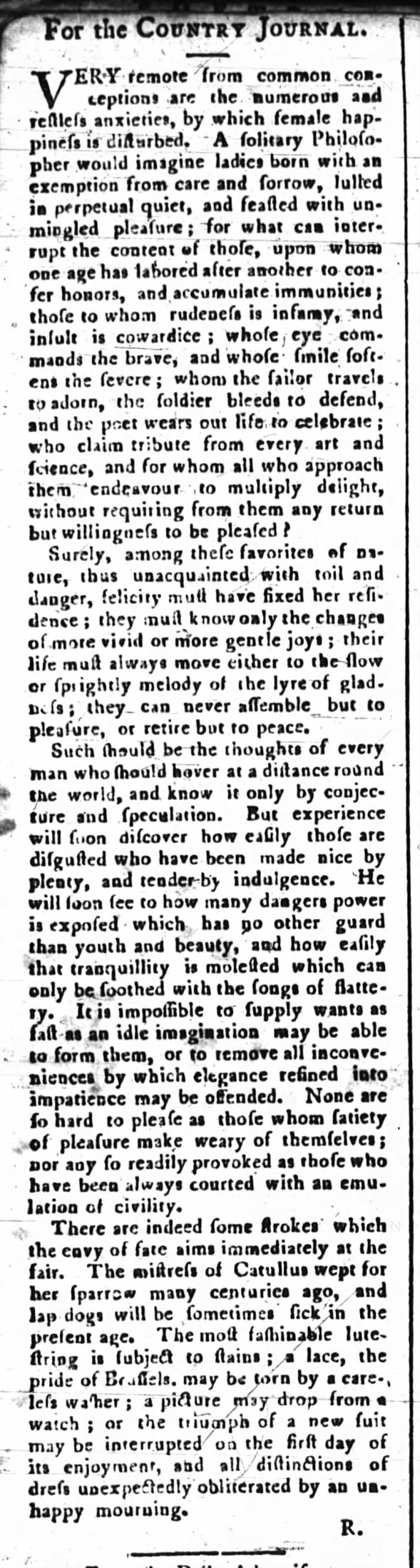
Samuel Johnson on female happiness, plagiarized in Poughkeepsie

From The Rambler No. 128 - June 8, 1751
Rather, unhappiness. A long, only slightly modified excerpt from Samuel Johnson's essay in The Rambler No. 128 (June 8, 1751) was published over the signature "R." in the Poughkeepsie Country Journal and Dutchess and Ulster County Farmer's Register of October 14, 1788. Otherwise uncredited, the item from "R." appeared under the heading "For the Country Journal." The Poughkeepsie contributor omits the general, "universal" application of the moral argument that concluded Johnson's 1751 essay:
"Such is the state of every age, every sex, and every condition: all have their cares, either from nature or from folly: and whoever therefore finds himself inclined to envy another, should remember that he knows not the real condition which he desires to obtain, but is certain that, by indulging a vicious passion, he must lessen that happiness which he thinks already too sparingly bestowed."  --The Rambler No. 128. Anxiety universal

· Tue, Oct 14, 1788 – Page 2 · Poughkeepsie Journal (Poughkeepsie, New York) · Newspapers.com

By virtue of the signature "R." this item is listed with other prose writings attributed to Henry Livingston Jr on the Livingston website, there transcribed under the title, Female Happiness. In a footnote to the second chapter of Who Wrote "The Night Before Christmas"? (page 177 note 18), MacDonald P. Jackson quotes Livingston on Catullus without acknowledging the source in Samuel Jonson's Rambler.

Related post:

Thursday, March 22, 2018

Alias Nasal Twistification: The News-Boy's Vision, 1812

Elisha Williams (1773-1833) via Historic Gravestones of Columbia County NY
The Northern Whig was a Federalist newspaper published in Hudson, New York, and edited by Francis Stebbins. A few chronicles have young William Leete Stone taking over for a few years in 1811, while the Cyclopædia of American Literature and other literary histories put Stone's arrival in Hudson later, after his stint c. 1813-1814 as editor of the Herkimer American. (Later and more famously, Stone edited the New York Commercial Advertiser.) On this point the reliable Duyckincks are vindicated by the following announcement dated October 25, 1814 and published in the Northern Whig on October 25, 1814. William L. Stone would become the new editor and proprietor of the Northern Whig, beginning on the first day of the new year 1815.

Northern Whig - November 1, 1814

Under Stebbins, as richly detailed in Columbia Rising by John L. Brooke (University of North Carolina Press, 2010), the Northern Whig replaced the old Balance, and Columbia Repository as chief antagonist of the Bee, the Democratic paper in Hudson edited until 1809 by Charles Holt, and after that by Samuel W. Clark. For many years in the Hudson Balance and Wasp, "Junior Editor" Harry Croswell (often over the pseudonym "Robert Rusticoat") waged war on Holt and Holt's Bee, and on Isaac Mitchell and Mitchell's Political Barometer down in Poughkeepsie. "The News-Boy's Vision of the Year 1812" appeared on the front page of the Northern Whig for January 6, 1812. By then Croswell had left town for Albany. There, before being baptized in the Episcopal Church, Croswell published a contrite and well-received farewell to the newspaper wars ("H. Croswell's Valedictory, Hudson Bee, January 21, 1812; reprinted from the Albany Balance, December 24, 1811). Croswell's former supporters Elisha Williams, Jacob R. Van Rensselaer, and William W. Van Ness ("the troika of the Columbia Junto" as Brooke calls them in Columbia Rising) carried on in Hudson, battling Demos until a banking scandal brought them down early in the next decade. Not surprisingly then, the verse "Vision" reflects the intensely partisan politics of the time and place.

At the Free Republic forum, mairdie wants to claim the 1812 "Vision" for Henry Livingston, Jr. It's not hard to see why. Advocates for Livingston's authorship of "A Visit from St. Nicholas" sorely need a poem by Henry with some hint of the vocabulary and magic of Moore's Christmas classic. Unfortunately there is none, as demonstrated in earlier Melvilliana posts on Livingston's Deal-Breakers and Moore's Eight Great Favorite Expressions. If somehow appropriated as Henry's, the 1812 "Vision" would conveniently supply the key word vision (as of sugarplums in the Christmas poem) and five other Moore favorites: should, would, dread, ere, and best of all, six similes using like. The 1812 "Newsboy's Vision" contains six of Moore's great eight in one poem. Plus, "Vision" depicts an imaginary home invasion by an elvish "spright" that exemplifies the intersection of the mundane and marvelous--in other words, the essence of "The Night Before Christmas" storyline that Livingston never offers anywhere in any poem. (Not that Clement C. Moore had anything to do with the 1812 "Vision" either, although as expressed in A Sketch of our Political Condition, Moore's political views at the time were similarly opposed to Jeffersonian ideals, alert to the perceived moral evils of French influence on democratic politics, and hostile to American "worshippers" of Napoleon.)

Contentedly farming and surveying in Poughkeepsie, Major Livingston had no motive to write the 1812 "Vision," and no documented opportunity. Besides the void of any historical evidence linking him to the Northern Whig and the decade of contentious party politics in Hudson from 1802 to 1812, the concentration of words in "Vision" that Livingston rarely used elsewhere, effectively excludes him as a plausible candidate for its authorship. As a Revolutionary War veteran and ally of the Clinton family, Major Livingston was not the man to blast poor Holt as the "tool of De Witt." Or spit in the face of a little person, especially a countryman of Lafayette. On the other hand, the impressively high percentages of shared rhymes, common words and phonemes that mairdie also cites at Free Republic ironically expose one huge flaw in the recently published study by MacDonald P. Jackson:
Style and Authorship in a Classic of Popular Culture: Henry Livingston and The Night Before Christmas; Style 51.4 (2017): 482-50.
By way of explaining his methods for selecting non-Livingston poems to compare with known Livingston poems, Jackson offers vague criteria for inclusion and no criteria for exclusion. Clear and objective principles of exclusion here are essential: otherwise, a biased researcher might (consciously or unconsciously) reject texts that seem difficult to discriminate from Livingston's and that therefore, if included, might yield dramatically different test results from those presented by Jackson. Regarding the main prize, rejection of Rebuses and other poems that share high-frequency words with A Visit from St Nicholas aka The Night Before Christmas, especially top-ten words like a, and, I, and all, could statistically force assignment of the commonest, highest frequency words to the category of Livingston-favored words, unfairly skewing the test results. An Appendix lists the Non-Livingston poems selected (by Mary Van Deusen, as Jackson acknowledges) for comparison, leaving readers to guess what poems were excluded from consideration, how many, and why. As indicated in "Appendix 1: Non-Livingston Corpus" on page 493, Jackson's test sample included two 1819 poems from the Northern Whig: "Sylph" by "Florio" and "To Florio." Why those two? And why not others, for instance the 1812 "Vision"? Or the 1819 Address of the Carrier of the Weekly Visiter, with Santa and sugar plums? And "Florio" alias James Gordon Brooks (not identified by Jackson) had many original poems published in the Northern Whig that could have been selected for testing. Claverack native and Union College grad James Gordon Brooks aka Florio also wrote the 1820 Carrier Address for the Northern Whig, published on New Year's Day--another appealing work, not selected for testing. According to George and Evert Duyckinck Brooks began writing and publishing poetry over the pseudonym "Florio" in Poughkeepsie--before 1823, when he was supposed by be studying law. Like the Hudson Whig, Livingston's local paper the Poughkeepsie Journal printed many more poems to choose from. Which extant poems in Livingston's hometown newspapers did Jackson exclude from consideration, and why?

Look, here's the thing: whether considered as politics or poetry, the "News-Boy's Vision" is more than a collection of words and sounds. It ain't exactly Shakespeare, but the poem means something, or at least tries to. Its rhetoric has particular motives and targets. The objects of abuse in "Vision" are very specific and, more often than not, identifiable--especially with the help of the "explanatory notes" that accompanied it in the same issue of the Northern Whig, courtesy of editor Francis Stebbins. To be at all credible, any investigation into authorship of the poem will require due consideration of the literal meaning of the text, and the most obvious political and cultural contexts.

Taking the form of a conventional New Year's address (presented by the local newspaper carrier in hopes of generous holiday tips), the 1812 "Vision" in the Northern Whig looked back as well as forward. Indeed, this one fixates on old fights with rival editors, rather than news of the world during the previous year. The polemic burden of the Northern Whig has not changed much since 1809 when it happily printed the harangue of "An American" against corrupting "foreign," specifically "French" influence, roasting "democratic editors" in particular as "servile tools" of France under Napoléon Bonaparte.
French Influence--French Tories.--
There never was a country so cursed by foreign influence, as is this unfortunate republic. The great body of democratic editors are as completely the servile tools of France, as the wretches who set types in France. --Northern Whig, July 18, 1809.
The preoccupation with French influence on Democrats explains why the elf or sprite in the news-boy's vision turns out to be an imposter: not NEW-YEAR, traditionally personified as a little child, but a devilish French dwarf instead. Those "nine empty purses" brandished by the French dwarf signify foreign payments allegedly accepted by corrupt Demos--just what the Northern Whig was always railing about. The last object of scorn in the 1812 "Vision" is Charles Holt, derided as "Captain Stargazer." Old news again, since Holt had left Hudson years before to start up a new Democratic newspaper (The Columbian) in New York City. Holt was being lampooned in verse as Captain Stargazer way back in 1804, at the instigation of Harry Croswell in the old Hudson Balance ("To Captain Stargazer" by "Robert Rusticoat," June 5, 1804).

The anonymous versifier's nightmare "vision" thus rehearses nearly a decade of partisan battles between Federalists and Democrats (aka Anti-Federalists aka Republicans) in Hudson. The "Vision" appeared on the front page of the Northern Whig for Monday, January 6, 1812, alongside explanatory notes "by the editor." Evidently the reigning editor regarded some of the hits as obscure enough to require explication. The "Vision" was dated January 1st and attributed only to the "Northern Whig Office." So whoever wrote it, the poem emanates from the editorial office of the Northern Whig. I can't quite decide at the moment if these explanatory notes reveal the editor and author of the poem to be one person, or if the notes rather imply two or more hands, that of Francis Stebbins as editor and the anonymous composer or composers whose verses needed explicating.

In any case. Sixty-four years old in 1812, Henry Livingston, Jr. of Poughkeepsie in Dutchess County was too genial a soul, and too detached from the brawling among Columbia county editors and politicos to have conspired with them on "The News-Boy's Vision." Along with Stebbins, the likeliest perps belonged to the rising generation: Elisha Williams and his brother-in-law Thomas P. Grosvenor, William W. Van Ness, and James Van Derpoel. The one Carrier Address definitely attributable to Henry Livingston, Jr. had been published 25 years before in the Poughkeepsie Journal. That 1787 holiday address sounds far far far removed in tone from the Whig Newsboy's bitter "Vision," published a quarter-century later. Friends of Livingston should be glad to cherish the genuinely blithe spirit of the one 1787 Carrier Address in Livingston's manuscript book, and leave the mean 1812 "Vision" to Francis Stebbins and/or the Columbia Junto who conceived it.


THE NEWS-BOY'S

VISION,

OF THE YEAR 

1812.

 NORTHERN WHIG OFFICE,
January 1, 1812
   GOOD Morning dear patrons—I've come do ye see,
With bowing and singing to levy a fee,
I'll give you good verse—and believe me sincere,
When I wish you long life—and a happy New-Year.
News-Boys just like Lawyers, will promise you fair,
They'll give, for your money, their lingo so rare—
And I, (lawyer like) though the best of the throng,
"Full costs" mean to "charge" for my excellent song.
    Three days had I labour'd—and in verbage sublime,
    I'd scribbled nine sheets—but the Devil a rhyme
Would appear in the whole—so all in a huff,
I sent to the flames a whole volume of stuff,
As smooth, at the least, as that lullaby trash,
Which Osander has publish'd—"to compass the cash."
    Having burnt myself out—last night much oppress'd,
I went to my garret and soon was at rest;
Not thinking, at all, that Hobgoblins or Elves
'Bout poor little NEWS-BOYS would trouble themselves;
Or dreaming that fate had a vision design'd
To enliven my muse and enlighten my mind.
The clock sounded twelve—And awaked by the chime,
I raised up my head—and beheld FATHER TIME
Approaching my bed through the dusk of the night;
In one hand his scythe—in the other a SPRIGHT!!!
Whom leading right to me—He spoke with a leer:
"My Lads be you friends—this is little NEW-YEAR!
"And this is YOUNG WHIG!! Now walk hand in hand
"Stick close to each other—in unity stand—
"And then, though from Clermont again shall appear,
"A Juror like Capron, you've nothing to fear:
"For when he beholds this young Spright at your side,
"Like Peter the honest from court you shall glide—
"Your pocket unpick'd—nor two hundred expose,
"To purchase some salve for an editor's nose—
"And then, though brave Matty his bristles should rear,
"And the honest old Sheriff in rage should appear—
"Though all the fell tribe who compose the wise club
"Where Dayton presides and holds forth to his mob,
"Should like savages yell—yet feel no alarm,
"This honest young spright will protect you from harm.
"These Gentry all worship little NEW-YEAR'S gold wand
"And its sight will unnerve every Democrats hand;
"And thus LITTLE WHIG it shall no more be said
"That you print sacred truth at the risk of your head."
    He ended—And spreading his pinions for flight,
Left little NEW-YEAR and MYSELF for the night.
And now raking open the embers, the light
A Goblin most horrible shew'd to my sight,
In stature a Dwarf —but in visage so fell
He seem'd a dark spirit —just issued from Hell.
He glittered in diamonds—of gold was his wand,
And a purse of "Napoleons" was held in each hand.
He ey'd me askant—and threw open his robe,
Displaying embroider'd a Map of the Globe.
I saw there old Germany struck from her seat,
And Russia bow'd down at an Usurper's feet,
And places where states in old Europe had stood,
We're buried, deep buried, in oceans of blood:
And o'er them I read on a label enrolled,
"The CONQUESTS of France and her Tyrant behold."—
I look'd to the south—a new scene struck my eye—
A kingdom "in armour"—And "freedom" the cry—
From her snow cover'd Mountains, her brave sons again,
As, erst with Pelagius, rush down to the plain;
 And there fixed as fate—with dread purpose they stand,
To die, or deliver, their dear native land.
    And there I beheld from the Isles of the west,
A band all heroic—at Freedom's behest
Rush forth to the battle—with banners unfurl'd,
And snatch from the Tyrant a tottering world—
"And O" I exclaimed "if the councils above,
"Are guided by Justice, sweet Mercy and Love,
"Sure, sure, here the Tyrants proud arm shall be stay'd,
"His armies shall fly, and his laurels shall fade;
"The blood of such Patriots shall not flow in vain,
"And the world be preserved by the Heroes of Spain!!"
    As I spoke, the fell Spright, with a grin further drew
His mantle aside—and the West met my view—
There drawn at full length, young Columbia I spied,
But ah! how disordered, how humbled her pride—
She seemed like a young man, in vigour and bloom,
By the nostrums of quackery swept to the tomb—
She seem'd a young Giant, unnerved by strong wine,
At her length all extended, inactive, supine—
Her Ports and her Cities how desolate all,
MEMENTOS alike of her rise and her fall.
    Indignant I turn'd from this view, to my guest
And "THE LEGION OF HONOR," appear'd on his breast.
Hah! a Frenchman! I cried—and not the New-Year!
And I shrunk from the wretch with disgust and with fear
With eyes flashing vengeance—with shrugs and with sneers
He shrieked forth his "foutres" his "pests" and "Monsieurs."
Of Orders and Edicts his gibberish ran
Of Rambouillet, and Berlin and also Milan
He pointed to Canada—chattered of Blood!
And shew'd on the map where free Switzerland stood!
He talk'd of embargos and other such stuff,
And "foutred" them all to the shades with a puff.
Our "restrictions" and threat'nings, he sent to "Diable,"
And Damn'd all our Gun-Boats—as tubs for the rabble.
Of the "love of Napoleon" he gabbled an hour,
Of his kindness, and justice, his friendship and power—
Of La Franchise, La Vengeance and other such trash—
And closed by an offer to lend me some cash.
    I shrunk from his offer—I spit in his face—
And told him, indignant, his conduct was base --
That though a poor NEWS-BOY, I scorned to do evil,
And him and his master consign'd to the Devil.
Enrag'd, the foul dwarf, wildly flourish'd his wand --
And nine empty purses appear'd in each hand --
Then full in my view, with triumph he rear'd,
On each, at full length, an inscription appear'd.
On the first, "Baptiste Irvine," was written alone;
The second, "To Dunn," shew'd its Contents had gone—
On the rest, lofty names, in plain characters glare,
Of statesmen, who rule, and who clamour for war:
    The fire flash'd new light—and as nearer I drew;
A purse of small size—was develop'd to view—
It seem'd that some Cents had once lodged therein,
And shillings and sixpences there had been seen,
And on it was written, in characters meet,
"For Captain Stargazer—the tool of De Witt."
With a scowl he, exclaimed— "You see my young friend,
"We ne'er want borrowers, while we've money to lend,
"And mark me, YOUNG WHIG—ere long you shall rue,
"This saucy refusal to join the French crew."
    Indignant I view'd him and swore to his head,
I'd publish this day ev'ry word he had said:
Nor would I one word from his gib'rish retrench;
But the shy little Devil spoke wholly in French.
At which growing angry—I bade him Adieu,
And wrote just at day light, this VISION for YOU.
As Francis Stebbins explains in his editorial notes to "The News-Boy's Vision," the line about "salve for an editor's nose" alludes to his assault on rival editor Samuel W. Clark of the Hudson Bee.

Hudson, New York Northern Whig - January 6, 1812
Local allusions abound--to Hudson, not Poughkeepsie. Thus the critique of Osander's "lullaby trash" refers to a Hudson production, Miscellaneous poems, on moral and religious subjects by "Osander" aka young Benjamin Allen (born in Hudson on December 9, 1787). As also explained in the notes, "Brave Matty" refers to Martin Van Buren--a Hudson resident since 1809, and lately challenged to a duel that never happened by Federalist lawyer John Sudam.

Stebbins claimed to have humiliated Clark by twisting his nose. (In print a few months later, Stebbins mocked the criminal charge of assault and battery, calling it "Nasal Twistification.") And check this out. In his published reply to Stebbins, Clark locates the motive of the Northern Whig editor in the New Year's address for 1811, published in the Hudson Bee.
His pretended cause of justification therefore fails him. I was at the time fully convinced that he had taken exceptions to some expression in the Bee New-Year's Ode, at the commencement of 1811, but being ashamed publicly to acknowledge the real cause of his fury, he sought a pretext where none existed.  --Hudson Bee, January 14, 1812
Clark's response to Stebbins indicates that he regarded the editor and Vision-poet as different writers:
"All the talents."--It has constantly been the boast of the federalists that they possessed all the talents. I have heretofore been against yielding to them the palm--but can no longer withhold the rich boon. They have given such evidence of "ripening talents" in a late "Vision" which adorns the federal paper of this city, that it would be madness to deny their superiority, in poetical talents at least. Such a flood of talents I presume never before issued from any law-office in this city at one time, and for the benefit of posterity the author's name ought not to be withheld from the public; but having formerly had occasion to take some slight notice of him, I will for the present only make a long mark for him in my note book.  Samuel W. Clark in the Hudson Bee, January 14, 1812
Samuel W. Clark thus ascribes the 1812 "News-Boy's Vision" to some unnamed person in a "law-office in this city." According to Clark, the author is a practicing Hudson lawyer. In reply, Stebbins makes a game of the authorship mystery, encouraging his democratic rival to keep "guessing."
We have not room this week to bestow much notice upon the editorial articles in the last Bee. Our "News-Boy's VISION," seems to have sorely disturbed the tenants and visitors of the democratic wigwam in this city; each savage, and each savage's poppoose, is guessing to whom the public is indebted for this "Vision," which they acknowledge could have been the product only of "a flood of talents." They must guess better, if they hope to guess right. --Northern Whig, January 20, 1812
The cryptic italics employed by our dueling editors possibly convey some clue to the author or authors of the 1812 "News-Boy's Vision" in the Northern Whig. I'm not sure the real perpetrator(s) will ever be established definitely, beyond doubt.

Along with editors Stebbins and Stone, Joel Munsell in his chapter on "The Newspaper Press in Hudson" names four additional contributors to the Hudson Northern Whig:
  • Elisha Williams
  • James Vanderpool [also spelled Vanderpoel or Van Derpoel]
  • William W. Van Ness
  • Thomas P. Grosvenor --Typographical Miscellany
Bee editor Samuel W. Clark suspected that a local lawyer wrote "The News-Boy's Vision."  If Clark was right, Elisha Williams seems like a great candidate. The outdated reference to Charles Holt as "Captain Stargazer" evokes the glory days of Harry Croswell, whom Williams had defended when Crosswell got sued for libel as noted in the chapter on Freedom of the Press: People v. Croswell in The Law Practice of Alexander Hamilton Volume 1, edited Julius Goebel Jr. (Columbia University Press, 1964). Williams even physically assaulted Croswell's rival at the Bee, Charles Holt. As the late Thomas Fleming told it in Verdict of History:
It never seemed to occur to Croswell that he was a David taking on a number of political Goliaths. One reason may have been the illusion created by the preponderance of Federalists in Hudson. Among his prominent contributors was a young attorney, Thomas Grosvenor, who was the brother-in-law of Elisha Williams. Williams did more than merely threaten Charlie Holt when the Bee turned some of its venom in his direction. He caught the small, thin Holt, described as a “cripple” by a Columbia County antiquarian, and with several supporters nearby, thrashed him thoroughly. --Thomas Fleming, Verdicts of History IV via American Heritage.
In and out of court Elisha Williams tangled with another target of the newsboy's Federalist "Vision," Martin Van Buren.


Mr. Williams had a great aversion to “Little Matty.” Mr. Bristed relates that on a certain trial Mr. Van Buren was opposed to him, and said that he was delighted with his eloquence and satirical remarks. “Sometimes,” he said, referring to Mr. Van Buren, “he would raise the little trembler to colossal size, and at other times he would depress him into such utter insignificance as scarcely to be perceptible to the human eye.”  --Ancient American Politics
Williams was celebrated for "imagination" and "magnificent invective," as recalled by Van Buren's close friend Benjamin Franklin Butler:
"Never were two men more dissimilar. Both were eloquent; but the eloquence of Williams was declamatory and exciting; that of Van Buren, insinuating and delightful. Williams had the livelier imagination; Van Buren the sounder judgment. The former presented the strong points of his case in bolder relief; invested them in a more brilliant coloring; indulged a more unlicensed and magnificent invective; and gave more life and variety to his arguments by his peculiar wit and inimitable humor...."  --quoted by William M. Holland in The life and political opinions of Martin Van Buren 2nd edition (Hartford, Connecticut, 1836); also by Adrian Hoffman Joline in The Autograph Hunter; more recently by Daniel B. Cole in Martin Van Buren and the American Political System (Princeton University Press, 1984); and Ted Widmer, Martin Van Buren: The American Presidents Series (Henry Holt and Company, 2005).
Strikingly corroborated in Biographical Sketches of the Distinguished Men of Columbia County:
"... he [Elisha Williams] was a man of rapid and quick perceptions, and was remarkable for his imitative and descriptive power, for his brilliant wit, and his surpassing eloquence." ... 
With an imagination as brilliant as that of Shakespeare....
Like Elisha Williams (1773-1833), all the other plausible authorship candidates were Hudson lawyers: Jacob Rutsen Van Rensselaer (1767-1835); William W. Van Ness (1776-1823); and Elisha Williams's brother-in-law Thomas P. Grosvenor (1778-1817). Same goes for identified Northern Whig contributor James Vanderpoel (1787-1843), too. But I'm guessing Elisha Williams. If that's wrong, if the Hudson Shakespeare did not write the 1812 "Newsboy's Vision" for the Northern Whig, I don't want to be right.


From the Northern Whig, March 9, 1812:
Saml. W. Clark vs. Francis Stebbins}
Fi. fa. Supreme Court. Assault and Battery. [alias, NASAL TWISTIFICATION.]
Levy $216.31
Sheriff's fees, 6.00
$222.31 
Northern Whig [Hudson, New York] March 9, 1812
Related posts:

Wednesday, February 7, 2018

Key witness letter by Livingston cousin and "genuine antiquarian" TWC Moore

New York, the interior of the Park Theatre, 1822.
 John Searle (1783-1834), Public domain, via Wikimedia Commons

In the "Witnesses" section of the main page for the Henry Livingston, Jr. website, Mary S. Van Deusen points out that
"Henry's 1st cousin Judith Livingston, who lived next door to him, was married to John Moore, a relative of Clement Moore's father's family."  --Mary S. Van Deusen
1st cousin is absolutely right since Judith's father James Livingston (1728-1790) and Henry Livingston, Jr.'s father Henry Livingston Sr (1714-1799 ) were brothers. For the relationship between Henry and one of cousin Judith's children in the next generation I need some help. Looking it up on the Cousins Chart, I see "your parent's first cousin is your first cousin, once removed." Once removed means a difference of one generation. In the next generation Van Deusen here only names Lydia, the daughter of Judith Livingston (1753-1813) and John Moore (1746-1828), important because "Lydia's daughter Frances married Rev. Clement Moore Butler, the brother of Harriet Butler." Harriet Butler reportedly gave a copy of "A Visit from St. Nicholas" to newspaper editor Orville Holley who published it for the first time, anonymously, on December 23, 1823 in the Troy Sentinel. In floating this particular family connection, Van Deusen and advocates for Henry Livingston Jr.'s authorship of "Visit" aka The Night Before Christmas want to suggest the plausibility of an imaginary sequence of transmission from Poughkeepsie to Troy by way of New York City and perhaps another, unspecified household somewhere "in the south."

Henry Noble MacCracken in Blithe Dutchess (pages 388-390) introduced Judith Moore, formerly "Judith Livingston," for the same purpose, first emphasizing her kinship with Major Livingston and the proximity of their residences in Poughkeepsie:
Judith Livingston, was a first cousin and next-door neighbor of Major Henry Livingston, Jr. --Blithe Dutchess by Henry Noble MacCracken
In less than three pages MacCracken's narrative goes from mostly conjecture to "some degree of probability," and it all starts with Major Livingston's first cousin and her children (in other words his first cousins, once removed):
"From Locust Grove to Judith Livingston Moore's children is the first step."
MacDonald P. Jackson rightly characterizes MacCracken's scenario as "pure speculation," but only after carefully and almost too closely paraphrasing the whole thing:
"The first step is from Livingston's homestead, Locust Grove, to Judith Livingston Moore's children."  --Who Wrote The Night Before Christmas, page 119
Hypothetically then, according to MacCracken and Van Deusen and Jackson, these children of Judith Livingston Moore might have mediated transmission of the now world-renowned Christmas poem to Troy via Clement C. Moore's home in New York City. They or nobody, it would seem, could testify to the facts of its original authorship and transmission.

Well if that's the case, authorship investigators should be looking hard for witness statements by one of Judith Livingston Moore's children. Too bad none of Judith Livingston Moore's children bothered to leave a letter for the historical record, telling the world who really wrote "A Visit from St. Nicholas." Wait a minute...


https://library.nyu.edu/persistent/lcn/nyu_aleph000690235?institution=NYU&persistent
MacCracken and Jackson after him only seem to know and talk about daughters. Lydia and Maria. Lydia Hubbard Moore Hart (1790-1831); and her sister Maria Seabury Moore Moore (1788-1812). But John Moore and his wife Judith Livingston Moore had more than two children. Van Deusen names eight of them on another page of her great website, quoting genealogist J. Wilson Poucher on "James Livingston, and Some of His Descendants":
They had eight children: Elizabeth Channing Moore, who died in infancy; Eliza Elliot Moore who married Alfred Livingston, Esq.; Townsend Moore who died unmarried; John; Maria Seabury Moore who died in infancy; a second Maria Seabury Moore who married the Rev. David Moore, D.D.; Lydia Hubbard Moore who married the Rev. William Henry Hart; and Thomas William Channing Moore who died unmarried.
--Dutchess County Historical Society Yearbook, Vol. 28 (1943) page 72 via Mary S. Van Deusen
Townsend Moore and Thomas William Channing Moore? Ah, forgotten brothers. How soon the most industrious family historian will drop a brother "who died unmarried." Not to mention a younger brother who emigrates west, although in Illinois, just about "everybody from Calhoun County to Rock Island used to know" ex-New Yorker Francis Childs Moore (1796-1874), Frank C. Moore to his friends. Before lighting out for Hillsboro and Quincy, Francis named his first child with his first wife John Moore III, aka John Livingston Moore III. Townsend Moore died in April 1833 "at the house of his brother-in-law" Rev. Hart in Walden, Orange County. Evidently one brother at least remained close to the family of his sister Lydia after her death in 1831, and presumably before. Then there's Thomas William Channing Moore (1794-1872), born four years after Lydia Hubbard Moore so her younger brother (if 1790 at WikiTree is closer to right than 1796 at Find A Grave for Lydia's date of birth). Call him T. W. C. Moore. Better yet, call him Cuz: first cousin once removed of Henry Livingston, Jr.

T. W. C. traveled often in South America and Europe but like his brother and fellow bachelor Townsend, T. W. C. Moore managed to stay connected with his sisters and their families. Under oath, niece Frances Livingston Hart Butler (Mrs. Clement Moore Butler) mentioned having conversed with him on a highly personal and delicate matter, something she would not fully disclose even to her own father. As Mrs. Butler testified in December 1844, the visit took place "early last spring" (so 1843), just before uncle T.W.C. sailed for Buenos Aires.


Frances told the court that she also made a confidante of her "sister-in-law, Miss Harriet Butler, of Troy." Obviously nobody involved in the sensational trial of Bishop Onderdonk for sexual misconduct cared too deeply about the authorship of "A Visit from St. Nicholas." Nevertheless, as a matter of documented history this one page of sworn testimony by Frances Livingston Hart Butler brings T. W. C. Moore, the brother of her deceased mother Lydia, into a small family circle that included Harriet Butler and few others, only her closest and most trusted friends and family members. Along with her husband Clement and her best friend Catherine, and maybe her father, T. W. C. Moore and Harriet Butler were practically the only people alive that Frances Livingston Butler could speak with about her experience of being molested by the Bishop, Benjamin T. Onderdonk.

Another sister of T. W. C., Maria Seabury Moore, died in 1812, and T. W. C. owned a profile portrait painting of her in tintype that in 1866 he inscribed to a relative.


And here is the back of the tintype, where the inscription by T. W.C. Moore shows his abiding interest in preserving historical artifacts, along with his characteristic and very antiquarian attention to relevant circumstantial details and facts. (Acquired from James Cummins Bookseller in February 2018, this item is now in the collection of Scott Norsworthy.)


Considering the ties he maintained over many years with family of his deceased sisters including his Livingston niece Frances and her husband, this Livingston cousin T. W. C. Moore must have known a good deal about his niece's confidante Harriet Butler, the unmarried sister of her husband. Next to Harriet of Troy herself, few persons could have been better equipped to hear the story of how those marvelous lines about St. Nicholas got copied and re-copied and eventually transmitted to editor Orville Holley for publication in the Troy Sentinel. With Townsend's death in 1833, and Francis's move west in 1834, two children of Judith Livingston and John Moore were left in New York State, T. W. C. and his older sister Eliza Elliot Moore Livingston of Poughkeepsie (1776-1847). Or possibly three children, if John Moore II survived and stayed in New York. At any rate, nobody then was in a better position than T. W. C. Moore, the living son of Major Henry Livingston's first cousin Judith, to know all about it if the Major himself had anything to do with "A Visit from St. Nicholas." If Henry Livingston, Jr. had written The Night Before Christmas as alleged by some Livingston descendants, T. W. C. Moore would have known it, and for the honor of his dear mother Judith Livingston Moore and her native town of Poughkeepsie and her worthy cousin Henry Livingston, Jr. he would happily have told the world. Not even the most persistent advocates for Livingston's authorship of The Night Before Christmas allege any conspiracy of silence. Their assumption has always been that printed attributions to Clement C. Moore astonished Livingston family members who only belatedly learned of the "mistake" made in giving credit to the wealthy New York seminary professor.  Before now, however, it has not been recognized that the person who forwarded the holograph manuscript to the librarian of the New-York Historical Society in 1862 was (in spite of the forwarder's surname) no "nephew" or any blood relation of Clement C. Moore's, but rather a Livingston cousin--blood kin, and perfectly situated to know the history of its authorship and earliest transmission.

So in the spring of 1843 T. W. C. Moore conversed with his niece Frances, whose most intimate friends included her sister-in-law Harriet Butler. Uncle T. W. C. and Frances talked more or less confidentially at the home of Frances and her husband (when they lived in New York City?). Writing from New York City on February 27th of the following year, Clement C. Moore tells editor Charles King of the New York American a surprising thing, that he only recently discovered how his verses about the Christmas Eve visit of St. Nicholas wound up in a Troy newspaper. Avowing that he originally wrote the Christmas poem "not for publication, but to amuse my children," Clement C. Moore revealed not only his "great surprise" upon learning of its publication in the Troy Sentinel, but something else, a little mystery that remained unsolved "until lately." About his "lines, describing a visit from St. Nicholas," Moore states for the record that he wrote them "many years ago" but only "lately" learned the method of their transmission or "how they got there":
... some lines, describing a visit from St. Nicholas, which I wrote many years ago, I think somewhere between 1823 and 1824, not for publication, but to amuse my children. They, however, found their way, to my great surprise, in the Troy Sentinel: nor did I know, until lately, how they got there.--Clement C. Moore, published letter to Charles King
Moore's innocent, frankly admitted uncertainty about the exact date he composed "A Visit from St Nicholas" ("I think somewhere between 1823 [the last number in the printed date appears smudged and hard to decipher on microfilm; possibly it reads "1822" instead] and 1824") shows that he has not yet received the extant letter from Norman Tuttle in which the former proprietor of the Troy Sentinel writes in reply to a query from Moore with additional details of the poem's transmission (to the extent that Tuttle can remember what Orville Holley told him). I don't offer this reading as a complicated hypothesis, but rather as the simplest and most logical inference from the details that Moore gives in this important published letter. If Moore had already received and read Tuttle's reply, he would have known exactly when his poem appeared on December 23, 1823 and would have adjusted the time frame of its composition accordingly, knowing for a fact that he could not possibly have written the lines in 1824, one year after they were first printed.

This point bears repeating: with Tuttle's letter in front of him, Moore would have known exactly when his poem was published in the Troy Sentinel. Hypothetically, the imputed motive of verifying that "the coast was clear" should have made him especially careful to date his composition of the poem before the date of its first publication. But Moore was not so guilty, or careful. He did not need to be so careful and without help, could not be more careful and precise than memory allowed. In the first place, Moore simply and most understandably could not remember the exact year he wrote it (more than 20 years before!). In the second place, he could not give the exact date of its first publication because he had not yet learned it. Evidently Norman Tuttle's response to his inquiry had not yet arrived from Troy. On this point the date of Moore's letter is crucial. Moore's letter to Charles King appeared in the New York American of March 1, 1844 but he wrote it three days before, on February 27, 1844 as the un-smudged heading of his printed letter clearly indicates. Three not two days before, since February in the leap year 1844 had 29 days.

The first Response by MacDonald P. Jackson to my blog-review of his Christmas book acknowledged the significance of Moore's published 1844 letter and generously credited the find as the product of "admirable scholarly diligence." More recently, in print, Jackson has again referenced Moore's published letter in the New York American in the last paragraph of his essay on Style and Authorship in a Classic of Popular Culture: Henry Livingston and The Night Before Christmas [Style 51.4 (2017): 482-505 at 491], showing exemplary scholarly generosity by crediting Melvilliana. Unfortunately, however, the case for Livingston's authorship demands a sinister reading of Moore's motives that, besides being grossly unfair and even slanderous, here turns on Jackson's error in mistaking the published date of Moore's letter (March 1, 1844) for the date he actually wrote it (February 27, 1844, three days earlier than Jackson supposes). In his online Response and more recent article in Style, Jackson takes an obvious typo ("1827" for 1837) as ground for "suspicion" of Moore's integrity, while failing to recognize the importance of Moore's plain statement that he "gave" the publishers of The New-York Book of Poetry four poems for their 1837 anthology, including "A Visit from St. Nicholas." Since Moore himself contributed all four poems that appeared under his name, The New-York Book of Poetry provides rock-solid bibliographic evidence that Moore had already claimed the Christmas poem with three other pieces in 1837, seven years before the false attribution to James Wood spurred him to write Norman Tuttle and Charles King.

From Troy in upstate New York Norman Tuttle dated his reply to Moore February 26, 1844. And Tuttle wants Professor Moore to know he has wasted no time in responding:
Yours of 23d inst. making inquiry concerning the publication of "A Visit from St. Nicholas" is just received. --Letter from Norman Tuttle to C. C. Moore, February 26, 1844
On Monday, February 26th Tuttle states plainly that he "just received" Moore's inquiry dated February 23, 1844, which was Friday. Literally interpreted, Tuttle's expression "just received" probably means "today" if not "five minutes ago." Tuttle just today, Monday, got Moore's inquiry written from New York City on Friday. Possibly it arrived over the weekend; it's hard to be certain. Obviously though, it takes some time to travel 152 miles from Troy to Chelsea, even today. The known facts are, Tuttle replies to Moore from Troy on Monday the 26th of February; and Moore writes Charles King from Manhattan on Tuesday, the 27th. Another fact that Tuttle communicates right away, and in wonderfully clear, legible script, is the all-significant date of December 23, 1823 when "Visit" "was first published in the Troy Sentinel." The contents of Moore's published letter in the New York American do not reflect knowledge of the particulars in Tuttle's letter of the day before. And the one-day window between Tuttle's letter to Moore and Moore's letter to Charles King makes it all the more likely that Moore had not yet received Tuttle's reply when he wrote the published letter to Charles King--a letter that is most immediately and directly motivated, as Moore clearly states at the outset, by new knowledge of the published claim for James Wood in a very respectable newspaper, the Washington, D. C. National Intelligencer.

Moore could not have written Norman Tuttle in the first place without already knowing something about the publication of his verses on St. Nicholas in the Troy Sentinel. While Moore reveals that he never knew "until lately, how they got there," he does not identify the source of his information. That unnamed source may well have been Livingston cousin T. W. C. Moore, who in fact did know essential details about the earliest transmission of Moore's verses on the visit of St. Nicholas. In his key 1862 witness letter, ironically overlooked or unreasonably discounted by advocates for authorship of the Christmas poem by Major Henry Livingston, Jr., Major Livingston's cousin T. W. C. Moore relates exactly what he knows about how Moore's verses got to Troy.

Turns out, Livingston cousin T. W. C. Moore wrote the earliest and best witness letter of all, fortunately still extant in the collection of the New-York Historical Society. As he states in the 1862 letter, T. W. C. Moore was responding a request from Society librarian George H. Moore (no relation to Clement C. but a friend of Melville's friend Evert A. Duyckinck and eminently worth further attention, another day). On behalf of the Historical Society, T. W. C. Moore got Clement C. Moore, in spite of his "advanced age" and "much impaired eye sight" to write out those famous lines one more time for posterity. T. W. C. Moore forwarded the requested manuscript copy of "A Visit from St Nicholas" along with his letter to George H. Moore.

Dated March 15, 1862, this crucial witness letter from Livingston cousin T. W. C. Moore begins with the good news of Moore's compliance. After declaring victory and complementing "the distinctness and beauty" of Professor Moore's handwriting at age 82, T. W. C. Moore continues with details of the poem's composition and transmission, presented--significantly, I think--in successive but separate paragraphs. First T. W. C. Moore relates what he knows about the date and original circumstances of composition:
These lines were composed for his two daughters, as a Christmas present, about 40 years ago.—They were copied by a relative of Dr. Moores in her Album, from which a copy was made by a friend of hers, from Troy, and, much to the surprise of the Author, were published (for the first time) in a Newspaper of that city.—
Here I wish to highlight the statement by T. W. C. Moore that Moore's lines on St. Nicholas "were copied by a relative of Dr. Moores in her Album, from which a copy was made by a friend of hers, from Troy." As a veteran collector of art and historical artifacts, T. W. C. Moore knows the value of careful and accurate written descriptions. In just the same spirit, T. W. C. Moore donated valuable papers of his father John Moore (his account of the Social Club, for example) to the New-York Historical Society. With gifts of historical artifacts and art, T. W. C. Moore habitually supplied annotations of his own, giving dates and pertinent facts, as shown in the 1873 Catalogue of the Museum and Gallery of Art of the New York Historical Society.


When William I. Street, grandson of Major Andrew Billings of Poughkeepsie, gave T. W. C. Moore souvenir locks of George Washington's hair (and Martha's, too!), T. W. C. meticulously recorded the provenance in a letter from New York City dated March 24, 1857.


One more example will suffice for now to illustrate T. W. C. Moore's characteristic interest in supplying accurate descriptions for valuable works of art.

Interior of the Park Theatre, New York
via The New York Public Library Digital Collections
In 1868, six years after writing the 1862 cover letter that accompanied Clement C. Moore's holograph manuscript of "A Visit from St Nicholas," T. W. C. Moore took the trouble to assemble a helpful "key" for identifying the subjects of a treasured water-color by John Searle titled "Interior of the Park Theatre, New York City, November 1822."
The painting is accompanied by a key added to a photograph from the original published by Mr. Elias Dexter in 1868. This key was prepared by the late Thomas W. C. Moore, a well known and highly esteemed member of this Society, and a liberal contributor to its Collection of Paintings. Mr. Moore had himself obtained the loan of the picture, at that time in the possession of Mrs. William Bayard, for the purpose of its reproduction, and took great pains to identify the persons represented....--The Iconography of Manhattan Island
via The New York Public Library Digital Collections
As Martha Joanna Lamb explains to the same effect, in his enlistment of knowledgeable persons to get the figures in Searle's Park Theater painting identified correctly, T. W. C. Moore displayed
"the instinct of a genuine antiquarian." --History of the City of New York
A reproduction of the painting by Searle appears in the New-York Historical Society Quarterly 54.2 (April 1970), right alongside the "Key" to persons shown. In the Quarterly these reproductions of the Park Theatre painting and Key nicely illustrate the article by Edward Pessen titled "The Wealthiest New Yorkers of the Jacksonian Era: A New List." Thomas W. C. Moore appears in the foreground--age 28 in 1822, identified by the Key he helped produce over forty years later as number 14.

Thomas W. C. Moore (1794-1872)
Detail from Interior of Park Theatre by John Searle
via The New York Public Library Digital Collections
This painting of John Searle's represents a scene on the opening night of November 7, when cold weather had permitted New York to return to its business, homes and amusements; Mathews is on the stage as "Monsieur Morbleau," and Miss Johnston as "Madame Bellgarde." Through an inspiration of Thomas W. C. Moore, forty-five years later (who prepared a key to the painting then owned by Mrs. William Bayard), we know the names of some eighty odd of the representative New Yorkers whom the artist portrayed as witnessing this important appearance. They are all here, Bayards, and Coldens and de Peysters and Livingstons, Crugers, Van Wycks, Clintons, Beekmans, Lenoxes, Brevoorts and the rest; not to mention the prodigious Doctor Mitchell, Doctor Hosack, Doctor Francis, James K. Paulding, Mrs. Daniel Webster and many another of the outstanding figures in the financial and social life of the period. --Henry Wysham Lanier, A Century of Banking in New York, 1822-1922 (New York: George H. Doran Company, 1922) page 62.
Not that T. W. C. always prevailed with popular icons of art and literature. Washington Irving in 1859 was less obliging than Clement C. Moore proved to be in 1862, as Wayne R. Kime details in Pierre M. Irving and Washington Irving (Wilfred Laurier University Press, 1977), page 159. Irving rebuffed aggressive attempts by T. W. C. to obtain Irving's photograph for a promotion to finance the restoration of Mount Vernon.

But Clement C. Moore obliged with his holograph manuscript, and  T. W. C. Moore with the habitual "instinct of a genuine antiquarian" was more than glad to add an appropriate cover letter. Since manuscript and letter are both for the historical record, T. W. C. means exactly what he says. In this part of his March 1862 letter to the Librarian of the New-York Historical Society, T. W. C. Moore calls attention to two stages of copying in manuscript, not counting authorial drafts. In the first stage "a relative of Dr Moores" copied his poem "in her Album." In another stage, "a friend of hers, from Troy" copied the copy. T. W. C. Moore does not name either person. However, the writer's discretion here does not necessarily signify that he is unable to identify one or both individuals, both women. Rather, he chooses not to identify them in this particular document. Later sources name Harriet Butler as one of the copyists--often without specifying clearly whether Harriet was the visiting "relative" or the Troy "friend." Nevertheless, given T. W. C.'s close ties to the family of his niece Frances, including her husband and sister-in-law Harriet, it seems plausible that T. W. C. Moore was the authority behind later identifications of Harriet Butler.

The copying is what T. W. C. Moore attests to from personal knowledge, perhaps derived from his documented conversation in 1843 with Frances Livingston Butler, or maybe long before that. In the next paragraph, T. W. C. relates what he learned during a personal "interview" with Clement C. Moore the day before, on March 14, 1862:
he told me that a portly, rubicund, Dutchman, living in the neighbourhood of his fathers country seat, Chelsea, suggested to him the idea of making St. Nicholas the hero of this "Christmas piece" for his children.
The identity of that Chelsea "Dutchman" remains a mystery. I can't do everything around here.

Transcribed in full below, the earliest known Livingston witness letter, fully and decisively affirming Clement C. Moore's authorship of "A Visit from St. Nicholas" aka "The Night Before Christmas." Addressed to the Librarian of the Historical Society, the letter from T. W. C. Moore was first published in The New York Historical Society Quarterly Bulletin 2.4 (January 1919) pages 111-115.


73 East 12th St.
New York, March 15th 1862.
Geo. H. Moore Esqr
Librarian of The New-York Historical Society:
Dear Sir:
I have the pleasure to inform you that Doctor Clement C. Moore has been so kind as to comply with my request (made at your suggestion) to furnish, for the Archives of our Society, an Autograph Copy of his justly celebrated "Visit from St. Nicholas." I now enclose it to you.—

I hardly need call your attention to the distinctness and beauty of his hand writing:—very remarkable, considering his advanced age, (he completed his 82d year in July last) and his much impaired eye sight.

These lines were composed for his two daughters, as a Christmas present, about 40 years ago.—They were copied by a relative of Dr. Moores in her Album, from which a copy was made by a friend of hers, from Troy, and, much to the surprise of the Author, were published (for the first time) in a Newspaper of that city.—

In an interview that I had yesterday with Dr. Moore, he told me that a portly, rubicund, Dutchman, living in the neighbourhood of his fathers country seat, Chelsea, suggested to him the idea of making St. Nicholas the hero of this "Christmas piece" for his children.
I remain, very respy. Your obt. st.

T. W. C. Moore

Listed in WorldCat from the library catalog of the New-York Historical Society as A Visit from St. Nicholas: Holograph; currently held in Mss Collection, BV Moore, Clement, Non-circulating.
Holograph manuscript, dated March 13, 1862, of Clement C. Moore's "A visit from St. Nicholas," originally composed ca. 1822 and written out by the author on this occasion at the suggestion of librarian George H. Moore of the New-York Historical who wished to add a holograph copy of the poem to the Society's library collection. The three page manuscript is accompanied by a cover letter addressed to George Moore by Thomas W.C. Moore presenting the enclosed manuscript and briefly discussing the circumstances of the poem's original composition forty years earlier.  --New-York Historical Society, catalog summary via BobCat
https://library.nyu.edu/persistent/lcn/nyu_aleph000690235?institution=NYU&persistent

More about TWC MOORE


The will of Thomas W. C. Moore confirms that he remembered many nieces including Frances Livingston Butler, and his Illinois connections, too. In his 1858 will (accessible via Ancestry.com, as I found with expert help from The Frick Collection, Center for the History of Collecting), T. W. C. names his brother Francis Childs Moore as one of the executors along with his friend Stephen Cambreling and nephew-in-law Joseph D. Evans. A codicil revokes the nomination of Cambreling due to his "impaired health of late." To his niece "Mrs. Frances L. Butler" Moore bequeathed "all my Italian books & pamphlets - all my loose engravings & prints - also a Landscape (No. 8.) by Dan Huntington"; these gifts were in addition to the legacy of two thousand dollars each that T. W. C. Moore bestowed on all four "daughters of my late sister Lydia."

T. W. C. Moore and Clement. C. Moore were both Original Members of the Union Club of the City of New York, founded in June 1836. Both belonged to the New York Society Library (whose 1764 copy of Seneca's Morals and 1754 edition of the Dictionnaire des monogrammes were both donated by TWC Moore).


The chapter on "Commercial History" in volume 4 of The Memorial History of the City of New York features a portrait of T. W. C.'s father John Moore. The footnote by editor James Grant Wilson relates that T. W. C. Moore "shared his father's love for literature, wrote society verses, and was an intimate friend of Fitz-Greene Halleck."
John Moore was deputy collector and receiver- general of his majesty's customs in New-York while occupied by the British forces during the Revolution, and for ten years previous. He was a favorite in society, a writer of pleasant satires on the men and women of the city, gay and convivial. Some of his writings yet survive in manuscript. and throw light on the manners of the time. His son, Thomas W. C. Moore, shared his father's love for literature, wrote society verses, and was an intimate friend of Fitz-Greene Halleck, as their fathers had been before them. The son's portrait appears in the picture of the interior of the Park Theater, in Volume III. Editor.  --James Grant Wilson, The Memorial History of the City of New York, Volume4 - page 517.

T. W. C. was fondly remembered in Virginia, too. After his death in 1872, a niece inherited two letters concerning portraits of George Washington, as documented in the Pennsylvania Magazine of History and Biography 18.1 (1894) on page 81. This niece was (like her sister Frances Livingston Hart, Mrs. Butler) another daughter of T. W. C.'s sister Lydia Hubbard Hart: Mrs. Elizabeth E. Coleman, widow of the Rev. Reuben Lindsay Coleman, of Albemarle County, Virginia. In Richmond T. W. C. may have visited Moore cousins as well, family of his father's brother Richard Channing Moore. Here's a vivid reminiscence from "old Virginia":
"Old Cousin Tom," we were wont to call him. What a stream of memories, sweet childish memories, his name evokes! Can we forget him who never forgot his juvenile kindred, but made glad their hearts, not once but always, when his travels brought him to old Virginia. His portrait appears in the picture of the interior of the Park Theatre in the History of New York City, in the library of the Penn. Hist. Society. He spent much time in genealogical research and was a steadfast friend of Fitz-Greene HALLECK. Peace to his ashes!  --Six centuries of the Moores of Fawley, Berkshire, England and their descendants amid the titled and untitled aristocracy of Great Britain and America (Richmond, VA, 1904) via RootsWeb
From Buenos Aires in 1824, T. W. C. wrote a letter to his father John Moore that is reproduced and transcribed on Spared & Shared 4, with this bit of biography:
Thomas W. C. Moore transcribed his father’s memoirs in 1851, was one of the promoters of the Academy of Fine Arts, and travelled through the art galleries of Europe with Washington Irving and Sir David Wilkie. He died unmarried. --Spared & Shared 4
MacDonald P. Jackson discusses the letter from T. W. C. Moore without recognizing Moore's kinship with Henry Livingston, Jr. as the son of Livingston's first cousin and Poughkeepsie neighbor Judith Livingston Moore. As Jackson does explain (Who Wrote, page 102), "T. W. C. Moore and Clement, though not related by blood, were both nephews of the same aunt and uncle." Edifying particulars may be found on the Stephen Moore of Mount Tirzah Family blog of David Jeffreys:
TWC Moore's uncle, Rev. Thomas Lambert Moore was married to Judith Moore, the aunt of Clement Clarke Moore, the author of the poem. The two Moore families are not otherwise related.  --Teri Bradshaw O'Neill
So T. W. C. Moore was related to Clement by marriage. But as discussed herein, the closer blood relation was to his mother's first cousin: Henry Livingston, Jr.

Disambiguation

  • Livingston cousin Thomas William Channing Moore (1794-1872), New York merchant and banker, art collector, antiquarian, and active member of the New-York Historical Society most definitely is not the Canadian diplomat T. W. C.( Thomas William CHARLES?) Moore (1794-1873).

  • And let's not confuse our T. W. C. Moore with his younger relative of the same name, Thomas William Channing Moore (1834-1881). The grandfather of that TWC Moore, the Rev Richard Channing Moore, was a brother of John Moore, our antiquarian TWC Moore's father. Young TWC Moore served in the U. S. Civil War with the Wisconsin volunteers; most famously an aide-de-camp of Philip Sheridan. Enlisted in Company B, Wisconsin 24th Infantry Regiment on 13 Aug 1862; mustered out 1866 and promoted to Brevet Lt Col in 1867. Staten Island TWCM is honorably remembered in Morris's Memorial History of Staten Island, New York as "Colonel Thomas W. C. Moore, Military Secretary on the staff of General Sheridan, during the Civil War, was born at Richmond; he was a son of Rev. Dr. David Moore, rector of St. Andrew's Church, and a brother of Richard Channing Moore."
Related posts: