Showing posts with label Harper's Magazine. Show all posts

Thursday, August 7, 2025

1873 reprinting of "The Fiddler" in Columbus, Ohio


Wednesday, April 16, 2025

"The Fiddler" ascribed to Melville in THE CHURCHMAN, edited by Henry Norman Hudson with a regular department of "LITERATURE" supervised by Evert A. Duyckinck

Henry Norman Hudson (1814-1886)
via The New York Public Library Digital Collections
Herman Melville's short story "The Fiddler" first appeared, uncredited as usual for magazine fiction of the time, in the September 1854 issue of Harper's New Monthly Magazine.

Melville's narrator in The Fiddler is Helmstone, a proud classicist and poet. Helmstone seems appealingly earnest though self-absorbed and over-ambitious, at first, of critical acclaim and "immortal fame." Distraught by bad reviews of his last poem, Helmstone bumps into a friend named Standard on Broadway. There they meet Standard's acquaintance Hautboy, happily on his way to the circus to see a renowned clown. Hautboy is a grown man, fortyish, but joys in the circus performance like a child. After the show they join "crowds of others" at the fabulous Taylor's Saloon, downing "stews and punches" while seated "at one of the small marble tables." Although moved by the "clear honest cheeriness" that Hautboy exhibited at the circus, Helmstone doubts his ability to do more than laugh and clap. Clearly he's no genius, this Hautboy. So thinks Helmstone before hearing Hautboy play his "dented old fiddle." And says out loud during Hautboy's absence from their table at Taylor's. In response, Standard mysteriously alludes to "Master Betty," the once-famous child actor William Henry West Betty. Helmstone is baffled by his friend's reference to the celebrated British virtuoso until he actually hears Hautboy (at Hautboy's home, off Broadway) doing "Yankee Doodle" and other popular tunes with "the bow of an enchanter," like "an Orpheus." Through Standard, the narrator learns Hautboy's true identity and humble occupation, teaching music "from house to house." Helmstone instantly recognizes the real name of Hautboy (whispered in his ear by Standard) as a favorite entertainer whom he had enthusiastically cheered and applauded "in the theater" as a boy. Thus chastened, the narrator ditches his poems in manuscript and buys a fiddle. Instead of writing, Helmstone will take lessons from Hautboy and let go his dreams of literary glory.

William H. Gilman in Melville's Early Life and Redburn (New York University Press and Oxford University Press, 1951) at page 316, note 148 identified Joseph Burke (1815-1902) as the likeliest real-life model for Melville's fictional fiddler, Hautboy. As a child in the early 1830's Melville could have seen "Master Burke" perform in Albany, New York and, like his narrator Helmstone in "The Fiddler," made himself "hoarse" from yelling and "applauding that name in the theatre."

MASTER BURKE as ROMEO.
via The New York Public Library Digital Collections
Later in the last century, John M. J. Gretchko began a provocative essay on sexually suggestive wordplay and germane historical contexts in "The Fiddler" by calling attention to the anonymity that Melville might have expected and indeed preferred; see "Fiddling with Melville's 'Fiddler'" in Melville Society Extracts Number 104 (March 1996) pages 20-23 at page 20. Citing Merton M. Sealts, Jr., Did Melville Write "The Fiddler"? Harvard Library Bulletin 26 (January 1978) pages 77-80, Gretchko observed that the story's original anonymity in some measure appears to have encouraged the later, false attribution of "The Fiddler" to Fitz-James O'Brien. As demonstrated by Sealts, and duly affirmed in the 1987 Northwestern-Newberry Edition of The Piazza Tales and Other Prose Pieces, 1839-1860, edited by G. Thomas Tanselle, Harrison Hayford and Hershel Parker, strong external evidence for Melville's authorship of "The Fiddler" is supplied by Melville's wife Elizabeth Shaw Melville, who 

listed "The Fiddler" in her memoranda of her husband's periodical pieces and kept a copy of it in her collection of his magazine stories. -- Northwestern-Newberry Piazza Tales and Other Prose Pieces, Editorial Appendix, Notes on "The Fiddler," page 692.

What's new on Melvilliana is my discovery of an early and explicit attribution of "The Fiddler" to Herman Melville in the New York Churchman of September 9, 1854, contemporary with the story's first, anonymous publication in Harper's magazine. 

New York Churchman - September 9, 1854

Harper's Magazine for September opens with an illustrated paper on the old Dutch times of Manhattan from the competent resources of LOSSING; has a sketch, "The Fiddler," by MELVILLE, showing how an author, as the world goes, may be reconciled to the failure of his volume; and TAYLER LEWIS throws out some conservative suggestions on the topic of the Unity of the Human Race.  -- The Churchman, September 9, 1854

"The Fiddler" was seldom referenced in newspaper roundups of periodical literature and, except in the Churchman, never linked to Herman Melville. Despite the rarity of any notice at all, the Churchman  discloses Melville's authorship of "The Fiddler" positively and rather casually, not so much as breaking news but as a matter of fact, familiar to insiders in New York City. Accompanied by a line of plot summary, this so-far unique contemporary attribution of "The Fiddler" to Herman Melville appeared in the last issue of the Churchman to be edited by H. N. Hudson. 

Middlebury Vermont Register - January 5, 1853
via genealogybank.com

A Vermonter by birth, Henry Norman Hudson was already well known for his trenchant literary criticism and popular lectures on Shakespeare. As shown by Mark Bayer, "Hudson was a prolific scholar, editor, and educator" whose influence on Shakespeare studies in the United States deserves fuller appreciation and respect. 

Hudson abruptly quit his position as editor of the Churchman, alleging undue interference from the owner, John Hecker:

Whether Hudson was too impractical or too temperamental, or whether the proprietor was a little impatient, we can not be sure. That friction arose is entirely certain and that Hudson was firmly determined to have no more of it is equally plain. He resigned, he announced in THE CHURCHMAN (September 9, 1854), because the proprietor was setting "the editorial department at strife and controversy with itself" by engaging outside writers without consulting the editor.  -- Clifton H. Brewer on "The History of The Churchman: Some Old-Time Editors" in The Churchman Volume 132 (November 28, 1925) pages 10-11. 

On Hudson's last day at work, September 9, 1854, the "Literature" department contained notices of two contributions by Melville in different magazines, "The Fiddler" in Harper's and several chapters of "Israel Potter" in Putnam's. In "Harper's Magazine for September" the Churchman acknowledges only three items. Ignored altogether are three new chapters from Thackeray's new novel, The Newcomes. Instead, the Churchman notices

a sketch, "The Fiddler," by MELVILLE, showing how an author, as the world goes, may be reconciled to the failure of his volume....

Brief as it is, this treatment of "The Fiddler" in the Churchman features a handy summary of the story's moral along with a remarkably casual attribution to Melville. Both the commentary and the attribution are unparalleled. In the selective survey of Harper's for September, the notice of "The Fiddler" appears in between mentions of an "illustrated paper on the old Dutch times of Manhattan" (uncredited in Harper's but knowingly associated here with "the competent resources" of Benson John Lossing) and Tayler Lewis on the "Unity of the Human Race" (sole topic of the unsigned essay taking up the whole "Editor's Table" that month, starting with the question, "IS THE HUMAN RACE ONE OR MANY?"). 

In the same column of the Churchman, surveying the contents of another prominent American journal, the reviewer went on to notice the latest installment of Melville's Israel Potter, as serialized in the September 1854 issue of Putnam's Monthly Magazine:

Putnam's Monthly has an elaborate article, clearly written, on the "Parties and Politics" of the country, past and present; several interesting descriptive papers of American nature; a continuation of Israel Potter's Fifty Years of Exile, the main incidents of which are founded on fact. POTTER was wounded at Bunker Hill, was captured by the British in an attempt to cut off their supplies in Boston harbour, and was carried to England. He was actually employed by FRANKLIN, as represented by MELVILLE in this embellished account of his career, the interest of which is well developed in the present number. 

These remarkably well-informed and favorable notices of Herman Melville's contributions to Harper's and Putnam's coincided with the tenure of Melville's good friend Evert A. Duyckinck as literary editor of the Churchman. Duyckinck's role as head of the regular "Department of Literature" was formally announced by owner John Hecker and editor H. N. Hudson in the Prospectus for volume 24, reprinted in the Churchman on March 4, 1854. 

The Churchman - March 4, 1854
via newspapers.com

"Arrangements have also been made for keeping up statedly a Department of Literature. This department is placed under the entire charge and control of EVERT A. DUYCKINCK, Esq., late Editor of the Literary World, whose name is deemed a sufficient guaranty of whatsoever attractions, both in matter and style, such a department is ordinarily capable of furnishing."

A "neat discriminating & appreciative" review of Thomas De Quincey's Essays on Philosophical Writers and Other Men of Letters in the Churchman, Vol. 23 (February 11, 1854) is ascribed to Duyckinck in a letter from William Gilmore Simms; collected in The Letters of William Gilmore Simms Volume 3, 1850-1857, edited by Mary C. Simms Oliphant and T. C. Duncan Eaves (University of South Carolina Press, 1954) page 280. In Volume 24 the new Literature department of the Churchman opened with a lavish two-part review (March 4 and 11, 1854) of The U. S. Grinnell Expedition in search of Sir John Franklin by Elisha Kent Kane (Harper & Brothers, 1854). I'm not sure why or how Evert A. Duyckinck decided to review that particular title, but he definitely knew a guy with expertise in the genre of nautical exploration and adventure. πŸ€” Did he dare ask Herman Melville for help? 

At present the online archive at Newspapers.com has digital images of The Churchman for two years only, 1854 (10 months, March through December) and 1855 (two months, January and February), generously furnished by the Brooklyn Public Library. Hopefully, future searches in other digital and print archives will uncover additional references to Herman Melville's magazine fiction. It would be wonderful to find some notice of Bartleby, for instance, in November or December 1853; or "COCK-A-DOODLE-DOO!" which first appeared in the December 1853 issue of Harper's New Monthly Magazine Magazine. 

For now I can offer three additional Melville items that appeared in the "Literature" section of the New York Churchman when conducted by Evert A. Duyckinck. In the Churchman for March 11, 1854, Duyckinck favorably noticed the opening sketch of "The Encantadas" in Putnam's Monthly. 

New York Churchman - March 11, 1854
Putnam's Monthly for March has the commencement of a series of papers by HERMAN MELVILLE, sketches of the barren islands of the Gallapagos, under the equator, on the Pacific. His opening sentence shows his graphic hand,-- "Take five-and-twenty heaps of cinders dumped here and there in an outside city lot; imagine some of them magnified into mountains, and the vacant lot the sea; and you will have a fit idea of the general aspect of the Encantadas or Enchanted Isles."
On April 22, 1854 Duyckinck observed that "Putnam's Monthly for April continues Mr. MELVILLE"S Encantadas...."

Also while "under the entire charge and control" of Evert Duyckinck, the Literature department of the Churchman (May 6, 1854) gave a shout-out to Melville in the long review of George W. Peck's Melbourne, and the Chincha Islands; with Sketches of Lima, and a Voyage round the World (New York: Charles Scribner, 1854).

New York Churchman - May 6, 1854
But we turn to more agreeable incidents. A sailor's dinner is a thing to be relished all the world over. Who does not remember, in Mr. MELVILLE'S capital book "Redburn," the achievements of that young gentleman on his first voyage when, at Liverpool, "he goes to supper at the sign of the 'Baltimore Clipper'," and the ardent company "wrapt themselves in hot jackets of beef-steaks." This is the kind of thing to give a wholesome shock to the dyspeptic. Would you know what appetite really is, of what this admirable structure is capable, flee Delmonico's and the St. Nicholas, the jaded tables of the Fifth avenue, and place yourself alongside of a potent skipper of the seas in DORAN's modest mansion, which rises amidst the incense of fiery oyster sacrifices in the very heart of the Fulton Market--or, for the same number of shillings, you may enjoy Mr. PECK's hardly less substantial feast at Melbourne.  
Reviewing Peck, Duyckinck directly quotes from Redburn Chapter 28.

As shown already, H. N. Hudson resigned his position as chief editor in September 1854. High quality book reviews, many concerned with non-fiction narratives of travel and exploration, continued to appear in the Churchman under the editorial watch of Hudson's successor, Thomas Ramsay. Apparently Evert Duyckinck stayed on for much if not all of 1855 as head of the Literature department. 

The Churchman for June 5, 1856 featured a favorable review of The Piazza Tales; reprinted by Brian Higgins and Hershel Parker in their great collection Herman Melville: The Contemporary Reviews (Cambridge University Press, 1995; paperback 2009) at pages 475-476. The Contemporary Reviews volume (see page 500) also has the brief notice of The Confidence-Man: His Masquerade in the New York Churchman for April 30, 1857. 

Also reprinted in Contemporary Reviews, at pages 394-395, the review of Moby-Dick; Or, The Whale that appeared in the Churchman for December 6, 1851. Back then, William Walton edited the Churchman. On Walton's watch, the Churchman had appreciated the "character of the monomaniac Captain Ahab" as "a novelty, and powerfully drawn," but found it "pitiable to see so much talent perverted to sneers at revealed religion and the burlesquing of sacred passages of Holy Writ."

New York Daily Times - November 13, 1852
Cleaning up now with the aim of good housekeeping, I would suggest that the otherwise unidentified "Mr. Hudson" on page 249 in the first volume of Jay Leyda's good old Melville Log (New York: Harcourt, Brace and Company, 1951) could well be Henry Norman Hudson, then a resident of Boston and well known for his lectures on Shakespeare. Leyda thus quotes Ida Russell in a letter dated July 8, 1847 to her cousin Richard Henry Dana, Jr.:
"Mr. Herman Melville is expected to take tea with us tomorrow which is Friday afternoon he would like to meet you . . . If you see Mr. Hudson will you be so kind as to extend the invitation to him.  
I intend only to ask a few Dr. Vinton among others. If any other members of your family are in town I wish they would come."
Possibly Melville got to meet Dana and "Mr. Hudson" the next day on Friday, July 9, 1847, at tea with Ida Russell. In any event, Henry Norman Hudson's presence in Boston is definitely established by extant letters to Evert A. Duyckinck, accessible courtesy of the New York Public Library Digital Collections. Most relevant there is Hudson's newsy 3-page letter from Boston dated March 27, 1847. Citation:
Manuscripts and Archives Division, The New York Public Library. "Hudson, Henry Norman (1814-86)" New York Public Library Digital Collections. Accessed April 16, 2025. https://digitalcollections.nypl.org/items/9462eaa0-69fc-0133-794f-00505686a51c

Looking further into the identity of Ida Russell's "Mr. Hudson," I just learned that Roma Rosen nominated Henry Norman Hudson 63 years ago in Melville's Uses of Shakespeare's Plays (PhD dissertation, Northwestern University, 1962). As Rosen reasons, 

"There is a possibility that the "Mr. Hudson" mentioned in Miss Russell's invitation was the Shakespearean critic and that Melville met him, too, on this occasion." (pages 183-184)

Rosen makes a great case for the influence of Hudson's negative view of Polonius in Lectures on Shakespeare Volume 2 (New York: Baker and Scribner, 1848) pages 119-121 on the equally salty commentary of Charlie in the Confidence-Man Chapter 30. 

In the first two months of 1847, Henry Norman Hudson made a hit with his two-part review of Philip James Bailey's Festus, A Poem in the American Whig Review: 
"This book has come to us, wafted on a perfect gale of puffery."

Hudson's 1847 review of Festus very likely influenced Melville's critique of Transcendentalism in Pierre (1852), as James Duban argues in Melville's Major Fiction: Politics, Theology, and Imagination (Northern Illinois University Press, 1983) at pages 172-176. John Stafford in The Literary Criticism of Young America (University of California Press, 1952) at page 102 recalls how

"Henry Norman Hudson thoroughly dissected P. J. Bailey's Festus for the Whig Review, objecting to its liberal and transcendental philosophy, its liberal and democratic politics.

At page 127 of the same book, Stafford pairs Hudson and George Washington Peck as New England "farm boys," both of whom became "conservative supporters of the Establishment party," more or less in opposition to democratic Young Americans and their Manhattan champion, Evert A. Duyckinck. 

Hudson's two-volume work, Lectures on Shakespeare (Baker and Scribner, 1848) is Number 376 in Melville's Sources by Mary  K. Bercaw (Northwestern University Press, 1987). Listed there on page 92, citing H. J. Lang who had proposed Hudson's 1848 Lectures on Shakespeare as a source for "Benito Cereno" and Billy Budd in "Poe in Melville's 'Benito Cereno,'" English Studies Today, Fifth Series (1973) pages 405-429. 

From the obituary of Henry Norman Hudson, "the well known Shakespearian scholar," as published in the Boston Evening Transcript on January 18, 1886: 

... Personally Mr. Hudson was said to be a man of marked peculiarities. He cared little for the opinions of others where they were at variance with his own, and would not have been troubled if he had had to stand against the world. He had the courage of his convictions almost more than any other man of his time. In appearance he was thought to resemble Carlyle. His life work had been primarily the study of the one great subject of Shakespeare, and his English text-books were a vigorous protest "against putting young students through a course of mere nibbles and snatches from a multitude of authors, where they cannot stay long enough with any one to develop any real taste for him or derive any solid benefit from him." In 1852 he married Emily S., the oldest daughter of the late Henry Bright of Northampton. His son is a merchant in Omaha. 

Also published in the year of Hudson's death, Jeremiah Eames Rankin's public address The Shakespeare Interpreter (Middlebury, Vermont, 1886), concluding with a fine memorial tribute to Henry Norman Hudson on pages 29-42. 

For more in the way of 19th century biography, see the entry for HENRY NORMAN HUDSON in the CyclopΓ¦dia of American Literature, Volume 2, edited by Evert A. Duyckinck and George L. Duyckinck (New York: Charles Scribner, 1856) pages 597-599. A later, more succinct treatment may be found in the New International EncyclopΓ¦dia, Volume 9, edited by Daniel Coit Gilman, Harry Thurston Peck, and Frank Moore Colby (New York: Dodd, Mead and Company, 1903) at page 630. 


HUDSON, HENRY NORMAN (1814-86). An American Shakespearean scholar and editor, born at Cornwall, Addison Co., Vt. In early life he worked as a baker and a wheelwright. He graduated from Middlebury College, Vermont, in 1840, and then taught school in Kentucky and Alabama. He presently became an authority of considerable note on Shakespeare, lectured widely on his works, and was appointed a professor in Boston University. Among his works in this field are: Lectures on Shakespeare ( 2 vols., 1848); a valuable annotated edition (11 vols.,1851-56); and Shakespeare: His Life, Art, and Characters (2 vols., 1872). Having entered the priesthood of the Protestant Episcopal Church, he was for some years editor of the Churchman; was rector at Litchfield, Conn., 1859-60, and served as chaplain in the Union Army during the Civil War. On his return he published A Chaplain's Campaign with General Butler (1865). He was author also of Sermons (1874); Studies in Wordsworth (1884); Essays in Education (1884); and other works. 


Related posts 

Monday, April 14, 2025

Story of the Week: The Fiddler

Story of the Week: The Fiddler: Herman Melville (1819–1891) From Herman Melville: Pierre, Israel Potter, The Piazza Tales, The Confidence-Man, Billy Budd, & Uncollected...

Wednesday, August 17, 2022

My Wife and I

Transcribed below from Harper's magazine for March 1858, "My Wife and I" is a rich bit of domestic fun in the comic style of Herman Melville's 1856 short stories I and My Chimney and The Apple-Tree Table, both of which first appeared in Putnam's Monthly Magazine. Coincidentally, in January 1858 Melville's subscription to Harper's New Monthly Magazine was renewed for one year according to Jay Leyda in The Melville Log (volume 2 page 593), citing family accounts at Harvard College Library. 

Melville fans will notice some familiar rhetorical moves in "My Wife and I," none more obvious than when the narrator (call him Persy for Perseverance) undertakes to explain his reckless vow to buy the wife a new dress: 

"Some years ago (I don't care to remember how many)...."

Like Ishmael in Moby-Dick, Persy also has a sadly depleted "purse." 

Near the end of the story, Persy's indiscreet reflections on the suitability of Eve's fig-leaf makes his wife "indignant": 

"Perseverance !" exclaimed my wife, as she colored with indignation at the idea....

A fanciful claim by Melville's narrator in The Apple-Tree Table gets pretty much the same reaction:

"Why did you tell me that boastful tale," said my wife, indignantly.

Among many delightful lines of dialogue and commentary, my favorite has to be where the narrator contemplates teaching his wife to say "The flour barrel is empty" in a more mellifluous language than English:

"In fact, I have sometimes thought of teaching her to say it in Spanish, and thus remove a little of its harshness...."

Hilarious, whoever wrote it. 

MY WIFE AND I.


“OH dear, I wish I were rich !"

This remark was extracted from my wife (as an obstinate molar might be extracted by a dentist) by the contemplation of a large opening in the toe of little Persy's stocking, which she had been trying in vain to devise some mode of closing, without destroying the symmetry of the garment, while a pile of similar articles, of various sizes and patterns, lay at her elbow, as much in need of mending as an old rake's habits. There they lay, seven pairs of little stockings, while their seven daily occupants were snugly snoozing in bed, forgetful of the many weary stitches their little feet had caused; and all around, on tables and chairs, was scattered a promiscuous assortment of juvenile aprons and dresses, jackets and breeches, each one bearing its owner's mark, in the shape of rips and rents.
 
"I wish I were rich!" repeated my wife.

There was a strength and heartiness in the tone and manner which left no doubt of her sincerity, and in an instant my mind went back some twenty years, to the time when we had been rich—rich in our young love, rich in our mutual dependence, and rich in the bright hopes which not only gilded but fairly plated the future all over with twenty-carat plate at least—as together we looked down the long vista of coming years, fair flowers of joy around our feet, ripe fruits of happiness over our heads, the richest of all riches, contentment, in our hearts, and flour at only five dollars a barrel.

Almost twenty years ago those soft hazel eyes that now beam with tender, matronly love, first told the story of that love which those rosy lips (their bloom has not yet faded) confirmed; and that fair, round face that has grown fairer and rounder year by year, first lay upon my breast in maiden trustfulness.

We did not fall in love, nor walk into it, nor glide into it, but we took to it by instinct as ducks take to water, and we were married, with about as definite an idea of the modes and means of meeting our current expenses as a raw Irishman has of Egyptian hieroglyphics, or a charcoal peddler of honesty. 

There must be a special Providence which watches over fools and young married people.

In point of worldly possessions we commenced with nothing, and have had it ever since; for, what with the increased expense of living, and our success in adding to the census returns, each year finds us as far from the possession of a respectable competency as its predecessor. Financially we have scrambled along in a helter-skelter way, tumbling into little puddles of debt from time to time, with now and then a long interval of exemption, to be followed by a new tumble and a new scramble for safety. Until now, on this cold Saturday night in January, my wife and I sit cozily by our cheerful fire, she with a load of unmended and to-be-mended stockings on her mind, and I, ostensibly reading, trying to solve the great problem of the relation between supply and demand; at least, so far as to make my own weekly supplies cover the weekly demands of my wife, children, the grocer, and the landlord. And so I sit, buried in thought, now brightened by remembrances of early happiness, and now darkened by shades of unpaid January bills, which load my desk, making the demand for the great staple, money, far exceed the supply, thereby, according to our best political economists, enhancing its value. 

Meantime my wife, still laboring under the weight of the stockings, says, for the third time, with increased fervor and a slight degree of asperity, as though demanding a reply,

“Oh dear! dear! I wish I were rich.” 

“Riches, my love, take to themselves wings and fly away,” I replied, with the air of one who had seen myriads of tender young dollars put on their pin feathers, become fully fledged, and soar away to unknown regions like a flock of wild geese, leaving not even the smell of money behind.

“Well, if they do, they must go to roost somewhere, and I don't see why some of them can't settle here as well as elsewhere,” said my wife, as she commenced on a fresh stocking; and then added, with a slight dash of acidity, “There's no danger of our riches flying away!" 

“No, my dear, the wealth of loving hearts, of unstained consciences, and contented dispositions is a permanent investment, and not at all prone to aerial flights. These are your only true riches. With these, you are richer than Croesus; without them, poor indeed.”

“That's all very well, but that kind of property don't constitute a legal tender. You can't pay the grocer with consciences and dispositions, however pure and contented. They don't go half as far as promises, for I've known you to make those last a year. But speaking of the grocer reminds me that I thought I saw bottom of the flour barrel this morning.” 

Now I knew in an instant that there wasn't flour enough in that barrel to make a homeopathic biscuit, for I had had a hint of its condition the day before, in the shape of an inquiry from my wife, “What is flour worth now?” —expressed in a tone intended to indicate that she had no more interest in the matter than she had in the number of statute miles between the earth and the moon.

It is a pleasant little fiction of hers, that a delicate hint, in relation to the consumptive state of that important ingredient in domestic economy, falls more lightly upon the ear of the moneyless than the plain and simple, though appalling statement, "The flour barrel is empty;" and she will resort to all manner of expedients for bringing the case to my mind rather than state it in plain English. In fact, I have sometimes thought of teaching her to say it in Spanish, and thus remove a little of its harshness, but as she had no aptness for any tongue, except her own, I have abandoned the idea. 

The purchase of a barrel of flour is an event in our household economy not to be treated lightly. It requires preparation and consideration. In the first place, a certain sum of money is to be provided to meet the emergency, for whatever latitude the grocer may allow in minor matters, when you talk to him of flour you must produce the quid pro quo, or there is no trade.

The next point to be decided is the selection of the "brand." This leads to a friendly interchange of views between the heads of the home department, which always results in my being commissioned to purchase the highest priced article in the market, and a caution to avoid all attempts at false economy by investing in a cheaper quality. In my younger days, I once made a purchase of a barrel of second quality (as the grocer called it), to see if my wife would know the difference; and I believe I have had the biscuit that were made from it thrown at me ever since.

You should see my wife when she assists at the opening of the new barrel, and its snowy treasures are disclosed to her gratified gaze. Smiles dimple her rosy cheeks, and pleasure sparkles in her eyes. How tenderly she lifts each dipperful from its receptacle, examines it with the eye of a judge, and pronounces its quality with the air of an expert! And what a glow of housewifely satisfaction mantles her fair face, when the first baking confirms her judgment! And then as, day be day, she descends deeper and deeper into its recesses, each dipperful, snowy though it be, leaves a shade upon her brow, until at last the flour and the smiles and dimples disappear together.

As I sit reading of an evening, I can hear that wooden dipper thumping at the staves or gently scraping the bottom of the barrel as it descends in search of the wherewithal for the bread of the coming day, and I know that my wife is intimating by these means the necessity of a fresh supply as plainly as though she told me in so many words, for she knows that I can hear every thump. And by-and-by she comes in looking as demure as a kitten, and none but the initiated would ever dream that she had an empty flour barrel on her mind. But the next day brings a fresh barrel, fresh smiles and dimples, and a renewed depletion of the already attenuated purse. The smiles and dimples are always cheap at the price, even if the flour is not. 

As I meditated on this momentous subject, I could see by the knitting of her brow and the increased vigor with which she applied herself to her weekly task, that my wife's financial aspiration was still working in her mind, and knowing by long experience that confined thoughts, like explosive gases, must have vent, and fearing that some more violent remark might be shot at me, like a pellet from a gun, I replied:

"True, my dear, I know that the grocer will only be satisfied with gold or its equivalent, which he is much better calculated to appreciate than purity of intention and loftiness of soul, and fortunately for him, it is much more plentiful in the market though scarce enough with us. But for all that we have untold treasures, if we did but know it."

"They must be untold, for I never heard of them before. If you have such an abundance, I wish you'd spare me enough to buy that black silk dress you promised me so long ago."

It is not to be inferred from this remark that my wife is prone to extravagance in her tastes or habits. She is usually content with plain and modest attire. She has never hidden herself in the recesses of a whalebone pyramid, nor submitted to the modern species of female cooperage; for, as she playfully remarks, “Any body can see that I am a tub without my being hooped.” (She weighs two hundred and one pounds avoirdupois.) No unpaid milliner's bills haunt her waking hours (nor mine). No needy dress-makers rise up in judgment against her. Her bonnet is much too large for our youngest daughter, aged eight years, and really seems designed for use as well as ornament; and from my long acquaintance with her, I am satisfied that she has something in her head worth protecting, unlike those ladies who patronize curtailed bonnets with more ribbon than crown, and more curtain than comfort.

She fully agrees with me when I lecture our young female friends on the extravagance of the age, although she contends that the men are as much to be blamed for it as the women. Of course I never assent to this proposition; and that leads to a friendly argument, from which, in my own opinion, I always gain the advantage—though I must confess that I am occasionally overborne by a torrent of words, especially when some friendly neighbor espouses my wife's side of the question. In such cases I beat a hasty retreat, and watch my opportunity for a new attack upon the position of the enemy under more favorable auspices. 

My wife detests flounces (she is too stout to wear them), has no hankering after “moire antique," and only knows of “Honiton" by having seen it mentioned in our daily paper. To be sure she doesn't believe all the criticisms upon the fashions which she sees in that paper, and she even goes so far as to say that she has no idea that the editor himself believes them. I think she is hardly just to the editor—a very clever fellow by-the-way, who never meddles with any thing but politics, except Church matters, ladies' dresses, and fish—and who never gets into trouble as long as he sticks to the politics and fish. 

But to return to the black silk dress. Some years ago (I don't care to remember how many), under the influence of an excess of affection and a delusion in regard to my financial prospects, I had made a rash promise to purchase such an article for her especial use and adornment; but had coupled the promise with the important proviso, "some time.” We had previously canvassed the relative merits of calicoes, cashmeres, silks and satins, and had decided that one good silk dress was worth half a dozen of any of the others, not only for its present purpose but as being more available in its later stages for the decoration of the young scions of our house, and a sly hint was thrown out that a spare “breadth” out of the skirt might be very useful in refacing any coat of mine that might happen to stand in need of that operation. The "some time" before alluded to, has not yet arrived, and from present appearances it is as far off as when the promise was made. Still, it lingers in my wife's memory, and she occasionally brings it to mind among, I fear, many other unfulfilled promises.

"In regard to the dress, you may depend upon having it 'some time,' but the treasures of which I was speaking are not exactly available for that purpose at present," I replied; "but I can easily convince you that we are possessed of them. Are there not seven rosy-cheeked cherubs (at least you call them so when they are not in mischief) now sleeping in happy unconsciousness of money and its attendant evils, each one of them worth his weight in gold? I've heard you say so many a time. Now at a moderate estimate they will average fifty pounds apiece. Even California gold is worth two hundred dollars a pound. So we have three hundred and fifty pounds of cherubs at two hundred dollars a pound, which, according to simple multiplication, makes seventy thousand dollars' worth of those little heavenly bodies alone." 

"Nonsense, Persy"—

"Oh! but it isn't nonsense. There it is, figured out according to your own estimate, and a very pretty little sum it makes to begin the world with. Now, my dear, what is my love worth!"

This was a poser. My wife looked up in a haze of blank astonishment as her mind grasped the idea, and I trembled for fear she might say "nothing," and thus overturn the whole groundwork of my theory. But as soon as she had swallowed the idea and mentally digested it, she replied,

"Why don't you ask me what the air is worth? for I could dispense with one as well as the other."

I thanked my wife for the compliment, and congratulated myself that she had drawn no worse comparison between my love and the air; and continued,

"Well then, what do you consider the air worth?"

"I sha'n't answer any such foolish question; for, if you go on with your calculations, you'll make us out millionaires."

"That's what I intend to do; and I think I am safe in putting down the love at a hundred thousand. Then, there is my honor, which is worth at least as much as the love—"

"I've no doubt of it," interrupted my wife—

"For you wouldn't value the one without the other. So there you have the sum of three items alone—cherubs, seventy thousand; love, a hundred thousand; and honor as much more, making the snug sum of more than a quarter of a million dollars, to say nothing of other items that might be mentioned, and which would perhaps double the amount, besides cash on hand amounting to one dollar and seventeen cents."

I paused here for my wife to appreciate the full force of my reasoning (she is a little slow at figures), and when she had had time to turn the whole subject in her mind, I asked,

"What have you to say to that ?” 

“All I have to say to that,” replied my wife, "is, that I wouldn't advise you to set up a carriage on the strength of your property. And if I thought, we were worth a quarter of that sum, I wouldn't mend such a looking stocking as this.” Saying which, she held up the stocking of our eldest girl, minus the heel and two-thirds of the toe, with a large rent near the top of the leg.

“And then look at that, and that, and that,” she continued, as she successively presented for my inspection the various articles which constitute the juvenile wardrobe; and I must confess that, seen through that medium, my imposing array of figures seemed scarcely large enough to fill one of the smallest rents among the multitude. Still I fondly hoped that my calculations had had a tendency to raise my wife's spirits, and I was unwilling that she should sink back into that slough of darning-needles and yarn. So I continued the subject.

“Clothes, my dear, especially in the case of children, are a mere matter of form, a blind adherence to the customs of society. If it cost more to wear shreds and patches than whole garments—if rents and rips could be rendered fashionable, all the world would be out at elbows. But though society turns up its nose at last year's fashions—though love looks askance at a seedy lover, and even the Church puts its ban on the threadbare coat, you and I can jog on our way regardless of frowns and favors, conscious of that hidden treasure which gilds and brightens our earthly existence. 

"And then, again, compare our condition with that of our first parents, when they had ‘notice to quit' from the Great Landlord, and first commenced housekeeping on their own account. Their wardrobe was extremely limited, and I've no doubt Eve would have been very thankful for a ninepenny calico, and Adam would not have scorned good satinet, even though the cut of the garments had been a few months old. For however rural a fig-leaf suit might appear, it is not exactly adapted for general use, especially with the thermometer at zero. And I don't think that a lady of your weight in the community would appear to advantage in that primitive style of dress.” 

"Perseverance !" exclaimed my wife, as she colored with indignation at the idea, and laid down the last of the stockings, preparatory to seeking her nightly rest. 

She never calls me “Perseverance” except when she is astonished or indignant; and I knew by the tone of her voice that it would useless to pursue the subject at present. So, winding up my argument and the little wooden clock that graces our mantle, I addressed myself to slumber, while that murmured aspiration floated on the midnight air from my wife's half-opened lips— 

"Oh dear! I wish I were rich!"

-- Harper's New Monthly Magazine, Volume 16 (March 1858) pages 522-525. Digitized versions are also accessible via HathiTrust Digital Library; and the great and growing Internet Archive.

 https://archive.org/details/harpersnew16harper/page/522/mode/2up

"My Wife and I" was anonymously published, as usual for periodical fiction in the 19th century. With very little fanfare the Harper's piece seems to have made an immediate hit, enjoying a rapid and wide circulation via numerous newspaper reprintings. For example:

  • Paterson, New Jersey Daily Guardian, March 4, 1858
  • Reprinted "From Harper's Magazine" in Trenton NJ State Gazette, March 8 and 9, 1858
  • New York Examiner, credited in the Portland, Maine Christian Mirror on March 9, 1858 
  • Cambridge MA Chronicle, March 13, 1858. Reprinted from the N.Y. Examiner.
  • Gloucester MA Telegraph, March 20, 1858
  • Schenectady Reflector, March 26, 1858, subtitled "A GRAPHIC PICTURE OF REAL LIFE." 
  • Westchester, Indiana Randolph County Journal, April 1, 1858
  • Vicksburg, Mississippi Daily Whig on April 8 and 9, 1858
  • Fredonia NY Advertiser, April 9, 1858
  • Buffalo Advocate, April 15, 1858
  • Honolulu Pacific Commercial Advertiser on May 27, 1858
  • Frankfort KY Tri-Weekly Commonwealth, September 15, 1858
  • Cleveland Daily Leader, September 29, 1858
  • Bridgeport CT Standard, October 23, 1858
  • Ashland OH Union, November 3, 1858 
  • Council Bluffs, Iowa Nonpareil, May 7, 1859
  • Bangor Daily Whig and Courier on September 15, 1859 
  • Washington DC Evening Star, October 6, 1860 
  • Brooklyn Daily Times, October 19, 1860.
  • Carrollton Sun (New Orleans, Louisiana), October 20, 1860
  • The Prairie Farmer Volume 22, November 8, 1860, pages 299-300.
  • Auburn, NY Weekly Union, December 26, 1860
  • Palmyra NY Wayne Sentinel, January 10, 1861
  • Stillwater, Minnesota Messenger, January 15, 1861
  • White Plains NY Eastern State Journal, January 23, 1863
  • Hempstead NY Queens County Sentinel, November 22 and 29, 1866
  • Newport, Rhode Island Mercury January 22, 1870 (with wife's closing exclamation now answered by the husband: "Do you, indeed!")
  • Boston Investigator March 16, 1870 (abbreviated version subtitled "Or, a Family Sketch," opens at "I wish you would spare me enough to buy that black silk dress" and closes with added query, "Do you, indeed?")
  • Monroe, Louisiana Ouachita Telegraph, July 22, 1881
  • Plagiarized in a letter to the editor of the Dayton Daily News for February 13, 1921 signed "A WORKING MAN." Letter is dated February 11, 1921 and printed in "People's Mail" under the heading "THE VALUE OF THE WORKINGMAN TO DAYTON."

Saturday, March 12, 2022

"The Happy Failure," newspaper reprintings in Melville's lifetime

Probably written in spring or summer 1853, Herman Melville's short story The Happy Failure appeared the following year in the July 1854 issue of Harper's New Monthly Magazine (Volume 9, pages 196-199). The humorously instructive tale of a delusional inventor and his impracticable scheme for draining swamps was first published anonymously, but rightly credited to Herman Melville in later indexes to contents of Harper's magazine. 

"The Happy Failure / A Story of the River Hudson" in Harper's New Monthly Magazine volume 9:

https://hdl.handle.net/2027/hvd.hnybgz?urlappend=%3Bseq=210%3Bownerid=27021597768253623-212

Not in The Piazza Tales (New York, 1856), but collected in the 1987 Northwestern Newberry edition, The Piazza Tales and Other Prose Pieces, 1839-1860 edited by Harrison Hayford, Alma A. MacDougall, G. Thomas Tanselle and others. Textual notes in the Northwestern-Newberry edition, page 690, indicate 

"No known manuscript, and no later printing in Melville's lifetime." 

However, "The Happy Failure" did get reprinted at least three times in Melville's lifetime, during and after the Civil War. On October 23, 1861 the Gloucester Telegraph and News, reprinted "The Happy Failure" on the front page, concluding the story on the fourth page where credit was given to "Harper's magazine." Also reprinted in full on page 4 of the Cape Ann Light and Gloucester Telegraph for the same day, October 23, 1861, with the same credit to Harper's magazine at the end. The Gloucester Telegraph was owned and edited by John Stevens Ellery Rogers.

Gloucester MA Telegraph and News - October 23, 1861
via Genealogy Bank

More than a decade later, "The Happy Failure" was reprinted in the Columbus, Ohio Daily Dispatch on September 18, 1873. Also reprinted in the Paterson, New Jersey Daily Press on October 31, 1873, under the byline of "Blanche Avignon."

Paterson NJ Daily Press - October 31, 1873

Sunday, June 13, 2021

Great Lake break

Lake Superior
"... this Lakeman, in the land-locked heart of our America, had yet been nurtured by all those agrarian freebooting impressions popularly connected with the open ocean. For in their interflowing aggregate, those grand fresh-water seas of ours,—Erie, and Ontario, and Huron, and Superior, and Michigan,—possess an ocean-like expansiveness, with many of the ocean’s noblest traits; with many of its rimmed varieties of races and of climes."  
-- Moby-Dick chapter 54, The Town-Ho's Story. 
Philadelphia Inquirer - October 25, 1851
via GenealogyBank

The Town-Ho's Story by Herman Melville was first published in Harper's New Monthly Magazine for October 1851. Reprinted in American newspapers including the St. Louis Missouri Republican on October 12 and 13, 1851; Philadelphia Inquirer on October 25, 27 and 28 1851; and Cincinnati Liberty Hall and Weekly Gazette on December 4 and 11, 1851.

In the Cincinnati Liberty Hall and Weekly Gazette for December 4, 1851, the first installment of "The Town-Ho's Story" was followed by the poem "Pumpkin Pies" By A Vermonter, reprinted there from the New York Tribune (July 8, 1851).

Thursday, January 25, 2018

Notice of The Town-Ho's Story, Newark Daily Advertiser

The Town-Ho's Story first appeared in the October 1851 issue of Harper's New Monthly Magazine, offered as an extract from Herman Melville's forthcoming novel The Whale (as the British edition was titled). The Town-Ho narrative forms chapter 54 in the American edition of Moby-Dick.

Reviewing Harper's for October, the Newark Daily Advertiser on September 29, 1851 alluded to "The Town-Ho's Story" and the forthcoming Whale, both favorably:

Newark Daily Advertiser - September 29, 1851
via GenealogyBank
"We are glad to have a foretaste of the fine dish which Herman Mellville is soon to offer us, and we venture to predict, that our friends will not shrink from going the whole WHALE (which is the title of the note from which this extract is taken) as soon as they have the chance."
Edited by Samuel Jackson Gardner, the father of Melville's friend Augustus Kinsley Gardner.

Related posts:

Tuesday, January 23, 2018

Poor Man's Pudding and Rich Man's Crumbs in The Independent Democrat

The Independent Democrat (Concord, New Hampshire)
via GenealogyBank
Herman Melville's short fiction Poor Man's Pudding and Rich Man's Crumbs was first published in the June 1854 issue of Harper's New Monthly Magazine. Both of the paired sketches or "pictures" were reprinted from Harper's on June 29, 1854 in The Independent Democrat, published in Concord, New Hampshire.

The Northwestern-Newberry Edition of The Piazza Tales and Other Prose Pieces, 1839-1860 locates only two reprints from Harper's magazine: in the Salem, Massachusetts Register on June 19, 1854; and the Buffalo Western Literary Messenger for August 1854. The headings and use of double quotation marks in the Independent Democrat version match the Harper's text rather than the Salem Register versions where "Poor Man's Pudding" and "Rich Man's Crumbs" are italicized in the subheadings, and single quotation marks are standard practice throughout. Even so, the immediate exemplar (Harper's? Salem Register? some other unknown version?) is hard to determine.

 The Independent Democrat (Concord, New Hampshire)
June 29, 1854
In the first sentence of Melville's story the Concord paper prints "earnestly" where Harper's and the Salem Register both read "enthusiastically." Further on, when Melville's narrator speaks "without equal enthusiasm" in the Harper's and Salem Register texts, the Concord Independent Democrat makes it "without equal earnestness." The change of "enthusiasm" to "earnestness" oddly but also quite deliberately reinforces the sense of the earlier usage of "earnestly," in place of "enthusiastically."

Salem Register - June 19, 1854
Later in "Picture First" the Concord Independent Democrat has the narrator refer to "friend Blandmour" where both Harper's and the Salem Register versions read only "Blandmour."

 "I suppose now, thinks I to myself, that friend Blandmour would poetically say--He goes to take a Poor Man's saunter." --Independent Democrat, June 29, 1854
Upon further review I see The Western Literary Messenger (August 1854) version exhibits the same quirks noted above, namely the calculated substitution of earnestly/earnestness for enthusiastically/enthusiasm; and the additional word "friend" in speaking of "friend Blandmour."

Western Literary Messenger - August 1854


More work will be needed to see what else the Concord editor made of Melville's diptych. The masthead names George G. Fogg as "Editor and Proprietor" of the Independent Democrat, published weekly in Concord, New Hampshire.


Related posts

Thursday, January 11, 2018

Melville in William Wallace Warden's Pen and Pencil


Edited by William Wallace Warden (1821-1890), The Pen and Pencil was an ambitious weekly journal of literature and art, published in Cincinnati, Ohio and Chicago, Illinois. Short-lived, Warden's venture lasted less than seven months: the rare volume 2 held by the University of Iowa and accessible online courtesy of Hathi Trust Digital Library ends with the third number of July 16, 1853.

At the outset Warden confessed his inexperience in a letter to Rufus W. Griswold, written at 2 a.m. on December 27, 1852 and accessible online via Digital Commonwealth:
"I am young and have much to learn in literary matters, and I am anxious to hear of my imperfections."
In the same letter, Warden asks Griswold to forward the conclusion of a "tale" by Alice Cary slated to appear in the first number of his new literary journal. A sketch by Alice Cary (spelled "Carey") titled "The Past" was published in Pen and Pencil on January 1, 1853, serving as a kind of preface to the serialized tale of Charlotte Ryan that began in the fifth number (January 29, 1853) and concluded in the eighth (February 19, 1853). The introductory sketch and tale of "Charlotte Ryan" were both included in Alice Cary's Clovernook or Recollections of Our Neighborhood in the West, Second Series (New York: Redfield, 1853). In his letter to Griswold, Warden also wonders how much to pay Phoebe Cary for a poem of "six or seven verses" he wants to publish. Phoebe Cary's poem My Baby Brother (in six stanzas, "Written for The Pen and Pencil") appeared in the January 22, 1853 issue of Pen and Pencil, credited to "Peoebe Carey."

Below, a friendly puff in the Louisville Daily Courier:

Found on Newspapers.com

The first volume of Warden's Pen and Pencil contains several brief references to Herman Melville. The earliest Melville mention in Pen and Pencil occurs in the second number (January 8, 1853) in an unsigned essay on "The Teeth":
Indeed, the natives of all savage and unsurgeoned countries, have invariably fine teeth. Having healthy constitutions, they have healthy teeth. Speaking of the inhabitants of the Marquessas, Herman Melville says,—"Nothing in the appearance of the islanders struck me more forcibly than the whiteness of their teeth." --Pen and Pencil - William Wallace Warden
Another Melville reference occurs in the article titled "Whales and Whale Fishing," excerpted from Eliza Cook's Journal (December 11, 1852):
We must here conclude our subject, but not without recommending our readers to peruse the great Whale Epic of Herman Melville--certainly one of the most curious, instructive, imaginative, and graphic books of the present day. --Pen and Pencil, February 26, 1853.
A more extended notice of Herman Melville in Pen and Pencil occurs in a review of The Captive in Patagonia by Benjamin Franklin Bourne. The Cincinnati reviewer, presumably Warden, tried to contrast South American Indians as portrayed by Bourne with Melville's romanticized South Sea islanders. Besides Typee and Omoo, the reviewer was also reminded of Poe's Narrative of Arthur Gordon Pym.
On the whole, the " Captive" is a sort of dismal Typee or Omoo, though the subject is very unattractive compared to those in which Herman Melville revelled of old. The Patagonians are too stupid and brutal to be interesting in any way. We hope no literary man will go any farther South! A book on Terra del Fuego might be too much for our nerves.
It seems to us that "the natives " are very much alike in all books of travels, that is to say they are savages in appearance, and in other respects incomprehensible. However, we would rather meet the swimming girls of Typee than the greasy thieves of Patagonia, even between the covers of a volume.
Somehow, the book before us reminds us of Poe's Gordon Pym— a tale, by the way, not included in the collected works of that writer. Why, we know not. --Pen and Pencil - April 23, 1853
In the May 21, 1853 issue Warden criticizes promotion of "hoaxes" in Putnam's Monthly Magazine, instancing Horace Greeley's unsigned article Modern "Spiritualism" in January 1853, and another the next month on the "Bourbon Question" by Rev. John H. Hanson titled, Have We a Bourbon Among Us?  Protesting the supposed dearth of good literature in English, Warden jokes,
 "We cannot live on one romance by Hawthorne, and half a one by Melville per annum" --Pen and Pencil - "Editor's Port-Folio."

May 1853 is too early for a contemporary critic to be talking about Melville's magazine fiction, since his first published effort in that line, Cock-A-Doodle-Doo! would not appear in print until December 1853, in Harper's magazine. Half a romance by Melville could describe either Moby-Dick (1851) as half-romance, half-Cetology, or Pierre (1852) as half-romance, half-metaphysics.

Later on in the same editorial of May 21, 1853, Warden attacks "determined flunkeyism" in recent Harper's articles on on Napoleon Bonaparte (by John Abbott, mis-identified by the Cincinnati editor as Jacob Abbott) and Louis Napoleon (with particular reference to France—Her Emperor in the April 1853 issue of Harper's New Monthly Magazine). In the course of criticizing "toadyism" in the exaltation of French emperors past and present, Warden alleges that Harper's routinely published flattering articles paid for by the contributor or another sponsor.

In a previous "Editor's Port-Folio" column on April 16, 1853, Warden examined the sorry state of American literature in "an age of literary mediocrity." Warden excepted Hawthorne and Melville as
"our only writers of elaborate fiction."  --The Pen and Pencil 1.16 (April 16, 1853).
That April 16, 1853 column is worth a closer look, as Warden helpfully identifies various contributors to New York newspapers and magazines. Charles Seymour, for example, gets named as author of "Pavement Sketches" and "School-house Sketches"; as former co-editor of The Lantern and Yankee Blade; and as current literary editor of the New York Daily Times, edited by Henry Raymond. Decades later, some of these associations would be independently confirmed in "Reminiscences of an Old New Yorker" (serialized in Frank Leslie's Sunday Magazine).


Warden's naming of Charles Seymour as author of "School-House Sketches" enables the further identification of Seymour as the writer who invoked Melville with Sinbad as legendary adventurers in the episode of "School-House Sketches" titled "Running Away," published in the July 1853 issue of The United States Democratic Review:
For my part, I have never ceased regretting the failure of the adventure, which might have made me a Herman Melville, or a Sinbad the Sailor, instead of a poor devil of a —; well, fill up the blank as your wisdom dictates. We are in, and somebody must be secretary of state in a country. But mum’s the word! 
--School-House Sketches, Running Away
One colleague of Charles Seymour's on the editorial staff of the New York Daily Times was Fitz-James O'Brien, described by Warden as "a brilliant critic, a pleasing poet, and a witty essayist." O'Brien wrote a couple of major review essays on Melville for Putnam's magazine in 1853 and 1857, as long known in Melville scholarship.

Not so well known today: the "City Hall Bell-Ringer" of the New York Daily Times--identified as "Mr. Weldon" by Warden, in fact Charles Welden (d. 1861); and Frank Tuthill (1822-1865) the physician and city news editor, later associated with the San Francisco Evening Bulletin and author of The History of California.

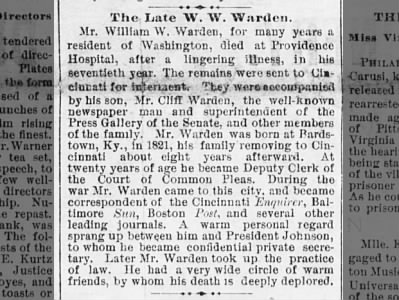
William Wallace Warden moved to Washington D. C. in 1862 and was there employed as Washington correspondent of the Cincinnati Enquirer. Eventually Warden became a private secretary to President Andrew Johnson, serving until the end of Johnson's administration.


Published shortly before Warden's death, an article by M. P. Handy in the Philadelphia North American gave away the pen names over which William Wallace Warden contributed insider views, while employed as Jonson's confidential secretary and afterwards:
  • "Data" in the Philadelphia Ledger and Baltimore Sun
  • "Wallace" in the Richmond Dispatch
  • "Zeta" in the New Orleans Times
  • "Dibon" in other leading newspapers
In Cincinnati Warden wrote "over the nom de plume of 'Ubiquitous Allabout."


Washington, D. C. Evening Star - March 19, 1890
The fullest biographical notice of Warden I have found so far appears in The Weekly Law Bulletin and Ohio Law Journal, Volume 23 (April 14, 1890).

Back to Pen and Pencil: in the June 18, 1853 number Warden recounts a visit to Louisville on the steamboat Jacob Strader. Enjoyment of the breeze and scenery from the cabin roof prompts an islamicist reverie (with peris, houris, and other features of the cultural discourse examined by Timothy Marr in The Cultural Roots of American Islamicism) and a glance at Melville's Mardi:
Now what can a poetical minded lounger, an easy going Lotus-eater, require more than pleasant scenery and pretty faces to look at, and a nice cool breeze blowing away all his feverish cares and troubles, as the breath of the houris blows the memory of sorrow from the brows of the faithful in the paradise of Mohammed, for which, and other particulars, see Abubeker & Co., and the Arabian commentators. We had not been cool for a fortnight, and at that moment would not have given that breeze for a middling sized empire in "Mardi," or any other out of the way region.
--Pen and Pencil - June 18, 1853
 

JACOB STRADER Steamboat - Original Image