Showing posts with label sources. Show all posts

Monday, December 30, 2019

Cetology in the Encyclopaedia Britannica and Brewster's Edinburgh Encylopaedia

Fig. 4. Spermaceti Whale. CETOLOGY. Plate 134
in Brewster's Edinburgh Encyclopaedia Vol. 5, First American Edition (Philadelphia, 1832).
For the Cetology chapter in Moby-Dick; or, The Whale, Herman Melville had more accurate and up-to-date sources than old editions of Encyclopædia Britannica. Lots of Melville's literary appropriations from the writings of Beale and Bennett and Scoresby are documented in The Trying-Out of Moby-Dick by Howard P. Vincent; and in the notes to the 1952 Hendricks House Moby-Dick that Vincent edited with Luther S. Mansfield. Rounding out the Big Five of Melville's favorite whale-books were more recent firsthand narratives by J. Ross Browne and Henry T. Cheever. In addition, Melville also borrowed extensively from the WHALES entry in The Penny Cyclopædia, as Kendra H. Gaines shows in Melville Society Extracts Number 29, January 1977, pages 6-12.


The Penny Cyclopædia referenced the systematizing efforts of various distinguished naturalists without actually calling their kind of work cetology. Earlier in the 19th century, two encyclopedias that did call it "Cetology" were the Encyclopaedia Britannica and Brewster's Edinburgh Encyclopaedia. Volume 5 in successive editions (4th, 5th, 6th) of Encyclopaedia Britannica contains a long, illustrated treatise titled "Cetology" on pages 327-360. Notes in the back of the great Northwestern-Newberry Edition of Moby-Dick; or, The Whale, edited by Harrison Hayford, Hershel Parker, and G. Thomas Tanselle (Evanston and Chicago: Northwestern University Press and The Newberry Library, 1988) page 857 refer to the treatise on Cetology in the 4th edition of Encyclopædia Britannica as "the article on whales."

But the first entry for "WHALE" in Volume 20 tells you to consult the treatise on Cetology in Volume 5:
See BALÆNA and PHYSETER, CETOLOGY Index.
In Volume 5 of Encylopaedia Britannica 4th ed. (Edinburgh, 1810), the first of two engravings that accompany the treatise on Cetology is PLATE CXL = Plate 140, labeled "CETOLOGY."
https://hdl.handle.net/2027/umn.31951002451535v?urlappend=%3Bseq=386
This Cetology engraving illustrates each of the four classes of "cetaceous fishes" (as classified in the main text after Linnaeus, by number and placement of teeth) with one representative figure. Stacked vertically, the figures from top to bottom show a large whalebone or Greenland whale; narwhal or unicorn fish; large sperm whale; and grampus. 


The huge "Greenland whale" (so-called, in the main text and "Explanation of Plates") or "Balaena Mysticetus" at the top of the CETOLOGY plate looks much the largest of the four kinds. Its dominating size and placement agree with the old-school cetology that Ishmael will overthrow by granting first place to the sperm whale:
This is Charing Cross; hear ye! good people all,— the Greenland whale is deposed,— the great sperm whale now reigneth! -- Moby-Dick, Cetology
The immediate textual prompt for Ishmael's mock proclamation was a bit in Thomas Beale's Natural History of the Sperm Whale that represents the Greenland Whale as royalty, metaphorically speaking: "the public voice has long enthroned him as monarch of the deep." Vincent makes the connection to Beale in The Trying-Out of Moby-Dick at page 132. Steven Olsen-Smith examines this and other borrowings in the "Introduction to Melville's Marginalia in Thomas Beale's The Natural History of the Sperm Whale," at Melville's Marginalia Online.

The CETOLOGY engraving in the Encyclopaedia Britannica visually reinforces the older idea of the Greenland Whale as "monarch of the deep."


Noah Webster's 1849 American Dictionary of the English Language defines CETOLOGY as
"The doctrine or natural history of cetaceous animals."

Webster even recognizes the CETOLOGIST, "One who is versed in the natural history of the whale and its kindred animals." Still, when Melville appropriated it, the word cetology could also evoke models of scientific discourse that were already outdated. Readers looking up CETOLOGY in the Seventh Edition of Encyclopaedia Britannica, Volume 6 (Edinburgh, 1842) get redirected to Volume 14: "See MAMMALIA." There, on pages 183-191, "Great-headed whales" conclude the treatment of "Cetacea," the final section in James Wilson's new contribution on the Natural History of Quadrupeds and Whales.

Again, cetology as cetology does not appear in Melville's invaluable source-article in the Penny Cyclopaedia. Beale only employs the word once, when quoting Scoresby in one of four epigraphs at the front. Melville managed to incorporate all four in the Cetology chapter of Moby-Dick. So William Scoresby Jr. happily accepted cetology as the right name for his discipline, aiming to improve it. Indeed, in the second volume of An Account of the Arctic Regions (Edinburgh, 1820) at page 111, Scoresby helpfully footnoted the article "Cetology" in the Encyclopaedia Britannica, 4th edition.

With Scoresby Melville embraces the word cetology and for fun, adopts the style and some elements of its antiquated practice. The joke of course is how Melville's narrator arranges whales like books according to their size, turning cetology into bibliography. The largest whales are FOLIOS in Ishmael's library system of taxonomy. Sperm Whale and Greenland Whale aka "Right Whale" form Chapters 1 and 2 of the same folio-size Book. Ishmael's Chapter 2 whale embodies the popular mix-up of different species, especially the confusion of the North Atlantic right whale or Eubalaena glacialis and Bowhead whale or Balaena mysticetus.


The Encyclopaedia Britannica article on "Cetology" is not listed in the searchable "Online Catalog of Books and Documents Owned, Borrowed and Consulted by Herman Melville" at Melville's Marginalia Online. Maybe he saw it somewhere, maybe not. One place Encyclopaedia Britannica would have been available to Melville was the New-York Society Library. The NYSL Supplementary Catalogue for 1841 lists the 6th edition only. The 1850 Alphabetical and Analytical Catalogue of the New York Society Library lists four different editions of Encyclopædia Britannica, including the 6th and 7th, as well as the six-volume Supplement to the 4th, 5th, and 6th editions.


Scoresby in his Account of the Arctic Regions formally cited "Cetology" from Encyclopaedia Britannica. As noted in the catalog at Melville's Marginalia Online, in 1850-1851 Melville borrowed this and another work by Scoresby, Journal of a Voyage to the Northern Whale-fishery (Sealts Numbers 450 and 451), from the New York Society Library.


If he ever looked into the Encyclopaedia Britannica article that Scoresby footnoted, Melville might have found a hint for his book-based system of classification in the way "Cetology" takes the form of discrete "Chapters":
In the following treatise, we propose to lay before our readers, 1st, The Classification and Natural History of Cetaceous Fishes; 2d, Their Anatomy and Physiology. And lastly, the History of the Whale Fishery as an object of trade. These shall be the subjects of three Chapters. -- Cetology, Encyclopædia Britannica Fourth Edition, Vol. 5, page 328.

As Jeff Loveland points out, Cetology was one of seven "new treatises dealing with animals" in the fourth edition of the Encyclopaedia Britannica, along with Conchology, Erpetology, Helminthology, Ichthyology, Mammalia, and Ophiology, "evidently imitating the zoological categories of the conemporary Encyclopédie méthodique." See Loveland on Unifying Knowledge and Dividing Disciplines: The Development of Treatises in the "Encyclopaedia Britannica" in Book History Vol. 9 (2006), pages 57-87 at page 75. <https://www.jstor.org/stable/30227385>  Ichthyology and other zoological treatises in the 4th edition of Encyclopaedia Britannica also were constructed in chapters, like books.

As promoted in the Encyclopaedia Britannica, the old and wonderfully loose category of "cetaceous fishes" accords well with Ishmael's definition of the whale as
 "a spouting fish with a horizontal tail."
To aid further study, here are links to successive editions of Encyclopaedia Britannica with the treatise on "Cetology" in Volume 5:
Google-digitized volumes of Encyclopaedia Britannica held by the New York Public Library and University of Michigan are accessible online courtesy of HathiTrust Digital Library.

Another nineteenth-century encyclopedia with a major article on "Cetology" was David Brewster's Edinburgh Encyclopædia, Volume 5 (Edinburgh, 1830), pages 676-694. Conspicuously, right at the start, the term "Cetaceous Animals" (not fishes) describes "the last order of the class MAMMALIA." Cetology is defined as "that department of Zoology, which treats of the structure, economy, and history of cetaceous animals, or of whales...."
https://books.google.com/booksid=IPpMAQAAMAAJ&pg=PA676&dq#v=onepage&q&f=false
The index in Volume 1 to "Authors of the Principal Articles in The Edinburgh Encyclopædia" identifies Josiah Kirby as author of the Cetology treatise there. In Volume 1 of Encyclopædia Britannica, 4th edition (Edinburgh, 1810), "Dr. Kirby, and Dr. Brewster of Edinburgh" had received credit along with general editor James Millar and Lockhart Muirhead for unspecified "articles in the various branches of Natural History."


The Edinburgh Encyclopaedia, Volume 5 (Edinburgh, 1830) is Google-digitized and available online courtesy of  HathiTrust Digital Library. Illustrated with two plates of engravings, located between pages numbered 688 and 689 in the University of Michigan volume.
  • https://hdl.handle.net/2027/mdp.39015082314470?urlappend=%3Bseq=736
The Albany Young Men's Association, the library owned a set of the Edinburgh Encyclopaedia, listed in the 1837 Catalogue of Books as
1002 ENCYCLOPAEDIA, Brewster's, 33 vols. 
When Herman Melville joined the YMA in January 1835, their set of Brewster's Edinburgh Encyclopedia was incomplete. However, Volume 5 was not among the missing numbers that were advertised as wanted by the Young Men's Association (Albany Argus, January 9, 1835).

Albany Argus - January 9, 1835 via GenealogyBank
The YMA Catalogue of Books for 1848 lists an incomplete set of the American edition, number 4061 under "Dictionaries and Encyclopedias."

A complete set in twenty-one volumes of David Brewster's New Edinburgh Encyclopaedia (Philadelphia, 1832) was available at the New York Society Library when Herman Melville belonged, according to the 1850 Alphabetical and Analytical Catalogue.


In the First American Edition (Philadelphia, 1832) of Brewster's Edinburgh Encyclopaedia, Volume 5 contains the "Cetology" article on pages 555-573:
  • https://hdl.handle.net/2027/osu.32435028241479?urlappend=%3Bseq=564
Two plates of engravings appear in the back of the same volume:
  • https://hdl.handle.net/2027/osu.32435028241479?urlappend=%3Bseq=876
  • https://hdl.handle.net/2027/osu.32435028241479?urlappend=%3Bseq=878 
Despite the displacement of "Cetology" in the 7th and later editions of Encyclopædia Britannica, aspiring cetologists like Ishmael in Moby-Dick still had oceans of room to investigate whales:

Let it be borne in mind by the rising race, that in relation to the cetaceous tribes, an enterprising naturalist of accurate habits, well versed in the recorded observations of his predecessors, and at the same time inclined to original investigation, has still before him a vast, and in several of its departments, an almost unexamined field.  --James Wilson on "Mammalia" in the Seventh Edition of The Encylopaedia Britannica (Edinburgh, 1842) Volume 14, page 191. Here signed "T." designating zoologist James Wilson in the alphabetical Table of Signatures. Signed "J. W." in the Eighth Edition (Edinburgh, 1857).

Further reading, A to Z:

Monday, June 11, 2018

Norway woodman

And now, loud above the roar of the sea, was suddenly heard a sharp, splintering sound, as of a Norway woodman felling a pine in the forest. It was brave Jarl, who foremost of all had snatched from its rack against the mainmast, the ax, always there kept.  --Mardi: And a Voyage Thither
In Mardi (1849) Melville's figurative Norway woodman cuts down a tree, successfully, whereas Shelley's Norway woodman stamps out a spark but fails to prevent the forest fire of revolt that it kindles in Lines Written among the Euganean Hills:

As the Norway woodman quells,
In the depth of piny dells,
One light flame among the brakes,
While the boundless forest shakes,
And its mighty trunks are torn
By the fire thus lowly born:
The spark beneath his feet is dead,
He starts to see the flames it fed
Howling through the darken'd sky
With myriad tongues victoriously,
And sinks down in fear: so thou,
O Tyranny, beholdest now
Light around thee, and thou hearest
The loud flames ascend, and fearest:
Grovel on the earth; ay, hide
In the dust thy purple pride!
Generally speaking, a Norway woodman has no very obvious business in the South Pacific or the hills south of Padua. In Mardi, however, Melville's simile is well adapted to Jarl, the narrator's Scandinavian companion, and Jarl's heroic action with the axe (in a gale, he chops at the rigging to bring down the mainmast of the Parki). Jarl as Norway woodman in Mardi inescapably evokes Shelley's Norway woodman--whom Melville might have first encountered the library of the Albany Young Men's Association, in Hazlitt's Select British Poets (London, 1824).

Related post:

Tuesday, August 1, 2017

Welcome to Washington Irving's world

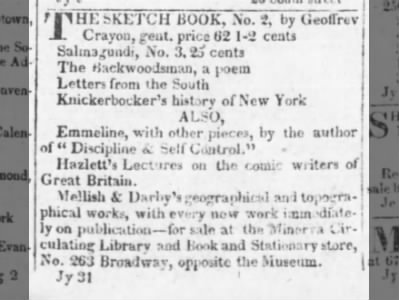
August 1, 1819 was a Sunday, so there was no Evening Post in New York City on the day Herman Melville was born. Ads on Saturday and Monday show what the Minerva Circulating Library and Book and Stationary store had for sale at 263 Broadway.

New York Evening Post - Monday, August 2, 1819
Topping the list, a new number of The Sketch Book by Washington Irving, writing as "Geoffrey Crayon." Still in England, Irving in 1819-1820 shipped his chapters or "numbers" of The Sketch Book to New York for publication in the United States. (Some were reprinted in the London Literary Gazette.)


Contents of Number One, published May 15, 1819: 
The Author's Account of Himself
The Voyage
Roscoe
The Wife
Rip Van Winkle 
Contents of Number Two, published in July 1819: 
English Writers on America
Rural Life in England
The Broken Heart
The Art of Book Making
In his 1859 lecture on Travel, Melville approvingly paraphrased from Irving's chapter "The Voyage," first published in the year of Melville's birth:
One must not anticipate unalloyed pleasure. Pleasure, pain and profit are all to be received from travel. As Washington Irving has remarked, the sea-voyage, with its excitements, its discomforts, and its enforced self-discipline, is a good preparation for foreign travel.  --Melville's Lecture on Travel
Everyone knows about Rip Van Winkle. Herman Melville would remake Irving's popular legend in "Rip Van Winkle's Lilac," part of the manuscript prose and poetry collection (posthumously published) titled Weeds and Wildings. Not so well known today is Irving's investigation into "The Art of Book Making." What Irving uncovered at the British Library and amusingly described was the practice by "predatory authors" of stealing material from old books to manufacture new ones.
Being now in possession of the secret, I sat down in a corner, and watched the process, of this book manufactory. I noticed one lean, bilious looking wight, who sought none but the most worm-eaten volumes, printed in black letter. He was evidently constructing some work of profound erudition, that would be purchased by every man who wished to be thought learned, placed upon a conspicuous shelf of his library, or laid open upon his table; but never read. I observed him, now and then, draw a large fragment of biscuit out of his pocket, and gnaw; whether it was his dinner, or whether he was endeavouring to keep off that exhaustion of the stomach, produced by much pondering over dry works, I leave to harder students than myself to determine.
There was one old getleman in bright coloured clothes, with a chirping, gossipping, expression of countenance, who had all the appearance of an author on good terms with his bookseller. After considering him attentively, I recognised in him a diligent getter up of miscellaneous works, that bustled off well with the trade. I was curious to see how he manufactured his wares. He made more stir and show of business than any of the others; dipping into various books, fluttering over the leaves of manuscripts, taking a morsel out of one, a morsel out of another, “line upon line, precept upon precept, here a little and there a little.” The contents of his book seemed to be as heterogeneous as those of the witches' cauldron in Macbeth. It was here a finger and there a thumb, toe of, frog and blind worm’s sting, with his own gossip poured in like “baboon's blood,” to make the medley “slab and good.
After all, thought I, may not this pilfering disposition be implanted in authors for wise purposes; may it not be the way in which providence has taken care that the seeds of knowledge and wisdom shall be preserved from age to age, in spite of the inevitable decay of the works in which they were first produced. We see that nature has wisely, though whimsically, provided for the conveyance of seeds from clime to clime, in the maws of certain birds; so that animals, which, in themselves, are little better than carrion, and apparently the lawless plunderers of the orchard and the cornfield, are, in fact, nature's carriers to disperse and perpetuate her blessings. In like manner, the beauties and fine thoughts of ancient and obsolete writers, are caught up by these flights of predatory authors, and cast forth, again to flourish and bear fruit in a remote and distant tract of time. Many of their works, also, undergo a kind of metempsychosis, and spring up under new forms. What was formerly a ponderous history, revives in the shape of a romance—an old legend changes into a modern play—and a sober philosophical treatise furnishes the body for a whole series of bouncing and sparkling essays. Thus it is in the clearing of our American woodlands; where we burn down a forest of stately pines, a progeny of dwarf oaks start up in their place; and we never see the prostrate trunk of a tree, mouldering into soil, but it gives birth to a whole tribe of fungi. 
Let us not, then, lament over the decay and oblivion into which ancient writers descend; they do but submit to the great law of nature, which declares that all sublunary shapes of matter shall be limited in their duration, but which decrees also, that their elements shall never perish. Generation after generation, both in animal and vegetable life, passes away, but the vital principle is transmitted to their posterity, and the species continues to flourish. Thus, also, do authors beget authors, and having produced a numerous progeny, in a good old age they sleep with their fathers, that is to say, with the authors who preceded them—and from whom they had stolen.
 --Washington Irving on The Art of Book Making
"The Art of Book Making" was reprinted with the review of Irving's Sketch Book in The London Literary Gazette for April 8, 1820.

Pitching Omoo, his second book, Melville wrote his publisher John Murray in July 1846 that
"A little experience in this art of book-craft has done wonders."  --The Letters of Herman Melville
Melville evidently meant that his new manuscript would look better and be much closer to finished than were the messy and insufficient pages of Typee. Omoo would not need significant rewriting, padding, expurgating or editorial fixing. Irving's sense of book-making as stealing remains in play, nevertheless. In Omoo Melville creatively adapted numerous scenes from William Ellis and other writers on the South Seas. Hendricks House editors Harrison Hayford and Walter Blair aptly call Melville's way with other people's words, "dramatizing." On occasion Melville dramatized "spectacularly" from his source in Polynesian Researches, as when he describes night fishing by torch-light in Chapter 70, Life at Loohooloo.

Two days after Herman Melville's birth, the Evening Post extensively reviewed the second number of Irving's Sketch Book.

Found on Newspapers.com
"The literary ambition of Mr. I. aims simply at a flute accompaniment, in our national concert of authors, leaving to the more aspiring the management of louder instruments. We gladly perceive, that he never suffers himself to be allured from his natural character, by a pompous display of his subject, or by an attempt to plunge his readers into the unfathomable depths of learning and research...."  
In closing, the reviewer (Henry Brevoort, so identified by Ralph M. Aderman in Critical Essays on Washington Irving) picks up on Irving's expose of authors and book-making, hoping that Irving will not imitate the practice he witnessed in the British Library, but carry on in his own modest and distinctively charming way.
We reverence the cause of true science; nor would we be understood to scoff at its unaffected votaries; but no one knows, who has not essayed the task, how cheaply an author may decorate his pages with the scattered fragments of learning, lying so invitingly at his mercy, in the multitudinous transactions and encyclopedias of our times. Our author has found out the art of book-making; he has traced to their fountain head, those muddy rills of knowledge that sometimes spread themselves even in America. It is not impossible, therefore, that in the future numbers of his work, he may avoid the labor of writing from the resources of his own mind, by compiling the present state of the Catholic question—the vast results of polar expeditions; or, peradventure, strike out some new geological hypothesis which shall reject the vulgar agency of fire or water. In such ambitious speculations, we fear, the admirers of his fine genius, might seek in vain for his sportive humor; his nice discrimination of character; his romantic associations of thought and language; his pure and affecting morality, and all the nameless graces of style, so appropriate to the captivating path of literature he has chosen to pursue.
 --New York Evening Post, August 3, 1819
Evert Duyckinck was right on many levels when he wrote in his diary that Melville
"models his writing evidently a great deal on Washington Irving...."   --Melville in His Own Time, edited by Steven Olsen-Smith
For further study...

In Melville and Repose, John Bryant devotes a whole chapter to The Example of Irving. There Bryant specifically discusses the influence of Salmagundi, and Knickerbocker's History of New York, both of which made the short list of works for sale at the Minerva Circulating Library, along with the new number of The Sketch Book.


Rarely mentioned in Melville criticism are the two works by Irving's good friend and literary collaborator James Kirke Paulding, sandwiched in the Minerva ad between Salmagundi No. 3 and Irving's History of New York. Below, links to some digitized volumes that are available online.
Related post:

Wednesday, July 12, 2017

Rewriting Old Zack

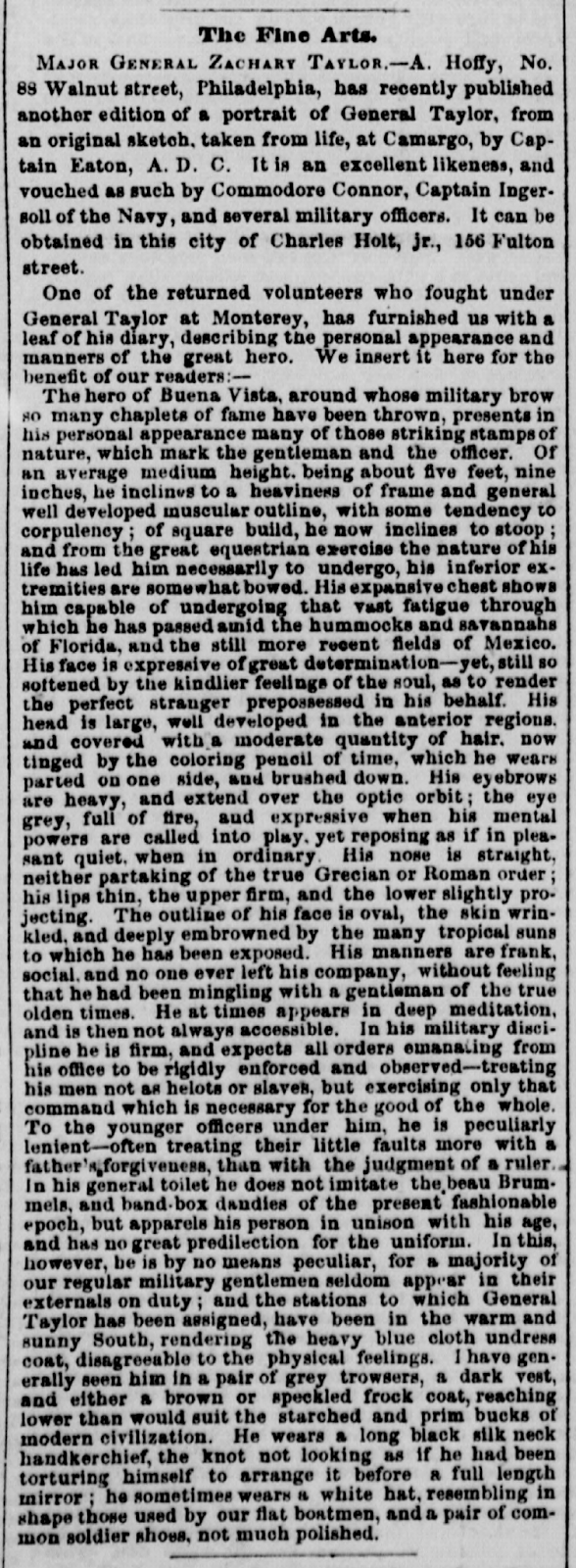
The previous post identified the 1847 newspaper source for Melville's physical description of Zachary Taylor in Yankee Doodle. With Melville's base-text in the New York Herald of June 30, 1847 before us, we can compare the original article with Melville's version to see exactly how Melville adapted it for comic effects. A closer look at Melville's changes may prove interesting and instructive.

Here's the author of Typee and Omoo at work, rewriting Old Zack. (The source is shown in black text; Melville's rewrite in blue.)
The hero of Buena Vista,
around whose military brow so many chaplets of fame have been thrown
upon the crown of whose caput have descended so many interleaved chaplets of fame
presents in his personal appearance many of those striking stamps of nature, which mark the gentleman and the officer.
presents in his general exterior personal appearance many of those extraordinary characteristics distinctive of the noble spirit tabernacled within.
Of an average medium height, being about five feet nine inches,
Of about the common length of ordinary mortals—say about five feet, nine inches, and two barley corns, Long Measure—
he inclines to a heaviness of frame and general well-developed muscular outline, with some tendency to corpulency; of square build, he now inclines to stoop;
he rather leans to a squat colossalness of frame and universal spread of figure, particularly on the lower part of the abdominal regions. To counteract a bulging forth of the latter parts, he is said to wear a truss of peculiar conformation. This circumstance, however, is not as yet fully established. Of a thick set and quadratular build, he now inclines to tenuity in the parts lying round about the calf.
and from the great equestrian exercise the nature of his life has led him necessarily to undergo, his inferior extremities are somewhat bowed.
Originally of great agility of the locomotive apparatus, he now betrays on his partially denuded head a want of energy in the capillary tubes of the hair, as his digestive machinery is liable to frequent suspensions of activity. 
His expansive chest shows him capable of undergoing that vast fatigue through which he has passed amid the hummocks and savannahs of Florida, and the still more recent fields of Mexico.
His broad and expanded chest shows the hero fully capable of encountering the prodigious fatigues of war, whether in the interminably interlocked everglades of the Floridian southerly terminus of the Republic, or upon the wide-spreading and generally level table-land savannahs of Mexico.
His face is expressive of great determination—
His face is a physignomical phenomenon, which Lavater would have crossed the Atlantic to contemplate. Of soul-awing determination of expression and significant of inflexible and immovable ironness of purpose,
yet, still so softened by the kindlier feelings of the soul, as to render the perfect stranger prepossessed in his behalf.
it (the external features of the countenance) are softened down and melted into a kindly benevolence which would prepossess a perfect stranger in his favor.
His head is large, well-developed in the anterior regions,
His head is large, extremely well dev[el]oped in the frontal quarter, but not classically elegant in the anterior portion. To employ an expressive, though somewhat rude comparison, it appears as if squshed between his shoulders. By close observers, the lobe of the right ear is thought to be depressed more than the corresponding auricular organ, on the lateral part of the caput. 
and covered with a moderate quantity of hair, now tinged by the coloring pencil of time, which he wears parted on one side, and brushed down.
In early adolescence of a beautiful amber or brown color, the hair, through the gradual ravages of time, has assumed a speckled, pepper and salt external appearance. In a most touching manner the thin and scattered locks are parted picturesquely on one side and combed slickly over the brows.
His eyebrows are heavy, and extend over the optic orbit; the eye grey, full of fire, and expressive when his mental powers are called into play, yet reposing as if in pleasant quiet, when in ordinary.—
The latter are Jupiternian in their awful bushiness—the hairy appendage curling over upon the optic orbits. His frown is Olympian and strikes terror and confusion into the overwhelmed soul of the spectator. The muscular energy of the brows is truly extraordinary. When ever their pupular is under mental excitation, they frequently become knit together in wrinkular pleats like unto the foldular developments under the lateral shoulder of the rhinoceros species of animated nature. His eye is Websternian, though grey. The left organ somewhat effects the dexter side of the socket, while examined by a powerful telescope several minute specks are observable in the pupil of the sinister orbit. But this detracts not from the majesty of its expression: the sun even has its spots. When the hero's soul is lashed into intellectual agitation by the external occurrence of irritating and stimulating circumstance, the eye assumes an inflamed and fiery appearance. The scantiness of the lashes and their short and singed appearance are ascribable, perhaps, to their vicinity to the pupil when thus kindled into fury. When a mental calm, however, pervades the serene soul of the hero, a Saucernian placidity is diffused over the entire visionary orb. 
His nose is straight, neither partaking of the true Grecian nor Roman order; his lips thin, the upper firm, and the lower slightly projecting.
The nostrilian organ, or proboscis. is straight, but neither inclining to the Roman, or Grecian, or, indeed, the Doric or Composite order of nasal architecture. 
The outline of his face is oval, the skin wrinkled, and deeply embrowned by the many tropical suns to which he has been exposed.
The labial appendages (suspended just under the proboscis) are attenuated—the upper tightly and firmly spread upon the dental parts beneath; and the lower pendant and projecting as represented in the prints. The outline of the caput, generally, is an ovalular elipsis inclining to the rotund, but having no predisposition to the quadrangular. The obvious cuticle or scarf-skin is wrinkled, freckled, and embrowned—doubtless through age and constant exposure to the ardent rays of the Floridian and Mexicanian sun combined. 
His manners are frank, social, and no one ever left his company, without feeling that he had been mingling with a gentleman of the true olden times.
The manner of the hero is frank and companionable—and never did mortal leave his society without being constantly impressed with the unavoidable conviction that he had been conversing with a good fellow and a gentleman. 
He at times appears in deep meditation, and is then not always accessible. In his military discipline he is firm, and expects all orders emanating from his office to be rigidly enforced and observed —
At times he is seen in deep and earnest meditation—the left auricular organ with the head attached thereto, deposited upon the open palm and outspread digits of the manual termination of the arm. At other times he assumes when meditating quite a different posture; the fore finger of the left hand being placed on the dexter side of the proboscis. In his military discipline, he is firm and unyielding to the last degree of military inflexibility—
treating his men not as helots or slaves, but exercising only that command which is necessary for the good of the whole. To the younger officers under him, he is peculiarly lenient — often treating their little faults more with a father's forgiveness, than with the judgment of a ruler.
but is, nevertheless, remarkably lenient to those under him, officers and privates included. Particularly to the youthful portion of his command, whom he treats with all the indulgence of a paternal relative or guardian—often permitting them to lay a-bed late in the morning, when the battle is raging at the fiercest.  
In his general toilet he does not imitate the Beau Brummels and band-box dandies of the present fashionable epoch, but apparels his person in unison with his age, and has no great predilection for the uniform.
In his general toilet he is far from imitating a Brummellian precision and starchedness of cravat. 
In this, however, he is by no means peculiar, for a majority of our regular military gentlemen seldom appear in their externals on duty; and the stations to which General Taylor has been assigned, have been in the warm and sunny south, rendering the heavy blue cloth undress coat disagreeable to the physical feelings.
He has no violent predilection for his regimentals and seldom appears in them, which, in fact, is the case with most of his officers, of whom it is even observed, that “they seldom appear in externals on duty,”—a habit indicative of superiority to foppish adornments, but might be construed by the fastidious into a want of good taste and decorousness. Their custom in this respect, however, is defensible upon the ground, that called by Divine Providence to perform their martial functions in the genial and delightful regions of the sunny south, the cumbersome military costume, or, indeed, any dress at all, “is disagreeable to the physical feelings."
I have generally seen him in a pair of grey trowsers,
The hero himself may be usually seen by an ordinary spectator arrayed in a pair of sheep's grey pants, shapeless and inclined to bagging—the latter predisposition being imputed, by a reflecting observer, to the singular fact that the hero never wears the common-place articles called suspenders.
a dark vest, and either a brown or speckled frock coat, reaching lower than would suit the starched and prim bucks of modern civilization. 
His coat is generally of a brownish tinge which in some cases is to be imputed to the original color imparted to the cloth when in the vat of the dyer, and in other cases to an heroic disregard of dust and oleaginous spots on the part of the ungent wearer. His vest usually, though not invariably, is of a darksome hue—resembling the ordinary sable. 
He wears a long black silk neck-handkerchief, the knot not looking as if he had been torturing himself to arrange it before a full-length mirror;
He wears a long crumpled black silk neck-handkerchief, much knotted and super-twisted, and evidently not put on with any great degree of care. But the carelessness with which it is tied in no respect approaches to the studied artlessness of the Byronic bow. The shirt collar is open, revealing considerable superfluous hair just above region of the thorax and windpipe, and betokening a disdain of Gouraud's Depillatory. Several individual hairs partake of the greyish tinge of the sparse covering of the head. 
he sometimes wears a white hat, resembling in shape those used by our flat-boatmen,
The hero sometimes wears a white wool hat, much marked by indentation, and irregular depressions and prominences upon the crown. It resembles in most respects the castor of a Mississippi flat-boatman.—
and a pair of common soldier shoes, not much polished.
His shoes are the common cow-hide sandals served out by the Commissary Departmtent to the free use of the army. They are usually stringless and not much polished.
For further study:
Gouraud Bottle via Hair Raising Stories

Related posts

Tuesday, July 11, 2017

Personal appearance of Zachary Taylor, Melville's 1847 sketch and newspaper source

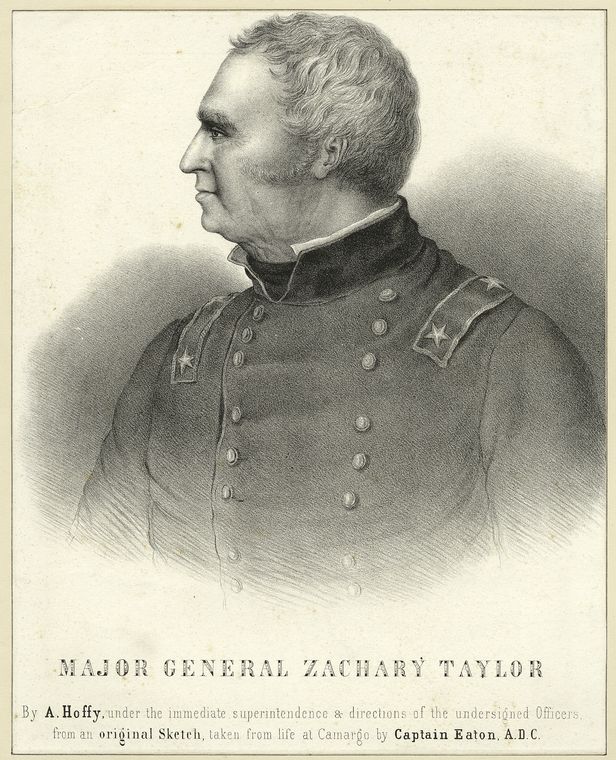
Major General Zachary Taylor
 The New York Public Library Digital Collections
Published in Yankee Doodle on August 7, 1847, Herman Melville's humorous sketch of the personal appearance of General Taylor directly parodies a newspaper report that first appeared in the New York Herald on June 30, 1847.
The New York Herald - June 30, 1847
via Chronicling America: Historic American Newspapers - Library of Congress
The Herald sketch circulated widely under various titles, including "Personal Appearance of Gen. Taylor" in the Morning Courier and New-York Enquirer (July 13, 1847); and "General Taylor's Personal Appearance" in The Anglo-American (July 17, 1847).

In his Yankee Doodle piece, Melville essentially rewrote the Herald article, embracing much of the descriptive language while crafting a comically exaggerated pose of pseudo-scientific seriousness. In many places Melville borrowed verbatim from his newspaper source. For example, two phrases from one or another version of the newspaper article on Zachary Taylor's personal appearance are amusingly quoted and italicized in Melville's Yankee Doodle parody. Officers
"seldom appear in their externals on duty" 
since in the hot climate of Mexico the heavy military uniform would soon become
"disagreeable to the physical feelings."
In recasting the quoted material, Melville exaggerates the informality of camp life, implying that officers wage war in their underwear. Melville's source and sketch both compare General Taylor's hat to those of "flat-boatmen." Both end by describing the General's shoes as "not much polished."

Melville's newspaper source and his unsigned parody in Yankee Doodle are transcribed below. First, the source:
Personal Appearance of Gen. Taylor.— One of the returned volunteers who fought under Gen. Taylor at Monterey, has furnished us with a leaf of his diary, describing the personal appearance and manners of the great hero, as follows:
The hero of Buena Vista, around whose military brow so many chaplets of fame have been thrown, presents in his personal appearance many of those striking stamps of nature, which mark the gentleman and the officer. Of an average medium height, being about five feet nine inches, he inclines to a heaviness of frame and general well- developed muscular outline, with some tendency to corpulency; of square build, he now inclines to stoop; and from the great equestrian exercise the nature of his life has led him necessarily to undergo, his inferior extremities are somewhat bowed. His expansive chest shows him capable of undergoing that vast fatigue through which he has passed amid the hummocks and savannahs of Florida, and the still more recent fields of Mexico. His face is expressive of great determination—yet, still so softened by the kindlier feelings of the soul, as to render the perfect stranger prepossessed in his behalf. His head is large, well-developed in the anterior regions, and covered with a moderate quantity of hair, now tinged by the coloring pencil of time, which he wears parted on one side, and brushed down. His eyebrows are heavy, and extend over the optic orbit; the eye grey, full of fire, and expressive when his mental powers are called into play, yet reposing as if in pleasant quiet, when in ordinary.— His nose is straight, neither partaking of the true Grecian nor Roman order; his lips thin, the upper firm, and the lower slightly projecting. The outline of his face is oval, the skin wrinkled, and deeply embrowned by the many tropical suns to which he has been exposed. His manners are frank, social, and no one ever left his company, without feeling that he had been mingling with a gentleman of the true olden times. He at times appears in deep meditation, and is then not always accessible. In his military discipline he is firm, and expects all orders emanating from his office to be rigidly enforced and observed — treating his men not as helots or slaves, but exercising only that command which is necessary for the good of the whole. To the younger officers under him, he is peculiarly lenient — often treating their little faults more with a father's forgiveness, than with the judgment of a ruler. In his general toilet he does not imitate the Beau Brummels and band-box dandies of the present fashionable epoch, but apparels his person in unison with his age, and has no great predilection for the uniform. In this, however, he is by no means peculiar, for a majority of our regular military gentlemen seldom appear in their externals on duty; and the stations to which General Taylor has been assigned, have been in the warm and sunny south, rendering the heavy blue cloth undress coat disagreeable to the physical feelings. I have generally seen him in a pair of grey trowsers, a dark vest, and either a brown or speckled frock coat, reaching lower than would suit the starched and prim bucks of modern civilization. He wears a long black silk neck-handkerchief, the knot not looking as if he had been torturing himself to arrange it before a full-length mirror; he sometimes wears a white hat, resembling in shape those used by our flat-boatmen, and a pair of common soldier shoes, not much polished."  --Morning Courier and New-York Enquirer, July 13, 1847
Reprinted many times for example:
  • Alexandria [Virginia] Gazette, July 5, 1847
  • New York Evening Mirror, July 13, 1847
  • Litchfield [Connecticut] Republican, July 15, 1847
  • Auburn [New York] Daily Advertiser, July 16, 1847
  • The Anglo-American vol. 9 - July 17, 1847
  • Rochester [New York] Daily Democrat, July 19, 1847 
  • Saratoga Springs, New York Daily Saratoga Republican, July 22, 1847 
  • Greenfield [Massachusetts] Gazette & Courier, July 27, 1847
  • Raleigh [North Carolina] Register, July 28, 1847
  • The Taylor Text-Book or Rough and Ready Reckoner - 1848 
Found on Newspapers.com

Now for the parody. Here is the text of Melville's sketch, transcribed from Yankee Doodle no. 44 (August 7, 1847):
"GEN. TAYLOR'S PERSONAL APPEARANCE," OR OLD ZACK PHYSIOLOGICALLY AND OTHERWISE CONSIDERED.

BY A SURGEON OF THE ARMY IN MEXICO.
The hero of Buena Vista, upon the crown of whose caput have descended so many interleaved chaplets of fame, presents in his general exterior personal appearance many of those extraordinary characteristics distinctive of the noble spirit tabernacled within. Of about the common length of ordinary mortals—say about five feet, nine inches, and two barley corns, Long Measure—he rather leans to a squat colossalness of frame and universal spread of figure, particularly on the lower part of the abdominal regions. To counteract a bulging forth of the latter parts, he is said to wear a truss of peculiar conformation. This circumstance, however, is not as yet fully established. Of a thick set and quadratular build, he now inclines to tenuity in the parts lying round about the calf. Originally of great agility of the locomotive apparatus, he now betrays on his partially denuded head a want of energy in the capillary tubes of the hair, as his digestive machinery is liable to frequent suspensions of activity. 
His broad and expanded chest shows the hero fully capable of encountering the prodigious fatigues of war, whether in the interminably interlocked everglades of the Floridian southerly terminus of the Republic, or upon the wide-spreading and generally level table-land savannahs of Mexico. His face is a physignomical phenomenon, which Lavater would have crossed the Atlantic to contemplate. Of soul-awing determination of expression and significant of inflexible and immovable ironness of purpose, it (the external features of the countenance) are softened down and melted into a kindly benevolence which would prepossess a perfect stranger in his favor. His head is large, extremely well dev[el]oped in the frontal quarter, but not classically elegant in the anterior portion. To employ an expressive, though somewhat rude comparison, it appears as if squshed between his shoulders. By close observers, the lobe of the right ear is thought to be depressed more than the corresponding auricular organ, on the lateral part of the caput.  
In early adolescence of a beautiful amber or brown color, the hair, through the gradual ravages of time, has assumed a speckled, pepper and salt external appearance. In a most touching manner the thin and scattered locks are parted picturesquely on one side and combed slickly over the brows. The latter are Jupiternian in their awful bushiness—the hairy appendage curling over upon the optic orbits. His frown is Olympian and strikes terror and confusion into the overwhelmed soul of the spectator. The muscular energy of the brows is truly extraordinary. When ever their pupular is under mental excitation, they frequently become knit together in wrinkular pleats like unto the foldular developments under the lateral shoulder of the rhinoceros species of animated nature. His eye is Websternian, though grey. The left organ somewhat effects the dexter side of the socket, while examined by a powerful telescope several minute specks are observable in the pupil of the sinister orbit. But this detracts not from the majesty of its expression: the sun even has its spots. When the hero's soul is lashed into intellectual agitation by the external occurrence of irritating and stimulating circumstance, the eye assumes an inflamed and fiery appearance. The scantiness of the lashes and their short and singed appearance are ascribable, perhaps, to their vicinity to the pupil when thus kindled into fury. When a mental calm, however, pervades the serene soul of the hero, a Saucernian placidity is diffused over the entire visionary orb.  
The nostrilian organ, or proboscis. is straight, but neither inclining to the Roman, or Grecian, or, indeed, the Doric or Composite order of nasal architecture. The labial appendages (suspended just under the proboscis) are attenuated—the upper tightly and firmly spread upon the dental parts beneath; and the lower pendant and projecting as represented in the prints. The outline of the caput, generally, is an ovalular elipsis inclining to the rotund, but having no predisposition to the quadrangular. The obvious cuticle or scarf-skin is wrinkled, freckled, and embrowned—doubtless through age and constant exposure to the ardent rays of the Floridian and Mexicanian sun combined.  
The manner of the hero is frank and companionable—and never did mortal leave his society without being constantly impressed with the unavoidable conviction that he had been conversing with a good fellow and a gentleman. 
At times he is seen in deep and earnest meditation—the left auricular organ with the head attached thereto, deposited upon the open palm and outspread digits of the manual termination of the arm. At other times he assumes when meditating quite a different posture; the fore finger of the left hand being placed on the dexter side of the proboscis. In his military discipline, he is firm and unyielding to the last degree of military inflexibility—but is, nevertheless, remarkably lenient to those under him, officers and privates included. Particularly to the youthful portion of his command, whom he treats with all the indulgence of a paternal relative or guardian—often permitting them to lay a-bed late in the morning, when the battle is raging at the fiercest.  
In his general toilet he is far from imitating a Brummellian precision and starchedness of cravat. He has no violent predilection for his regimentals and seldom appears in them, which, in fact, is the case with most of his officers, of whom it is even observed, that they seldom appear in externals on duty,”—a habit indicative of superiority to foppish adornments, but might be construed by the fastidious into a want of good taste and decorousness. 
Their custom in this respect, however, is defensible upon the ground, that called by Divine Providence to perform their martial functions in the genial and delightful regions of the sunny south, the cumbersome military costume, or, indeed, any dress at all, is disagreeable to the physical feelings." 
The hero himself may be usually seen by an ordinary spectator arrayed in a pair of sheep's grey pants, shapeless and inclined to bagging—the latter predisposition being imputed, by a reflecting observer, to the singular fact that the hero never wears the common-place articles called suspenders. His coat is generally of a brownish tinge which in some cases is to be imputed to the original color imparted to the cloth when in the vat of the dyer, and in other cases to an heroic disregard of dust and oleaginous spots on the part of the ungent wearer. His vest usually, though not invariably, is of a darksome hue—resembling the ordinary sable. He wears a long crumpled black silk neck-handkerchief, much knotted and super-twisted, and evidently not put on with any great degree of care. But the carelessness with which it is tied in no respect approaches to the studied artlessness of the Byronic bow. The shirt collar is open, revealing considerable superfluous hair just above region of the thorax and windpipe, and betokening a disdain of Gouraud's Depillatory. Several individual hairs partake of the greyish tinge of the sparse covering of the head. 
The hero sometimes wears a white wool hat, much marked by indentation, and irregular depressions and prominences upon the crown. It resembles in most respects the castor of a Mississippi flat-boatman.— His shoes are the common cow-hide sandals served out by the Commissary Departmtent to the free use of the army. They are usually stringless and not much polished. 
--[Herman Melville] in Yankee Doodle No. 44 - August 7, 1844
In print, texts of this sketch and nine numbered "Old Zack" Anecdotes are available in the Northwestern-Newberry edition of Melville's Piazza Tales and Other Prose Pieces, 1839-1860. The University of Chicago volume with Yankee Doodle, Volumes 1-2 has been digitized by Google Books, and is also available online courtesy of Hathi Trust Digital Library.


Related posts

Tuesday, January 10, 2017

Ben Jonson and Melville's "In a Bye-Canal"

Fronted I have, part taken the span
Of portents in nature and peril in man.
I have swum — I have been
'Twixt the whale's black flukes and the white shark's fin;
The enemy's desert have wandered in
And there have turned, have turned and scanned,
Following me how noiselessly,
Envy and Slander, lepers hand in hand.
--from In a Bye-Canal by Herman Melville
Robert Penn Warren half-suspected the influence of Ben Jonson on Melville's poem "In a Bye-Canal." In a footnote to the speaker's claim there of having literally and figuratively lived between "the whale's black flukes and the white shark's fin," Warren wonders:
Can this be an echo of the "wolf's black jaw" and the "dull ass' hoof" in Ben Jonson's "An Ode to Himself" (Underwoods)? In both Jonson and Melville, the content is the same: the affirmation of independence in the face of a bad and envious age.
--Melville the Poet, number 160 in the Scholarship section of Melville's Sources by Mary K. Bercaw.
Short answer: Yes.
And since our dainty age
Cannot endure reproof,
Make not thyself a page
To that strumpet, the stage,
But sing high and aloof,
Safe from the wolf's black jaw and the dull ass's hoof.
--from An Ode to Himself by Ben Jonson
The next question would be, did Melville adapt the phrasing from "An Ode to Himself" as Robert Penn Warren suggests, or was Melville remembering the same line as it appeared in Jonson's "Apologetical Dialogue"? Melville owned the 1692 Works of Ben Jonson (Sealts 302 / Bercaw 405); his copy has survived and is now held by the New-York Historical Society. So Melville could have recalled "wolf's black jaw" and "dull ass's hoof" from the Apologetical Dialogue that follows Poetaster in the Folio edition. Jonson introduces the appended Dialogue as his only "Answer" to critics:
"only once spoken upon the Stage and all the Answer I ever gave to sundry impotent Libels then cast out (and some yet remaining) against me, and this Play."
In concert with certain additions to the Quarto text of Poetaster, the Apologetical Dialogue thus presents, as David Bevington explains, Ben Jonson's
"supreme defence of his position in the War of the Theatres and more broadly in the writing of drama for the London stage." --Poetaster: Textual Essay
Jonson's much-quoted line may be found in a variety of later contexts. Isaac Disraeli, for one example, includes it in the second volume of his Miscellanies of Literature, with generous extracts from what he calls the "Apologetical Epilogue to the Poetaster":
Leave me! There's something come into my thought
That must and shall be sung, high and aloof,
Safe from the wolfs black jaw, and the dull ass's hoof.
Friend. I reverence these raptures, and obey them." --Quarrels of Authors
In Disraeli's version, speeches by Jonson's companions "Nasutus" and "Polyposus" are assigned to one Friend in dialogue with the Author.


Isaac Disraeli commends "the noble strain in which Jonson replied to his detractors in the town, and to his rivals about him." Disraeli also records Jonson's revelation that his Dialogue had been suppressed. Melville owned four of Disraeli's popular books in 1859 editions, including The Calamities and Quarrels of Authors (Sealts number 185) with the chapter on Jonson and Decker.

The influence of Ben Jonson, particularly in the context of Poetaster and the War of the Theatres, nicely illuminates Melville's concern in "Bye-Canal" with Envy and Slander. Jonson was notably preoccupied with Envy, one of the seven deadly sins and long affiliated with slander:
The intimate relationship between envy and slander is one that pervades medieval and early modern literature. Before Jonson, the poet most attuned to the problem of slanderous defacement was Spenser.  --Lynn S. Meskill - Ben Jonson and Envy
Melville personifies Envy and Slander as a pair of lepers, following the "tradition in which leprosy represents the sin of Envy" (Byron Lee Grigsby, Pestilence in Medieval and Early Modern English Literature) that Spenser models in The Faerie Queene. In Book 1 Canto IV,  Envy spews "Poison" out of his "leprous Mouth." The toxic discharge by Envy is a figure of malicious criticism aimed specifically at writers:
And eke the Verse of famous Poet's Wit
He does backbite, and spightful Poison spues
From leprous Mouth, on all that ever writ:
Such one vile Envy was, that first in row did sit. 

Saturday, October 29, 2016

oh! ye mighty Whales


One true friend of Irving's cracked antiquary Diedrich Knickerbocker was the city librarian. Knickerbocker's landlord half suspected this librarian had "some hand" in A History of New York.
Here then I cut my bark adrift, and launch it forth to float upon the waters. And oh! ye mighty Whales, ye Grampuses and Sharks of criticism, who delight in shipwrecking unfortunate adventurers upon the sea of letters, have mercy upon this my crazy vessel. Ye may toss it about in your sport; or spout your dirty water upon it in showers; but do not, for the sake of the unlucky mariner within—do not stave it with your tails and send it to the bottom. --A History of New York - 1809
Howard Vincent only names Irving once and negatively in The Trying-Out of Moby-Dick. Too bad, because the ghost of Irving's meditative chapter on the Battery looms large over Loomings in Moby-Dick. Somebody must have noticed that before now but who, and where?

[Belated answer 08/19/2018: James C. Keil on "Melville's 'American Goldsmith': Moby-Dick and Irving's A History of New York" in Melville Society Extracts 102 (September 1995): 13-16.]

Melville had published only Typee and Omoo when Evert A. Duyckinck noted the strong influence of Irving, in a diary entry later effaced. The 1847 page from Duyckink's diary is now digitized and available via NYPL Digital Collections. Jay Leyda in The Melville Log, 1.253 gave a partial transcript. Steven Olsen-Smith solves the mystery of one long-lost word with his reading "fluent" in Melville in His Own Time.
"July 31. Dined with Herman Melville at the Astor House. He is to be married next Wednesday. He is cheerful company without being very fluent or original and models his writing evidently a great deal on Washington Irving...."
Evert A. Duyckinck - Diary Page - July 1847
From The New York Public Library Digital Collections

Saturday, April 30, 2016

Alice P. Kenney on Herman Melville and the Dutch Tradition

Gansevoort Mansion. Doug Kerr from Albany, Upstate New York, United States
CC BY-SA 2.0 via Wikimedia Commons

HathiTrust Digital Library has the Bulletin of the New York Public Library 79.4 (Summer 1976) with Alice P. Kenney's article, Herman Melville and the Dutch Tradition at pages 386-399.


Not Pierre but Mardi is "Melville's 'Dutchiest' work"(393) according to Professor Kenney. More recent scholarship has challenged the reliability of Kenney's source Lawrence Gwyn Van Loon. Well, the proposed connection between a Dutch folk tale about "Joekie and the poolmaiden" and the role of Yillah in Mardi never seemed all that strong to begin with. Nonetheless, other Dutch elements and motifs doubtlessly inform Mardi and other prose works by Melville. Kenney points out that Dutch influences abound in Melville's poetry, too:
Life at Gansevoort is probably also described in one of Melville's poems, "A Dutch Christmas Up the Hudson in the Time of the Patroons," which depicts not the elaborate festivities to be expected of Van Rensselaers or Van Cortlandts, but the homely celebration of a farm family who, while decking their rooms with greens and preparing good food, encourage the servants to make merry amid their labors and extend a share in the cheer to farm animals and their less fortunate neighbors. Extra measures of oats and hay for the livestock and wreathing the horns of the cattle with holly suggest the continued practice by Dutch farmers of widespread North European folkways, while Santa Claus's gifts of a mince pie to "the one man in jail" and good things to the poor so proud that "pudding for an alms they would spurn from the door" recall the quiet, practical charities which made Melville's sisters Augusta and Fanny beloved in Gansevoort. Most quintessentially Dutch of all is the last line of the poem, "Happy harvest of the conscience on many Christmas Days." (395)
The case, in summary:
Dutch influences in Melville's works, therefore, clearly include elements from Hudson
Valley folklore, basic attitudes toward language, rhetoric, and literary form, and values
fundamental to the Hudson Valley Dutch tradition as well as explicit references to Dutch subject matter. (399)
Professor Kenney aimed in this 1976 article to spur closer study of Melville's Dutch influences. Forty years later, a fresh look would still be welcome.

Wednesday, December 23, 2015

The Picture of Liverpool: Redburn's "Prosy Old Guide-Book"

From Redburn: His First Voyage (1849):
And lastly, and to the purpose, there was a volume called “ THE PICTURE OF LIVERPOOL.”
It was a curious and remarkable book; and from the many fond associations connected with it, I should like to immortalize it, if I could.

But let me get it down from its shrine, and paint it, if I may, from the life.

As I now linger over the volume, to and fro turning the pages so dear to my boyhood,—the very pages which, years and years ago, my father turned over amid the very scenes that are here described; what a soft, pleasing sadness steals over me, and how I melt into the past and forgotten !

Dear book! I will sell my Shakspeare, and even sacrifice my old quarto Hogarth, before I will part with you. Yes, I will go to the hammer myself, ere I send you to be knocked down in the auctioneer’s shambles. I will, my beloved,—old family relic that you are;—till you drop leaf from leaf, and letter from letter, you shall have a snug shelf somewhere, though I have no bench for myself.

In size, it is what the booksellers call an 18mo; it is bound in green morocco, which from my earliest recollection has been spotted and tarnished with time; the corners are marked with triangular patches of red, like little cocked hats; and some unknown Goth has inflicted an incurable wound upon the back. There is no lettering outside; so that he who lounges past my humble shelves, seldom dreams of opening the anonymous little book in green. There it stands; day after day, week after week, year after year; and no one but myself regards it. But I make up for all neglects, with my own abounding love for it.

But let us open the volume....

The Library of Congress volume is also available in the HathiTrust Digital Library.

Thirteen images from the 1808 edition of The Picture of Liverpool are accessible online via Wikimedia Commons.

The Picture of Liverpool is No. 547 in Mary K. Bercaw's checklist of Melville’s Sources. A quirk of scholarly rigor now excludes The Picture of Liverpool from the "Online Catalog of Books and Documents Owned, Borrowed and Consulted by Herman Melville" since:
"This resource lists only books and titles that can be linked to Herman Melville and his immediate family by documentary evidence, such as Melville’s autograph in extant copies, references to book purchases in his letters and journals, and library charge records." --Melville's Marginalia Online
Nevertheless, Melville consulted it--and how!

I guess it's the old problem: "If we make an exception for you, we have to do it for everybody." Hmm. Perhaps the page in Redburn where Melville copied out (and slightly modified) the title page of The Picture of Liverpool should be treated as graphic documentary evidence, as well as textual evidence, of Melville's certain engagement with the "Prosy Old Guide-Book."

Anyone contemplating a conference or other academic sort of paper on Melville's use of The Picture of Liverpool will want to consult Willard Thorp's 1938 article in PMLA and Hershel Parker's Historical Note in the Northwestern-Newberry edition of Redburn. Below, for a start, are links to Thorp and some other helpful scholarship:
Related melvilliana post: