Showing posts with label Dutch Christmas. Show all posts

Friday, December 22, 2023

Evert Duyckinck on Christmastime festivities in Manhattan


Excerpted below from Life in New York City in its Later Colonial Days by Evert A. Duyckinck, as posthumously published in Frank Leslie's Popular Monthly Volume 17, June 1884 page 691. This installment was part of 

"a series of articles which present in a style full of attraction and charm the early annals of the City of New York. They were the literary work of one who was acknowledged for many years the finest literary scholar and critic of the city, and a work, too, for which he devoted the best gifts of his intellect, for he claimed descent from one of the earliest settlers of the city."

The series began in the January 1884 issue and was there represented as Duyckinck's "last work and one of which he felt a just pride." The Christmas matter would be reprinted two years later in Frank Leslie's Sunday Magazine for March 1886, on pages 203-6 of the article titled "The Origin of the New York Churches."

By Manhattoes Duyckinck means "New Yorkers":
There were several national or religious festivals kept by the Dutch in New Amsterdam: Christmas, New Year's Day, Paas or Easter, Pinxter at Whitsuntide, and Santa Claus or St. Nicholas Day. Some of the peculiar Dutch honors of the last have been transferred to Christmas ; particularly the visit of St. Nicholas, who, to the wondering children of Manhattan, on the eve of the sacred day, still, as of yore, a burly, benevolent figure, clad in his ancient furry habiliments, a pipe in his mouth, a capacious, well-filled hamper of toys on his back, rides in his airy sleigh, swiftly borne by his reindeer-team, over the roofs of the houses, descending, spite of narrow flues and modern contracted chimneys, to fill the stockings suspended, in expectation of his gifts, at the mantel corner.

The faith in the old legend of St. Nicholas, patron of the Manhattoes, would, with other superstitions of the past, doubtless have died out long ago were it not invigorated by these perennial gifts and bounties. There is practically no discrediting a belief which is backed by such unfailing beneficence. We,"children of a larger growth," hoodwink our perceptions and act upon it every day in our intercourse with society and estimate of character, feigning to believe in more doubtful virtues than those of the boy-saint. Besides, has not Weir painted the scene? and has it not been described by one of the best of men in most exquisite rhymes ?—
"The moon on the breast of the new-fallen snow
Gave the lustre of midday to objects below,
When, what to my wondering eyes should appear,
But a miniature sleigh and eight tiny reindeer,
With a little old driver, so lively and quick,
I knew in a moment it must be St. Nick. 

*        *        *        * 

And then, in a twinkling, I heard on the roof
The prancing and pawing of each little hoof—
As I drew in my head, and was turning around,
Down the chimney St. Nicholas came with a bound,
He was dressed all in fur, from his head to his foot,
And his clothes were all tarnished with ashes and soot;
A bundle of toys he had flung on his back,
And he looked like a peddler just opening his pack.
His eyes—how they twinkled! his dimples how merry!
His cheeks were like roses, his nose like a cherry!
His droll little mouth was drawn up like a bow,
And the beard of his chin was as white as the snow:
The stump of a pipe he held tight in his teeth,
And the smoke it encircled his head like a wreath,
He had a broad face and a little round belly,
That shook when he laughed, like a bowlfull of jelly." *
* Poems by Clement C. Moore, LL.D.: 1844, pp. 125-6.
This is the children's saint of the Manhattoes, fixed in his great lineaments for all time.

Saint Nicholas Day, if lost to the juveniles, is not forgotten by the elders, the representative men of the race of the older dynasty, the members of the venerable St. Nicholas Society of the city, who annually meet on the Saint's day—the 6th of December—to feast on the old dainties, and continue the old festive observances of the fatherland. The Society, as we learn from an oration delivered at one of its anniversaries by that worthy descendant from the old stock, Mr. James W. Beekman, had its public observance of the day in New York immediately preceding the Revolution, when the impending war, as in the season of struggle in Holland, taught men the virtue of joining hands in friendly association and of uniting their sympathies in cheerful enjoyment.

The old Dutch observance of New Year's Day also happily survives in the modern metropolis. It was, as it is now, a day peculiarly dedicated to family congratulations and the renewal of friendships in expressions of sympathy and goodwill, which, following so closely upon the sacred festival of Christmas, may well be inspired with a peculiar significance. On that day, in old New York, the citizens thronged to the Fort to pay their respects to the Governor, with their "compliments of the season"a familiar and convenient phrase in use on these occasions time out of mind.* The clergy, too, were similarly honored, and with something more substantial in various hospitable gifts. The English," says Chaplain Wolley, in his narrative already cited, "observed one anniversary custom, and that without superstition. I mean the strenarum commercium, as Suetonius calls them, a neighborly commerce of presents every New Year's Day. Some would send me a sugar-loaf, some a pair of gloves, some a bottle or two of wine. In a word, the English merchants and factors were very unanimous and obliging." In the olden time, with the compact, neighborly arrangement of the town, hemmed in by its two rivers and clustering round the Fort, when an easy stroll of the pedestrian carried him in a few minutes from one end to the other of its fashionable streets, the friendly calls of the day were easily maintained.
New York, as Washington Irving has said, was then "a handy city," and "any one who did not live over the way was to be found round the corner." The good people of Manhattan were, in fact, almost as near to one another as the occupants of a modern mammoth hotel, and a regard for one another's feelings was essential to home comfort. The city has outgrown many old usages, and, it must be confessed, has in its "magnificent distances" rendered the observance of New Year's Day in the old style rather onerous, but still it is maintained in perhaps the most thoroughly kept holiday of the year. Nor, as a genuine record of these antique observances, should we forget the New Year cake handed down in its primitive shapes from our forefathers. 
* See a notice of the usage in a letter of Governor Colden to the Earl of Hillsborough, January 6th, 1770. Col. Doc. VIII., 200.
The Google-digitized volume 17 of Frank Leslie's Popular Monthly with Duyckinck's "Life in New York City in its Later Colonial Days" is accessible online courtesy of HathiTrust Digital Library
https://hdl.handle.net/2027/inu.32000000492084?urlappend=%3Bseq=710%3Bownerid=13510798895696212-722
Evert A. Duyckinck
via NYPL Digital Collections

Related post:

Saturday, November 10, 2018

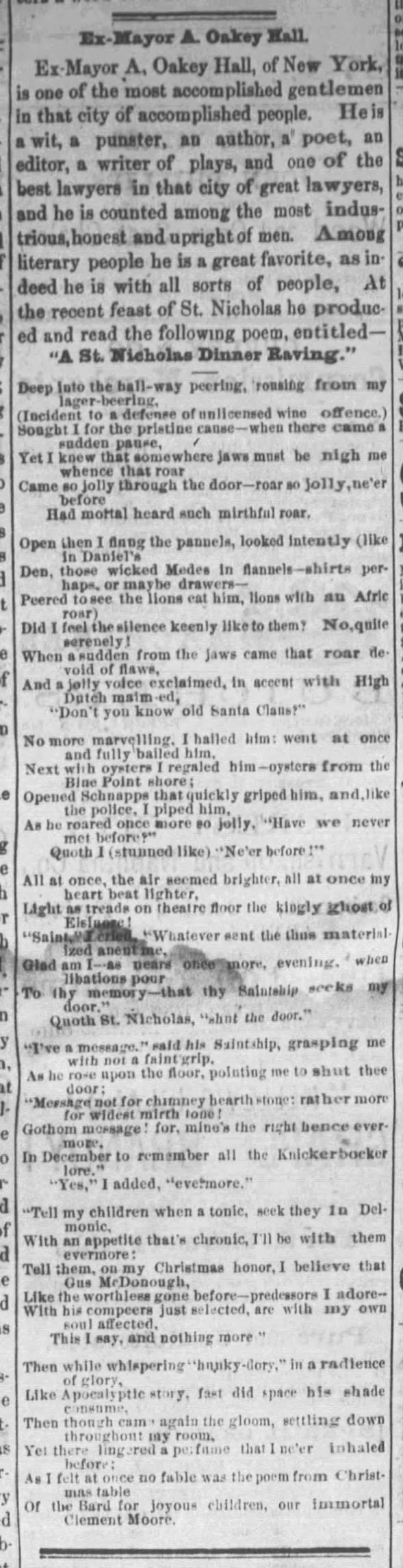
Santa Claus poem by A. Oakey Hall

A. Oakey Hall, Cabinet Photo c. 1870
Public domain via Wikimedia Commons
A la Poe in The Raven with a fine closing tribute to Clement C. Moore, author of "A Visit from St. Nicholas," as
"the Bard for joying children."
Herman Melville's old friend Abraham Oakey Hall delivered this now forgotten Santa Claus poem before The Saint Nicholas Society at their annual dinner, held on December 7, 1874 at Delmonico's (Fifth Avenue and Fourteenth Street). Monday evening, since the proper Feast of Saint Nicholas day, December 6th, fell on a Sunday that year.
"The dinner, which was served in excellent style, was enlivened by the usual Dutch peculiarities, by the burgomaster-appearance of the President [Augustus R. Macdonough], the orange neckties of many of the guests, and the almost universal smoking of tobacco in long clay pipes." --New York Herald, December 8, 1874
A partial transcription of Hall's poem was included in the account of the dinner published in the New York Herald on December 8, 1874; accessible via Chronicling America: Historic American Newspapers, The Library of Congress.
With minor variations the verse text appeared also in the Rock Island Daily Argus (Rock Island, Illinois) on December 16, 1874; and Providence Evening Express (Providence, Rhode Island) on December 21, 1874.

Not transcribed and so presumably lost are the "few introductory stanzas" read before the one that begins "Deep into the hall-way peering...." The New York Herald gives the title of Hall's poem as "A St. Nicholas Dinner Raving." In the fifth stanza all known versions print "widest mirth" where one might expect "wildest mirth." In the last line, the Herald gives "joying children" which must be right, rather than "joyous children" in the Rock Island Argus version.

New York Herald - December 8, 1874

EX-MAYOR HALL'S POEM.

After the above regular toasts were disposed of ex-Mayor Hall was called upon for a speech. In lieu of a speech he read a poem, which, after a few introductory stanzas, concluded as follows:--

A ST. NICHOLAS DINNER RAVING.

Deep into the hallway peering, rousing from my lager-beering,
(Incident to a defence of unlicensed wine offence),
Sought I for the pristine cause--when there came a sudden pause,
Yet I knew that somewhere jaws must be nigh me whence that roar
Came so jolly through the door--roar so jolly, ne'er before
Had mortal heard such mirthful roar.  
Open then I flung the panels, looked intently (like in Daniel's
Den, those wicked Medes in flannels-shirts perhaps, or maybe drawers--
Peered to see the lions eat him, lions with an Afric roar).
Did I feel the silence keenly like to them? No, quite serenely!
When a sudden from the jaws came that roar devoid of flaws,
And a jolly voice exclaim-ed, in accents with High Dutch maim-ed,
Don't you know old Santa Claus?

No more marvelling: I hailed him; went at once and fully bailed him,
Next with oysters I regaled him--oysters from the Blue Point shore;
Opened Schnapps that quickly griped him, and, like the police, I piped him,
As he roared once more so jolly, "Have we never met before?"
Quoth I (stunned like), "Ne'er before!"
 All at once the air seemed brighter, all at once my heart beat lighter,
Light as treads on theatre floor the kingly ghost of Elsinore!
"Saint," I cried, "whatever sent thee thus materialized anent me,
"Glad am I--as nears, once more, evening, when libations pour,
To thy memory--that thy Saintship seeks my door."
Quoth St. Nicholas, "shut the door."
 "I've a message, said his Saintship," grasping me with not a faint grip,
As he rose upon the floor, pointing me to shut the door;
"Message not for chimney hearthstone, rather more for widest mirth tone!
Gotham message! for, mine's the right hence evermore
In December to remember all the Knickerbocker lore."
"Yes," I added, "evermore."
 "Tell my children when a tonic, seek they in the halls Delmonic,
With an appetite that's chronic, I'll be with them evermore;
Tell them, on my Christmas honor, I believe that Gus McDonough,
Like the worthies gone before--predecessors I adore--
With his compeers just selected, are with my own soul affected;
This I say but nothing more."
Then while whispering "hunky-dory," in a radiance of glory,
Like Apocalyptic story, fast did space his shade consume.
Then though came again the gloom, settling down throughout my room,
Yet there lingered a perfume that I ne'er inhaled before;
As I felt at once no fable was the poem from Christmas Table,
Of the Bard for joying children, our immortal Clement Moore.
Wed, Dec 16, 1874 – 2 · The Rock Island Argus (Rock Island, Illinois, United States of America) · Newspapers.com
As Mayor of New York City Oakey Hall had often been mocked in cartoon caricatures by Thomas Nast. Today, of course, Nast is still celebrated for his iconic drawings of Santa Claus, particularly Merry Old Santa Claus in Harper's Weekly on January 1, 1881.

The Historical Society of Pennsylvania Digital Library has images of A. Oakey Hall's prose tale The Santa Claus Ice Palace, in manuscript.
  •  https://digitallibrary.hsp.org/index.php/Detail/objects/14813
Maybe I will get inspired and transcribe that too before Christmas.

And this, also in the HSP collection of  Abraham Oakey Hall manuscripts 1860-1890: Hall's prose history of The Evolution of Olden Manhattan Christmas.
  • https://digitallibrary.hsp.org/index.php/Detail/objects/14827
For now, I see that Oakey Hall's undated "Manhattan Christmas" narrative makes several interesting references to Clement Moore as author of "The Night Before Christmas":
... When [Peter] Minuit departed to pass the remaining Xmasses of his days at home over which St. Nicholas was presiding as Holland's National Spirit, Master Van Twiller came with yet more emigrants to celebrate additional Christmas times. Himself was in aspect no mean double of a Santa Claus: for he was good natured: & a corpulent wine bibbing Dutchman: although of looser life than St Nicholas would have tolerated. The description of Santa Claus given in Clement Moore's Manhattan rhyme would seem to fit the descriptions & pictures extant of that Merry Xmas Wouter Van Twiller. He had a chaplain in a Lutheran Dominie Bogardus: a man of mark & high character whose usual hot temper never came to the surface on Xmas day. But Santa Claus Van Twiller came to grief in 1637, being removed for diverting the monies of the Netherlands corporation to his own private use--Manhattan's original boodler--& his Christmas of that year was not for him a merry one.  --A. Oakey Hall, "Evolution of Olden Manhattan Christmas" manuscript pages 6-7.
From 1775 to 1783 under him a Merry Christmas seems to have quit New York. Then came another welcome 25th day of a month--the Evacuation day of November 25th. With Peace Santa Claus regained his Christmas throne & never thereafter has he quitted it as monarch over juvenility. For did not a Columbia College professor commemorate Santa Claus in the lyric entitled "The night before Christmas" that every New York child learns by the time he or she is seven years old? --A. Oakey Hall, "Evolution of Olden Manhattan Christmas" manuscript pages 23-24.

via Library of Congress

Saturday, December 24, 2016

Melville's Santa Claus

Drawing by F. O. C. Darley via Library of Congress
Like Clement C. Moore's little "elf" with his "miniature sleigh" and "tiny reindeer," Herman Melville's Santa Claus is a fairy:
... a wight
More than mortal, with something of man,
Whisking about, an invisible spright,
Almoner blest of Oberon's clan.  --Stockings in the Farm-house Chimney
Verbal echoes of Moore's A Visit from St. Nicholas aka "'The Night Before Christmas" in Melville's "Stockings" poem begin in the title with the stockings and chimney. The children are there, of course, only now they have names. (Two boys and two girls, same number and gender as the children Herman and Lizzie had when they lived in Pittsfield, on the farm called "Arrowhead.") Like the children in Moore's poem, Melville's wait "in hope." Moore said "In hopes," and Melville says "in hope" twice, managing through repetition to make them plural.

Melville's Santa gets his sleigh from Moore's St. Nick. And his elvish features, too, borrowed from Moore and amplified by Melville. That habit of "Whisking about" displayed by Melville's Santa imitates the "lively and quick" manner of Moore's St. Nick. Moore's Santa may be "chubby and plump" but he never waddles or dawdles. When Santa moves, he springs. Or flies. And Melville's Santa arrives in triple anapests (the delight / to believe / in a wight), the metrical dress of Moore's Santa.

Melville's invocation of Oberon makes explicit the implied associations in Moore's poem between Santa Claus and the fairy world, particularly as represented by Shakespeare in A Midsummer Night's Dream, and by Michael Drayton in Nymphidia. Drayton's fairy mythology surely influenced the naming of Santa's Reindeer. Associations with Oberon's fairy kingdom are unmistakable by the end of Moore's "Visit," when Santa flies up and away like the down of a thistle--just the stuff that cushions Queen Mab's chariot:
          With thistle-down they shod it:
For all her maidens much did fear,
If OBERON had chanc'd to hear,
That MAB his queen should have been there,
           He would not have abode it.  --Nymphidia: The Court of Fairy
Please don't make me explicate the last stanza of Melville's "Stockings in the Farm-house Chimney." It's Christmas Eve!

Alright, after the kids fall asleep (hahahaha) maybe I'll whisper something like this: when Melville or his appointed speaker says "Stay, Truth, O stay," he or she really means it. Now turn off The Simpsons and go to bed or Santa will never get here.

Drawing by F. O. C. Darley via Library of Congress

Stockings in the Farm-house Chimney


Happy, believe, this Christmas Eve
Are Willie and Rob and Nellie and May—
Happy in hope! in hope to receive
These stockings well stuffed from Santa Claus' sleigh.

O the delight to believe in a wight
More than mortal, with something of man,
Whisking about, an invisible spright,
Almoner blest of Oberon's clan.

Stay, Truth, O stay in a long delay!
Why should these little ones find you out?
Let them forever with fable play,
Evermore hang the Stocking out!  --Herman Melville
As mentioned in a previous melvilliana post, the drawings for the 1862 illustrated edition of Clement C. Moore's A Visit from St. Nicholas are by Herman Melville's friend Felix Darley. Melville's Christmas Eve poem "Stockings" draws from one or another version of that delightful "Visit." Melville's other Santa poem, next as it should be in Weeds and Wildings, celebrates Christmas Day. "A Dutch Christmas Up the Hudson in the Time of Patroons," looks back to Moore's own source-text in The History of New York by Washington Irving, properly regarded as the genius of invented traditions. For historical background that illuminates Melville's "Dutch Christmas" poem like the Griswold Family Christmas Tree, get The Battle for Christmas by Stephen Nissenbaum. Historian Charles W. Jones made the essential point about the importance of Irving in his entertaining 1954 essay, available online via the St Nicholas Center:
Without Irving there would be no Santa Claus. The History contains no less than twenty-five allusions to him—many of them the most delightful flights of imagination in the volume. Here is the source of the legends about St. Nicholas in New Amsterdam—of the emigrant ship Goede Vrouw, like a Dutch matron as broad as she was long, with a figurehead of St. Nicholas at the prow. Here are the descriptions of festivities on St. Nicholas Day in the colony, and of the church dedicated to him. Here is the description of Santa Claus bringing gifts, parking his horse and wagon on the roof while he slides down the chimney.
--Charles W. Jones on the Knickerbocker Santa Claus
And Patrick Browne summarizes Jones and reconsiders the Irving connection in his thoughtful St. Nicholas Day post of a few years back, Santa Claus was Made by Washington Irving.

Here's a pertinent sample of Irving's style and substance there:
The good old Dutch festivals, those periodical demonstrations of an overflowing heart and a thankful spirit, which are falling into sad disuse among my fellow-citizens, were faithfully observed in the mansion of Governor Stuyvesant. New year was truly a day of open-handed liberality, of jocund revelry, and warm-hearted congratulation—when the bosom seemed to swell with genial goodfellowship; and the plenteous table was attended with an unceremonious freedom, and honest broad-mouthed merriment, unknown in these days of degeneracy and refinement. Paas and Pinxter were scrupulously observed throughout his dominions; nor was the day of St. Nicholas suffered to pass by without making presents, hanging the stocking in the chimney, and complying with all its other ceremonies.  --History of New York
Being well versed in his Irving, Melville knows and uses details from various works, most obviously the successive Christmas chapters that begin the second volume of The Sketch Book of Geoffrey Crayon. In 1876 these were combined in a separate volume titled Old Christmas, lavishly illustrated by Randolph Caldecott. So the hospitality of Melville's "Dutch Christmas" strongly resembles English hospitality as Irving imagined it at Bracebridge Hall. Melville fuses holiday trappings there, like indoor evergreens, roasted apples, turkey and ale, with situations and characters from elsewhere. The mistletoe "bush" that will lure "our Hans and Cousin Chris" after the dance is a notable enticement of Irving's chapter on Christmas Eve. As Irving explains in his footnote on "misletoe":
The misletoe is still hung up in farm houses and kitchens at Christmas; and the young men have the privilege of kissing the girls under it, plucking each time a berry from the bush. When the berries are all plucked, the privilege ceases. --Christmas Eve
Katrina, however, seems lifted from "The Legend of Sleepy Hollow," as Robert Ryan points out in the notes to his 1967 edition.

In the service of Melville's speaker (some prosperous Dutch farmer, if not the noble old Patroon himself) Santa rides out with mince-pie and pudding for all the prisoners in town (turns out there's only one), and for less fortunate neighbors or dependents. Not poor, we're told, and too proud to accept any gift condescendingly bestowed as charity. Melville's final line affirms the ideal of charity, or love, with a clear conscience. Possibly the poet has been reading in the Epistles of St. Paul:
"Now the end of the commandment is charity out of a pure heart, and of a good conscience, and of faith unfeigned. --1 Timothy 1:5
Considering the day (Christmas) and place (barn or stable), Melville comes close to homilizing on the Nativity with reflections on "the ox, ass, and Babe new-born." Melville we know read and commended Montalembert's Life of St. Elizabeth of Hungary. Did Melville's reading of French Catholics in translation include Prosper Guéranger on The Liturgical Year? Guéranger's paraphrase of Rabanus Maurus similarly links Christmas and conscience, alongside the appropriate references to ox, ass, and Babe in that order:
the pious Rabanus Maurus—who, in a Homily on the Nativity of our Lord, encourages sinners to come and take their place, side by side with the just, in the stable of Bethlehem, where even the ox and the ass recognise their Master in the Babe who lies there.

"I beseech you, dearly beloved Brethren, that you receive with fervent hearts the words our Lord speaks to you, through me, on this most sweet Feast, on which even infidels and sinners are touched with compunction; on which the wicked man is moved to mercy, the contrite heart hopes for pardon, the exile despairs not of returning to his country, and the sick man longs for his cure; on which is born the Lamb who taketh away the sins of the world, that is, Christ, our Saviour. On such a Birth Day, he that has a good conscience, rejoices more than usual; and he whose conscience is guilty, fears with a more useful fear...." --The Liturgical Year: Christmas
The most distinctively Melvillean touch in "Dutch Christmas" might be the speaker's concern for the well-being of other animals (excepting I guess the poor turkey) as his fellow creatures. Horses get extra oats, cows their favorite hay, birds the best crumbs. When Herman Melville lived at Arrowhead, he liked to watch his cow at breakfast, eating her pumpkins:
"for it's a pleasant sight to see a cow move her jaws—she does it so mildly & with such a sanctity."  --Some Personal Letters of Herman Melville
For the farmer-speaker of Melville's "Dutch Christmas," the fittingest place to go on Christmas morning is the barn, to visit the cows and take in "their sweet breath."

A Dutch Christmas Up the Hudson in the Time of Patroons


Over the ruddy hearth, lo, the green bough!
In house of the sickle and home of the plough,
Arbored sit and toast apples now!
Hi, there in barn! have done with the flail.
Worry not the wheat, nor winnow in the gale:
'Tis Christmas and holiday, turkey too and ale!
Creeping round the wainscot of old oak red,
The ground-pine, see — smell the sweet balsam shed!
Leave off, Katrina, to tarry there and scan:
The cream will take its time, girl, to rise in the pan.
Meanwhile here’s a knocking, and the caller it is Van
Tuenis Van der Blumacher, your merry Christmas man.
Leafless the grove now where birds billed the kiss:
To-night when the fidler wipes his forehead, I wis,
And panting from the dance come our Hans and Cousin Chris,
Yon bush in the window will never be amiss!
But oats have ye heaped, men, for horses in stall?
And for each heifer young and the old mother-cow
Have ye raked down the hay from the aftermath-mow?
The Christmas let come to the creatures one and all!
Though the pedlar, peering in, doubtless deemed it but folly,
The yoke-cattle’s horns did I twine with green holly.
Good to breathe their sweet breath this blest Christmas morn,
Mindful of the ox, ass, and Babe new-born.
The snow drifts and drifts, and the frost it benumbs:
Elsie, pet, scatter to the snow-birds your crumbs.
Sleigh-bells a’ jingle! ’Tis Santa Claus: hail!
Villageward he goes thro’ the spooming of the snows;
Yea, hurrying to round his many errands to a close,
A mince-pie he’s taking to the one man in jail. —
What! drove right out between the gate-posts here?
Well, well, little Sharp-Eyes, blurred panes we must clear!
Our Santa Claus a clever way has and a free:
Gifts from him some will take who would never take from me.
For poor hereabouts there are none: — none so poor
But that pudding for an alms they would spurn from the door.
All the same to all in the world’s wide ways—
Happy harvest of the conscience on many Christmas Days.  --Herman Melville
Melville put his two Santa Claus poems in the collection of poetry and prose titled "Weeds and Wildings." The great Houghton Library, Harvard University has the manuscript of Weeds and Wildings in their Herman Melville papers. In a wonderful present to Melville readers the world over, manuscript pages with Santa Claus poems in late stages of drafting are digitized and available online:
The forthcoming Northwestern-Newberry Edition of Melville's uncompleted writings doubtless will provide the best-edited texts of these poems ever. Meanwhile, available printed versions of Melville's Santa Claus poems in posthumously published editions of Weeds and Wildings include:
Handy e-texts:
Happy Christmas to all, and don't forget: What happens under the mistletoe stays under the mistletoe.