Copy of Christmas classic for sale at auction house https://t.co/H8SUDeYD3V
— Scott Norsworthy 🇺🇸 (@Melvilliana) December 10, 2024

Original research and riffs on Herman Melville, authorship, and nineteenth-century American literature.
Copy of Christmas classic for sale at auction house https://t.co/H8SUDeYD3V
— Scott Norsworthy 🇺🇸 (@Melvilliana) December 10, 2024
,_page_1.jpg)
In A Visit From St. Nicholas, best known as " 'Twas the Night Before Christmas," Clement C. Moore borrowed the reindeer and other details from the illustrated Christmas poem in The Children's Friend Number III, published in New York in 1821 by William B. Gilley.
Old SANTECLAUS with much delight
His reindeer drives this frosty night,
O'er chimney-tops, and tracks of snow,
To bring his yearly gifts to you.
The steady friend of virtuous youth,
The friend of duty, and of truth,
Each Christmas eve he joys to come
Where love and peace have made their home.
Through many houses he has been,
And various beds and stockings seen;
Some, white as snow, and neatly mended,
Others, that seem'd for pigs intended.
To some I gave a pretty doll,
To some a peg-top, or a ball;
No crackers, cannons, squibs, or rockets,
To blow their eyes up, or their pockets.
Where e’er I found good girls or boys,
That hated quarrels, strife and noise,
I left an apple, or a tart,
Or wooden gun, or painted cart.
No drums to stun their Mother’s ear,
Nor swords to make their sisters fear;
But pretty books to store their mind
With knowledge of each various kind.
But where I found the children naughty,
In manners rude, in temper haughty,
Thankless to parents, liars, swearers,
Boxers, or cheats, or base tale-bearers,
I left a long, black, birchen rod,
Such as the dread command of GOD
Directs a Parent’s hand to use
When virtue’s path his sons refuse.
AAS https://gigi.mwa.org/imagearchive/filename/249665_
YALE https://collections.library.yale.edu/catalog/2014510
Besides, has not Weir painted the scene? and has it not been described by one of the best of men in most exquisite rhymes? --Evert A. Duyckinck
There were several national or religious festivals kept by the Dutch in New Amsterdam: Christmas, New Year's Day, Paas or Easter, Pinxter at Whitsuntide, and Santa Claus or St. Nicholas Day. Some of the peculiar Dutch honors of the last have been transferred to Christmas; particularly the visit of St. Nicholas, who, to the wondering children of Manhattan, on the eve of the sacred day, still, as of yore, a burly, benevolent figure, clad in his ancient furry habiliments, a pipe in his month, a capacious, well-filled hamper of toys on his back, rides in his airy sleigh, swiftly borne by his reindeer-team, over the roofs of the houses, descending, spite of narrow flues and modern contracted chimneys, to fill the stockings suspended, in expectation of his gifts, at the mantel-corner. The faith in the old legend of St. Nicholas, patron of the Manhattoes, would, with other superstitions of the past, doubtless have died out long ago were it not invigorated by these perennial gifts and bounties. There is practically no discrediting a belief which is backed by such unfailing beneficence. We, "children of a larger growth," hoodwink our perceptions and act upon it every day in our intercourse with society and estimate of character, feigning to believe in more doubtful virtues than those of the boy-saint. Besides, has not Weir painted the scene? and has it not been described by one of the best of men in most exquisite rhymes?—
"The moon on the breast of the new-fallen snow
Gave the lustre of midday to objects below,
When, what to my wondering eyes should appear,
But a miniature sleigh and eight tiny reindeer.
With a little old driver, so lively and quick,
I knew in a moment it must be St Nick.
* * * *
And then, in a twinkling, I heard on the roof
Tho prancing and pawing of each little hoof—
As I drew In my head, and was turning around,
Down the chimney St. Nicholas came with a bound,
He was dressed all in fur, from his head to his foot,
And his clothes were all tarnished with ashes and soot;
A bundle of toys he had flung on his back,
And he looked like a peddler just opening his pack.
His eyes—how they twinkled! his dimples how merry!
His cheeks were like roses, his nose like a cherry!
His droll little mouth was drawn up like a bow,
And the beard of his chin was as white as the snow:
The stump of a pipe he held tight in his teeth,
And the smoke it encircled his head like a wreath,
He had a broad face and a little round belly,
That shook when he laughed, like a bowlfull of jelly." *
* Poems by Clement C. Moore, LL. D: 1844, pp. 125-6
This, is the children's saint of the Manhattoes, fixed in his great lineaments for all time.
-- from Life in New York City in its Later Colonial Days by Evert A. Duyckinck; also incorporated in "The Origin of the New York Churches," Frank Leslie's Sunday Magazine (March 1886).In their 1855 Cyclopædia of American Literature, co-editors Evert A. Duyckinck and his brother George L. Duyckinck had accorded Moore a similarly generous treatment, likewise informed by some personal knowledge of the man being described:
Professor Moore has lightened his learned labors in the seminary by the composition of numerous poems from time to time, chiefly expressions of home thoughts and affections, with a turn for humor as well as sentiment, the reflections of a genial, amiable nature. They were collected by the author in a volume in 1844, which be dedicated to his children. Though occasional compositions they are polished in style....Even more expansively, the updated National Cyclopedia of American Biography praises the same admirable traits of character in Clement C. Moore:
--Cyclopædia of American Literature
He was a man of rare beauty and simplicity of character, kindly disposed and generous to a fault. Upon his death, the faculty of the seminary he had so faithfully served passed resolutions declaring, "We recognize in him one whom God has blessed with selected gifts; warmhearted in friendship, genial in society, kindly and considerate to all; possessed of fine literary tastes, poetic instincts and expressiveness, and of cheerful humor withal; at the same time well accomplished in severer studies and resolute for more laborious undertakings, as his learned works in Hebrew grammar and lexicography distinctly testify."From the New York Sun, May 16, 1886:
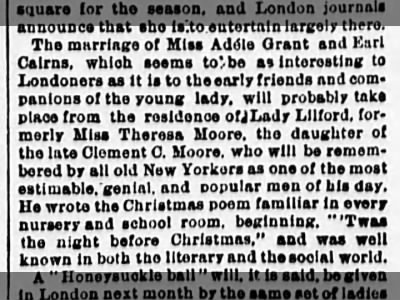
... Lady Lilford, formerly Miss Theresa Moore, the daughter of the late Clement C. Moore, who will be remembered by all old New Yorkers as one of the most estimable, genial, and popular men of his day. He wrote the Christmas poem familiar in every nursery and school room, beginning, "'Twas the night before Christmas," and was well known in both the literary and the social world.
...the then extremely rare “Happy Christmas” rather than “Merry Christmas”
--Response by MacDonald P. Jackson
 |
| Letters from John Pintard to His Daughter Volume 2 (New York, 1940), page 114 |
happy Christmas, and a merry New Year, your Cellars full of Money, and your Pockets full of Beer....The regular choice of "happy" over "merry" in many texts by clergymen and other pious writers is neatly explained below, in the 1752 letter to his wife by John Newton (published in 1810). While still active in the African slave trade (twenty years before he composed the words to "Amazing Grace"), Newton distinguishes mirth and happiness, in his mind "two very different things." Our Anglican moralists seem to prefer "happy" over "merry" because for them, "merry" implies inebriation. A happy Christmas, as opposed to a merry one, means a sober Christmas. Clergymen and missionaries in particular do not want to encourage holiday drunkenness and debauchery, or anything like the carnival rites that Clement C. Moore (as brilliantly demonstrated by Stephen Nissenbaum in The Battle for Christmas) aimed to tame in "A Visit from St. Nicholas." Say now. Perhaps with Santa's parting "Happy Christmas to all," Moore the sturdy Episcopalian and inveterate moralizer has managed to slip a little didactic pill in with the sugar-plums, when we weren't looking.
"I Send You this to express my hearty Wishes, That You may enjoy a Happy Christmass and New-Year." --George Wheeler, An account of the churches, or places of assembly, of the primitive Christians
MY wishes to your lad[yshi]p] and Community, are of a most happy Christmasse... I present you with The voice of Truth, the Angel of peace who giving himself unto us, gave us the first happy Christ-masse.... --F. G., The voyce of truth or The high way leading to true peace composed in Latine by M.G. and translated into Inglish by F.G.1679
Durham Dec. 23 1679.1684
"... wishing you a happy Christmas and new yeare...."
--Reverend Denis Grenville, archbishop of York to John Locke via Electronic Enlightenment Scholarly Edition of Correspondence.
"it hath been no holy nor happy Christmass, if it hath not prevailed with us to resolve to be better men...." --Denis Grenville, The compleat conformist, or, Seasonable advice concerning strict conformity1687
Merry song fit to be sung at Christmas. The Tune, Oh Mother Roger.
1693Now, now this happy Christmas Season,
I present you with Delight;
[...]nce it is no more than Reason,
For to pass away each Night....--Chaucer, Junior - Canterbury Tales
"O the happy Christmas this will prove to us, in case we can but resolve to practice Humility and Charity!" --La Mothe, Two discourses concerning the divinity of Our Saviour

... wishing you, and all my Tenants, a happy Christmas, and merry New Year, and expecting to year from you: And am1707
Your Friend at Command,Inner Temple,
Wm. Milman.
27 December 1700. --Journals of the House of Commons v. 13 1699-1702, page 404.
With respects to Mr. Benson and all at Salisbury-court; wishing your Lordship and them an happy Christmas, and many good New Years.... --Letter "From Mr. Joseph Nicolson" dated December 22, 1707 in Letters on Various Subjects (London, 1809), volume 2 page 338.
"I wish you a happy Christmas and New Year."1712
--Mrs. Frances Shaftoe's Narrative
26th. I was to wish the duke of Ormond a happy Christmas, and give half a crown to his porter. It will cost me a dozen half crowns among such fellows. --Letters, written by Jonathan Swift1738

... My service with my spouse's to you and your family, wishing you all a happy Christmas,
I am, Madam, &c. --Letters Written by His Excellency Hugh Boulter, D. D. (Dublin, 1770), volume 1 page 198.1749
"Please permit me to wish all your senatorical Rank, happy Christmas, and a merry New Year, your Cellars full of Money, and your Pockets full of Beer a l' Irelandoite." --Machiavel's Letter to the Lords and CommonsJanuary 3, 1750
"Most people would think it too late, to wish you a happy Christmas." --Original Letters of the Rev. James Hervey; also in Herveiana (London, 1823)1771
I hope you have had a happy Christmas at Leeds. We have kept holidays here indeed. --Works of the Reverend George Whitefield, M. A. Vol. 2 (London, 1771)1773

Dar as boas festas a alguem, to wish a happy Christmas, or Easter to one, to wish one the compliments of the season. --Anthony Vieyra, A Dictionary of the Portuguese and English Languages (London, 1773).1799
"To conclude: Do your duty to God and men; enjoy the company of your friends and neighbors; eat and drink with strict temperance and sobriety; and then you will not fail to have, what I heartily wish you, a COMFORTABLE AND AN HAPPY CHRISTMAS." --Admonitions for Sunday-Schools (London, 1799)

Carlisle, Dec. 25.
The Editor of the Carlisle Gazette presents his readers with the compliments of the season A HAPPY CHRISTMAS -- and at the same time condoles with them at the late melancholy news, the death of Lieutenant General GEORGE WASHINGTON....
-- Kline's Carlisle Weekly Gazette (Carlisle, Pennsylvania) December 25, 1799
"[we] are coming down to the vicarage to keep the Christmas:--and a happy Christmas 'tis likely to be for honest folks: as for they that are not honest, it is not for them to expect to be happy, at Christmas or any other time." --Maria Edgeworth, The Parent's Assistant 3rd edition (London, 1800)1807
An Advent spent in a devout and penitential manner, cannot fail of conducting thee to a happy Christmas. --Richard Challoner, Meditations or Considerations upon Christian Truths and Duties1808
"One happy Christmas laid upon the shelf " --Poem "A Chapter on Logic." Collected in The Spirit of the Public Journals for 1808; and frequently reprinted, for example in the Philadelphia Mirror of Taste and Dramatic Censor, May 1, 1810; and the Cortland Village Museum, October 9, 18201809
"... we were looking forward to a happy Christmas time last December, when one of them said, ' Will anybody think of the little sick children at the Union ?' "--Emma Sheppard, Sunshine in the Workhouse1810
I wish you, my dear friend, a very happy Christmas; may the blessed Jesus himself "bring you good tidings of great joy!" --George Russell, Letters, Essays and Poems on Religious Subjects
"I NOW sit down to wish you a happy Christmas; a merry one, is a frequent phrase, but that falls far short of my desire. For I have often found mirth and happiness to be two very different things... --Works of the Rev. John Newton1811
Here, and in the neighbouring villages, I spent my Christmas, and a happy Christmas too. --"Mode of celebrating Christmas in Yorkshire" in The Gentleman's Magazine
"After spending a very happy Christmas with his family, he set off again for Charlestown [South Carolina], where he arrived January 3, 1741; and on the 16th, went on board for England. --Memoirs of the Life and Character of the Late Rev. George Whitefield
Saturday 25, we had a happy Christmas-day. --Wesleyan-Methodist Magazine1813
"I wish you both a happy christmas, and that your holidays, may be days of the Son of man...." Methodist preacher William Huntington in Gleanings of the Vintage1815
a drunkard who, to the great joy of his wife and family, is reformed, having learned how much his temporal comfort is improved by his new habits, consoles himself by anticipating the superior happiness he shall enjoy this Christmas, compared to the riot and intoxication of the last festival season.... this will be the best way of enjoying a happy Christmas. --Thomas Pole, A History of the Origin and Progress of Adult Schools
"You have now, my dear children," continued he, "enjoyed a merry and a happy Christmas, have you not?" --The Welcome Visitor, or, The Good Uncle1821
NEW YORK, 26 Decembr, 18211822
A Happy Christmas to our dearest daughter, her good husband and large family of children, was the health drunk yesterday by your parents and Sister at their tranquil board. . . . --Letters from John Pintard to His Daughter, Volume 2
Never did I spend a more happy Christmas. --Missionary Register, January 1, 1822
"Christmas. To us this has been a happy Christmas, by the arrival of letters from America...." --Religious Intelligencer, July 6, 1822
"... here I found a letter from home, wishing me a happy Christmas." --Thomas Rees, A Journal of Voyages and Travels1823

Be diligent the other 'leven,
And this month may to joy be given--
To christian acts--your Maker's praise--
And happy CHRISTMAS holidays.
J. E. --The Georgia and South-Carolina Almanack for 1823
"I hope you have spent a happy Christmas." --Christian Repository, January 31, 18231824
"We have celebrated a very happy Christmas and entrance into the New Year." --Hans Peter Hallbeck, United Brethren's Missionary Intelligencer, 4th Qtr 1824
"We return the compliment of a happy Christmas to the writer." --London Courier and Evening Gazette, December 27, 18241825
"Wishing our numerous friends, a cheerful and happy Christmas...." --The Lady's Monthly Museum
... wishing our fair readers, from our hearts, a very merry and happy Christmas, with the simplicity which always accompanies truth. --New York Mirror, December 24, 18251826
CHRISTMAS BOX DAY. / The Watchmen's Petition
...
Thus, whether Male or Female, Old or Young,
Or Wed or Single, be this burden sung:
Long may you live to hear, and we to call,
"A Happy Christmas, and New Year to all!"--Kentish Weekly Post or Canterbury Journal, December 26, 1826
"It will be a happy Christmas for me, if I learn to think more about Jesus Christ..." --The Child's Companion or Sunday Scholar's Reward, December 1, 18261827
"We exclaim'd, "O, tell me, is it
Long to happy CHRISTMAS-DAY? --Christmas and the New Year (London, 1827)
The Holidays.--The season of presents, cakes, and hilarity, has arrived again, and we issue this number in the very midst of it. The throngs of happy children that we encounter in the streets, whose little smiling faces look almost blue with the cold, but whom wind and weather cannot restrain from sallying out, to spend their holiday finances in the nearest toyshop; the greeting of "a happy Christmas to you," that salutes our ears, into whatever house we step, and for saying which the urchins expect a return--but not in kind; and the peculiar nature of the amusements and sports around the evening fireside, where a sort of moral sunshine diffuses itself, bright in proportion to the bleak and disagreeable state of external nature, all are but so many evidences of the undecaying spirit with which this festival spirit of the year is still observed.1828
--The New York Mirror, December 29, 1827
The season is near at hand, when the silver voices of the merry and gay-hearted little urchins will be heard in the usual greeting "a happy Christmas to you!" and what a delightful sensation it must afford a benevolent heart thus addressed, to return the salutation with a Christmas Box, or a Casket, such as we have just been rifling for the entertainment of our readers. --The Critic, December 13, 18281829
"A HAPPY Christmas and a merry new year!" How many million times will this good natured salutation be interchanged, wherever the English language is spoken….1829?
--New York Mirror, December 26, 1829
A NEW CAROL TO THE TUNE OF "God rest ye, Merry Gentlemen."1830
Now may the ruler of this house,
These great glad tidings know;
And many a happy Christmas
May he have here below;
And to his friends and kindred,
The Saviour's mercy show;
Glad tidings of comfort and joy. --Broadside printed in London by A. Applegate and E. Cowper; in 1810-1840 Radical Politics and the Working Man in England Set 41. British Library.
"And wishing Happy Christmas all, beg leave to make my bow, Sir.1832
Bow, wow, &c."
--"Marvellous Times / A Christmas Carol for the year 1830"; in the Chester Chronicle and Cheshire and North Wales General Advertiser, December 31, 1830.
"A happy Christmas and a prosperous New Year to all our Readers! "Related post:
--Bury and Norwich Post, December 26, 1832
 |
| Drawing by F. O. C. Darley via Library of Congress |
... a wightVerbal echoes of Moore's A Visit from St. Nicholas aka "'The Night Before Christmas" in Melville's "Stockings" poem begin in the title with the stockings and chimney. The children are there, of course, only now they have names. (Two boys and two girls, same number and gender as the children Herman and Lizzie had when they lived in Pittsfield, on the farm called "Arrowhead.") Like the children in Moore's poem, Melville's wait "in hope." Moore said "In hopes," and Melville says "in hope" twice, managing through repetition to make them plural.
More than mortal, with something of man,
Whisking about, an invisible spright,
Almoner blest of Oberon's clan. --Stockings in the Farm-house Chimney
With thistle-down they shod it:Please don't make me explicate the last stanza of Melville's "Stockings in the Farm-house Chimney." It's Christmas Eve!
For all her maidens much did fear,
If OBERON had chanc'd to hear,
That MAB his queen should have been there,
He would not have abode it. --Nymphidia: The Court of Fairy
 |
| Drawing by F. O. C. Darley via Library of Congress |
As mentioned in a previous melvilliana post, the drawings for the 1862 illustrated edition of Clement C. Moore's A Visit from St. Nicholas are by Herman Melville's friend Felix Darley. Melville's Christmas Eve poem "Stockings" draws from one or another version of that delightful "Visit." Melville's other Santa poem, next as it should be in Weeds and Wildings, celebrates Christmas Day. "A Dutch Christmas Up the Hudson in the Time of Patroons," looks back to Moore's own source-text in The History of New York by Washington Irving, properly regarded as the genius of invented traditions. For historical background that illuminates Melville's "Dutch Christmas" poem like the Griswold Family Christmas Tree, get The Battle for Christmas by Stephen Nissenbaum. Historian Charles W. Jones made the essential point about the importance of Irving in his entertaining 1954 essay, available online via the St Nicholas Center:Stockings in the Farm-house Chimney
Happy, believe, this Christmas Eve
Are Willie and Rob and Nellie and May—
Happy in hope! in hope to receive
These stockings well stuffed from Santa Claus' sleigh.
O the delight to believe in a wight
More than mortal, with something of man,
Whisking about, an invisible spright,
Almoner blest of Oberon's clan.
Stay, Truth, O stay in a long delay!
Why should these little ones find you out?
Let them forever with fable play,
Evermore hang the Stocking out! --Herman Melville
Without Irving there would be no Santa Claus. The History contains no less than twenty-five allusions to him—many of them the most delightful flights of imagination in the volume. Here is the source of the legends about St. Nicholas in New Amsterdam—of the emigrant ship Goede Vrouw, like a Dutch matron as broad as she was long, with a figurehead of St. Nicholas at the prow. Here are the descriptions of festivities on St. Nicholas Day in the colony, and of the church dedicated to him. Here is the description of Santa Claus bringing gifts, parking his horse and wagon on the roof while he slides down the chimney.And Patrick Browne summarizes Jones and reconsiders the Irving connection in his thoughtful St. Nicholas Day post of a few years back, Santa Claus was Made by Washington Irving.
--Charles W. Jones on the Knickerbocker Santa Claus
The good old Dutch festivals, those periodical demonstrations of an overflowing heart and a thankful spirit, which are falling into sad disuse among my fellow-citizens, were faithfully observed in the mansion of Governor Stuyvesant. New year was truly a day of open-handed liberality, of jocund revelry, and warm-hearted congratulation—when the bosom seemed to swell with genial goodfellowship; and the plenteous table was attended with an unceremonious freedom, and honest broad-mouthed merriment, unknown in these days of degeneracy and refinement. Paas and Pinxter were scrupulously observed throughout his dominions; nor was the day of St. Nicholas suffered to pass by without making presents, hanging the stocking in the chimney, and complying with all its other ceremonies. --History of New YorkBeing well versed in his Irving, Melville knows and uses details from various works, most obviously the successive Christmas chapters that begin the second volume of The Sketch Book of Geoffrey Crayon. In 1876 these were combined in a separate volume titled Old Christmas, lavishly illustrated by Randolph Caldecott. So the hospitality of Melville's "Dutch Christmas" strongly resembles English hospitality as Irving imagined it at Bracebridge Hall. Melville fuses holiday trappings there, like indoor evergreens, roasted apples, turkey and ale, with situations and characters from elsewhere. The mistletoe "bush" that will lure "our Hans and Cousin Chris" after the dance is a notable enticement of Irving's chapter on Christmas Eve. As Irving explains in his footnote on "misletoe":
The misletoe is still hung up in farm houses and kitchens at Christmas; and the young men have the privilege of kissing the girls under it, plucking each time a berry from the bush. When the berries are all plucked, the privilege ceases. --Christmas EveKatrina, however, seems lifted from "The Legend of Sleepy Hollow," as Robert Ryan points out in the notes to his 1967 edition.
"Now the end of the commandment is charity out of a pure heart, and of a good conscience, and of faith unfeigned. --1 Timothy 1:5Considering the day (Christmas) and place (barn or stable), Melville comes close to homilizing on the Nativity with reflections on "the ox, ass, and Babe new-born." Melville we know read and commended Montalembert's Life of St. Elizabeth of Hungary. Did Melville's reading of French Catholics in translation include Prosper Guéranger on The Liturgical Year? Guéranger's paraphrase of Rabanus Maurus similarly links Christmas and conscience, alongside the appropriate references to ox, ass, and Babe in that order:
the pious Rabanus Maurus—who, in a Homily on the Nativity of our Lord, encourages sinners to come and take their place, side by side with the just, in the stable of Bethlehem, where even the ox and the ass recognise their Master in the Babe who lies there.The most distinctively Melvillean touch in "Dutch Christmas" might be the speaker's concern for the well-being of other animals (excepting I guess the poor turkey) as his fellow creatures. Horses get extra oats, cows their favorite hay, birds the best crumbs. When Herman Melville lived at Arrowhead, he liked to watch his cow at breakfast, eating her pumpkins:
"I beseech you, dearly beloved Brethren, that you receive with fervent hearts the words our Lord speaks to you, through me, on this most sweet Feast, on which even infidels and sinners are touched with compunction; on which the wicked man is moved to mercy, the contrite heart hopes for pardon, the exile despairs not of returning to his country, and the sick man longs for his cure; on which is born the Lamb who taketh away the sins of the world, that is, Christ, our Saviour. On such a Birth Day, he that has a good conscience, rejoices more than usual; and he whose conscience is guilty, fears with a more useful fear...." --The Liturgical Year: Christmas
"for it's a pleasant sight to see a cow move her jaws—she does it so mildly & with such a sanctity." --Some Personal Letters of Herman MelvilleFor the farmer-speaker of Melville's "Dutch Christmas," the fittingest place to go on Christmas morning is the barn, to visit the cows and take in "their sweet breath."
A Dutch Christmas Up the Hudson in the Time of Patroons
Over the ruddy hearth, lo, the green bough!
In house of the sickle and home of the plough,
Arbored sit and toast apples now!
Hi, there in barn! have done with the flail.
Worry not the wheat, nor winnow in the gale:
'Tis Christmas and holiday, turkey too and ale!
Creeping round the wainscot of old oak red,
The ground-pine, see — smell the sweet balsam shed!
Leave off, Katrina, to tarry there and scan:
The cream will take its time, girl, to rise in the pan.
Meanwhile here’s a knocking, and the caller it is Van —
Tuenis Van der Blumacher, your merry Christmas man.
Leafless the grove now where birds billed the kiss:
To-night when the fidler wipes his forehead, I wis,
And panting from the dance come our Hans and Cousin Chris,
Yon bush in the window will never be amiss!
But oats have ye heaped, men, for horses in stall?
And for each heifer young and the old mother-cow
Have ye raked down the hay from the aftermath-mow?
The Christmas let come to the creatures one and all!
Though the pedlar, peering in, doubtless deemed it but folly,
The yoke-cattle’s horns did I twine with green holly.
Good to breathe their sweet breath this blest Christmas morn,
Mindful of the ox, ass, and Babe new-born.
The snow drifts and drifts, and the frost it benumbs:
Elsie, pet, scatter to the snow-birds your crumbs.
Sleigh-bells a’ jingle! ’Tis Santa Claus: hail!
Villageward he goes thro’ the spooming of the snows;
Yea, hurrying to round his many errands to a close,
A mince-pie he’s taking to the one man in jail. —
What! drove right out between the gate-posts here?
Well, well, little Sharp-Eyes, blurred panes we must clear!
Our Santa Claus a clever way has and a free:
Gifts from him some will take who would never take from me.
For poor hereabouts there are none: — none so poor
But that pudding for an alms they would spurn from the door.
All the same to all in the world’s wide ways—Melville put his two Santa Claus poems in the collection of poetry and prose titled "Weeds and Wildings." The great Houghton Library, Harvard University has the manuscript of Weeds and Wildings in their Herman Melville papers. In a wonderful present to Melville readers the world over, manuscript pages with Santa Claus poems in late stages of drafting are digitized and available online:
Happy harvest of the conscience on many Christmas Days. --Herman Melville

 |
| via Library of Congress |
And Mamma in her 'kerchief, and I in my cap,Clement C. Moore liked the word brain so much he used it twenty times in his poetry, not counting "settled our brains" in A Visit from St. Nicholas, aka "The Night Before Christmas." Henry Livingston maybe speaks of "brains" one time only, in one poem that he might or might not have written: Filly and Wolf, where the wolf got its brains kicked out by the clever and spirited filly.
Had just settled our brains for a long winter's nap.... -- A Visit from St Nicholas
The moon on the breast of the new-fallen snowIf you want to try this at home, here are links to searchable texts that Mary S. Van Deusen provides on the aforementioned Livingston site:
Gave the lustre of mid-day to objects below... -- A Visit from St. Nicholas
... The above is printed immediately over some lines, describing a visit from St. Nicholas, which I wrote many years ago, I think somewhere between 1822 and 1824, not for publication, but to amuse my children. They, however, found their way, to my great surprise, in the Troy Sentinel: nor did I know, until lately, how they got there. When "The New York Book" was about to be published, I was applied to for some contribution to the work. Accordingly, I gave the publisher several pieces, among which was the "Visit from St. Nicholas." It was printed under my name, and has frequently since been republished, in your paper among others, with my name attached.
Under these circumstances, I feel it incumbent on me not to remain silent, while so bold a claim, as the above quoted, is laid to my literary property, however small the intrinsic value of that property may be.
The New York Book was published in 1827 [1837].
Yours, truly and respectfully,
CLEMENT C. MOORE
 |
| New York American - March 1, 1844 |
When out on the driveway I heard such a clatter,
I dimmed all the lights and turned on Clyde McPhatter.

"By the way, opening the files in a research institution is much like reaching into a sock on Christmas morning, you never can be certain as to the goodies that could be found." --Ruby CusackSolutions to authorship mysteries are most satisfying when there’s a real mystery to solve, and when style evidence fits with biographical and historical evidence. For historical background, The Battle for Christmas (Random House, 1996) is indispensable. There Stephen Nissenbaum offers a superb reading of "The Night Before Christmas" which underscores the class tensions and unruly carnival rites historically evoked in celebrations of Christmas and New Year's Day. As Professor Nissenbaum shows, Moore's poem helped domesticate Christmas.
"he was substituting a silicon chip for a tin ear." -- The Shakespeare Wars (Random House, 2006) page 173In a nutshell, that's it! Sir Brian Vickers, before he became "Sir Brian," more elaborately and devastatingly critiqued Professor Foster's methodology and results in Counterfeiting Shakespeare (Cambridge University Press, 2002). As the Funeral Elegy fiasco reminds, anything can happen once you turn words into numbers. Professor Jackson knows this and therefore tries early on to ground his investigation on sound principles of literary criticism. Unsuccessfully, because he takes for granted the very thing he wants to test. Professor Jackson gives away his bias for Livingston in one sentence and appears not to realize the damage done to his desired stance of cool scientific objectivity:
"However, no reader of poetry with any sense of literary style and value could compare Moore’s body of verse with Livingston’s without recognizing that 'The Night Before Christmas' is a conspicuous misfit within Moore’s canon but would be comfortably at home within Livingston’s.” (11)In other words, only an idiot would align “Night Before Christmas” with the transparently awful poetry of Clement C. Moore. But if that were true, the thing is already proved by chapter 2 so we don’t need to bother with chi-squares, arithmetical means, and standard deviations. We don't even need to turn on the computer. Fortunately for the future survival of computational stylistics as a legitimate method of academic inquiry, it's not true!
“No experienced reader of poetry who was familiar with the verse of the two rival candidates could fail to recognize that “The Night Before Christmas” is as uncharacteristic of Moore as it is characteristic of Livingston, with his proven ability to take a child’s view of things, his intense awareness of flying creatures, and his fascination with the miniature.” (128)"No experienced reader"? O! for an esteemed and truly estimable Shakespeare scholar to bluster so. Professor Jackson’s dual purpose premise-conclusion excludes anybody who does not agree with his dim view of Moore's poetry from the ranks of discerning readers. His exclusive club of experienced readers of poetry would not have included William Alfred Jones, the accomplished essayist (as Bryant called him) and Hazlitt fan, who wrote a glowing contemporary review of Moore’s Poems that appeared in the July 17, 1847 issue of the New York Literary World. Niels Henry Sonne the distinguished librarian would not have known enough poetry by Livingston, so he's banned along with his rock solid defense of Moore's authorship on the biographical evidence. More recently, the case for Moore’s authorship has been ably upheld, in print and online, by Seth Kaller, Joe Nickell, and (as mentioned already) Stephen Nissenbaum. All excluded from the club. Professor Jackson does list Stephen Nissenbaum's excellent book and online essay in his bibliography. But he never directly engages with the enlightening discussion in There Arose Such a Clatter of "A Trip to Saratoga," the poem "that shows Moore at his most child-centered." Throughout his monograph Professor Jackson argues with Joe Nickell, without much luck.
The moon on the breast of the new-fallen snow,
Gave the lustre of mid-day to objects below... --A Visit from St. Nicholas
 |
| via Library of Congress |
That goddess refulgent whose far beaming rays,Professor Jackson explains it this way:
Dart full upon error's dark midnight their blaze. --Apollo Rebus
The Goddess refulgent whose far-beaming rays
Can pour upon error meridian blase. --Deity Rebus
That goddess refulgent whose glance pours the day,
Where midnight, and error, and ignorance lay. --War Rebus
"The moon's shedding of bright light that turns night to noonday is a recurrent notion in Livingston's verse that links it to the lines in "Visit." There is nothing comparable in Moore's Poems."Bleah!
A breast from beauty's model madeMajor Livingston never looks at a non-human breast. Every one of the 14 occurrences of the word breast in known Livingston poems and poems attributable to him belongs to a human being. Breast with reference to any phenomenon of non-human nature occurs only once in Moore, but contextually the image is good and relevant. Lines by Moore figure "breast" in non-human terms as a "mountain's breast," in close thematic connection with all forms of water in nature including snow.
Where all the loves & graces play'd. --Spadille
Howe'er disguis'd by Nature's power,Better yet, who speaks of interesting things and people as "objects"? Who points these "objects" out to his children, and marvels at their clarity and brightness in broad daylight? Moore, of course, 3x (two plural forms, one singular) in "A Trip to Saratoga." For example:
In chrystal ice or snowy shower;
Whether to open sight reveal'd,
Or in the ambient air conceal'd;
In misty vapor if it rest
Upon some lofty mountain's breast,
In clouds bedeck the welkin blue,
Or, heav'n-distill'd, descend in dew;
In earth or sky, wherever found,
The praise of water I'll resound. --The Water-Drinker
All objects shone so lucid and so clear,Likewise the whole point of visiting West Point is to view "objects near" and far.
So sharp each outline on the deep-blue sky,
That what was distant seem'd to draw more near,
And ev'ry tint came radiant to the eye. --A Trip to Saratoga
"Surpris'd, I found the moon's soft silvery rayThe verse-epic "Elphinstone" (Elfin-Stone, get it?) is another poem in manuscript that, like the unpublished Biography of the Heart of Clement C. Moore, defies computerized analysis:
Spread like a mantle o'er the objects round. --Charles Elphinstone
"It is so remote in manner and matter from 'The Night Before Christmas' that breaking it down into sections and offering counts of all the authorial data is scarcely warranted."Fortunately, one grand consequence of Professor Jackson's research and the monumental work done by Mary S. Van Deusen is the online availability now of most (not all) Moore's poems, including From St. Nicholas among miscellaneous manuscript poems, and many others transcribed from the Poetry Manuscript Book of Clement C. Moore, now held by the Museum of the City of New York. These lines from "Charles Elphinstone" are worth another look:
"Surpris'd, I found the moon's soft silvery rayThe "Elphinsone" example in context invites both literal and metaphorical readings. Dying, the hero recalls this vivid experience of illuminating moonlight which he perceives in figurative terms as "an emblem of my death!" The poet goes on to claim another level of significance for the natural, physical sight of objects lit up by the moon, as a literal foretaste of the soul's experience of the "light celestial that guide's it on angels' wings to heaven. Bottom line: there is no bottom, as Ron Rosenbaum perceives in Shakespeare. The eye of man hath not heard, the ear of man hath not seen....
Spread like a mantle o'er the objects round. --Charles Elphinstone
I saw my wife, then, to the grave descend,Biography makes a difference. Professor Jackson constructs a fictional scenario for how it went down in 1844, and imagines how much “moral courage” Moore would have needed to confess he never wrote "A Visit From St. Nicholas." Moore's imaginary moral failure goes from hypothetical to practically certain when Professor Jackson graciously pardons it as just another example of human frailty. These little slips happen to the best of us, even lawmakers and priests. Ah! humanity!
Beloved of my heart, my bosom friend.
So interwoven were our joys, our pains
That, as I weeping followed her remains,
I thought to tell her of the mournful scene—
I could not realize the gulph between. --To Southey
But hark what a clatter! the Jolly bells ringing,conceivably might have morphed over time and blended with other holiday memories of reading or hearing "A Visit From St. Nicholas." (If you're smiling at my hypocrisy here, after complaining about Professor Jackson's fantasy of moral failure by Moore, please consider that the facts are already for Moore. Another advantage: I don't have to impute bad faith to the Livingstons or anybody, whereas Professor Jackson does.)
The lads and the lasses so jovially singing,
Tis New-Years they shout and then haul me along
In the midst of their merry-make Juvenile throng;
But I burst from their grasp: unforgetful of duty
To first pay obeisence to wisdom and Beauty,
My conscience and int'rest unite to command it,
And you, my kind PATRONS, deserve & demand it.
On your patience to trespass no longer I dare,
So bowing, I wish you a HAPPY NEW YEAR.
--1819 Carrier's Address, Poughkeepsie Journal
"Probably no American poem is more widely and favorably known than this, and the only wonder is that it has not been claimed by a legion of would be authors. It is doubtless because a well-informed public has been early possessed of the knowledge that the author was Clement Clarke Moore, son of Bishop Benjamin Moore, the second Bishop of New York. What is less generally known is that Mr. Moore studied for Holy Orders, but never presented himself for the ministry." --The Churchman - December 22, 1888
"Charles Elphinstone" is a long pseudo-autobiographical "epic" blank-verse narrative about the struggle between the powers of heaven and hell for the hero's "immortal soul." It is so remote in manner and matter from "The Night Before Christmas" that breaking it down into sections and offering counts of all the authorial data is scarcely warranted.Nevertheless... Professor Jackson does in fact give raw counts and percentages for the whole of "Charles Elphinstone," same as for the other manuscript poems (except that translated sonnet): Moore markers, high- and medium-high-frequency words, phoneme pairs, articles definite and indefinite, and attributive adjectives. Whew! Just when I thought Elfin-Stone was benched, he's back in the game. Good. Still, the unjustified exclusion of some Moore data and inclusion of some Livingston data just possibly invalidates the whole experiment.
--MacDonald P. Jackson - Who Wrote - page 91
“But the claim that a particular poem, play, or novel is “more like” the work of A than B is essentially a claim about frequency—that A employs a certain kind of linguistic unit (sentence, phrase, word, phoneme) more (or less) often than B, relative to the sizes of their respective corpora. And to make the claim good, counting is imperative…”Agreed then, we have to count things. Count what? is the question. Since we're all about establishing authorship, here again the methodology deserves a more expansive discussion than we get. How and why exactly do common words discriminate better than uncommon ones? As hinted at the outset, I myself am abnormally interested in the possibilities here. Granting the vaunted success of such tests when investigating authorship of plays written by professional playwrights in Renaissance England, I want to know if and how they should be adapted for American amateurs writing mostly occasional verse in a different century.
"don’t be fooled into thinking they are the only ones – there’s tons!"To his everlasting credit, Professor Jackson counts the rocks in his way and eventually recognizes them as functions of meter. Indeed, if you're on a deadline and need to cut to the chase, go right to page 97. I told you Professor Jackson has scruples, and here in chapter 18 is where he proves it by walking back earlier claims in chapter 7 for the discriminating value of attributive adjectives:
-- 20 Crazy Rock Formations in New Zealand
So it seems likely that the meter militates against the liberal use of adjectives.... It would be reasonable to infer that Livingston's lower rates than Moore's are in part due to his much greater use of anapests, and that Moore could conceivably have written a poem in anapests that was as sparing of adjectives as "The Night Before Christmas."With that concession, it's all over but the crying.
--MacDonald P. Jackson - Who Wrote - pages 97-98
"Anapestic tetrameter is more familiar from comic poetry, like Twas the night before Christmas, Yertle the Turtle, and other Doctor Seuss stories." -- AngelaD on Eminem via Genius
“But, sure, thro' my brain how your image kept jaunting!”At evening balls in the resort town of Newport, the blaring music and bright lights “confound” the eye and what else? Right, “the brain.” Charles Elphinstone features six instances of the word brain, unsettled variously in that manuscript poem by anxieties, fever, mysteries, dreams, and delirium. Also in a serious vein, Lines on the Sisters of Charity depict the excited mind of a party-girl as a “giddy brain.”
As dreams which haunt the fever'd brain. (Revised in the 1844 Poems volume to "feverish brain.")
So spoke the friendly power; then, waving lightThen there’s "dread." Don Foster malevolently but accurately established the word dread as a Moore marker. Foster made dread out to be a bad sign, but a good clue to Moore's identity as the first Grinch who stole Christmas. Stephen Nissenbaum answers with impeccable logic that
His azure pinions, vanish'd from my sight.
--Apology for Not Accepting an Invitation to a Ball
“in his own terms the appearance of this word in ‘The Night Before Christmas’ (and at a key moment in its narrative) ought to constitute textual evidence of Moore's authorship.” --There Arose Such a ClatterJoe Nickell lists a couple of examples of dread in the online Comparison of Phraseology at Seth Kaller’s website. One particularly revealing instance, not listed by Nickell, occurs in Moore’s poem “A Trip to Saratoga.”
Ah no! her ev'ry word and ev'ry lookStephen Nissenbaum in There Arose Such a Clatter very helpfully contextualizes “A Trip to Saratoga” as a light verse satire, a humorous travelogue in the manner of Byron’s Childe Harold only more family-friendly. The father-with-kids theme of the whole poem recalls the setting of "The Night Before Christmas." Besides that, the usage of dread in the lines quoted above is remarkably similar to the usage of dread in “The Night Before Christmas”:
Proclaim'd that no such fate she need to dread; --A Trip to Saratoga
A wink of his eye and a twist of his head,In both cases, dread occurs as an end-rhyme. Not only end-rhyme, but end rhyme in the infinitive form “to dread.” Moreover, the two examples exhibit parallel thought, structure, and syntax. Thought: facial features display harmlessness. Structure: next line begins with synonymous verbs, both in the past tense (proclaimed/gave to know). Syntax: negatively constructed with “no such” in “Saratoga” comparable to “nothing” in “The Night Before Christmas.”
Soon gave me to know I had nothing to dread;
 |
| via Library of Congress |
You should have heard just what I seen.... --Bo Diddley, Who Do You LoveOne instance of wondering, compressed for the sake of meter--imabic tetrameter--to wond'ring, does not appear in Joe Nickell’s Comparison of Phraseology:
Thus whisper'd in his wond'ring ear. --To the Nymphs of Mount HarmonyIn a conventional move of pastoral verse, Moore’s shepherd in “To the Nymphs of Mount Harmony” hears in his “wond’ring ear” the complaints of an Arcadian “sprite” or fairy (or elf, like jolly old you-know-who), a “mournful spirit of the wood.” He tells of his enchantment by a fiend, the cause of his present captivity in the woods. The imprisoned elf hopes the nymphs will return to the woods someday and release him from the evil spell. What the whispering spirit misses most is their dancing and singing. If those fine maids ever do come back, he vows to join them.
When what to my wondering eyes should appear... --A Visit from St. NicholasIt takes a wondering ear to hear talking elves and fairies in the woods, just like it takes wondering eyes to see Santa Claus on the lawn, under the moonlight. Clement C. Moore had the right hardware.
"And away they all flew like the down of a thistle:" --First printing of A Visit from St Nicholas
Happy Christmas! 12/07/2021... the Christian name of Niels H. Sonne is misspelled "Neils" 3x on pages 111, 176, and 189. Sonne's important article appeared in December 1972 not 1971 as incorrectly given in the bibliography, page 189.
Sonne, Niels H. “‘The Night Before Christmas’: Who Wrote It?” Historical Magazine of the Protestant Episcopal Church 41, no. 4 (1972): 373–80. http://www.jstor.org/stable/42973358.


