Showing posts with label Springfield Republican. Show all posts

Thursday, October 3, 2024

Gottschalk reminiscence by Charles G. Whiting, with "Corrupt as Lima" quoted from MOBY-DICK

Signed "C. G. W." this reminiscence of the brilliant New Orleans-born pianist Louis Moreau Gottschalk by Charles Goodrich Whiting appeared in the Springfield Daily Republican (Springfield, Massachusetts) on January 29, 1870. Notices of Gottschalk's death in Rio de Janeiro, Brazil in December 1869 had reached the United States nine days before, via steamship. Responding to the sad news, Whiting offers a heartfelt tribute to Gottschalk's genius and patriotism, informed by random personal encounters with the celebrated pianist in 1862, while vacationing in Saratoga, New York. Whiting also shares a memorable story (extracted from the report of another, unidentified Saratoga tourist) about Gottschalk's fired-up playing of the Star Spangled Banner in Saratoga, around the start of the Civil War. 

Springfield Daily Republican - January 29, 1870
via genealogybank.com

For Melville fans, another point of interest in Charles G. Whiting's published tribute to Gottschalk will be found in a casual allusion to Moby-Dick, specifically Chapter 54: The Town-Ho's StoryAfter the Civil War and rumors of a scandalous romance in San Francisco, Gottschalk left the United States for South America, touring in Peru, Chile, Uruguay, Argentina and Brazil. According to Whiting,

"He found more luxurious rest in the city of the Incas, whose wickedness has become a proverb,--"Corrupt as Lima,"--or among the orange groves around Rio Janeiro."

Glossing Gottschalk's warm and apparently forgiving reception in Lima, Peru, Whiting quotes the expression "Corrupt as Lima" as a supposedly well-known "proverb" of sinfulness. However pervasive the association of Lima with immorality may have become, that particular way of expressing it with the simile, "Corrupt as Lima" was always Melville's own invention, creatively inspired by a passage in one of his favorite source-books, A Visit to the South Seas (New York: John P. Haven, 1831) by Charles S. Stewart. 

"Lima is said to be the most corrupt city on the continent—so much so that along the whole coast, I am told, the name alone is a proverb of sin. The walks of the avenue, as we drove through the gate, exhibited some specimens of the morals to be expected within, by several intoxicated officers, and three Dominican friars in the garb of their order, in very familiar conversation with persons of rather equivocal, or perhaps I should say, unequivocal appearance: several of whom, in gay attire, were lounging without protector or attendant on the sofas around."  -- Charles S. Stewart, A Visit to the South Seas Volume 1, page 157

Charles Goodrich Whiting would not have found the "proverb" expressed in just the way he quotes it, "Corrupt as Lima," outside of "The Town-Ho's Story" from Moby-Dick; or, The Whale in some version or other, as it first appeared in Harper's New Monthly Magazine for October 1851 or later in Chapter 54 of Moby-Dick

Transcribed below from the Springfield MA Daily Republican of January 29, 1870; this item was reprinted in the weekly edition of the Springfield Republican on February 4, 1870.

LOUIS MOREAU GOTTSCHALK 

Reminiscences from a Saratoga Season.  

So Gottschalk is dead! The passionate pulse is still, the generous heart is hushed, the poet-soul is fled. Some cannot think of anything in his varied and brilliant life, but one strange episode which banished him from the northern world's regard, four years ago in San Francisco. I knew about this man, though merely by observation, only three years previous to his fall,--if fall it were, and not a fatal mistake of the world's. It was at Saratoga in the hight of the season of 1862. He was of course an object of great interest to all the transient idlers, and I, idle like the rest, was drawn toward him irresistibly the first time I saw him. It was in a church, and a certain reverend beggar, with a wondrous gift of story-telling, was effectively stirring the sympathies of a large audience, even in a sweltering sultriness of air which invited sleep.

The usher inducted me into a pew where sat a young man, whose face would hardly have challenged a second glance, and whose presence even I did not at first heed. When my attention was drawn to him it was by a nervous motion of his fingers upon the seat before him, and I was struck by the rare refinement and delicacy of his hand. Hands have their expression no less truly than faces; Lavater said once that he would venture to pronounce upon the character of each person in a miscellaneous assembly, while passing around a contribution plate, and looking only on the hand as it dispensed or refused the chance of charity. This right hand was not slender, but its proportion and grace would not have shamed the immortality of marble. In its restlessness it showed as supple as silk, yet as strong as steel, and the nails were like shells, transparent and scrupulously trimmed. Then I scrutinized the man. Dark, wavy hair, a low brow, liquid and poetic eyes,--the only really fine feature his face held,--a handsome nose, though thick-nostriled as I once saw in a French sculpture of Apollo, a heavy moustache, a weak lower lip, a chin cleft with a deep dimple, and not too full cheeks,--these made his physiognomy. His dress was rich but not obtrusive or foppish, a large diamond shone on his left hand. It flashed across me, "This is Gottschalk!"

What impelled the artist to such a place, if he was merely a man of luxury and self-indulgence, is an enigma I should decline the attempt to solve. More astonishing than his presence was the emotion he plainly felt as the orator wrought up a painful tale of ruin and shame in the great city. I lost my interest in the story in watching the musician. And a lesser than Lavater would have been satisfied to call him "generous" on the evidence of the banknote he added to the collection of bits and fractions that followed the appeal.

I saw him often after that, and heard, too, many an incident of like tenor, testifying to a liberal, open-handed sharing of his rapidly gained fortunes with the needy; though I confess to having heard unpleasant tales enough about the unchecked riot of his passions. And yet in Saratoga he was the fast friend of the blind preacher, Rev. W. H. Milburn. Both were at the same Hotel--Union Hall--and they were much in each other's society; Mr. Milburn deeply loved music, and for his benefit Gottschalk's improvisations flowed freely. The pianist and the orator joined forces during this season in a charity entertainment, Gottschalk giving an hour's concert, Milburn his lecture on Milton.

I find in a letter written from Saratoga a description of an incident occurring there before my visit, but which I often heard alluded to by those present. It should be premised that the war had then but begun, and the old secesh element had not yet given place to the shoddy in that favorite resort of southern chivalry. Gottschalk was playing at a concert, a rare treat always. He had entranced all with his sensuous, brilliant, dreamy, gorgeous imagery of tone, his mastery of touch,--and now the struck into the "Star Spangled Banner." "The audience hissed him,--a thing unheard of, utterly out of his experience! They hissed him, as I said; the man turned, his face,--not a notable one,--flushed, his eyes flamed, intense scorn vibrated through his frame, he looked a lion! 'Now we shall hear playing,' whispered a friend at my elbow. And we did. He turned to his piano. Such a Star Spangled Banner I never before heard or shall hear again. The audience held their breath, patriots in despite of themselves. There followed Hail Columbia, and an interwoven rendering of other tunes, and mingling therein, still the Star Spangled Banner, glorious, unshaken, triumphant! They'll never try again to hiss down Louis Moreau Gottschalk!" One who never heard Gottschalk play cannot fully understand the possibilities of the piano. There is no one left like him. Sebastian Bach Mills plays mystically, Alide Topp is a marvel of artistic decision and delicacy, Ritter's splendid touch is a mere memory of Gottschalk's own,--but his genius has no successor. His vanity, which was undeniably great, as his kindliness of heart, always led him freely to display his marvelous talent for the entertainment of others. And the piano of Union Hall was a Mecca of music lovers the season through. Amid a society in which I never mingled, to be sure, but in regard to which I was more or less au fait, he was a prince.

A delicate courtesy or an ardent gallantry characterized his manner with women; and I have heard it said that his exquisite refinement rendered him the most dangerous assailant of woman's honor, and that he was not nearly so wicked as he might have been. His passions were like his birth, tropical; I have tried to believe less of their evil results than the gossip-mongers have bruited abroad, but the San Francisco story is not to be hid by any blind faith soever. Gottschalk's friends are said to claim that he was grossly abused at that time, and that all the damning record of lust, abduction, shame and hasty flight before the indignant avengers thereof, was half distortion, half fabrication. But they have not published their defensive version, and certainly since that hour he has never set  foot on northern shores. He found more luxurious rest in the city of the Incas, whose wickedness has become a proverb,--"Corrupt as Lima,"--or among the orange groves around Rio Janeiro.

But how magnificent, how enviable, his death-stroke! Leading a monster concert, stilling a storm of applause with the awful tenderness and mystery of his own inspired "La Mort," and amid the hushed listeners smitten by la mort in verity, and falling there, with a farewell clangor of chords he should never strike again on earth,--could ambition have wished a more ideal end to his life of prodigal passion and glowing genius?

C. G. W.
Springfield, January  28.

As recounted by C. G. Whiting, the hisses Gottschalk got from secesh-leaning listeners in Saratoga motivated a defiant performance of his patriotic composition "The Union: Concert Paraphrase on National Airs," still appreciated well into this our 21st century as A Rousing Anthem of National Unity. A similar anecdote circulated widely in Northern U. S. newspapers after an 1862 performance in Montreal, Canada.

12 Aug 1862, Tue St. Louis Globe-Democrat (St. Louis, Missouri) Newspapers.com

GOTTSCHALK ON THE UNION.-- During the late provincial tour of this celebrated pianist in the Canadas, he gave an exhibition of his patriotism to our neighbors. At his concert in Montreal, the house being crammed to overflowing, loud calls were made for "Dixie" as soon as the pianist took his seat. Such a reception for a moment naturally confused the pianist, but collecting his ideas at once, he faced his audience and sat in silence for a few moments, with folded arms. When the tumult ceased he turned to his piano and, as one of his companions says, played "Hail Columbia," the "Star Spangled Banner," and "Yankee Doodle," as they were never before played on that instrument. The audience was completely shamed, and acknowledging the rebuke, were liberal in their applause during the rest of the evening. It may not be generally known that Gottschalk is a native of New Orleans, and for this exhibition of his patriotism he should have full credit. After the concert, he remarked to a friend that he would have seen the audience in Tophet before he would have complied with their demand.

-- St. Louis Globe-Democrat, August 12, 1862.
In case you're wondering if Melville knew Gottschalk, the answer is "maybe." 
Taylor, Bayard, 1825-1878. A.L.s.(Bayard Taylor) to [Herman Melville];[New York] 24 Feb 1865., 1865.. Herman Melville papers, MS Am 188-188.6, MS Am 188, (339), Box: 7. Houghton Library.
Archived with Herman Melville papers at Houghton Library, Harvard University is an 1865 letter to Melville from Bayard Taylor naming Gottschalk as one of several members of "The Travellers" Club whom Melville might already know and enjoy socializing with. 
No. 139 East 8th St.
(Between B'way & 4th Avenue)
Feb. 24, 1865.

My dear Sir:

On Monday evening next, the 27th, "The Travellers" meet here, and it will give me great pleasure to see you among the guests of the Club. Many of the members are no doubt old friends of yours--Darley, Church, Bierstadt, Gottschalk, Cyrus Field, Hunt, Bellows and Townsend Harris. We simply meet to talk, winding up our evenings with a cigar and frugal refreshments.

Very truly yours,
Bayard Taylor.
-- printed text is available in Selected Letters of Bayard Taylor, edited by Paul C. Wermuth (Associated University Presses, 1997) on page 238; also in the 1993 Northwestern-Newberry Edition of Herman Melville's Correspondence, edited by Lynn Horth on page 696. 
New York Observer - March 23, 1865

Face-time with L. M. Gottschalk and other members of "The Travellers" seems at least conceivable. Newspaper ads confirm that Gottschalk at the time of Bayard's invitation to Melville was definitely still performing in New York City. In late February and March of 1865, "the most brilliant pianist that our country has produced" gave a series of "Farewell Concerts" at Niblo's Saloon. Early in April he would sail for California via Panama. 

As it happened, Gottschalk was still aboard the steamer Constitution when he learned that President Lincoln had been assassinated, as Barbara Cohen-Stratyner has related on the NYPL Blog in a moving 2015 post, An Incommensurable Grief... Louis Moreau Gottschalk on Lincoln's Assassination.


Related posts:

Friday, January 19, 2024

More on Thorndike Rice and his 1885 newspaper syndicate

As shown on Melvilliana, the formerly mysterious appearance of Herman Melville's sea-poem "The Admiral of the White" (revised and re-titled The Haglets in his 1888 collection John Marr and Other Sailors) in multiple newspapers on the same day in May 1885 was enabled by Allen Thorndike Rice (1851-1889) and his pioneering though short-lived newspaper syndicate. 

24 May 1889, Fri Public Weekly Opinion (Chambersburg, Pennsylvania) Newspapers.com

Early in 1885 the Springfield Massachusetts Daily Republican gave interesting and highly relevant details of Thorndike Rice's ambitious scheme for the "simultaneous publication" of non-fiction articles, short stories ("or novelets") and poems "in the Sunday editions" of involved newspapers, "or where a paper has no Sunday edition, in the weekly." Melville's poem "The Admiral of the White" appeared in the Sunday editions of the Boston Herald, St. Paul MN Pioneer Press, and New York Tribune on May 17, 1885; and the weekly edition of the Cincinnati Star-Times on May 21st. 

Found on genealogybank.com and transcribed below.

Springfield Daily Republican 1 of 2
January 5, 1885

Springfield Daily Republican 2 of 2
January 5, 1885

ALLEN THORNDIKE RICE, editor of the North American Review, has taken a very remarkable step in the way of coöperative journalism, as it may be termed. Heretofore its only development beyond "patent outsides"--or insides, as the case might be--has been in the formation of "syndicates" for the simultaneous publication of stories, short and long, in various newspapers throughout the country. Mr. Rice has conceived a scheme of great importance on the same principle, which his possession of a considerable fortune enables him to launch with an assurance of success. This is to enlist in the service of the American newspapers the pens of the most distinguished men of Europe and America, in every department of human interest,--statesmen, publicists, generals, scientists, philosophers, churchmen, jurists, financiers, merchants, manufacturers, poets, novelists. When any event of moment occurs, or any great question springs into immediate importance, Mr Rice will procure from the man best qualified to explain and discuss its significance and its bearings an article upon the subject. When the occasion demands it, the procurement will be made by cable, and the article sent to him at New York by cable, and thence distributed by mail or telegraph, as may be necessary, to the various newspapers that have entered into the arrangement. These newspapers, in several parts of the Union, have each the exclusive copyright of each article for a certain extent of territory, extending over 10 days after publication. The articles will appear in the Sunday editions of the papers, or where a paper has no Sunday edition, in the weekly. The publishing of poems or novelets is, of coursed, governed by the same conditions, but that is of less consequence than the articles. Mr Rice spent a year in Europe principally to secure the eminent contributors to this remarkable scheme, and his list numbers over 300 names. For a single article he will sometimes pay thousands of dollars, and the total expense will therefore be very large, while the expense to each paper will be such as to require a large circulation and advertising patronage to justify. It is another emphatic evidence of the great and constantly increasing domain of the newspaper, which as the universal and continuous medium of information, if in no other character, is becoming the great force of human life in civilized countries. Prince Bismarck does not approve of or trust in the press in his Germany, but when Mr Rice wants his opinion on a great event or a domestic complexity, he will not hesitate to confide it to the press of America.

-- Springfield Daily Republican, January 5, 1885

Related posts:

Friday, July 31, 2020

Whiting on Elizabeth Stoddard and Melville

Elizabeth Drew Stoddard
Published by Coates, Philadelphia, Public domain, via Wikimedia Commons
Distinguished journalist, poet, and Melville fan Charles Goodrich Whiting (1842-1922) was literary editor of the Springfield Republican from 1874 to 1910. As shown previously on Melvilliana
https://melvilliana.blogspot.com/2016/08/charles-goodrich-whiting-author-of.html
Whiting wrote two substantial memorial tributes after Melville's death, published in the Springfield, Massachusetts Republican on October 4 and October 18, 1891. 

Lecturing before the local teachers' club in 1901, Whiting extolled Melville "as a magnificent imaginative writer." Before he got around to Melville and Moby-Dick, Whiting ranked Two Men and Temple House by Elizabeth Stoddard with the "chief American novels," praising their author as "a great elemental genius." 

Springfield MA Republican - April 24, 1901

This was the fifth lecture by Whiting for the teachers' club, delivered at the Springfield YMCA. From "A Talk on American Novels" as printed in the Springfield Republican on April 24, 1901; found at genealogybank.com:
The novels of Mrs Elizabeth Stoddard were made note of, and it was said that "Two Men" and "Temple House" were among the "chief American novels," and should have a high place in the esteem of students of our literature and of human life. Mrs Stoddard was characterized as a great elemental genius. Also Herman Melville was brought to the attention of the audience as a magnificent imaginative writer: it was said that only the impossibility of recognizing a white whale as a hero, alongside of Macbeth or Achilles or Lancelot or--let us say,--Vivian Grey,--prevented this book from taking its place as one of the great novels. In fact, "Moby Dick" is really an epic, and stands for the tragedy of the whale. Miss Murfree's "Great Smoky Mountain" stories were highly praised, and especial attention was given to "Where the Battle was Fought," one of her less read novels. Slight attention was paid to the present drift of historical fiction, the "Gadzooks" school, and the rural anecdotal tales which James Lancaster Ford has so happily named the "B'gosh" school.
Charles Goodrich Whiting is also known for discerning reviews of works by Henry James, as Robin Hoople notes on page 253 of In Darkest James: Reviewing Impressionism, 1900-1905 (Associated University Presses, 2000). Whiting specifically criticized The Sacred Fount in his 1901 "Talk on American Novels":
The novels of Henry James and W. D. Howells were in part described, and it was said that Mr James had in his latest writings abandoned the writing of fiction for the inferior role of guessing what may be wrong with persons who are queer, as in "The Sacred Fount." 

Wednesday, April 25, 2018

Forgotten or well known?

Famously forgotten, perhaps, except by the best informed literati and most discerning readers.
"Mr. Herman Melville, the well known author of popular seafaring stories, died at his home in New York Sunday night."  --Boston Journal, September 29, 1891
New York Tribune - October 3, 1891
via GenealogyBank


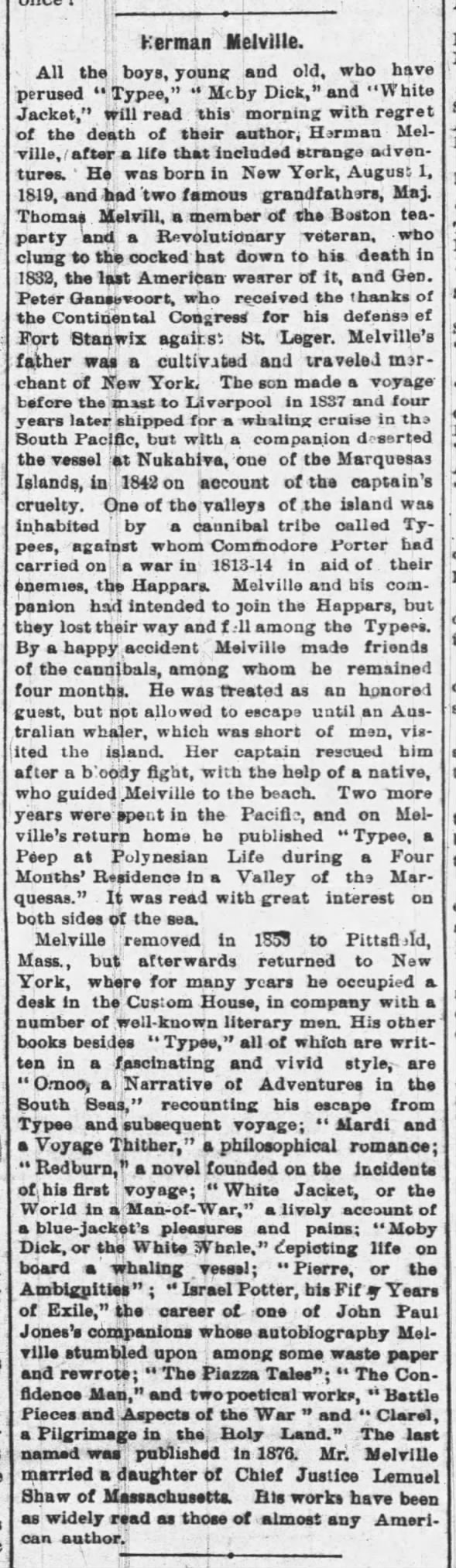
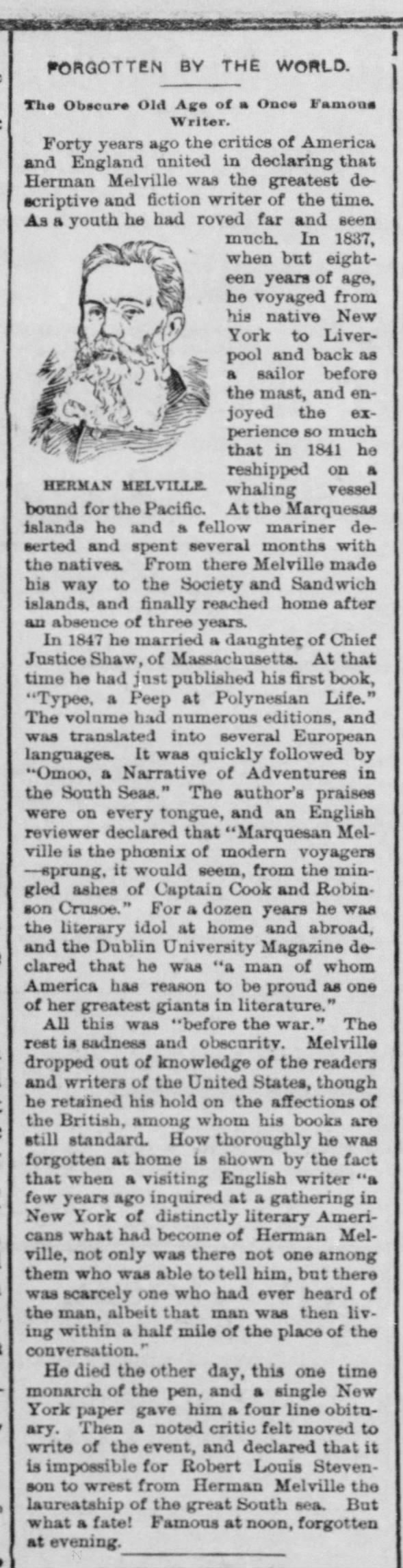
"The New-York Times" of yesterday, in an appreciative editorial concerning the late Herman Melville, remarks that only one newspaper (presumably "The Times") contained an obituary account of him, and this was but of three or four lines. Had "The Times" consulted the files of The Tribune, it would have found a much longer obituary of Mr. Melville on the morning after his death, and in Thursday's issue it might have noted a half column review of his life and work. A perusal of this latter article might, perhaps, have prevented the further dissemination of a misleading report that Mr. Melville had been forgotten by the contemporary literary guild. He was invited, among the very first, to join in the founding of the democratic little Authors' Club that flourishes in this city. This occurred in 1882, but Mr. Melville always has been an object of interest among literary people here, who have regretted his extreme self-isolation. --New York Tribune, October 3, 1891.
Here's the obituary of Herman Melville in the New York Tribune, the one printed "on the morning after his death":
New York Tribune - September 29, 1891
And here's the longer funeral notice by Arthur Stedman:

New York Tribune - October 1, 1891
via Library of Congress, Chronicling America
HERMAN MELVILLE'S FUNERAL.

The funeral of the late Herman Melville was held at the family residence in Twenty-eighth-st. yesterday afternoon, the Rev. Theodore C. Williams, of All Souls' Church, delivering a short address. Among the relatives and friends present, beside the widow and daughter of the deceased, were Mrs. Thomas Melville, widow of the late governor of the Sailors' Snug Harbor; the Misses Melville, daughters of the late Allan Melville; Samuel Shaw, of Boston; W. B. Morewood, George Brewster, Mrs. Griggs, Miss Lathers, Dr. Titus Munson Coan, Arthur Stedman and George Dillaway.

The death of Herman Melville, although following a lingering illness, has come as a surprise to even his few acquaintances in the city, for their opportunities of seeing him have been extremely limited in number. Much has been written, particularly in English journals, concerning the alleged neglect and disregard of Mr. Melville by contemporary authors in this country, but it is a well-known fact here that his seclusion has been a matter of personal choice.

This writer gained an international reputation at an earlier date than James Russell Lowell, although born in the same year, 1819. His practical abandonment of literary work some twenty-five years ago, however, has allowed general interest in his books to die out.

Mr. Melville came of patrician blood on both sides of his family, his fraternal and maternal grandfathers figuring prominently in the Revolution, being respectively of Scottish, New-England and Dutch dissent. As in Richard Henry Dana's case, Melville's first literary success was a narrative of his own experience while a common sailor before the mast and in new countries; but unlike Dana, he continued work in the same field, and with credit. In regard to "Typee," Dr. Coan was heard to remark at the service yesterday that his father, the Rev. Titus Coan, of the Hawaiian Islands, had personally visited the Marquesas group, found the Typee Valley, and verified in every detail the romantic descriptions of the gentle but man-devouring islanders. Dr. Coan further said: "Herman Melville was the first man who shared the life of a cannibal community in the South Seas—who had the consummate literary skill to describe it—and who got away alive to write his book. 'Typee' will be read when most of the Concord group are forgotten."  
However this may be, Mr. Melville always has been an interesting figure to New-York literary circles. So far from being forgotten, he was among the very first to be invited to join the Authors' Club at its founding in 1882. His declination of this offer, as well as his general refusal to enter into social life, are said to have been chiefly due to the very adverse critical reception accorded his novel, "Pierre, or the Ambiguities," published in 1852. He was always a great reader, and was much interested in collecting engravings of the old masters, having a large library and a fine assortment of prints, those of Claude's paintings being his favorites.

His tall, stalwart figure, until recently, could be seen almost daily tramping through the Fort George district or Central Park, his roving inclination leading him to obtain as much out-door life as possible. His evenings were spent at home with his books, his pictures and his family, and usually with them alone.

While at Pittsfield, Mass., from 1850 to 1862, he became the intimate friend of Hawthorne, who lived for a while near by at Lenox, and they often exchanged visits. It was at this place that most of Melville's writing was done. The place in the New York Custom House was given up about 1881.

At the beginning of failing health, some three years ago, Mr. Melville wrote and privately circulated a little story entitled "John Marr." It was dedicated to Clark Russell, who was a cordial admirer and correspondent. Last spring, after his final illness set in, he collected and had printed his miscellaneous shorter poems under the title "Timoleon, etc." This volume is dedicated to "My Countryman, Elihu Vedder." Both little books are limited to twenty-five copies. Mr. Melville's later style became somewhat rugged and mystical. His best-known poem was "Sheridan at Cedar Creek," thought by most literary experts to be superior to "Twenty Miles Away," though lacking a popular refrain.

The following poem is from "Timoleon":
L'ENVOI.

The Return of the Sire de Nesle,
A. D. 16——.

My towers at last! These rovings end.
Their thirst is slaked in larger dearth;
The yearning infinite recoils,
       For terrible is earth.

Kaf thrusts his snouted crags through fog;
Araxes swells beyond his span.
And knowledge poured by pilgrimage
       Overflows the banks of man.

But thou, my stay, thy lasting love,
One lonely good, let this but be!
Weary to view the wide world's swarm,
       But blest to fold but thee.
--New York Tribune, October 1, 1891; reprinted without the poem from Timoleon in Melville in His Own Time, edited by Steven Olsen-Smith (University of Iowa Press, 2015), pages 164-166.
Philip Hale may have contributed the obit of Melville published in the Boston Journal on September 29, 1891, part of which is lifted from the end of the 1856 article A Trio of American Sailor-Authors
in The Dublin University Magazine.

Boston Journal - September 29, 1891
via GenealogyBank


Herman Melville.

Mr. Herman Melville, the well known author of popular seafaring stories, died at his home in New York Sunday night. So little has been heard of him, personally, in late years that many people imagined he was dead, yet his literary honors were well won and deserved. In the past 15 years he wrote little for publication. Mr. Melville's early life was full of adventures. He was born of an ancient Scotch family in New York Aug. 1, 1819. In his 18th year he made a voyage from New York to Liverpool and back home before the mast, and liked his marine experience sufficiently to embark in a whaling vessel for the Pacific Jan. 1, 1841. About July of the next year the vessel arrived at Nukaheva, one of the Marquesas Islands, and Melville, with a fellow sailor, who like himself was tired of strait quarters and a tyrannical captain, embraced the opportunity of leaving the ship without waiting for the usual formality of a discharge. Falling into the hands of a warlike race who inhabited Typee Valley, Melville was detained a prisoner for four months, when he was unexpectedly rescued by the crew of a Sydney whaler. After passing several months in the Society and Sandwich Islands, he shipped on board the frigate United States and arrived at Boston in October, 1844, having been absent from home nearly three years. 
Most readers associate Herman Melville only with those adventures which his early life as a sailor made the means of his literature; but besides "Omoo," "Typee," "Mardi" and books of kindred character, he wrote such stories as "The Confidence Man," a volume of poems about the Civil War and two volumes on a pilgrimage to the Holy Land. The cannibals whom he met were made the subject of his first novel, "Typee," published in 1846. Besides those already mentioned he wrote a philosophical romance, "Redburn," "Plute Jacket; or, The World on a Man-of-War," "Moby Dick," "Pierre," Israel Potter" and "The Prazza Tales." 
It is interesting to recall the fact that the grandfather of Herman Melville, Major Thomas Melville, was a noted Bostonian and a member of the famous tea party. In 1847 Herman Melville married a daughter of Chief Justice Shaw of Boston and resided for some years at Berkshire, Mass. He was undoubtedly an original thinker, and boldly and unreservedly expressed his opinions, often in a way that irresistibly startles and enchains the interest of the reader. He possessed marked powers of expression. He could be terse, copious, eloquent, brilliant, imaginative, poetical, satirical, pathetic, at will. Though never stupid or dull, yet he was often mystical and unintelligible, though not from any inability to express himself. His death removes a noted figure in American literature.  --Boston Journal, September 29, 1891.
Melville was well-remembered in Buffalo and Troy, as shown by obituaries in Buffalo Courier (September 29, 1891) and the Troy Budget (reprinted with cuts in the San Francisco Chronicle on October 18, 1891). Warren Broderick found the original, longer obit in the Troy Northern Budget of October 4, 1891; transcribed in Deceased but Not Forgotten: Obituaries for Herman Melville in the Upstate Press (Leviathan 16. 2, June 2014), pages 58-68 at 66-7.

· Tue, Sep 29, 1891 – 4 · Buffalo Courier (Buffalo, New York) · Newspapers.com

San Francisco Chronicle - October 18, 1891
via GenealogyBank
Below, the memorial essay by Charles Goodrich Whiting in his column "The Literary Wayside," published in the Springfield (Massachusetts) Republican on October 4, 1891:

Springfield Republican - October 4, 1891
via GenealogyBank
· Wed, Oct 28, 1891 – Page 3 · The York Daily (York, Pennsylvania) · Newspapers.com
Related:

Saturday, January 27, 2018

Another jokey birth announcement

Here's one more like those identified in the earlier post on 1853 birth announcements.

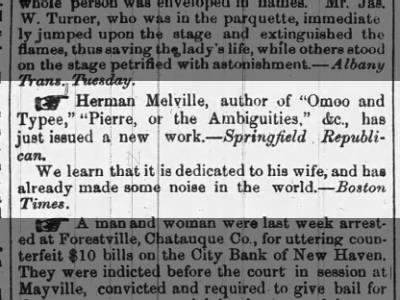
Same year, same baby girl (Bessie Melville, born May 22nd) but involving different newspapers in Boston and Buffalo. The original Springfield notice has been abbreviated for the sake of another joke, contributed by the Boston Times and reprinted in the Buffalo Morning Express on June 2, 1853:


Herman Melville, author of "Omoo and Typee," "Pierre, or the Ambiguities," &c., has just issued a new work.Springfield Republican.

     We learn that it is dedicated to his wife, and has already made some noise in the world.Boston Times
Related post:

Sunday, December 17, 2017

Birth announcements, 1853

More than one newspaper in western Massachusetts indulged in a joke about authorship as a kind of fatherhood when announcing the birth on May 22, 1853 of Herman Melville's daughter Elizabeth "Bessie" Melville. The first item below is one I had not seen before, from the Franklin Democrat (May 30, 1853) courtesy of Fulton History

Franklin Democrat [Greenfield, Massachusetts] May 30, 1853

BORN.

...
In Pittsfield, 22d, a daughter to Herman Melville, the well-known author of several literary, not physiological works.
Greenfield native Joseph Hussey Sprague edited and published the Franklin Democrat from 1852 to 1854.

As reported by Jay Leyda in Another Friendly Critic for Melville, this earlier notice of Melville's "new work" in the Springfield Republican for May 28, 1853 (page 2):

Springfield Republican - May 28, 1853
 refers to this birth announcement on the same page, different column:

Springfield Republican - May 28, 1853
Related posts:

Thursday, June 8, 2017

Re-printings of 1853 Pittsfield news that "Herman Melville has gone to New York to superintend the issue of a new work."

As Gary Scharnhorst reported in Melville Society Extracts 75 (November 1988), news of Melville's working trip to New York in June 1853 originally appeared in the Springfield Republican on June 11, 1853. Melville's "new work" sounds like a book, probably the one his mother had said (in a letter to her brother Peter Gansevoort on April 20, 1853) was nearly ready for the press. Later the same year, in November 1853, Herman alluded to his having been "prevented from printing" it in New York. The only work in progress we know about for sure is the Agatha project, which Hershel Parker logically relates to the working title "Isle of the Cross," mentioned twice in family letters from Herman Melville's cousin Priscilla to his sister Augusta.

I have a different view, admittedly conjectural and based on just nothing in the way of satisfying documentary evidence. Inspired by what strikes me as unusually strong internal evidence, I've long been holding out for a project of re-writing by Melville called "Fragments of Military Life," the working title of the book that Philip St. George Cooke eventually published as Scenes and Adventures in the Army. Both parts of Scenes and Adventures were previously published in the Southern Literary Messenger, and the 1851-3 series Scenes Beyond the Western Border which became Part II would be concluded in the August 1853 issue. Hypothetically, the job of "superintending" that project would have meant providing Harper & Brothers with printed copies of the magazine installments, much in the same way that, a few years later, Melville did publish the book version of Israel Potter. Either the Harpers' lawyers or then Lt. Colonel Cooke himself might have "prevented" Melville from publishing a ghost-written or ghost-edited narrative of western travel that did not properly credit the well-known, highly regarded cavalry officer whose journals supplied most of the raw material.

Well, that Christmas business chastened me all over again. It's always been hard to voyage chartless, with no external evidence anywhere in the historical record linking Melville and the wandering dragoon, Philip St George Cooke. The revived claim for Henry Livingston's authorship of "A Visit from St. Nicholas" perfectly exemplifies how wrong one can go without reliable facts.

For the record, here is the original notice that Scharnhorst found in the Springfield Republican, June 11, 1853. Images of this and the following items are available in the online archives of Historical Newspapers at Genealogy Bank.
:
Springfield Republican / June 11, 1853
"Herman Melville has gone to New York to superintend the issue of a new work."
Four days later the Pittsfield news was reprinted verbatim in the Boston Weekly Messenger (June 15, 1853):

Boston Weekly Messenger / June 15, 1853
The Franklin Democrat [Greenfield, Massachusetts], June 20, 1853 reprinted the same Melville item under the head of "LOCAL INTELLIGENCE. / BERKSHIRE COUNTY.":
"Herman Melville has gone to New York to superintend the issue of a new work."
In early July the news from Pittsfield about Melville's trip to New York showed up in the Boston Flag of our Union (July 2, 1853) under the heading, "Editorial Inkdrops":


Boston Flag of our Union / July 2, 1853

First installment of Scenes Beyond the Western Border
Southern Literary Messenger - June 1851

Related post:

Friday, August 26, 2016

Also by Charles G. Whiting: "Concerning Herman Melville" in the Springfield Republican - October 18, 1891

A long follow-up to Whiting's exceptional memorial to Herman Melville of October 4, 1891 appeared two weeks later in the Springfield Republican on October 18, 1891 under the title "CONCERNING HERMAN MELVILLE." This later piece took notice of the article on Melville's funeral in the New York Tribune (reprinted in The Critic Number 406) and of Arthur Stedman's October 11, 1891 article in the Sunday New York World (reprinted as "Melville of Marquesas" in the Review of Reviews, Volume 4). Along the way, the Republican writer echoes Stedman when commenting on "shallow" English admirers, namely Robert Buchanan:
"It is a pet notion of a few of these English men of letters of the lesser sort that they were born to discover the great writers of America, and Buchanan couples Melville with Walt Whitman as abiding in shadow to their own countrymen."
The Republican writer calls attention to Arthur Stedman's youth in relation to Melville "whom he knew well, as a young man knows a veteran."
 
Internal evidence that the writer is Charles Goodrich Whiting (1842-1922) appears in the paragraph where the writer makes a point of correcting misinformation in the October 4, 1891 memorial about the location of Melville's Pittsfield home:
Melville wrote his “Moby Dick” at Arrow Head, as we have stated, but it appears that we were in error in identifying that residence with the Van Schaack house in Pittsfield. Melville’s uncle lived in that house when Herman taught school in Pittsfield, but he “boarded round,” as we learn. The author’s house was about three-fourths of a mile from the Van Schaack mansion, on a road parallel with the South road. There was a cross-road running from one house to the other, and Herman Melville owned land on both sides this road clear up to the Van Schaack house. It was at Arrow Head that he used to receive visits from Hawthorne and other guests of note…. --"Concerning Herman Melville," Springfield Republican, Sunday, October 18, 1891
As confirmed in numerous places, for example the notice in the New York Times April 4, 1903, Whiting had been literary editor for the Springfield Republican since 1874. The whole piece "Concerning Herman Melville" immediately follows Whiting's Sunday column and graphically appears as a second item, after "THE LITERARY WAYSIDE," under the major head of "BOOKS, AUTHORS AND ART." 

Related posts:

Thursday, August 25, 2016

Charles Goodrich Whiting, author of the memorial tribute to Melville in the Springfield Republican, October 4, 1891

"No other newspaper carried so full and accurate an account of Melville’s career; the man who wrote 'The Literary Wayside' column for that Sunday was someone who had read and loved Melville’s work and had known him personally, at least in his last years. And he was not waiting for the next century to admire Moby Dick." --Jay Leyda
Past Melvilliana posts have positively identified formerly unknown authors of early Melville criticism and notices, for example:
Here's another one in the inexpressibly satisfying line of giving real names to once anonymous, pseudonymous, or otherwise unknown authors. 

The Century Magazine, January 1893 - publisher's ad for 1892 edition of Moby-Dick 
quoting "Charles G. Whiting, in Springfield Republican."

Charles Goodrich Whiting (1842-1922) was literary editor of the Springfield Republican from 1874 to 1910. Newspaper colleagues remembered Whiting for his deep love of nature, independent spirit, and "poetic temperament." According to the memorial published in the Springfield [Massachusetts] Republican on June 21, 1922, Whiting had belonged to the Authors' Club of New York City and enjoyed "literary friendships" with J. G. Holland, Edmund Clarence Stedman, and Richard Henry Stoddard among others.

Academic specialists in the critical receptions of Emily Dickinson and Henry James are ahead of Melville scholars here. Whiting is already known and honored in Emily Dickinson scholarship for early and perceptive criticism of Dickinson's first (posthumously published) volume of poems in his regular Sunday column, "The Literary Wayside." And Robin P. Hoople has extensively discussed Whiting's discerning reviews of Henry James in the Springfield Republican. Whiting's March 25, 1882 article for the Republican on "The Poet Longfellow's Death" received high praise from Joel Chandler Harris in the Atlanta Constitution as an exemplary "biographical sketch and critical estimate" and "one of the most remarkable essays of the kind ever written."


Very soon after Herman Melville's death on September 28, 1891, Whiting devoted the whole of his "Wayside" column to a long, thoughtful, and sincerely appreciative memorial of Herman Melville, published in the Springfield Republican on October 4, 1891. Jay Leyda stressed the uniqueness of this "extraordinary obituary article" in the historically friendly pages of the Springfield Republican, but Leyda did not know who wrote it:
"It may not have been the belittler of Moby Dick’s “preposterous heroes” [Leyda here refers to the anonymous reviewer of Melville's Clarel who called Ahab and the Whale "preposterous heroes"; Thomas Blanding assigns the July 18, 1876 review of Clarel to Frank Sanborn in the Spring 1977 Concord Saunterer.] who wrote the extraordinary obituary article on Melville that appeared in the first Sunday Republican after the death. No other newspaper carried so full and accurate an account of Melville’s career; the man who wrote “The Literary Wayside” column for that Sunday was someone who had read and loved Melville’s work and had known him personally, at least in his last years. And he was not waiting for the next century to admire Moby Dick." --Another Friendly Critic for Melville - New England Quarterly 27 (June 1954): 248.
In the second volume of Herman Melville: A Biography, Hershel Parker quotes extensively from the unsigned 1891 article without identifying the admiring author. More (not all!) of the 1891 Springfield Republican article has long been available at the pioneering and still sturdy Melville site The Life and Works of Herman Melville. Nevertheless, the identification of the author as Charles Goodrich Whiting is another Melvilliana exclusive...

Melville obituary-essay by Charles Goodrich Whiting (1842-1922)
Springfield [Massachusetts] Republican - October 4, 1891 - from the online Newspaper Archives at Genealogy Bank
Transcribed below:
Herman Melville, one of the most original and virile of American literary men, died at his home on Twenty-sixth street, New York, a few days ago, at the age of 72. He had long been forgotten, and was no doubt unknown to the most of those who are reading the magazine literature and the novels of the day. Nevertheless, it is probable that no work of imagination more powerful and often poetic has been written by an American than Melville's romance of "Moby Dick; or the Whale," published just 40 years ago; and it was Melville who was the first of all writers to describe with imaginative grace based upon personal knowledge, those attractive, gentle, cruel and war-like peoples, the inhabitants of the South Sea islands. His "Typee," "Omoo" and "Mardi" made a sensation in the late forties, when they were published, such as we can hardly understand now; and from that time until Pierre Loti began to write there has been nothing to rival these brilliant books of adventure, sufficiently tinged with romance to enchain the attention of the passing reader as well as the critic. Melville wrote many books, but ceased to write so long ago as 1857, having since that date published only two volumes of verse which had no obvious relation to his previous work, and gave no addition to his literary reputation.

Herman Melville had old New England and Knickerbocker ancestry. His grandfather on his father’s side was Maj. Thomas Melville, one of the famous Boston tea-party, a soldier of the Revolution, and it is recorded that he was, so far as may be known, the last of all Americans who stuck to the cocked hat until his death. On the mother’s side his grandfather was that Peter Gansevoort who so well stopped by his defense of Fort Schuyler in 1777 the reinforcement of Burgoyne by the troops under St. Leger. Herman’s father, Allan Melville, was a merchant; but the boy had an adventurous disposition, and shipped when 18 as a sailor before the mast for Liverpool, and four years later became a sailor on the Dolly for a whaling cruise in the south Pacific. The captain was cruel, and he and another sailor left the ship at a harbor of one of the Marquesas islands. They made for the interior, and reached the valley of the Typee tribe, with whom by a singular fortune they became friendly. He was, however, held as a prisoner, and when he was finally rescued by a whaler, it was the occasion of a bloody fight. Melville spent two more years in the South seas, and on his return he electrified his countrymen with the book called “Typee: a Peep at Polynesian Life during a Four Months’ Residence in a Valley of the Marquesas.” The book rapidly passed through several editions; it was dedicated to Chief Justice Shaw of Massachusetts, whose daughter the author afterward married.
Mr. and Mrs. Melville made their home in Pittsfield on the edge of Lenox. The house was the old Van Schaack mansion on South street, a mile below the park, which Melville purchased in 1852, and named Arrow-Head, from the Indian relics found upon the grounds. Here, says the excellent historian of Pittsfield, J. E. A. Smith, he wrote “Moby Dick,” here also he wrote that strange vagary “Pierre, or the Ambiguities,” and also the “Piazza Tales,” romances to which he gave this name because they were mainly written on a broad piazza by the author on the north end of the house, which commands a bold and striking view of Greylock and the interviewing hights and vales. Mr. Smith adds: “’My Chimny and I,’ a quaintly humorous essay of which the cumbersome old chimney—overbearing tyrant of the house—is the hero, was also written here, as well as ‘October Mountain,’ a sketch of mingled philosophy and word-painted landscape, which found its inspiration in the massy and brilliant autumnal tints presented by a prominent and thickly wooded spur of the Hoosac mountains, as seen from Arrow-Head on a fine day after the early frosts.” Melville loved the Berkshire scenery with an ardent love and he dedicated his “Pierre” to “Greylock’s most excellent majesty,” saying:—
In old times authors were proud of the privilege of dedicating their works to Majesty. A right noble custom, which we of Berkshire must revive. For whether we will or no, Majesty is all around us here in Berkshire, sitting as in a grand Congress of Vienna of majestical hill-tops, and eternally challenging our homage. But since the majestic mountain, Greylock, my own more immediate sovereign lord and king, hath now, for innumerable ages, been the one grand dedicatee of the earliest rays of all the Berkshire mornings, I know not how his imperial purple majesty (royal-born: porphyrogenitus) will receive the dedication of my own poor solitary ray. Nevertheless, forasmuch as I, dwelling with my loyal neighbors, the maples and the beeches, in the amphitheater over which his central majesty presides, have received his most bounteous and unstinted fertilizations, it is but meet that I here devoutly kneel, and render up my gratitude, whether thereto, The most excellent purple majesty Greylock benignantly incline his hoary crown, or no.
This dedication shows Melville’s later tendency to extravagance of rhetoric, which confused and diminished the effect of his real genius, and yet which perfectly fitted the astonishing book thus dedicated,—in which, surely, Greylock’s steadfast dignity and noble proportions found no literary counterpart.
Herman Melville later was appointed to a clerkship in the New York custom-house, and since then his home has been in New York city, where in the society of a few friends he has been content to see the world go by. He published a volume of war poems in 1866, and 10 years later his versified record of travel, "Clarel, a Pilgrimage in the Holy Land." Mr. Melville has not gained a place as poet, yet no one can read his book of “Batttle Pieces” without much admiration for the vigor of the verse, and the frequent flashes of prophetic fire which they show. It is startling to read these lines, called “The Portent”:—
Hanging from the beam,
   Slowly swaying (such the law),
Gaunt the shadow on your green,
   Shenandoah!
The cut is on the crown
(Lo, John Brown),
And the stabs shall heal no more.

Hidden in the cap
   Is the anguish none can draw;
So your future veils its face,
   Shenandoah!
But the streaming beard is shown
(Weird John Brown),
The meteor of the war.
The book is exceptional in that its verse was not suggested and put forth at the time of the events it wraps up in rhythmic guise, but after the fall of Richmond Melville wrote nearly all of the poems; they show, nevertheless, such differences of proportion as might have occurred from the spontaneity of immediate impulse. The verses on Worden, “In the Turret,” on Cushing, “St the Canon’s Mouth,” are not ordinary writing, nor is the poem “Chattanooga” on the battle fought in November, 1863, of which these are a few stanzas—there are not many in all:—
A kindling impulse seized the host
   Inspired by heaven’s elastic air;
Their hearts outran their General’s plan,
   Though Grant commanded there—
   Grant, who without reserve can dare;
And, “Well, go on and do your will,”
   He said, and measured the mountain then:
So master-riders fling the rein—
   But you must know your men. 
The summit-cannon plunge their flame
   Sheer down the primal wall,
But up and up each linking troop
   In stretching festoons crawl,
   Nor fire a shot. Such men appal
The foe, though brave. He, from the brink,
   Looks far along the breadth of slope,
And sees two miles of dark dots creep,
   And knows they mean the cope.
He sees them creep. Yet here and there
   Half hid 'mid leafless groves they go,
As men who ply through traceries high
   Of turreted marbles show—
   So dwindle these to eyes below.
But fronting shot and flanking shell
   Sliver and rive the inwoven ways,—
High tops of oaks and high hearts fall,—
   But never the climbing stays.
Here is a piece that makes one think of Gen. W. F. Bartlett,—Frank Bartlett, the knightly soldier whom Pittsfield counts her hero with pride, and who may well have been in Melville’s mind as he wrote of “The College Colonel”:—
He rides at their head;
   A crutch by his saddle just slants in view,
One slung arm is in splints, you see,
   Yet he guides his strong steed—how coldly, too.

He brings his regiment home—
   Not as they filed two years before
But a remnant half-tattered, and battered and worn,
   Like castaway sailors, who—[s]tunned
By the surf’s loud roar,
   Their mates dragged back and seen no more,—
Again and again breast the surge,
   And at last crawl, spent, to shore.

A still rigidity and pale, —
   An Indian aloofness, lines his brow;
He has lived a thousand years
   Compressed in battle’s pains and prayers,
Marches and watches slow.
There are welcoming shouts and flags;
   Old men off hat to the boy,
Wreaths from gay balconies fall at his feet,
   But to him—there comes alloy.

It is not that a leg is lost,
   It is not that an arm is maimed,
It is not that the fever has racked,—
   Self he has long disclaimed.

But all through the Seven Days’ fight,
   And deep in the Wilderness grim,
And in the field hospital tent,
   And Petersburg crater, and dim
Lean brooding in Libby, there came—
   Ah heaven!—what truth to him!
Yet the better evidence of the divine afflatus that was in him appeared in his South Sea romances and in "Moby Dick"; his "Clarel" cannot be read except as a task, and contains probably nothing worth quoting, although some very patient reader might discover here and there lines of some consequence. Melville was very interesting in his personality, — a man above the ordinary stature, with a great growth of hair and beard, and a keen blue eye; and full of vigor and quickness of thought in his age,—which he felt and yielded to earlier than would have been expected of one of so stalwart a frame.
Although as aforesaid Melville's early novels are not now read, they are as well worth reading as the more sensuous stories of Pierre Loti, or the vivacious ventures of Robert Louis Stevenson, whose scenes are laid in the same region of "lotus eating," to describe in a fit phrase the common life of the Pacific islands. "Typee," particularly, would be found to retain its charm for even the sophisticated readers of to-day. But the crown of Melville's sea experience was the marvelous romance of "Moby Dick," the White whale, whose mysterious and magical existence is still a superstition of whalers,— at least such whalers as have not lost touch with the old days of Nantucket and New Bedford glory and grief. This book was dedicated to Nathaniel Hawthorne, and Hawthorne must have enjoyed it, and have regarded himself as honored in the inscription. This story is unique; and in the divisions late critics have made of novels, as it is not a love-story (the only love being that of the serious mate Starbuck for his wife in Nantucket, whom he will never see again), it is the other thing, a hate-story. And nothing stranger was ever motive for a tale than Capt Ahab's insane passion for revenge on the mysterious and invincible White whale, Moby Dick, who robbed him of a leg, and to a perpetual and fatal chase of him the captain binds his crew. The scene of this vow is marvelously done, and so are many other scenes, some of them truthful depictions of whaling as Melville knew it; some of the wildest fabrications of imagination. An immense amount of knowledge of the whale is given in this amazing book, which swells, too, with a humor often as grotesque as Jean Paul's, but not so genial as it is sardonic. Character is drawn with great power too, from Queequeg the ex-cannibal, and Tashtego the Gay Header, to the crazy and awful Ahab, the grave Yankee Starbuck, and the terrible White whale, with his charmed life, that one feels can never end. Certainly it is hard to find a more wonderful book than this Moby Dick, and it ought to be read by this generation, amid whose feeble mental food, furnished by the small realists and fantasts of the day, it would appear as Hercules among the pygmies, or as Moby Dick himself among a school of minnows.
--Charles Goodrich Whiting's memorial article on Herman Melville in the Springfield Republican, October 4, 1891
Ten years later Charles Goodrich Whiting was still promoting Melville and Moby-Dick. The Springfield Republican summarized Whiting's remarks to the local Teachers' Club (including a fine appreciation, too, of Elizabeth Stoddard) in an article headed "A TALK ON AMERICAN NOVELS," published in the Springfield Republican on Wednesday April 24, 1901:
The fifth talk on novels before the teachers’ club by Charles G. Whiting was given last evening at the rooms of the club in the Young Men’s Christian association building. The subject was “The chief American novels.” A brief survey was made of the early novel writing, imitative to a degree of English originals....

The novels of Mrs. Elizabeth Stoddard were made note of, and it was said that “Two Men” and “Temple House” were among the “chief American novels,” and should have a high place in the esteem of students of our literature and of human life. Mrs. Stoddard was characterized as a great elemental genius. Also Herman Melville was brought to the attention of the audience as a magnificent imaginative writer; it was said that only the impossibility of recognizing a white whale as a hero, alongside of Macbeth or Achilles or Lancelot or—let us say,—Vivian Grey—prevented this book from taking its place as one of the great novels. In fact, “Moby Dick” is really an epic, and stands for the tragedy of the whale....  --Springfield Republican, April 24, 1901; found in the online Newspaper Archives at Genealogy Bank.
Find A Grave has more about Charles Goodrich Whiting from the 1922 obituary in the Springfield Republican.

For a selection of his nature poetry, check out the entry for Charles Goodrich Whiting in the 1907 volume The Poets and Poetry of Springfield. It takes a poet to see through the monster to the hero.

The Saunterer by Charles Goodrich Whiting is digitized at Google Books.

Walks in New England by Charles Goodrich Whiting, also at Google Books.

 Related posts:
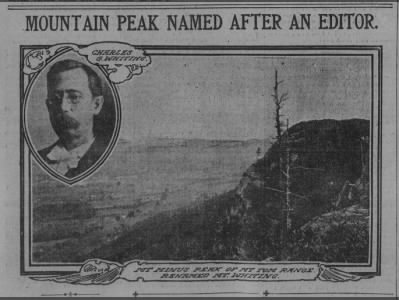
Inset with Whiting's portrait:

Boston Daily Globe - November 5, 1905