Showing posts with label Philip Hale. Show all posts

Wednesday, June 2, 2021

The Smith College Library Rap


Melville biographer Newton Arvin was Professor of English at Smith College in Northampton, Mass. The Library honored in Jodi Shaw's great Library Rap has a large collection (18.5 linear feet; 43 boxes) of Newton Arvin papers. In 1938, as mentioned a few years back in the Melvilliana post
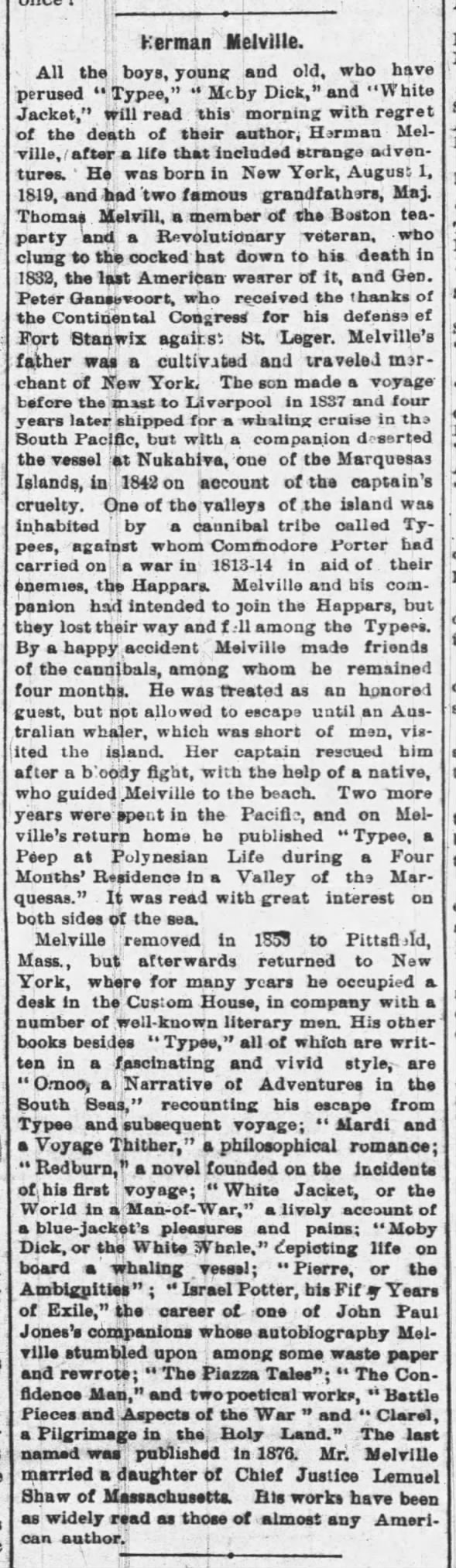
Smith College got Philip Hale's library of 2000 books from Mrs. Hale his widow, including first editions of Whitman's Leaves of Grass and Melville's Moby-Dick

Springfield MA Republican - May 5, 1938
via Genealogy Bank

Does one of the Smith College Libraries still have Philip Hale's copy of Moby-Dick? What did Jodi Shaw say in that Smith College Library Rap?
"You go online and you take your pick

 From the Five College Catalog just one click."

With one or two maybe three clicks I found two first editions of Melville's Moby-Dick. Remember, five colleges. One of the two 1851 volumes is at AC = Amherst College. The other is at SC/RBR which I guess means Smith College/Rare Book Room? "Special Collections, there are three parts...
And the rare books, you know the written word

The name is Mortimer I don't know if you heard

The collection is deep the collection is wide

 From medieval manuscripts to literary archives."

 Yes! Acquired by "Gift: Mrs. Philip Hale, 1938" and described as follows:

SC/RBR: Original blue cloth (front free endpaper wanting; inner front hinge cracked); signature of Philip Hale cut and mounted on front flyleaf.

Wednesday, April 25, 2018

Forgotten or well known?

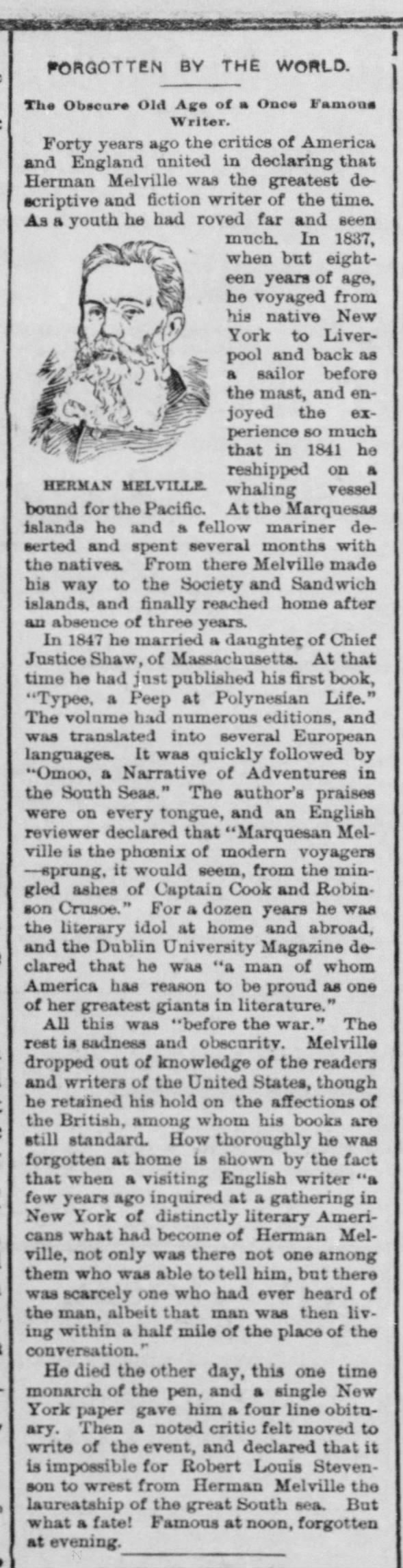
Famously forgotten, perhaps, except by the best informed literati and most discerning readers.
"Mr. Herman Melville, the well known author of popular seafaring stories, died at his home in New York Sunday night."  --Boston Journal, September 29, 1891
New York Tribune - October 3, 1891
via GenealogyBank


"The New-York Times" of yesterday, in an appreciative editorial concerning the late Herman Melville, remarks that only one newspaper (presumably "The Times") contained an obituary account of him, and this was but of three or four lines. Had "The Times" consulted the files of The Tribune, it would have found a much longer obituary of Mr. Melville on the morning after his death, and in Thursday's issue it might have noted a half column review of his life and work. A perusal of this latter article might, perhaps, have prevented the further dissemination of a misleading report that Mr. Melville had been forgotten by the contemporary literary guild. He was invited, among the very first, to join in the founding of the democratic little Authors' Club that flourishes in this city. This occurred in 1882, but Mr. Melville always has been an object of interest among literary people here, who have regretted his extreme self-isolation. --New York Tribune, October 3, 1891.
Here's the obituary of Herman Melville in the New York Tribune, the one printed "on the morning after his death":
New York Tribune - September 29, 1891
And here's the longer funeral notice by Arthur Stedman:

New York Tribune - October 1, 1891
via Library of Congress, Chronicling America
HERMAN MELVILLE'S FUNERAL.

The funeral of the late Herman Melville was held at the family residence in Twenty-eighth-st. yesterday afternoon, the Rev. Theodore C. Williams, of All Souls' Church, delivering a short address. Among the relatives and friends present, beside the widow and daughter of the deceased, were Mrs. Thomas Melville, widow of the late governor of the Sailors' Snug Harbor; the Misses Melville, daughters of the late Allan Melville; Samuel Shaw, of Boston; W. B. Morewood, George Brewster, Mrs. Griggs, Miss Lathers, Dr. Titus Munson Coan, Arthur Stedman and George Dillaway.

The death of Herman Melville, although following a lingering illness, has come as a surprise to even his few acquaintances in the city, for their opportunities of seeing him have been extremely limited in number. Much has been written, particularly in English journals, concerning the alleged neglect and disregard of Mr. Melville by contemporary authors in this country, but it is a well-known fact here that his seclusion has been a matter of personal choice.

This writer gained an international reputation at an earlier date than James Russell Lowell, although born in the same year, 1819. His practical abandonment of literary work some twenty-five years ago, however, has allowed general interest in his books to die out.

Mr. Melville came of patrician blood on both sides of his family, his fraternal and maternal grandfathers figuring prominently in the Revolution, being respectively of Scottish, New-England and Dutch dissent. As in Richard Henry Dana's case, Melville's first literary success was a narrative of his own experience while a common sailor before the mast and in new countries; but unlike Dana, he continued work in the same field, and with credit. In regard to "Typee," Dr. Coan was heard to remark at the service yesterday that his father, the Rev. Titus Coan, of the Hawaiian Islands, had personally visited the Marquesas group, found the Typee Valley, and verified in every detail the romantic descriptions of the gentle but man-devouring islanders. Dr. Coan further said: "Herman Melville was the first man who shared the life of a cannibal community in the South Seas—who had the consummate literary skill to describe it—and who got away alive to write his book. 'Typee' will be read when most of the Concord group are forgotten."  
However this may be, Mr. Melville always has been an interesting figure to New-York literary circles. So far from being forgotten, he was among the very first to be invited to join the Authors' Club at its founding in 1882. His declination of this offer, as well as his general refusal to enter into social life, are said to have been chiefly due to the very adverse critical reception accorded his novel, "Pierre, or the Ambiguities," published in 1852. He was always a great reader, and was much interested in collecting engravings of the old masters, having a large library and a fine assortment of prints, those of Claude's paintings being his favorites.

His tall, stalwart figure, until recently, could be seen almost daily tramping through the Fort George district or Central Park, his roving inclination leading him to obtain as much out-door life as possible. His evenings were spent at home with his books, his pictures and his family, and usually with them alone.

While at Pittsfield, Mass., from 1850 to 1862, he became the intimate friend of Hawthorne, who lived for a while near by at Lenox, and they often exchanged visits. It was at this place that most of Melville's writing was done. The place in the New York Custom House was given up about 1881.

At the beginning of failing health, some three years ago, Mr. Melville wrote and privately circulated a little story entitled "John Marr." It was dedicated to Clark Russell, who was a cordial admirer and correspondent. Last spring, after his final illness set in, he collected and had printed his miscellaneous shorter poems under the title "Timoleon, etc." This volume is dedicated to "My Countryman, Elihu Vedder." Both little books are limited to twenty-five copies. Mr. Melville's later style became somewhat rugged and mystical. His best-known poem was "Sheridan at Cedar Creek," thought by most literary experts to be superior to "Twenty Miles Away," though lacking a popular refrain.

The following poem is from "Timoleon":
L'ENVOI.

The Return of the Sire de Nesle,
A. D. 16——.

My towers at last! These rovings end.
Their thirst is slaked in larger dearth;
The yearning infinite recoils,
       For terrible is earth.

Kaf thrusts his snouted crags through fog;
Araxes swells beyond his span.
And knowledge poured by pilgrimage
       Overflows the banks of man.

But thou, my stay, thy lasting love,
One lonely good, let this but be!
Weary to view the wide world's swarm,
       But blest to fold but thee.
--New York Tribune, October 1, 1891; reprinted without the poem from Timoleon in Melville in His Own Time, edited by Steven Olsen-Smith (University of Iowa Press, 2015), pages 164-166.
Philip Hale may have contributed the obit of Melville published in the Boston Journal on September 29, 1891, part of which is lifted from the end of the 1856 article A Trio of American Sailor-Authors
in The Dublin University Magazine.

Boston Journal - September 29, 1891
via GenealogyBank


Herman Melville.

Mr. Herman Melville, the well known author of popular seafaring stories, died at his home in New York Sunday night. So little has been heard of him, personally, in late years that many people imagined he was dead, yet his literary honors were well won and deserved. In the past 15 years he wrote little for publication. Mr. Melville's early life was full of adventures. He was born of an ancient Scotch family in New York Aug. 1, 1819. In his 18th year he made a voyage from New York to Liverpool and back home before the mast, and liked his marine experience sufficiently to embark in a whaling vessel for the Pacific Jan. 1, 1841. About July of the next year the vessel arrived at Nukaheva, one of the Marquesas Islands, and Melville, with a fellow sailor, who like himself was tired of strait quarters and a tyrannical captain, embraced the opportunity of leaving the ship without waiting for the usual formality of a discharge. Falling into the hands of a warlike race who inhabited Typee Valley, Melville was detained a prisoner for four months, when he was unexpectedly rescued by the crew of a Sydney whaler. After passing several months in the Society and Sandwich Islands, he shipped on board the frigate United States and arrived at Boston in October, 1844, having been absent from home nearly three years. 
Most readers associate Herman Melville only with those adventures which his early life as a sailor made the means of his literature; but besides "Omoo," "Typee," "Mardi" and books of kindred character, he wrote such stories as "The Confidence Man," a volume of poems about the Civil War and two volumes on a pilgrimage to the Holy Land. The cannibals whom he met were made the subject of his first novel, "Typee," published in 1846. Besides those already mentioned he wrote a philosophical romance, "Redburn," "Plute Jacket; or, The World on a Man-of-War," "Moby Dick," "Pierre," Israel Potter" and "The Prazza Tales." 
It is interesting to recall the fact that the grandfather of Herman Melville, Major Thomas Melville, was a noted Bostonian and a member of the famous tea party. In 1847 Herman Melville married a daughter of Chief Justice Shaw of Boston and resided for some years at Berkshire, Mass. He was undoubtedly an original thinker, and boldly and unreservedly expressed his opinions, often in a way that irresistibly startles and enchains the interest of the reader. He possessed marked powers of expression. He could be terse, copious, eloquent, brilliant, imaginative, poetical, satirical, pathetic, at will. Though never stupid or dull, yet he was often mystical and unintelligible, though not from any inability to express himself. His death removes a noted figure in American literature.  --Boston Journal, September 29, 1891.
Melville was well-remembered in Buffalo and Troy, as shown by obituaries in Buffalo Courier (September 29, 1891) and the Troy Budget (reprinted with cuts in the San Francisco Chronicle on October 18, 1891). Warren Broderick found the original, longer obit in the Troy Northern Budget of October 4, 1891; transcribed in Deceased but Not Forgotten: Obituaries for Herman Melville in the Upstate Press (Leviathan 16. 2, June 2014), pages 58-68 at 66-7.

· Tue, Sep 29, 1891 – 4 · Buffalo Courier (Buffalo, New York) · Newspapers.com

San Francisco Chronicle - October 18, 1891
via GenealogyBank
Below, the memorial essay by Charles Goodrich Whiting in his column "The Literary Wayside," published in the Springfield (Massachusetts) Republican on October 4, 1891:

Springfield Republican - October 4, 1891
via GenealogyBank
· Wed, Oct 28, 1891 – Page 3 · The York Daily (York, Pennsylvania) · Newspapers.com
Related:

Tuesday, September 6, 2016

Discarded by the Public Library in Watertown: Piazza Tales, with marginal comment on Melville as "a great humbug"

In this letter to Philip Hale as editor of the "As the World Wags" column, Boston reader "G. E." reports on his purchase of an ex-library copy of The Piazza Tales. From the Boston Herald, Friday, September 23, 1921; found in the online Newspaper Archives at Genealogy Bank. Note the spelling: Melvillians!


Boston Herald - September 23, 1921


BENIGHTED WATERTOWN.

As the World Wags:

It would be unkind, if not unjust, to deposit the whole blame at your doorstep: however, you’ll find enough there to stumble over, if you ever cross your threshold to face an angry mob of Melvillians! Your well-intentioned propaganda costs us dearly. Prices have gone up sky high.

One bookseller in Boston can’t get the “Piazza Tales” for love or money. Another had a copy offered to him (first and apparently only edition) at $4.50. I politely declined. At last by the merest chance I obtained through him a copy marked “discarded”—mind you—by the Watertown public library; price $2. I’m not kicking. On the contrary, now that I have read the book, I’ll confess that it is worth those two iron men; and more.

But I am moved to reflect on the fact that Watertown had no use for these stories, and upon this extraordinary thing: At the end of that wonderfully uncomfortably tale about the poor, demented Scrivener, once employed in the Dead Letter Office, one Watertown reader (perhaps the one that recommended the book for the dump-heap) has indulged in the following pencilled opinion: “This Herman Melville is a great humbug.” As one of the converted, I would urge you therefore, move on to Watertown, and smite the Waterstownsman with your ire.

G. E.
Boston

Are booksellers able to procure for you Melville’s “Israel Potter,” The Confidence Man,” “Pierre, or the Ambiguities?” If so, at what price. A contributor to the Nation and Athenaeum of London states that the British Museum is without a copy of the “Piazza Tales.” These stories worked their strange spell on us when years ago we read them in Putnam’s Magazine, that monument to the fine taste of George William Curtis, the editor. Reading the tales again and again, we are at a loss to say which is the best. “The Bell Tower” has been reprinted in collections of short stories, yet we prefer “Bartleby” and “Benito Cereno,” the account of Capt. Amasa Delano’s surprising adventures. Whenever a thunderstorm comes along, we think of “The Lightning Rod Man” and loathe the critic who, years ago, characterized it as “grotesque verbiage.” He probably came from Watertown. Ed. [Philip Hale]
In his reply, Hale references the June 11, 1921 issue of The Nation and The Athenaeum, where (after printing letters from Michael Sadleir and James Billson) the editor notes:
We believe that the British Museum has no copy of "The Piazza Tales." Verb. sap.
In 1881 The Watertown Free Public Library still boasted a first edition of The Piazza Tales.


As shown in the previous melvilliana post Forty Years of Philip Hale and Melville, Hale had been promoting Melville in the pages of the Boston Herald since 1904, not long after he moved there from the Boston Journal--where he had talked nonstop about Melville in "Talk of the Day." Doubtless Hale and his Boston reader are too hard on Watertown, Mass. According to the Librarian's Report for 1907, more than 700 volumes, many "among the most used and most popular books" in the library, had to be discarded as "worn out by constant and increasing usage." Moby-Dick and Typee are listed as 1907 additions to the 1881 catalog.

Wednesday, August 31, 2016

Alice C. Hyde on reading Moby-Dick aloud in 1921

"So every night four of us sat around a roaring, open fire in the raw, spring evenings and listened to “Moby Dick.” I did the reading aloud, and I know the sweep of the sentences, and the lift and thrill of their cadences. Never was such a book written before, so drenched with the sea." --Alice C. Hyde, North Cohasset; from her published letter to "As the World Wags" editor Philip Hale in the Boston Herald, July 5, 1921.
Boston Herald, July 5, 1921

The complete letter from Alice Charles Hyde (1872-1936), a graduate of Smith College, is transcribed below. Having looked into the renewed enthusiasm for Moby-Dick in England, Philip Hale introduces correspondence from Melville's American fans, thus:
Now for letters from Melvillians.

A SANE ENTHUSIAST

As the World Wags:

One cannot throw a match into dry tinder without starting a fire, perhaps a conflagration, so after reading the article in your column about “Moby Dick,” I must add to the conflagration and chorus with the others that it is the most remarkable, blood-stirring, romantic, and virile book of adventure that the English language contains. During last month’s cold weather, we—a household of three middle-aged people with a fourth over 70—found ourselves in a country house with everything to make life tolerable except human companionship. No neighbor had “moved” with us. So every night four of us sat around a roaring, open fire in the raw, spring evenings and listened to “Moby Dick.” I did the reading aloud, and I know the sweep of the sentences, and the lift and thrill of their cadences. Never was such a book written before, so drenched with the sea.

Now I know the difference between genius and talent and no academic admirer of style and finished English will ever confuse my mind on that subject again. Stevenson, the great stylist, wrote a toy book, about a toy ocean, with toy men playing around on toy ships, and called it “Treasure Island.” That’s talent. Then Melville wrote a book almost as great as the ocean itself with real men, sailing real oceans, and hunting real Leviathans, and facing awful perils; with the whole shot through with the smell and pull and mystery of the sea, and with more genius on one page of it than on all the pages of all the works of other sea writers put together. (Like your other correspondent, I insist that I am sane-minded.)

Last week I was in Martha’s Vineyard in the house of an old island family where we had the privilege of staying. On the mantel of the main room was a piece of bone about six inches long with a picture on it, rubbed in, in India ink, of a whale boat and three ships’ crews sailing up to those terrible jaws. Not a spark of interest could I get from any other member of the party about it; they saw nothing there to interest one. To me it was the biggest thing on Martha’s Vineyard, for I had read “Moby Dick.”

Couldn’t you get up a Moby Dick club so that a little of the inflammable enthusiasm which those of us who have read the book feel about it could have a safe outlet?

Still sanely-minded yours,

ALICE C. HYDE.
North Cohasset.

Melville is too fine a fellow for a club in his honor. Remember the cruel fate of Walt Whitman and Robert Browning. A letter from Mr. Earle E. Riser must wait its turn. —Ed. [Philip Hale]
First ever Moby-Dick Marathon? Held the previous month (June 1921) "in a country house," presumably the Jerusalem Road estate where the Hydes of 380 Commonwealth Avenue, Boston summered. The two other "middle-aged people" in her group were probably her sister Louvan W. Hyde and brother Benjamin D. Hyde, a Boston lawyer. The unnamed person "over 70" most likely would have been their mother: Mrs. Luvan Charles Hyde, who died the following year at the age of 80.
"Benjamin, Louvan, and Alice Hyde continued to live at 380 Commonwealth during the 1922-1923 winter season, after which they moved to The Charlesgate at 535 Beacon." --Back Bay Houses
Alice C. Hyde wrote and performed one-act plays ("Gladstone's Letter," "Cromwell's Letter") for the Cohasset Dramatic Club and is credited with providing much of the chapter on Cohasset in Agnes Rothery's The Old Coast Road.

Boston Herald - February 16, 1936
Related post:

Philip Hale as "Taverner" in the Boston Post, c. 1890

was engaged by the "Boston Post," in 1890, for which paper he wrote musical criticisms, editorials, and a column called "The Taverner."
In the great Pursuing Melville, 1940-1980, Merton M. Sealts, Jr. identifies "Taverner" as Alexander Young, who died in March 1891. However, ace librarian Charles Ammi Cutter in the Library Journal of September 1891 notes that "Mr. Young was only one of several who wrote in the column over that signature." People evidently assumed that Young was always "Taverner" because so many of his stories wound up in the "Here in Boston" column over that signature. On March 20, 1891 the new "Taverner" Philip Hale mourned the loss of his close friend in gracious terms, crediting Alexander Young as a frequent source of local information and inspiration while disavowing Young's actual authorship.

Found on Newspapers.com

Excerpted in Nathan Haskell Dole's "Boston Letter" dated March 23, 1891, reprinted in The Critic -  March 28, 1891. As later revealed also in the Library Journal, Dole acknowledges multiple authors of the "Here in Boston" column by "Taverner." Alongside Hale's disclosure, Dole honors Young as one member in "a brilliant trinity, quaternity or rather fraternity" of "composite, ubiquitous and genial" men writing over the pseudonym of "Taverner." Besides Alexander Young and Philip Hale, another "contributor to the same column" was Arthur Hooper Dodd (Boston Herald, March 15, 1891).

As corroborated in the National Cyclopaedia of American Biography, Philip Hale by this time had taken over as the reigning "Taverner." Additional support for Hale's authorship may be seen in the clipping above. The "Music" column signed "PHILIP HALE" immediately follows the "Here in Boston" column of March 20, 1891, in which "TAVERNER" eulogizes his friend and regular source, Alexander Young.
HERE IN BOSTON. The death of so old, so highly valued a friend as Alexander Young was a sharp and painful shock to me. I had known him long and intimately, and ever since I began to write my daily paragraphs in the POST I have drawn deeply on his wit, upon his rare stock of reminiscences, upon his notes on men and things here in Boston, upon his fund of literary information. That my name was associated with his, and that “Taverner” by many persons was considered to be no other than Mr. Young himself—this mistake I have always regarded as a great compliment to myself at the expense, perhaps, of my friend. In his way of life, in his character, he presented so close a resemblance to the ideal Taverner that the real Taverner has been led at times almost to doubt his own identity. 
Mr. Young was one of the kindliest of natures. His friendships were strong and enduring. He was a genial companion whose conversation was brilliant and sparkling, and whose wit was spontaneous and mellow, never harsh and biting. He was an ideal club man, a most delightful diner-out, a courteous gentleman of engaging manner, whose acquaintance was a delight, and whose friendship something to be cherished. He took life in a leisurely way, and while interested and in touch with all the activities of the town, he was never hurried or flurried. He was one of the founders of our Papyrus Club, and was active in bringing about the first meeting at which it was formed. It was he who interested the late N. S. Dodge and Frank Underwood in the movement, and at the first dinner at the old Park’s he added greatly to the pleasure of the occasion by his fund of information concerning the literary clubs of the past. 
It was to Dodge that he made, some time after, that witty remark which I quoted not so very long ago, without mentioning names, apropos of something or other, I’ve forgotten just what. Dodge, at the time president of the Papyrus, was sitting at one of the long tables at the Athenaeum talking with a friend. Young came in and stood at Dodge’s side, waiting for him to finish what he was saying. This disconcerted him and he made a little slip in grammar, which he was about to correct, when Young laid his hand upon his shoulder and said: "Dodge, don’t let the inaccuracies of your writing creep into your conversation.” Dodge looked a trifle stern at first, for the quality of his English, which indeed was fine, was a very tender point with him, but in a moment a smile came over his face and he joined the bystanders in the gentle laugh which Young’s remark had raised. Young’s familiarity with the English classics was notable, and his memory of what he had read remarkable. Of old-time Boston he was full of reminiscences, and I hope that the MS. of the book which I am told he was writing on Old Boston Town, is in condition to be printed. I am sure it will be a most agreeable as well as valuable volume.
...
... TAVERNER
The March 20, 1891 declaration of "Taverner" makes it desirable to revisit the attribution of several "Taverner" items exclusively to Alexander Young. Philip Hale is said in the American History and Encyclopaedia of Music to have started at the Boston Post in 1890. Too late to have contributed the 1889 items, perhaps, although Hale we also know came to Boston in 1889. Hale would take over as "Taverner" soon enough, so possibly he had something to do with at least the second of the two important 1889 items discussed by Sealts in Pursuing Melville, 1940-1980 and The Early Lives of Melville. The first Boston Post item focuses on Melville's South Sea adventures more exclusively than is usual for Hale in his later Melville notices. But in the September 13, 1889 article, references by "Taverner" to his "old friend" echo the 1891 acknowledgement of Alexander Young as "so old, so highly valued a friend." That one about Major Thomas Melville and his wife on Green Street must have been written for the Boston Post by some other "Taverner" than Alexander Young, who is surely the writer's (or collaborating writers'?) "old friend" and extremely knowledgeable informant. If Philip Hale is not yet the official "Taverner," at least he's in the area. We'll have to look for more evidence. Hopefully we can learn if this friendship between Alexander Young and Philip Hale is more than hypothetical.
  • Boston Post, September 9, 1889. "Here in Boston" by "Taverner." Calls for re-issue of Omoo and Typee; and a study of Melville's life "in the American Men of Letters series."
Found on Newspapers.com
  • Boston Post, Friday, September 13, 1889. "Here in Boston" by "Taverner." The writer and his informant are two different persons. Alexander Young most likely is the "old friend" who remembers Herman Melville's grandparents and their home on Green Street in Boston.
Found on Newspapers.com

Related melvilliana post: Forty Years of Philip Hale on Melville

Forty Years of Philip Hale on Melville, 1891-1933

40+ actually. This must be a preliminary inventory, a first look into a subject huger than I knew. Doubtless we're a long way from capturing anything close to all of Philip Hale's Melville notices, so this post is--you know, the draft of a draft. For one thing, the catalog below only covers two of the newspapers that Hale wrote for. And I don't pretend to have found all of Hale on Melville in the Journal and the Herald. Down the road I really hope to supplement and where necessary correct individual entries. Some day let's number them for more convenient reference. Too early for that now, however. Meanwhile it would be nice to open with a photograph of Philip Hale somewhere...
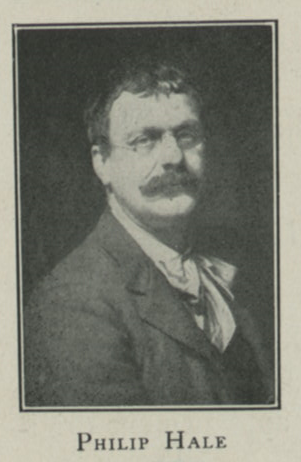
Here's one to start with, the portrait of Philip Hale c. 1900 for The Book Buyer


Images of Philip Hale including the Book Buyer portrait shown above are accessible also via the NYPL Digital Collections. There's a trove of photos in the Philip Hale Papers, 1850's-1936. Must get to the Mortimer Rare Book Room in the William Allan Neilson Library, at Smith College in Northampton, Mass. Looks like the 1851 first edition of Moby-Dick in the Rare Book Room of the Smith College library (825 M495m 185) might have belonged to Philip Hale. In 1938 Smith College got Hale's library of 2000 books from his widow, including first editions of Whitman's Leaves of Grass and Melville's Moby-Dick (Springfield Republican, Thursday, May 5, 1938). In 1937 some portion of the collection was on display at Harvard, in the front hall of Widener Library:
Philip Hale Collection
Also on view in the front hall of the Library, is an exhibition of books belonging to the well-known Boston music-critic, Philip Hale, presented by his wife. Hale was well known as a book collector, and part of his collection of first editions of Walt Whitman and Herman Melville are shown here.
Of interest is a letter from Good-speeds' the Boston bookseller, crediting Hale with the revival of public interest in Melville's work, and specifically with the sale of 200 copies of "Moby Dick."  --Collections and Critiques - The Harvard Crimson
Musician and newspaper columnist Philip Hale (1854-1934) is best known for vibrant musical and dramatic criticism, and for his brilliant program notes for the Boston Symphony Orchestra. As a young reader, Catholic journalist Michael Williams (first editor of Commonweal) found himself bedazzled by Hale's "splendidly lucid, colourful and musical prose style" and "vital, illuminating wit and irony" (The Book of the High Romance).

Nowdays? Still highly regarded as "Boston's Consummate Critic" by Jon Mitchell, Professor of Performing Arts at UMass, Boston. Professor Mitchell lectured on Hale in October 2012:
"As writer and critic, Hale was a powerful and influential figure in the artistic life of Boston." --University of Massachusetts-Boston, Center for the Study of Humanities, Culture, and Society
Although his name is not down on any map of Melville's critical reception, Philip Hale also deserves credit for three decades of perceptive and influential writing about Melville's works in the Boston Herald. And before that, for another dozen or so years of Melville mentions between 1891 and 1903, when Hale worked for the Boston Journal. Philip Hale was a one-man Melville band, as the inventory of his Melville promotions in the Herald and other Boston newspapers will show.

Bostonians knew what brought the Melville Revival when it came around in the early 1920's, and it wasn't Raymond Weaver. No need to seek for pioneering Melville enthusiasts in New York City or London. As Hale's colleague John Clair Minot put it in 1922:
A few lovers of the best in literature, remote from one another in time and place, have kept alive an interest in “Moby Dick,” “Typee,” “Omoo” and White Jacket” through the years. No one has done more to that end—as any Boston bookseller can tell you—than Philip Hale in his “As the World Wags,” which appears daily on this page except when he courteously gives my modest column a chance. --"Speaking of Books," Boston Herald, January 11, 1922.
In 1923, another tribute to Hale's sponsorship of the ongoing "Melville vogue":
"The Herman Melville vogue, for which Philip Hale of the Herald deserves a share of the credit that is commonly given to Frederick O'Brien, is not only bringing out new editions and de luxe sets of his works, but it is resulting in a small library of books about him.  --Boston Herald, February 3, 1923
In March 1929, the Herald promised a review of Lewis Mumford's new Melville biography by
Philip Hale, whose repeated allusions a few years ago to “Moby-Dick” and other of Melville’s books in his “As the World Wags” department was an important factor in bringing about the great revival of interest in this long neglected novelist. --Boston Herald, March 9, 1929
Philip Hale's bio in the 1910 National Cyclopaedia of American Biography:
HALE, Philip, journalist and musician, was born in Norwich, Vt., Mar. 5, 1854, son of William Bainbridge and Harriet Amelia (Porter) Hale and eighth in descent from Thomas Hale, who settled in Newburg, Mass., about 1638. His parents removed to Northampton, Mass., where he attended the public schools and took organ and piano lessons. He was organist in the Unitarian church when fourteen years old. He continued his studies at Phillips Exeter Academy, and was graduated at Yale College in 1876. While at college he took several prizes in composition, was pianist for the Yale Glee Club, and was one of the editors of the Yale “Record.” After graduation he studied the organ with Dudley Buck, meanwhile contributing to the New York “World,” and then went to Albany to study law in the office of his uncle. He was admitted to the bar in 1880, and practised for two years, but a considerable portion of his time was given to music. He was organist of St. Peter's (Episcopal) church, musical critic for the Albany “Times,” and a student of the piano and the theory of music. He spent five years in Dresden and Berlin studying the piano under Xaver Scharwenka, the organ under Albert Heintz and Carl Haupt, harmony under Heinrich Urban, and counterpoint and Partitur reading under Waldemar Bargiel. He was in Paris for a period studying composition as well as organ playing under Alexandre Guilmant. Upon his return to America in 1887 Mr. Hale settled again in Albany, becoming director of the Schubert Club of male voices, and organist and director of the choir of St. John's (Episcopal) church at Troy. During the two years that he held these positions he gave organ and harmony lessons, wrote musical and dramatic criticisms for the Albany “Express,” and was on the staff of the Albany “Union,” where he wrote editorials, attended concerts and theaters as critic, and edited “telegraph copy.” In the fall of 1889 he was called to the First Religious Society (Unitarian) of Roxbury, Mass., as organist and choir director, and held that position for seventeen years. Finding that he could not support himself by the organ alone, he took up newspaper work as a critic. His first employment in this capacity was with the "Boston Home Journal.” He was engaged by the “Boston Post” in 1890, for which paper he wrote musical criticisms, editorials and a column called “The Taverner.” Two years later he went to the Boston “Journal,” where his work was of the same character, his special column being called “Talk of the Day.” He remained with the “Journal” for twelve years and resigned in May, 1903, to take a position on the staff of the Boston “Herald,” to which he contributed, besides musical criticisms and editorials, a special column on “Men and Things.” Since 1908 he has had charge of both music and drama for the “Herald.” For several years during his residence in Boston he was the local correspondent for the New York “Musical Courier,” and he edited the “Musical Record” for two years, and the “Musical World” for one year. He has edited the Boston symphony programme book since 1901, and has contributed occasionally to various magazines. In the course of this busy career he also gave lectures at Columbia University, at Carnegie Institute, Pittsburg and elsewhere, but eventually withdrew altogether from lecturing because the work was distasteful to him. Mr. Hale is one of a small group of brilliant writers identified with musical criticism in America who command respect quite as much for the literary quality of their work as for the special knowledge upon which their observation and verdicts are based. He is conspicuous among critics by reason of his pronounced individuality and the extended range of his information. His influence on musical art bids fair to be as permanent as that of any of his contemporaries in criticism, because the force and pungent flavor of his utterance fix them in the memory, and because, beneath the wit that illuminates his dicta, and beneath the occasional outbursts of contempt for mediocrity and humbug, there is manifest devotion to high ideals that should, and often does, stimulate those who writhe temporarily under his lashing to stern endeavor toward improvement. The “Musical Record” during the brief years of its existence under his editorship was a vehicle for information and comment on musical affairs that upheld the art from contact with petty personalities and sordid commercialism, and not finding sufficient support to justify the publishers in continuing it, its disappearance was felt as a personal loss by those who had come to watch for it and know through it the lofty ideals of its editor. Mr. Hale was married in Berlin, Germany, July 9, 1884, to Irene, daughter of Peter Baumgras, of Washington, D.C.
When I started compiling Melville references in the Boston Journal, I noticed how most of them appeared in the "Talk of the Day" column. Written, as Jon Ceander Mitchell confirms, by Philip Hale:
The Boston Journal, not to be confused with the Boston Home Journal, beckoned and Hale was more than ready for the call…. Hale was hired as music critic, but he was also given full rein over a non-musical column, “Talk of the Day,” of the “cabbages and kings” variety. --Trans-Atlantic Passages: Philip Hale on the Boston Symphony Orchestra
In 1890 Philip Hale wrote the "Taverner" column in the Boston Post, according to the National Cyclopaedia of American Biography, cited above. In the great Pursuing Melville, 1940-1980, Merton M. Sealts, Jr. has identified "Taverner" as Alexander Young, who died March 19, 1891. However, in the Library Journal of September 1891 C. A. C. = Charles Ammi Cutter corrects an item from the New York Times about the identity of "Taverner." The renowned librarian notes that
"Mr. Young was only one of several who wrote in the column over that signature."


Inventory of Melville Notices by Philip Hale


BOSTON JOURNAL 1890-1903


Jon Ceander Mitchell dates the hiring of Philip Hale to late fall 1891. Before Hale's arrival, a few conspicuous but fairly isolated references to Melville in the Boston Journal were supplied by Edward W. Bok and John H. Drew, writing as "Kennebecker." "Talk of the Day" begins to appear in the Boston Journal on October 1, 1891--one day after Melville's obituary was reprinted in the morning edition.
Boston Journal - September 29, 1891
  • Mortuary notice, September 29, 1891; reprinted on September 30, 1891. Interesting and substantive Melville obituary with fuller than usual catalog of Melville's literary works, that includes Moby-Dick and alludes to Mardi as a "philosophical romance." Possibly by Philip Hale who knew the 1856 Dublin University Magazine article titled A Trio of American Sailor-Authors which the Journal obit plagiarizes in closing. In his signed "As the World Wags" column of May 6, 1927 Hale gives a quote from the Dublin journal slamming Mardi as "one of the saddest, most melancholy, most deplorable and humiliating perversions of genius of a high order in the English language."
  • October 31, 1891. Talk of the Day. Holmes's poem "The Last Leaf" and its subject Major Thomas Melville, Herman's grandfather. Reprinted the following Monday, November 2, 1891.
First Melville reference in Philip Hale's "Talk of the Day"
Boston Journal - October 31, 1891
  • August 18/19, 1893. Talk of the Day. Beluga whale really a dolphin, not "that famous malicious monster, Moby Dick, the white whale who played such a bloody part in the legends of Nantucket."
  • December 13, 1893. "Clangor of the Bells." Alludes to The Bell-Tower, "that ghastly, weird tale by Herman Melville."
  • July 11, 1894. Talk of the Day. Melville's Israel Potter features "the most singular use of Paul Jones in romance."
  • November 28, 1894. Talk of the Day. Quotes Mardi on patriotic naming of ships, "the whole federated fleet." Used again! for the Boston Herald, March 2, 1931; see below.
  • May 2, 1895. Talk of the Day. Quotes Melville in Mardi on the cigarret. Same subject as Hale's AWW column in the Boston Herald, March 27, 1916; see below.
  • June 18, 1895. Talk of the Day. Melville in Moby-Dick on the women of New Bedford.
  • October 2, 1896. Talk of the Day. Melville counted with notable writers of short stories in English. Contrasted favorably with Kipling.
  • April 13, 1897. Talk of the Day. Moby-Dick.
  • June 30, 1897. Typee mention.
  • October 8, 1897 "Our Filthy Lucre." "If the Marquesans had any microbe theories, Herman Melville did not mention them, though he found the savages both clean and healthful."
  • November 10, 1897. Books and Reading. Review of Hero in Homespun casually mentions "Father Taylor's sermons, which were used in fiction to such excellent advantage by Herman Melville." 
  • May 12, 1898. Moby-Dick quote about the sweet breath of Salem girls.
  • June 8, 1898. Riff on "joys of noon dinner," quoting Melville's White-Jacket.
  • October 12, 1898. Talk of the Day. Sweet breath of Salem women, again.
  • October 26, 1898. Melville good on "aesthetic pleasures of life among savages," along with Stoddard and Stevenson.
  • July 24, 1899. "Moby Dick escaped Captain Ahab...."
  • September 25, 1900. Talk of the Day. "Moby Dick, the whale that mocked Captain Ahab and his predecessors and followers."
  • November 21, 1900. "Current Literature." Unsigned.  Herman Melville in New Edition. Probably by Philip Hale.
  • October 3, 1900. Talk of the Day. Stevenson on Melville as "howling cheese."
  • October 4, 1900. Talk of the Day. More about Stevenson's use of "howling cheese"; Hale responds to reader "T. M. F."
  • March 27, 1900. Talk of the Town. Irritated by ignorance of the New York Sun, and Peter Toft in the NYT.
  • May 29, 1900. Talk of the Day. Queequeg's tall hat. Used again in Hale's AWW column in the Boston Herald, March 18, 1912.
  • May 4, 1901. Talk of the Day. Wharf-Rat. Superb column on O'Brien's poem and Melville's Encantadas.
  • April 28, 1902. "Talk of the Day Column" quotes NY Sun on Moby-Dick and real ships sunk by whales.
  • May 21, 1902. Not by Philip Hale? Current Literature. Favorable review of Deep Sea Plunderings by Frank T. Bullen, "in the distinguished class headed by our own Dana and Melville."
  • August 13, 1902. Talk of the Day. Lord Lovely's coroneted boot-heel in Redburn.
  • September 16, 1902. Introduces a Mr. Johnson (prototype of Herkimer Johnson in AWW) whose favorite books include "yarns by Herman Melville."
  • September 26, 1902. Talk of the Day. Moby-Dick.  "Herman Melville's story still remains the one great romance of whaling."
  • April 3, 1903. Talk of the Day. Moby-Dick. Again with the women of Salem.
May 22, 1905. Philip Hale admits to reading Melville "with special pleasure" in correspondence with the Walt Whitman Fellowship:
"You will laugh when I tell you that the three Americans I now read with special pleasure are Whitman, Poe and Herman Melville." --Philip Hale, letter from Boston of May 22, 1905 to the convention of the Walt Whitman Fellowship in New York as quoted in the June 1905 issue of The Conservator.
In 1903 Philip Hale joined the staff of the Boston Herald and wrote musical criticism, editorials and a special column on "Men and Things." --National Cyclopaedia of American Biography

BOSTON HERALD 1903-1933

AWW = As the World Wags

  • May 15, 1904. "Rich Sea Fruit." Unsigned. "This odorous fruit of ocean has served novelist and moralist as well as cook, physician and experimenter with aphrodisiacs. One of the finest chapters in Herman Melville’s 'Moby Dick' is that descriptive of the surgical operation on the whale—and what a marvelous romance is this same book, one that puts to shame and confusion all subsequent cetological novels."
  • July 5, 1904. "Suggestive Spelling." Unsigned. Fitz James O'Brien's Wharf-Rat, Encantadas.
  • February 23, 1907. "In Spotless White." On the whiteness of Mark Twain's favorite suit. Unsigned comment: "Not even a reading of Herman Melville's inquiry into the terror of the color white would disconcert him...."
  • July 17, 1907. "Dead Letters." Unsigned, probably by Philip Hale. "Bartleby, in Herman Melville's fantastical tale, had been a subordinate clerk in the dead letter office, and his duties had fed his natural hopelessness."
  • March 31, 1908. "More Stevensoniana." Unsigned. Evangelical "zeal is distressing to the romanticist, for its aim is to make prosaic the native life that to him, a foreigner, is full of poetry." Notes the anti-missionary vein of Melville's Omoo.
  • May 18, 1908. "Men and Things." Unsigned. Subject of teeth inspires thought that even "regular and white" teeth might "threaten and command, or recall Herman Melville's inquiry into the inherent and mysterious horror of the color white." As for instance in Poe's story "Berenice."
  • May 23, 1908. Item on "Trees and Thunderbolts" recalls "Herman Melville's fantastical tale, The Lightning-Rod Man." Probably by Philip Hale, who loves this story and repeatedly uses the word fantastical when describing Melville's writings.
  • July 27, 1908. "At Honolulu." Unsigned item; reception at Honolulu evokes Typee and the "enchanting Fayaway."
  • July 29, 1909. "Men and Things." Important critical survey of Melville's works a decade before the centenary of his birth. Style and substance of comments here (for example, on a naval battle in Israel Potter favorably compared with Walt Whitman) will resurface in "As the World Wags" columns by Philip Hale.
Melville in Philip Hale's "Men and Things" column
Boston Journal - July 29, 1909
    • August 22, 1909. "Men and Things." Herkimer Johnson counts Herman Melville with Artemus Ward and Jacob Abbott (after Jonathan Edwards, Poe, Emerson, Hawthorne, and Walt Whitman) among "the great writers of this country."
    • July 16, 1910. "Men and Things." Melville's "amusing" though "fictitious"description of Benjamin Franklin in Israel Potter.
    • July 17, 1910. "On the White House." Unsigned, by Philip Hale. Wonders if Melville's story contributed to the diminished reputation of the traveling lightning-rod salesman. Recalls that Melville's tale "The Lightning-Rod Man" had been "characterized by an unsympathetic reviewer at the time as  grotesque verbiage." 
    • January 25, 1911. "The Galapagos." Unsigned. With Hale's characteristic references to Fitz James O'Brien's Wharf-Rat, Melville's Encantadas.
    • December 18, 1911. AWW. High praise for Israel Potter.
    • December 25, 1911. Israel Potter, again. "The most satisfactory portrait of John Paul Jones is that drawn by Herman Melville."
    • March 18, 1912. AWW. Queequeg's hat. "Herman Melville's friend in 'Moby Dick,' the South Sea harpooner, whom he met at the New Bedford inn, began dressing in the morning by clapping a silker on his head."
    • April 27, 1912. AWW. Consideration of "Loblolly and Burgoo" includes reference to "Herman Melville's boy Redburn."
    • June 25, 1912. AWW.
    Melville's Squid.
    And now a question about the “great white squid” described by Herman Melville in “Moby Dick.” It was seen by Ishmael and others from the vessel captained by mad Ahab. It was stretching its beautiful and fearful length under a cloudless sky, and they that saw the squid shuddered, knowing that those who looked upon it at any time were doomed to perish and that soon. Not long after the white whale, pursued relentlessly, turned on his enemies and Ishmael alone was left to tell the wondrous tale. I can find nothing about this variety of squid in any book of reference.
    • June 15, 1912. AWW. "Veranda Traveller" named Hunkerton adventures out by train; quest for books of travel includes "trying to find a set of Herman Melville's sea tales."
    • June 29, 1912. Moby-Dick counted with "Strange Favorites"
    • July 12, 1912. AWW. High estimation of "The Lightning-Rod Man" and other of Melville's short stories. Protests old view of LRM  (by unnamed critic) as "grotesque verbiage."
    • August 24, 1912. "Irritating White." Excuse to consider Melville on whiteness of the whale--unsigned.
    • September 9, 1912. AWW. Whiteness of the whale discussed in the Herald.
    • May 23, 1913. AWW.
    The late Capt. De Friez was one of the whalers that made Nantucket famous the world over. The glory is departed, yet the tradition of pluck and daring will outlive the child born yesterday. The Capt. Ahab of Herman Melville’s vividly realistic and wildly fantastical story may yet be taken as a historically legendary character as Sinbad or Achilles, and the white whale Moby Dick may be classed with the monstrous kraken. In ‘Moby Dick” the adventurous dreamer Melville gave a lifelike picture of scenes in New Bedford, where now a statue stands in honor of the whaler.
     PH goes on to cite De Crevecoeur on opium use by Nantucketers, particularly women.
    • June 27, 1913. AWW. The killer whale according to Melville's system of classification.
    • June 28, 1913. AWW. Frank T. Bullen plagiarized from Moby-Dick. "Herman Melville is now little read. Mr. Bullen read him faithfully before he wrote his whale story and profited largely without due acknowledgement."
    • July 4, 1913. AWW. Letter from "C. F. A." of Cambridge informs AWW of Frank Bullen's letter of September 20, 1905 in the New York Times Saturday Review of Books, honoring Melville while disclaiming his influence on Cruise of the Cachelot. Philip Hale comments: "We are glad to be reminded of Mr. Bullen's letter for we would not do anyone injustice. We now recall the fact that the controversy did not end with the publication of this letter."
    • July 17, 1913. "With a Plume" Discussion of John Paul Jones leads to consideration of "the undeservedly forgotten novel" Israel Potter--and the writer makes Philip Hale's characteristic connection to Walt Whitman.
    • October 11, 1913. AWW. "Color Fancies." Whiteness of the Whale.
    • January 28, 1914. AWW. Nominal mention of "Melville" with other writers of "admirable short stories."
    • July 22, 1914.  Not by Philip Hale. "Literary Notes" signed "S. C. W." Notice of the reissue of Melville's romances by the Page Company "which acquired them with the book publishing business of Dana Estes & Co."
    • September 9, 1914. "Whale Meat." Unsigned, with informed references to "Herman Melville's 'Moby Dick,' the great epic of the sea."
    • January 12, 1915. AWW - Letter to AWW signed "Capt. Brassbound" cites Moby-Dick for definition of "old salts": "Every finger a fish-hook, every hair a rope-yarn, and blood of Stockholm tar."
    • March 19, 1915. AWW Another letter from Brassbound, this on the death of Frank Bullen. PH comments: "When all is said, the great book about the whale is not by Bullen; it is 'Moby-Dick,' of Herman Melville."
    • June 24, 1915. "Mr. Morris the Critic." Unsigned, on short stories with mention of Melville's "The Bell Tower."
    • January 5, 1916. AWW. "Ironical Nomenclature." On naming of ships, with favorite lines from Mardi on "the whole federated fleet."
    • January 12, 1916. AWW. Hale as editor vouches for the corporeality of his regular correspondents including Herkimer Johnson; will swear on a stack of bibles, like Melville (as Ishmael) "at the end of the Town-Ho's story."
      • March 7, 1916. AWW.
      So there’s a new book about whalers and whaling. Whenever we see a book of this kind advertised, we read Melville’s “Moby Dick” again. And Herman Melville, by the way, had been a whaler when he wrote that strange mixture of information, romance, imagination, mysticism and hysteria—the one great book of the sea.
      • March 27, 1916. AWW. Quotes from "Herman Melville’s wildly fantastical romance, 'Mardi'" on the pipe vs. cigarette, and wonders where Melville got the non-standard form "cigarret." 
      • June 6, 1916. "Sea-Fights and Poets." Unsigned, with Hale's characteristic references to Israel Potter and Walt Whitman.
      • July 4, 1917. AWW. Beer and ale, Ben Franklin and Israel Potter.
      • August 10, 1917. AWW. Survey of Melville's works in answer to query from reader "C. F. A." Some of this material including the closing reference to Allan Melville gets recycled two years later, in the centenary AWW published August 1, 1919.
      • September 24, 1917. Quotes from Moby-Dick on definition and classification of the whale.
      • June 20, 1918. AWW. Quotes from chapter 65 of Moby-Dick, treating Stubb's way of cooking whale steaks; and citing Melville's riff on universal cannibalism as "one of his delightfully fantastical digressions."
      • July 13, 1918. AWW. Letter from book collector W. E. K. accuses PH of "raising the price of literature" in Boston by commending Melville's "fascinating tale." "One can find 'Moby Dick' in the great libraries, but it deserves a place on one's private shelf." 
      • August 1, 1919. Centenary of Melville's birth. Unsigned biographical article, "Today's Centenary of Herman Melville" appears alongside AWW, where Philip Hale presents a critical survey of Melville's works. Hale urges merits of Piazza Tales and Israel Potter, and offers  concluding reminiscence of Herman's brother Allan Melville.
        Boston Herald - August 1, 1919
        Found in the historical Newspaper Archives at Genealogy Bank
        • August 16, 1919. AWW. Letter from Emil Schwab of Arlington informing AWW of Melville's frontispiece portrait in the 1892 edition of Typee.
        • October 31, 1919. Debussy's L'isle joyeuse evokes Melville, especially Mardi
        • April 19, 1920. AWW. "Salt Horse and Salt Tales" With mentions of Moby-Dick and Israel Potter.
        • September 8, 1920. AWW. Quotes from White-Jacket on the subject of keelhauling and adds, "There is a still fuller description in Marryat's 'Snarleyyow.'"
        • May 11, 1921. AWW - Exchange with reader Rory Dillon "Concerning Moby Dick." Philip Hale cites Viola Meynell; and gives excerpts from the "wildly enthusiastic" response to Moby-Dick by "H. M. T." =  Henry Major Tomlinson in The Nation, January 1, 1921.
        • May 19, 1921. AWW. Nobody reads Melville's Piazza Tales except "some old fogies who remember them as appearing in Putnam's Magazine."
        • June 22, 1921. AWW. "Moby Dick" Again. Tomlinson's "rhapsody" in the Nation; quotes response by "Wayfarer." With Hale's critical survey of Melville's works, more detailed than usual.
        • July 5, 1921. AWW.  "Let us talk again about "Moby Dick." More about the new enthusiasm in England sparked by publication of the Oxford Books Moby-Dick. Hale has been following the British revival in The Nation and The Athenaeum; quotes published letters from Michael Sadleir and James Billson. Letter to AWW from Alice C. Hyde reports on reading Moby-Dick aloud in North Cohasset (first ever M-D Marathon?) and asks, "couldn't you get up a Moby Dick club so that a little of the flammable enthusiasm which those of us who have read the book feel about it could have a safe outlet?" Philip Hale replies that "Melville is too fine a fellow for a club in his honor. Remember the cruel fate of Walt Whitman and Robert Browning."
        • July 8, 1921. AWW. Prints letter from Earle E. Riser, longtime admirer of Melville and his "masterpiece" Moby-Dick; Riser "gratified as well as amused" by current Melville Revival.
        • July 13, 1921 AWW. Letters by Melville collectors/fans Charles B. Hawes and Charlotte Reed White. They independently resent all the recent attention to Melville, particularly in AWW.
        • August 9, 1921. AWW - Brisk sales of Moby-Dick ("The Reprint, Of Course") in Boston bookstores.
        • August 29, 1921. AWW. editions of Moby-Dick.
        • August 30, 1921. AWW - Dough-Boy, with suggestions for future exam questions on Moby-Dick.
        • September 6, 1921. AWW.  Letter from E. H. B. of Boston commends White-Jacket. Hale remembers and quotes from the "appreciative editorial article" in the New York Times for the centenary of Melville's birth.
        • September 19, 1921. AWW - New Everyman editions; appeal and "picaresque" vein of Omoo.
        • September 23, 1921.  Letter to AWW from Boston reader "G. E." blames Hale for high prices of Melville's books now: "Your well-intentioned propaganda costs us ["Melvillians"] dearly." Reports on marginalia in volume of Melville's Piazza Tales discarded by the Watertown Public Library," at the end of "Bartleby": "This Herman Melville is a great humbug."
        • December 3, 1921. Reference to whale dissection in a lecture on Iceland recalls Moby-Dick.
        • December 17, 1921. AWW. Melville reference in verses by "LAND CRAB" titled "MOBY DICK'S DESCENDENT / IN LIBERATED LINES." Views appalling butchery of whales in recent film. Then "Home to Melville! To his horrors / He adds thrills!"
        • June 17, 1922. AWW Moby-Dick; influences on Melville include Rabelais and Sir Thomas Browne, doubts Strachey on proposed influence of Balzac.
        • June 25, 1922. AWW. Parenthetical comment on recent editions of Moby-Dick: "For full enjoyment of these reprints the introductions by belated admirers should of course be torn out, or the leaves pasted together."
        • July 3, 1922. AWW. High regard for The Piazza Tales.
        • July 5, 1922. AWW. "Calm Chowder" and Mrs. Hussey's Clam Chowder in Moby-Dick.  Also a bit on Mardi.
        • July 25, 1922. AWW. The Lightning-Rod Man. 
        • July 29, 1922. AWW. "The tortoises on the Galapagos Islands inspired Herman Melville to describe and moralize curiously and wildly in his account of these strange islands known to old Spanish sailors as 'The Enchanted.' These chapters with 'Benito Cereno,' 'Bartleby' and 'The Bell Tower'--all in 'The Piazza Tales'--should alone glorify the name of Melville."
        • October 2, 1922. AWW. Moby-Dick, "The Tail."
        • October 20, 1922. AWW. British praise for Melville and Moby-Dick in the September 30, 1922 Athenaeum review, "The Vogue of Herman Melville."
          • December 11, 1922. AWW. Prefers "old thumbed battered volumes" to new "sumptuous edition" of Melville's works. Appreciative quotes from Mardi
          • December 30, 1922. AWW. Quotes (again) and responds to the old Dublin University Magazine criticism of Mardi. "Tut-tut! Pish! Likewise, go to!" With longish excerpt titled "GOOD KING MEDIA ON JURIES." 
          •  January 6, 1923. Mentions The Bell-Tower.
          • January 31, 1923. AWW. 'A prominent bookseller in Boston writes to us that since the references to Herman Melville's 'Moby Dick' in The Herald he has sold over 2000 [sic] copies in various editions, and also many copies of Melville's other books." With comments on Israel Potter, "Benito Cereno," Lightning-Rod Man, Raymond Weaver, Elihu Vedder.
          • February 17, 1923. Salzedo performed by Boston Symphony Orchestra contrasted with Melville's Encantadas.
          • May 2, 1923. AWW. Percy A. Hutchinson on Conrad, unable to discern "psychology" in Melville. What, he "never read Melville's 'Moby-Dick'"?
          • May 12, 1923. "Moscow Players in Work by Gorky." Signed review of "The Lower Depths." "It was easy to guess that Luka was of kin to the gentle soul who roomed in the third floor back and to the stranger who boarded the steamboat in Herman Melville's fantastical story "The Confidence Man," if story it can be called."
          • May 23, 1923. Galapagos, Melville's Encantadas. H. M. Tomlinson in The Nation and The Athenaeum.
          • September 16, 1923. Moby-Dick and D. H. Lawrence
          • September 20, 1923. Letter to the Editor from Philip N. Sanborn gratefully credits Philip Hale for popularizing Melville in "As the World Wags."
          • October 9, 1923. A. A. Milne's Mr. Pim "reminded one in a way of Bartleby."
          • October 15, 1923. AWW. Praises Melville's "Encantadas"; quotes "Mr. A. N. Tomlinson" [in The Nation and The Athenaeum volume 30]: "In simple, firm, and nervous English, which in these days is salutary to read, he creates the Galapagos in a reader's vision till they loom with all the dark, sinister, and significant character of a nightmare in which reason plays only like fitful lightning."
          • October 23, 1923. Letter to AWW from "E. H. J." wonders about "Salvator Tarnmoor," the stated author of "The Encantadas" in Putnam's. "Was this the name under which Melville wrote?" Hale: "Why Melville chose to give a name of his invention to 'The Encantadas,' as if to conceal authorship, is not known; at least we have never seen an explanation."
          • November 18, 1923. AWW. Quote from The Confidence-Man, Melville's cosmopolitan on "that good dish, man."
          • October 7, 1924. Mentions Tacitus in The Confidence-Man.
          • June 3, 1925. AWW. Recommends "The Lightning-Rod Man" "to those who are afraid of thunder storms."
          • September 12, 1925. AWW. Encantadas.
          • October 16, 1925. AWW. Bartleby.
          • May 11, 1926. AWW. Favorable reception of Melville's books in England. 
          • May 26, 1926. AWW. Franklin in Paris, Israel Potter.  
          • February 15, 1927. Signed review of a three-act comedy "Mozart," at Opera House. Sacha Guitry as Grimm "in his make-up and in many of his comments, his irony, his common-sense, reminded one of Benjamin Franklin in Paris as described by Herman Melville in his "Israel Potter."
          • March 18. 1927. AWW. "Benito Cereno," new edition from Nonesuch Press with illustrations by E. McKnight Kauffer. "It seems to us that Melville told the gruesome story mighty well." 
          • March 30, 1927. AWW. "How many who are still 'discovering' Herman Melville could pass an examination on "Israel Potter."?  Hale thinks it "one of Melville's most characteristic and delightful books," offering "touches of Melville's irony."
            • April 8, 1927. AWW. Israel Potter, with identification of Melville's pamphlet source. 
            • May 6, 1927. Lots on and from Mardi. "What better book for summer reading than this strange, mystical, satirical, poetic, romantic 'Mardi'?" Rhapsodizing, smoking, etc. Naming battleships, again. Looks back on British reviews of Mardi, negative and positive. 
            •  June 8, 1927. AWW;  nominal mention of notes on Herman Melville by Van Wyck Brooks. 
            • May 23, 1928. Encantadas.
            • July 13, 1928. AWW.  Jonah and the Whale. Lots here about and from Moby-Dick. "Melville had Father Taylor of Boston in mind when he described Father Mapple." Melville also "was reminded of Perseus, the prince of whalemen, who harpooned the monster and bore away the maid Andromeda."
            • March 23, 1929. Major review of Mumford's biography. "... concerning Melville, the man, comparatively little is added to one's previous street and house acquaintance of him." All in all, in spite of occasional extravagances, "a book that no lover of Melville can afford to ignore."
            • April 30, 1929. "The 'Agatha' Letter." Summarizes NEQ article by S. E. Morison.
            • May 23, 1929. "Israel Potter." Unsigned, but probably by Philip Hale with elaborate discussion and characteristic reference to Walt Whitman.
            • June 2, 1929. "The Horse and His Rider." Unsigned; quotes from Melville's Civil War poem "Sheridan at Cedar Creek."
            • January 24, 1930. "Aids to the Conference." Signed, By Philip Hale. Ponders what might happen if international political conferences encouraged drinking and smoking; "if the outcome of King Media, Babbalanja and the other worthies known to the Herman Melville of 'Mardi' were to be commended...."
            • March 2, 1931. "Names, Not Numbers." Signed, By Philip Hale. On the subject of naming warships, quotes Melville's Mardi: "how glorious, poetically speaking, to range up the whole federated fleet, and pour forth a broadside from Florida to Maine." 
            • April 21, 1931. "Out of the Whale." Signed, By Philip Hale. On ambergris.
            •  May 14, 1931. "Melville and Hawthorne." Article signed, By Philip Hale.
            • June 24, 1931. "Illustrated by—" Signed, By Philip Hale. Books of fiction by some authors "are best illustrated by the authors' descriptions of characters and scenes....Who would not rather see Captain Ahab as Herman Melville saw him than as imagined by a recent illustrator?" [Rockwell Kent???] 
            • December 9, 1931. "Phil Sheridan and Poets." Signed By Philip Hale. Gives the first stanza of Melville's "stirring poem" Sheridan at Cedar Creek.
            • February 24, 1932. "Whales and the League." Signed, By Philip Hale. Protection of whales by The League of Nations, from perspective of Moby-Dick.
            • April 16, 1932. "Appropriately Bound." Notice of NEQ article by John Birss on Melville's review of The Red Rover by James Fenimore Cooper
            • May 30, 1932. "Twisted Meanings." Signed, By Philip Hale. Consideration of calligraphy inspires hypothetical reference to scriveners in Dickens and Melville:
            The scrivener, whether he were a poor devil working for some Tulkinghorn, or a Bartleby who finally rebelled, as in Herman Melville’s story, wrote what was described as a legal hand, often a fine example of calligraphy.
            •  July 11, 1933. "A Note on Bluffing." Signed, By Philip Hale. Contra Donald A. Laird,
            “literature owes much to exaggeration, learned professor, and not only the writings of early American humorists, but Shakespeare and other Elizabethans, Rabelais, Milton coming down to Herman Melville in his 'Mardi' and still later writers.”
            Philip Hale's review of Raymond Weaver's "engrossing and irritating" Melville biography; here from "The Atlantic's Bookshelf," The Atlantic Monthly (February 1922):
            Hale's review of Weaver's Melville biography in
            The Atlantic's Bookshelf - The Atlantic Monthly - February 1922
             Related posts: