Showing posts with label Boston Herald. Show all posts

Thursday, January 18, 2024

Syndicated in Cincinnati, and beyond: Melville's 1885 poem "The Admiral of the White"

Cincinnati Weekly Times-Star - May 21, 1885
Found on newspaperarchive.com

So MACSWELL spilled the beans in Buffalo.

In the latter half of May 1885, as previously revealed here on Melvilliana, a New York City correspondent of the Buffalo Courier named Walter Langdon Russ (1852-1930) aka "Macswell" informed readers of a scheme to get the justly forgotten author Herman Melville Resuscitated by mass-marketing "The Admiral of the White," a mysterious and thrilling sea-tale in verse that Melville would slightly revise and re-title "The Haglets" for private publication in John Marr and Other Sailors (1888). 
Writing from Manhattan on May 21, 1885 Macswell reported having seen Melville's new poem "printed in one of our morning papers last Sunday." As the New York correspondent of the Buffalo Courier understood things, the same poem "was printed at the same time, I believe, in other papers, east and west." Macswell blamed a young, wealthy, and ambitious media mogul for the irritating attempt to rescue Melville from oblivion:
Mr. Thorndyke Rice, the ingenious editor of the North American Review, is, I am told, responsible for his resuscitation.
C. Allen Thorndike Rice March 1883

Turns out, Macswell was right. Charles Allen Thorndike Rice (1851-1889), a pioneer of the press syndicate, evidently had enlisted Melville with other talented writers in a new cultural project to entertain more high-minded readers of popular American periodicals with excellent literary works by the best authors. The innovative manner of mass publication appealed to publishers and authors, too, as mutually beneficial. Ellery Sedgwick explains:

S. S. McClure, Charles Dana, and Thorndike Rice had also begun their syndicates that brought fiction from authors and sold publication rights to newspapers across the country...both the illustrated magazines and the syndicates very significantly increased the dollar value of literature and the potential for making a living by writing it.

Sedgwick, Ellery. “Magazines and the Profession of Authorship in the United States, 1840–1900.” The Papers of the Bibliographical Society of America, vol. 94, no. 3, 2000, pp. 399–425. JSTOR, http://www.jstor.org/stable/24304071. Accessed 18 Jan. 2024.

Samuel Sidney McClure acknowledged Thorndike Rice as a former and at one time formidable rival in the syndicate business:

Of course, as soon as my syndicate began to pay, other syndicates were started. The most powerful of these was started by Allan Thorndyke Rice, editor of the North American Review. My friends and many of the editors I served thought such a competitor would be too much for me. I remember that at this time Miss Sarah Orne Jewett, who wrote for the syndicate and took a friendly interest in my business, wrote me to ask whether I could not form some combination with Mr. Rice to avoid being wiped out. Mr. Rice's syndicate was very strong for a time, but eventually it died out without seriously cutting into my business.
-- My Autobiography (New York, 1914) pages 182-183.

The "morning paper" in which Macswell had seen "The Admiral of the White" must have been the New York Tribune. Melville fans have long known about the Tribune printing of Melville's poem on May 17, 1885, and another, more complete version on the same date in the Boston Herald. The text of Herman Melville's "The Haglets" in John Marr closely follows that of "The Admiral of the White" as previously published in the Boston Herald and, incompletely, in the New York Tribune. Before now only those two newspaper versions of Herman Melville's 1885 poem have been recorded in Melville scholarship. The New York and Boston printings of "The Admiral of the White" are discussed in editorial notes on "The Haglets" for the 2009 Northwestern-Newberry edition of Melville's Published Poems, edited by Robert C. Ryan, Harrison Hayford, Alma MacDougall Reising and G. Thomas Tanselle, at pages 725-726. Both newspaper printings, the Boston Herald version and the "abridged" New York Tribune version, are referenced also in notes on the manuscript version of "The Admiral of the White" (a different poem with the same title) in the back of the Northwestern-Newberry Edition of Billy Budd, Sailor and Other Uncompleted Writings, edited by G. Thomas Tanselle, Harrison Hayford, Hershel Parker, Robert Sandberg and Alma MacDougall Reising, at page 888. 

Only the "complete" Boston Herald and "abridged" New York Tribune versions of "The Admiral of the White" are referenced in Robert Sandberg's "Note on the Texts" for Herman Melville: Complete Poems (Library of America No. 320, 2019) page 930. Edited by Hershel Parker, the LOA edition of Complete Poems has "The Haglets" on pages 677-683 and the uncollected manuscript poem "The Admiral of the White" (which is not the 1885 poem with the same title) on pages 865-866.

A good reading text of Melville's poem "The Haglets" is conveniently accessible online courtesy of poets.org

For explication you can find "The Haglets" helpfully discussed by William H. Shurr in The Mystery of Iniquity (University Press of Kentucky, 1972) at pages 130-134; 

and, more recently, by Peter Riley in "The Fair Poet's Name": Late Poems, Chapter 14 in A New Companion to Herman Melville, edited by Wyn Kelley and Christopher Ohge (Wiley Blackwell, 2022) pages 171-183 at 177.

Long unacknowledged in Melville studies, Allen Thorndike Rice's role in the newspaper syndication of "The Admiral of the White" seems confirmed by the publication of his name as copyright holder in the heading of a previously unknown printing of Melville's poem in the Cincinnati Weekly Times-Star. Headings in both the New York Tribune and Boston Herald versions merely stated "Copyright, 1885," below the title and (in the NY Tribune version) author credit. 

Boston Sunday Herald - May 17, 1885
via genealogybank.com

The Cincinnati version places the copyright statement within brackets, above the title:
[Copyrighted by Allen Thorndike Rice.]

Admiral of the White. 

Cincinnati Weekly Times-Star - May 21, 1885
via newspaperarchive.com

As published on May 21, 1885 in the Weekly Times-Star, the byline further asserts that the original poem was "Written for the Times." Presumably the weekly edition of the Cincinnati Times-Star copied "Admiral of the White" from the Sunday Times where it had appeared according to schedule on Sunday, May 17, 1885, the same day it definitely debuted in New York and Boston. Unfortunately, the Sunday edition is not currently included in the files of the Cincinnati Times-Star at NewspaperArchive. After renewing my subscription there I did find "The Admiral of the White" reprinted on May 21, 1885 in the weekly edition of the Cincinnati Times Star. In terms of length, the Cincinnati text of Admiral of the White matches the complete Boston Herald version, rather than the Tribune abridgment. Some words and expressions (Admiral, Plate Fleet, and Milky Way) in the Cincinnati version are treated as proper nouns with the first letter of each word capitalized, where the Boston Herald version uses all lower case letters, at least early on. Among other minor differences, the Cincinnati version 
  • reads "Laced Sleeves" (as in the New York Tribune version) where the Boston Herald gives "Lace Sleeves"; 
  • does not italicize "A tomb or a trophy" (italicized in the New York and Boston texts); 
  • punctuates "sculptured Fate!" with an exclamation mark; 
  • has "hatted" as in the NY Tribune where Boston Herald reads "hated"; and
  • reads "No less content" where the Boston Herald and New York Tribune both have "Nor less content."

As I found in files of the daily edition (excluding Sunday, as noted above), also via Newspaper Archive, the plan for simultaneous publication in multiple U. S. cities (including the western towns of Chicago, IL and St. Paul, MN) had been explicitly and repeatedly advertised by the Cincinnati Times-Star. On May 14, 1885, for example, the Cincinnati Times-Star announced that "'Admiral of the White,' by Herman Melville" would appear with other "SPECIAL PAPERS" in the Sunday edition of May 17th.

Cincinnati Times-Star
May 14, 1885

SPECIAL PAPERS

In the SUNDAY TIMES-STAR of next Sunday, May 17, will be:

"Admiral of the White," by Herman Melville, author of "Typee, or Life in the Marquesas," "Moby Dick," etc.

"Charles Kingsley," by Canon Farrar.

"A Letter of Marque," by Gail Hamilton.

"The Doctrines of the Flag," by Hon. James H. Gerard.

These papers will be found of especial interest to the better class of newspaper readers. They appear simultaneously in the New York Tribune, Boston Herald, Philadelphia Press, Detroit Post, St. Paul Pioneer-Press, and Chicago Times.

In addition to the special papers, the SUNDAY TIMES-STAR contains all local and telegraphic news and as much general matter as one has time to read. Everything is presented in an attractive and convenient manner, so that the reader who devotes a reasonable time to his paper can be sure that he has not missed any news of great importance.

Price Three Cents.

The advertisement transcribed above lists six newspapers in addition to the Cincinnati Times-Star that were then engaged in Thorndike Rice's newspaper syndicate, apparently, and thus committed to simultaneous publication on Sunday, May 17, 1885 of Melville's "Admiral of the White" and other works "of especial interest to the better class of newspaper readers." The Cincinnati Times or Times-Star would make a seventh, thus:

  1. New York Tribune ✅
  2. Boston Herald ✅
  3. Philadelphia Press
  4. Detroit Post
  5. St. Paul Pioneer-Press ✅ verified 02/29/2024
  6. Chicago Times
  7. Cincinnati Times-Star

Versions of Melville's poem in two of the six newspapers we already knew about, the New York Tribune and Boston Herald, as explained already. That leaves four more to investigate. Well, five if you count the Sunday edition of the Cincinnati Times-Star that I have not yet located. Being in Minnesota, of course I feel duty-bound to begin with the Pioneer Press down in St. Paul. Alas, for the specific date of Sunday, May 17, 1885 our Minnesota Digital Newspaper Hub only gives images from the St. Paul Daily Globe and Minneapolis Daily Tribune. 

Yikes! this could be harder than I thought. Clearly there's plenty more to look for, besides more printings than we knew about of Melville's 1885 poem. For instance, does any correspondence survive between Melville and Allen Thorndike Rice? Did Melville ever formally transfer the copyright for "The Admiral of the White"? Or sign a contract?

Related posts:

Tuesday, February 22, 2022

Melville Resuscitated, 1885

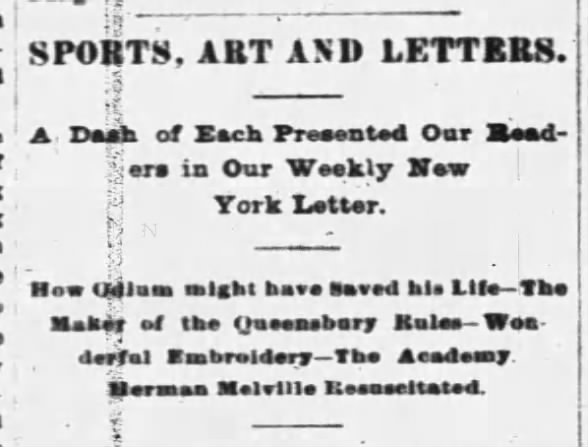
In the mid 1880's Walter Langdon Russ (1852-1930) aka "Macswell" was a New York correspondent of the Buffalo Courier. After the New York Tribune printed Melville's poem "The Admiral of the White" out of the blue, "Macswell" remarked on the weirdness of "Herman Melville Resuscitated" in the weekly New York letter dated May 21st and printed in the Buffalo Courier on Monday, May 25, 1885. 

Macswell is identified as journalist W. L. Russ in Fact, Fancy, and Fable, ed. Henry Frederic Reddall (Chicago, 1892). Another correspondent of the Courier around this time was Daniel Connelly aka "Rapidan," so identified in Initials and Pseudonyms: A Dictionary of Literary Disguises, ed. William Cushing (New York, 1885). There W. L. Russ is listed under two pseudonyms, "Macswell" (page 181) and "Persimmons" (page 228). 

Without further explanation, Macswell credits Charles Allen Thorndike Rice, "ingenious editor of the North American Review," with the "resuscitation" of Melville. The calculation of Melville's age (then nearing 66) is obviously off, unless by "sixty years old" Macswell meant in his sixties. 

25 May 1885, Mon Buffalo Courier (Buffalo, New York) Newspapers.com

SPORTS, ART AND LETTERS.

A Dash of Each Presented Our Readers in Our Weekly
New York Letter.

How Odium might have saved his Life--The Maker of the Queensbury Rules--Wonderful Embroidery--The Academy. Herman Melville Resuscitated.

From Our Own Correspondent. 

... A poem entitled "The Admiral of the White" was printed in one of our morning papers last Sunday and was printed at the same time, I believe, in other papers, east and west. The author of this poem was Herman Melville, who, as an American author, has been lost to sight for many years. The re-appearance of Melville in literature is, one might say, a curious freak of destiny. There is no special reason why he should re-appear, and everyone had come to the conclusion that he had given up serious authorship. If I am not mistaken, he was eulogized at one period as a man of vigorous talent. But he drifted away from the work he had set himself to do, and, since the civil war, he had been a drudge in some office down town. His first volume of verse, published in 1866, was called "Battle Pieces." Some of the verses in that volume were spirited, though most of them were not better than respectable. "The Victor of Antietam," for example, which has been praised with enthusiasm, seems a cold and dull thing. "Sheridan at Cedar Creek" is more genuine, to say the best of it. 
MELVILLE was born in 1819. He is at present, therefore, sixty years old. Mr. Thorndyke Rice, the ingenious editor of the North American Review, is, I am told, responsible for his resuscitation.

... MACSWELL.  -- Buffalo Courier, May 25, 1885.

A compressed version of "The Admiral of the White," expanded and retitled The Haglets in John Marr and Other Sailors (1888), had appeared on page 9 of the Sunday New York Tribune, May 17, 1885. 

New-York tribune. [volume] (New York [N.Y.]), 17 May 1885. Chronicling America: Historic American Newspapers. Library of Congress. <https://chroniclingamerica.loc.gov/lccn/sn83030214/1885-05-17/ed-1/seq-9/>
Also on May 17, 1885, the Boston Herald printed a longer version of "The Admiral of the White, not abridged as in the New York Tribune. The Library of America edition of Herman Melville: Complete Poems, edited by Hershel Parker with a note on the texts by Robert A. Sandberg, has "The Haglets" with all of the poems in John Marr and Other Sailors, as well as the different, uncollected poem also titled The Admiral of the White.

Melville's poem "The Haglets" on poetry.org:

Tuesday, September 6, 2016

Discarded by the Public Library in Watertown: Piazza Tales, with marginal comment on Melville as "a great humbug"

In this letter to Philip Hale as editor of the "As the World Wags" column, Boston reader "G. E." reports on his purchase of an ex-library copy of The Piazza Tales. From the Boston Herald, Friday, September 23, 1921; found in the online Newspaper Archives at Genealogy Bank. Note the spelling: Melvillians!


Boston Herald - September 23, 1921


BENIGHTED WATERTOWN.

As the World Wags:

It would be unkind, if not unjust, to deposit the whole blame at your doorstep: however, you’ll find enough there to stumble over, if you ever cross your threshold to face an angry mob of Melvillians! Your well-intentioned propaganda costs us dearly. Prices have gone up sky high.

One bookseller in Boston can’t get the “Piazza Tales” for love or money. Another had a copy offered to him (first and apparently only edition) at $4.50. I politely declined. At last by the merest chance I obtained through him a copy marked “discarded”—mind you—by the Watertown public library; price $2. I’m not kicking. On the contrary, now that I have read the book, I’ll confess that it is worth those two iron men; and more.

But I am moved to reflect on the fact that Watertown had no use for these stories, and upon this extraordinary thing: At the end of that wonderfully uncomfortably tale about the poor, demented Scrivener, once employed in the Dead Letter Office, one Watertown reader (perhaps the one that recommended the book for the dump-heap) has indulged in the following pencilled opinion: “This Herman Melville is a great humbug.” As one of the converted, I would urge you therefore, move on to Watertown, and smite the Waterstownsman with your ire.

G. E.
Boston

Are booksellers able to procure for you Melville’s “Israel Potter,” The Confidence Man,” “Pierre, or the Ambiguities?” If so, at what price. A contributor to the Nation and Athenaeum of London states that the British Museum is without a copy of the “Piazza Tales.” These stories worked their strange spell on us when years ago we read them in Putnam’s Magazine, that monument to the fine taste of George William Curtis, the editor. Reading the tales again and again, we are at a loss to say which is the best. “The Bell Tower” has been reprinted in collections of short stories, yet we prefer “Bartleby” and “Benito Cereno,” the account of Capt. Amasa Delano’s surprising adventures. Whenever a thunderstorm comes along, we think of “The Lightning Rod Man” and loathe the critic who, years ago, characterized it as “grotesque verbiage.” He probably came from Watertown. Ed. [Philip Hale]
In his reply, Hale references the June 11, 1921 issue of The Nation and The Athenaeum, where (after printing letters from Michael Sadleir and James Billson) the editor notes:
We believe that the British Museum has no copy of "The Piazza Tales." Verb. sap.
In 1881 The Watertown Free Public Library still boasted a first edition of The Piazza Tales.


As shown in the previous melvilliana post Forty Years of Philip Hale and Melville, Hale had been promoting Melville in the pages of the Boston Herald since 1904, not long after he moved there from the Boston Journal--where he had talked nonstop about Melville in "Talk of the Day." Doubtless Hale and his Boston reader are too hard on Watertown, Mass. According to the Librarian's Report for 1907, more than 700 volumes, many "among the most used and most popular books" in the library, had to be discarded as "worn out by constant and increasing usage." Moby-Dick and Typee are listed as 1907 additions to the 1881 catalog.

Wednesday, August 31, 2016

Alice C. Hyde on reading Moby-Dick aloud in 1921

"So every night four of us sat around a roaring, open fire in the raw, spring evenings and listened to “Moby Dick.” I did the reading aloud, and I know the sweep of the sentences, and the lift and thrill of their cadences. Never was such a book written before, so drenched with the sea." --Alice C. Hyde, North Cohasset; from her published letter to "As the World Wags" editor Philip Hale in the Boston Herald, July 5, 1921.
Boston Herald, July 5, 1921

The complete letter from Alice Charles Hyde (1872-1936), a graduate of Smith College, is transcribed below. Having looked into the renewed enthusiasm for Moby-Dick in England, Philip Hale introduces correspondence from Melville's American fans, thus:
Now for letters from Melvillians.

A SANE ENTHUSIAST

As the World Wags:

One cannot throw a match into dry tinder without starting a fire, perhaps a conflagration, so after reading the article in your column about “Moby Dick,” I must add to the conflagration and chorus with the others that it is the most remarkable, blood-stirring, romantic, and virile book of adventure that the English language contains. During last month’s cold weather, we—a household of three middle-aged people with a fourth over 70—found ourselves in a country house with everything to make life tolerable except human companionship. No neighbor had “moved” with us. So every night four of us sat around a roaring, open fire in the raw, spring evenings and listened to “Moby Dick.” I did the reading aloud, and I know the sweep of the sentences, and the lift and thrill of their cadences. Never was such a book written before, so drenched with the sea.

Now I know the difference between genius and talent and no academic admirer of style and finished English will ever confuse my mind on that subject again. Stevenson, the great stylist, wrote a toy book, about a toy ocean, with toy men playing around on toy ships, and called it “Treasure Island.” That’s talent. Then Melville wrote a book almost as great as the ocean itself with real men, sailing real oceans, and hunting real Leviathans, and facing awful perils; with the whole shot through with the smell and pull and mystery of the sea, and with more genius on one page of it than on all the pages of all the works of other sea writers put together. (Like your other correspondent, I insist that I am sane-minded.)

Last week I was in Martha’s Vineyard in the house of an old island family where we had the privilege of staying. On the mantel of the main room was a piece of bone about six inches long with a picture on it, rubbed in, in India ink, of a whale boat and three ships’ crews sailing up to those terrible jaws. Not a spark of interest could I get from any other member of the party about it; they saw nothing there to interest one. To me it was the biggest thing on Martha’s Vineyard, for I had read “Moby Dick.”

Couldn’t you get up a Moby Dick club so that a little of the inflammable enthusiasm which those of us who have read the book feel about it could have a safe outlet?

Still sanely-minded yours,

ALICE C. HYDE.
North Cohasset.

Melville is too fine a fellow for a club in his honor. Remember the cruel fate of Walt Whitman and Robert Browning. A letter from Mr. Earle E. Riser must wait its turn. —Ed. [Philip Hale]
First ever Moby-Dick Marathon? Held the previous month (June 1921) "in a country house," presumably the Jerusalem Road estate where the Hydes of 380 Commonwealth Avenue, Boston summered. The two other "middle-aged people" in her group were probably her sister Louvan W. Hyde and brother Benjamin D. Hyde, a Boston lawyer. The unnamed person "over 70" most likely would have been their mother: Mrs. Luvan Charles Hyde, who died the following year at the age of 80.
"Benjamin, Louvan, and Alice Hyde continued to live at 380 Commonwealth during the 1922-1923 winter season, after which they moved to The Charlesgate at 535 Beacon." --Back Bay Houses
Alice C. Hyde wrote and performed one-act plays ("Gladstone's Letter," "Cromwell's Letter") for the Cohasset Dramatic Club and is credited with providing much of the chapter on Cohasset in Agnes Rothery's The Old Coast Road.

Boston Herald - February 16, 1936
Related post:

Forty Years of Philip Hale on Melville, 1891-1933

40+ actually. This must be a preliminary inventory, a first look into a subject huger than I knew. Doubtless we're a long way from capturing anything close to all of Philip Hale's Melville notices, so this post is--you know, the draft of a draft. For one thing, the catalog below only covers two of the newspapers that Hale wrote for. And I don't pretend to have found all of Hale on Melville in the Journal and the Herald. Down the road I really hope to supplement and where necessary correct individual entries. Some day let's number them for more convenient reference. Too early for that now, however. Meanwhile it would be nice to open with a photograph of Philip Hale somewhere...
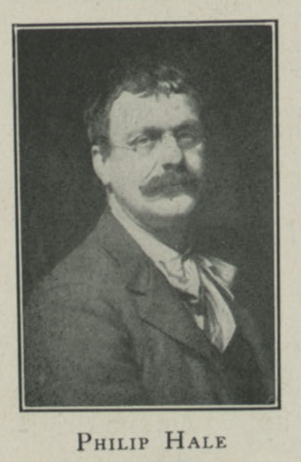
Here's one to start with, the portrait of Philip Hale in the Book Buyer for January 1900 


Images of Philip Hale including the Book Buyer portrait shown above are accessible also via the NYPL Digital Collections. There's a trove of photos in the Philip Hale Papers, 1850's-1936, part of the Mortimer Rare Book Collection, Smith College Libraries. Location update: 
  • Smith College Special Collections MRBC MS 145
Must get to the William Allan Neilson Library at Smith College in Northampton, Mass. Looks like the 1851 first edition of Moby-Dick (formerly?) in the old Rare Book Room of the Smith College library (825 M495m 185) might have belonged to Philip Hale. 

In 1938 Smith College got Hale's library of 2000 books from his widow, including first editions of Whitman's Leaves of Grass and Melville's Moby-Dick (Springfield Republican, Thursday, May 5, 1938). In 1937 some portion of the collection was on display at Harvard, in the front hall of Widener Library:
Philip Hale Collection
Also on view in the front hall of the Library, is an exhibition of books belonging to the well-known Boston music-critic, Philip Hale, presented by his wife. Hale was well known as a book collector, and part of his collection of first editions of Walt Whitman and Herman Melville are shown here.
Of interest is a letter from Good-speeds' the Boston bookseller, crediting Hale with the revival of public interest in Melville's work, and specifically with the sale of 200 copies of "Moby Dick."
-- Collections and Critiques - The Harvard Crimson
Musician and newspaper columnist Philip Hale (1854-1934) is best known for vibrant musical and dramatic criticism, and for his brilliant program notes for the Boston Symphony Orchestra. As a young reader, Catholic journalist Michael Williams (first editor of Commonweal) found himself bedazzled by Hale's 
"splendidly lucid, colourful and musical prose style" and "vital, illuminating wit and irony" 
-- The Book of the High Romance: A Spiritual Autobiography (New York: The Macmillan company, 1918) page 50.
Nowdays? Still highly regarded as "Boston's Consummate Critic" by Jon Mitchell, Professor of Performing Arts at UMass, Boston. Professor Mitchell lectured on Hale in October 2012:
"As writer and critic, Hale was a powerful and influential figure in the artistic life of Boston." -- University of Massachusetts-Boston, Center for the Study of Humanities, Culture, and Society
Although his name is not down on any map of Melville's critical reception, Philip Hale also deserves credit for three decades of perceptive and influential writing about Melville's works in the Boston Herald. And before that, for another dozen or so years of Melville mentions between 1891 and 1903, when Hale worked for the Boston Journal. Philip Hale was a one-man Melville band, as the inventory of his Melville promotions in the Herald and other Boston newspapers will show.

Bostonians knew what brought the Melville Revival when it came around in the early 1920's, and it wasn't Raymond Weaver. No need to seek for pioneering Melville enthusiasts in New York City or London. As Hale's colleague John Clair Minot put it in 1922:
A few lovers of the best in literature, remote from one another in time and place, have kept alive an interest in “Moby Dick,” “Typee,” “Omoo” and White Jacket” through the years. No one has done more to that end—as any Boston bookseller can tell you—than Philip Hale in his “As the World Wags,” which appears daily on this page except when he courteously gives my modest column a chance. --"Speaking of Books," Boston Herald, January 11, 1922.
In 1923, another tribute to Hale's sponsorship of the ongoing "Melville vogue":
"The Herman Melville vogue, for which Philip Hale of the Herald deserves a share of the credit that is commonly given to Frederick O'Brien, is not only bringing out new editions and de luxe sets of his works, but it is resulting in a small library of books about him.  --Boston Herald, February 3, 1923
In March 1929, the Herald promised a review of Lewis Mumford's new Melville biography by
Philip Hale, whose repeated allusions a few years ago to “Moby-Dick” and other of Melville’s books in his “As the World Wags” department was an important factor in bringing about the great revival of interest in this long neglected novelist. --Boston Herald, March 9, 1929
Philip Hale's bio in the 1910 National Cyclopaedia of American Biography:
HALE, Philip, journalist and musician, was born in Norwich, Vt., Mar. 5, 1854, son of William Bainbridge and Harriet Amelia (Porter) Hale and eighth in descent from Thomas Hale, who settled in Newburg, Mass., about 1638. His parents removed to Northampton, Mass., where he attended the public schools and took organ and piano lessons. He was organist in the Unitarian church when fourteen years old. He continued his studies at Phillips Exeter Academy, and was graduated at Yale College in 1876. While at college he took several prizes in composition, was pianist for the Yale Glee Club, and was one of the editors of the Yale “Record.” After graduation he studied the organ with Dudley Buck, meanwhile contributing to the New York “World,” and then went to Albany to study law in the office of his uncle. He was admitted to the bar in 1880, and practised for two years, but a considerable portion of his time was given to music. He was organist of St. Peter's (Episcopal) church, musical critic for the Albany “Times,” and a student of the piano and the theory of music. He spent five years in Dresden and Berlin studying the piano under Xaver Scharwenka, the organ under Albert Heintz and Carl Haupt, harmony under Heinrich Urban, and counterpoint and Partitur reading under Waldemar Bargiel. He was in Paris for a period studying composition as well as organ playing under Alexandre Guilmant. Upon his return to America in 1887 Mr. Hale settled again in Albany, becoming director of the Schubert Club of male voices, and organist and director of the choir of St. John's (Episcopal) church at Troy. During the two years that he held these positions he gave organ and harmony lessons, wrote musical and dramatic criticisms for the Albany “Express,” and was on the staff of the Albany “Union,” where he wrote editorials, attended concerts and theaters as critic, and edited “telegraph copy.” In the fall of 1889 he was called to the First Religious Society (Unitarian) of Roxbury, Mass., as organist and choir director, and held that position for seventeen years. Finding that he could not support himself by the organ alone, he took up newspaper work as a critic. His first employment in this capacity was with the "Boston Home Journal.” He was engaged by the “Boston Post” in 1890, for which paper he wrote musical criticisms, editorials and a column called “The Taverner.” Two years later he went to the Boston “Journal,” where his work was of the same character, his special column being called “Talk of the Day.” He remained with the “Journal” for twelve years and resigned in May, 1903, to take a position on the staff of the Boston “Herald,” to which he contributed, besides musical criticisms and editorials, a special column on “Men and Things.” Since 1908 he has had charge of both music and drama for the “Herald.” For several years during his residence in Boston he was the local correspondent for the New York “Musical Courier,” and he edited the “Musical Record” for two years, and the “Musical World” for one year. He has edited the Boston symphony programme book since 1901, and has contributed occasionally to various magazines. In the course of this busy career he also gave lectures at Columbia University, at Carnegie Institute, Pittsburg and elsewhere, but eventually withdrew altogether from lecturing because the work was distasteful to him. Mr. Hale is one of a small group of brilliant writers identified with musical criticism in America who command respect quite as much for the literary quality of their work as for the special knowledge upon which their observation and verdicts are based. He is conspicuous among critics by reason of his pronounced individuality and the extended range of his information. His influence on musical art bids fair to be as permanent as that of any of his contemporaries in criticism, because the force and pungent flavor of his utterance fix them in the memory, and because, beneath the wit that illuminates his dicta, and beneath the occasional outbursts of contempt for mediocrity and humbug, there is manifest devotion to high ideals that should, and often does, stimulate those who writhe temporarily under his lashing to stern endeavor toward improvement. The “Musical Record” during the brief years of its existence under his editorship was a vehicle for information and comment on musical affairs that upheld the art from contact with petty personalities and sordid commercialism, and not finding sufficient support to justify the publishers in continuing it, its disappearance was felt as a personal loss by those who had come to watch for it and know through it the lofty ideals of its editor. Mr. Hale was married in Berlin, Germany, July 9, 1884, to Irene, daughter of Peter Baumgras, of Washington, D.C.
When I started compiling Melville references in the Boston Journal, I noticed how most of them appeared in the "Talk of the Day" column. Written, as Jon Ceander Mitchell confirms, by Philip Hale:
The Boston Journal, not to be confused with the Boston Home Journal, beckoned and Hale was more than ready for the call…. Hale was hired as music critic, but he was also given full rein over a non-musical column, “Talk of the Day,” of the “cabbages and kings” variety. 
-- Trans-Atlantic Passages: Philip Hale on the Boston Symphony Orchestra (Palgrave Macmillan / St. Martin's Press, 2014)

 In 1890 Philip Hale wrote the "Taverner" column in the Boston Post, according to the National Cyclopaedia of American Biography, cited above. In the great Pursuing Melville, 1940-1980 (University of Wisconsin Press, 1982) Merton M. Sealts, Jr. has identified "Taverner" as Alexander Young, who died March 19, 1891. However, in the Library Journal of September 1891 C. A. C. = Charles Ammi Cutter corrects an item from the New York Times about the identity of "Taverner." The renowned librarian notes that

"Mr. Young was only one of several who wrote in the column over that signature."


Inventory of Melville Notices by Philip Hale


BOSTON JOURNAL 1890-1903


Jon Ceander Mitchell dates the hiring of Philip Hale to late fall 1891. Before Hale's arrival, a few conspicuous but fairly isolated references to Melville in the Boston Journal were supplied by Edward W. Bok and John H. Drew, writing as "Kennebecker." "Talk of the Day" begins to appear in the Boston Journal on October 1, 1891--one day after Melville's obituary was reprinted in the morning edition.
Boston Journal - September 29, 1891
  • Mortuary notice, September 29, 1891; reprinted on September 30, 1891. Interesting and substantive Melville obituary with fuller than usual catalog of Melville's literary works, that includes Moby-Dick and alludes to Mardi as a "philosophical romance." Possibly by Philip Hale who knew the 1856 Dublin University Magazine article titled A Trio of American Sailor-Authors which the Journal obit plagiarizes in closing. In his signed "As the World Wags" column of May 6, 1927 Hale gives a quote from the Dublin journal slamming Mardi as "one of the saddest, most melancholy, most deplorable and humiliating perversions of genius of a high order in the English language."
  • October 31, 1891. Talk of the Day. Holmes's poem "The Last Leaf" and its subject Major Thomas Melville, Herman's grandfather. Reprinted the following Monday, November 2, 1891.
First Melville reference in Philip Hale's "Talk of the Day"
Boston Journal - October 31, 1891
  • August 18/19, 1893. Talk of the Day. Beluga whale really a dolphin, not "that famous malicious monster, Moby Dick, the white whale who played such a bloody part in the legends of Nantucket."
  • December 13, 1893. "Clangor of the Bells." Alludes to The Bell-Tower, "that ghastly, weird tale by Herman Melville."
  • July 11, 1894. Talk of the Day. Melville's Israel Potter features "the most singular use of Paul Jones in romance."
  • November 28, 1894. Talk of the Day. Quotes Mardi on patriotic naming of ships, "the whole federated fleet." Used again! for the Boston Herald, March 2, 1931; see below.
  • May 2, 1895. Talk of the Day. Quotes Melville in Mardi on the cigarret. Same subject as Hale's AWW column in the Boston Herald, March 27, 1916; see below.
  • June 18, 1895. Talk of the Day. Melville in Moby-Dick on the women of New Bedford.
  • October 2, 1896. Talk of the Day. Melville counted with notable writers of short stories in English. Contrasted favorably with Kipling.
  • April 13, 1897. Talk of the Day. Moby-Dick.
  • June 30, 1897. Typee mention.
  • October 8, 1897 "Our Filthy Lucre." "If the Marquesans had any microbe theories, Herman Melville did not mention them, though he found the savages both clean and healthful."
  • November 10, 1897. Books and Reading. Review of Hero in Homespun casually mentions "Father Taylor's sermons, which were used in fiction to such excellent advantage by Herman Melville." 
  • May 12, 1898. Moby-Dick quote about the sweet breath of Salem girls.
  • June 8, 1898. Riff on "joys of noon dinner," quoting Melville's White-Jacket.
  • October 12, 1898. Talk of the Day. Sweet breath of Salem women, again.
  • October 26, 1898. Melville good on "aesthetic pleasures of life among savages," along with Stoddard and Stevenson.
  • July 24, 1899. "Moby Dick escaped Captain Ahab...."
  • September 25, 1900. Talk of the Day. "Moby Dick, the whale that mocked Captain Ahab and his predecessors and followers."
  • November 21, 1900. "Current Literature." Unsigned.  Herman Melville in New Edition. Probably by Philip Hale.
  • October 3, 1900. Talk of the Day. Stevenson on Melville as "howling cheese."
  • October 4, 1900. Talk of the Day. More about Stevenson's use of "howling cheese"; Hale responds to reader "T. M. F."
  • March 27, 1900. Talk of the Town. Irritated by ignorance of the New York Sun, and Peter Toft in the NYT.
  • May 29, 1900. Talk of the Day. Queequeg's tall hat. Used again in Hale's AWW column in the Boston Herald, March 18, 1912.
  • May 4, 1901. Talk of the Day. Wharf-Rat. Superb column on O'Brien's poem and Melville's Encantadas.
  • April 28, 1902. "Talk of the Day Column" quotes NY Sun on Moby-Dick and real ships sunk by whales.
  • May 21, 1902. Not by Philip Hale? Current Literature. Favorable review of Deep Sea Plunderings by Frank T. Bullen, "in the distinguished class headed by our own Dana and Melville."
  • August 13, 1902. Talk of the Day. Lord Lovely's coroneted boot-heel in Redburn.
  • September 16, 1902. Introduces a Mr. Johnson (prototype of Herkimer Johnson in AWW) whose favorite books include "yarns by Herman Melville."
  • September 26, 1902. Talk of the Day. Moby-Dick.  "Herman Melville's story still remains the one great romance of whaling."
  • April 3, 1903. Talk of the Day. Moby-Dick. Again with the women of Salem.
May 22, 1905. In correspondence with the Walt Whitman Fellowship, Philip Hale admits to reading Melville "with special pleasure": 

"You will laugh when I tell you that the three Americans I now read with special pleasure are Whitman, Poe and Herman Melville." 
-- Philip Hale, letter from Boston of May 22, 1905 to the convention of the Walt Whitman Fellowship in New York, as quoted in the June 1905 issue of The Conservator. 

In 1903, as recorded in the National Cyclopaedia of American Biography, Philip Hale joined the staff of the Boston Herald and wrote musical criticism, editorials and a special column on "Men and Things." 

BOSTON HERALD 1903-1933

AWW = As the World Wags

  • May 15, 1904. "Rich Sea Fruit." Unsigned. "This odorous fruit of ocean has served novelist and moralist as well as cook, physician and experimenter with aphrodisiacs. One of the finest chapters in Herman Melville’s 'Moby Dick' is that descriptive of the surgical operation on the whale—and what a marvelous romance is this same book, one that puts to shame and confusion all subsequent cetological novels."
  • July 5, 1904. "Suggestive Spelling." Unsigned. Fitz James O'Brien's Wharf-Rat, Encantadas.
  • February 23, 1907. "In Spotless White." On the whiteness of Mark Twain's favorite suit. Unsigned comment: "Not even a reading of Herman Melville's inquiry into the terror of the color white would disconcert him...."
  • July 17, 1907. "Dead Letters." Unsigned, probably by Philip Hale. "Bartleby, in Herman Melville's fantastical tale, had been a subordinate clerk in the dead letter office, and his duties had fed his natural hopelessness."
  • March 31, 1908. "More Stevensoniana." Unsigned. Evangelical "zeal is distressing to the romanticist, for its aim is to make prosaic the native life that to him, a foreigner, is full of poetry." Notes the anti-missionary vein of Melville's Omoo.
  • May 18, 1908. "Men and Things." Unsigned. Subject of teeth inspires thought that even "regular and white" teeth might "threaten and command, or recall Herman Melville's inquiry into the inherent and mysterious horror of the color white." As for instance in Poe's story "Berenice."
  • May 23, 1908. Item on "Trees and Thunderbolts" recalls "Herman Melville's fantastical tale, The Lightning-Rod Man." Probably by Philip Hale, who loves this story and repeatedly uses the word fantastical when describing Melville's writings.
  • July 27, 1908. "At Honolulu." Unsigned item; reception at Honolulu evokes Typee and the "enchanting Fayaway."
  • July 29, 1909. "Men and Things." Important critical survey of Melville's works a decade before the centenary of his birth. Style and substance of comments here (for example, on a naval battle in Israel Potter favorably compared with Walt Whitman) will resurface in "As the World Wags" columns by Philip Hale.
Melville in Philip Hale's "Men and Things" column
Boston Journal - July 29, 1909
    • August 22, 1909. "Men and Things." Herkimer Johnson counts Herman Melville with Artemus Ward and Jacob Abbott (after Jonathan Edwards, Poe, Emerson, Hawthorne, and Walt Whitman) among "the great writers of this country."
    • July 16, 1910. "Men and Things." Melville's "amusing" though "fictitious"description of Benjamin Franklin in Israel Potter.
    • July 17, 1910. "On the White House." Unsigned, by Philip Hale. Wonders if Melville's story contributed to the diminished reputation of the traveling lightning-rod salesman. Recalls that Melville's tale "The Lightning-Rod Man" had been "characterized by an unsympathetic reviewer at the time as  grotesque verbiage." 
    • January 25, 1911. "The Galapagos." Unsigned. With Hale's characteristic references to Fitz James O'Brien's Wharf-Rat, Melville's Encantadas.
    • December 18, 1911. AWW. High praise for Israel Potter.
    • December 25, 1911. Israel Potter, again. "The most satisfactory portrait of John Paul Jones is that drawn by Herman Melville."
    • March 18, 1912. AWW. Queequeg's hat. "Herman Melville's friend in 'Moby Dick,' the South Sea harpooner, whom he met at the New Bedford inn, began dressing in the morning by clapping a silker on his head."
    • April 27, 1912. AWW. Consideration of "Loblolly and Burgoo" includes reference to "Herman Melville's boy Redburn."
    • June 25, 1912. AWW.
    Melville's Squid.
    And now a question about the “great white squid” described by Herman Melville in “Moby Dick.” It was seen by Ishmael and others from the vessel captained by mad Ahab. It was stretching its beautiful and fearful length under a cloudless sky, and they that saw the squid shuddered, knowing that those who looked upon it at any time were doomed to perish and that soon. Not long after the white whale, pursued relentlessly, turned on his enemies and Ishmael alone was left to tell the wondrous tale. I can find nothing about this variety of squid in any book of reference.
    • June 15, 1912. AWW. "Veranda Traveller" named Hunkerton adventures out by train; quest for books of travel includes "trying to find a set of Herman Melville's sea tales."
    • June 29, 1912. Moby-Dick counted with "Strange Favorites"
    • July 12, 1912. AWW. High estimation of "The Lightning-Rod Man" and other of Melville's short stories. Protests old view of LRM  (by unnamed critic) as "grotesque verbiage."
    • August 24, 1912. "Irritating White." Excuse to consider Melville on whiteness of the whale--unsigned.
    • September 9, 1912. AWW. Whiteness of the whale discussed in the Herald.
    • May 23, 1913. AWW.
    The late Capt. De Friez was one of the whalers that made Nantucket famous the world over. The glory is departed, yet the tradition of pluck and daring will outlive the child born yesterday. The Capt. Ahab of Herman Melville’s vividly realistic and wildly fantastical story may yet be taken as a historically legendary character as Sinbad or Achilles, and the white whale Moby Dick may be classed with the monstrous kraken. In ‘Moby Dick” the adventurous dreamer Melville gave a lifelike picture of scenes in New Bedford, where now a statue stands in honor of the whaler.
     PH goes on to cite De Crevecoeur on opium use by Nantucketers, particularly women.
    • June 27, 1913. AWW. The killer whale according to Melville's system of classification.
    • June 28, 1913. AWW. Frank T. Bullen plagiarized from Moby-Dick. "Herman Melville is now little read. Mr. Bullen read him faithfully before he wrote his whale story and profited largely without due acknowledgement."
    • July 4, 1913. AWW. Letter from "C. F. A." of Cambridge informs AWW of Frank Bullen's letter of September 20, 1905 in the New York Times Saturday Review of Books, honoring Melville while disclaiming his influence on Cruise of the Cachelot. Philip Hale comments: "We are glad to be reminded of Mr. Bullen's letter for we would not do anyone injustice. We now recall the fact that the controversy did not end with the publication of this letter."
    • July 17, 1913. "With a Plume" Discussion of John Paul Jones leads to consideration of "the undeservedly forgotten novel" Israel Potter--and the writer makes Philip Hale's characteristic connection to Walt Whitman.
    • October 11, 1913. AWW. "Color Fancies." Whiteness of the Whale.
    • January 28, 1914. AWW. Nominal mention of "Melville" with other writers of "admirable short stories."
    • July 22, 1914.  Not by Philip Hale. "Literary Notes" signed "S. C. W." Notice of the reissue of Melville's romances by the Page Company "which acquired them with the book publishing business of Dana Estes & Co."
    • September 9, 1914. "Whale Meat." Unsigned, with informed references to "Herman Melville's 'Moby Dick,' the great epic of the sea."
    • January 12, 1915. AWW - Letter to AWW signed "Capt. Brassbound" cites Moby-Dick for definition of "old salts": "Every finger a fish-hook, every hair a rope-yarn, and blood of Stockholm tar."
    • March 19, 1915. AWW Another letter from Brassbound, this on the death of Frank Bullen. PH comments: "When all is said, the great book about the whale is not by Bullen; it is 'Moby-Dick,' of Herman Melville."
    • June 24, 1915. "Mr. Morris the Critic." Unsigned, on short stories with mention of Melville's "The Bell Tower."
    • January 5, 1916. AWW. "Ironical Nomenclature." On naming of ships, with favorite lines from Mardi on "the whole federated fleet."
    • January 12, 1916. AWW. Hale as editor vouches for the corporeality of his regular correspondents including Herkimer Johnson; will swear on a stack of bibles, like Melville (as Ishmael) "at the end of the Town-Ho's story."
      • March 7, 1916. AWW.
      So there’s a new book about whalers and whaling. Whenever we see a book of this kind advertised, we read Melville’s “Moby Dick” again. And Herman Melville, by the way, had been a whaler when he wrote that strange mixture of information, romance, imagination, mysticism and hysteria—the one great book of the sea.
      • March 27, 1916. AWW. Quotes from "Herman Melville’s wildly fantastical romance, 'Mardi'" on the pipe vs. cigarette, and wonders where Melville got the non-standard form "cigarret." 
      • June 6, 1916. "Sea-Fights and Poets." Unsigned, with Hale's characteristic references to Israel Potter and Walt Whitman.
      • July 4, 1917. AWW. Beer and ale, Ben Franklin and Israel Potter.
      • August 10, 1917. AWW. Survey of Melville's works in answer to query from reader "C. F. A." Some of this material including the closing reference to Allan Melville gets recycled two years later, in the centenary AWW published August 1, 1919.
      • September 24, 1917. Quotes from Moby-Dick on definition and classification of the whale.
      • June 20, 1918. AWW. Quotes from chapter 65 of Moby-Dick, treating Stubb's way of cooking whale steaks; and citing Melville's riff on universal cannibalism as "one of his delightfully fantastical digressions."
      • July 13, 1918. AWW. Letter from book collector W. E. K. accuses PH of "raising the price of literature" in Boston by commending Melville's "fascinating tale." "One can find 'Moby Dick' in the great libraries, but it deserves a place on one's private shelf." 
      • August 1, 1919. Centenary of Melville's birth. Unsigned biographical article, "Today's Centenary of Herman Melville" appears alongside AWW, where Philip Hale presents a critical survey of Melville's works. Hale urges merits of Piazza Tales and Israel Potter, and offers  concluding reminiscence of Herman's brother Allan Melville.
        Boston Herald - August 1, 1919
        Found in the historical Newspaper Archives at Genealogy Bank
        • August 16, 1919. AWW. Letter from Emil Schwab of Arlington informing AWW of Melville's frontispiece portrait in the 1892 edition of Typee.
        • October 31, 1919. Debussy's L'isle joyeuse evokes Melville, especially Mardi. 
        • April 19, 1920. AWW. "Salt Horse and Salt Tales" With mentions of Moby-Dick and Israel Potter.
        • September 8, 1920. AWW. Quotes from White-Jacket on the subject of keelhauling and adds, "There is a still fuller description in Marryat's 'Snarleyyow.'"
        • May 11, 1921. AWW - Exchange with reader Rory Dillon "Concerning Moby Dick." Philip Hale cites Viola Meynell; and gives excerpts from the "wildly enthusiastic" response to Moby-Dick by "H. M. T." =  Henry Major Tomlinson in The Nation, January 1, 1921.
        • May 19, 1921. AWW. Nobody reads Melville's Piazza Tales except "some old fogies who remember them as appearing in Putnam's Magazine."
        • June 22, 1921. AWW. "Moby Dick" Again. Tomlinson's "rhapsody" in the Nation; quotes response by "Wayfarer." With Hale's critical survey of Melville's works, more detailed than usual.
        • July 5, 1921. AWW.  "Let us talk again about "Moby Dick." More about the new enthusiasm in England sparked by publication of the Oxford Books Moby-Dick. Hale has been following the British revival in The Nation and The Athenaeum; quotes published letters from Michael Sadleir and James Billson. Letter to AWW from Alice C. Hyde reports on reading Moby-Dick aloud in North Cohasset (first ever M-D Marathon?) and asks, "couldn't you get up a Moby Dick club so that a little of the flammable enthusiasm which those of us who have read the book feel about it could have a safe outlet?" Philip Hale replies that "Melville is too fine a fellow for a club in his honor. Remember the cruel fate of Walt Whitman and Robert Browning."
        • July 8, 1921. AWW. Prints letter from Earle E. Riser, longtime admirer of Melville and his "masterpiece" Moby-Dick; Riser "gratified as well as amused" by current Melville Revival.
        • July 13, 1921 AWW. Letters by Melville collectors/fans Charles B. Hawes and Charlotte Reed White. They independently resent all the recent attention to Melville, particularly in AWW.
        • August 9, 1921. AWW - Brisk sales of Moby-Dick ("The Reprint, Of Course") in Boston bookstores.
        • August 29, 1921. AWW. editions of Moby-Dick.
        • August 30, 1921. AWW - Dough-Boy, with suggestions for future exam questions on Moby-Dick.
        • September 6, 1921. AWW.  Letter from E. H. B. of Boston commends White-Jacket. Hale remembers and quotes from the "appreciative editorial article" in the New York Times for the centenary of Melville's birth.
        • September 19, 1921. AWW - New Everyman editions; appeal and "picaresque" vein of Omoo.
        • September 23, 1921.  Letter to AWW from Boston reader "G. E." blames Hale for high prices of Melville's books now: "Your well-intentioned propaganda costs us ["Melvillians"] dearly." Reports on marginalia in volume of Melville's Piazza Tales discarded by the Watertown Public Library," at the end of "Bartleby": "This Herman Melville is a great humbug."
        • December 3, 1921. Reference to whale dissection in a lecture on Iceland recalls Moby-Dick.
        • December 17, 1921. AWW. Melville reference in verses by "LAND CRAB" titled "MOBY DICK'S DESCENDENT / IN LIBERATED LINES." Views appalling butchery of whales in recent film. Then "Home to Melville! To his horrors / He adds thrills!"
        • June 17, 1922. AWW Moby-Dick; influences on Melville include Rabelais and Sir Thomas Browne, doubts Strachey on proposed influence of Balzac.
        • June 25, 1922. AWW. Parenthetical comment on recent editions of Moby-Dick: "For full enjoyment of these reprints the introductions by belated admirers should of course be torn out, or the leaves pasted together."
        • July 3, 1922. AWW. High regard for The Piazza Tales.
        • July 5, 1922. AWW. "Calm Chowder" and Mrs. Hussey's Clam Chowder in Moby-Dick.  Also a bit on Mardi.
        • July 25, 1922. AWW. The Lightning-Rod Man. 
        • July 29, 1922. AWW. "The tortoises on the Galapagos Islands inspired Herman Melville to describe and moralize curiously and wildly in his account of these strange islands known to old Spanish sailors as 'The Enchanted.' These chapters with 'Benito Cereno,' 'Bartleby' and 'The Bell Tower'--all in 'The Piazza Tales'--should alone glorify the name of Melville."
        • October 2, 1922. AWW. Moby-Dick, "The Tail."
        • October 20, 1922. AWW. British praise for Melville and Moby-Dick in the September 30, 1922 Athenaeum review, "The Vogue of Herman Melville."
          • December 11, 1922. AWW. Prefers "old thumbed battered volumes" to new "sumptuous edition" of Melville's works. Appreciative quotes from Mardi. 
          • December 30, 1922. AWW. Quotes (again) and responds to the old Dublin University Magazine criticism of Mardi. "Tut-tut! Pish! Likewise, go to!" With longish excerpt titled "GOOD KING MEDIA ON JURIES." 
          •  January 6, 1923. Mentions The Bell-Tower.
          • January 31, 1923. AWW. 'A prominent bookseller in Boston writes to us that since the references to Herman Melville's 'Moby Dick' in The Herald he has sold over 2000 [sic] copies in various editions, and also many copies of Melville's other books." With comments on Israel Potter, "Benito Cereno," Lightning-Rod Man, Raymond Weaver, Elihu Vedder.
          • February 17, 1923. Salzedo performed by Boston Symphony Orchestra contrasted with Melville's Encantadas.
          • May 2, 1923. AWW. Percy A. Hutchinson on Conrad, unable to discern "psychology" in Melville. What, he "never read Melville's 'Moby-Dick'"?
          • May 12, 1923. "Moscow Players in Work by Gorky." Signed review of "The Lower Depths." "It was easy to guess that Luka was of kin to the gentle soul who roomed in the third floor back and to the stranger who boarded the steamboat in Herman Melville's fantastical story "The Confidence Man," if story it can be called."
          • May 23, 1923. Galapagos, Melville's Encantadas. H. M. Tomlinson in The Nation and The Athenaeum.
          • September 16, 1923. Moby-Dick and D. H. Lawrence
          • September 20, 1923. Letter to the Editor from Philip N. Sanborn gratefully credits Philip Hale for popularizing Melville in "As the World Wags."
          • October 9, 1923. A. A. Milne's Mr. Pim "reminded one in a way of Bartleby."
          • October 15, 1923. AWW. Praises Melville's "Encantadas"; quotes "Mr. A. N. Tomlinson" [in The Nation and The Athenaeum volume 30]: "In simple, firm, and nervous English, which in these days is salutary to read, he creates the Galapagos in a reader's vision till they loom with all the dark, sinister, and significant character of a nightmare in which reason plays only like fitful lightning."
          • October 23, 1923. Letter to AWW from "E. H. J." wonders about "Salvator Tarnmoor," the stated author of "The Encantadas" in Putnam's. "Was this the name under which Melville wrote?" Hale: "Why Melville chose to give a name of his invention to 'The Encantadas,' as if to conceal authorship, is not known; at least we have never seen an explanation."
          • November 18, 1923. AWW. Quote from The Confidence-Man, Melville's cosmopolitan on "that good dish, man."
          • October 7, 1924. Mentions Tacitus in The Confidence-Man.
          • June 3, 1925. AWW. Recommends "The Lightning-Rod Man" "to those who are afraid of thunder storms."
          • September 12, 1925. AWW. Encantadas.
          • October 16, 1925. AWW. Bartleby.
          • May 11, 1926. AWW. Favorable reception of Melville's books in England. 
          • May 26, 1926. AWW. Franklin in Paris, Israel Potter.  
          • February 15, 1927. Signed review of a three-act comedy "Mozart," at Opera House. Sacha Guitry as Grimm "in his make-up and in many of his comments, his irony, his common-sense, reminded one of Benjamin Franklin in Paris as described by Herman Melville in his "Israel Potter."
          • March 18. 1927. AWW. "Benito Cereno," new edition from Nonesuch Press with illustrations by E. McKnight Kauffer. "It seems to us that Melville told the gruesome story mighty well." 
          • March 30, 1927. AWW. "How many who are still 'discovering' Herman Melville could pass an examination on "Israel Potter."?  Hale thinks it "one of Melville's most characteristic and delightful books," offering "touches of Melville's irony."
            • April 8, 1927. AWW. Israel Potter, with identification of Melville's pamphlet source. 
            • May 6, 1927. Lots on and from Mardi. "What better book for summer reading than this strange, mystical, satirical, poetic, romantic 'Mardi'?" Rhapsodizing, smoking, etc. Naming battleships, again. Looks back on British reviews of Mardi, negative and positive. 
            •  June 8, 1927. AWW;  nominal mention of notes on Herman Melville by Van Wyck Brooks. 
            • May 23, 1928. Encantadas.
            • July 13, 1928. AWW.  Jonah and the Whale. Lots here about and from Moby-Dick. "Melville had Father Taylor of Boston in mind when he described Father Mapple." Melville also "was reminded of Perseus, the prince of whalemen, who harpooned the monster and bore away the maid Andromeda."
            • March 23, 1929. Major review of Mumford's biography. "... concerning Melville, the man, comparatively little is added to one's previous street and house acquaintance of him." All in all, in spite of occasional extravagances, "a book that no lover of Melville can afford to ignore."
            • April 30, 1929. "The 'Agatha' Letter." Summarizes NEQ article by S. E. Morison.
            • May 23, 1929. "Israel Potter." Unsigned, but probably by Philip Hale with elaborate discussion and characteristic reference to Walt Whitman.
            • June 2, 1929. "The Horse and His Rider." Unsigned; quotes from Melville's Civil War poem "Sheridan at Cedar Creek."
            • January 24, 1930. "Aids to the Conference." Signed, By Philip Hale. Ponders what might happen if international political conferences encouraged drinking and smoking; "if the outcome of King Media, Babbalanja and the other worthies known to the Herman Melville of 'Mardi' were to be commended...."
            • March 2, 1931. "Names, Not Numbers." Signed, By Philip Hale. On the subject of naming warships, quotes Melville's Mardi: "how glorious, poetically speaking, to range up the whole federated fleet, and pour forth a broadside from Florida to Maine." 
            • April 21, 1931. "Out of the Whale." Signed, By Philip Hale. On ambergris.
            •  May 14, 1931. "Melville and Hawthorne." Article signed, By Philip Hale.
            • June 24, 1931. "Illustrated by—" Signed, By Philip Hale. Books of fiction by some authors "are best illustrated by the authors' descriptions of characters and scenes....Who would not rather see Captain Ahab as Herman Melville saw him than as imagined by a recent illustrator?" [Rockwell Kent???] 
            • December 9, 1931. "Phil Sheridan and Poets." Signed By Philip Hale. Gives the first stanza of Melville's "stirring poem" Sheridan at Cedar Creek.
            • February 24, 1932. "Whales and the League." Signed, By Philip Hale. Protection of whales by The League of Nations, from perspective of Moby-Dick.
            • April 16, 1932. "Appropriately Bound." Notice of NEQ article by John Birss on Melville's review of The Red Rover by James Fenimore Cooper
            • May 30, 1932. "Twisted Meanings." Signed, By Philip Hale. Consideration of calligraphy inspires hypothetical reference to scriveners in Dickens and Melville:
            The scrivener, whether he were a poor devil working for some Tulkinghorn, or a Bartleby who finally rebelled, as in Herman Melville’s story, wrote what was described as a legal hand, often a fine example of calligraphy.
            •  July 11, 1933. "A Note on Bluffing." Signed, By Philip Hale. Contra Donald A. Laird,
            “literature owes much to exaggeration, learned professor, and not only the writings of early American humorists, but Shakespeare and other Elizabethans, Rabelais, Milton coming down to Herman Melville in his 'Mardi' and still later writers.”
            Philip Hale's review of Raymond Weaver's "engrossing and irritating" Melville biography; here from "The Atlantic's Bookshelf," The Atlantic Monthly (February 1922):
            Hale's review of Weaver's Melville biography in
            The Atlantic's Bookshelf - The Atlantic Monthly - February 1922

             Related posts

            Sunday, July 20, 2014

            Whaling in the Straits of Timor

            http://mysite.du.edu/~ttyler/ploughboy/bealeold.htm

            Whaling in the Straits of Timor, a first-hand narrative of adventure on a London whaler, was published in the April 1859 issue of The Knickerbocker magazine.

            A British newspaper erroneously credited Herman Melville with the authorship of "Whaling in the Straits of Timor," introducing excerpts from the story under the heading "A Massacre of Whales":
            A recent number of the “Knickerbocker, or New York Merchant’s Magazine,” contains the following interesting description of a whale hunt, which we may undoubtedly attribute to the versatile and graphic pen of Mr. Herman Melville, whose talents in describing such scenes are unequalled:—  (Luton Times and Advertiser, May 7, 1859)
            The transparently and uniformly cheerful style of the piece is nothing like Moby-Dick, but five times the captain of the whale-ship "Diana" addresses the narrator as "Melville."
            It was eight bells, (noon,) and I was about descending into the half-deck to dinner, when Captain Hunter called me to him, and said: ‘Melville, I want you to go aloft, and take a long look and strong look for whales; the chaps at the mast-heads I think are all asleep, they are so quiet. I would almost swear there are whales in sight, for I can smell them. Look sharp to windward.’
            The reason he selected me, was my luck. I had seen three-fourths of the whales during the voyage; and the ship now only required a couple of hundred barrels to fill up. It was therefore conceded fore and aft that I had the best eyes in the ship. Five bottles of rum had been won by me in succession for having seen whales. . . . (351-352)
            In the Index to volume 53 of The Knickerbocker (January-June 1859), the author of "Whaling in the Straits of Timor" is identified as Duncan McLean.

            WorldCat likewise names Duncan McLean as the author.

            On May 23, 1859 The Boston Traveler reprinted McLean's story as a "spirited description of sperm-whaling incidents" from "the time when whales were more plentiful than at present, and before the invention of bomb-lances and whaling-guns." 

            The month before Whaling in the Straits appeared, The Knickerbocker published an article by McLean titled "Seamanship of the Atlantic Monthly.”
            Its author, Duncan McLean, asserts that an article called “Men of the Sea,” from the January 1859 issue of The Atlantic Monthly, which describes sailors as degraded, was written out of inexperience, ignorance, and stupidity. His own assertion that “the seamen of our day have not degenerated” seems more in keeping with publications such as Harper’s and Leslie’s, where the activities of ships and sailors are extolled rather than bemoaned. -- Jill B. Gidmark, Encyclopedia of American Literature of the Sea
            Not much is known about Duncan McLean. Or rather, not much is remembered. McLean the author of "Seamanship" was from Boston, according to the Springfield Republican (March 5, 1859). Presumably then he is the same Duncan McLean who wrote letters to the Boston Traveler on behalf of a "Sewing Teacher of the Adams School" from his residence at No. 96 Princeton street, East Boston" (Boston Traveler, September 27, 1865).

            Published in the month before Herman Melville's death, the Boston Herald article "Father Neptune's Visit" records the reminiscences of a "Capt. Duncan McLean" on the nautical traditions connected with Crossing the Line:
            In old times, when most ships crossed the equator, Neptune and his suite came on board and shaved the greenhorns—those who had not crossed it before,. But this ancient ceremony, like the “shells” who invented it, has passed away, never, perhaps to be revived. As late as 60 years ago, it was quite common, and has been frequently described by nautical writers.
            “The last time I crossed the line, outward bound,” said Capt. Duncan McLean the other day, “I belonged to a sperm whaler, when sperm whaling was in the zenith of its glory, and sperm oil brought $1 a gallon. . ." --Boston Herald, August 9, 1891; found in the Newspaper Archives at Genealogy Bank.
            On Sunday, October 18, 1896 McLean's obituary appeared in the Worcester Daily Spy:

            DEATH OF DUNCAN McLEAN.

            Boston, Oct. 17.—Duncan McLean, the well known journalist, died today, aged 85 years. Capt. McLean’s death occurred at his residence, 119 Princeton street, East Boston.

            Duncan McLean was born in Kirkwall, Orkney, one of the scenes of Sir Walter Scott’s “Pirate,” on Oct. 14, 1811, and was a sailor in early life. He used to swim with Oliver Wendell Holmes. He was particularly well known as a writer of sea stories and as a ship editor. He had an interest in several newspaper enterprises. 
            So now we can supply dates for the life of Melville's contemporary Duncan McLean (1811-1896).

            The Boston Herald obituary confirms that Duncan “was well known in newspaper circles" and adds:
            ... he was actually the oldest newspaper man in this city. He was born in Kirkwell, Orkney, Scot., Oct. 14, 1811.
            Deceased went to sea at an early age. He acquired a fund of nautical information. He had charge of the shipping department of the Boston Post when it was under Col. Greene’s management. He subsequently purchased an interest in the Boston Atlas. When the Atlas and various other papers were joined to the Traveler, McLean took charge of the shipping and commercial departments of that paper, and remained with it 30 years. 
            He leaves two daughters and a son. (Boston Herald, October 18, 1896)
            In a speech on “Old Time Editors,” Benjamin F. Stevens remembered McLean and his contributions to Boston journalism:
            The Atlas was, besides its strong political views, a thoroughly excellent newspaper, as were the others of that day. It was especially noted for its ship news—a portion of the paper conducted in the forties by the late Duncan McLean, a thorough-going Scotchman of genuine worth as a writer as well as a gatherer of news. --Boston Herald, Sunday, January 31, 1897
            The Boston Journal on Saturday, October 17, 1896 provides a long detailed tribute in the Mortuary Notice for Duncan McLean. Among other fascinating facts, the Journal obituary reveals that McLean wrote nautical tales "over the nom de plum of Capt Oakum."

            After a break, we will give the whole tribute from the Journal in another post.

            Related post: