Showing posts with label California. Show all posts

Thursday, September 7, 2023

Harry Hubbard in Stockton, 1887 notice of his illness with mentions of Melville and THE WHALE

Stockton
Albertus Del Orient Browere via American Gallery

Henry F. Hubbard (1820-1887) was a "green hand" with Herman Melville on the whaleship Acushnet. Hubbard, just 20 years old, and the future author of Moby-Dick, 21, signed on late in December 1840. On January 3, 1841 they sailed out of Fairhaven, Mass. with Captain Valentine Pease on Melville's (and their ship's) first whaling voyage. Eighteen months later, in June of 1842, Melville and another "green hand" Richard Tobias Greene famously deserted at Nuku Hiva in the Marquesas. Melville and Hubbard would reconnect in the early 1850's when Hubbard visited Pittsfield. On March 23, 1853 Melville inscribed a copy of The Whale to 

"Henry Hubbard from his old shipmate and watchmate on board the good ship Acushnet (Alas, wrecked at last on the Nor'west)"

https://www.lib.uchicago.edu/collex/exhibits/special-collections-special-director/whale-1851/

At some point (then or earlier) Hubbard updated Melville on the fates of former shipmates, as shown by Melville's extant memorandum of What became of the ship's company of the whale-ship "Acushnet" according to Hubbard who came home in her. Melville's memo and Hubbard's inscribed copy of The Whale (with two interesting annotations about real-life counterparts of Stubb and Pip) are presented and fully discussed in the 1988 Northwestern-Newberry Edition of Moby-Dick.

Hubbard made a name and fortune for himself in California. His obituary in the Stockton Evening Mail of March 26, 1887, cited for relevant biographical facts of Hubbard's life by the N-N editors, contains no reference to Moby-Dick or its author. Melville and the British title of his great whale book were both mentioned, however, in a previous notice published by the same newspaper under the heading, "H. F. HUBBARD'S SICKNESS." The writer thought Harry Hubbard's whaling adventures "would make an interesting book" and believed also that

"Many of his experiences were mentioned by Melville in his works."

Transcribed below from the Stockton, California Evening Mail of March 9, 1887. Found on newspapers.com; accessible also via the California Digital Newspaper Collection.
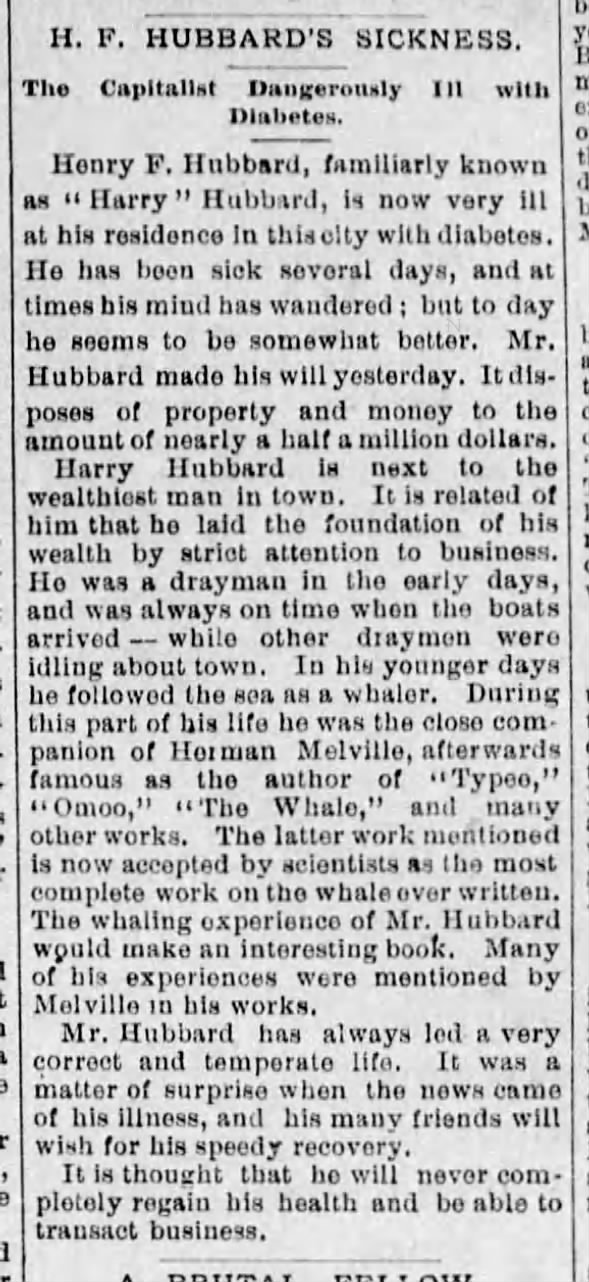

09 Mar 1887, Wed The Evening Mail (Stockton, California) Newspapers.com

H. F. HUBBARD'S SICKNESS.

The Capitalist Dangerously Ill with Diabetes.

Henry F. Hubbard, familiarly known as "Harry" Hubbard, is now very ill at his residence in this city with diabetes. He has been sick several days, and at times his mind has wandered; but to day he seems to be somewhat better. Mr. Hubbard made his will yesterday. It disposes of property and money to the amount of nearly a half a million dollars.

Harry Hubbard is next to the wealthiest man in town. It is related of him that he laid the foundation of his wealth by strict attention to business. He was a drayman in the early days, and was always on time when the boats arrived--while other draymen were idling about town. In his younger days he followed the sea as a whaler. During this part of his life he was the close companion of Herman Melville, afterwards famous as the author of "Typee," "Omoo," "The Whale," and many other works. The latter work mentioned is now accepted by scientists as the most complete work on the whale ever written. The whaling experience of Mr. Hubbard would make an interesting book. Many of his experiences were mentioned by Melville in his works.

Mr. Hubbard has always led a very correct and temperate life. It was a matter of surprise when the news came of his illness, and his many friends will wish for his speedy recovery. It is thought that he will never completely regain his health and be able to transact business. 

Daily Alta California - March 26, 1887

Monday, April 7, 2014

Herman Melville, seven of his works, his wife, and and both lawyer brothers remembered in California, 1854


Here are two items from the short-lived Daily Placer Times and Transcript of San Francisco, California. Both are available in the Newspaper Archives at GenealogyBank. Adding a few new errors along the way, the Times and Transcript took some delight in correcting the comically inept reporting of a rival paper.

From the Daily Placer Times and Transcript, Thursday, November 16, 1854:
THE RIP VAN WINKLE OF THE PRESS—The News, last evening treated its readers with the following astounding announcement:
Among the arrivals by the Golden Gate, we notice that of S. Ross Browne, of Washington City, well known to literateurs as the author of “Typee, or a Voyage Thither,” “The Howadji, or Travels in Syria and Egypt,” “Two Years before the Mast,” etc., and will be recollected by old Californians as the official reporter of the Convention that drafted the existing constitution of our State. For the past two years Mr. B. has been engaged as chief clerk in one of the Departments at Washington. Of the object of his visit here at the present time we are not advised, but take the liberty to express the wish that he may be induced to give to the reading public his impressions of California as she presents herself to the tourist in 1854.
The reliability of the news we had considered unimpeachable, but this out Herods all newsmonger’s gossip we ever met with. Mr. J. Ross Browne did not arrive by the Golden Gate, nor is he the author of any of the works mentioned above, and the object of his presence is well known. Mr. Browne has been in the country since July last, in his capacity of Government Fiscal Agent, examining the accounts of civil, naval, military, land and Indian office officials on the Pacific coast, and as such has visited Oregon, and nearly all the posts in our State. Mr. J. Ross Browne is well and favorably known as “Yusuf” in the literary world, and stands in the same niche of popular estimation as Mr. Herman Melville, the author of “Typee,” Mr. Curtis, the “Howardje,” and the Rev. Mr. Dana, the author of “Two Years Before the Mast.”
However gratifying it may be to Mr. Browne to be classed as the source of such distinguished literary effort, we feel justified from his proverbial modesty, in setting our neighbor correct on this point. Mr. J. Ross Browne arrived in the Goltah from a visit to the Indian Reserve at Tejou, with the affairs of which we are gratified to learn he felt much pleased. That Mr. Browne will give the world his impressions of the American possessions on the Pacific we feel a certainty, and to none more able could such a task be committed.
Below is the follow up article, also from the Daily Placer Times and Transcript, Friday, November 17, 1854:
RIP VAN WINKLE IN SEARCH OF INFORMATION.—To relieve the “intense anxiety” expressed by the News, in regard to our remarks on the distinguished literary honors it bestowed on Mr. J. Ross Browne, and the queries it levels at us, we would state that Herman Melville is the bona fide baptismal and paternal appellation of a distinguished son of the State of New York, he having been born in Duchess county, of a staid and respectable Knickerbocker family. He is, we believe, the second of three brothers, all of whom have become men of note. Actuated by a roving disposition, after his collegiate education, he ran away from home and made a voyage in a whaler round the world, and on his return gave to the reading public his impressions of travel in “Typee” which, from its peculiar style, was accepted by the literary world as an ideal composition presented under an assumed name. His eldest brother, Gansevoort Melville, died in London whilst filling the position of Secretary of the U. S. Legation, under the Hon. Louis McClane, to which place he was appointed by President Tyler. His remaining brother is a lawyer of considerable repute as a chamber practitioner, whose “shingle” we have seen on the fan-light of No. 14 Wall street, New York. With both gentlemen we are happy to be acquainted. So far as regards Melville being a “nom de plume,” it is nowhere disputed that Mr. H. M. did write Typee, Omoo, Mardi, Redburn, White-Jacket and Bartleby the Scrivener; and moreover he is the author of the admired serial novel now in course of publication in Putnam’s Monthly, entitled “Israel Potter, or Fifty Years of Exile,” a national tale of the early days of our confederacy, written in an entirely different style from any of his previous works. Mr. M. now resides on his farm at Berkshire, Massachusetts, with his family, his wife having been a Boston belle, in company with G. P. R. James, Rev. H. Ward Beecher, and like kindred coterie, as neighbors.
Mr. Curtis, the “Howadji,” is the author of those widely read satire known as the “Potiphar Papers,” and as such the public were made acquainted with his physiognomy by means of an admirably executed steel engraving, which adorned a late number of Putnam’s Monthly. He is also a newspaper man, being one of the New York Tribune’s host of contributors. Mr. Richard H. Dana, Jr., the author of “Two Years before the Mast,” is a lawyer of Boston, who has rendered himself conspicuous in the late slave case in that city.
Having satisfied the News as to the gentleman, we need scarcely remark, that the error in spelling “Howadji,” and the prefixture of Rev. for Rich., were merely typographical errors, and would not, with others, have appeared but for an incidental omission of proof reading.
About the typos, maybe so--but President Polk appointed Gansevoort Melville, not Tyler. Also the writer neglects to mention Herman Melville's younger brother Thomas, and does not know that Herman was born in New York City. And wait, what happened to Moby-Dick and Pierre?

Still, the November 17th item provides a friendly and knowing treatment--and you gotta love the rare mention of Bartleby, the Scrivener by somebody who remembered 14 Wall Street.