Showing posts with label Stanwix Hall. Show all posts

Tuesday, October 19, 2021

Another Mrs. Tomlinson

Daily Albany Argus - January 4, 1847
 found on Fultonhistory.com

Herman Melville gave one very early copy of his first book to a "Mrs. Tomlinson." Before now, this Mrs. Tomlinson has been identified in Melville scholarship as the wife of Gansevoort Melville's friend and fellow lawyer Theodore Edwin Tomlinson (1817-1887). As Hershel Parker noticed, Mrs. Tomlinson was privileged to receive her signed copy of Typee before close family members and other friends got theirs:
"On 18 March, in the excitement of being an author, Herman inscribed a copy of Typee to the wife of Gansevoort's friend Theodore Tomlinson, rather than saving all the first copies for older acquaintances and family." -- Herman Melville: A Biography Volume 1, 1819-1851 (Johns Hopkins University Press, 1996) pages 406-7.
In The Melville Log, Jay Leyda cited "Martin" for the gift of Typee to "Mrs. [Theodore E.?] Tomlinson" on March 18, 1846, referencing the "Collection of H. Bradley Martin, Jr, New York." In January 1990 this item was sold at auction by Sotheby's along with other Melville rarities from Martin's extraordinary collection, as Lynn Horth reported in Melville Society Extracts Number 80 (February 1990) pages 10-11. Lot 2141, the first American edition of Typee inscribed to Mrs. Tomlinson, was acquired by the Nineteenth Century Shop.

The full inscription as described in an earlier sale catalog:
... PRESENTATION COPY FROM THE AUTHOR, inscribed on the front end-leaf: "Mrs. Tomlinson from the author March 18, 1846."  -- Sales - Parke-Bernet Galleries

Abby E. Tomlinson (1820-1907)


New York Spectator - December 21, 1844

As a young attorney in New York City during the early 1840's, Gansevoort Melville shared the law office of Albany friends and mentors Alexander W. Bradford and Theodore Edwin Tomlinson. Both Bradford and Tomlinson were committed Whigs, while Gansevoort passionately sided with Democrats and would become a celebrity orator on behalf of Polk in the 1844 presidential campaign. Theodore did not get married until after the election. His new wife was the former Abigail Esther Walden (1820-1907), aka "Abby." Abby E. Walden married Theodore E. Tomlinson on December 11, 1844, just two months after Herman Melville returned home on the frigate United States. (Did Herman Melville or his brother Gansevoort attend their wedding at the Church of the Ascension in NYC?) Abby was the youngest daughter of Thomas Treadwell Walden (1779-1825) and Esther Franklin (1789-1874).

As noted in Gansevoort Melville's 1846 London Journal, edited by Hershel Parker (The New York Public Library, 1966), pages 46 and 53, Gansevoort mailed newspapers to "Mrs Tomlinson" but not (why not?) her husband, Gansevoort's old friend Theodore E. Tomlinson. In 1846 Theodore and his new wife Abby lived in New York City. Gansevoort, age 30, was in London sending letters and newspapers to family and friends in the United States, and by March Herman was autographing copies of his first book. Theodore's wife, being 26 years old in 1846, does not really fit the pattern observed by Hershel Parker regarding Gansevoort's attentiveness to 
"women married to powerful men, women somewhat older than he."
In Lansingburgh, NY Herman Melville did not fail to inscribe and mail one copy of Typee to its distinguished dedicatee, Lemuel Shaw in Boston. Other known recipients of Typee from the author himself in March 1846 lived nearby in Albany and Troy, NY: aunt Susan L. Gansevoort (Albany), cousin Maria Peebles (Troy), and William E. Cramer, assistant editor of the Albany Argus

Anna Staples Tomlinson (1806-1873)


Another, older Mrs. Tomlinson also lived in Albany, New York where she had moved in 1834 with her husband and children. This was Anna Staples Tomlinson (1806-1873), wife of Theodore's cousin Oliver Mead Tomlinson (1796? -1867). Let's restore the question mark that Jay Leyda attached in volume one of The Melville Log, page 207, to his tentative identification of 
"Mrs [Theodore E.?] Tomlinson"
as the person whom Melville generously blessed with a signed copy of Typee on March 18, 1846. 

?


Done! Now then... was Mrs. Anna S. Tomlinson in Albany the real correspondent of Gansevoort and fortunate recipient of Herman Melville's first book? Anna (age 40) and Oliver M. Tomlinson (about 50?) had been married more than twenty years when Gansevoort was writing to "Mrs. Tomlinson" from London. When Gansevoort was appointed Secretary of Legation, O. M. co-managed the Stanwix Hall Hotel in Albany. Stanwix Hall was the magnificent marble building at Broadway and Maiden Lane, constructed in 1833 by Gansevoort and Herman Melville's Dutch-descended uncles, Herman Gansevoort and Peter Gansevoort.

O. M. and Gansevoort's friend Theodore E. Tomlinson were Connecticut cousins; their fathers were sons of Joseph Tomlinson (1741-1813).

In Albany O. M. Tomlinson previously operated a line of packet boats on the Erie Canal. He owned or co-owned the Western Navigation Company, then an important company of canal "forwarders."
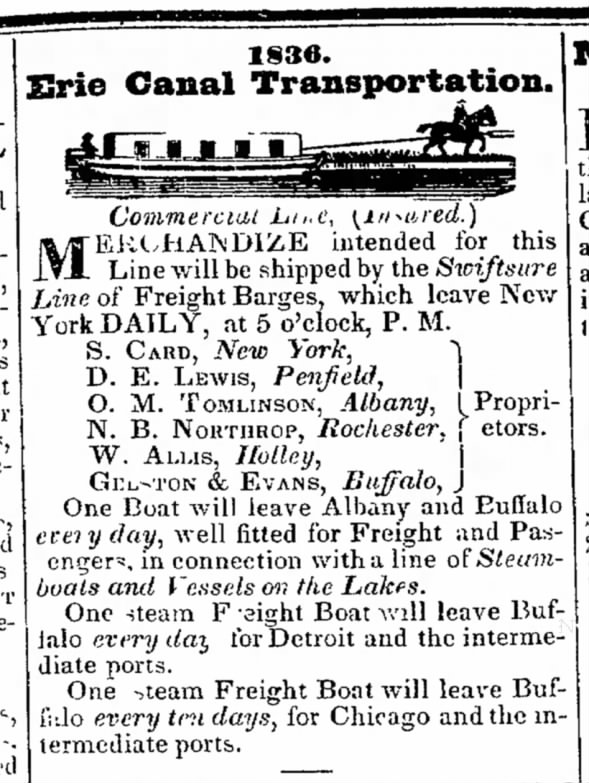
Thu, Nov 3, 1836 – Page 4 · The Weekly Wisconsin (Milwaukee, Wisconsin) · Newspapers.com
In 1844-5 O. M. Tomlinson lived at 24 Dallius according to the Albany City Directory

In March 1845, celebrating St. Patrick's Day at Stanwix Hall, O. M. Tomlinson gave the following toast:

Irishmen, the readiness with which they adapt themselves to the laws of freemen in America, the active lead and steadfast manner in which they maintained the cause of Temperance, the peaceable and orderly manner free discussion has been conducted on political subjects in large assemblages, clearly shows that the Irish people are capable of self-government, and that Ireland of right ought to have a Parliament of her own.

 --Albany Evening Journal, April 1, 1845; reprinted in the Albany Argus on April 7, 1845.

During the fall of 1845, O. M. Tomlinson ran Stanwix Hall in partnership with Daniel Comstock.

Albany Argus - September 30, 1845
 STANWIX HALL.-- This favorite Hotel has recently been still farther improved and enlarged by the annexation of the new four story building in Broadway, adjoining, which gives it forty feet more front on that fine avenue. The addition comprises some twelve parlors, with bed-rooms adjoining, peculiarly well adapted for winter boarding. The present proprietors of Stanwix Hall are Messrs. TOMLINSON and COMSTOCK, who with the energy of new lessees, are constantly making additional efforts to render their fine House more worthy of the patronage of the traveling public.
During the coming winter, Albany will present an array of Public Houses that would do credit to any city in the Union, not even excepting New York.  --Albany Argus, September 30, 1845.
The Schenectady Cabinet - September 30, 1845 via NYS Historic Newspapers

The brief partnership between O. M. Tomlinson and Daniel Comstock was formally dissolved in late November 1845.
THE Copartnership heretofore existing between the subscribers is this day dissolved by mutual consent, all debts of the firm of Tomlinson & Comstock will be paid by the said Comstock, and all debts due the said firm will be paid to the said Comstock, at Stanwix Hall in the city of Albany. Dated Albany, November 26, 1845.

O. M. TOMLINSON
DANIEL COMSTOCK

The business of STANWIX HALL will be conducted hereafter by Daniel Comstock and Charles H. Comstock under the firm of D. COMSTOCK 7 SON, who will settle all unsettled business of Tomlinson & Comstock.-- A share of public patronage is respectfully solicited. D. COMSTOCK & SON.

The Albany City Directory for 1845/6 lists Wheeler and Tomlinson as "proprietors of Stanwix Hall." 

Afterwards Mrs. Tomlinson was associated by that name with the operation of a hotel or boarding house at 21 Hamilton street in Albany. State legislators reported to be staying in Albany with "Mrs. Tomlinson" in January 1847 were Senators Thomas J. Wheeler, Enoch B. Talcott, and Henry J. Sedgwick.  

Daily Albany Argus - January 4, 1847
via Fultonhistory.com

As announced in the Albany Evening Journal, proprietorship of the boarding house at 21 Hamilton street "lately occupied by O. M. Tomlinson, Esq." was assumed by a "Miss Ball" in May 1848. 

Albany Evening Journal - May 2, 1848
"BOARDING. Miss Ball has taken House No. 21 Hamilton street, lately occupied by O. M. Tomlinson, Esq., where she will be pleased to accommodate a select number of Boarders from the 1st of May...."

Bill Poray gives an entertaining account of "The Amazing Life and Times of Oliver Mead Tomlinson" in the Perinton Historical Society Historigram, Vol. 44 No. 8, May 2012.

"In the spring of 1825, Mr. Tomlinson married Ann Staples, daughter of Olney and Susannah Staples, the proprietors of Staples Tavern in Egypt. The Tomlinsons had three children, Ann Eliza, born in 1828, a son, Victory, born in 1830, and a second daughter, Statira, born in 1834. Not long after the birth of Statira, her father's business pursuits took him to Albany, and later, to the western frontier."

In 1854, the Tomlinsons' daughter Statira Tomlinson (1834-1925) married New Yorker William Maltman in Nevada City, California. William died there in 1870. 

O. M. Tomlinson is the subject of another article by Bill Poray, "The ingenuity and incarceration of a Perinton Pioneer" in the May 2019 Historigram

After his adventures out west, Oliver Mead Tomlinson left California and returned to Albany NY where in 1863 he lectured at Tweddle Hall on "How to Silence Southern Guns."

Albany Evening Journal - March 14, 1863
via Genealogy Bank

O. M. Tomlinson died in Cheektowaga, Erie County, New York on September 30, 1867.

A letter was received yesterday by William Mattman, notifying him of the death of his father in law, Oliver M. Tomlinson. He died near Buffalo, on the 30th of September, aged seventy years. Mr. Tomlinson resided in Nevada for Many years, and carried on an extenstive mining operation at Mansanita Hill. He returned East in 1862, and has since resided near Buffalo.  --Marysville CA Daily Appeal, October 26, 1867.
Oliver's widow Anna Staples Tomlinson died in Fairport, New York on November 20, 1873 according to her obituary in the Buffalo Express. The "late Mrs. A. R. Cobb" refers to Mrs. Tomlinson's daughter Ann Eliza or Eliza Anna Tomlinson (1828-1862) who married Ansel R. Cobb (1806-1884) in Buffalo, NY on September 19. 1849.
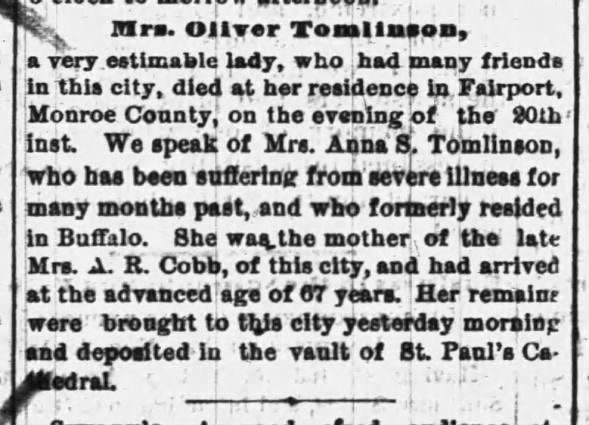
25 Nov 1873, Tue Buffalo Morning Express and Illustrated Buffalo Express (Buffalo, New York) Newspapers.com

Mrs. Oliver Tomlinson, 

a very estimable lady, who had many friends in this city, died at her residence in Fairport, Monroe County, on the evening of the 20th inst. We speak of Mrs. Anna S. Tomlinson, who has been suffering from severe illness for many months past, and who formerly resided in Buffalo. She was the mother of the late Mrs. A. R. Cobb, of this city, and had arrived at the advanced age of 67 years. Her remains were brought to this city yesterday morning and deposited in the vault of St. Paul's Cathedral.  
--Buffalo Express, November 25, 1873.

Thursday, December 20, 2018

1833 banquet, Albany St Nicholas Society

via The Annals of Albany v. 10
In December 1833 Herman Melville was fourteen, living with his mother and siblings in Albany. His older brother Gansevoort turned eighteen that month. Now in the business of making and selling fur hats, Gansevoort was regarded as the man of the family after their father Allan Melvill died in January the year before. Hershel Parker's chapter for this time is titled, "In the Shadow of the Young Furrier" (Herman Melville: A Biography V1. 84-103). Withdrawn from school, Herman worked as a clerk for the New York State Bank. His mother's brother Peter Gansevoort was one of the Directors there. Earlier in 1833 Peter and another uncle, Herman Gansevoort, opened Stanwix Hall (originally to be named "The Pavilion"). On December 6th, Gansevoort Melville's birthday as well as the traditional feast day of St. Nicholas, the St. Nicholas Benevolent Society of Albany held its annual banquet in the brand new building. Naturally, festivities 185 years ago included congratulations and formal toasts to and by the proud landlords: Herman Melville's Dutch-descended uncles.

via New York Public Library Digital Collections
New York Governor William L. Marcy made it to the affair, along with the Lieut. Gov. John Tracy. Martin Van Buren, then Vice President of the United States, unfortunately had to send his regrets. Former Chargé Rutger B. Huygens was the most prominent of guests actually from the Netherlands.

The toasts that night make intoxicating reading. Herman Melville's former school principal T. Romeyn Beck toasted Herman's maternal grandfather Peter Gansevoort, Hero of Fort Stanwix

via The Annals of Albany v. 8
Uncle Peter toasted the president (Abraham Van Vechten) and fellow officers of the St. Nicholas Society. Uncle Herman toasted
 The memory of Col. Marinus Willett, a patriot and soldier of the revolution.
Perhaps the most Melvillean sentiment was expressed by the unnamed "Guest" who gave
The memory of Rip Van Winkle--He being dead yet "sleepeth."
"Rip Van Winkle asleep" by F. O. Darley (1864)
via New York Public Library Digital Collections
Excerpts below are from the report in the Albany Evening Journal on Friday, December 13, 1833; reprinted in the Albany Argus on December 16, 1833. Both issues are accessible online via fultonhistory.com.

A Visit from St Nicholas, 1830 illustration by Myron King via Spectrum News

ST. NICHOLAS BENEVOLENT SOCIETY, 

 OF THE CITY OF ALBANY.


The anniversary festival of this society was celebrated on the evening of the 6th inst., at the large room of Stanwix Hall--the splendid and substantial building recently erected by the Messrs. Gansevoort.

The room was beautifully decorated with various appropriate banners, devices, festoons and other ornaments, in which Orange was the predominant color. Through the politeness of several gentlemen, many portraits of distinguished individuals of the olden time of Dutch descent, were politely loaned for the occasion, and added much to the interest of the decorations. Among them were those of Jeremiah Van Rensselaer, the second Patroon; Philip Livingston, one of the signers of the declaration of Independence; Abraham Yates, formerly Mayor of the city; and Gen. Abraham Ten Broeck.

Opposite the centre panel of the gallery, the portrait of Gen. Gansevoort, with that of his brother Judge Gansevoort on the one side, and Col. Varrick on the other. Busts of various distinguished individuals were also placed in appropriate situations about the room. Among others, were those of Pierre Van Cortland, Alexander Hamilton, De Witt Clinton, and John V. Henry. Several fine paintings and engravings from the collection of John Meads, Esq., were also politely loaned by him for the occasion; and under the guidance of his established and excellent taste the decorations were arranged.

The room was opened in the afternoon for the reception of visitors, and many hundreds of ladies and gentlemen took the opportunity of viewing the table and decorations.

At 8 o'clock the members of the society, together with their guests, sat down to a table most sumptuously prepared by Mr. Charles F. Rice, late of the Pavilion at Saratoga Springs, who has taken the refectory connected with the Hall.

The bill of fare, in addition to the national dishes, contained all that could be wished or desired, and did honor to the host and the occasion.

The venerable Abraham Van Vechten, Esq., President of the society, presided at the table, assisted by Harmanus Bleecker, Esq., as 1st Vice President, Jacob Ten Eyck, Esq., as 2nd Vice President, and Peter Gansevoort, Esq., as 3d Vice President. Among the guests were Rutger B. Huygens, late Chargé of his Majesty the King of the Netherlands to this country; his Excellency Gov. Marcy; Lieut. Gov. Tracy; the Mayor; Gen. Pierre Van Cortland of Westchester county; Guert Van Schoonhoven, Esq., of Waterford; S. F. B. Morse, Esq., President of the Academy of Design; Rensselaer Schuyler and Herman Gansevoort, Esqs, of Saratoga county.

After the removal of the various courses, the following toasts were drunk:

STANDING TOASTS.
I. Netherland--Our father land. Auld Lang Syne.
II. The President of the United States. Hail Columbia.
III. The King of the Netherlands--True to his great name; true to his illustrious house; true to a patriotic people. God save the King.
(Drunk with great enthusiasm.)
IV. The memory of William the first, Prince of Orange--Tolerant in an age of bigotry; liberal, when all around were tyrants. Marseilles Hymn.
V. The memory of Grotius--An illustrious example of moral and intellectual power: a private individual in adversity and in exile, he gave law to the law-givers of Christendom. Roslin Castle.
VI. The memory of the Rev. Dr. Eilardus Westerlo--The learned and pious man; the dignified and affectionate Pastor. Adeste fideles.
VII. The Schoolmaster--The mighty conqueror, whose march no holy or unholy alliance can oppose. Flow on thou shining River.
VOLUNTEER TOASTS.

By the President. Baron Huygens, the late resident Minister in the United States, of a nation we delight to honor--A gentleman whose official conduct and private virtues, entitle him to our profound respect.

[This toast was drunk with great applause.]

By the First Vice president, Harmanus Bleecker, Esq. Massachusetts--A republic, founded on board of the May Flower, in 1620, and yet exhibiting unsurpassed happiness, and the complete dominion of law and order.

By the Second Vice President, Jacob Ten Eyck, Esq. Our Guest, Rutger B. Huygens, late Chargé of the Netherlands--For his own sake, for his fathers sake, we are gratified that this festival is distinguished by his presence.

[After the long continued cheering with which this toast was received, had subsided, Mr. Huygens rose and addressed the company in Dutch.--The following is a translation of his remarks:--]
* * *
... Permit me, gentlemen, to offer you as a sentiment--

The St. Nicholas Benevolent Society of Albany--Whose members throw, by their patriotic exertions, a new splendor upon the virtues of a glorious ancestry.--May the band of brotherly love between children of the same family connect them closer and closer every day.

By Volkert P. Douw, Treasurer of the Society. May the ebbings of our treasury be replenished by floods of liberality; and our dollars, in the cause of benevolence, be kept as bright as our grandmother's copper kettles.

[The Secretary of the Society, John V. L. Pruyn, being called upon by the President for a toast, accompanied the same with the following remarks.]
* * *
… I give you, Sir, as a sentiment,

THE FESTIVAL OF ST. NICHOLAS.--A link connecting the past with the present--may it extend to the future.

[Richard V. De Witt, Chairman of the Board of Managers, then read a letter from Mr. Adrian Martini, ChargĂ© d' Affaires of His Majesty, the King of the Netherlands, in reply to an invitation to attend the Anniversary Festival.]

…I beg leave to offer the subjoined toast:

"The virtue, firmness and constancy of our Dutch Ancestors, and of the Williams of Orange--May these high qualities always be remembered, and, if necessary, imitated by their descendants on both sides of the Atlantic."

[Mr. Martini's toast was then drunk.]

Mr. DeWitt then gave as a sentiment, the health of Adrian Martini, the representative of the King of Holland, to the United States--A true Dutchman, we hail him as a friend and brother:

[A letter was then read from J. C. Zimmerman, Esq. Consul of the Netherlands, at New York, in reply to a similar invitation--apologizing for his absence, and offering the following toast, which was drunk:]

The Lion of the Netherlands, and the Eagle of the United States of America--Noble emblems of both Nations--Honor and Independence.

Dr. Herman Wendell, one of the Managers, then proposed the health of Mr. Zimmerman, which was drunk by the company.

[The following communication from the Hon. Martin Van Buren, Vice President of the United States and a member of the society, was then read….]
 * * *
... The health of the Baron [Minister of foreign affairs, Baron Verstolk van Soelen] was then drunk.

After which, Dr. Barent P. Staats, one of the Managers, gave as a sentiment.

Our distinguished fellow member, Martin Van Buren--Who, by his magic power, has fully demonstrated himself a true descendant of St. Nicholas.

Mr. Huygens then rose and said--
… I am too well aware, Gentlemen, of the feelings which animate Baron Verstolk Van Soelen, not to offer you in his name the following sentiment.

The United States of America--Their Star Spangled Banner is a noble emblem of the motto of our ancestors--"Eendragt maakt maght."
[The following communication from Professor Lauts of Medenblik, Holland, was then read.--The original was in Dutch, and the following translation has been prepared by a member of the Society.]
 * * *
... The health of Mr. Lauts was then drunk.

A letter from Mr. Bierman, of Amsterdam, to Harmanus Bleecker, Esq. 1st Vice President of the Society, was then read--after which, the toast proposed by him was drunk by the company.
* * *
... The health of Mr. Bierman was then drunk.

A letter received from Hendrik Kuyper of Rotterdam, accompanied by two poems of his--one on the eighty years war, and the other a eulogy of Admiral Pieter Pieters Hein, addressed to the 1st Vice President--was communicated to the society, and the health of Mr. Kuyper was drunk. 
A letter from B. Thooft, Esq. of New York, to the 1st Vice President, was then read, in reply to an invitation from the Managers to attend the festival, regretting his inability to do so, and enclosing a toast, which was drunk by the Society.-- The following is the toast.
The memory of the illustrious patriots and statesmen, Kornelis and John De Witt--The admiration of their countrymen and of the world.

The health of Mr. Thooft was then drunk.

By Egbert Egberts, Esq. one of the Managers. Industry and perseverance--Characteristics of our Dutch ancestors.

Dr. Beck being called upon for a toast, remarked, that in connexion with the occasion, the place where we were assembled deserved some notice. This building had been erected through the liberality and public spirit of two gentlemen, brothers, natives of this city, and bearing an honorable name. This beautiful and spacious edifice bore the name of "Stanwix Hall," and he took pleasure in stating, as it was not probably known generally, that this appellation had been given to it at the request of a number of our fellow citizens. It alluded to a memorable fact in the history of the father of these gentlemen. At an eventful period of the Revolutionary war, when the forces of Burgoyne were pouring down in this state, when every circumstance seemed threatening to the American arms, Fort Stanwix (now Rome) was gallantly defended by Colonels Willet and Gansevoort against a detachment of British and Indians. The importance of this protracted and signal defence need not be mentioned to any who are familiar with our Revolutionary annals. For this gallant exploit, the name of Gansevoort was inscribed on that imperishable scroll, which is headed by the name of Washington. As a descendant of Dutch ancestors, and in reference to the place, connected with his services, it appeared peculiarly appropriate to drink
"The memory of General Peter Gansevoort."
[The toast was drunk--After which Peter Gansevoort, Esq. rose and said.]

For this compliment, so unexpected--so flattering--permit me, Mr. President, to return to this company, the warmest thanks of the proprietors of Stanwix Hall.

They have erected this spacious building on a site, which, under the blessing of Divine Providence, has descended to the sixth generation. As the recipients of this blessing, they are humbly grateful.

This Hall, in compliance with the expressed wish of our fellow citizens, bears a name in reference to an important event in our Revolutionary History--a name associated with an actor in that scene, who was cradled on this very spot, and whose memory is most dear to its present owners.

If the proprietors, actuated by the spirit of the times, have reared a structure, which not only adds to the embellishment of their native city, but affords conveniences so long required for the exhibition of works of art, and suitable and ample accommodations for those public amusements, innocent in themselves and indispensably necessary in a large and growing commercial community, they have accomplished their intention, and experience a high satisfaction, which is greatly increased by the moral spectacle now exhibited in this Hall.

Mr. Gansevoort then offered as a toast--

The President and other Officers of the St. Nicholas Benevolent Society--We thank them for their spirited exertions, indicated by this sumptuous banquet and these splendid decorations. As representatives of a society, based on benevolence, they have higher praise in their prompt ministrations to the wants of the poor.

[His Excellency, the Governor, being called on by the President, for a sentiment, remarked, that he regretted that no Dutch blood flowed in his veins, but to show that he was, in some measure, connected with the father land of Dutchmen, he would give]

Holland--Endeared to the descendants of the New England Pilgrims, as the first Asylum of their persecuted forefathers.

[The sentiment was received with great applause.]
By John B. Van Schaick, one of the Managers. The memory of Laurens Koster, of Haerlem--Printer, 1430--The early and conspicuous promoter of the art, which gives wings to thought, and renders the products of genius, the common property of mankind.

By His Honor, the Lieutenant Governor. The Albany St. Nicholas Society--Its members well sustain the patriotic and honorable character of their Ancestors.

By G. W. Ryckman, one of the Managers. The characteristics of our Ancestors--Industry, frugality, virtue, courage and hospitality--Let the sons of St. Nicholas emulate the noble example of their forefathers.

[Dr. Johnathan Eights, one of the Physicians of the Society, being called upon for a toast, made the following prefatory remarks:]

Mr. President:-- I believe the national character of the Dutch, for Heroic Patriotism, and desperate resolution, is proverbial, and, although it has frequently been asserted, that they have degenerated from their former reputation, I believe the same inherent principle, still remains. The obstinate defence of the Citadel of the City of Antwerp, of a very recent date, is strong evidence that it is not extinct.

I beg leave, as introductory to a toast I am about to give, to relate an Historical Anecdote, corroborative of the sentiment it contains:

In the year 1574, if I recollect right, the city of Leyden, (celebrated for its university, and as being the birth place, of many eminent men, sustained a memorable Siege against the Spaniards. From the great length of the Siege, and the great severity, with which it was carried on, the inhabitants were so reduced by famine, as to be under the horrible necessity of feeding on the dead bodies of their companions. The Spanish General being well informed of their distressed condition, summoned them to surrender. The answer was returned to the summons, by the unanimous consent of the citizens and soldiers, is worthy of the best days of Rome or Sparta, and deserves to be engraved on Tablets of Gold, and on the hearts of their descendants to the latest generation:--
"They would rather, than surrender, eat the flesh from their left arms, and, with the right, defend the city, themselves, and their families." [David Ramsay, Universal History Americanised, v. 8.]
Their courage and their Heroism was crowned with success. They had already opened their sluices, and inundated the country. But the Spaniards obstinately pressed the Siege. In the mean-time, Admiral Brissot, with a fleet of flat-bottomed boats, calculated to navigate the deluged country, aided by a strong wind, which drove the water, with violence against their works, compelled them to raise the Siege, after losing the flower of their army.

There was a remarkable circumstance attending this memorable Siege, which, I think, is worth mentioning: during the whole of this period, the inhabitants of the city carried on a correspondence with other places, by means of Carrier Pigeons.-- Several of those Pigeons were embalmed and are preserved in the Town House of Leyden, in commemoration of this event.

I now, Sir, give you--Dutch Courage, and Dutch Patriotism.

Gen. Van Cortland. Albany--with a strong stamp of the Dutch upon it--it will not cease to be respected and admired until frugality, honesty, and, hospitality cease to pass current as virtues in the world.

John Van Buren, one of the Managers. De Stad Saardam--An wien behoort de Eer van een der gooteste mannen van latere tyden tohebben opgekweckt.  
Gen. Van Schoonhoven, of Waterford. The British Tourists--A little of Dutch honesty imparted to their journals would render them more just to the American, as well as more honorable to the British character.

Judge Vanderpoel. Our mothers, and their daughters--Characterized by intelligence, frugality and neatness. Our happy homes bear testimony to their virtues and their worth.

Simeon De Witt, Esq. Our Atavi more noble than the Atavis regibus of Maecenas--His fought, conquered and triumphed to entail slavery and misery on the earth. Ours fought, struggled, suffered and died to entail liberty and happiness on their posterity.

T. Van Vechten. The memory of Abraham Yates, former Mayor of the city of Albany--The sturdy rough hewer. A strenuous opponent of oppression in every form, and a decided advocate for the rights and liberties of the people, during the dark days of the revolution.

George M. Bleecker, one of the managers.--Commerce and liberty, the glory of Holland.

D. Graham, Jr. Esq. of New York. The ancient city of Albany--May it ever be the happiness of strangers, as it is now, to acknowledge its hospitality.  
Dr. Herman Wendell, one of the managers.--Our Dutch Ancestry--May we, their descendants, ever cherish their memory, and revere their worth.

General Solomon Van Rensselaer. Leeuw van Holland en de Arend van America--Moogen zy als blicksem stralen on de vyandem van vryheid springen. The Lion of Holland and the Eagle of America--May they pounce like lightning upon the enemies of freedom.

John Meads, Esq. a guest. Stanwix Hall--The new temple of St. Nicholas--May it always hereafter be toasted, yet never be burnt.
Rensselaer Schuyler, Esq. of Saratoga county. The prince of Orange--May he ever be successful in guarding the liberty of his country, and expelling English pensioners from the soil of his ancestors.

C. W. Groesbeeck. The Dutchmen of Albany. May they emulate the improvements and spirit of the age.

J. Blunt, Esq. of New York. Dutch Hospitality--As warm hearted in its welcome of the stranger here, as when it sheltered the exiled Pilgrims in the father land.

P. V. Shankland. The city of Albany--Its inhabitants exhibiting the unwearied industry, and practical sagacity, associated with the ancient name of Beverwyck, proudly point to their present prosperity, as the result of these qualities.

S. F. B. Morse, Esq. of New York. Holland--The hospitable asylum of the Puritans, and the land of Reubens and Van Dyck: descendants of the former, and admirers of the latter, may well connect with thanks for present hospitalities, grateful recollection of the generosity of the Vaderland.

C. C. Sebring, esq. of New York. The pilgrim voyagers in the Goede Vrouw, who, under the patronage of St. Nicholas, laid the foundations of this great states--may their descendants ever be as celebrated for their probity and social virtues, as they are for their enterprising public spirit.

Wm. Smith. Integrity, the pride of our ancestors--May our children imbibe their principles.

C. A. Ten Eyck. The St. Nicholas Society--Not the least among the societies of this republic, for out of thee may yet be called a ruler to preside over the people.

L. Cruttenden. The St. Nicholas Benevolent Society of the city of Albany--It has caused many tears of joy to flow, by wiping the tears of sorrow from the eyes of the widow and the fatherless.

Adjutant General Hubbell. The memory of Count Van Polanen--A noble and learned Dutchman, who represented his country with honor in the four quarters of the globe, and retired to this land of liberty to spend the evening of his life.-- He died, during the present year, at Bridgeport, in the state of Connecticut, a true friend to freedom, to literature and to the christian religion.

Doct. Peter Wendell.-- May our strong predilections in favour of Dutch Presidents continue, and increase until their benign and salutary influence shall be felt and acknowledged from Georgia to Maine, and from the Atlantic to the Mississippi.

Herman Gansevoort, of Saratoga county. The memory of Col. Marinus Willett, a patriot and soldier of the revolution.

Cornelius Egberts. The memory of the brave Van Speyk.
W. W. Groesbeck. May Dutchmen never forget to celebrate the annual festival of St. Nicholas.

Silas C. Herring. Stanwix Hall--Its granite walls are no unfit emblem of the enduring glory of the hero of Fort Stanwix.

George Brinckerhoof. Unhappy Poland--She claims and has our sympathies.
H. H. Martin. Our Dutch Vice President, Martin Van Buren.--At the anniversary of St. Nicholas in 1837, may he be smoking his pipe in the "east room" at Washington.

J. F. Porter. The memory of Daniel D. Tompkins.--[Drunk standing.]

William Seymour. The Messrs. Gansevoort, descendants of a revolutionary patriot, (and one of that noble phalanx of Dutch patriots,) they have displayed an enterprizing spirit worthy their illustrious ancestor, in erecting this magnificent edifice, which, while it adorns the city and affords the most splendid accommodations to the St. Nicholas Society, also hands down to posterity the birth place of the Hero of Fort Stanwix.

Cornelius Ten Broeck. The late Peter Van Schaack of Kinderhook.--His name is a proud one among those of "our fathers in the law."
J. Rhoades. Martin Van Buren, our Dutch Vice President.--The ides of November, 1836, will purge all sin from his title.

Isaac W. Staats. The memory of Col. Richard Varick, a patriot of our glorious revolution.--He lived rich in the esteem of his fellow citizens, and full of good works he has departed, ripe in years and rich in faith: Let such men not be forgotten.

A. M. Strong. Dutch character.--But another name for Industry and Integrity.
W. H. Staats. The memory of DeWitt Clinton.
"Bright eye'd genius mourns a brilliant gem
Torn rudely from its sparkling diadem."
S. S. Benedict. Dutch Girls--The fairest and rarest among the daughters of men.

After the President had retired, Albert Gallup gave--

Our venerable fellow citizen, Abraham Van Vechten--A Dutchman of the old school, admired for his talents, revered for his virtues--[Received with cheers.]

Dr. A. Groesbeck. The Dutchman's Pipe--"May its shadow never be the less."

D. P. Marshall. The city of Albany--Founded by the Dutch--may it continue to the latest posterity to sustain a population as prosperous and happy as were the families of its founders and their immediate descendants.

Charles N. Bleecker. The Dutchmen of the old school--Practical illustrations of the fact that these are "piping times of peace."

Wm. H. Fondey. The Torch of Science--Which hath lighted to the Escurial the Philips and the Alvas of the earth.

H. Ames. The citizens of Albany, and her sons in the councils of the nation--May their efforts be united in the removal of the deposites from the Overslaugh.

By a guest. Knickerbacker and other venerable Dutch names--May we always know how to spell them, and thus prove that we are not ignorant of their origin and signification.
 
Stephen Groesbeck, Esq. of Watervliet, being called upon for a toast, addressed the chair as follows.

We have this evening recurred to some of the most brilliant instances recorded in the history of the past. Let us not, however, forget one instance in our own age, which is yet too recent to appear on the page of history, but which will surely be written there in the fairest and most indelible characters. But a short time has elapsed, wince a veteran general in the service of Holland, with a mere handful of men, successfully resisted the combined forces of two nations, immediately greater than his own, until his provisions and ammunition were exhausted, his last fortification leveled to the earth, and his last magazine dismantled. His brave but ineffectual resistance was far more glorious than the victory obtained by his enemies. He is, I believe, still living, to receive the just tribute of universal respect and admiration. I propose, sir,

General Chasse--the heroic defender of the city of Antwerp.

Charles B. Lansing. The phlegmatic character of the Dutchman, lost in imparting his hospitality.

Mr. Pruyn. The Fair--Our guardian angels.--In childhood we are nursed by their care--in youth our characters are formed by their influence--in manhood our joys and sorrows are sanctified by their participation of our lot. With grateful affection we say--Love to them all.

J. P. Bradstreet. The present festival an appropriate christening to the monument of the illustrious defender of Fort Stanwix.

W. H. De Witt. The Sons of Amsterdam, Rotterdam, Schiedam and the other Dams of Holland--may their known valor and patriotism always form an impervious Dam to the enemies of their country's rights.

J. G. Mather. I will give you the Saint Nicholas Society--it is National, and it is rational, for it cultivates one of the most endearing ties of humanity--a respect and love for 'Home, Sweet Home.'

P. H. Ostrander. The memory of our illustrious Washington--The greatest and best of men. His character, like the pyramids of Egypt, will forever stand the unrivalled object of our admiration.

John Knower. The Dikes of Holland--A lasting monument of the energy and perseverance of the Dutch.

D. B. Slingerland. The genius of temperance which sheds its balmy influence over our western hemisphere--May its healthful blessings visit all the nations of the earth.

R. V. De Witt, read an extract from a letter from James Stevenson, Esq. one of the members of the society now in Europe, referring to the hospitality he had received from Mr. Matthiesen, residing in the vicinity of Haerlem.

The health of Mr. Matthiesen was then drunk, followed by that of Mr. Stevenson.

Henry Bleecker, Jr. The revolution of the seven Provinces--As the character of their people was mild and pacific, their achievements of valor were brilliant, as the yoke of tyranny had been cruel and oppressive, their emancipation was glorious.

Wm. E. Bleecker. The history of Holland--As a record of events, it is a repository of wonders: as a biography of a nation, a monument of glory.

J. C. Van Schoonhoven. St. Nicholas--May the name ever be reverenced by the descendants of Dutchmen.

A. M. Slingerland: Mr. President--Sir: It gives me pleasure to have the opportunity, on this occasion, to pay a small tribute of respect to a class of men, well deserving to be remembered at our anniversary festivals. I allude, sir, to the Horticulturalists of Holland. We have, with true national pride, toasted the Patriots, the Statesmen, and the Jurists, and it is very gratifying that we can, with propriety, refer back to our ancestors, and find men of heroism, of wisdom, and of learning, fully equal to any other nation in the world.--But sir, when I consider Holland, renowned as a garden of flowers, and that we annually import from her shores, some of the finest bulbous roots, from the small crocuses and snow flakes, which shoot forth from the earth as soon as the snow leaves us in the spring, together with the beautiful tints and delightful flavor of the hyacinths, the various and glowing colors of the tulips, the splendid and much admired peoneas, the lofty crown imperial, and many other varieties, all beautiful, and many of them very fragrant, we must acknowledge that we receive a treat from the labors of those men, which is not only delightful but highly gratifying. I think, sir, of all recreations the cultivation of fruits and flowers is one which ought to be the most encouraged; and every rank of people, from the humble cottager, with his favorite geraniums and marygolds, to the lady of fashion, with her more tender exotics, equally enjoy flowers as a gratification. Indeed, of all luxurious indulgences, the cultivation of flowers is the most innocent; and they are of all embellishments the most beautiful. I therefore give you, sir,

Holland--The land of Flower Gardens;

Her Horticulturists--Men of correct taste.

Dr. J. F. Townsend. The industry of our ancestors--Exemplified in their habits of patient thinking, laborious attention, and close application.

P. Carmichael. Virtue, wisdom and patriotism, the chief materials in a Dutchman's character.

John C. Staats. Henry Hudson--May his memory be cherished as long as the noble stream which wafted the adventurer to this happy shore, shall wear his name and roll in its mighty channel.

Mr. Whale being called upon, remarked that at the moment he could think of no sentiment of his own worthy of offering, and therefore begged the company to accept one which he had somewhere seen in rhyme.
When nature, yet unskilled, 'tis said,
Contrived of man the cunning art,
She formed at first the Yankee's head,
And moulded then the Dutchman's heart.
L. Fidler. Dutch Supper--A cognomen significant of intellectual banqueting, and delicious feasting.

By a Guest. The memory of Rip Van Winkle--He being dead yet "sleepeth."

H. H. Martin. Stanwix Hall--A noble monument of Dutch enterprise--May it never be rent in twain, but may it sustain the rents made by time, and in time may its rents sustain it.

From Giles F. Yates, Esq. of Schenectady--Holandesche Aenelach--Tot welcken wy lieden danckbearlyck verbonden syne, voor het eersten, upbouwen der steden Beverwyck, Nieuw Amsterdam en Schachnachtada, tusschen de jaren 1610 en 1617, by onsen voorouderen. Zegenigen tot Haren gedachtenesse!

Translation. Dutch Enterprise--To it we are indebted for the settlement between the years 1610 and 1617 of the three cities, Albany, New York, and Schenectady. Blessed be the memories of their founders!

Dr. B. P. Staats. The sons of St Nicholas at Fort Stanwix in 1777, and at Stanwix Hall in 1833--The former shook the bush and endured real pain. The latter caught the birds and have champagne.

By a Guest. The commercial prosperity of our happy country, the best evidence of a well regulated government.

Related posts:

Friday, May 5, 2017

Promoting masquerades at Stanwix Hall

Costumes for a Masked Ball
via The New York Public Library Digital Collections
In March 1839 Herman Melville was living in Lansingburgh and finishing his engineering studies at the Academy there, hoping to find work on the Erie Canal. Pro-masquerade items in the Albany Microscope, transcribed below, offer an interesting glimpse of the social life he was missing, probably, back at Stanwix Hall. The year before, letters from Melville on the "Philo Logos" debate club controversy had appeared in the Albany Microscope over the signature of Philologian. In May 1839, the Democratic Press, and Lansingburgh Advertiser published his two sketches, Fragments from a Writing Desk No. 1 and No. 2. In June Melville sailed to Liverpool on his first transatlantic voyage. He went a-whaling, as everybody knows, in January 1841. But Melville did not have to travel very far to find cannibals and con men, with every other cultural stereotype, however fanciful or grotesque--they were all partying in Albany at the Masquerade Ball. Enticing ads for the Masquerade Ball in the Albany Evening Journal (March 27, 1839) expressly invited "ladies and gentlemen of Albany, Troy, Lansingburgh, and Schenectady."

In the Microscope, one defender mentions "vociferous deprecation" of masquerades, alluding to strong attacks like the blast against masquerades that had been reprinted in the New York Evangelist from an unspecified Albany newspaper.

Also according to the Microscope, some patrons attended the dance academy at Stanwix Hall more for the music (conducted by William Whale's new business partner A. G. Graves, "that well known talented musician"), without necessarily taking lessons:
STANWIX HALL.

The present winter has been the most brilliant ever witnessed in the dancing way. Stanwix Hall has been more fully and fashionably attended than at any preceding season. Messrs. Whale and Graves jointly are capable of and do give the most entire satisfaction to their numerous visitors; many who do not dance attend for the mere purpose of listening to the music which is superb. On Monday evening next they give a Masquerade Ball, which will no doubt, call together a numerous and respectable company and be productive of much amusement. Keep the "ball" in motion. 
Pre-publicity for the first Masquerade Ball on Monday night included the following letter to the editor, singed "Veritas" and published in the Albany Microscope on Saturday, March 9, 1839:
THE MASQUERADE BALL.

MR. EDITOR:--I understand Mr. Whale intends having a Masquerade Ball on Monday evening the 11th instant, and the preparations making for the same, are very great, and a large company is expected. Great glee and joy will be realized by the company--those who are fond of "touching the light fantastic toe" will be on the move; and many important characters will be presented--there will be seen a Richard, a Hamlet, a Brutus, a Ceasar, a Rienzi, the Scourge of the Ocean, the Pirate of the Gulf, Bill Johnston, the Hero of the Lakes, and many other characters personated by the gentlemen, and on the part of the ladies will be seen Queen Victoria, and Lady Jane Grey, Queen Elizabeth, and the Queen of the Thousand Islands. Those who are fond of attending Masquerades will be highly gratified with this. Mr. Whale is sparing no pains to have every thing as it should be on an occasion like this, and will superintend the dancing. Mr. Graves, that well known talented musician, will lead the music.--

Let there be a general attendance, and my word for it, all will retire to their homes satisfied with the evening's amusement.

I will merely say those gentlemen wishing to procure Masks or Dominoes for the Masquerade Ball on Monday evening the 11th inst., will be supplied at a much cheaper rate and a first rate article at Mr. Van Schaick's in South Market street, and also at Berringer's in State street near Pearl.

VERITAS.
The March 11th Masquerade received several enthusiastic notices in the Microscope. The spelling "achme" in "achme of abominations" appears in the notice as originally published in the Albany Microscope on March 16, 1839:
MASQUERADE BALL.

The recent Masquerade at Stanwix Hall under the supervision of Messrs. Whale and Graves, was the most brilliant pageant imaginable, and far exceeded the most sanguine expectations of its projectors. The costume and peculiarities of the inhabitants of the four quarters of the world were on that occasion congregated within the Hall--and a most motley and amusing group they were. Many of the characters were most ably sustained, and will afford a subject of pleasurable retrospection for many a day. The utmost good order was observed and nothing was wanting to render the evening's amusements perfectly satisfactory.

We have just learned that at the earnest solicitation of a great number of both gentlemen and ladies, Messrs. W. & G. have concluded to repeat it, on the evening of Wednesday March 27. There can be no doubt but that it will be thronged, as on this second occasion many who did not attend the first for fear of its proving a failure, will embrace the opportunity with the most perfect assurance of its entire success.

By many people Masquerading is spoken of with the most vociferous deprecation, and is conceived to be the very achme of abominations; but for the life of us we cannot view it in that light: as a mask does not protect its wearer from exposure and chastisement in the event of an insult--and one who is naturally vicious will manifest it masked or not. It is true the committee of arrangements should be most rigid in the enforcement of decorum, and so they should at any hall. We hope to see them often repeated. As several correspondents have noted the affair in detail, we refrain from enlarging on it.
The March 16, 1839 notice of "The Masked Ball" employs a conventional racial slur, twice, when describing a comical pair of "Siamese Twins." As described in the Albany Microscope, the "Siamese Twins" costume was inspired by popular theatrical representations of "The Siamese Twins" as an obvious fraud, with actors playing artificially conjoined stereotypes of an Irishman and African American. As documented by Joseph Andrew Orser in The Lives of Chang and Eng, one version of the Siamese Twins burlesque by Charles White played in New York in 1863 (and evidently remained popular well into the 1870's).
THE MASKED BALL.

For the first time in my life, Mr. Editor, I was induced to attend Messrs. Whale & Graves' Masked Ball, at Stanwix Hall, on Monday evening; and I must confess, notwithstanding the deep rooted prejudice, I had formed against this kind of amusement, that I was never more highly delighted with any amusement, and what is more my prejudice at once evaporated, and thrilling delight and perfect satisfaction took its place. It was certainly one of the most exciting, novel, grotesque, pleasing scenes I ever enjoyed or fancied--all was life, bustle, hilarity and mirth--the most perfect order and decorum was observed throughout. The various characters assumed, were most admirably sustained and in perfect keeping. It would occupy more time and space than your limits will allow, to give any thing like an adequate description of the affair. Almost every nation, profession, trade, and character under the sun, had a representative--from the crowned head down to the commonest loafer. I have only a faint recollection, of some of them, which I will attempt to enumerate. There was Jim Coffin, with badge of office, his blacking brushes, &c. &c, Jim Bags, Paul Pry, Brutus, Bill Johnson, armed capapee--with pistols, dirk, etcetera, St. Crispin, with hammer, awl and waxend--Titus, Corporal Trim, Major Longbow, the Striped Pig--with a "fifteen gallon" keg lashed on his back--Hamlet in full dress--Jack Junk, John Lump, Jimmy Twitcher, Loony McTwoiter, Dennis Bulgruddery, with quizzing-glass, Jeremy Didler, Jack Downing, Sam Patch, Siamese Twins (united together by an artificial ligament--an Irishman and a nigger, most capitally sustained, especially the nigger.) There were Canadian Patriots, Veterans, of the sixteenth century, Volunteers from Maine; Hottentots, Cannibals, Brigands, Ostlers, Boot Blacks, Chimney Sweeps, Loafers, Bear Dancers, Monkeys, French Dancing Masters, Portrait Painters, Indians, &c. &c., mermaids, or half male and half female,--Quakeresses, Broom Girls, Candy and Match Girls, Dutch or Swiss, Gipseys, Ballet Dancers, Squaws, Queens, Princesses, and a thousand others, which I have not time to mention. I have only to say, that I really wish that Messrs. Whale & Graves will get up another before the season for dancing is over.
LESLIE.

Mr. EDITOR:--Many who attended the masquerade, missed the most intellectual and interesting portion of the evening's entertainments by retiring at too early an hour. During the whole of the early part of the evening the most prominent object in the room was an antique "citidel" erected between the columns, and many enquiries were made in reference to its use, but in the sequel it proved to be a representation of the castle at the "Siege of Belgrade"--at one o'clock the assault commenced, and was conducted by Capt. Tactic, Ben, acting as orderly, Faun walked into the scene of carnage with singular bravery, the attack was irresistable and the application of the battering ram levelled the fortress to the ground. The professor acted as senes[c]hal, and after the demolition, was seen seated on the fallen fabric, like unto Caius Marius viewing the ruins of Carthage. Can't this exhibition be repeated at the next

MASQUERADE.
Albany Evening Journal - March 27, 1839
The second Masquerade Ball on Wednesday the 27th also received favorable attention.  From the Albany Microscope, March 30, 1839:
THE MASQUERADE.

The second masked ball of the season on Wednesday evening last was a most amusing and pleasant affair. The Hall was comfortably filled, and many of the characters were ably sustained. It would be impossible to describe all or even half of the singularly conceived characters, but decidedly the best dressed character was TIME, who was represented with scythe in hand, as seen in the primmer--close on his heels followed the "evil one," with a most threatening pair of horns, and golly what a tail! a printer's devil couldn't hold a candle to him. A man mountain in the shape of a huge Dutchman, occupied a great deal of space, and was productive of much mirth. A Yankee pedlar was cute, and carried it out well. Jim Bags "discoursed most terrific music," and "moved on" to the infinite delight of all within hearing. A dandy of the most refined school, languished enchantingly--he did poz. Loafers, soldiers, (detatchments from the 246th, commanded by Capt. J**n P*******n.) fancy men and nondescripts, were in abundance. There was a profusion of old women and lots of young ones. There were sisters of charity, and sisters most uncharitable in tormenting the unoffending beaux  with their killing glances and their sarcasms. The sword combat between a sailor and brigand, was admirable--could not have been bettered, had a little more regard to time been observed. But we find it impossible to keep track of the subject, and to keep cool at the same time, and shall therefore take the "back track."
 And now it is more than probable that some of our friends may suppose we intend to speak and expatiate on our character, and tell of the many good things we gave vent to, and the infinite number of witticisms, and killing speeches we poked into the ears of the ladies. But if they do expect any such expose, they are doomed to a sad disappointment. --Albany Microscope, March 30, 1839
As the following notice in the Albany Microscope (April 6, 1839) makes clear, the "Masquerade" as conducted by Whale and Graves was not the same thing as their "Grand Fancy Ball."
MESSRS. WHALE AND GRAVES' GRAND FANCY FALL.

We beg to call the attention of our dancing friends, to this close up of the season, which is to take place on Wednesday next. This class of balls is most interesting to the aged as well as to the youthful, as they principally consist of a beautiful succession of fancy dances performed by the juvenile portion of the scholars of both sexes. This portion is executed with spirited rapidity, and the remainder of the evening is devoted to a general tripping of the toes of all who are inclined to join in the "misty mazes of the dance." We are informed that on this occasion Messrs. W. and G. have taken unusual pains in order to ensure the production of something unique in the fancy way. Let them be liberally patronised, as it most probably will be the closing SCENE of the season.
Related post

Tuesday, December 13, 2016

Against masquerades at Stanwix Hall

"Sad business, this holding out against having a good time. Life is a pic-nic en costume; one must take a part, assume a character, stand ready in a sensible way to play the fool. To come in plain clothes, with a long face, as a wiseacre, only makes one a discomfort to himself, and a blot upon the scene. Like your jug of cold water among the wineflasks, it leaves you unelated among the elated ones. No, no. This austerity won't do." --The Confidence-Man: His Masquerade
Right around the time that Herman Melville came back to Albany after a stint as rural schoolmaster, one local newspaper published a diatribe against costume balls or masquerades, specifically masquerades at Stanwix Hall. Melville was about to get himself elected as president of the Philo Logos debate club and would soon secure a room for club business in Stanwix Hall. The editorial blast at masquerades was practically guaranteed to get young Melville's attention by invoking the ghost of his grandfather Peter Gansevoort as a war hero and patriot, "one of the gallant fathers of our ancient city." Not only that, the call to more serious and socially responsible enterprises amid the "fiery ordeal of bankruptcy and distress" had an intensely personal application to the unfortunate Melville family, distressed yet again in April 1837 when Herman's brother Gansevoort filed for bankruptcy.

Formal balls regularly took place at Stanwix Hall, hosted by such reputable organizations as the Odd Fellows, Albany Burgesses Corps, Van Rensselaer Guards, and Albany Republican Artillery. The crusading Albany editor does not go for plays or circuses either, but his particular target seems to be the more exotic, foreign style of "fancy ball." Mr. William Whale operated the Dancing Academy at Stanwix Hall and might have been the unnamed villain who allegedly wanted to import masquerades to Albany. In October 1837 Mr. Whale had represented his European influences as a clear benefit, advertising "every facility through foreign correspondents of obtaining all the new and fashionable dances, music, etc. as introduced in London and Paris" (Albany Evening Journal, October 8, 1837). That same year Mr. Whale's "Fancy Dress and Masquerade Ball" had to be postponed from January to February, "in consequence of the necessary preparations" (Albany Argus, January 31, 1837). The following year Mr. Whale defied his puritanical newspaper critic with the announcement of "his 8th annual GRAND FANCY BALL" taking place at Stanwix Hall on March 28, 1838.

In August 1850 Herman Melville dressed up as a Turk for a costume ball hosted by Sarah Morewood, soon to be his Berkshire neighbor. The "Princess of Pic Nic," Cornelius Mathews called her. "Fairy Belt." Sarah Morewood also hosted outdoor "fancy dress" parties, often linked in Melville criticism with those philosophical remarks on life as "a pic-nic en costume" in The Confidence-Man. Masquerade is the last word and titular theme of Melville's novel. Masks and disguises receive plenty of critical attention, of course, but how about dancing? The Evangelist offers a contemporary view of the masquerade as foreign, degenerate, and threatening. This brand of dance is to be suppressed as morally dangerous public conduct. Considering the case for Melville's shape-shifting confidence man as the Devil variously disguised, it's also suggestive to find the engineer of masquerades exposed in Melville's Albany as Satan, the "Arch Apostate":
"A masquerade is but the apple of Eden in another shape; for the Arch Apostate well knows how to dish up his temptations in all possible shapes, from an apple in the bowers of paradise to a midnight coterie in Stanwix Hall...."
Under the head of "Christian Morals," the editorial against "Masquerades" was reprinted from an unnamed "Albany Paper" in the New York Evangelist on January 20, 1838. The Evangelist is where Melville would receive stinging criticisms for his first book, including the association of Typee with corrupt and corrupting "theatres, opera-dancers, and voluptuous prints" in London.
The New York Evangelist - January 20, 1838
1 of 2

The New York Evangelist - January 20, 1838
2 of 2

CHRISTIAN MORALS.

MASQUERADES.

We believe that every editor of a newspaper, or any other periodical, ought to show himself a watchful guardian of the laws of morality and religion; always, however, with that due deference to the opinions of others, which both modesty and decorum require. Under this impression it grieves us to behold an attempt making to introduce MASQUERADES into this city. These pernicious institutions have been for ages, in Europe, the hot-beds of every species of vice and wickedness. They are peculiarly calculated to give full scope to the most vicious propensities, the vilest corruptions, of our nature. It may be considered by some, perhaps, as a hard sentence; but it is our honest conviction, that masquerades are the direct offspring of that Arch Apostate, who was turned out of heaven for his treason to the Almighty. We believe it to be a moral impossibility for young people to attend these exhibitions steadily and at the same time preserve their virtue; and if they cannot be attended steadily with safety, then the very first step is a dangerous one. They are, like the theatre, among the surest path-ways to ruin, both temporal and eternal, of all who visit them. But one thing is certain, they cannot be supported without the aid of the female sex: and we shall, we trust, most wofully mistake the character of the female population of Albany, if they be found to encourage these devices of the worst enemy of the human race. A masquerade is but the apple of Eden in another shape; for the Arch Apostate well knows how to dish up his temptations in all possible shapes, from an apple in the bowers of paradise to a midnight coterie in Stanwix Hall—a name associated with the heroic achievements of our gallant fathers, and especially with those of one of the gallant fathers of our ancient city. We venture to assert, that could the shade of PETER GANSEVOORT look down upon the noble structure which bears a name so nearly allied to his fame as a patriot, and a virtuous citizen, it would frown indignantly upon every attempt to plant the standard of vice and immorality within those walls consecrated to the memory of his virtues as a citizen, and his valor as a hero of the revolution. Once more, we repeat it, this vile innovation upon our ancient simple manners, and republican and Christian virtues, cannot succeed without female countenance—and where, we ask, is the virtuous mother who will consent, or the virtuous daughter who will ask for consent, to participate in such scenes as masquerades have ever given birth to. We hope, for the honor of the female sex—for the honor of our city—and for the character of our common country, and the stability of its civil and religious institutions, that those who may have projected the foul amusement to which we allude, may pause and reflect upon its evil consequences; in which case, we are satisfied they will give it up as a pernicious design. Is it not, indeed, remarkable, that human beings—rational beings—immortal beings—should delight in frivolous, to say nothing of vicious amusements?

Independent of many other reasons that might be given, the present state of our country is such as to require both serious reflection and serious conduct, on the part of every citizen who feels an interest in her prosperity and happiness. Internally, she is going through a terrible if not a fiery ordeal, of bankruptcy and distress; and externally on one border she is herself engaged in savage warfare; and on another, though beyond her own limits, a dreadful civil war is raging, whose consequences, as they may bear upon her safety, no human being can foresee. With the flames of a national and savage war raging on one side of her and those of a civil war on the other, we repeat it, this is no time for revelry, licentiousness or levity of any kind. If any of our citizens have money to spare, let them look to the thousands of shivering and starving poor, with whom our cities are every where crowded, and will continue to be so through the winter. How many thousands of honest mechanics are now out of employment? And which is the best course for our youth to pursue—to spend their money in such frivolous and vicious pursuits as those of masquerades, theatres and circusses, or bestow it upon the unfortunate? If we blame Nero for fiddling and dancing over the burning ruins of his capital, can we commend those who would now laugh over the calamities which press upon their country, or the other calamities with which she seems to be threatened? We trust that every virtuous and patriotic citizen—and especially every true Republican and Christian—will look seriously to these things, and prevent, if possible, the youth under their care from running into the paths of perdition; and their country from adopting institutions which have grown out of the corruptions of Europe, and the dark designs of her tyrants and oppressors. —Albany Paper.
--New York Evangelist, January 20, 1838
In mid January 1846, Mrs. Edward Satterlee hosted a surpassingly elegant costume ball at Yates Mansion in Albany. Herman Melville's uncle Peter came to that Fancy Ball dressed in the costume of his own father, General Peter Gansevoort:
"Gen. G——t of Albany excited even more than usual attention and respect, by appearing in the uniform of his brave father, the Hero of Fort Stanwix."  --The Fancy Ball


Related post:

Thursday, March 5, 2015

Questions for Debate in Melville's Albany, 1837-8

Albany Evening Journal - February 2, 1838

Herman Melville resided with his family in Albany, New York from 1830 to 1838. Early in 1838 Melville got himself elected as president of an Albany debate club then calling itself "Philo Logos." Published letters full of high-sounding snark, mostly to and from Charles Van Loon (1819-1847), indicate Herman Melville's brief but intense period of involvement with the debate club, reportedly starting in 1837. These Philo Logos letters are collected in the Northwestern-Newberry edition of Melville's Correspondence.

As pointed out a few years back on Hershel Parker's blog, published 1858 recollections by newspaper editor William J. Moses supply additional details. Thanks to Fulton History archives (the legible parts) anyone can see that Moses remembered Philo Logos as a club of two dominant antagonists, Van Loon and Melville:
"they being a tight match for each other, and delighting in nothing more than in being pitted against each other in intellectual combat."
--Auburn [New York] Daily American, January 4, 1858; found at Fulton History.

Moses freely admitted to having been stumped when Melville asked him to define "Philo Logos." Searching Fulton History for "Philo Logos" also gets you to the Albany Evening Journal for October 27, 1836, where then "President" Charles Van Loon submits an earlier 1836 exchange of letters on that tendentious topic of the meaning of Philo Logos. Critic "HERODITUS" (said to be a lawyer) judged Philo Logos ungrammatical and meaningless, and specifically recommended the term Philologean as an intelligible alternative. In the reply dated October 24, 1836, the writer signed "PHILOLOGIST" defends Philo Logos as traditional and grammatically sound. This published (but previously unknown?) 1836 exchange complements the 1858 recollections of William J. Moses in supplying background for Melville's Philologos correspondence, including his long-known use of the pseudonym "Philologean" / "Philologian."

Herman Melville like his older brother Gansevoort belonged for a time to the Albany Young Men's Association, but Philo Logos was a kind of upstart, intended apparently to rival the older and more formally organized debating society of the YMA. Before 1840 the YMA debating society met in the Association rooms at Knickerbocker Hall, which "then stood on Broadway between Maiden Lane and State Street" (Young Men's Association). Philo Logos met in Stanwix Hall.

Image Credit: drinkdrank

The Northwestern-Newberry Correspondence volume seems mistaken in a headnote equating the two debating societies (18). Herman Melville's final published letter in the Albany Microscope of March 31, 1838 (headed YOUNG MEN'S ASSOCIATION) only promotes the unnamed debating society of the Albany Young Men's Association and never names the Philo Logos Society.

Before now, the only known question for debate by Philo Logos was the definition of Philo Logos. A few more topics for debate by the Philologos Society are uncovered in Melvilliana posts on the Philo Logos Society in 1837 and Philo Logos Society debate on abolition of slavery. As it happens, however, the debating society affiliated with the Albany Young Men's Association (not Philo Logos) advertised some wonderfully appealing and controversial questions for debate during the period of Melville's known involvement with Philo Logos. Presumably Herman would have been interested in these questions even if he did not participate in or attend the actual YMA debates:

"Should the administration of oaths be abolished?" -- Albany Argus, January 16, 1837

Albany Argus - January 31, 1837

"YOUNG MEN'S ASSOCIATION--DEBATING SOCIETY.--
The question for debate this evening is, "Has the general diffusion of knowledge a tendency to diminish crime?" Meeting at 7 o'clock in the Lecture Room.
T. W. LOCKWOOD, Sec'y. -- Albany Argus for Tuesday, January 31, 1837

"Ought the Elective Franchise to be restricted to property qualifications?"
--Albany Argus, December 7, 1837

"Should capital punishment be abolished?"
-- Albany Argus, Thursday, December 14, 1837

Albany Evening Journal - December 22, 1837
“Is the mind of woman of equal capacity with that of man?” --Albany Evening Journal, Friday, December 22, 1837

"Have the public laws of the U. States been, and are they beneficial to the country?" -- Albany Evening Journal, December 29, 1837

"Should Representatives be bound by the will of their Constituents?"  --Albany Evening Journal, January 11, 1838
“Should the benefits of the copyright law be extended to foreign authors?” --Albany Evening Journal, Thursday, January 18, 1838
"Are prose works of fiction beneficial?” --Albany Evening Journal, February 1, 1838
"Does an individual on entering into society, surrender any of his natural rights?"
--Albany Argus, February 22, 1838
“Is the removal of the Indians beyond the Mississippi by the U. S. Government, politic or just?” --Albany Argus, April 12, 1838
"Was the banishment of Napoleon by the allied powers justifiable?" --Albany Evening Journal, Thursday, April 26, 1838

Herman Melville was elected President of the Philo Logos Society on February 9, 1838, as announced in the Albany Evening Journal on February 13, 1838. By the end of March he was urging support for the debating society of the Young Men's Association. For an earlier letter with the same aim of endorsing the YMA debating society, see the Melvilliana post on the December 1837 letter by Juvinis. 

Albany, New York: Broadway from Maiden Lane, 1863
Image Credit: new york heritage

Related posts