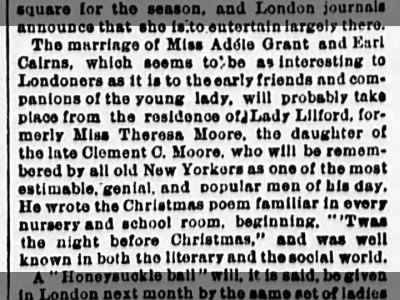
"a series of articles which present in a style full of attraction and charm the early annals of the City of New York. They were the literary work of one who was acknowledged for many years the finest literary scholar and critic of the city, and a work, too, for which he devoted the best gifts of his intellect, for he claimed descent from one of the earliest settlers of the city."
The series began in the January 1884 issue and was there represented as Duyckinck's "last work and one of which he felt a just pride." The Christmas matter would be reprinted two years later in Frank Leslie's Sunday Magazine for March 1886, on pages 203-6 of the article titled "The Origin of the New York Churches."
By Manhattoes Duyckinck means "New Yorkers":
There were several national or religious festivals kept by the Dutch in New Amsterdam: Christmas, New Year's Day, Paas or Easter, Pinxter at Whitsuntide, and Santa Claus or St. Nicholas Day. Some of the peculiar Dutch honors of the last have been transferred to Christmas ; particularly the visit of St. Nicholas, who, to the wondering children of Manhattan, on the eve of the sacred day, still, as of yore, a burly, benevolent figure, clad in his ancient furry habiliments, a pipe in his mouth, a capacious, well-filled hamper of toys on his back, rides in his airy sleigh, swiftly borne by his reindeer-team, over the roofs of the houses, descending, spite of narrow flues and modern contracted chimneys, to fill the stockings suspended, in expectation of his gifts, at the mantel corner.
The faith in the old legend of St. Nicholas, patron of the Manhattoes, would, with other superstitions of the past, doubtless have died out long ago were it not invigorated by these perennial gifts and bounties. There is practically no discrediting a belief which is backed by such unfailing beneficence. We,"children of a larger growth," hoodwink our perceptions and act upon it every day in our intercourse with society and estimate of character, feigning to believe in more doubtful virtues than those of the boy-saint. Besides, has not Weir painted the scene? and has it not been described by one of the best of men in most exquisite rhymes ?—
"The moon on the breast of the new-fallen snow
Gave the lustre of midday to objects below,
When, what to my wondering eyes should appear,
But a miniature sleigh and eight tiny reindeer,
With a little old driver, so lively and quick,
I knew in a moment it must be St. Nick.
* * * *
And then, in a twinkling, I heard on the roofThe prancing and pawing of each little hoof—As I drew in my head, and was turning around,Down the chimney St. Nicholas came with a bound,He was dressed all in fur, from his head to his foot,And his clothes were all tarnished with ashes and soot;A bundle of toys he had flung on his back,And he looked like a peddler just opening his pack.His eyes—how they twinkled! his dimples how merry!His cheeks were like roses, his nose like a cherry!His droll little mouth was drawn up like a bow,And the beard of his chin was as white as the snow:The stump of a pipe he held tight in his teeth,And the smoke it encircled his head like a wreath,He had a broad face and a little round belly,That shook when he laughed, like a bowlfull of jelly." *
* Poems by Clement C. Moore, LL.D.: 1844, pp. 125-6.
This is the children's saint of the Manhattoes, fixed in his great lineaments for all time.
Saint Nicholas Day, if lost to the juveniles, is not forgotten by the elders, the representative men of the race of the older dynasty, the members of the venerable St. Nicholas Society of the city, who annually meet on the Saint's day—the 6th of December—to feast on the old dainties, and continue the old festive observances of the fatherland. The Society, as we learn from an oration delivered at one of its anniversaries by that worthy descendant from the old stock, Mr. James W. Beekman, had its public observance of the day in New York immediately preceding the Revolution, when the impending war, as in the season of struggle in Holland, taught men the virtue of joining hands in friendly association and of uniting their sympathies in cheerful enjoyment.
The old Dutch observance of New Year's Day also happily survives in the modern metropolis. It was, as it is now, a day peculiarly dedicated to family congratulations and the renewal of friendships in expressions of sympathy and goodwill, which, following so closely upon the sacred festival of Christmas, may well be inspired with a peculiar significance. On that day, in old New York, the citizens thronged to the Fort to pay their respects to the Governor, with their "compliments of the season"—a familiar and convenient phrase in use on these occasions time out of mind.* The clergy, too, were similarly honored, and with something more substantial in various hospitable gifts. The English," says Chaplain Wolley, in his narrative already cited, "observed one anniversary custom, and that without superstition. I mean the strenarum commercium, as Suetonius calls them, a neighborly commerce of presents every New Year's Day. Some would send me a sugar-loaf, some a pair of gloves, some a bottle or two of wine. In a word, the English merchants and factors were very unanimous and obliging." In the olden time, with the compact, neighborly arrangement of the town, hemmed in by its two rivers and clustering round the Fort, when an easy stroll of the pedestrian carried him in a few minutes from one end to the other of its fashionable streets, the friendly calls of the day were easily maintained.
New York, as Washington Irving has said, was then "a handy city," and "any one who did not live over the way was to be found round the corner." The good people of Manhattan were, in fact, almost as near to one another as the occupants of a modern mammoth hotel, and a regard for one another's feelings was essential to home comfort. The city has outgrown many old usages, and, it must be confessed, has in its "magnificent distances" rendered the observance of New Year's Day in the old style rather onerous, but still it is maintained in perhaps the most thoroughly kept holiday of the year. Nor, as a genuine record of these antique observances, should we forget the New Year cake handed down in its primitive shapes from our forefathers.
* See a notice of the usage in a letter of Governor Colden to the Earl of Hillsborough, January 6th, 1770. Col. Doc. VIII., 200.The Google-digitized volume 17 of Frank Leslie's Popular Monthly with Duyckinck's "Life in New York City in its Later Colonial Days" is accessible online courtesy of HathiTrust Digital Library
https://hdl.handle.net/2027/inu.32000000492084?urlappend=%3Bseq=710%3Bownerid=13510798895696212-722
 |
| Evert A. Duyckinck via NYPL Digital Collections |
Related post:
- Evert Duyckinck on Clement C. Moore: "one of the best of men"
https://melvilliana.blogspot.com/2017/02/evert-duyckinck-on-clement-c-moore-one.html