Showing posts with label Cyclopaedia of American Literature. Show all posts

Sunday, August 6, 2017

Ellis Henry Roberts protests "ferocious diatribe" against Melville and Pierre (1852) in the Whig Review

Ellis Henry Roberts
Men of Mark Publishing, Washington DC, Public domain, via Wikimedia Commons
Known as "a leading Whig journal of central New York" (Men of Mark in America), the Oneida Herald was edited and published in Utica from 1851 to 1889 or later by Ellis Henry Roberts. Roberts had worked his way through Yale as a professional printer and compositor. After a year as principal of the Utica Academy, he took over the Morning Herald from Richard Updike Sherman. At Yale, Roberts
took prizes including the Townsend prize in English composition in his senior year; he was chosen by his classmates in his junior year first editor of the "Yale Literary Magazine." --Men of Mark in America
In print, Roberts continued the friendly treatment of Herman Melville displayed in the Utica Morning Herald by former editors Richard U. Sherman and Erastus Clark. Transcribed below, the Whig editor's complaint about the "ferocious diatribe" in the November 1852 American Whig Review is important as a rare public defense of Melville when he really needed it. The pro-Melville protest went against the current of popular criticism in which Melville's latest book, Pierre, had been generally damned. Melville's own publishers started the rumor that he was crazy, as Hershel Parker demonstrates in the second volume of Herman Melville: A Biography (page 125); and revealingly elaborates in Melville Biography: An Inside Narrative (page 409).

Oneida Weekly Herald - October 26, 1852
WHIG REVIEW.— The November number is already at hand. It is embellished by a portrait of Hon. Truman Smith. The articles entitled "The Prospect" and "General Scott an his Assailants" should be read by every voter, Whig and Democrat. The other articles, with the exception of a most ferocious diatribe on Herman Melville—which is by far the most unjust specimen of criticism we have read during the past five years—are of more than ordinary merit.
Roberts does not name names, but Melville scholars now attribute the notably "ferocious" and "unjust" review to George Washington Peck.

The American Whig Review - November 1852
"A BAD book! Affected in dialect, unnatural in conception, repulsive in plot, and inartistic in construction. Such is Mr. Melville's worst and latest work."
Parker memorably calls him "Melville's perverse alcoholic nemesis" (Herman Melville: A Biography, V2.142). With good reason, as the published complaint in the Oneida Weekly Herald, a prominent Whig newspaper, serves to confirm (accepting the usual attribution of the very very nasty review to G. W. Peck). I wonder though: as Pierre bombed, who besides Ellis Henry Roberts (Whig or Democrat) ever called attention to the extraordinary meanness of the criticism in the American Whig Review? Not Samuel Bowles and J. G. Holland, friendly editors of the Springfield Republican and then practically in Melville's back yard.

Springfield Republican - October 25, 1852
"The American Whig Review, for November, has a very fine portrait of Truman Smith, and is well filled with sterling literary and political articles. It can be found at Bessey's."
--Springfield Republican, October 25, 1852
G. W. Peck's correspondence with Evert A. Duyckinck included, besides desperate offers of his writing to pay for rent and food, several manuscript pages of autobiography. The autobiographical sketch and a few surviving letters and notes received by Duyckinck are now available online, courtesy of The New York Public Library Digital Collections.

Peck's manuscript autobiography was incorporated in the 1856 Cyclopaedia of American Literature, edited by Evert and his brother George L. Duyckinck. The entry for G. W. Peck appears in Volume 2 between entries for Cornelius Mathews and J. Ross Browne.
"Mr. Peck is a well read literary critic of insight and acumen, and a writer of freshness and originality."  --Cyclopaedia of American Literature, 
A condensed and posthumously published entry in Appleton's Cyclopaedia informs readers that the Atlantic Monthly published something by G. W. Peck shortly before his death on June 6, 1859, part of a longer "essay on Shakespeare." Peck's contribution may be the unsigned article titled "Shakespeare's Art," published in the June 1859 issue of The Atlantic Monthly. Peck is credited as the author of "Shakespeare's Art" in the bibliography of "Shakespeariana" published in the 1878 Catalogue of the Works of William Shakespeare by James Mascarene Hubbard.

Other sources credit Herman Melville's friend and future Customs House colleague Richard Grant White as author of the same essay on "Shakespeare's Art" in the June 1859 Atlantic Monthly.

More information about the life and career of Ellis Henry Roberts may be found in the 1918 edition of American Biography: A New Cyclopedia, Volume 2, offering an extended treatment of Roberts as an exceptionally influential "molder of the thought of Central New York, politically and socially."

Related posts:

Saturday, February 18, 2017

Evert A. Duyckinck on Clement C. Moore: "one of the best of men"

In the posthumously published article for Frank Leslie's Popular Monthly (June 1884) titled "Life in New York City in its Later Colonial Days," Herman Melville's friend Evert Duyckinck remembered Clement C. Moore as "one of the best of men" and extensively quoted Moore's "exquisite rhymes" on St. Nicholas:
Besides, has not Weir painted the scene? and has it not been described by one of the best of men in most exquisite rhymes? --Evert A. Duyckinck

There were several national or religious festivals kept by the Dutch in New Amsterdam: Christmas, New Year's Day, Paas or Easter, Pinxter at Whitsuntide, and Santa Claus or St. Nicholas Day. Some of the peculiar Dutch honors of the last have been transferred to Christmas; particularly the visit of St. Nicholas, who, to the wondering children of Manhattan, on the eve of the sacred day, still, as of yore, a burly, benevolent figure, clad in his ancient furry habiliments, a pipe in his month, a capacious, well-filled hamper of toys on his back, rides in his airy sleigh, swiftly borne by his reindeer-team, over the roofs of the houses, descending, spite of narrow flues and modern contracted chimneys, to fill the stockings suspended, in expectation of his gifts, at the mantel-corner. The faith in the old legend of St. Nicholas, patron of the Manhattoes, would, with other superstitions of the past, doubtless have died out long ago were it not invigorated by these perennial gifts and bounties. There is practically no discrediting a belief which is backed by such unfailing beneficence. We, "children of a larger growth," hoodwink our perceptions and act upon it every day in our intercourse with society and estimate of character, feigning to believe in more doubtful virtues than those of the boy-saint. Besides, has not Weir painted the scene? and has it not been described by one of the best of men in most exquisite rhymes?—
"The moon on the breast of the new-fallen snow
Gave the lustre of midday to objects below,
When, what to my wondering eyes should appear,
But a miniature sleigh and eight tiny reindeer.
With a little old driver, so lively and quick,
I knew in a moment it must be St Nick. 
* * * *
And then, in a twinkling, I heard on the roof
Tho prancing and pawing of each little hoof—
As I drew In my head, and was turning around,
Down the chimney St. Nicholas came with a bound,
He was dressed all in fur, from his head to his foot,
And his clothes were all tarnished with ashes and soot;
A bundle of toys he had flung on his back,
And he looked like a peddler just opening his pack.
His eyes—how they twinkled! his dimples how merry!
His cheeks were like roses, his nose like a cherry!
His droll little mouth was drawn up like a bow,
And the beard of his chin was as white as the snow:
The stump of a pipe he held tight in his teeth,
And the smoke it encircled his head like a wreath,
He had a broad face and a little round belly,
That shook when he laughed, like a bowlfull of jelly." *
* Poems by Clement C. Moore, LL. D: 1844, pp. 125-6

This, is the children's saint of the Manhattoes, fixed in his great lineaments for all time.

 -- from Life in New York City in its Later Colonial Days by Evert A. Duyckinck; also incorporated in "The Origin of the New York Churches," Frank Leslie's Sunday Magazine (March 1886).
In their 1855 Cyclopædia of American Literature, co-editors Evert A. Duyckinck and his brother George L. Duyckinck had accorded Moore a similarly generous treatment, likewise informed by some personal knowledge of the man being described:
Professor Moore has lightened his learned labors in the seminary by the composition of numerous poems from time to time, chiefly expressions of home thoughts and affections, with a turn for humor as well as sentiment, the reflections of a genial, amiable nature. They were collected by the author in a volume in 1844, which be dedicated to his children. Though occasional compositions they are polished in style....
--Cyclopædia of American Literature
Even more expansively, the updated National Cyclopedia of American Biography praises the same admirable traits of character in Clement C. Moore:
He was a man of rare beauty and simplicity of character, kindly disposed and generous to a fault. Upon his death, the faculty of the seminary he had so faithfully served passed resolutions declaring, "We recognize in him one whom God has blessed with selected gifts; warmhearted in friendship, genial in society, kindly and considerate to all; possessed of fine literary tastes, poetic instincts and expressiveness, and of cheerful humor withal; at the same time well accomplished in severer studies and resolute for more laborious undertakings, as his learned works in Hebrew grammar and lexicography distinctly testify."
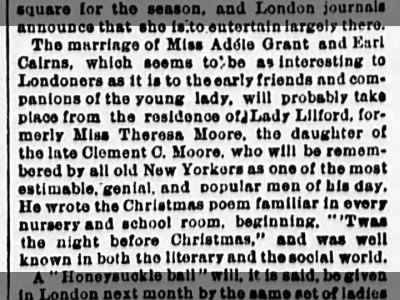
From the New York Sun, May 16, 1886:
... Lady Lilford, formerly Miss Theresa Moore, the daughter of the late Clement C. Moore, who will be remembered by all old New Yorkers as one of the most estimable, genial, and popular men of his day. He wrote the Christmas poem familiar in every nursery and school room, beginning, "'Twas the night before Christmas," and was well known in both the literary and the social world.


Related posts