"Let the dead past bury its dead" as Longfellow says, or as we lesser lights would say "let the old Cat die." --Cornelia Griswold Goodrich
New York City physician William S. Thomas impressed Clement C. Moore's biographer Samuel W. Patterson as "sincere, earnest, indefatigable" in his long "quest" to prove that his great grandfather Henry Livingston, Jr. wrote "A Visit from St. Nicholas" aka "'The Night Before Christmas." Patterson honored the memory of Dr. Thomas by reviewing the Livingston claim in an appendix to his 1956 biography,
The Poet of Christmas Eve. In so doing, Moore's biographer was being extraordinarily nice. So, too, was
Henry Litchfield West when he characterized Dr. Thomas's three decades of devotion to his
idée fixe as "intelligent and unremitting industry."
Livingston descendant Mary S. Van Deusen has mistaken Patterson's kindness for weakness, in the
brief critique of Patterson's work on her magnificent Henry Livingston website. In this post I want to offer a different perspective on the obsessive "industry" of Dr. Thomas after WWI, in particular as exemplified in his bullying of Cornelia Griswold Goodrich in May 1920, and her most courageous stand of defiance.
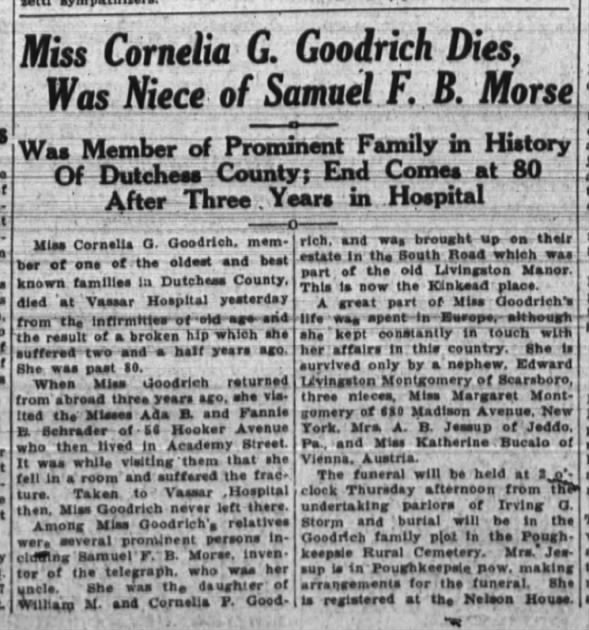
Cornelia Griswold Goodrich (1842-1927) was a great-great granddaughter of
Henry Livingston, Jr. and his first wife Sarah Welles. CGG had two
younger sisters: Anne Livingston Goodrich (1851-1902); and Mary Willis
Goodrich
(1859-1918), later Mrs. M. W. Montgomery after her marriage to Edward
Livingston Montgomery (1855-1913). Mary S. Van Deusen credits CGG as one of the first persons to delve
seriously into the family legend that Henry Livingston, Jr. wrote "A
Visit from St. Nicholas." CGG corresponded with distinguished historian Benson J.
Lossing. Misreading curiosity and courtesy as shared passion, CGG convinced herself that Lossing had been as enthusiastic for
the Livingston cause as she was. In her early excitement, CGG
apparently missed the wry humor and cautionary import of Lossing's
1886 reply:
"The circumstantial evidence that your G.
G. Grandfather wrote "The Visit of St. Nicholas" seems as conclusive as
that which has taken innocent men to the gallows."
--Benson J. Lossing to Cornelia Griswold Goodrich, November 25, 1886
Lossing
the methodical historian never got the documentation he asked for in
reply to CGG, most crucially the date of the Poughkeepsie newspaper in
which "Visit" supposedly first appeared, and written affidavits from kin
who allegedly heard Livingston's readings firsthand. The absence of basic, verifiable facts such as those requested by Lossing is the chief reason that so-called
witness letters assembled by Van Deusen do not count as evidence that Henry Livingston, Jr. wrote "The Night Before Christmas." To be at all believable, key claims eventually must be backed up with facts. The earliest testimonies are mostly
hearsay ("the report of another person's words by a witness") rather than direct, eyewitness reports. Supported by indirect and unreliable evidence, the Livingston claims were destined to be rejected, as indeed they have been. In print, the most thorough and convincing rejection of the Livingston claim appears in the two-part article in
Manuscripts (Fall 2002 and Winter 2003) by
Joe Nickell, titled "The Case of the Christmas Poem." Online, strong refutations are readily accessible via Seth Kaller's page on
The Authorship of The Night Before Christmas; and in the
Common-Place article by Stephen Nissenbaum titled
There Arose Such a Clatter.
By 1920, Cornelia Griswold Goodrich had almost made herself crazy in the effort to prove her great great grandfather's authorship of the beloved Christmas poem. Her increasingly manic state is reflected in the disjointed letter she wrote on
May 21, 1920 to William S. Thomas. Her "Cousin Will" was just then making arrangements with Winthrop P. Tryon for a fresh statement of the Livingston case in
The Christian Science Monitor:
"Mr. Tryon ought to show the similarity of the metre in the 4th stanza of Nancy Crooke acrostick, & some of grandfather's other poems - * ask the public if there is anything similar in any of Clement Moore's trashy poems - I don't see why we should handle him with kid gloves - there need be no "disrespect" shown him, or said of him, but facts are facts, & justice is justice...." --Cornelia Griswold Goodrich, May 21, 1920
Although CGG began by cheering her cousin on ("I approve & applaud"), she seems headed for a crash as the letter progresses. This letter breaks off before the end ("last page missing"), but you can guess where she's going in what's left of her last sentence:
"However I say push on - even Home[r] & Shakespeare have..."
It looks to me like CGG was going to say that even Homer and Shakespeare have doubters, or have been exposed as myths by higher criticism. Her example of Shakespeare alludes to well-publicized claims for the authorship of Shakespeare's works by somebody other than William Shakespeare. Francis Bacon was probably the best known alternative candidate. However, J. Thomas Looney had just published
Shakespeare Identified (London, 1920). Did Cornelia Griswold Goodrich go on to reference Looney's argument for Edward de Vere, 17th Earl of Oxford, as the true Shakespeare? We'll never know, unless that missing page turns up.
Near the end of May CGG did visit with Dr. William S. Thomas and Winthrop P. Tryon. She was surprised and extremely upset by their "inquisitional questioning" on family history. In her letter of
May 31, 1920 to Dr. Thomas, CGG recalls that Tryon "hardly opened his mouth." Tryon's silence as reported by CGG suggests that the grilling she received and here complains of was mainly conducted by her "dear" but domineering cousin:
Newburgh, N.Y. stationery
please excuse pencil May 31 1920
My dear Cousin Will,
I am writing from my bed- I could not sleep last night in thinking over our conversation with Mr. Tryon I got drawn into this cross-examination which was quite inquisitorial in its nature, Quite unwittingly for I did not realize there was to be such a delving & talking over our past history & genealogy. even to bringing in my parents, sisters, brothers, aunts & Uncles, & eventually having them in the limelight of public criticism, for the problematical authorship of that poem- In thinking it over I got frightened & the issue being very uncertain, the obloquay that would fall upon us by people & press, is more than I could stand-
My health is not good & I have been under the Doctor's orders to lead a very quiet life & that is why I am out of the city & up here. I don't sleep well & am easily distressed & worried over the least thing, and I have many things to worry me
Being very sensitive & tender hearted I really could not stand any publicity, or disagreeable controvery- "Let the dead past bury its dead" as Longfellow says, or as we lesser lights would say "let the old Cat die"
I don't approve of having the ashes of the past relative to two old Colonial gentlemen raked up stainless tho they be one as to a very problematical authorship (as we have no proof positive) & the other to a long reputed claim! It is a very delicate question to handle & I am not at all in favor of a writer for a christian science paper handling it- It ought to be touched on very delicately & by some man of eminent literary attainments- A very charming article can be made on the character of Henry L- by itself, but don't drag in the question of authorship now, wait till you find the fit man to do it- We relatives would only have dirt thrown at us by press & people for C. Moore is a demi-god almost in their eyes! almost a century has this "fetish" been adored & I will not have myself or my family mixed up in it. What inquisitional questioning has frightened me & to tell the truth & I was not prepared for it, & I was not very much impressed by Mr. T- He never gave any plan of operation & hardly opened his mouth! He has a fine subject & theme & probably would enjoy the notoriety it would bring him but it is too delicate a subject to be dragged & raked about except with great tact & reverence- As far as I am concerned & all my family to the 4th and 5th generation concerned, I do not wish them in the limelight of an antagonistic criticism before the public eye Cousin. Wait till you get some one of high literary merit to write about the authorship, we would only be scoffed at & held to derision, & fall back humiliated into our former place- Do not make this of any but a first class writer & let alone a Xian Science one.
Remember you are the grandson of an Episcopal cleryman & it appears to me like a smirch on his fair name to be connected with the other avenue of publication. I advise you to wait awhile & let us talk it over together - this summer quietly- I am not in favor of the scheme as it stands, please remember, dear Cousin Will & if we disapprove Mr. T has no right to xx for I disapprove of myself or any of my family so categorically given away (inadvertently thro enthusiasm for the subject) & talked about up in a Xian Science periodical, by a writer who has no well known name.
Wait, please wait a little longer- I am feeling too unwell & run down to discuss it now, & as others of the family do not quite approve of this publicity either, I say, wait & let the old Cat die, for the present. You as a doctor, & dear relative, do not want to make me feel distressed & make me sleepless- besides I think some of the family feel as I do about publishing this as a controvery-
My head aches badly today & I'm glad to be back in my quiet home- Didn't sleep well in N. York, or last night either. I felt after Mr. Tryon's short hand examination as tho I had been on trial before a jury! so forgive me for now changing my mind for the present- couldn't stand it- & don't let him begin this xx back & I would like to have my article back as it belongs to one of my family- We will confer this summer & don't be angry please.
Your affte Cousin Nellie
SOURCE: New York Historical Society, Thomas Papers
--transcribed by Mary S. Van Deusen
In addition to protesting the surprise "cross-examination" by Thomas and Tryon, CGG twice refers to the "problematical authorship" of the Christmas poem. She emphatically acknowledges the absence of documentary "
proof positive" for the Livingston side, alongside the weight of tradition on Moore's. She well appreciates the extent to which undue focus on authorship might detract, unnecessarily, from a just tribute to the life and legacy of Henry Livingston, Jr. She fears being exposed and vulnerable to criticism as a result of airing family legends. More specifically, she expects and fears that any appearance of disrespect towards Clement C. Moore might generate negative press and recriminations. And she strongly doubts that the
Christian Science Monitor is the right venue for a balanced, sympathetic treatment of Henry Livingston, Jr. and the disputed authorship of "The Night Before Christmas." CGG keenly perceives, too, the desirability of obtaining the impartial views of a qualified expert in literary studies, "some one of high literary merit" and "a first class writer."
In short, Cornelia Griswold Goodrich came to her senses. This is no regression or lamentable failure of nerve on her part. Rather, as her letter of May 31, 1920 reveals, Cornelia Griswold Goodrich has wrestled with the dark side of prolonged self-delusion, and won. The most compelling evidence of her moral and psychological victory is the wise advice she gave to her obsessive cousin, Dr. Thomas: "let the old cat die."
Mary S. Van Deusen presents a different take on the 1920 interview and fall-out, focusing on Cornelia's "hysterical" reaction, rather than the merits of her argument, or her eloquent protest of Dr. Thomas's conduct, or her wise advice to "let the old cat die":
Thomas's papers in the New York Historical Society show that he and Mr. Tryon, a gentleman who planned to publish the information in the Christian Science newspaper, came to visit Cornelia in 1920 and try to get a brain dump of her information so that they could look for potentially missed clues. But the interview didn't go as planned. Enthusiastic before the interview and anxious to see Henry identified as the author (The right & truth does not always come out in this life but it surely will in the next, and then woe to Clement Moore!), Cornelia came out of the interview absolutely hysterical with the thought that contradicting an American icon, Clement Clarke Moore, would end up in some material hitting the proverbial fan that would not increase the fragrance of the immediate environment. She begged him not to continue, or to only publicize Henry Livingston for his other writing. --Chapter 1, The Mouse in the House
As Van Deusen points out elsewhere, CGG was not the only female relative to push back against Dr. Thomas.
Helen Thomas Blackwell (emboldened by the neutral and very sensible opinion of her husband, Howard Lane Blackwell) also complained to WST about the projected article by Tryon in
the
Christian Science Monitor. WST was not about to budge, however. His reply to HTB on
May 18, 1920 indicates the intensity and inflexibility of his commitment:
There is no poem in the English or any other language as widely read than the "Night Before Christmas". It is the precious heritage of all children, young and old. Our great-grandfather wrote it and the fact should be known to all the world, and I propose to do my duty toward making it know. Let me bear alone whatever calumny may result; you know that I don't fear a good fight. Only I ask those of our family who shrink from controversy to give me a fair field. --William Sturges Thomas
In a mostly conciliatory
reply on May 20. 1920, Helen Thomas Blackwell still felt the need to reassert the importance of showing respect for Clement C. Moore and his reputation for honesty:
"... the article might well be impaired by what would seem to such a reader a gratuitous aspersion cast upon the truthfulness of Mr. Moore." --Helen Thomas Blackwell
To the urgent message from Cornelia Griswold Goodrich, WST replied immediately. In his letter of May 31, 1920, WST makes it clear that although he is sorry CGG is upset, he has no intention of putting the brakes on Tryon's
Christian Science Monitor article, as CGG begged him to do. CGG is mixed up, WST condescendingly tells her, confused by "mistaken impressions." She herself practically started the whole authorship quest, anyhow, and must not now hinder the investigation.
"Your interest and urgings have, up to now, been one of my chief inspirations. We have our convictions; for the Truth's sake let us stick to them, I beg of you. Have not the fatigue of your journey and its excitement, something to do with your fears? Remember the toil I have put into this thing and your former encouragement, and lend a helping hand, wont you, dear Cousin? --William Sturges Thomas to Cornelia Griswold Goodrich, May 31, 1920
In his reply of May 31, 1920 William Sturges Thomas never acknowledges the bullying that CGG complained of in her letter of the same date. But CGG could not forget the fierceness of her cousin's interrogation. In her
letter of June 9, 1920, CGG reminds WST of his "strenuous cross questioning that day, which frightened me really." Reluctantly, CGG accepts the decision by WST to go ahead with the article. Before the end, she even expresses gratitude to WST for not delivering the "scolding" that she she had expected, and feared.
But I beg you never to send me at any time any more Xian Science papers or tell me about the poem as it progresses. Just now I cannot stand it- I shall hope to write you this summer, for I am going to be in Fishkill for a few weeks to board, & then we can talk it over. --Cornelia Griswold Goodrich to William S. Thomas, June 9, 1920
Mary S. Van Deusen notes on her Henry Livingston site that "Cornelia Griswold Goodrich worked for 40 years to prove Henry's case." The letter of June 9, 1920 is the last one associated with CGG in the
index of Witness Letters there. Distraught still, she implores Dr. Thomas to stop bothering her about the poem, begging him
"never to send me at any time" news of the crusade. Presumably Dr. Thomas respected her wishes. Cornelia Griswold Goodrich died in 1927. Whether she was able to enjoy some measure of restored physical and emotional health, the witness letters do not say. I would be glad to learn more about Cornelia Griswold Goodrich and her experiences during any year, especially 1920-1927. In any event, her courage in 1920 remains exemplary. Likewise her hard-won wisdom, which is applicable here and now, and not only to deluded heirs of Henry Livingston, Jr.
Related posts