
Original research and riffs on Herman Melville, authorship, and nineteenth-century American literature.
Showing posts with label Allan Melvill. Show all posts
Showing posts with label Allan Melvill. Show all posts
Monday, March 14, 2022


Tuesday, July 6, 2021
Melville family in NYC Municipal Archives, new find by Warren F. Broderick
Warren F. Broderick reports a new Melville family find in the New York City Municipal Archives, this from an incomplete series of Jury Censuses for the years 1816, 1819 and 1821. Here's a link to the finding aid that describes this series:  Herman Melville was born August 1, 1819. Concerning his father Allan Melvill and household, Broderick notes the following information:
https://www1.nyc.gov/assets/records/pdf/Jury%20Census_REC0055_finding%20aid_MASTER.pdf
- The 1816 census does not list 6 Pearl Street in Ward 1.
- The 1819 census lists "Allen Mevill" at that address in Ward 1 (see image above).
- The 1821 census for the 3rd Ward is missing.
- The 1819 entry reads as follows:
Number of House / Name of Street 6 Pearl St
Name Allen Melvill
Occupation Mercht
Age 36
Personal estates of $150 1
Total Number of [eligible] Jurors 1
White Inhabitants, male 3
White Inhabitants, female 3
Coloured Inhabitants, not Slaves, male 1
Coloured Inhabitants, not Slaves, female 1
Tenants Earning $5 per annum 1
Total number of Inhabitants 9
Comments by John Bryant, as forwarded by Warren F. Broderick:
"I find one mention of 'servants' (no number or race) in the Log, and no mention of a lodger. I can account for the 3 white males: They would be, presumably, Allan, Gansevoort, and Herman (assuming the Jury census was conducted in fall 1819 or early 1820). The three females are a puzzle; they would include Maria and Helen, but who is the third? Maria wrote much later that Caroline Taylor Yates was visiting at the time in the "winter" (maybe 1819-1820), and Maria's mother Catherine Gansevoort was also visiting around the time of HM's birth."In Herman Melville: A Biography Volume 1, 1819-1851 (Johns Hopkins University Press, 1996), Hershel Parker highlights the importance of Caroline Yates and her visit during that "first winter of Herman's life":
Miss Yates (later Mrs. Taylor) read aloud a Dumas novel in French and translated it for Maria sentence by sentence. Herman became "very fond" of his mother's friend, his first recorded preference. (pages 24-25)
Wednesday, November 27, 2019
Steamboats Chancellor Livingston and Connecticut
 |
| Steamship Chancellor Livingston. 1822 by Richard Varick DeWitt (1800-1868). Image Credit: Albany Institute of History and Art |
Allan Melvill's diary:
Left New York with Mrs. Melvill, five children, Miss Adams & Nurse in the Steam Boat Chancellor Livingston at 4 P M -
August 21 Arrived at Albany at 11 A M --as quoted by Jay Leyda in The Melville Log, 2 vols. (New York: Harcourt, Brace and Company, 1951) volume 1, page 15.Allan Melvill's actual diary is held with Correspondence and miscellaneous manuscripts in the Herman Melville Papers at Houghton Library, Harvard. Citation:
Melville, Allan, 1782-1832.Diary. A.Ms.s.(variously); [v.p.] 1800-1831., 1800-1831. Herman Melville papers, MS Am 188-188.6, MS Am 188, (118). Houghton Library, Harvard College Library. https://id.lib.harvard.edu/ead/c/hou00338c00127/catalog Accessed November 27, 2019
 |
| New York National Advocate - August 19, 1823 via GenealogyBank |
- Gansevoort, age 7 (b. December 6, 1815)
- Helen, 6 (b. August 4, 1817)
- Augusta, almost 2 (b. August 24, 1821)
- Herman, 4 (b. August 1, 1819)
- Allan, 4 months (b. April 7, 1823)
(Catherine/Kate was born on May 21, 1825; Frances Priscilla/Fanny on August 26, 1827; and Thomas/Tom on January 24, 1830.)
The summer before (August 7, 1822), Herman and family left New York for Providence on the steamboat Connecticut, then commanded by Captain Elihu S. Bunker (1772-1847).
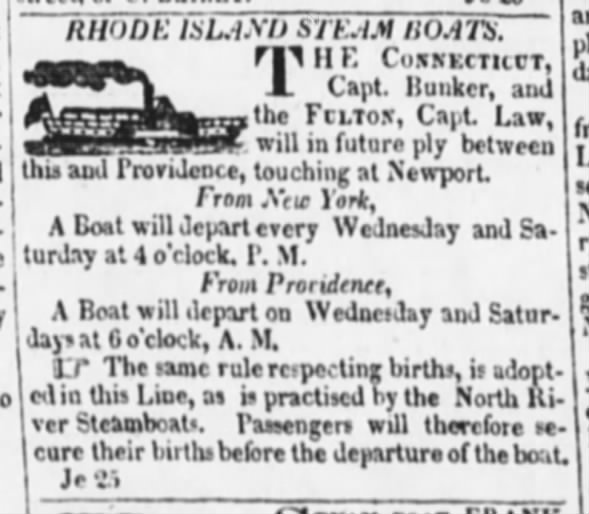 Tue, Aug 6, 1822 – Page 4 · The Evening Post (New York, New York) · Newspapers.com
After a night at Sanford Horton's Globe Tavern aka Golden Ball Inn on the corner of Benefit and South Court Streets they proceeded on to Boston "in a private Carriage" for a long visit with Herman's grandfather Thomas Melvill and family (Melville Log Vol 1, page 11).
The summer before (August 7, 1822), Herman and family left New York for Providence on the steamboat Connecticut, then commanded by Captain Elihu S. Bunker (1772-1847).
Tue, Aug 6, 1822 – Page 4 · The Evening Post (New York, New York) · Newspapers.com
After a night at Sanford Horton's Globe Tavern aka Golden Ball Inn on the corner of Benefit and South Court Streets they proceeded on to Boston "in a private Carriage" for a long visit with Herman's grandfather Thomas Melvill and family (Melville Log Vol 1, page 11).
 |
| Golden Ball Inn, Providence RI via Library of Congress |
 |
| Rhode Island American - June 28, 1822, page 2 via GenealogyBank |
 |
| Rhode Island American - June 28, 1822, page 3 via GenealogyBank |
CHANCELLOR LIVINGSTON
https://hdl.handle.net/2027/mdp.39015018442189?urlappend=%3Bseq=24
Related post:
- Swiftsure line in 1830
https://melvilliana.blogspot.com/2019/11/swiftsure-line-in-1830.html
Monday, July 3, 2017
New York High Schools, Allan Melvill on Board of Trustees for 1829
From 1825 to 1829 young Herman Melvill (age six to ten) attended the New York High School where his father Allan Melvill eventually became a stockholder and trustee. Here Herman served as a student "monitor" and, as Allan Melvill reported to Peter Gansevoort in February 1828, "proved the best Speaker in the introductory Department."
Organized in 1824 by a group of well-to-do New Yorkers, it had quickly acquired over six hundred students. Its spacious three-story brick building, fifty feet by seventy-five, stood in Crosby street, a walk of five short blocks for the Melville boys. --William Gilman, Melville's Early Life and Redburn (page 28)David K. Titus has more on Melville's early education at the New York High School in his article on "Herman Melville at the Albany Academy," published in Melville Society Extracts 42 (May 1980).
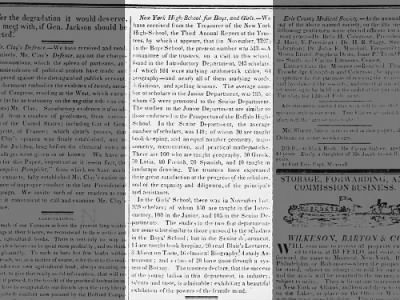
New York-High School for Boys, and Girls.--We have received from the Treasurer of the New York High-School, the Third Annual Report of the Trustees, by which it appears, that (in November, 1827) in the Boys School, the present number was 543.-- A committee of the trustees, on a visit to this school, found in the Introductory Department, 243 scholars, of which 184 were studying arithmetick tables, 64 geography--and nearly all of them studying words, definitions, and spelling lessons. The average number of scholars in the Junior Department, was 185, of whom 65 were promoted to the Senior Department. The studies in the Junior Department are similar to those embraced in the Prospectus of the Buffalo High School. In the Senior Department, the average number of scholars, was 148; of whom 30 are taught book-keeping, and an equal number geometry, trigonometry, mensuration, and practical mathematicks. There are 100 who are taught geography, 30 Greek, 70 Latin, 80 French, 20 Spanish, and 40 taught in landscape drawing. The trustees have expressed their great satisfaction at the progress of the scholars, and of the capacity and diligence of the principals and assistants.Found on Newspapers.com
In the Girls' School, there was in November last, 359 scholars; of whom 150 are taught in the Introductory, 100 in the Junior, and 105 in the Senior Departments. The studies in the two first departments are somewhat similar to those pursued by the scholars in the Boys' School; but in the Senior department, 14 are taught book keeping, 20 read Blair's Lectures, 8 Alison on Taste, 16 classical Biography, 4 study Astronomy; and a class of 20 have gone through a system of Botany. The trustees declare, that the success of the young ladies in this department, in industry, talents and taste, is admirable: exhibiting a beautiful exhibition of the powers of the female mind. --Buffalo and Black Rock Gazette, January 17, 1828.
As noted in the previous post on Dancing with Miss Whieldon, Herman's sister Helen Maria Melville received private instruction from Mrs. Whieldon.
In September 1829 (when Gansevoort and Herman were enrolled at the Columbia Grammar School), the Female High School continued to offer an impressive course of study in the Senior department, where young women could study (besides needlework and French) "moral philosophy, history, and belles lettres," and attend "lectures on astronomy, natural history and natural philosophy."
 |
| New York Observer - September 5, 1829 Found in the online archives of Historical Newspapers at Genealogy Bank |
- "Columbia Grammar School: An Overlooked Year in the Lives of Gansevoort and Herman Melville" in Melville Society Extracts 46 (May 1981): 1-3; and
- "Old School Ties: Melville, the Columbia Grammar School, and the New Yorkers" in Melville Society Extracts 55 (September 1983): 1-5.
Wednesday, December 23, 2015
The Picture of Liverpool: Redburn's "Prosy Old Guide-Book"
From Redburn: His First Voyage (1849):
The Library of Congress volume is also available in the HathiTrust Digital Library.
Thirteen images from the 1808 edition of The Picture of Liverpool are accessible online via Wikimedia Commons.
The Picture of Liverpool is No. 547 in Mary K. Bercaw's checklist of Melville’s Sources. A quirk of scholarly rigor now excludes The Picture of Liverpool from the "Online Catalog of Books and Documents Owned, Borrowed and Consulted by Herman Melville" since:

Anyone contemplating a conference or other academic sort of paper on Melville's use of The Picture of Liverpool will want to consult Willard Thorp's 1938 article in PMLA and Hershel Parker's Historical Note in the Northwestern-Newberry edition of Redburn. Below, for a start, are links to Thorp and some other helpful scholarship:
And lastly, and to the purpose, there was a volume called “ THE PICTURE OF LIVERPOOL.”
It was a curious and remarkable book; and from the many fond associations connected with it, I should like to immortalize it, if I could.
But let me get it down from its shrine, and paint it, if I may, from the life.
As I now linger over the volume, to and fro turning the pages so dear to my boyhood,—the very pages which, years and years ago, my father turned over amid the very scenes that are here described; what a soft, pleasing sadness steals over me, and how I melt into the past and forgotten !
Dear book! I will sell my Shakspeare, and even sacrifice my old quarto Hogarth, before I will part with you. Yes, I will go to the hammer myself, ere I send you to be knocked down in the auctioneer’s shambles. I will, my beloved,—old family relic that you are;—till you drop leaf from leaf, and letter from letter, you shall have a snug shelf somewhere, though I have no bench for myself.
In size, it is what the booksellers call an 18mo; it is bound in green morocco, which from my earliest recollection has been spotted and tarnished with time; the corners are marked with triangular patches of red, like little cocked hats; and some unknown Goth has inflicted an incurable wound upon the back. There is no lettering outside; so that he who lounges past my humble shelves, seldom dreams of opening the anonymous little book in green. There it stands; day after day, week after week, year after year; and no one but myself regards it. But I make up for all neglects, with my own abounding love for it.
But let us open the volume....
The Library of Congress volume is also available in the HathiTrust Digital Library.
Thirteen images from the 1808 edition of The Picture of Liverpool are accessible online via Wikimedia Commons.
The Picture of Liverpool is No. 547 in Mary K. Bercaw's checklist of Melville’s Sources. A quirk of scholarly rigor now excludes The Picture of Liverpool from the "Online Catalog of Books and Documents Owned, Borrowed and Consulted by Herman Melville" since:
"This resource lists only books and titles that can be linked to Herman Melville and his immediate family by documentary evidence, such as Melville’s autograph in extant copies, references to book purchases in his letters and journals, and library charge records." --Melville's Marginalia OnlineNevertheless, Melville consulted it--and how!
I guess it's the old problem: "If we make an exception for you, we have to do it for everybody." Hmm. Perhaps the page in Redburn where Melville copied out (and slightly modified) the title page of The Picture of Liverpool should be treated as graphic documentary evidence, as well as textual evidence, of Melville's certain engagement with the "Prosy Old Guide-Book."
Anyone contemplating a conference or other academic sort of paper on Melville's use of The Picture of Liverpool will want to consult Willard Thorp's 1938 article in PMLA and Hershel Parker's Historical Note in the Northwestern-Newberry edition of Redburn. Below, for a start, are links to Thorp and some other helpful scholarship:
- Willard Thorp, Redburn's Prosy Old Guidebook - PMLA 53. 4 (December 1938): 1146-1156.
- Wyn Kelley in Melville's City examines Redburn's Liverpool as a New York labyrinth.
- Marvin Fisher, "The American Character, the American Imagination," and the Test of International Travel in Redburn" in Melville "Among the Nations", ed. Sanford E. Marovitz and Athanasios C. Christodoulou.
- Steven Olsen-Smith offers an abstract of his paper on "Redburn's Prosy Old Guidebook, Revisited (in Power Point)" in Melville Society Extracts 127 (July 2004).
- Christopher Hager has a thoughtful discussion of Redburn's Liverpool guidebook in "Melville in the Customhouse Attic" - American Literature 82.2 (2010): 305-332
- Katie McGettigan, Redburn's ‘Prosy Old Guidebook’ Revisited: Herman Melville's Use of William Roscoe's ‘Mount Pleasant’ - Notes and Queries 58.4 (2011): 555-7
- Martyn Smith, "Between Book and Reality: The Guidebook in Redburn and Clarel" -
Leviathan, Volume 13, Issue 3, October 2011, pp. 30-40
Related melvilliana post:
Sunday, November 30, 2014
Allan Melvill's New French Goods Store
 |
| Image Credit: Tea in a Teacup |
What in the world are Morocco ridicules? Aha, a ridicule is a reticule, a lady's purse.NEW FRENCH GOODS STORE.
No. 123 Pearl St. (up stairs) corner of Sloat-lane.
ALLAN MELVILL has imported by the late
arrivals from Havre, 60 cases choice and
fashionable French goods, selected by himself in
France expressly for this market; viz.
Florences, velvets, extra fine crapes and
Tulle laces.
Plain and pearl edged heavy lustring ribbons.
Soft satin and fancy garnitures do.
Rich raw silk, in imitation of real Cashmere
shawls.
Embroider'd muslin bands, caps sad spensers
Superb embroidered robes for ladies and children
Linen cambrics and handkerchiefs
A large and elegant assortment of laces, footings
and edgings
Mecklin laces and black and white lace veils
Superior Courtray linens, lawns and sheetings
Habit and extra kid gloves
Silk hose; ostrich and fancy feathers
Flowers and wreaths
Ball dresses and trimmings
Rich ornamented combs, plush trimmings
Morocco ridicules with steel chains
Broad lustring ribbons for sashes
And a variety of other new, fancy and staple
articles, direct from Paris.
1. (Clothing & Fashion) (in the 18th and 19th centuries) a woman's small bag or purse, usually in the form of a pouch with a drawstring and made of net, beading, brocade, etc.
--The Free Dictionary
 |
| Reticule / French / early 19th century Image Credit: www.metmuseum.org |
 |
| Albany Argus, October 27, 1818 |
Friday, August 1, 2014
195 years young
 | |||
| Maria Gansevoort Melvill (Mrs. Allan Melvill) Painting by Ezra Ames, c. 1815 |
Image Credit: Courtesy National Gallery of Art, Washington
Soon we have to start planning for a stupendous Bicentennial Bash!
August 1, 1819 was a Sunday. Here is the newspaper ad (or one of them) Allan Melvill ran the next morning, one day after the birth of his second son. From the New York Mercantile Advertiser, August 2, 1819.
 |
| New York Mercantile Advertiser - Monday, August 2, 1819 |
MISSES’ & MENS’ LEGHORN HATS.
ONE case Ladies’ and Misses’ Yellow Leghorn Hats, Nos. 18 to 33, with extra Crowns, and Mens’ fine Black do, Nos. 10 to 25—Also, 1 case Ladies’ very superior Yellow do, Nos. 50 to 57, with extra crowns to match, for sale by
ALLAN MELVILL
123 Pearl-st, Hanover Square.
Allan Melvill regularly advertised his French imports in other commercial papers such as the New York Gazette. Unusually, in April he offered works of original art by Dutch masters and a selection of engravings.
 |
| New York Gazette - April 24, 1819 |
ORIGINAL PAINTINGS—Received direct from Paris, by the Adonis, a valuable collection of Paintings in appropriate frames, by eminent masters, of the Dutch School; and a variety of Engravings framed and glazed, worth the attention of amateurs and artists, for sale byWhen Herman's first Christmas came around, his father still had the paintings. The same advertisement (without mentioning the Adonis) ran December 25, 1819 in the New York Mercantile Advertiser.
ALLAN MELVILL,
123 Pearl-st. Hanover-square. --New York Gazette, Saturday, April 24, 1819; found in the Newspaper Archives at Genealogy Bank.
Subscribe to:
Posts (Atom)