Showing posts with label Yankee Doodle. Show all posts

Wednesday, July 12, 2017

Rewriting Old Zack

The previous post identified the 1847 newspaper source for Melville's physical description of Zachary Taylor in Yankee Doodle. With Melville's base-text in the New York Herald of June 30, 1847 before us, we can compare the original article with Melville's version to see exactly how Melville adapted it for comic effects. A closer look at Melville's changes may prove interesting and instructive.

Here's the author of Typee and Omoo at work, rewriting Old Zack. (The source is shown in black text; Melville's rewrite in blue.)
The hero of Buena Vista,
around whose military brow so many chaplets of fame have been thrown
upon the crown of whose caput have descended so many interleaved chaplets of fame
presents in his personal appearance many of those striking stamps of nature, which mark the gentleman and the officer.
presents in his general exterior personal appearance many of those extraordinary characteristics distinctive of the noble spirit tabernacled within.
Of an average medium height, being about five feet nine inches,
Of about the common length of ordinary mortals—say about five feet, nine inches, and two barley corns, Long Measure—
he inclines to a heaviness of frame and general well-developed muscular outline, with some tendency to corpulency; of square build, he now inclines to stoop;
he rather leans to a squat colossalness of frame and universal spread of figure, particularly on the lower part of the abdominal regions. To counteract a bulging forth of the latter parts, he is said to wear a truss of peculiar conformation. This circumstance, however, is not as yet fully established. Of a thick set and quadratular build, he now inclines to tenuity in the parts lying round about the calf.
and from the great equestrian exercise the nature of his life has led him necessarily to undergo, his inferior extremities are somewhat bowed.
Originally of great agility of the locomotive apparatus, he now betrays on his partially denuded head a want of energy in the capillary tubes of the hair, as his digestive machinery is liable to frequent suspensions of activity. 
His expansive chest shows him capable of undergoing that vast fatigue through which he has passed amid the hummocks and savannahs of Florida, and the still more recent fields of Mexico.
His broad and expanded chest shows the hero fully capable of encountering the prodigious fatigues of war, whether in the interminably interlocked everglades of the Floridian southerly terminus of the Republic, or upon the wide-spreading and generally level table-land savannahs of Mexico.
His face is expressive of great determination—
His face is a physignomical phenomenon, which Lavater would have crossed the Atlantic to contemplate. Of soul-awing determination of expression and significant of inflexible and immovable ironness of purpose,
yet, still so softened by the kindlier feelings of the soul, as to render the perfect stranger prepossessed in his behalf.
it (the external features of the countenance) are softened down and melted into a kindly benevolence which would prepossess a perfect stranger in his favor.
His head is large, well-developed in the anterior regions,
His head is large, extremely well dev[el]oped in the frontal quarter, but not classically elegant in the anterior portion. To employ an expressive, though somewhat rude comparison, it appears as if squshed between his shoulders. By close observers, the lobe of the right ear is thought to be depressed more than the corresponding auricular organ, on the lateral part of the caput. 
and covered with a moderate quantity of hair, now tinged by the coloring pencil of time, which he wears parted on one side, and brushed down.
In early adolescence of a beautiful amber or brown color, the hair, through the gradual ravages of time, has assumed a speckled, pepper and salt external appearance. In a most touching manner the thin and scattered locks are parted picturesquely on one side and combed slickly over the brows.
His eyebrows are heavy, and extend over the optic orbit; the eye grey, full of fire, and expressive when his mental powers are called into play, yet reposing as if in pleasant quiet, when in ordinary.—
The latter are Jupiternian in their awful bushiness—the hairy appendage curling over upon the optic orbits. His frown is Olympian and strikes terror and confusion into the overwhelmed soul of the spectator. The muscular energy of the brows is truly extraordinary. When ever their pupular is under mental excitation, they frequently become knit together in wrinkular pleats like unto the foldular developments under the lateral shoulder of the rhinoceros species of animated nature. His eye is Websternian, though grey. The left organ somewhat effects the dexter side of the socket, while examined by a powerful telescope several minute specks are observable in the pupil of the sinister orbit. But this detracts not from the majesty of its expression: the sun even has its spots. When the hero's soul is lashed into intellectual agitation by the external occurrence of irritating and stimulating circumstance, the eye assumes an inflamed and fiery appearance. The scantiness of the lashes and their short and singed appearance are ascribable, perhaps, to their vicinity to the pupil when thus kindled into fury. When a mental calm, however, pervades the serene soul of the hero, a Saucernian placidity is diffused over the entire visionary orb. 
His nose is straight, neither partaking of the true Grecian nor Roman order; his lips thin, the upper firm, and the lower slightly projecting.
The nostrilian organ, or proboscis. is straight, but neither inclining to the Roman, or Grecian, or, indeed, the Doric or Composite order of nasal architecture. 
The outline of his face is oval, the skin wrinkled, and deeply embrowned by the many tropical suns to which he has been exposed.
The labial appendages (suspended just under the proboscis) are attenuated—the upper tightly and firmly spread upon the dental parts beneath; and the lower pendant and projecting as represented in the prints. The outline of the caput, generally, is an ovalular elipsis inclining to the rotund, but having no predisposition to the quadrangular. The obvious cuticle or scarf-skin is wrinkled, freckled, and embrowned—doubtless through age and constant exposure to the ardent rays of the Floridian and Mexicanian sun combined. 
His manners are frank, social, and no one ever left his company, without feeling that he had been mingling with a gentleman of the true olden times.
The manner of the hero is frank and companionable—and never did mortal leave his society without being constantly impressed with the unavoidable conviction that he had been conversing with a good fellow and a gentleman. 
He at times appears in deep meditation, and is then not always accessible. In his military discipline he is firm, and expects all orders emanating from his office to be rigidly enforced and observed —
At times he is seen in deep and earnest meditation—the left auricular organ with the head attached thereto, deposited upon the open palm and outspread digits of the manual termination of the arm. At other times he assumes when meditating quite a different posture; the fore finger of the left hand being placed on the dexter side of the proboscis. In his military discipline, he is firm and unyielding to the last degree of military inflexibility—
treating his men not as helots or slaves, but exercising only that command which is necessary for the good of the whole. To the younger officers under him, he is peculiarly lenient — often treating their little faults more with a father's forgiveness, than with the judgment of a ruler.
but is, nevertheless, remarkably lenient to those under him, officers and privates included. Particularly to the youthful portion of his command, whom he treats with all the indulgence of a paternal relative or guardian—often permitting them to lay a-bed late in the morning, when the battle is raging at the fiercest.  
In his general toilet he does not imitate the Beau Brummels and band-box dandies of the present fashionable epoch, but apparels his person in unison with his age, and has no great predilection for the uniform.
In his general toilet he is far from imitating a Brummellian precision and starchedness of cravat. 
In this, however, he is by no means peculiar, for a majority of our regular military gentlemen seldom appear in their externals on duty; and the stations to which General Taylor has been assigned, have been in the warm and sunny south, rendering the heavy blue cloth undress coat disagreeable to the physical feelings.
He has no violent predilection for his regimentals and seldom appears in them, which, in fact, is the case with most of his officers, of whom it is even observed, that “they seldom appear in externals on duty,”—a habit indicative of superiority to foppish adornments, but might be construed by the fastidious into a want of good taste and decorousness. Their custom in this respect, however, is defensible upon the ground, that called by Divine Providence to perform their martial functions in the genial and delightful regions of the sunny south, the cumbersome military costume, or, indeed, any dress at all, “is disagreeable to the physical feelings."
I have generally seen him in a pair of grey trowsers,
The hero himself may be usually seen by an ordinary spectator arrayed in a pair of sheep's grey pants, shapeless and inclined to bagging—the latter predisposition being imputed, by a reflecting observer, to the singular fact that the hero never wears the common-place articles called suspenders.
a dark vest, and either a brown or speckled frock coat, reaching lower than would suit the starched and prim bucks of modern civilization. 
His coat is generally of a brownish tinge which in some cases is to be imputed to the original color imparted to the cloth when in the vat of the dyer, and in other cases to an heroic disregard of dust and oleaginous spots on the part of the ungent wearer. His vest usually, though not invariably, is of a darksome hue—resembling the ordinary sable. 
He wears a long black silk neck-handkerchief, the knot not looking as if he had been torturing himself to arrange it before a full-length mirror;
He wears a long crumpled black silk neck-handkerchief, much knotted and super-twisted, and evidently not put on with any great degree of care. But the carelessness with which it is tied in no respect approaches to the studied artlessness of the Byronic bow. The shirt collar is open, revealing considerable superfluous hair just above region of the thorax and windpipe, and betokening a disdain of Gouraud's Depillatory. Several individual hairs partake of the greyish tinge of the sparse covering of the head. 
he sometimes wears a white hat, resembling in shape those used by our flat-boatmen,
The hero sometimes wears a white wool hat, much marked by indentation, and irregular depressions and prominences upon the crown. It resembles in most respects the castor of a Mississippi flat-boatman.—
and a pair of common soldier shoes, not much polished.
His shoes are the common cow-hide sandals served out by the Commissary Departmtent to the free use of the army. They are usually stringless and not much polished.
For further study:
Gouraud Bottle via Hair Raising Stories

Related posts

Tuesday, July 11, 2017

Personal appearance of Zachary Taylor, Melville's 1847 sketch and newspaper source

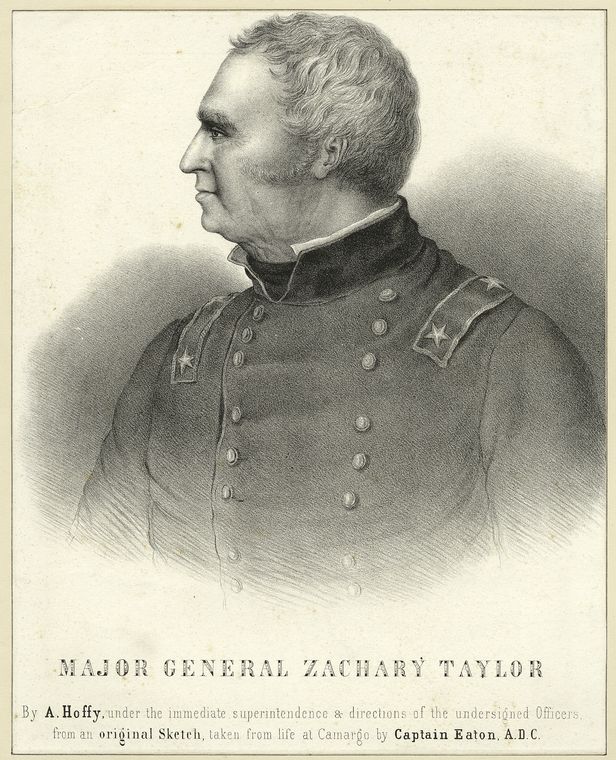
Major General Zachary Taylor
 The New York Public Library Digital Collections
Published in Yankee Doodle on August 7, 1847, Herman Melville's humorous sketch of the personal appearance of General Taylor directly parodies a newspaper report that first appeared in the New York Herald on June 30, 1847.
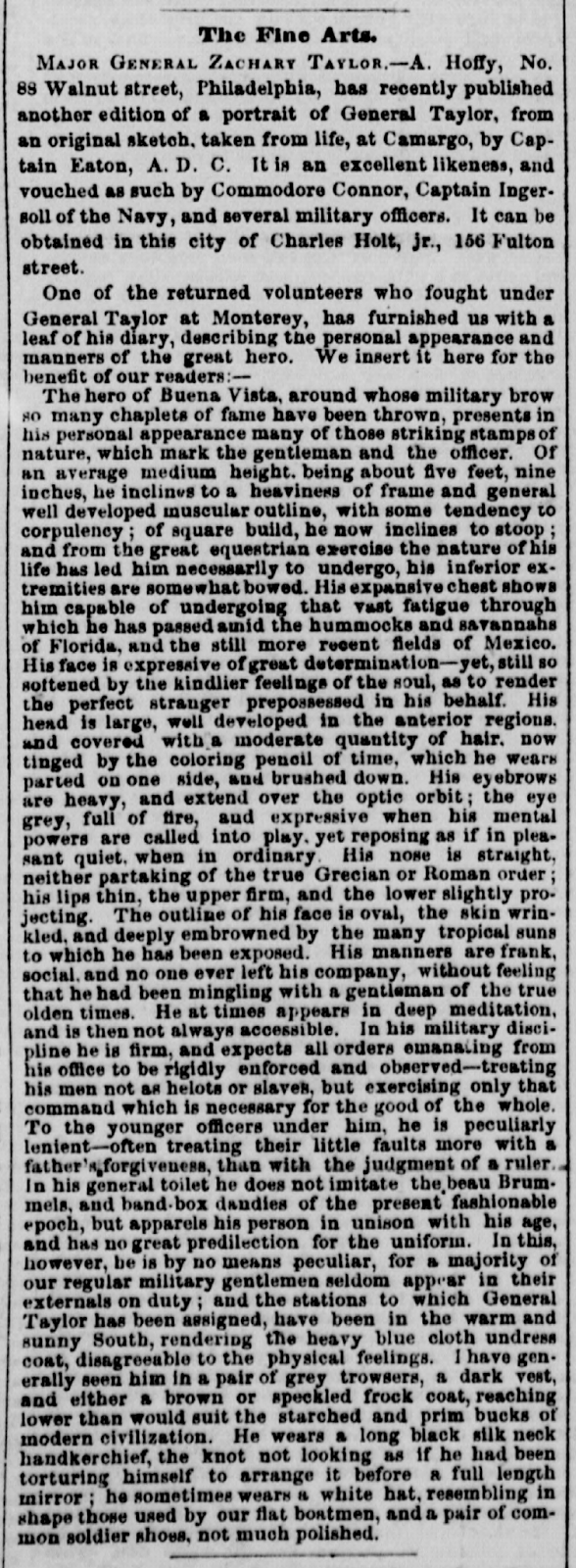
The New York Herald - June 30, 1847
via Chronicling America: Historic American Newspapers - Library of Congress
The Herald sketch circulated widely under various titles, including "Personal Appearance of Gen. Taylor" in the Morning Courier and New-York Enquirer (July 13, 1847); and "General Taylor's Personal Appearance" in The Anglo-American (July 17, 1847).

In his Yankee Doodle piece, Melville essentially rewrote the Herald article, embracing much of the descriptive language while crafting a comically exaggerated pose of pseudo-scientific seriousness. In many places Melville borrowed verbatim from his newspaper source. For example, two phrases from one or another version of the newspaper article on Zachary Taylor's personal appearance are amusingly quoted and italicized in Melville's Yankee Doodle parody. Officers
"seldom appear in their externals on duty" 
since in the hot climate of Mexico the heavy military uniform would soon become
"disagreeable to the physical feelings."
In recasting the quoted material, Melville exaggerates the informality of camp life, implying that officers wage war in their underwear. Melville's source and sketch both compare General Taylor's hat to those of "flat-boatmen." Both end by describing the General's shoes as "not much polished."

Melville's newspaper source and his unsigned parody in Yankee Doodle are transcribed below. First, the source:
Personal Appearance of Gen. Taylor.— One of the returned volunteers who fought under Gen. Taylor at Monterey, has furnished us with a leaf of his diary, describing the personal appearance and manners of the great hero, as follows:
The hero of Buena Vista, around whose military brow so many chaplets of fame have been thrown, presents in his personal appearance many of those striking stamps of nature, which mark the gentleman and the officer. Of an average medium height, being about five feet nine inches, he inclines to a heaviness of frame and general well- developed muscular outline, with some tendency to corpulency; of square build, he now inclines to stoop; and from the great equestrian exercise the nature of his life has led him necessarily to undergo, his inferior extremities are somewhat bowed. His expansive chest shows him capable of undergoing that vast fatigue through which he has passed amid the hummocks and savannahs of Florida, and the still more recent fields of Mexico. His face is expressive of great determination—yet, still so softened by the kindlier feelings of the soul, as to render the perfect stranger prepossessed in his behalf. His head is large, well-developed in the anterior regions, and covered with a moderate quantity of hair, now tinged by the coloring pencil of time, which he wears parted on one side, and brushed down. His eyebrows are heavy, and extend over the optic orbit; the eye grey, full of fire, and expressive when his mental powers are called into play, yet reposing as if in pleasant quiet, when in ordinary.— His nose is straight, neither partaking of the true Grecian nor Roman order; his lips thin, the upper firm, and the lower slightly projecting. The outline of his face is oval, the skin wrinkled, and deeply embrowned by the many tropical suns to which he has been exposed. His manners are frank, social, and no one ever left his company, without feeling that he had been mingling with a gentleman of the true olden times. He at times appears in deep meditation, and is then not always accessible. In his military discipline he is firm, and expects all orders emanating from his office to be rigidly enforced and observed — treating his men not as helots or slaves, but exercising only that command which is necessary for the good of the whole. To the younger officers under him, he is peculiarly lenient — often treating their little faults more with a father's forgiveness, than with the judgment of a ruler. In his general toilet he does not imitate the Beau Brummels and band-box dandies of the present fashionable epoch, but apparels his person in unison with his age, and has no great predilection for the uniform. In this, however, he is by no means peculiar, for a majority of our regular military gentlemen seldom appear in their externals on duty; and the stations to which General Taylor has been assigned, have been in the warm and sunny south, rendering the heavy blue cloth undress coat disagreeable to the physical feelings. I have generally seen him in a pair of grey trowsers, a dark vest, and either a brown or speckled frock coat, reaching lower than would suit the starched and prim bucks of modern civilization. He wears a long black silk neck-handkerchief, the knot not looking as if he had been torturing himself to arrange it before a full-length mirror; he sometimes wears a white hat, resembling in shape those used by our flat-boatmen, and a pair of common soldier shoes, not much polished."  --Morning Courier and New-York Enquirer, July 13, 1847
Reprinted many times for example:
  • Alexandria [Virginia] Gazette, July 5, 1847
  • New York Evening Mirror, July 13, 1847
  • Litchfield [Connecticut] Republican, July 15, 1847
  • Auburn [New York] Daily Advertiser, July 16, 1847
  • The Anglo-American vol. 9 - July 17, 1847
  • Rochester [New York] Daily Democrat, July 19, 1847 
  • Saratoga Springs, New York Daily Saratoga Republican, July 22, 1847 
  • Greenfield [Massachusetts] Gazette & Courier, July 27, 1847
  • Raleigh [North Carolina] Register, July 28, 1847
  • The Taylor Text-Book or Rough and Ready Reckoner - 1848 
Found on Newspapers.com

Now for the parody. Here is the text of Melville's sketch, transcribed from Yankee Doodle no. 44 (August 7, 1847):
"GEN. TAYLOR'S PERSONAL APPEARANCE," OR OLD ZACK PHYSIOLOGICALLY AND OTHERWISE CONSIDERED.

BY A SURGEON OF THE ARMY IN MEXICO.
The hero of Buena Vista, upon the crown of whose caput have descended so many interleaved chaplets of fame, presents in his general exterior personal appearance many of those extraordinary characteristics distinctive of the noble spirit tabernacled within. Of about the common length of ordinary mortals—say about five feet, nine inches, and two barley corns, Long Measure—he rather leans to a squat colossalness of frame and universal spread of figure, particularly on the lower part of the abdominal regions. To counteract a bulging forth of the latter parts, he is said to wear a truss of peculiar conformation. This circumstance, however, is not as yet fully established. Of a thick set and quadratular build, he now inclines to tenuity in the parts lying round about the calf. Originally of great agility of the locomotive apparatus, he now betrays on his partially denuded head a want of energy in the capillary tubes of the hair, as his digestive machinery is liable to frequent suspensions of activity. 
His broad and expanded chest shows the hero fully capable of encountering the prodigious fatigues of war, whether in the interminably interlocked everglades of the Floridian southerly terminus of the Republic, or upon the wide-spreading and generally level table-land savannahs of Mexico. His face is a physignomical phenomenon, which Lavater would have crossed the Atlantic to contemplate. Of soul-awing determination of expression and significant of inflexible and immovable ironness of purpose, it (the external features of the countenance) are softened down and melted into a kindly benevolence which would prepossess a perfect stranger in his favor. His head is large, extremely well dev[el]oped in the frontal quarter, but not classically elegant in the anterior portion. To employ an expressive, though somewhat rude comparison, it appears as if squshed between his shoulders. By close observers, the lobe of the right ear is thought to be depressed more than the corresponding auricular organ, on the lateral part of the caput.  
In early adolescence of a beautiful amber or brown color, the hair, through the gradual ravages of time, has assumed a speckled, pepper and salt external appearance. In a most touching manner the thin and scattered locks are parted picturesquely on one side and combed slickly over the brows. The latter are Jupiternian in their awful bushiness—the hairy appendage curling over upon the optic orbits. His frown is Olympian and strikes terror and confusion into the overwhelmed soul of the spectator. The muscular energy of the brows is truly extraordinary. When ever their pupular is under mental excitation, they frequently become knit together in wrinkular pleats like unto the foldular developments under the lateral shoulder of the rhinoceros species of animated nature. His eye is Websternian, though grey. The left organ somewhat effects the dexter side of the socket, while examined by a powerful telescope several minute specks are observable in the pupil of the sinister orbit. But this detracts not from the majesty of its expression: the sun even has its spots. When the hero's soul is lashed into intellectual agitation by the external occurrence of irritating and stimulating circumstance, the eye assumes an inflamed and fiery appearance. The scantiness of the lashes and their short and singed appearance are ascribable, perhaps, to their vicinity to the pupil when thus kindled into fury. When a mental calm, however, pervades the serene soul of the hero, a Saucernian placidity is diffused over the entire visionary orb.  
The nostrilian organ, or proboscis. is straight, but neither inclining to the Roman, or Grecian, or, indeed, the Doric or Composite order of nasal architecture. The labial appendages (suspended just under the proboscis) are attenuated—the upper tightly and firmly spread upon the dental parts beneath; and the lower pendant and projecting as represented in the prints. The outline of the caput, generally, is an ovalular elipsis inclining to the rotund, but having no predisposition to the quadrangular. The obvious cuticle or scarf-skin is wrinkled, freckled, and embrowned—doubtless through age and constant exposure to the ardent rays of the Floridian and Mexicanian sun combined.  
The manner of the hero is frank and companionable—and never did mortal leave his society without being constantly impressed with the unavoidable conviction that he had been conversing with a good fellow and a gentleman. 
At times he is seen in deep and earnest meditation—the left auricular organ with the head attached thereto, deposited upon the open palm and outspread digits of the manual termination of the arm. At other times he assumes when meditating quite a different posture; the fore finger of the left hand being placed on the dexter side of the proboscis. In his military discipline, he is firm and unyielding to the last degree of military inflexibility—but is, nevertheless, remarkably lenient to those under him, officers and privates included. Particularly to the youthful portion of his command, whom he treats with all the indulgence of a paternal relative or guardian—often permitting them to lay a-bed late in the morning, when the battle is raging at the fiercest.  
In his general toilet he is far from imitating a Brummellian precision and starchedness of cravat. He has no violent predilection for his regimentals and seldom appears in them, which, in fact, is the case with most of his officers, of whom it is even observed, that they seldom appear in externals on duty,”—a habit indicative of superiority to foppish adornments, but might be construed by the fastidious into a want of good taste and decorousness. 
Their custom in this respect, however, is defensible upon the ground, that called by Divine Providence to perform their martial functions in the genial and delightful regions of the sunny south, the cumbersome military costume, or, indeed, any dress at all, is disagreeable to the physical feelings." 
The hero himself may be usually seen by an ordinary spectator arrayed in a pair of sheep's grey pants, shapeless and inclined to bagging—the latter predisposition being imputed, by a reflecting observer, to the singular fact that the hero never wears the common-place articles called suspenders. His coat is generally of a brownish tinge which in some cases is to be imputed to the original color imparted to the cloth when in the vat of the dyer, and in other cases to an heroic disregard of dust and oleaginous spots on the part of the ungent wearer. His vest usually, though not invariably, is of a darksome hue—resembling the ordinary sable. He wears a long crumpled black silk neck-handkerchief, much knotted and super-twisted, and evidently not put on with any great degree of care. But the carelessness with which it is tied in no respect approaches to the studied artlessness of the Byronic bow. The shirt collar is open, revealing considerable superfluous hair just above region of the thorax and windpipe, and betokening a disdain of Gouraud's Depillatory. Several individual hairs partake of the greyish tinge of the sparse covering of the head. 
The hero sometimes wears a white wool hat, much marked by indentation, and irregular depressions and prominences upon the crown. It resembles in most respects the castor of a Mississippi flat-boatman.— His shoes are the common cow-hide sandals served out by the Commissary Departmtent to the free use of the army. They are usually stringless and not much polished. 
--[Herman Melville] in Yankee Doodle No. 44 - August 7, 1844
In print, texts of this sketch and nine numbered "Old Zack" Anecdotes are available in the Northwestern-Newberry edition of Melville's Piazza Tales and Other Prose Pieces, 1839-1860. The University of Chicago volume with Yankee Doodle, Volumes 1-2 has been digitized by Google Books, and is also available online courtesy of Hathi Trust Digital Library.


Related posts

Thursday, April 14, 2016

Melville's "Old Zack" Anecdotes, in Yankee Doodle and some newspapers


In the summer of 1847, Herman Melville wrote anonymously for Yankee Doodle, the New York humor magazine then edited by his friend Cornelius Mathews. Melville's best and best-known contribution to Yankee Doodle was the mock-journalistic series on Zachary Taylor at war called "Authentic Anecdotes of 'Old Zack.'" As documented in textual notes to "Authentic Anecdotes" in the Northwestern-Newberry edition of Piazza Tales and Other Prose Pieces, the New York Evening Post reprinted Anecdotes I and II on Friday, July 23, 1847; and part of Anecdote IV on Tuesday, August 17, 1847.

New York Evening Post - July 23, 1847
via genealogybank.com
Some of Melville's "Anecdotes" appeared also in other newspapers.

Melville's first "Old Zack" anecdote was reprinted from Yankee Doodle in the Lowell Daily Courier, Saturday, July 24, 1847.

Lowell Daily Courier  - July 24, 1847
Found at Fulton History
The Natchez Mississippi Free Trader, August 18, 1847 gave Anecdotes I and II from Yankee Doodle (via the New York Evening Post, as evidenced by the editorial preface copied verbatim from the New York paper).

Found on Newspapers.com

And on Wednesday, September 1, 1847 the Edgefield [South Carolina] Advertiser reprinted Anecdote II, crediting Yankee Doodle.

Found on Newspapers.com

Below, the first two of Melville's "Authentic Anecdotes," transcribed from the digitized volume of Yankee Doodle at Google Books.

ANECDOTE, NO. I

It is well known that upon the battle field the hero of Palo Alto is as cool as a Roman Punch. His surprising self-collectedness and imperturbability in times of the greatest peril, was never more forcibly shown than in a little circumstance at Buena Vista. A Mexican mortar being in full play upon the front of the American columns, a large shell with the burning fusee fizzing at the aperture weighing hard on 200 cwt., fell directly at the feet of old Zack, who, with his characteristic contempt of danger, was sitting on his horse upon a conspicuous knoll and was surrounded by several of his staff. Thinking it altogether fool-hardy and superogatory to stand still and be blown to pieces, the officers betrayed no delicacy in instantly galloping out of harm's way. But old ZACK moved not a peg. “ Don’t be alarmed, gentlemen," he observed quietly, shifting his attitude by throwing the other leg on the neck of his horse—“don’t be alarmed—them 'are chaps don‘t bust always. What will you wager now, Major BLISS, that the fusee doesn’t go out afore harm’s done?"* While the Major at a good distance leveled his long spy glass at the globular apparition, the old hero calmly took out his spectacles, polished their glasses by rubbing them gently against his thigh—clapped them on his nose—descended, and approaching the shell, bent over and closely scrutinized the fusee. It had just burnt to within a hair's breadth of the inflammable bowels of the shell—and old ZACK taking it between his fore finger and thumb, drew forth the fusee and waving it towards his aghast officers, quietly observed that if any of them had a cigar to smoke he could supply them with a light.
P. S. to Anecdote, No. I.—Mr. BARNUM happening to drop in when we opened our communications from our correspondent, we read him the above. He immediately seized pen and ink and wrote to a military acquaintance of his in the army, to institute a diligent search after the above mentioned shell—pack up carefully in cotton and send it on for his Museum with all possible despatch. Thinking, however, that the search might not prove effectual, Mr. BARNUM has given orders for a shell of the proper dimensions to be cast at one of the foundries up town. We feel confident, however, in stating that the latter will not be exhibited for the genuine article, unless the genuine article fails to come to hand.
* In all cases we give the old man‘s very words. If they show a want of early attendance at the Grammar School, it must be borne in mind that old ZACK never took a college diploma—was cradled in the backwood camp—and rather glories in the simplicity and unostentation of his speech. “Describe me. Sir," said he to our correspondent,—“describe me, Sir, as I am—no polsyllables—no stuff—it's time they should know me in my true light."

ANECDOTE, NO. II.

The Cincinnatus-like simplicity and unaffectedness of old ZACK's habits have frequently been celebrated. But it is not commonly known, perhaps, that he generally does his own washing. Of a pleasant evening, after the war-like toils of the day are closed, the old hero may be seen at the opening of his tent, sitting plump on the ground with a camp-kettle between his legs—and with shirt sleeves rolled up, creating a loud splashing of his garments in the suds. The old General by the way, wholly excludes hard soap as an unsoldier-like luxury, and uses nothing but the soft; a barrel of which furnishes part of his tent furniture.
The old hero, however, on account of his eye sight, is not very nimble with the needle. Nevertheless, he insists upon doing his own mending, and particularly prides himself upon the neatness and expedition with which he puts a new seat in his ample pants. These nether garments, of course, require frequent repairs, owing to the constant practice, and the habit the old hero has of violently slapping his person when
excited. At Buena Vista his being a long time in the saddle, united to the ire-provoking and dastardly conduct of the Illinois regiments, came near entirely rending them in pieces and it was late that night before the General retired, as he always makes it a principle not to permit his basket of new clothes to accumulate.
At Monterey, when the deputies from Gen. Ampudia first ushered the old hero at his quarters, they found him sitting cross-legged upon a gun carriage and earnestly engaged in letting out the seams of his coat—a proceeding necessitated by his increasing bulkiness.
--Yankee Doodle via Google Books - Authentic Anecdotes of "Old Zack"
This 1847 volume of Yankee Doodle with Melville's Authentic Anecdotes of Old Zack is also available courtesy of HathiTrust Digital Libary.
  • https://hdl.handle.net/2027/chi.66322947
The great Walter Blair checked it out at the University of Chicago.

Dates for Melville's unsigned Yankee Doodle sketches in the "Old Zack" series are listed below, with links to digitized pages or online texts where I can find them:

"Authentic Anecdotes of 'Old Zack'" in Yankee Doodle vol. 2 (1847)

The pioneering study is by Luther Stearns Mansfield, Melville's Comic Articles on Zachary Taylor.

Related posts

Saturday, May 24, 2014

Yankee Doodle, borrowed by Walter Blair

So Yankee Doodle is digitized! Much of it anyhow, although some numbers may be missing in this collection. We can look more into that later on...


I do remember once visiting a library somewhere to inspect Yankee Doodle--on microfilm, probably. Yankee Doodle you know has Melville's comic Authentic Anecdotes of Old Zack and probably some other bits he contributed in the summer of 1847, before getting married to Elizabeth Shaw.

This particular volume hails from the University of Chicago library. Look in the back! Sticking out of the pocket, there's an old library card with a few signatures, or names anyhow, presumably of students and faculty. 


The first listed borrower is W. Blair, a faculty member. Wow, Walter Blair. Due (or checked out? yikes, I can't even remember how the ancient system used to work) November 14, 1929. Then renewed until the end of August 1930, by or for Walter Blair. So he was teaching by then at the University of Chicago, while working toward the PhD he earned in 1931.
The legendary Walter Blair!
“Unsophisticated and frivolous, I elected to write a dissertation on a subject even less respected than American literature—our humor.”
--quoted by Hamlin Hill in Essays on American Humor: Blair Through the Ages (University of Wisconsin Press, 1993).