Showing posts with label New Orleans. Show all posts

Thursday, October 3, 2024

Gottschalk reminiscence by Charles G. Whiting, with "Corrupt as Lima" quoted from MOBY-DICK

Signed "C. G. W." this reminiscence of the brilliant New Orleans-born pianist Louis Moreau Gottschalk by Charles Goodrich Whiting appeared in the Springfield Daily Republican (Springfield, Massachusetts) on January 29, 1870. Notices of Gottschalk's death in Rio de Janeiro, Brazil in December 1869 had reached the United States nine days before, via steamship. Responding to the sad news, Whiting offers a heartfelt tribute to Gottschalk's genius and patriotism, informed by random personal encounters with the celebrated pianist in 1862, while vacationing in Saratoga, New York. Whiting also shares a memorable story (extracted from the report of another, unidentified Saratoga tourist) about Gottschalk's fired-up playing of the Star Spangled Banner in Saratoga, around the start of the Civil War. 

Springfield Daily Republican - January 29, 1870
via genealogybank.com

For Melville fans, another point of interest in Charles G. Whiting's published tribute to Gottschalk will be found in a casual allusion to Moby-Dick, specifically Chapter 54: The Town-Ho's StoryAfter the Civil War and rumors of a scandalous romance in San Francisco, Gottschalk left the United States for South America, touring in Peru, Chile, Uruguay, Argentina and Brazil. According to Whiting,

"He found more luxurious rest in the city of the Incas, whose wickedness has become a proverb,--"Corrupt as Lima,"--or among the orange groves around Rio Janeiro."

Glossing Gottschalk's warm and apparently forgiving reception in Lima, Peru, Whiting quotes the expression "Corrupt as Lima" as a supposedly well-known "proverb" of sinfulness. However pervasive the association of Lima with immorality may have become, that particular way of expressing it with the simile, "Corrupt as Lima" was always Melville's own invention, creatively inspired by a passage in one of his favorite source-books, A Visit to the South Seas (New York: John P. Haven, 1831) by Charles S. Stewart. 

"Lima is said to be the most corrupt city on the continent—so much so that along the whole coast, I am told, the name alone is a proverb of sin. The walks of the avenue, as we drove through the gate, exhibited some specimens of the morals to be expected within, by several intoxicated officers, and three Dominican friars in the garb of their order, in very familiar conversation with persons of rather equivocal, or perhaps I should say, unequivocal appearance: several of whom, in gay attire, were lounging without protector or attendant on the sofas around."  -- Charles S. Stewart, A Visit to the South Seas Volume 1, page 157

Charles Goodrich Whiting would not have found the "proverb" expressed in just the way he quotes it, "Corrupt as Lima," outside of "The Town-Ho's Story" from Moby-Dick; or, The Whale in some version or other, as it first appeared in Harper's New Monthly Magazine for October 1851 or later in Chapter 54 of Moby-Dick

Transcribed below from the Springfield MA Daily Republican of January 29, 1870; this item was reprinted in the weekly edition of the Springfield Republican on February 4, 1870.

LOUIS MOREAU GOTTSCHALK 

Reminiscences from a Saratoga Season.  

So Gottschalk is dead! The passionate pulse is still, the generous heart is hushed, the poet-soul is fled. Some cannot think of anything in his varied and brilliant life, but one strange episode which banished him from the northern world's regard, four years ago in San Francisco. I knew about this man, though merely by observation, only three years previous to his fall,--if fall it were, and not a fatal mistake of the world's. It was at Saratoga in the hight of the season of 1862. He was of course an object of great interest to all the transient idlers, and I, idle like the rest, was drawn toward him irresistibly the first time I saw him. It was in a church, and a certain reverend beggar, with a wondrous gift of story-telling, was effectively stirring the sympathies of a large audience, even in a sweltering sultriness of air which invited sleep.

The usher inducted me into a pew where sat a young man, whose face would hardly have challenged a second glance, and whose presence even I did not at first heed. When my attention was drawn to him it was by a nervous motion of his fingers upon the seat before him, and I was struck by the rare refinement and delicacy of his hand. Hands have their expression no less truly than faces; Lavater said once that he would venture to pronounce upon the character of each person in a miscellaneous assembly, while passing around a contribution plate, and looking only on the hand as it dispensed or refused the chance of charity. This right hand was not slender, but its proportion and grace would not have shamed the immortality of marble. In its restlessness it showed as supple as silk, yet as strong as steel, and the nails were like shells, transparent and scrupulously trimmed. Then I scrutinized the man. Dark, wavy hair, a low brow, liquid and poetic eyes,--the only really fine feature his face held,--a handsome nose, though thick-nostriled as I once saw in a French sculpture of Apollo, a heavy moustache, a weak lower lip, a chin cleft with a deep dimple, and not too full cheeks,--these made his physiognomy. His dress was rich but not obtrusive or foppish, a large diamond shone on his left hand. It flashed across me, "This is Gottschalk!"

What impelled the artist to such a place, if he was merely a man of luxury and self-indulgence, is an enigma I should decline the attempt to solve. More astonishing than his presence was the emotion he plainly felt as the orator wrought up a painful tale of ruin and shame in the great city. I lost my interest in the story in watching the musician. And a lesser than Lavater would have been satisfied to call him "generous" on the evidence of the banknote he added to the collection of bits and fractions that followed the appeal.

I saw him often after that, and heard, too, many an incident of like tenor, testifying to a liberal, open-handed sharing of his rapidly gained fortunes with the needy; though I confess to having heard unpleasant tales enough about the unchecked riot of his passions. And yet in Saratoga he was the fast friend of the blind preacher, Rev. W. H. Milburn. Both were at the same Hotel--Union Hall--and they were much in each other's society; Mr. Milburn deeply loved music, and for his benefit Gottschalk's improvisations flowed freely. The pianist and the orator joined forces during this season in a charity entertainment, Gottschalk giving an hour's concert, Milburn his lecture on Milton.

I find in a letter written from Saratoga a description of an incident occurring there before my visit, but which I often heard alluded to by those present. It should be premised that the war had then but begun, and the old secesh element had not yet given place to the shoddy in that favorite resort of southern chivalry. Gottschalk was playing at a concert, a rare treat always. He had entranced all with his sensuous, brilliant, dreamy, gorgeous imagery of tone, his mastery of touch,--and now the struck into the "Star Spangled Banner." "The audience hissed him,--a thing unheard of, utterly out of his experience! They hissed him, as I said; the man turned, his face,--not a notable one,--flushed, his eyes flamed, intense scorn vibrated through his frame, he looked a lion! 'Now we shall hear playing,' whispered a friend at my elbow. And we did. He turned to his piano. Such a Star Spangled Banner I never before heard or shall hear again. The audience held their breath, patriots in despite of themselves. There followed Hail Columbia, and an interwoven rendering of other tunes, and mingling therein, still the Star Spangled Banner, glorious, unshaken, triumphant! They'll never try again to hiss down Louis Moreau Gottschalk!" One who never heard Gottschalk play cannot fully understand the possibilities of the piano. There is no one left like him. Sebastian Bach Mills plays mystically, Alide Topp is a marvel of artistic decision and delicacy, Ritter's splendid touch is a mere memory of Gottschalk's own,--but his genius has no successor. His vanity, which was undeniably great, as his kindliness of heart, always led him freely to display his marvelous talent for the entertainment of others. And the piano of Union Hall was a Mecca of music lovers the season through. Amid a society in which I never mingled, to be sure, but in regard to which I was more or less au fait, he was a prince.

A delicate courtesy or an ardent gallantry characterized his manner with women; and I have heard it said that his exquisite refinement rendered him the most dangerous assailant of woman's honor, and that he was not nearly so wicked as he might have been. His passions were like his birth, tropical; I have tried to believe less of their evil results than the gossip-mongers have bruited abroad, but the San Francisco story is not to be hid by any blind faith soever. Gottschalk's friends are said to claim that he was grossly abused at that time, and that all the damning record of lust, abduction, shame and hasty flight before the indignant avengers thereof, was half distortion, half fabrication. But they have not published their defensive version, and certainly since that hour he has never set  foot on northern shores. He found more luxurious rest in the city of the Incas, whose wickedness has become a proverb,--"Corrupt as Lima,"--or among the orange groves around Rio Janeiro.

But how magnificent, how enviable, his death-stroke! Leading a monster concert, stilling a storm of applause with the awful tenderness and mystery of his own inspired "La Mort," and amid the hushed listeners smitten by la mort in verity, and falling there, with a farewell clangor of chords he should never strike again on earth,--could ambition have wished a more ideal end to his life of prodigal passion and glowing genius?

C. G. W.
Springfield, January  28.

As recounted by C. G. Whiting, the hisses Gottschalk got from secesh-leaning listeners in Saratoga motivated a defiant performance of his patriotic composition "The Union: Concert Paraphrase on National Airs," still appreciated well into this our 21st century as A Rousing Anthem of National Unity. A similar anecdote circulated widely in Northern U. S. newspapers after an 1862 performance in Montreal, Canada.

12 Aug 1862, Tue St. Louis Globe-Democrat (St. Louis, Missouri) Newspapers.com

GOTTSCHALK ON THE UNION.-- During the late provincial tour of this celebrated pianist in the Canadas, he gave an exhibition of his patriotism to our neighbors. At his concert in Montreal, the house being crammed to overflowing, loud calls were made for "Dixie" as soon as the pianist took his seat. Such a reception for a moment naturally confused the pianist, but collecting his ideas at once, he faced his audience and sat in silence for a few moments, with folded arms. When the tumult ceased he turned to his piano and, as one of his companions says, played "Hail Columbia," the "Star Spangled Banner," and "Yankee Doodle," as they were never before played on that instrument. The audience was completely shamed, and acknowledging the rebuke, were liberal in their applause during the rest of the evening. It may not be generally known that Gottschalk is a native of New Orleans, and for this exhibition of his patriotism he should have full credit. After the concert, he remarked to a friend that he would have seen the audience in Tophet before he would have complied with their demand.

-- St. Louis Globe-Democrat, August 12, 1862.
In case you're wondering if Melville knew Gottschalk, the answer is "maybe." 
Taylor, Bayard, 1825-1878. A.L.s.(Bayard Taylor) to [Herman Melville];[New York] 24 Feb 1865., 1865.. Herman Melville papers, MS Am 188-188.6, MS Am 188, (339), Box: 7. Houghton Library.
Archived with Herman Melville papers at Houghton Library, Harvard University is an 1865 letter to Melville from Bayard Taylor naming Gottschalk as one of several members of "The Travellers" Club whom Melville might already know and enjoy socializing with. 
No. 139 East 8th St.
(Between B'way & 4th Avenue)
Feb. 24, 1865.

My dear Sir:

On Monday evening next, the 27th, "The Travellers" meet here, and it will give me great pleasure to see you among the guests of the Club. Many of the members are no doubt old friends of yours--Darley, Church, Bierstadt, Gottschalk, Cyrus Field, Hunt, Bellows and Townsend Harris. We simply meet to talk, winding up our evenings with a cigar and frugal refreshments.

Very truly yours,
Bayard Taylor.
-- printed text is available in Selected Letters of Bayard Taylor, edited by Paul C. Wermuth (Associated University Presses, 1997) on page 238; also in the 1993 Northwestern-Newberry Edition of Herman Melville's Correspondence, edited by Lynn Horth on page 696. 
New York Observer - March 23, 1865

Face-time with L. M. Gottschalk and other members of "The Travellers" seems at least conceivable. Newspaper ads confirm that Gottschalk at the time of Bayard's invitation to Melville was definitely still performing in New York City. In late February and March of 1865, "the most brilliant pianist that our country has produced" gave a series of "Farewell Concerts" at Niblo's Saloon. Early in April he would sail for California via Panama. 

As it happened, Gottschalk was still aboard the steamer Constitution when he learned that President Lincoln had been assassinated, as Barbara Cohen-Stratyner has related on the NYPL Blog in a moving 2015 post, An Incommensurable Grief... Louis Moreau Gottschalk on Lincoln's Assassination.


Related posts:

Friday, June 11, 2021

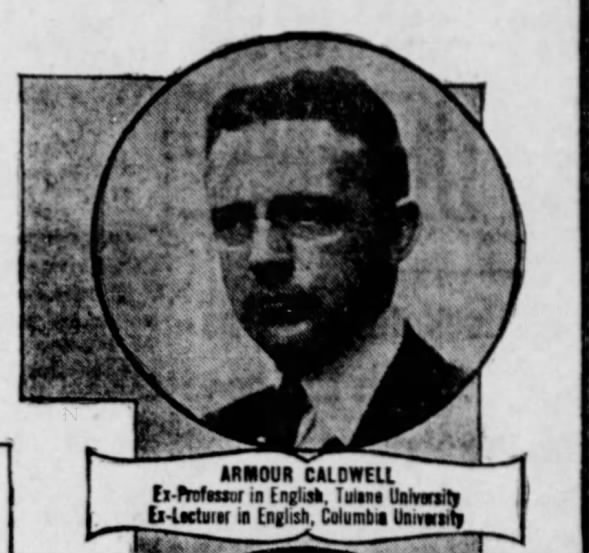
Armour Caldwell at Tulane, 1908

07 Feb 1916, Mon Pittsburgh Daily Post (Pittsburgh, Pennsylvania) Newspapers.com
Here is the paper I read in New York on June 17, 2019 at the 12th International Melville Society Conference. Images and links added for fun and further study. 

 New Orleans Origins of Melville Revival: Armour Caldwell at Tulane, 1908


We know better than to say THE Melville Revival, we just can't help it. As shown in 1931 by O. W. Riegel and affirmed in 21st century surveys by Sanford Marovitz and Eric Aronoff, Melville always had passionate fans, even during the years of legendary neglect after his death, before the first centenary of his birth. In New York City, Elizabeth Shaw Melville collaborated with Arthur Stedman (1859-1908) on reissues of Typee, Omoo, White-Jacket, and Moby-Dick. British admirers and promoters included sea-novelist William Clark Russell (1844-1911) and social reformer Henry S. Salt (1851-1939). From London, New York Times correspondent William Livingston Alden (1837-1908) in 1899 called for "A" Melville revival--and for good measure, A Melville Society. Canadian scholar Archibald MacMechan (1862-1922) touted Moby-Dick as Melville's one good book and 
The Best Sea Story Ever Written.
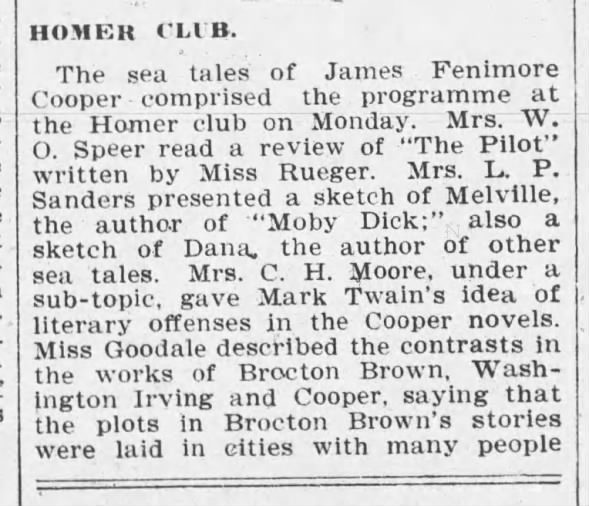
Less well known as active Melville advocates are two Massachusetts journalists: Charles Goodrich Whiting (1842-1922), editor of the Springfield Republican; and Philip Hale (1854-1934), the Boston music critic who championed Melville for forty years, thirty in his newspaper column "As the World Wags." In Butte, Montana, ladies of the "Homer Club" reserved a day in early 1907 for "sea tales" as part of their daunting program of literary study. Ethelyn Caldwell Adams (Mrs. John Coit Adams) originally was assigned Moby-Dick, but in February 1907 it was Mrs. L. P. Sanders who "presented a sketch of Melville, the author of 'Moby Dick.'"


03 Feb 1907, Sun The Anaconda Standard (Anaconda, Montana) Newspapers.com
Still we speak of THE Revival, later than and distinct from the Melville "vogue" before the First World War (Zimmerman, page 23). THE Revival launched with the centenary in 1919 and Raymond Weaver's "foolish and enormously influential" biography, as Stanley Edgar Hyman called it. Martina Pfeiler and I will be looking at precursors, each with ties in New York City--predictably, considering the Columbia University connections of so many participants. Less predictably, one flowered in the South.

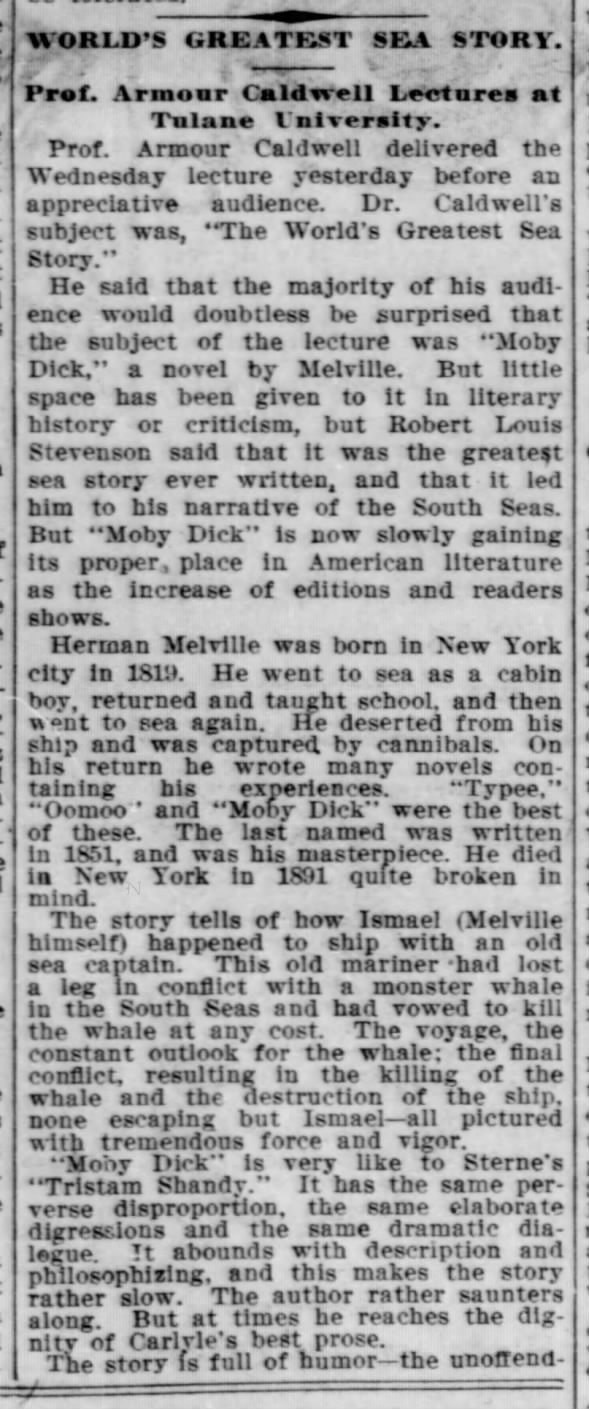
On April 1, 1908, a visiting Assistant Professor of English named Armour Caldwell (1878-1929) gave a public lecture at Tulane University in New Orleans, Louisiana titled "The World's Greatest Sea Story." Mrs. Sanders would have scooped him in Butte, but Melville had to share "Sea Tale" day in 1907 with Cooper and Dana. Caldwell's 1908 talk would seem to be the first lecture devoted exclusively to Moby-Dick in a formal academic setting. Notice of the Tulane lecture was first discovered in online archives of the New Orleans Picayune by Martina Pfeiler; further investigation turned up another report in the Times-Democrat. Three questions to address here: 
  1. Who was Armour Caldwell?
  2. What did he say about Moby-Dick? and
  3. What the devil is a picayune? (Answered first, with help from Grammarphobia: Anglicized version of picaillon, south Louisiana French for the Spanish medio real worth 6 1/4 cents, the smallest coin in circulation and the name of the daily newspaper in New Orleans.)

Who was Armour Caldwell?


On March 31, 1908 the Daily Picayune announced that Armour Caldwell would lecture the following day in "his first public appearance in New Orleans." Subject: "The Greatest Sea Story." The paper added that "Prof. Caldwell is an interesting talker and the public is cordially invited to be present." The lecturer was born William Armour Caldwell on May 21, 1878 in Salt Lake City, Utah to John Armour Caldwell (1849-1911) and Margaret Wylie Cook (1853-1913). His mother was a native of New York and resident of Troy; his father was a Scottish immigrant, engineer, and inventor. Only a year after Armour's birth the family moved back East. Armour grew up in Brooklyn and attended Columbia University. His brothers (Robert John or "R. J." and Jean Cook Caldwell) had highly successful careers in cotton and international banking, but Armour Caldwell followed the different path of English Major.  At Columbia Caldwell developed an interest in social reform and became president of the Social Progress Club (Brooklyn Daily Eagle for January 6, 1901). He earned his B. A. from Columbia in 1902; M. A,. from Harvard in 1907. In between he lectured in the Columbia English Department. Collaborating with Brander Matthews, Caldwell wrote extensive endnotes for the student edition of Washington Irving's Sketch-book, published in 1905 by Longman's. In 1908 he filled in for the absent head of the English Department at Tulane, in "the picturesque old French town of New Orleans" (American Leader Volume 1).  After the Tulane gig he returned to New York City and taught English at Union Theological Seminary. Caldwell next organized and managed the Educational Department at E. P. Dutton and Company before joining The American Leader magazine as managing editor. Published by the American Association of Foreign Language Newspapers, the American Leader appealed to "new immigrants" from southern and eastern Europe and mobilized support for their concerns. After the Great War Caldwell moved west, to Creighton, Arizona and eventually to Los Angeles. Thence, in May 1922, he went to Europe citing health reasons on his passport application. He died of TB at Badenweiler in Germany on August 9, 1929. 

What did Armour Caldwell say about Moby-Dick?


Caldwell's Tulane talk was one in a series of Wednesday noon lectures, following J. C, Ransmeier of the German Department on "A Survey of Germany's Contribution to Civilization"; and before that, Mary Eileen Ahern (1860-1938) on "Library Work as a Career for Educated Men and Women." The fearless Miss Ahearn would have been the harder act to follow; as founding editor of Public Libraries and regular guest speaker she developed a reputation for "spicy comment" that "broadened the horizons of librarians in smaller communities" (Marian C. Manley). 

02 Apr 1908, Thu The Times-Democrat (New Orleans, Louisiana) Newspapers.com
To begin with, Caldwell expected his audience to be "surprised" by the subject of his lecture, Moby-Dick, since "little space has been given to it in literary history or criticism." At the same the speaker did register "the increase of editions and readers." New editions then were the illustrated 1902 volume in the series of Famous Novels of the Sea by Charles Scribner's Sons; and the 1907 volume in Everyman's Library, edited by Earnest Rhys. Availability of these new volumes offered some hope that "Moby Dick is now slowly gaining its proper place in American Literature."

Caldwell told his Tulane audience a little about Melville's life. Facts and phrases in Caldwell's abridged biography reveal his reliance on the intro by Arthur Stedman in the 1892 edition of Typee copyrighted by Elizabeth S. Melville. For example, Caldwell repeats Stedman's misleading claim that Melville first went to sea "as a cabin boy." From Stedman, Caldwell knows that between voyages Melville worked as a schoolteacher. The newspapers do not report that Caldwell mentioned, say, The Confidence-Man or any works of poetry (Stedman did). Apparently, the lecturer did call Moby-Dick Melville's "masterpiece." That was MacMechan's verdict, implied also in Stedman's view that his Whale-book earned Melville "the topmost notch of his fame." Caldwell gets the date and place of Melville's death right, 1891 in New York, adding however the questionable news that Melville experienced mental breakdown and died "quite broken in mind."

Next Caldwell gave this plot summary:
The story tells of how Ismael (Melville himself) happened to ship with an old sea captain. This old mariner had lost a leg in conflict with a monster whale in the South Seas and had vowed to kill the whale at any cost. The voyage, the constant outlook for the whale; the final conflict, resulting in the killing of the whale and the destruction of the ship, none escaping but Ismael--all pictured with tremendous force and vigor.

Of the Pequod's crew the newspaper names only Melville's narrator Ishmael ("Ismael"), reporting that Caldwell identified him as a stand-in for "Melville himself."  But Caldwell keyed on "the old sea captain" and his inflexible, vengeance-driven quest. Enthralled by the revenge plot, the lecturer in both extant newspaper accounts has Moby Dick killed in the end, making Ahab a kind of Beowulf and the White Whale dead as the Dragon.

Next the speaker tackled literary matters. For narrative technique, Caldwell found Moby-Dick "very like to Sterne's Tristram Shandy."
"It has the same perverse disproportion, the same elaborate digressions and the same dramatic dialogue. It abounds with description and philosophizing, and this makes the story rather slow."

In 1851, William A. Butler [Correction: literary editor James C. Welling reviewed Moby-Dick in his regular "Notes on New Books" column for the Washington National Intelligencer, as I discovered in August 2024.] had said much the same thing when reviewing Moby-Dick for the Washington National Intelligencer. With the help of Mary K's black book on Melville's Sources, we can readily find pertinent scholarship through 1987. In the Hendricks House edition of Moby-Dick, Luther S. Mansfield and Howard P. Vincent particularize debts to Tristram Shandy for the cozy "confidential disclosures" between Ishmael and Queequeg as bedmates in Chapter 10 A Bosom Friend; and for the figure of Cervantes in Melville's apostrophe to "thou Just Spirit of Equality" and "great democratic God!" in Chapter 26 Knights and Squires.

After Sterne, Caldwell named Carlyle as a major influence on the elevated style in Moby-Dick which occasionally "reaches the dignity of Carlyle's best prose." Here again later scholarship has abundantly confirmed Melville's debt to Carlyle, which seemed obvious not only to Caldwell but also to the earliest critics of Moby-Dick (and before that, Mardi). Friendly ones regretted Carlyle's bad influence; hostile ones condemned it. Caldwell's Columbia teacher and colleague William P. Trent counted as a knock, Melville's "obvious imitation of Carlylean tricks of style and construction." MacMechan the Carlyle expert never named the author of Sartor Resartus. In the new 20th century, however, imitations of Carlyle sounded fine to Caldwell, another descendant of Scots.

In the Extracts section of Moby-Dick Melville quotes from Goldsmith's History of the Earth and Animated Nature. But Caldwell names Goldsmith as one of Melville's more important influences for his "unoffending humor," not his geology or zoology. The 1906 anthology, English Humorists of the Eighteenth Century, groups Goldsmith with Sterne, Addison, and Steele, providing a handy collection of possible influences on Moby-Dick. For his part, Melville once scorned the sort of imitation that Caldwell alleges: "We want no American Goldsmiths." Ironically, Melville's own debt to Washington Irving's graceful way of travel writing was already manifest to Evert Duyckinck in 1847, as John Bryant points out in Melville and Repose. What Bryant elsewhere calls "the Ishmaelian mode" carries on "the 'amiable tradition' of British humor" and is characterized by "geniality" (1994, Comic Debate, page 1). In contrast to the early recognition of Melville's debts to Carlyle, recognition of the Goldsmith (English or American) in Ishmael is really a 20th century insight.

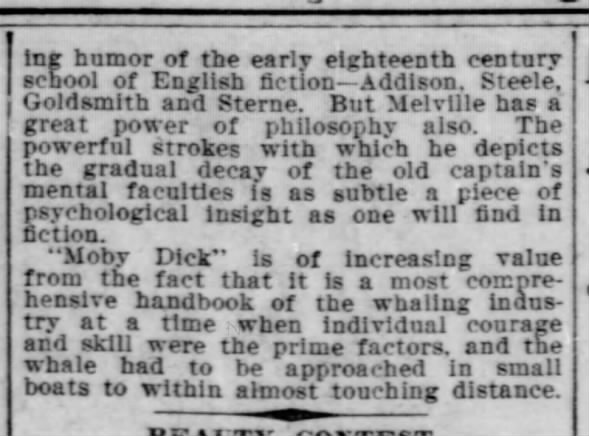
Caldwell also addressed philosophical and psychological dimensions of Moby-Dick:

"But Melville has a great power of philosophy also. The powerful strokes with which he depicts the gradual decay of the old captain's mental faculties is as subtle a piece of psychological insight as one will find in fiction.... "

-- New Orleans Times-Democrat, April 2, 1908

Caldwell understands Ahab's whale-mania as a variety of progressive mental illness. The lecturer's appreciation of Melville's "psychological insight" anticipates scholarship on Ahab's "madness" or "insanity," hinting perhaps at the clinical focus of more recent work in the genre of disability studies, rather than psychoanalytic readings inspired by Freud and Jung.

New Orleans Daily Picayune - April 2, 1908 - page 5
via Genealogy Bank

Caldwell ended by quoting a student reader who

"after reading Moby Dick told me that he thought it was a symbol, or had a meaning that it was the story of man's pursuit after his heart's desire, how after a long, hard journey it was only gotten at the end of the voyage, and then both go down together in the awful abyss."

-- Daily Picayune, April 2, 1908

The Picayune reported also that Caldwell "had planned last summer to write Melville's life, but he found some on was already at work on it." It's too bad Caldwell gave up on the idea, since contemplated biographies by J. E. A. Smith, Arthur Stedman, Frank Jewett Mather, and Melville's daughter Elizabeth ("Bessie") never materialized.

Caldwell's Tulane lecture marks the earliest known phase of the specifically academic Melville Revival. Archibald MacMechan had already praised Moby-Dick as "The best sea story ever written." But MacMechan's view of Moby-Dick as best-sea-story-ever did not employ now familiar terms of formal literary analysis. As V. L. O. Chittick points out, "Symbolism, allegory, myth, ritual, and literary sources are not discussed--nor, of course, are fixations, complexes, and compulsions." At Tulane, Armour Caldwell did speak of 18th century literary influences on Moby-Dick, citing Sterne for the technique of narrative expansion through digression and dialogue; and Addison, Steele, and Goldsmith for inoffensive, British-style whimsy. Caldwell explicitly addressed the problem of literary symbolism, sharing the response of a student reader struck by the symbolic meaning of Ahab's quest as "man's pursuit after his heart's desire." And Caldwell did address Melville's treatment of "complexes and compulsions," judging the portrayal of Ahab's monomania to be "as subtle a piece of psychological insight as one will find in fiction." Moby-Dick as a great story is one thing. Moby-Dick as the deserving subject of literary analysis and study is another. At Tulane in 1908 Armour Caldwell bequeathed it to fellow English Majors, for better or worse.

Works Cited

American Leader, volume 1 number 1. February 29, 1912. Photo and bio of Armour Caldwell, Managing Editor on pages 10 and 11.

Aronoff, Eric. "The Melville Revival" in Herman Melville in Context, ed. Kevin J. Hayes (Literature in Context, pages 296-306). Cambridge University Press, 2018. doi:10.1017/9781316755204.030

Bercaw, Mary K. Melville's Sources. Northwestern University Press, 1987.

Bryant, John. Melville and Repose: The Rhetoric of Humor in the American Renaissance. Oxford University Press, 1993.
Bryant, John. “Melville, Twain and Quixote: Variations on the Comic Debate.” Studies in American Humor, New Series 3 number 1, 1994, pages 1–27. JSTOR, www.jstor.org/stable/42573302
Chittick, V. L. O. “The Way Back to Melville: Sea-Chart of a Literary Revival.” Southwest Review volume 40 number 3 (Summer 1955) pages 238–248. JSTOR, www.jstor.org/stable/43464100

Hyman, Stanley Edgar. The Promised End. World Publishing Company, 1963. 

Irving, Washington. Washington Irving's Sketch book. With introduction by Brander Matthews and notes by Armour Caldwell. New York: Longman's, Green, and Co., 1905.

MacMechan, Archibald. "The Best Sea Story Ever Written" in Queen's Quarterly volume 7, October 1899, pages 120-130.

Marovitz, Sanford E. The Melville Revival chapter 33 in A Companion to Herman Melville, ed. Wyn Kelley. Blackwell, 2006.  

Manley, Marian C. A Worm's-Eye View of Library Leaders.  Wilson Library Bulletin volume 27 (November 1952) page 233; reprinted in An American Literary History Reader, ed. John David Marshall (Shoe String Press, 1961) pages 150-160 at page 155.

Melville, Herman. Moby-Dick; Or, The Whale. Ed. Luther S. Mansfield and Howard P. Vincent. Hendricks House, 1952.  

Pfeiler, Martina. “‘The Time has Come for a Melville Revival’: Edwin Emery Slosson’s Journalistic Contributions to the Origins of Melville’s Revival in New York City.” Conference paper presented June 17, 2019 at the 12th International Melville Society Conference in New York City.

Riegel, O. W. “The Anatomy of Melville's Fame.” American Literature volume 3 number 2 (May 1931) pages 195–203. JSTOR, www.jstor.org/stable/2919779
Trent, William P. A History of American Literature, 1607-1865. New York: D. Appleton, 1903. Pages 389-391 at 390. 

Zimmerman, Michael P. "Melville in the 1920's: A Study in the Origins of the Melville Revival, with an Annotated Bibliography." PhD dissertation. Columbia University, 1963. 


Related posts:

Thursday, April 4, 2019

Fogle on Melville's tortoise


Richard H. Fogle, The Unity of Melville's "The Encantadas" in Nineteenth-Century Fiction 10.1 (June 1955): 34-52 at 39:
"The tortoise is both black and bright," but one notes for what it is worth the entertaining implication that the bright side is not the right side; to see it you have to turn your tortoise upside down, and to maintain it you must keep him upside down.
<https://www.jstor.org/stable/304437>
Sketch First of The Encantadas, or Enchanted Isles
in Putnam's Monthly Magazine, March 1854

1856 book version of "The Encantadas" can be found in
Also accessible courtesy of the Internet Archive:

Saturday, February 18, 2017

Battle-Pieces in New Orleans

We are indebted to HARPER & BROTHERS, New York, for a very handsomely printed and bound volume, entitled Battle Pieces and Aspects of the War, embracing a collection of fugitive pieces written during the conflict, by Herman Mellville. The writer, though he gave in to the general sentiment of the North in regard to the necessity of "crushing out the rebellion" by any and all means, seems often to have had a secret misgiving, as to whether much that was done, was in reality justified by the laws of humanity which rise higher than those of war. Hence, when the conflict is over he ranges himself on the side of the Conservatives and peace. The lines entitled "Lee in the Capital," evidence this mind. He makes the hero say without disapproval:
"These noble spirits are yet yours to win.
Shall the great North go Sylla's way?
Proscribe—prolong the evil day?
Confirm the curse? Infix the hate?
In Union's name forever alienate?
               . . . Unless you shun
To copy Europe in her worst estate—
Avoid the tyranny you reprobate."
--DeBow's Review - November 1866
Related post:

Saturday, December 10, 2016

Mitchell, Melville, and real Havanas in the New Orleans Daily Creole


From the New Orleans Daily Creole, December 10, 1856; found in the online Newspaper Archives at Genealogy Bank:
JUST THE THING.— "Ik Marvel," with his feet upon the mantel-piece, discussing the so-called glories of a bachelor's life with his touchy maiden aunt, with his brain swung into a half reverie by the semi-narcotic influence of a real Havana, gives us a glowing picture of a man content with all the world and "the rest of mankind." Happy Donald Mitchell! Herman Melville in his quiet valley of Typee was not happier. And the aromatic fumes of a cigar did all this—literally puffed away the sadness incident to human life! 
We had a trial of this yesterday. A box of real Havanas, such as Gen. Concha would praise, and, puffing, praise again, was laid upon our table. They were from the importing house of E. J. Hart & Co., Tchoupitoulas street. Knocking the ashes from the end, we looked into the consuming red, and thought that even in an editor's life there was occasionally a bright spot, after all.
Published by J. M. Weymouth, the New Orleans Daily Creole began in June 1856 and only lasted a year or so. On WorldCat and Chronicling America, The Daily Creole is still identified as an African-American newspaper--erroneously, as Thomas J. Davis noted in his contribution on "Louisiana" for 
The Black Press in the South, 1865-1979, edited by Henry Louis Suggs. The persistent "African-American" listing is also questioned by Armistead S. Pride and Clint C. Wilson in A History of the Black Press. The main cause for which the Daily Creole strove was the electoral agenda of the "American Party," the so-called Native-American or Know-Nothing Party backing former president Millard Fillmore against Buchanan and Frémont in the 1856 presidential election. Irish newsboys allegedly refused to carry the Daily Creole ("The Creole and the Newsboys," Daily Creole, August 5, 1856).

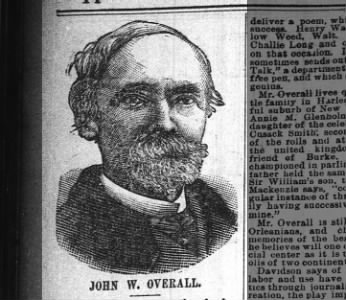
Reportedly, Virginia native John Wilford Overall served as editor of the short-lived Daily Creole. Those dreamy references to Ik Marvel and Melville in "Just the Thing" (transcribed above) indicate a poetic temperament and New York sensibility, both of which seem consistent with Overall as poet and eventually, after the Civil War, literary editor of the New York Sunday Mercury. Ignorant of Overall's postwar career in New York City, James Ryder Randall remembered him in New Orleans as a rival journalist and poet with "a vast ambition for literary fame" (Baltimore Sun - July 28, 1907).

On November 10, 1859, John W. Overall participated in the grand Schiller Festival in New Orleans, celebrating the centennial anniversary of Schiller's birthday. The New Orleans True Delta which Overall by then edited printed the whole of his speech at Odd Fellows' Hall. J. W. Overall delivered his remarks after the opening address in German by J. K. Gutheim. At one point in his enthusiastic tribute to Schiller, Overall paraphrased the segment in Melville's Typee on The Birds of the Valley:
In the bright, green islands of the Marquesas, brilliant-hued birds float like fragments of rainbows flashing in sunshine. But the birds, full-winged and sharp-beaked, transverse the amber-colored air with songless throats.

The New World but comparatively a few years back was like the lonely, yet beautiful Marquisan Islands. There were no sweet singers in all its Israel. Statesmen and heroes were her's, but the children of song who "marry them to immortality," built not the "lofty rhyme."  --New Orleans Daily True Delta, November 13, 1859
The New Orleans Delta also published the "Schiller Festival" speech by John W. Overall, along with the comment that
"Mr. Overall's address is especially marked by glowing imagery, imaginative thought, striking phrase, and fervid application of his subject."  --New Orleans Delta, November 13, 1859
In the New Orleans Sunday Delta a couple of years before, this same bit on the birds of Typee valley had flavored the unsigned rant on the supposed "Literary Subordinacy of the South." As shown in a previous post on Melville in the Sunday Delta, the writer there compared southern readers to Melville's "voluptuous and indolent Typees." The 1857 paraphrase is very close to Overall's 1859 paraphrase of the same passage in Typee:
"... birds with brilliant wings, flashing in the sun, fly noiselessly in the air, beautiful to look upon, yet songless as death."  --"Paragraphs for the Times," New Orleans Sunday Delta, June 21, 1857 
Both paraphrases of Melville use the words "brilliant," "flashing," and "songless." Both associate Melville with an atmosphere that is "amber-colored."

So then. John W. Overall wrote for all these New Orleans newspapers: the Daily Creole in 1856-7; the Sunday Delta in 1857-8; and the True Delta in 1859. Possibly the Melville mentions during those years are all his. I guess he was more of a Typee fan than a Melville fan. Another day I'll have to look for any Melville items in the New York Sunday Mercury during John W. Overall's tenure as literary editor there.


Related post:

Saturday, November 24, 2012

"Truth can never die": Gansevoort Melville at the 1844 Jackson Jubilee

Here we have Herman's older brother Gansevoort Melville at his ripping, racy, romantic best. Surely this is one of the great American political speeches, and "richly worth preserving" as the Troy Budget editorialized when printing the whole thing:
The text below of Gansevoort's speech at the New York City celebration of Andrew Jackson's birthday on March 15, 1844 mostly follows the printing in the New York Herald, Saturday, March 16, 1844. For comparison and help deciphering blurry type, other newspaper printings of the complete oration were consulted including:
  • New York Evening Post, Saturday, March 16, 1844
  • Albany Argus, Friday, March 22, 1844 (reprinted from the New York Plebian)
  • Lyons NY Western Argus, Wednesday, March 27, 1844
  • Pittsfield Sun, Thursday, March 28, 1844
  • Raleigh, North Carolina Standard, April 3, 1844
    A now rare pamphlet edition of Gansevoort's speech was printed as a supplement to the Columbus, Ohio Statesman.

    The Herald report sets the scene as follows:
    The rain fell in torrents last evening, but it couldn’t quench the enthusiasm of the “unterrified democracy." The dimly burning gas-lamps threw their flickering gleams on streets a fathom deep in mud, but still the thousands found their way to the Tabernacle. Such a gathering! To the inspiriting music of the fife and drum, the locofoco forces of the various wards marched as gaily along as a crack volunteer company, on a smiling morning in June, setting out on a target excursion; and on foot, in stages, and in cabs, came hundreds of the fairest, brightest-eyed, neatest, sweetest, most irresistible of the locofoco girls.
    Long before the commencement of the proceedings of the evening, the tabernacle was densely crowded with the assembled throng....
    Immediately behind the chair, a splendid portrait of General Jackson, (smiling benignantly on the scene,) hung suspended from amid the folds of the American Flag… On the front of the gallery were suspended, at either side, the arms of New York obverse and reverse, supported by two flags representing the old States of the Union. All round the front of the galleries were suspended beautiful flags representing the various States of the Union, each of them bearing a star and the date of admission of each State into the Union. The entire arrangements had a very elegant and splendid effect. A piano was placed on the right of the Chair. A very excellent brass band were ranged in the back tier, near the organ, and in front of them a full choir of elegantly dressed and decidedly beautiful ladies, which were selected, avowedly, from the democratic ranks, as rivals in the charming graces of the softer sex, to those ladies who graced the Whig Meeting held in the Tabernacle, some evenings ago...
     After stirring rounds of “Hail Columbia,” a specially commissioned “Ode—The Watchword” ("We conquer or die."), and the reading of letters from James Buchanan and Silas Wright,
    His honor the MAYOR [Robert H. Morris] then said—Fellow citizens, I have now the pleasure of introducing to you Gansevoort Melville, Esq., the orator of the occasion. (Great cheering.)

    MR. MELVILLE then stepped forward, and was greeted with prolonged applause. On its subsidence, he delivered the following

    ADDRESS.

    FELLOW DEMOCRATS—We are not here to mouth high-sounding phrases—to prate of transcendental philosophy in transcendental language—and to deify “The Mill Boy of the Slashes.” Neither are we here to indulge in fulsome eulogy, and debase ourselves at the foot stool of any man.— Nor are we here to enter deep into a discussion of the principles and policy of the democratic party. This is not the fitting time for the elaborate consideration of a subject so grave and weighty. What, then, are we here for? Why, this gathering in of the democratic host?—Wherefore are the beauty and the bravery of this fair city congregated here to-night? This is a jubilee. We come here to discharge a duty which is a pleasure. We are here to celebrate the anniversary of the birth day of Andrew Jackson—(applause)—the man who has filled the measure of his country’s glory. He who, in times not long passed, was our champion and our leader—he whose crest always danced in the hottest and thickest of the fight—he who swept on at the head of the democratic masses with a force as resistless as the surges of the sea. And we come here to celebrate the anniversary of his birth day, as he would have us celebrate it—to take each other by the hand—to look each other in the face—to cheer each other onward to feel that we stand as we did of yore, shoulder to shoulder, making common cause against a common enemy. (Cheers.) This is the way that the anniversary of his birth day should be celebrated. We are brethren and we meet as brethren. The spirit which actuates us, one and all, is the spirit of union, harmony, concession. Everything for the cause—nothing for men.
    Our opponents, the whigs, held a great pow-wow here on the fourth day of this present March. It was a celebration—in anticipation—of the inauguration—of Henry Clay. (Laughter.) Apprehensive that they will be deprived of his reality, they are determined not to do without the illusion. Their celebration will turn out to be very much like the dead sea apple—fair to the eye, but turning to ashes on the lips. They have enjoyed their shadow, but we have a word to say about the substance. Who ever before heard of a celebration in anticipation? There is not a farmer’s wife in the country but who might have taught the magnates of the Whig party here a lesson of practical wisdom, by simply referring to the old saw, that it is imprudent to count chickens before they are hatched. (Great laughter.) This celebration of theirs is pretty much the same thing as if some poor, hungry, starving loafer should cuddle up in a warm corner, close his eyes, shut his mouth, and eat a glorious good dinner—in imagination.

    (Continued laughter and cheers.)

    The Whigs said one thing at their late meeting here, which cannot be passed over in silence—The orator of the evening declared that the women were with them. This sentiment was concurred in by a very high authority. A gentleman who in private life is estimable and respectable, and to whom I only refer in his public capacity. He distinguished himself on that occasion—calling to mind the fact that the devil can quote scripture; and feeling justified by the precedent, he quoted scripture too, (laughter)—for all must know who is referred to—the celebrated Whig extravaganza singer, Mr. Jim-along-Josey Hoxie. (Roars of laughter, and cries of “clear the way old Dan Tucker.”) Now, with all due respect to such high authority, we meet this assertion boldly and plumply, and deny that the women are with them. On that point we are ready and desirous to join issue whenever and wherever they choose. On that point they have thrown down the gauntlet. We take it up, and in behalf of our fair democratic countrywomen, accept the challenge. Calling to witness the bright cestus of Venus and the blushes of young Aurora, we feel confident that we can produce more and prettier women than they can. (Tremendous cheering for several minutes.) When I learned that their orators had made that most monstrous assertion, it caused me to reflect. What, thought I, the fairer, the better, and the gentler sex—that we all delight to honor—to whom we all owe so much—they who make a paradise of home—against us!
    If this be so, we might as well give it up first as last—for it would be decidedly a bad job. (Laughter.) But it is not so. (Cheers.) Every man of us, on that subject, can speak from his own observation. (Cheers.) As for myself, I come from a stock, the women as well as the men, of which have, from the first organization of parties, manifested a preference for and a sympathy with the democratic cause. (Loud cheers.) If any man wishes more proof than is derived from his own personal knowledge, let him look around him. Those galleries will settle the question. (Tremendous applause and nine cheers for the ladies.) The wild flowers of feminine delicacy, beauty, and grace, that honor us with their presence here tonight, and whose exceeding loveliness might lure an anchorite from his cell, were never plucked from the prim and artificial gardens of modern whiggery. (Shouts of laughter and tremendous applause.)
    Show me a woman who can sympathise with the magnificent mother of the Gracchi—who, when asked by the aristocratic dames of ancient Rome to exhibit her store of ornaments of gold and precious stones—answered, that she had none of these, but at the same time produced her two glorious sons, exclaiming, “these are my jewels.” Show me a woman who can understand this and feel it—and that woman is at heart a democrat. (Cheers.) 
    Remember the simple story of the sweet English girl, who was affianced to an officer on foreign service. It so chanced that he was desperately wounded in battle, losing one limb and the use of another, besides being terribly hacked and disfigured. The first use that he made of returning strength was to write to his affianced wife—she who was a part of his very being—informing her of the misfortune which had befallen him, and releasing her from her engagement. This was the first intelligence that she had received of the sad occurrence. It fell upon her with stunning force. Recovering from the shock, with heaving bosom and suffused eye, she sat down and wrote: “If your feelings for me are unchanged, and you have body enough left to contain your soul, I will not be released from my engagement.” That glorious girl, whose high souled and self sacrificing spirit dictated those words, well illustrated the hopeful, trusting, Christian nature of the democratic creed. [Great cheers.]
    Now, my fair countrywomen, with your permission, a word with you. I grant ye that the whigs have the advantage of us plain-spoken democrats in scented hair, diamond rings, and white kid gloves—[roars of laughter]—in the language of compliment and the affectation of manner, and most particularly, in their style of dressing. If one of these exquisites wished to express the idea contained in the home-spun adage, “There is the devil to pay and no pitch hot,” he would say, “There is a pecuniary liability due to the old gentleman, and no bituminous matter, of the proper temperature, wherewith to liquidate the obligation.” [Uproarious laughter and applause, in which the ladies joined.] These flashing qualities do not answer the purpose. They do not rank in the list of fireside virtues. They do not make home the holiest spot on earth, loved and prized as it ought to be. Such qualifications will not smooth the pillow for aching head; will not pour balm into the wounded heart, and quicken the soul of sympathy. [Cheers.] It is most presumptuous in me, ladies, to proffer you advice, for I am so unfortunate as to be a bachelor. (A laugh.) But I may never have another opportunity—and, anyhow, I can’t resist the temptation. So, let me tell ye, that if you wish your lovers, when transformed into husbands, to be all that you would wish them, kind, affectionate, reliable, of good habits, truth loving—husbands that will be the idols of your hearts, your protection, your glory and your pride—be sure and choose from among the democracy. (Thundering applause.) To sum up, in the word of an old lady of my acquaintance, who, I must confess, has strong political predilections. Says she to me, one day, “I always tell my daughters that they must never marry anybody but democrats, because they always wear so well.” (Laughter and great applause.) Intelligent, warm-hearted and right-feeling women, the world over, must always wish well to that great democratic party, whose watchword, and whose crowning glory is—“Equal and exact justice to all men.” And I may add, “women too.” (Tremendous cheering.)
    Now let us give a little of our attention to our friends, the whigs. They like to be noticed; it will not do to neglect them on this festive occasion. (Cheers.) Their modesty is only equaled by their merit. (Laughter.) They claim all the respectability, all the morality, all the decency. A party with such claims commends itself especially to our attention. We have all heard a good deal said about amalgamation. Did it ever occur to you that the whigs are practical political amalgamationists? It is clearly so. Federalists, national republicans, anti-masons, and conservatives—all rallying under one banner, professing one set of principles, and uniting in the support of one man. If this is not practical amalgamation, what is? The whigs naturally affect the composite order of architecture. The democracy prefer the Doric. The Doric is more in consonance with our principles. It scorns all superfluous ornament. It is strong, simple, severe, sublime. The whig party and whig principles call to my mind two things. The whig party—practical political amalgamation, and whig principles—Joseph’s coat of many colors. (Laughter.) Their principles shift with every anticipated change in popular opinion. They change their names with a facility kindred to that of those ingenious gentry, who, when brought up to the bar of our police court charged with petty larceny, or something of the sort, are always provided with half a dozen appellations—Jack Smith, alias Tom Brown, alias Jim Jenkins. (Cheers.)
    To do our opponents justice in speaking of them, they should always receive the benefit of full name and title. Federalists, alias national republicans, alias anti-masons, alias conservatives, alias native Americans, or adopted whigs, alias democratic whigs. (Great laughter and applause.) But this last cognomen is enough to make a horse laugh. Why, they might as well talk of a white black cat, or a tall short man, or anything else that is a contradiction in terms. If they do procure any suffrages by such petty shuffling as this, I am inclined to think that an indictment would lie against them for obtaining votes under false pretences. (Great laughter and applause.) Whig tactics are very peculiar, and there is a reason for that. They feel and know that, in sober earnest, they are the weaker party. And hence the manner in which they conduct their campaigns (Cheers.) Did you ever see a man contending, physically, with one who is an overmatch for him? Now he strains, swells and tugs—but to no purpose. The strong man puts his hand on him, and it’s all over.— Do you know the way they catch a rattlesnake at Lake George? A man, armed with a long stick, forked and sharpened, sallies out among the hills and rocks. Spying a rattlesnake, he watches his opportunity, and with a quick and sudden dart, catches with the forked end of the stick the head of the reptile, as it lies upon the ground, and pins it to the earth. The rattlesnake, no doubt very much surprised, squirms most unmercifully. But it does no good---he is despatched at leisure. So it is with the whigs. (Great cheering.) We have got their heads to the ground and all that they can do is to make a splutter, and a noise, and kick up a great dust.— (Tremendous cheering—cries of “That’s the talk!”—“Give it to ‘em, old boy!”)
    The whigs are a Protean party. They change their principles and their names with a magical facility. An animal is their emblem. Their animal affinities are very strong—they can crow, snort, snuffle, grunt, bray and baa. Now let us make them whine, yelp, and squeal—(Cheers and shouts of “We will, by blazes!”) I said that an animal is their emblem—so it is. And what sort of an animal?—Something dull and that never learns—is it the ass? Something vicious—is it the mule? Something stupid and hiding its stupidity under the garb of seeming wisdom—is it the owl? Something blind and that works in the dark—is it the mole? Something thievish and nibbling in its propensities—is it the rat? No—none of these; but a nicely adjusted and fitting compound of them all—a coon! A fat, lazy, oily, thieving, cowardly, skulking coon—the hybrid emblem of a hybrid party.—(Great laughter, tremendous cheering, and groans for some minutes.)—
    The banner of the whigs is a coonskin!

    In the long night of the middle ages, when armed Europe sent forth her steel-clad barons, with their stout retainers, on a pilgrimage to Jerusalem to rescue the Holy Sepulchre from the tenacious clutch of the Infidel—and alas, to redden the sands of Palestine with Christian gore—the banner that waved above the bold Crusader then, as he fought and bled
    And died, the sword in his red hand,
    On the holiest spot of that blessed land,
    was the banner of the Holy Cross.— (Cheers.)

    When the Bourbons desired to call to their aid the lances of imperial France, the Oriflamme was displayed, and the Gallic chivalry rallied round it to conquer or to die.— (Cheers.)
    In more modern times, the tri color of the revolution and the golden eagles of the empire have been carried in triumph into every capital on the continent. There is not a single breeze that blows in which the meteor flag of England does not wave; and Blenheim, Ramilies, Seringapatam, Albuera, Salamanca and Quebec—Acre, Aboukir, Waterloo and Trafalgar, are eloquent with its glories. We rally under a banner inferior to none of these—a flag loved at home and respected abroad—the star spangled banner of our country.—(Tremendous cheering.) It is familiar to the British soldier for he saw it on the plains of Saratoga, in the lines at Yorktown, and upon the breastwork at New Orleans.—(Great cheering.) It is associated in the mind of the British sailor with the names of Hull, Porter and Decatur. It streamed from the masthead of the Constitution, when the Guerriere struck—(Cheering.) True—these are the banners of nations—but this contemptible coonskin is the emblem and the banner of a party which aspires to control the destinies of a nation.—(Groans and hisses.) And such a nation, too—a nation which doubles its population every two and twenty years—the only free nation on the face of God’s earth—a nation, the cornerstone of whose greatness was laid by him, in speaking of whom all language fails and all utterance becomes palzied. Ransack the records of all time. Invoke the aid of the genius of the past. Who is his peer? He is unapproached in the intellectual symmetry and moral grandeur of his character.
    GEORGE WASHINGTON knows no peer—he has no parallel. (Loud and enthusiastic applause.) Let me call your attention to the startling fact that an indirect and most insidious attack has been lately made upon the memory of Washington. It was made from this very stand only eleven days ago, by one who stood here before the whole country as an acknowledged mouth piece of the whig party. The language of that whig orator was this: “He (Mr. Clay) has made his own character the character of the age, as Washington did in his time. Washington left the nation sober, orderly, high-principled and patriotic, but on the whole rather with negative qualities, but the man of our time (i.e. Mr. Clay) came to give the nation additional traits of a positive and active character—to make it while it yet retained all those Washingtonian virtues, still more enterprizing, bold, energetic, ardent, enthusiastic, aspiring, self-improving and self-protective.” An honest political adherent and admirer of Henry Clay should hang his head in shame to hear such language. And yet it was uttered in the presence of, and listened to with approbation by nearly 5000 whigs, and not one voice was raised against it. It has been extensively published in the whig press. Not one whig editor has passed strictures upon it. On the contrary, “The Tribune,” without reservation, pronounces the whole oration of which the above is a part as “truthful” and “masterly.” The Courier and Enquirer praises and regrets that it can not publish it. The Express predicts that “when published it will be the text-book of the campaign;” the minnows of the whig press follow in the wake of these, their leviathans. Now this whig “text-book” exalts Henry Clay at the expense and makes him the equal of GEORGE WASHINGTON—the equal of him who is degraded by a comparison with any man—whose fame should be dearer to us than our heart’s blood—who is our father—for he is the father of our country.—
    Not content with this attempted parricide, this accredited organ of the whig party further says—“Mr. Clay is not only American, but America itself, the Republic personified.” This is nought but man-worship. It has no foundation in truth. It is the reckless and destructive spirit of ultra partizanship. It is a bowing of the knee to Baal. What reasonable and unprejudiced man would trust a party who, exasperated by defeat and mad with excessive lust of power, are now endeavoring to gain their end by making an idol of Clay and falling down before it. To hear their orators and their presses speak of Henry Clay, one would suppose him to be more than man. I am no calumniator of Henry Clay; I seek not to detract from his fair fame: I am willing and desirous to accord him his true position. I do not impugn his patriotism. I freely grant that he is persevering, energetic, eloquent and brave—endowed with an indescribable magic of manner, and pre-eminently fitted by nature to be what he is—a great partizan leader. In his democratic youth, before he was flattered and caressed into the ranks of the advocates of special legislation, he stood up manfully against the re-charter of the U. S. Bank, and for Madison and the war. We honor him for it. We gratefully remember his exertions in behalf of the acknowledgment of the independence of Greece and the South American Republics. At the same time we must regret that he whose youth gave such glorious promise, should, in the full maturity of his manhood, forsake the house of his fathers and go wandering after strange gods.
    It is beneath the dignity of the democratic party to war with any man. The democracy war not with Henry Clay, the man—but with Henry Clay, the representative of certain principles. The whig party and Henry Clay are one; they are thoroughly identified with the policy of the land distribution, a high tariff based upon the principle of protection, and a U. S. Bank. Mark how these three kindred measures naturally aid and assist each other. They dove-tail together most admirably. Each ensures the necessity for, and the permanence of, the existence of all. Let them but be established and rivetted on the industry of the country, and an incubus will be placed on the moral welfare and substantial prosperity of this great Republic, which will be most difficult to shake off, and which, when shaken off, will have cost a bitter and protracted struggle. Elect Henry Clay President of the United States—give him a majority in both branches of Congress—let this system of policy go into effect, and a feverish, false, and fictitious state of things will be engendered, and you will have entailed upon your posterity a burthen and a curse. (A voice—“No fear of that”—loud cheers.) The question of a United States’ Bank, one main link in the triple chain, we thought was settled long ago. We deemed that Andrew Jackson had strangled that hydra-headed monster, and sowed salt upon its grave. But lo! In 1840, the whigs came into power. And one of the first things that they did was to attempt to resuscitate an institution, the very name of which stunk and stinks in the nostrils of the community. Under the Congressional dictatorship of Henry Clay they passed a bill re-chartering the United States Bank. John Tyler vetoed it. For that act, at least, he deserves and should receive credit and gratitude. (Cheers.) Now, sanguine as the whigs always are before an election, and hugging to their bosoms the delusion that they will succeed in the great Presidential canvass of 1844, they are already quietly engaged in endeavoring to galvanize that old corpse again. The whig leaders here would mask their battery and avoid an issue upon the bank. They make it an issue in Tennessee, Kentucky, and the contiguous States. We will not permit this playing fast and loose. We will make it an issue here on the sea-board, and charge it home upon them.
    Turn to the position of our party previous to and after the general election of 1840. The spring elections in that year were sufficiently favorable. To all appearance the democracy were never stronger. The re-election of Martin Van Buren to the Presidential chair, which he had so worthily occupied, seemed certain. And yet not many weeks had passed before it was evident that the supremacy of our party and our principles was in danger. A union of the whigs, as it was called, for the sake of the union, brought about that mingling of parties and commingling of interests, which resulted in a combined league of the opponents of the democracy, and paved the way for the Harrisburg Convention. By that convention William Henry Harrison was nominated for the Presidency. Scott men, Clay men, and Webster men, federalists, whigs, conservatives, Anti-Masons, tarriffites, bankites—all the scattered remnants of those various factions which had been time and again defeated by the democracy, rallied, united and swarmed about that coon skin and hard cider standard of which the available candidate, General Harrison, had been chosen bearer. The log cabin mummery commenced—everything which could contribute to the delusion, and height of the artificial excitement which had been evoked into existence, was called into requisition. Their presses vomited forth Ogle’s lies. Their orators patrolled the country. Prentiss, of Mississippi, Wilson, of New Hampshire, Preston, Of South Carolina, Webster, Clay, and even Harrison himself, took the field.—Nothing was left undone. On our part, we were not idle. We saw through and despised this contemptible stage trickery—this attempt to swindle the people out of their votes, and did not believe that it could succeed. In so believing we erred, as the result proved. The Ides of November arrived; the battle was fought; we were beaten, and forced to retire from the field; and retire we did, in good order—discomfited, but not dismayed. Although our strongest defences were a prey to the spoiler—although in the violence of that political hurricane, Tennessee, the home of our venerated Jackson, had succumbed beneath the shock. Our own brave State—the Empire State—had parted from her democratic moorings—though the keystone of the arch had given way, and the “star in the east” gone down. Even then, when 19 States out of the six-and-twenty had declared against us, and our candidate had been defeated by more than 140,000 votes—though the sun of our political heaven was shrouded from our longing view—through darkness, disaster, and desolation, we hoped, and toiled, and struggled on.—(Great applause.)
    To any other party a defeat like that which we then suffered, would have been destruction—annihilation. But to us it was not so—it could not be so, and why? Why is it that the democracy can be beaten but never subdued—vanquished but never conquered?—Because of that which is within us—because we strive for the true, and aim at the equal and the just. The very truths for which we contend, afford us a rallying point and a support in the hour of adversity. (Cheers.)
    In the canvass of 1840, the Whigs systematically endeavored to blind the people to the true questions at issue. Letters were written to General Harrison enquiring his views upon disputed questions of moment, and the line of policy which he would adopt if elected. The answer was, “Ask my committee.” Success attained by fraud is in its very nature temporary. The Whigs triumphed by fraud. They triumphed on such issues as these—coon skins, hard cider, log cabins, William Henry Harrison, two dollars a day and roast beef, or Martin Van Buren, six and a quarter cents a day and sheep’s pluck.—They triumphed—but their triumph was short lived and bitter. Firm, united, undismayed, standing on the immutable basis of their own principles, the unterrified democracy rallied.
    In the elections of the following spring and summer, we recovered our foot-hold throughout the country. The granite column of the young democracy charged upon the enemy, and they went down before it. (Tremendous applause.) Since then we have maintained our position. Why, then, should any man doubt our success in this coming conflict? Let us be organised, vigilant, determined. Let us fight the battle, inch by inch. We must resume the offensive. We must carry the war into Africa. We must be true to ourselves, our candidate, and our cause. We must do our duty, our whole duty, and nothing but our duty. We must deserve success, and leave the event to Him who made us.

    If I read rightly the signs of the times, and do not greatly misunderstand the temper of the democracy, on the fourth Monday of May next, there will be a thorough organization, and earnest purpose, and deep seated enthusiasm throughout the length and breadth of the land. That organization, earnestness, and enthusiasm will be centered on the nominee of the Baltimore Convention, whoever he may be. Here upon the anniversary of the birth day of the Hero of New Orleans, intent upon the preservation of our principles, and merging our preferences for men, we pledge to the nominee of that convention an honest, earnest, and whole-souled support. (Great cheers.) Now, nine cheers for the nominee of the Baltimore Convention. (Nine deafening cheers, and “one more,” were accordingly given.) 
    Our local matters demand a passing notice. Our municipal election is approaching. All parties appreciate its great importance. At the late whig convention here, Horace Greeley could not let his section of the party go home without a parting admonition as to the great importance of carrying the city in April. He desires the whigs to start their ball here—let them try it. If they wait to start their ball until they start it here, they will never start it at all. Turn we now to the new-fangled and short-lived Native American party—(tremendous cheering for some minutes)—because their principles are characterized by an ingratitude, a narrowness of view, a want of true patriotism, a bigoted, intolerant and persecuting spirit which are any thing else but American. They lack vitality—they can be likened to an inverted pyramid—sure to topple over. Their whole scheme of action is comprised in an attempt to procure the essential modification or repeal of the present naturalization laws, combined with a war upon the foreign vote. (Great applause.) We will never recognise any distinction between the native and adopted citizen—we are one and the same—Americans all. (Renewed cheers.) Let the safety and stability of our government be menaced to-morrow—I care not how—or by whom—by domestic treason or foreign force—and I’ll stake my soul’s salvation that the naturalized citizens would be as true as steel. (Great applause.) Instead of being deficient in, they would brim over with patriotism. They would contribute their money and shed their blood—oh—how gladly and, how willingly!—to keep the flag of freedom flying. (Deafening applause, and cries of “they done so before, and they’d do so again!”)
    Flag of the free heart’s only home,
       By angel hands to valor given.
    Thy stars have lit the welkin dome,
       And all thy hues were born in heaven.
    Forever float that standard sheet!
       Where breathes the foe but falls before us,
    With Freedom’s soil beneath our feet,
    In speaking of ANDREW JACKSON I began. In speaking of Andrew Jackson, I will end. He is the son of poor Irish parents, who, driven from their native country by oppression, sought a refuge here. The father died about two years after his emigration, leaving three sons (of whom the infant, Andrew, was the youngest) to the care of a widowed mother. Her circumstances were straitened, but she kept her little household together. She lived for her children, and is now reaping her exceeding great reward. There are two leading traits in the Irish character, which should not go unnoticed here. Their strong domestic affections, and unquenchable love of country. (Cheers.)

    Follow the Irish exile, driven forth by the sad condition of things at home; for, disguise it as you may, the true source of the poverty and wretchedness of the Irish people, lies in misgovernment and oppressive laws—the exile seeks a home and a country elsewhere; but wherever he may be, wander where he will, he never forgets the mother who watched over his infancy, the companions of his youth, and the land of his forefathers. Deprive him of everything that renders life desirable—impair his health; strip him of his property; take friend and relative from his side; steep him to the very lips in the whelming slough of poverty; you may deprive him of all else, but you cannot wring from him his love of country.—(Great cheers.) That pure and unselfish love will burn but with a brighter ray amid the atmosphere of penury and privation, and the death-damps of despair. Weaken his body by disease—stretch him on the couch of sickness and the bed of death—his thoughts are far away—the home of his childhood flits before his glazing vision—and even as the parting spirit wings his flight, still will his heart find an echo to the cry of Erin Mavourneen, Erin go bragh.

    To resume. The War of the Revolution broke out, and these poor Irish boys joined the American party. Andrew being only 14 years old. The older brother died in arms, fighting against the British at the battle of Stono [Ferry]. The second was taken prisoner, treated as a rebel, thrown into a dungeon, uncared for, and with his wounds undressed. This brought on an inflammation of the brain. An exchange of prisoners took place, and he went home to die. This broke the mother’s heart, and the grave closed on her, as it had done on her murdered boy. At fifteen, Andrew Jackson was alone in the world. In the emphatic language of the Indian chieftain, not a drop of his blood ran in the veins of any living creature. There is not time to follow, step by step, his energetic onward career. Poor, unfriended, solitary, uneducated, despite all obstacles, he worked his upward way. Oh, how mysterious are the ways of Providence! Had there been no Andrew Jackson, there would have been no New Orleans. And the cruelties and wrongs inflicted by the British Government upon that poor, exiled family, ultimately cost England the saddest field that she has seen since Bannockburn, and were expiated on the banks of the Mississippi in the blood of five thousand of her bravest.— (Tremendous cheering, and stentorian shouts of “Old Hickory forever!”)
    I am not about to enlarge upon the battle of New Orleans. Its history is familiar to you all. There are very few here who have not heard its story told eloquently and well by Major Davezac.—(Cheers.) He was an eye-witness and participator in the action. It would be presumptuous and unbecoming in me to trespass on ground so peculiarly his own. Pass we then on in this rapid review, exulting as we go that our democratic members in Congress have procured the passage of a law reimbursing General Jackson the fine so unjustly imposed upon him by Judge Hall. The act has been carried into effect; and thus the country has restored to the hero’s laurelled brow the only leaf that was ever plucked from it.—(Loud applause.) There are many here who well remember how Andrew Jackson has been assailed. Calumny and vituperation exhausted their malice on him—combinations of foiled political opponents—adventurers disappointed in their ambitious projects—the factions prejudiced and designing—were banded together against our leader, and threatened him with annihilation. They filled the air with clamor, but they howled, and howled in vain around that brave old hickory tree that struck its roots so firmly and so well into the generous soil of democracy. (Cheers.) Then was the name of Andrew Jackson our cloud by day, and our pillar of fire by night. He was our shield and sword, our Fabius and Marcellus both.
    Mutually sustaining and sustained, we grappled with the head and front of our mushroom moneyed aristocracy, the United States Bank, and strangled the hydra, not in its youth, not in its old age, but in the lusty prime of its golden manhood. (Cheers.) Its defunct carcase has never received decent burial from the hands of its friends and mourners, the whigs; but has been left to rot, to putrify, and to contaminate the moral atmosphere of the land— (Groans and hisses.)
    Aye, Andrew Jackson was true to our principles, true to us, and we were true to him. We gave him a hearty and triumphant support, the same support that we will always give to the man who, elevated by our suffrages, conscientiously and determinedly carries out our views.
    No man ever knew and no man ever will know the Democracy falter or shrink in sustaining our faithful public servants. To our public men we say—adhere to our principles and we will adhere to you. Desert our principles and we will spurn you from us. No man, however exalted by genius and elevated by station, can do without the people half so well as the people can do without him. Demagogues are apt to forget this truth. They conceive themselves with their attendant train of satellites and wire-pullers, to be the people. As long as they merely think so, without acting on the supposition, it is all well enough. The moment they act under this false belief, they are undeceived only to awake in utter and deserved ruin. When men prove recreant to the trust reposed in them, as, among others, Nathaniel P. Tallmadge, present United States Senator, has done, they must expect to have their ears saluted with music as is made up of the curses of hate and the hisses of scorn.—
    Moreover, they are sure to receive the wages of political sin, which is political death. (Hisses “for all renegades.”) When our public men are true to us—true to those broad principles of equal rights and equal laws which constitute our democratic creed—as Thomas Jefferson, James Madison, Andrew Jackson have been—and as Richard M. Johnson, Martin Van Buren, John C. Calhoun and Silas Wright are—whenever and wherever they are assailed, we will rally around them to a man, and unitedly and triumphantly sustain them to the last.

    Hereafter, when men speak of New Orleans and Andrew Jackson—when they contemplate his consistent, dignified, and patriotic course as President of the United States—when they call to mind the obloquy and contumely that poured upon him—as they remember the fact that in the midst of all this conflict he was deprived of the wife of his bosom, she whom he had cherished with an exceeding tenderness, on whom he had lavished the wealth of his affections, whom he had loved as the strong man only can love—and as those memories rise before them, they will feel as Halleck did when he wrote his beautiful lines to the memory of Burns—lines that will live forever—
    What soft tears dim the eye unshed?
    What wild vows falter on the tongue?
    When Scots who ha’ wi’ Wallace bled,
    Picture him now in the Hermitage. The sun is setting. Its declining rays fall through the casement on the bowed form of one, who had he been a Roman, would have been the noblest Roman of them all. Silent and alone he falls into a reverie. His eyes involuntarily close. And the days of his youth come back upon him. His countenance saddens as he feels that the voice of her, who is in heaven, falls no longer on his ear. Her form flits not by him on its thousand customed errands of domestic love. He is alone—but he is not lonely—he reflects on his latter day. He rejoices in the contemplation of the doctrines of that holy christian faith, which bids us live forever. He is conscious that his sun is going down in peace. The air around him is laden with the blessings of a grateful people, and every breeze is vocal with his praises. 
                —All things wear in him
    An aspect of eternity—his thoughts,
    His feelings, passions, good or evil,
    Have nothing of old age; and his bold brow
    Bears but the scars of mind, the thoughts of years,
     When Andrew Jackson dies, he will have left
    ————— a deathless lesson—
    Which multiplies itself throughout all time.
    The rich inheritance of his virtues and his glory is ours. That inheritance we will cherish and defend forever. Long may he live. But when his spirit shall ascend to the God that gave it, the whole land will rise up and call him blessed. The manhood and the womanhood of this Republic will unite in the heartfelt and trusting prayer that when he appears at the bar of Omnipotence, he will receive the salutation of “Well done good and faithful servant.” (Loud and continued cheering.)

    One word more, and I have done. I spoke but a short time since of the Baltimore Convention, and I spoke of its nominee; and now let me speak for the assembled democracy of this fair city, and say that whoever this nominee may be, we will give him our united—our undivided—our all-conquering support. (Loud cheers.) Whether he be Lewis Cass of Michigan—(feeble cheers)—James Buchanan, of Pennsylvania (Silence)—the old Kentucky war horse, Richard M. Johnson (Loud cheers)—John C. Calhoun, of South Carolina—(Louder cheers)—or New York’s favorite son, Martin Van Buren. (Tremendous and deafening cheers.) The principles which Andrew Jackson advocated from his boyhood to his more than three score years and ten, are once more at stake. Let us then, from this moment henceforth
    Forgetting the feuds and the strife of past time,
    Vow to go into this coming presidential canvass with the stern resolve to do our duty—in the largest and widest sense of the term, and let the consequences take care of themselves. If we do this—if we fight this battle as it should be fought, with honesty, abiding energy, and an enthusiasm tempered by a cool, calm, courage, we will triumph. Do this, and even if we fail, we will have no cause for self-accusation. And whatever the result, we have one consolation vouchsafed to us and denied to our opponents; and that is, that the sun of Truth can never set—the mists of prejudice may arise and obscure its rays—the clouds of error intervene and hide its beams—the tempests of faction and party hate shut out its genial and life bestowing heat; but the mists will arise—the clouds will pass away—the tempest roll on and be forgotten, while the sun, the brighter and the dearer for his temporary obscurity, will shine on as he shone of yore—to brighten, to gladden, to vivify and to bless. It is so in the physical world—so in the moral—so in the political.— Truth can never die. And those political principles which we uphold—in which we live, and for which we are willing to die, will widen and deepen, extend and exist forever. (Loud and prolonged applause.) 
    MR. MELVILLE’S address was heard with the greatest attention, and was remarkably well received.