Showing posts with label Monument Mountain. Show all posts

Thursday, December 17, 2015

August 5, 1850 as remembered by Cornelius Mathews

Cornelius Mathews via Library of Congress
So Melville and fellow guests of the Fields dined with Mary Rowly O'Sullivan. In his 2000 book on Young America, Edward L. Widmer points out John Louis O'Sullivan's close ties to Hawthorne and also Stockbridge, Massachusetts where
"he formed lifelong friendships with Thomas Wilson Dorr and several Stockbridge natives, including the lawyer David Dudley Field and members of the Sedgwick clan."
-- Young America
And Widmer goes on to identify John's mother Mary Rowly O'Sullivan or "Madame O'Sullivan" as a previously unidentified companion at the dinner party in Stockbridge--after the adventure up Monument Mountain, before the trek through Icy Glen:
Another guest at Field’s dinner, never before noticed, completed the sense of convergence felt in Stockbridge that day. The guest, whom Cornelius Mathews described only as “a most lady-like and agreeable conversationalist, mother of a distinguished democratic reviewer,” was almost certainly O’Sullivan’s mother, the celebrated Madame O’Sullivan. Not only was she a long-term Stockbridge visitor, and close to the Sedgwicks, but her presence makes sense when the overall composition of the group is considered. For Field, Duyckinck, Mathews, and Hawthorne had a common bond in their Review experience, and Melville was no stranger to their machinations. 
--Edward L. Widmer, Young America: The Flowering of Democracy in New York City
Brilliant! (Just for the record, Mathews's word as originally printed in the Literary World is the unusual form: "conversationist".) 

First serialized in The Literary World, the engaging three-part narrative of "Several Days in Berkshire" by Cornelius Mathews has recently been reprinted in Steven Olsen-Smith's valuable collection of 19th century biography, Melville in His Own Time. The transcription there of Part II (August 31, 1850) concerning "The Mountain Festival" of August 5, 1850 gives real names of participants within editorial brackets--for the most part helpfully. However, Melville in His Own Time does not reference Widmer's discovery about the "lady-like" presence of Mary Rowly O'Sullivan and her "agreeable" talk at the dinner table. Also host and hostess of the day are misidentified in one place as "John and Sarah Morewood" (page 46). Impossible, since the hikers have returned to "the Umbrage" for dinner, in Stockbridge. Sarah Morewood is Fairy Belt, but Host and Hostess here are still David Dudley Field II and his wife Harriet Davidson Field. (Confirmed by the narrator's bon voyage at the close, appropriate because the Field family were about to leave Stockbridge for Italy.)

David Dudley Field via Library of Congress

 "Humble Self" the correspondent (later "Behemoth") is Cornelius Mathews.
  • New Neptune = Herman Melville
  • Silver Pen = Evert A. Duyckinck
  • Town Wit  = Oliver Wendell Holmes
  • Mr. Noble Melancholy / Essayist = Nathaniel Hawthorne
  • Fairy Belt = Sarah Morewood
  • Harry Gallant = Henry Dwight Sedgwick II
  • Mr. Greenfield / Boston publisher = James T. Fields
  • Greenfield's new wife = Eliza Willard Fields 
  • Host = David Dudley Field II
  • Hostess = Harriet Davidson Field
  • Fair Daughter = Jenny Field
  • Amiable invalid son of a collegian = ?
  • "a most lady-like and agreeable conversationist, mother of a distinguished democratic reviewer" [so, editor or notable contributor to the United States Democratic Review] = Mary Rowly O'Sullivan, mother of editor John Louis O'Sullivan, as shown by Edward L. Widmer in Young America
  • New York Lawyer with "Channing blood in him" = is this Henry Dwight Sedgwick II again? (Harry Gallant)
  • Celebrated military author = Joel Tyler Headley  
From The Literary World, August 31, 1850

SEVERAL, DAYS IN BERKSHIRE,
(From an " Esteemed Correspondent.")
PART II.
THE MOUNTAIN FESTIVAL.

Destiny has appointed to all of us, in the course of our lives, a delay of five, ten, or fifteen minutes at a railway station; when we may rove about the platform, stroll through the waiting-rooms, contemplate the mystery of the shut-up ticket-hole, and dwell, with a sort of childish regard of wonder, on the silent ears, lingering on the track as if they belonged there, like houses in a row. Our destination from Pittsfield, remember, is to Stockbridge village, twelve miles down, and we are invited to a Feast of Quidnuncs, incidental to a visit to the Monument Mountain in that neighborhood. Loitering there, up and down and all around the premises, New Neptune, Silver Pen, and our Humble Self: a slight apparition presently appears with a glazed India-rubber bag in hand, another of our party, Mr. Town Wit.
We are in the cars, and with a hurrah to the neighborhood from the steam-whistle, we are away. Our stately inviter appears promptly at the other end, and conducts us at once, by horse-power, to his Umbrage in a hollow, in the skirts of Stockbridge, where we make acquaintance with a delightful lady, the mistress of the mansion, a fair daughter, and an amiable invalid son of a collegian. There are plenty of arm-chairs in the summer parlor, a bowery look-out, a sea of trees, in which the cottage seems to be swimming for dear life, a wonderful poodle, and just by way of a rehearsal, for the grand climb, we take a run to the top of Sacrifice Mount, not far off, where in the old time the Indians brought their sacrifices to the knife. 
On our return to the house we have the mountain party completed, with the addition of the charming sketcher of New England mystic life, Mr. Noble Melancholy, and, with a watchful eye on the fall crop, close at hand, his publisher, Mr. Greenfield, and the new wife, who is the violet of the season in Berkshire; a young gentleman also, a twig of a celebrated Stockbridge tree, Harry Gallant, is on horseback—and we set out in procession for the Mountain of the Monument, some three miles eastward. Passing, as we gallop along, the domicil of the late right-reverend Agrippa, formerly servant to that noted Polander, Kosciusko, we reach the foot of the mountain—of which we had, by the way, a chalky outline sketch, with its white cliffs, as we came along. Higher, higher up we go, stealing glances through the trees at the country underneath; rambling, scrambling, climbing, rhyming—puns flying off in every direction, like sparks among the bushes. 
Behold, now! the panorama spread out like a sea. At that height it occurs to us all, at once, that we have passed the previous parts of our lives in very small matters. What is Trade to us at that elevation! Business is referred to with disgust. Wall street and Washington (supposed to be of some importance down below) are mere alleys and dog-paths. Even the writing of Books and Poems is child's play—regarded from that watch-tower, so near up towards heaven. Somebody attempts a pun—we believe it's that rogue,Town Wit,— and is, righteously, near losing his foothold and tumbling straight down a thousand feet. As far as landsmen can, we have a glorious ocean-feeling, not diminished when a swift-sailing thunder cloud, like a black pirate-ship, goes scudding past directly alongside of us. New Neptune is certainly fancying himself among the whalers of the Pacific, for he perches himself astride a jutting rock,like a bowsprit, which is exceedingly painful to the feelings of Mr. Town Wit, who describes himself as epigastrically affected, and talks of the mountains as if they were so many thundering boluses. 
The tempest vindicates himself as superior to the mountains, and rising, spreads his cloudy wings, which he presently shakes upon us, and compels us to a retreat, which, honored as the harbor of two lovely women, shall be henceforth known as the Fairy Shelter. A couple of bottles are broached, we drink all round, and to the vast organ-bass of the rolling thunder, Humble Self reads Bryant's grand poem, dedicated to this very scene,—the Story of the Indian Girl, "a sad tradition of unhappy love." 
If silence and sighing are tributes of interest, the reader should have been well pleased with his endeavor. The storm had passed away, but there still lingered in the thoughts of the mountain-climbers a remembrance of the sad daughter who, in default of love, cast herself from this lonesome height, and perished on the rocks below. We walk about, in the new sun, upon the mountain top, as though we were the angels of the time, and as though these airy ridges were our natural promenade. We look on, to east and west, far, far away on either hand, and think meanly of our fellow creatures, the under-dwellers: the individual man on the peak is raised to a noble spirit, but man in general, occupying those little, paltry sheds and toy structures, is regarded with scorn,—he hardly rises to the dignity of contemptuous reference in the grand survey of hills, valleys, and wide-sweeping tracts of earth. But we must go back to that condition whether we will or no. Slowly descending a winding way, we seek out the little cairn or stone-heap which rises on the spot where the Indian maiden fell; a little way-side heap of stones, cast there by the tribes-people as they passed. Remembering Fairy Belt, who should never be forgotten, as never forgetting others, we pluck a brief memorial from the monument as a remembrancer of our visit; and with a cool gallop along the road, we are returned to the Umbrage. We will seat the company at the dinner table. 
Host and hostess at either end: right side from hostess, a most lady-like and agreeable conversationist, mother of a distinguished democratic reviewer; next, Noble Melancholy (as we name him), a delightful mystical essayist, a late "Letter" of whose is or would be a letter of introduction any man might be proud of presenting anywhere; the violet-bride, and next, her husband, a classical Boston publisher, whose name on a title-page is a pretty sure guarantee of the "better sort" of poetry. Thereabouts at the table a most companionable New York Lawyer, who has Channing blood in him to keep him from malpractice. The Host, rising like Babel in the confusion of tongues: Silver Pen, with whom the readers of the Literary World are particularly well acquainted: the fair daughter of the house; New Neptune (in our vocabulary), the sea-dog of our Berkshire homestead, whose tales—such is their wonderful growth—have reached to several ends of the earth; next to the Nautical, an earth-monster, a perfect Behemoth, the mention of whose name has before now driven three critics crazy and scared a number of small publishers out of a year's growth; a mighty shadow, whose name we dare not mention: next to him, sitting erect in his chair, bristling with eyes, collar, and ears attent, the Town Wit, whose clever verses and jeux d'esprit are on everybody's tongue. And now, with (or without) your leave, reader, we propose to shut the Dining-Room Doors. 
You are disappointed, we know—you would give the world to have an accurate account from so careful a pen as ours of what that picked company of wits and belles had to say to each other over the wine. But—we have sworn on oath—we have sealed a seal, never, never to divulge, no, never. We can only intimate, in the remotest way, that the Sea-Serpent and Mr. Payne were referred to; the Rochester Knockers not; that one of the gentlemen in company (we are not ashamed to connect this happy hypothesis with the name of Mr. Town Wit) gave it as his deliberate opinion and as the result of a most elaborate and searching scrutiny, that in less than twenty years it would be a common thing to grow in these United States men sixteen and seventeen feet high; and intellectual in proportion. There was no mention of molasses in the course of the dinner. Stephen Girard was not introduced personally as a topic; somebody or other spoke of a remarkable bullock at Great Barrington. The condition of American Poetry may or may not have been dwelt upon. But we are going a little too far; the oath—the oath! 
It's a long session, but dinner is at last concluded—a fillip having been imparted to the close of it, by the sudden appearance of a celebrated military author—when, military author and all, tumbling out into the road, we make three miles away for a mysterious defile—where you can have iced punches in their natural state—in the middle of August: the Icy Glen, by name. A dark and slippery region, with oozing rocks for stairways, and rotten logs for bridges; such face of melancholy we never in all our mortal life witnessed, as did our Boston Bibliopole put on when he saw his two prize-producers— now under way with a volume each—the Essayist and Town Wit, engage in the neck-endangering progress through the treacherous gully, dripping with anxiety and mournfully repining at his own fat, which kept him from sallying after. "Ten per cent more to your authors on your next book, and you'll have less fat to complain of," was quietly suggested to the struggling and perspiring book-man. We are out again upon the open air; try a pass or two with some scythes lying in the meadow —the Umbrage receives us again—coffee, conversation, Fay the Poodle taking an active part on his hind legs, and giving his opinion of the music in a jargonic howl equal to the most learned professor. 
Good-bye, friends, all round. Friends at the Umbrage, farewell—God speed you safely over the ocean in your new path of travel, and return you wisely and safely to the dear harborage of Stockbridge! Shake hands all round. Our kind and liberal entertainer sees us to the cars—away! 
And here be remembered that friendly Conklin, who, taking pity on three roving knights of the quill, did gently pause his train at the bridge, saving us there a foot-sore tramp at midnight. Be all conductors like him: and may every Berkshire Festival-Day, like this of ours, be provided with an Evening Star, like that, to rise upon the train and cheer us just when he is wanted. But there's another small bottle of Berkshire to be discussed—for which see our next!  --The Literary World No. 187, August 31, 1850
For a modern edition of "Several Days in Berkshire" in all three parts, get Melville in His Own Time, edited by Steven Olsen-Smith. Online, Google Books has digitized the 1850 volume of the Literary World which alas! lacks the September 7, 1850 number containing the third and final part,
For the fun of it, here below are images of Part III, scanned from authentic pages of the 1850 Literary World in the Melvilliana library of odd volumes:


Wednesday, December 16, 2015

Seeking Enceladus

Last time around we were looking for a natural counterpart to Melville's Enceladus and almost found him in a couple of Berkshire glens: Dalton's Wizard's Glen or "Gulf" as described by Godfrey Greylock, and Ice Glen near Stockbridge. Also called Icy Glen, this Ice-Glen was celebrated in prose and poetry for just the sort of giant moss-topped rocks that Melville describes in the Enceladus dream-vision of Pierre. In verse, Mary M. Chase anticipated Melville's figure of rocks as defeated Titans when she imagined
the Titan rocks gloomy and vast,
Fettered firm to the earth, where in wrath they were cast. --The Ice-Glen at Stockbridge
Icy Glen seems all the more appealing since Melville definitely knew the place and famously had visited there in a company of literary adventurers that included Evert Duyckinck and Nathaniel Hawthorne. As often recounted, Melville and Hawthorne first met that day--August 5, 1850, the day of the unforgettable excursion to Monument Mountain.

Symbolically, critics find Hawthorne all over Pierre (as Plinlimmon, as Isabel), and Mildred K. Travis for one has already interpreted Enceladus as another version of Hawthorne in stone, in "Hawthorne and Melville's Enceladus," ATQ 14 (Spring 1972): 5-6.

We might get there yet (to deep layers of symbolism I mean), but for now the problem is finding a model in the natural world. As widely recognized, Pierre's Memnon Stone also called the Terror Stone closely resembles Balance Rock, a real phenomenon that tourists can still visit and apparently vandalize today. Likewise Pierre's Enceladus dream is supposedly inspired by a real rock in the neighborhood of the Mount of Titans which critics reasonably take to be Greylock. Did Melville have in mind one gigantic rock in particular, or does his imagined Enceladus blend imagery from Wizard's Glen and Ice Glen, Greylock and Monument Mountain? Should we be looking out of state to, say Monadnock?

Melville further particularizes the natural habitat of with topographical and even historical details that I neglected to consider in the previous post. Some clues, especially concerning the early attempt by energetic "young collegians" to dig out the giant rock, might prove essential to any proper quest for Enceladus. Melville's junior archaeologists dig out "a circular well" with picks and spades, "to the depth of some thirteen feet." Williams College seems evoked in this passage--did Geology students or faculty ever do such a thing on an expedition from Williamstown? Leads might be awaiting in Sketches of Williams College and Geological Excursions in the Vicinity of Williams College. And of course we've got to find out what others have discovered already--while I check the newspapers and that promising 1839 gazetteer, JSTOR and why not? Monadnock, let's review the textual clues. Grab a spade if you please and come along...
No more now you sideways followed the sad pasture's skirt, but took your way adown the long declivity, fronting the mystic height. In mid field again you paused among the recumbent sphinx-like shapes thrown off from the rocky steep. You paused; fixed by a form defiant, a form of awfulness. You saw Enceladus the Titan, the most potent of all the giants, writhing from out the imprisoning earth;—turbaned with upborn moss he writhed; still, though armless, resisting with his whole striving trunk, the Pelion and the Ossa hurled back at him;—turbaned with upborn moss he writhed; still turning his unconquerable front toward that majestic mount eternally in vain assailed by him, and which, when it had stormed him off, had heaved his undoffable incubus upon him, and deridingly left him there to bay out his ineffectual howl.
To Pierre this wondrous shape had always been a thing of interest, though hitherto all its latent significance had never fully and intelligibly smitten him. In his earlier boyhood a strolling company of young collegian pedestrians had chanced to light upon the rock; and, struck with its remarkableness, had brought a score of picks and spades, and dug round it to unearth it, and find whether indeed it were a demoniac freak of nature, or some stern thing of antediluvian art. Accompanying this eager party, Pierre first beheld that deathless son of Terra. At that time, in its untouched natural state, the statue presented nothing but the turbaned head of igneous rock rising from out the soil, with its unabasable face turned upward toward the mountain, and the bull-like neck clearly defined. With distorted features, scarred and broken, and a black brow mocked by the upborn moss, Enceladus there subterraneously stood, fast frozen into the earth at the junction of the neck. Spades and picks soon heaved part of his Ossa from him, till at last a circular well was opened round him to the depth of some thirteen feet. At that point the wearied young collegians gave over their enterprise in despair. With all their toil, they had not yet come to the girdle of Enceladus. But they had bared good part of his mighty chest, and exposed his mutilated shoulders, and the stumps of his once audacious arms. Thus far uncovering his shame, in that cruel plight they had abandoned him, leaving stark naked his in vain indignant chest to the defilements of the birds, which for untold ages had cast their foulness on his vanquished crest.

Not unworthy to be compared with that leaden Titan, wherewith the art of Marsy and the broad-flung pride of Bourbon enriched the enchanted gardens of Versailles;—and from whose still twisted mouth for sixty feet the waters yet upgush, in elemental rivalry with those Etna flames, of old asserted to be the malicious breath of the borne-down giant;—not unworthy to be compared with that leaden demi-god—piled with costly rocks, and with one bent wrenching knee protruding from the broken bronze;—not unworthy to be compared with that bold trophy of high art, this American Enceladus, wrought by the vigorous hand of Nature's self, it did go further than compare;—it did far surpass that fine figure molded by the inferior skill of man. Marsy gave arms to the eternally defenseless; but Nature, more truthful, performed an amputation, and left the impotent Titan without one serviceable ball-and-socket above the thigh.

Such was the wild scenery—the Mount of Titans, and the repulsed group of heaven-assaulters, with Enceladus in their midst shamefully recumbent at its base;—such was the wild scenery, which now to Pierre, in his strange vision, displaced the four blank walls, the desk, and camp-bed, and domineered upon his trance. But no longer petrified in all their ignominious attitudes, the herded Titans now sprung to their feet; flung themselves up the slope; and anew battered at the precipice's unresounding wall. Foremost among them all, he saw a moss-turbaned, armless giant, who despairing of any other mode of wreaking his immitigable hate, turned his vast trunk into a battering-ram, and hurled his own arched-out ribs again and yet again against the invulnerable steep.

"Enceladus! it is Enceladus!"—Pierre cried out in his sleep. That moment the phantom faced him; and Pierre saw Enceladus no more; but on the Titan's armless trunk, his own duplicate face and features magnifiedly gleamed upon him with prophetic discomfiture and woe. With trembling frame he started from his chair, and woke from that ideal horror to all his actual grief.  --Pierre, Or, The Ambiguities

Monday, December 14, 2015

Monument Mountain, Ice Glen and Pierre's Rocks


Memnon Stone? Cake! That's Balance Rock, as even the most Distracted Wanderer knows. Long ago Melville's friend J. E. A. Smith revealed "The true story of the Memnon naming...."

Now I'm trying to visualize different rocks, belonging to the natural landscape of the young hero's weird dream-vision of Enceladus and the Mount of Titans as described late in Pierre. I know it's only a dream--a fantasy described in fiction, so really a dream within a dream. Nevertheless: in the novel, Melville locates the inspiration for Pierre's dream of giant, weirdly humanoid rocks at war with their tyrannical overlord in Nature--in the scenery and geology around the so-called "Mount of Titans." Critics routinely identify Pierre's Mount of Titans with Greylock.

Greylock, everybody knows. At his Pittsfield home, Melville could see Greylock from his window while writing Moby-Dick (1851). Then he formally dedicated his next book, Pierre (1852), to "The Most Excellent Purple Majesty of Greylock." Not surprisingly, Greylock and Melville's natural surroundings in and around Pittsfield in Berkshire County, Massachusetts strongly influence the scenic descriptions of the fictional "Saddle Meadows," Pierre's ancestral estate.

Henry A. Murray explains the connection in the notes to his influential Hendricks House edition:
Saddle Meadows: Mt. Greylock was originally called Mt. Saddleback or Saddle Mountain; hence Saddle Meadows as a name for Pitt's field (Pittsfield) in this novel.
--Hendricks House Pierre, 432
In a later endnote, Murray affirms the importance of Greylock not only for Melville's depiction of Saddle Meadows, but also to the fictional "Mount of Titans":
About the time that Melville moved to the Berkshires the name of Saddle Mountain (or Mt. Saddleback) was changed to Mt. Greylock. Melville's description of the Mount of Titans is exactly applicable to Greylock, 15 miles north of Broadhall, Pittsfield. See note to Dedication.
Flipping back: the explanatory note to Melville's Dedication points out that "Greylock (3505 ft.) is the highest mountain in the state of Massachusetts." And Murray states emphatically that
"Greylock, rechristened the Mount of Titans, is not only a prominent feature of the country setting but plays a critical role as partial instigator of Pierre's Enceladus vision."
Good, but here's the thing. Greylock is real, the Mount of Titans fiction. Some of Melville's descriptive details match Greylock. and some don't. Saddle Meadows also resembles Gansevoort in Saratoga County, New York as pointed out in the Historical Note for the Northwestern-Newberry edition of Pierre:
"The Glendinning estate of Saddle Meadows was a combination of his Uncle Herman’s home in Gansevoort and his own Arrowhead, with perhaps some features of the neighboring Broadhall which had once belonged to relatives and was now owned by the Morewoods. The Mount of Titans was Mt Greylock….”
We might have to "interrogate" as critics now like to say, and perhaps go so far as to "complicate" the too-easy reading of Pierre's Mount of Titans as Melville's Greylock. Again, what first got me going on this question was my search for images of real rocks something like the ones Melville describes in Pierre's dream vision. Online anyhow, nothing close to Enceladus turns up in pictures of hikes to Greylock.

Forward then, on the quest for a natural counterpart to Melville's fictionalized Enceladus--questioning as we go, but with no thought of ever denying the huge overall influence of Greylock to whose majesty the book is, after all, dedicated.

In his first take Melville describes the "Mount of Titans" (formerly styled "The Delectable Mountain") as
"a singular height standing quite detached in a wide solitude not far from the grand range of dark blue hills encircling his ancestral manor."
Having once received its new name, Mount of Titans, the mountain turned monster:
For as if indeed the immemorial mount would fain adapt itself to its so recent name, some people said that it had insensibly changed its pervading aspect within a score or two of winters. Nor was this strange conceit entirely without foundation, seeing that the annual displacements of huge rocks and gigantic trees were continually modifying its whole front and general contour. 
So far it's a "singular height" standing "detached" and lonely, and frequently altered by falling trees and rocks. But that's not how Greylock looks in the famous view from Melville's Arrowhead study.

Greylock from Melville's window does not seem all that "detached." At a glance Greylock looks not so far from another, lower peak--Saddle Ball I think it is. Indeed, this topography of plural peaks and contours apparently inspired the original name, "Saddle Mountain" or "Saddle Back."

Then Melville gives the height of the Mount of Titans: "some two thousand feet':
On the north side, where it fronted the old Manor-house, some fifteen miles distant, the height, viewed from the piazza of a soft haze-canopied summer's noon, presented a long and beautiful, but not entirely inaccessible-looking purple precipice, some two thousand feet in air, and on each hand sideways sloping down to lofty terraces of pastures.
Greylock is about 3,500 feet high, or some 2600 feet above the town which makes it hundreds of feet higher, at least, than Pierre's Mount of Titans. Seeking a natural counterpart to Pierre's Enceladus and his fallen regiment of Titans means looking for a place where strange rocks abound.

Before now the most suggestive likeness to Melville's Enceladus I could manage to find in rock was a Manitou Stone in Newbury, MA. As discussed in Manitou by James W. Mavor, Jr. and Byron E. Dix, manitou stones are "anthropomorphized stones" that "are found throughout North America as part of Indian ritual." The armless and legless torso seemed to me suggestive of Melville's limbless Titan, but these manitou stones, frequently resembling gravestones, have been shaped or worked by humans.

Jim Moore provides wonderfully suggestive pictures of strictly natural rocks in the south Berkshires, and above Cheshire in the central Berkshires. Fortunately, Godfrey Greylock himself can also guide us (again), in a book published in the very same year as Melville's Pierre (1852). In Taghconic, Godfrey Greylock, aka J. E. A. Smith tells readers where to look in Berkshire County for rocks that look like the demolished
"wall of the Heaven-defying Titans."
So these these rectangular building blocks of rocks don't so much resemble the Titans themselves as their "impious wall." Still, Godfrey Greylock's language does evoke "the repulsed group of heaven-assaulters" that Melville had just described in the belatedly-written Enceladus portion of his new novel. Sure Greylock has some, as does Taconic. However, the best viewing is only four miles away in the "Gulf" or "Wizard's Glen":
A Four miles' drive from our village brings the excursionist to a deep gorge, now called the "Gulf," but known in the earlier and less sceptical days of the settlement as the "Wizard's Glen." It is the wildest scene in our immediate neighborhood. A narrow valley is enclosed by steep hills, covered far up their sides with the huge rectangular flint rocks which mark this whole mountain range. You see them scattered every where, from Greylock to Taghconic; but nowhere else — unless, perhaps, at Icy Glen — piled up in such magnificent and chaotic profusion. It is as though an angry Jove had here thrown down some impious wall of the Heaven-defying Titans. Block lies heaped upon block, squared and bevelled, as if by more than mortal art, for of such adamantine hardness are they, that never hand nor implement of man could carve them into symmetry.
In their desolation they seemed charmed to everlasting changelessness; storm and sunshine leave few traces upon them; the trickling stream wears no channel in their obdurate surface; only a falling thunderbolt sometimes splinters an uplifted crag, and marks its course by a scar of more livid whiteness. No flower springs from, no creeping plant clings to them for support, save when the rare Herb Robert would fain cheer them with his tiny blossom; or some starveling lichen strives to shroud the livid ghastliness of their hues. 
It is a stern featured place; and yet of a warm Summer afternoon, one — no, not one, it is too intensely sombre for that — but a party can pass a merry hour there, in the cool depths of the ravine. There are some books too, written in a spirit akin to the fantastic and demoniac grandeur of the place, which can be read there with a double zest. Perched between the double angles of a cleft boulder, I once keenly enjoyed some scenes in "Faust." "Manfred" would not be out of place there, nor would some parts of "Festus."
--Taghconic by Godfrey Greylock
Closest rival to "Wizard's Glen" is not Greylock but ha! Icy Glen where Melville and Hawthorne first met during that momentous and now world-famous hike to Monument Mountain in August 1850.

As Johnathan A. Cook well summarizes the event:
The story of their first meeting at a literary picnic on 5 August 1850 and their subsequent sixteen-month friendship while both were residents in the Berkshires has often been told, including (on Melville's side) the friendship's initial heady intellectual exchange, creative fertilization, and confessional urgency, to be followed by gradual estrangement, disillusionment, and a long-term ambivalence.   
-- Melville's Marginalia Online, "Introduction to Melville's Marginalia in Nathaniel Hawthorne's Mosses from an Old Manse."
Wizard or Ice? Maybe both, but I can't resist Icy Glen or "The Ice Glen" for its association with Hawthorne in Melville lore, and for its proximity to Monument Mountain which seems a potential rival to Greylock as the natural model for Melville's fictional Mount of Titans. The Enceladus material must have been a late addition or interpolation in the manuscript along with added chapters on Pierre as author--"a grand afterthought" as Brian Higgins and Hershel Parker emphasize in Reading Melville's Pierre (172). Possibly then different influences and associations are working in this intensely emotional new material. The Enceladus vision could in some way reflect a turn from Gansevoort, New York and Arrowhead to different images and memories, say of Monument Mountain and Icy Glen.

After being there with Melville and company, Evert Duyckinck described Icy Glen as
“a break in one of the hills of tumbled, huge, damp, mossy rocks in whose recesses ice is said to be found all the year round.”  --quoted in Melville in His Own Time
Writing also in 1850, Mary M Chase reported the dreamlike feeling of "strange enchantment" or "distempered vision" commonly experienced in the Ice-Glen:
Fallen trees, moist and slippery with decay, impeded our progress; break-neck descents alternated with as steep acclivities; often we tried a passage which proved too dangerous and we were obliged to retrace our daring steps; the yawning caverns, which the eye sought in vain to penetrate, narrowed our path; the rocks overhead threatened to fall down and cover us. 
But the strange enchantment of the scene, the feeling that it was, or might be a dream, the utter unreality about the whole affair— such an expedition, at such a time, and so near that quiet and beautiful village, wrapped in perfect repose—precluded positive fear. Even now, it seems like a distempered vision rather than a fact, that eighty-five sensible people, possessed of sound mind and with a reasonable expectation of long life, should peril their precious bodies in such a wild-goose chase after the romantic.  --Holden's Dollar Magazine
Chase's poem on "The Ice-Glen at Stockbridge" marvels explicitly at
the Titan rocks gloomy and vast,
Fettered firm to the earth, where in wrath they were cast.  --The Ice-Glen at Stockbridge
Dream feeling and defeated Titans? Enough, on to Ice Glen:
"Cross the tracks into the forest beyond – you will immediately start seeing giant rocks situated snugly among the trees."  --The Outdoor New Yorker at Ice Glen
Likewise at Monument Mountain near Great Barrington, hikers also find moss-topped rocks that seem to grow out of the ground:
Image Credit: The Outdoor New Yorker
Another Berkshire Hiker at Monument Mountain exclaims: "Again, the rocks are amazing!"
Photo Credit: Berkshire Hiker
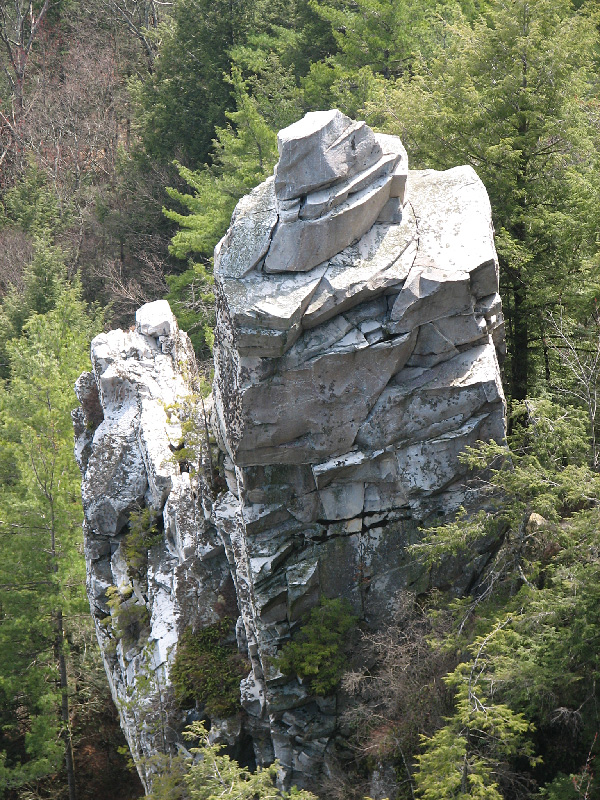
Looking down from Squaw Peak you can just about see more defeated rebel Titans. Below the grouped rocks in the foreground is the tall tower of rock called Devil's Pulpit. What a name!  This Devil's Pulpit would surely be Melville's Enceladus--if only he wore a mossy turban on top like the rocks in the woods, shown above. I guess you can't have everything.
Image Credit: The Outdoor New Yorker
Closer up, Devil's Pulpit does look like the "battering ram" to which Melville compares the limbless torso of Enceladus:


Rather, call him the American Enceladus as Melville patriotically insists. Devil's Pulpit might be the all-natural American Enceladus that Melville in Pierre favorably compares to Marsy's artificial hero at Versailles:
Parc de Versailles, Bosquet de l'Encelade, bassin 03