Showing posts with label New Orleans Sunday Delta. Show all posts

Friday, April 21, 2017

Another Melville reference by John W. Overall in the New Orleans Sunday Delta

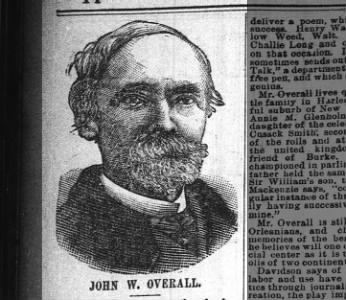
Today's search on Newspapers.com for Melville notices in newspapers added there within the past month yields another reference to Typee by Virginia-born journalist and poet John Wilford Overall. This Melville notice appears in Overall's regular "Paragraphs for the Times" column, as published in the New Orleans Sunday Delta on January 24, 1858. 

Found on Newspapers.com
Nevertheless, the romantic reader should not yearn for Simla, like the infatuated youth who fell in love with the Marquesas Islands, and went thither to find Melville's beautiful Typee Fayaway, with her liquid eyes, streaming locks, and girdle and robe of colored tappa, standing in the tabooed boat in the lake of the "Happy Valley." Paradises of the Simla and Typee order give not heart-happiness. Somebody said—we believe it was Wordsworth—that
"Heaven lies about us in our infancy."  
True enough; only it continues as long as humanity will permit it to lie about us. Heaven is within us, around us and above us, if we will have it so. That is all. 
--John W. Overall, "Paragraphs for the Times" in The Sunday Delta, January 24, 1858
Related posts

Saturday, December 10, 2016

Mitchell, Melville, and real Havanas in the New Orleans Daily Creole


From the New Orleans Daily Creole, December 10, 1856; found in the online Newspaper Archives at Genealogy Bank:
JUST THE THING.— "Ik Marvel," with his feet upon the mantel-piece, discussing the so-called glories of a bachelor's life with his touchy maiden aunt, with his brain swung into a half reverie by the semi-narcotic influence of a real Havana, gives us a glowing picture of a man content with all the world and "the rest of mankind." Happy Donald Mitchell! Herman Melville in his quiet valley of Typee was not happier. And the aromatic fumes of a cigar did all this—literally puffed away the sadness incident to human life! 
We had a trial of this yesterday. A box of real Havanas, such as Gen. Concha would praise, and, puffing, praise again, was laid upon our table. They were from the importing house of E. J. Hart & Co., Tchoupitoulas street. Knocking the ashes from the end, we looked into the consuming red, and thought that even in an editor's life there was occasionally a bright spot, after all.
Published by J. M. Weymouth, the New Orleans Daily Creole began in June 1856 and only lasted a year or so. On WorldCat and Chronicling America, The Daily Creole is still identified as an African-American newspaper--erroneously, as Thomas J. Davis noted in his contribution on "Louisiana" for 
The Black Press in the South, 1865-1979, edited by Henry Louis Suggs. The persistent "African-American" listing is also questioned by Armistead S. Pride and Clint C. Wilson in A History of the Black Press. The main cause for which the Daily Creole strove was the electoral agenda of the "American Party," the so-called Native-American or Know-Nothing Party backing former president Millard Fillmore against Buchanan and Frémont in the 1856 presidential election. Irish newsboys allegedly refused to carry the Daily Creole ("The Creole and the Newsboys," Daily Creole, August 5, 1856).

Reportedly, Virginia native John Wilford Overall served as editor of the short-lived Daily Creole. Those dreamy references to Ik Marvel and Melville in "Just the Thing" (transcribed above) indicate a poetic temperament and New York sensibility, both of which seem consistent with Overall as poet and eventually, after the Civil War, literary editor of the New York Sunday Mercury. Ignorant of Overall's postwar career in New York City, James Ryder Randall remembered him in New Orleans as a rival journalist and poet with "a vast ambition for literary fame" (Baltimore Sun - July 28, 1907).

On November 10, 1859, John W. Overall participated in the grand Schiller Festival in New Orleans, celebrating the centennial anniversary of Schiller's birthday. The New Orleans True Delta which Overall by then edited printed the whole of his speech at Odd Fellows' Hall. J. W. Overall delivered his remarks after the opening address in German by J. K. Gutheim. At one point in his enthusiastic tribute to Schiller, Overall paraphrased the segment in Melville's Typee on The Birds of the Valley:
In the bright, green islands of the Marquesas, brilliant-hued birds float like fragments of rainbows flashing in sunshine. But the birds, full-winged and sharp-beaked, transverse the amber-colored air with songless throats.

The New World but comparatively a few years back was like the lonely, yet beautiful Marquisan Islands. There were no sweet singers in all its Israel. Statesmen and heroes were her's, but the children of song who "marry them to immortality," built not the "lofty rhyme."  --New Orleans Daily True Delta, November 13, 1859
The New Orleans Delta also published the "Schiller Festival" speech by John W. Overall, along with the comment that
"Mr. Overall's address is especially marked by glowing imagery, imaginative thought, striking phrase, and fervid application of his subject."  --New Orleans Delta, November 13, 1859
In the New Orleans Sunday Delta a couple of years before, this same bit on the birds of Typee valley had flavored the unsigned rant on the supposed "Literary Subordinacy of the South." As shown in a previous post on Melville in the Sunday Delta, the writer there compared southern readers to Melville's "voluptuous and indolent Typees." The 1857 paraphrase is very close to Overall's 1859 paraphrase of the same passage in Typee:
"... birds with brilliant wings, flashing in the sun, fly noiselessly in the air, beautiful to look upon, yet songless as death."  --"Paragraphs for the Times," New Orleans Sunday Delta, June 21, 1857 
Both paraphrases of Melville use the words "brilliant," "flashing," and "songless." Both associate Melville with an atmosphere that is "amber-colored."

So then. John W. Overall wrote for all these New Orleans newspapers: the Daily Creole in 1856-7; the Sunday Delta in 1857-8; and the True Delta in 1859. Possibly the Melville mentions during those years are all his. I guess he was more of a Typee fan than a Melville fan. Another day I'll have to look for any Melville items in the New York Sunday Mercury during John W. Overall's tenure as literary editor there.


Related post:

Friday, January 22, 2016

Southern readers as Fayaways and Mehevis, indifferent to home-grown genius

Image Credit: Earnest J. Gaines Center Blog
Under the head of "Paragraphs for the Times," a correspondent (or the editor, D. C. Jenkins?) of the New Orleans Sunday Delta (June 21, 1857) complains of the "miserable literary subordinacy of the South," comparing southern readers, indifferent to southern writers, to Melville's "voluptuous and indolent Typees." Below is an excerpt only, not the full rant. Ironically, considering the blast at "servile dependence upon European and Northern bookwrights," the first "paragraphs" (not transcribed here) were devoted to Dickens and Thackeray.

Literary Subordinacy of the South 

Herman Melville—we like those men whose wizard genius brings to us amber-colored dreams—draws with the pencil of a poet-painter a glorious picture of a Happy Valley hidden among the palm-covered hills of the Marquesas, where the voluptuous and indolent Typees spend their time in the temple of their god with King Mehevi, and in paying court to the fair, young Fayaways lingering beneath the shade of the trees. In the deep stillness which reigns over the valley at mid-day, when every Typee is enjoying an undisturbed siesta, birds with brilliant wings, flashing in the sun, fly noiselessly in the air, beautiful to look upon, yet songless as death. 
We of the South, in the blazing light of this nineteenth century, though we boast a bolder, greater, grander race than the heathens of the far-distant isles which here and there dot the Pacific, are not unlike the self-complacent Typees. We, too, linger aobut the temple of our god, and though it is not of wood or stone, it is equally disrespectful to the Deity. The god of gold, the shining, captivating Mammon, is set up in our midst, for recklessly parodying Maximillian Robespierre, we seem to think, “if there is no God it is necessary to create one!” We, too, dwell in a Happy Valley, caring nothing about home intellectual nutriment, if it is allowable to compare the sensual to the spiritual; indifferent to the splendid birds of song which hover about us, silent as those of the Marquesas—not, however, because Heaven has sealed their throats, but because to build the lofty rhyme is neither to be applauded nor supported. 
Our Southern Mehivas [sic] idly turn over the leaves of a Southern book, and lay it contemptuously aside to dream of the rise or fall of Cotton. Our fair Fayaways having much the same feeling for Southern literature, whether embodied in books, magazines or newspapers, daintily put them away for the last new sensation story of the redoubtable Sylvanus Cobb, or some other Northern literary charlatan. Nothing good can come out of Nazareth, thought the Judeans of the olden time, though Incarnate Divinity moved in their midst—nothing good can come out of the South think thousands of our own people, though the land is full of Genius, the essence of that Divinity towards whom the wise men of the East turned, all radiant with joy! 
Sir Walter Scott said of Jeffrey, that he “had scarcely body enough to cover his brains.” There are abundance of similar men in the South, filled to the lip-brim with song, and endowed with the highest intellectual gifts. Poets, historians, essayists and painters exist everywhere in the South, who only want the genial smile of encouragement to bring out the rare intellectual qualities which for years have slumbered. They feel that the non-appreciation and non-patronage of learning, literature, science and the arts is humiliating. They are keenly alive to the miserable literary subordinacy of the South, and its servile dependence upon European and Northern bookwrights. They are fully aware that no people can be called independent who have not an independent literature. But in the present state of popular sentiment, it were madness for most of them to make literature a profession. There are more Otways and Tannahills among men of genius than there are Mat Priors and Sam Rogerses. Starvation is a most unpalatable sort of suicide....

--from the New Orleans Sunday Delta, June 21, 1857; found in the Newspaper Archives at Genealogy Bank
At first I wrongly took "An Old Fogy" to be the pseudonym of the writer of "Paragraphs for the Times." But the pseudonym appears in a different unrelated paragraph, where the Sunday Delta correspondent or rather editor (as now seems more likely) is quoting a previous column in the Baton Rouge Advocate signed, "AN OLD FOGY."

Additional references to Melville's South Sea narratives in "Paragraphs for the Times" appear in the New Orleans Sunday Delta on April 18, 1858 ("A Cuban Lulu") and August 8, 1858 ("Polynesian Dances"). So who was the Melville fan who edited the New Orleans Sunday Delta in 1857-8?

Donelson Caffery Jenkins?

Update 12/11/2016: John W. Overall, more likely. See the related post on