
JUST THE THING.— "Ik Marvel," with his feet upon the mantel-piece, discussing the so-called glories of a bachelor's life with his touchy maiden aunt, with his brain swung into a half reverie by the semi-narcotic influence of a real Havana, gives us a glowing picture of a man content with all the world and "the rest of mankind." Happy Donald Mitchell! Herman Melville in his quiet valley of Typee was not happier. And the aromatic fumes of a cigar did all this—literally puffed away the sadness incident to human life!
We had a trial of this yesterday. A box of real Havanas, such as Gen. Concha would praise, and, puffing, praise again, was laid upon our table. They were from the importing house of E. J. Hart & Co., Tchoupitoulas street. Knocking the ashes from the end, we looked into the consuming red, and thought that even in an editor's life there was occasionally a bright spot, after all.Published by J. M. Weymouth, the New Orleans Daily Creole began in June 1856 and only lasted a year or so. On WorldCat and Chronicling America, The Daily Creole is still identified as an African-American newspaper--erroneously, as Thomas J. Davis noted in his contribution on "Louisiana" for
The Black Press in the South, 1865-1979, edited by Henry Louis Suggs. The persistent "African-American" listing is also questioned by Armistead S. Pride and Clint C. Wilson in A History of the Black Press. The main cause for which the Daily Creole strove was the electoral agenda of the "American Party," the so-called Native-American or Know-Nothing Party backing former president Millard Fillmore against Buchanan and Frémont in the 1856 presidential election. Irish newsboys allegedly refused to carry the Daily Creole ("The Creole and the Newsboys," Daily Creole, August 5, 1856).
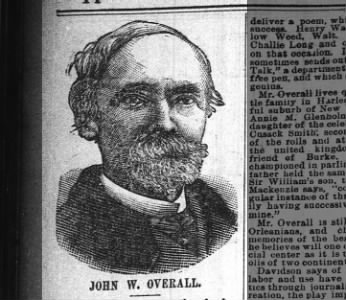
Reportedly, Virginia native John Wilford Overall served as editor of the short-lived Daily Creole. Those dreamy references to Ik Marvel and Melville in "Just the Thing" (transcribed above) indicate a poetic temperament and New York sensibility, both of which seem consistent with Overall as poet and eventually, after the Civil War, literary editor of the New York Sunday Mercury. Ignorant of Overall's postwar career in New York City, James Ryder Randall remembered him in New Orleans as a rival journalist and poet with "a vast ambition for literary fame" (Baltimore Sun - July 28, 1907).
On November 10, 1859, John W. Overall participated in the grand Schiller Festival in New Orleans, celebrating the centennial anniversary of Schiller's birthday. The New Orleans True Delta which Overall by then edited printed the whole of his speech at Odd Fellows' Hall. J. W. Overall delivered his remarks after the opening address in German by J. K. Gutheim. At one point in his enthusiastic tribute to Schiller, Overall paraphrased the segment in Melville's Typee on The Birds of the Valley:
In the bright, green islands of the Marquesas, brilliant-hued birds float like fragments of rainbows flashing in sunshine. But the birds, full-winged and sharp-beaked, transverse the amber-colored air with songless throats.The New Orleans Delta also published the "Schiller Festival" speech by John W. Overall, along with the comment that
The New World but comparatively a few years back was like the lonely, yet beautiful Marquisan Islands. There were no sweet singers in all its Israel. Statesmen and heroes were her's, but the children of song who "marry them to immortality," built not the "lofty rhyme." --New Orleans Daily True Delta, November 13, 1859
"Mr. Overall's address is especially marked by glowing imagery, imaginative thought, striking phrase, and fervid application of his subject." --New Orleans Delta, November 13, 1859In the New Orleans Sunday Delta a couple of years before, this same bit on the birds of Typee valley had flavored the unsigned rant on the supposed "Literary Subordinacy of the South." As shown in a previous post on Melville in the Sunday Delta, the writer there compared southern readers to Melville's "voluptuous and indolent Typees." The 1857 paraphrase is very close to Overall's 1859 paraphrase of the same passage in Typee:
"... birds with brilliant wings, flashing in the sun, fly noiselessly in the air, beautiful to look upon, yet songless as death." --"Paragraphs for the Times," New Orleans Sunday Delta, June 21, 1857Both paraphrases of Melville use the words "brilliant," "flashing," and "songless." Both associate Melville with an atmosphere that is "amber-colored."
So then. John W. Overall wrote for all these New Orleans newspapers: the Daily Creole in 1856-7; the Sunday Delta in 1857-8; and the True Delta in 1859. Possibly the Melville mentions during those years are all his. I guess he was more of a Typee fan than a Melville fan. Another day I'll have to look for any Melville items in the New York Sunday Mercury during John W. Overall's tenure as literary editor there.
Related post:


