
Perhaps it was the chivalrous "Colonel" Tom Picton who regarded Mardi as "next door to immortal."
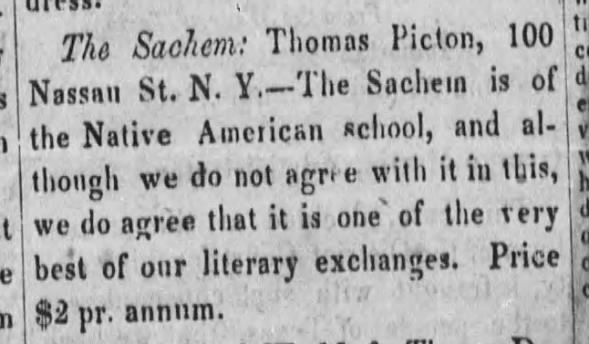 06 Nov 1852, Sat Santa Fe Weekly Post (Santa Fe, New Mexico) Newspapers.com
There is some hope for England! A lord has been sent for twelve months to the house of correction. Think of this, ye Britishers! a real live lord, one of the dii minores or demi-gods, as Herman Mellville hath it, in his next-door-to-immortal Mardi! The report is explicit; his hair was cut to the regulation felon clip; he was washed and shaved; we fear his cherished moustaches must have been sacrificed by the relentless fates, or rather by the adamantine turnkeys; furthermore, he was dressed in a suit of pepper and salt, and condemned to the--we speak the word with a slight nervous twitch of horror--TO THE MILL. Yes, reader, at this precise moment, the Noble Lord Frankfort is engaged in the remarkably monotonous employment of the perpetually walking up stairs, without ever getting any higher. If the reader has ever been on the treadmill--we do not mean professionally, but experimentally--he will understand and appreciate the sufferings of this fallen angel from the empyrean of British aristocracy. Lord F. was a great scamp; no doubt he was a[s] thoroughly debauched and degraded a specimen of a rowdy lord as one might hope to meet on a summer day. Nevertheless it is satisfactory to reflect that even this titled "ne'er do weel" can be made eminently useful to the cause of justice. This punishment is an example to his fellow nobles. It vindicates the majesty of the law and the equality of justice.
N. Y. Sachem.
In Mardi, and a Voyage Thither, Melville's narrator masquerades as Taji, one of the "demi-gods" recalled so fondly by the New York Sachem editor.Reprinted in the Helena, Arkansas Southern Shield on February 26, 1853; and Cleveland OH Plain Dealer on March 7, 1853.
Samoa now gave me to understand, that from all he could learn, the Islanders regarded me as a superior being. They had inquired of him, whether I was not white Taji, a sort of half-and-half deity, now and then an Avatar among them, and ranking among their inferior ex-officio demi-gods. To this, Samoa had said ay; adding, moreover, all he could to encourage the idea.
06 Nov 1852, Sat Santa Fe Weekly Post (Santa Fe, New Mexico) Newspapers.com

