Monday, August 5, 2019

Pierre in Utica

Hon. Ellis H. Roberts, M.C.
via The New York Public Library Digital Collections
Somehow I overlooked this friendly notice of Pierre in the Oneida Morning Herald, then published and edited in Utica, New York by Ellis H. Roberts. A few months later (October 26, 1852), the Utica editor protested the "ferocious diatribe on Herman Melville" in the November 1852 American Whig Review as "the most unjust specimen of criticism we have read during the past five years."

From the Oneida Morning Herald (Utica, New York), Thursday, August 5, 1852; found at Fulton History:
Oneida Morning Herald (Utica, NY) - August 5, 1852
PIERRE, or the Ambiguities. By Herman Melville, New York: Harper & Brothers.

Another work by the author of "Typee!" Those who have read the earlier as well as some of the later productions of this author, need no importuning of ours to read the present volume. We must confess the story of Pierre is to us as yet a profound mystery; but the dozen or so pages which we have read tempt us so strongly to proceed that we have made a vow to read the book as soon as we shall get sufficient breathing time. "Pierre" is dedicated to our old friend, "His Purple Majesty, Greylock," and he could not have enlisted the favor of a more lordly patron.

For sale by John W. Fuller & Co. 
Still looking for any notice of Moby-Dick in Utica.

Related posts:

Sunday, August 4, 2019

1817 book by Mary and P. B. Shelley, from the library of Herman Melville


Herman Melville died in September 1891. His widow Elizabeth and daughter "Bessie" moved to the Florence Apartments on June 7, 1892, as documented by John M. Gretchko in The Florence, Leviathan Volume 16, Number 1 (March 2014), pages 22-32 at 30. Before that, as Steven Olsen-Smith recounts, lots of volumes in Herman Melville's library
"were sold off to second-hand bookdealers in February, 1892, when Melville's widow, Elizabeth Shaw Melville, was preparing to vacate their residence of 28 years at 104 East 26th Street in Manhattan." -- A Fourth Supplementary Note to Melville's Reading (1988), Leviathan Volume 2, Issue 1 (March 2000), pages 105-111 at 106. 
In Melville's Reading (University of Wisconsin Press, 1966), Merton M. Sealts, Jr. reported that Francis Harper and his younger brother Lathrop C. Harper purchased an unknown number of unidentified books from Mrs. Melville (page 6 and page 122, note 13); reprinted in Sealts, Pursuing Melville, 1940-1980 (University of Wisconsin Press, 1982), page 35.

Here's one. Among "recent additions to the stock of Francis P. Harper" in May 1892 was the 1817 first edition of Mary Shelley's History of a Six Weeks' Tour, "from the library of Herman Melville, with his autograph in pencil." Listed in Harper's Catalogue of Standard and Out-of-Print Books No. 54 (May 1892), page 24:
476 Shelley, P. B. and Mary. History of a Six-Weeks' Tour through a Part of France, Switzerland, Germany and Holland, with letters, etc. 12mo, cloth, pp. 183. Lond., 1817. $6.00

First Edition, from the library of Herman Melville, with his autograph in pencil.
--Selected Catalogues, 1890-1895 via Google Books:
    <https://books.google.com/books?pg=RA5-PA24&dq=&id=X_k4AQAAMAAJ#v=onepage&q&f=false>
      Largely Mary Shelley's History of a six weeks' tour, the 1817 volume has a preface and two letters by her husband Percy Bysshe Shelley, and concludes with first printing of P B Shelley's poem Mont Blanc.
      The first edition of History of a Six Weeks' Tour is accessible online courtesy of The British Library; Hathi Trust Digital Library; and the Internet Archive:


      Related posts:

      Saturday, August 3, 2019

      Chicago bookman offers Thomson's Shelley from Meville's library

      The October 1920 Catalogue of Miscellaneous Books (Catalogue 86) from Chicago bookseller Walter M. Hill lists Shelley: A Poem by James Thomson, "From Herman Melville's library."

      435 SHELLEY: A Poem, with other Writings relating to Shelley, by the late James Thomson ('B. V.'), with Essay on the Poems of William Blake by the same Author. Tall 8vo, boards (breaking), uncut. (London), 1884. $7.50.

      Only 190 copies printed on toned paper for private circulation by Whittingham & Co. at the Chiswick Press. From Herman Melville's library.
       <https://hdl.handle.net/2027/mdp.39015089588266?urlappend=%3Bseq=970>
      Hill's Catalogue 86 presents books from the library of Joseph Very Quarles ("Judge Quarles") of Milwaukee, Wisconsin and two unspecified "private libraries."

      At Melville's Marginalia Online, Thomson's Shelley is Number 520 in The Online Catalog of Books and Documents Owned, Borrowed and Consulted by Herman Melville. As stated there in the note, this volume most likely was a gift from James Billson. Melville found Thomson's essay on "The Poems of William Blake" particularly interesting and enlightening, as he wrote Billson on "The last day of 1888."

      The Nation and the Athenaeum - August 13, 1921
      • Shelley, a  Poem via Google Books
        https://books.google.com/books?id=g6Xv96FjotcC&pg 
      Related posts:

      Friday, August 2, 2019

      Books autographed by Melville, listed in early Anderson catalogues


      Auction catalogues of John Anderson, Jr. in the year 1900 (Numbers 4 and 14) offer two books at some time owned by Herman Melville: The Arts and Artists by James Elmes, 3 vols. (London, 1825); and Mysteries of Corpus Christi, with translations of sacramental Autos (Belshazzar's Feast and The Divine Philothea, plus the first scene of The Poison and the Antidote) from the Spanish of Pedro Calderón de la Barca by Denis Florence MacCarthy (Dublin, 1867). Each of these four volumes has the signature of Herman Melville, according to the catalogue descriptions transcribed below.

      The 1867 MacCarthy translation is explicitly described as "From library of Herman Melville." As previously known, Melville owned and annotated Three Dramas of Calderón (Dublin, 1870), also translated by Denis F. MacCarthy. The 1870 volume of Calderón is Sealts Number 114, listed thus in The Online Catalog of Books and Documents Owned, Borrowed and Consulted by Herman Melville at the great Melville's Marginalia Online.

      Lot 67 in the Anderson Catalogue of Books, etc. No. 4, For Sale by Auction on Friday, February 16, 1900 is the 1825 London edition of The Arts and Artists by James Elmes, in three volumes:


      "67. ELMES (JAS.) The Arts and Artists: or, Anecdotes and Relics of the Schools of Painting, Sculpture and Architecture. Portraits and vignettes. 3 vols. 18mo, uncut. Lond. 1825
                Autograph of Herman Melville in each volume. Written with pencil."
      <https://hdl.handle.net/2027/hvd.hnmsyh?urlappend=%3Bseq=72>
      Links below are for general reference and further study. Harvard has multiple copies of each volume in the three-volume set of Elmes's The Arts and Artists, Google-digitized and accessible online courtesy of Hathi Trust Digital Library. Also available via Google Books:
      Lot 323 in the Anderson Catalog of An interesting assortment of Books and Pamphlets No. 14, For Sale By Action over two days in 1900, April 11 (Lots 1-260) and April 12 (Lots 261-end), is Denis F. MacCarthy, Mysteries of Corpus Christi (Dublin, 1867):


      "323. MYSTERIES OF CORPUS CHRISTI, from the Spanish, by Denis F. MacCarthy. 12mo. Dublin, 1867.  From library of Herman Melville and contains his autograph."
       <https://hdl.handle.net/2027/hvd.hnmsyh?urlappend=%3Bseq=302>
      Harvard University has the 1867 translation by Denis Florence MacCarthy from the Spanish [of Calderón de la Barca], originally the gift of James Russell Lowell and now available online courtesy of Hathi Trust Digital Library; and the Internet Archive:


      A different copy of the same title via Google Books:
      For essential background, especially on John Anderson, Jr.:
      • Merton M. Sealts, Jr., Pursuing Melville, 1940-1980 (University of Wisconsin Press, 1982), especially Part II, "A Correspondence with Charles Olson," pages 106-107 and 144-147.
      • Oscar Wegelin, "Herman Melville as I Recall Him," The Colophon Vol. 1, New Series, No. 1 (Summer 1935), pages 21-24; reprinted in Steven Olsen-Smith, ed., Melville in His Own Time (University of Iowa Press, 2015), pages 148-151. 
      Related posts:

      Friend of Bessie remembers Herman Melville, his "dignified" figure and "wonderful library"

      William Lyon Phelps
      via NYPL Digital Collections

      Books to the right of you, books to the left of you, books all above you.... 
      The June 1929 issue of Scribner's Magazine with the second installment of Hemingway's "A Farewell to Arms" also contains a rare reminiscence of Herman Melville, attributed to an unnamed, presumably female friend of Melville's daughter Elizabeth "Bessie" Melville (1853-1908). The "personal recollection" by Bessie Melville's "most intimate friend" was provided, apparently in writing, to Yale professor of English William Lyon Phelps who quoted it in his monthly column, "As I Like It":
      Happening to mention the name of Herman Melville in a lecture in Brooklyn, a member of the audience gave me this personal recollection, which seems to me of general interest.
      The mention of his name revived memories. His daughter, Elizabeth Melville, was my most intimate friend during my school days and until her death, several years ago, I was a frequent guest in the home. Although a little in awe of his dignified presence, I found him always kindly and most cordial. Bessie so often referred to their ancestral home at Pittsfield, Mass., where the children were born. The home "Arrow Head" is still in possession of some of the family, I think the daughter of Capt. Thomas Melville, who was a well-known Captain, living at Governor's Island, or at Staten Island, in the early seventies. I visited "Arrow Head" a few summers ago and saw with deep interest Herman Melville's library, and his old desk, with books everywhere. His city home, then in 26th St., near Fourth Ave., contained a wonderful library, at which I gazed with wonder and respect. Books to the right of you, books to the left of you, books all above you, and on the long table. I can see him now, in memory's picture, sitting in his big arm chair, a fine specimen of manhood. He was quite a well-known figure on the avenue, as he walked to and fro from business, cane in hand, withal tall, stately, and dignified. My father who admired Mr. Melville greatly, often spoke of "Omoo," and "Moby Dick." At that time Mr. Melville's books were appreciated in England-- "A prophet is not without honor." 
      His contemporaries, extending over some years, Hawthorne, Holmes, Longfellow, Emerson, Thoreau, Alcott, were often topics of conversation in his home to which I enjoyed listening, for in our studies at school we were studying the same in literature. 
      --Scribner's Magazine Vol. 85 No. 6 (June 1929), page 711.
      <https://archive.org/details/scribnersmag85editmiss/page/710
      On April 28, 1929, Phelps lectured for the Brooklyn Institute on "Contemporary Books Worth Reading," including the new biography of Herman Melville by Lewis Mumford. Possibly the friend of Elizabeth "Bessie" Melville heard Professor Phelps and his mention of Melville then.

      Letter to "Aunt Augusta" from "Bessie" Melville, May 26, 1862. Page 2.
      Manuscripts and Archives Division, The New York Public Library
      The New York Public Library Digital Collections, 1862 - 1863.
      http://digitalcollections.nypl.org/items/518e2520-4711-0136-c2ba-4f36b4d67c3e
      More than twenty years before, in November 1906, Herman Melville's daughter Elizabeth had solicited personal "letters and reminiscences" for a "memoir" or "biography" of her father that never materialized. The project was announced in the New York Evening Post on November 12, 1906

      New York Evening Post - November 12, 1906
      via Fulton History
      The family of the late Herman Melville, author of "Typee," "Moby Dick," etc., are collecting materials for a memoir and would be grateful if any persons having letters by him would lend them to Miss Elizabeth Melville, "The Florence," Fourth Avenue and Eighteenth Street, New York. Such letters will be carefully kept and promptly copied and returned.
       and the Springfield Republican on November 19, 1906:
      Herman Melville, the original of all romancers of the South seas,--none of whom, Loti, Stevenson, Becke, each in his several fashion, have equaled him,--is to have a biography at last. He was emphatically a man; and his writings are of a merit so extraordinary that it seems amazing that little stories, without a bit of life or character in them, can be sold by hundred thousand, while "Typee," "Omoo" and the great "Moby Dick" are passed by when some editor and publisher undertakes to present them once more to the public. Any one who has material in the shape of letters or reminiscences is asked to lend the letters or write out the reminiscences, for Miss Elizabeth Melville, the Florence, Fourth avenue and Eighteenth street, New York city. 
      Also The Dial, December 16, 1906, reported by George Monteiro in "Herman Melville: Fugitive References (1845-1922)," Resources for American Literary Study Vol. 33 (2008; AMS Press, 2010), pages 19-93 at 77;

      the New York Herald on December 8, 1906; and the Boston Herald on December 22, 1906:

      "Week-End Book Notes" - Boston Herald - December 22, 1906
      via GenealogyBank
      "Elizabeth Melville, the daughter of Herman Melville, is preparing a biography of her father, and asks for the use of letters and reminiscences. As the friend of Hawthorne, and the best of the South sea romancers, Melville deserves such a memorial as his daughter contemplates."
      Elizabeth "Bessie" Melville died on May 26, 1908. In the 1929 text presented by Phelps, her friend's expression "cane in hand" verbally echoes the longer reminiscence by Melville's granddaughter Eleanor Melville Metcalf, as quoted by Raymond Weaver in Herman Melville, Mariner and Mystic.

      Arrowhead remained in the family of Herman's brother Allan Melville (not Tom, Third Governor of Sailors' Snug Harbor) until 1927. Allan's surviving daughters Mrs. Maria G. Morewood and Katherine G. Melville sold the home to paper company executive Robert E. Kimball. Bessie's friend associated Arrowhead with the wrong younger brother. But she was evidently right about the books of his there (as well as that "wonderful library" in Melville's home on E. 26th Street in New York City). The change of ownership in the summer of 1927 occasioned an estate sale at Arrowhead that offered books purportedly from the library of Herman Melville.

      From The Berkshire Eagle, Friday, July 29, 1927:

      Antiques

      other household furniture, glass, china, and books from Herman Melville library, now being sold at "Arrowhead," the Morewood place on Holmes road. (1/4 mile below Miss Hall's school). Sale to continue Saturday and Monday. 
      Also as advertised in the Berkshire Eagle, the last day of the sale took place on Monday, August 1, 1927. Coincidentally, Herman Melville's 108th birthday.
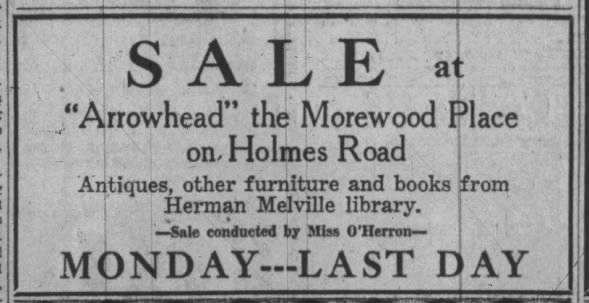
      Sat, Jul 30, 1927 – 5 · The Berkshire Eagle (Pittsfield, Massachusetts) · Newspapers.com
      SALE at
      "Arrowhead" the Morewood Place
      on Holmes Road 
      Antiques, other furniture and books from
      Herman Melville library. 
      --Sale conducted by Miss O'Herron-- 
      MONDAY --- LAST DAY 

      Thursday, August 1, 2019

      Fragments from a Writing Desk: Interview today on the Library of America volume H...

      Fragments from a Writing Desk: Interview today on the Library of America volume H...: LOA celebrates Herman Melville's 200th birthday ... - Library of America https://www.loa.org/.../1542-loa-celebrates-herman-mel...

      If 6 was 9


      [Unpublished before today, the 200th birthday of Herman Melville.]
      Now if six turned out to be nine,
      I don’t mind. I don’t mind. -- Jimi Hendrix
      Forgive me for bragging, but that exceedingly rare typo in the note to “A Dirge for McPherson” on page 655 of the 2009 Northwestern-Newberry Edition of Published Poems (Volume 11 in The Writings of Herman Melville) is my doing. Don’t be fooled when others pipe up to claim it. In my heart I know it’s mine, and I want due credit. As will be seen, the error is fairly and squarely on me, though the real, underlying motive remains murky and difficult to fix, fluctuating among various sins, all more or less damnable: inexcusable laziness (best case scenario); ego-tripping and blind hero-worship (not so good); and unbelievably mean and petty jealousy (worst case, fortunately inadmissible since nobody ever admits to Envy, as pointed out by somebody somewhere in Volume 13.) Anyhow, here’s what happened. In 2008 (after Sczcecin, before Jerusalem if you know what I mean), Legends of Melville scholarship were at work, assisted by Giants of library science and academia. I hacked a few of their alarming emails to each other: substantive, deeply informed, intellectually rigorous communications about the next-to-last job on a monumental project that had started decades and decades before, back when I was digging MAD magazine and Iron Butterfly. In-A-Gadda-Da-Vida, the 17:05 album version, which upon reflection has everything to do with Typee and archetypes of Paradise. I mean Paradise Lost. Well you see why I might not make the most disciplined of proofreaders. Here and there I did attempt to make myself useful on bibliographical puzzlers—tricky business then, now pretty much child’s play on a smart phone. Otherwise, I kept telling myself, “Be quiet; stay out of the way; don’t bother The Legends.” Eventually though, I got sick and tired of their being right all the time. Once General Editor Hershel Parker (Maestro to me) with his knack for getting at cruxes asked about McPherson as Sarpedon in Melville’s “Dirge.” Simply Melville’s mistake for Patroclus, or some craftier confusion of opposed heroes?

      On that score, no one could better what Hennig Cohen wrote into his great 1964 edition of Battle-Pieces. The unsolved and maybe unsolvable mystery of Sarpedon led to reconsideration of the account of McPherson’s fall that Melville quoted in his original 1866 note, crediting “the Achilles to this Sarpedon.” Where did Melville get it? Which “Achilles” in the United States Army testified, “On that day we avenged his death”? From context, Associate General Editor Robert D. Madison inferred Sherman. I guessed General John A. Logan and the fight was on. Privately, I vowed to confound all those Legends, dead or alive, with documentary proof that Logan not Sherman was Melville’s primary source. Alas, however, the most suggestive evidence I could muster was aggravatingly short of conclusive: the New York Times (13 October 1864) and later sources merely identified Logan as having “avenged the death of his comrade and commander.” Then again, Logan as heroic avenger (“McPherson and Revenge!” his wrathful cry in the Battle for Atlanta) fit the Achilles mold so well, maybe we could finesse the failure to locate a more exact verbal parallel to the quoted words in Melville’s note. Page proofs came with my Logan reference newly and neatly blended into the editorial “Discussion” of Sarpedon. Victory! If only it would do, which it would not. In prose Melville described his Union Army Achilles as both warrior and narrator. Logan avenged, to be sure, but the word avenged was from one of the official reports—by who? Sherman. Searching again in Google Books, I found it, the passage that Melville took verbatim from Sherman’s letter to the Adjutant-General dated July 24, 1864, reporting the death of James B. McPherson. The relevant text of the 1864 letter appeared in Sherman’s article titled “The Late Major-General J. B. McPherson,” first published in the April 1866 issue of Hours at Home and reprinted soon thereafter in newspapers, for instance The New York World on April 14, 1866, under the heading “THE LATE GEN. MCPHERSON. / A Personal Sketch by Major-General Sherman….”


      Madison was right all along. This late in the game (and Jerusalem looming), could the page proof be massaged one more time to incorporate the discovery of Melville’s source in one or another version of Sherman’s 1864 report? Yes. The editors obliged with the coolness and grace of veterans. Little left to do, right, except reserve a room at Mount Scopus Hotel and, oh yeah, proofread. Like I promised. Especially that one page with those late changes and later changes to changes. OK, bad news first: the wrong number in the date of 1895 in the cite of Sealts, no. 17 occurred amidst revisions I should have proofread. Worse, I did proofread that page. Even worse than that, I half-remember seeing 1895 and thinking “WTF?”

      Now for the good news of my mental breakthrough: no more self-torment. Six did turn out to be nine, so what? If you can’t handle the truth, Scott, just turn the book around and read Melville upside-down.


      One more thing and my humble tribute to Harrison Hayford is done. (Forgot to mention Hayford by name, but The Legends were, are his students—every blessed one.) Since Herman Melville at long last has sailed into the public domain, most of his writings are available online. One fine day The Writings of Herman Melville must get there, too. Now that any clown can Google William Tecumseh Sherman, will future publishers of Melville in digital and other media yet undreamt even bother about explanatory notes? If they do bother with such quaint and increasingly unnecessary endeavors, my boasted contribution, along with the residual honor and glory I frankly covet, could vanish in two clicks. In other words, faster than you can say “Ahab.” What then, Mr. Big Stuff? Nothing for it but last respects among the remains of my personal library, that part not carted to Half-Price Books. Cubs cap in one hand and Volume 11 (hardback, 960 pages) in the other, I will have to console myself with its undeniable heft and the fact that in print, typos are forever.