Friday, June 30, 2017

Henry T. Tuckerman remembers the smiling face of "dear old Clement Moore"

Herman Melville's friends held Clement C. Moore in high regard. As shown in an earlier post, Evert A. Duyckinck honored the author of "A Visit from St. Nicholas" as
"one of the best of men" --Frank Leslie's Popular Monthly (June 1884).
Writing in 1866 for The Atlantic Monthly, Henry T. Tuckerman counted
"the benign smile of dear old Clement Moore"
among his most cherished reminiscences of Broadway in New York City. Other departed friends that Tuckerman remembered in the same class of "endeared figures and faces" were Dr. John W. Francis and Charles Fenno Hoffman. Melville knew them, too, when he lived in New York City.

And then, to the practised frequenter, how, one by one, endeared figures and faces disappear from that diurnal stage! It seems but yesterday since we met there Dr. Francis’s cheering salutation, or listened to Dr. Bethune’s and Fenno Hoffman's genial and John Stephens’s truthful talk,—watched General Scott‘s stalwart form, Dr. Kane’s lithe frame, Cooper’s self-reliant step, Peter Parley’s juvenile cheerfulness, — and grasped Henry Inman’s cordial hand, or listened to Irving’s humorous reminiscence, and met the benign smile of dear old Clement Moore. As to fairer faces and more delicate shapes,—to encounter which was the crowning joy of our promenade,—and “cheeks grown holy with the lapse of years,” memory holds them too sacred for comment. “Passing away” is the perpetual refrain in the chorus of humanity in this bustling thoroughfare, to the sober eye of maturity. The never-ending procession, to the sensitive and the observant, has also infinite degrees of language. Some faces seem to welcome, others to defy, some to lower, and some to brighten, many to ignore, a few to challenge or charm,—as we pass. And what lessons of fortune and of character are written thereon,—the blush of innocence and the hardihood of recklessness, the candid grace of honor and the mean deprecatory glance of knavery, intelligence and stupidity, soulfulness and vanity, the glad smile of friendship, the shrinking eye of fallen fortune, the dubious recognition of disgrace, the effrontery of the adventurer, and the calm, pleasant bearing of rectitude,—all that is beautiful and base in humanity, gleams, glances, and disappears as the crowd pass on.
--Henry T. Tuckerman, "Through Broadway" in The Atlantic, Volume 18
 Related posts:

Thursday, June 29, 2017

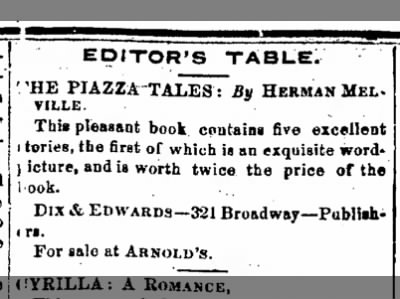
Piazza Tales in Milwaukee

Milwaukee, Wisconsin Daily Free Democrat - June 5, 1856
The Milwaukee Daily Free Democrat was edited by Sherman M. Booth, a native of western New York State, Yale grad, and prominent abolitionist. The year before this notice of Melville's Piazza Tales appeared in the Daily Free Democrat, Booth had been sentenced in federal court to "a month's imprisonment and a fine of $1,000" for his role in the rescue of Joshua Glover.
THE PIAZZA TALES: By Herman Melville.

This pleasant book contains five excellent stories, the first of which is an exquisite word-picture, and is worth twice the price of the book.

DIX & EDWARDS—321 Broadway—Publishers.
For sale at ARNOLD'S

Notice of The Piazza Tales in the NY Evening Express

New York Evening Express - June 20, 1856
The "Piazza Tales," by Herman Melville, presents some half dozen attractive short stories originally published in Putnam's Magazine. Under the caption of "The Piazza" a pleasing introductory idyl is given, after which, the stories "Bartleby" "Benito Cereno" "The Lightning-rod Man" the "Encantadas," and the "Bell Flower" [Bell Tower] are supposed to be recited. It forms a very pretty parlor volume.  
--New York Evening Express, June 20, 1856

Friday, June 23, 2017

Short notice of Clarel in the New York Observer

New York Observer - June 29, 1876
CLAREL: A Poem and Pilgrimage in the Holy Land. By Herman Melville. In Four Parts. 1, Journalism. 2, The Wilderness; 3, Mar Saba; 4, Bethlehem. G. P. Putnam's Sons.
This is a dreary pilgrimage of two volumes of miserable poetry (if such it can be called) which few readers will be able to complete. --New York Observer, June 29, 1876
So Melville was right when he described Clarel as "eminently adapted for unpopularity," in his letter to James Billson dated October 10, 1884. The first book is titled "Jerusalem," not "Journalism."

Thursday, June 22, 2017

Philip Jenkins on Melville's Dualism in "Lost Gnostic Poem"


Philip Jenkins reads a Timoleon poem and locates Melville's poetical Fragments on the Albigensian part of the "Dualist/Gnostic continuum."
More curious is why it is allegedly “of the twelfth century.” All the Patristic sources concerning Gnosticism were focused on the first three or so centuries of the Christian era. Now, there were medieval Dualist movements in the twelfth and thirteenth centuries like the Bogomils and Albigensians, and many writers (including myself) have suggested possible continuities from ancient Gnosticism. I have even spoken of the Dualist/Gnostic continuum. In that sense, you could even imagine an Albigensian poem of the twelfth century, say, being described as Gnostic in a very broad sense.
Along the way, the Baylor historian raises interesting questions pertaining to the study of Melville's sources. Did Melville read Jules Michelet or Madame Blavatsky? Check out the enlightening blog post by Philip Jenkins for The Anxious Bench, on Patheos via the Evangelical Channel:

http://www.patheos.com/blogs/anxiousbench/2017/06/fragments-lost-gnostic-poem/

Sunday, June 18, 2017

Clement C. Moore disclaimed authorship of the charity hymn, "Lord of life, all praise excelling"


In 1866, Reverend Samuel R. Johnson wrote a letter to the editor of the Utica, New York Gospel Messenger in which he reported a conversation with Clement C. Moore that had taken place around 1856-7, "six or seven years before his death." Johnson was curious about the authorship of Hymn 117, a charity hymn often attributed to Moore. When asked by his fellow churchman, Moore disclaimed authorship of the Episcopal hymn, "Lord of life, all praise excelling."
"Do you know who wrote that Hymn 117, for charitable occasions, beginning 'Lord of life, all praise excelling?'" He replied, "I do not know." Why, said I, Dr. Moore, do you know that I have repeatedly heard that hymn attributed to you, confidently, and by clergymen of reputation; more than that, I have seen the assertion several times in print. "No," said he, "it is a mistake; I did not write it, nor do I know who did write it." So his disclaimer settles that question forever. It was some six or seven years before his death, while his memory was evidently clear and firm.  --Gospel Messenger, January 25, 1866
As shown in a previous melvilliana post, the words to the hymn beginning "Lord of life, all praise excelling" were in fact written by Samuel Birch, the dramatist, pastrycook, and in 1814 Lord Mayor of London.

The published letter from Samuel R. Johnson provides additional testimony that Clement Clarke Moore did not compose the charity hymn commonly attributed to him. As also confirmed in Johnson's 1866 letter to the editor of the Gospel Messenger, Moore had no trouble denying authorship of widely beloved lyrics when he did not write them.
... Long years after, when the discussion concerning the authorship of the hymns was going on in the Church papers, especially in Philadelphia, this hymn was attributed by several to Prof. Moore. Some years after, endeavoring to verify the authors, at the request of a friend, I said to myself "Why was not this hymn, written so long ago, which was deemed good enough even for the Church's use, inserted in Dr. Moore's volume of poems, prepared by his own hand, published under his own eye? and as I met him weekly, why should I leave the matter at all in doubt, so easily determined by his very word? Accordingly, on visiting him, I turned the conversation to the authorship of these hymns, and put the question plainly, "Do you know who wrote that Hymn 117, for charitable occasions, beginning 'Lord of life, all praise excelling?'" He replied, "I do not know." Why, said I, Dr. Moore, do you know that I have repeatedly heard that hymn attributed to you, confidently, and by clergymen of reputation; more than that, I have seen the assertion several times in print. "No," said he, "it is a mistake; I did not write it, nor do I know who did write it." So his disclaimer settles that question forever. It was some six or seven years before his death, while his memory was evidently clear and firm.  --Gospel Messenger and Church Record of Western New York, January 25, 1866

Gospel Messenger and Church Record of Western New York
 January 25, 1866 (1 of 2)
Gospel Messenger and Church Record of Western New York
January 25, 1866 (2 of 2)
Related post:

Saturday, June 17, 2017

Daniel Webster on the Bunker Hill Monument as orator

View of Bunker Hill & Monument, June 17: 1843
via Library of Congress
Speaking in 1852 at the annual Printers' Banquet, Melville's friend Dr. John W. Francis opened by recalling what Daniel Webster famously had said about the Bunker Hill Monument:
WHEN the great defender of the Constitution delivered the oration at Bunker Hill, he pointed to the just completed monument and exclaimed, “There stands the Orator of the Day.”  --Reminiscences of Printers, Authors, and Booksellers in New-York
Dr. Francis paraphrased and condensed, making one great line out of the well-known passage in which Webster personified the Bunker Hill Monument as "itself the orator of this occasion." As reported by Richard Frothingham and painted in oil by an unknown hand, Webster dramatically gestured to his superior when he said,
"The powerful speaker stands motionless before us."
Daniel Webster, 1843 Speech at Bunker Hill Monument
via Gallery 76 Americana & Folk Art
Herman Melville made a similarly humble move when he dedicated Israel Potter to the Bunker Hill Monument:


Your Highness will pardon me, if, with the warmest ascriptions on this auspicious occasion, I take the liberty to mingle my hearty congratulations on the recurrence of the anniversary day we celebrate, wishing your Highness (though indeed your Highness be somewhat prematurely gray) many returns of the same, and that each of its summer's suns may shine as brightly on your brow as each winter snow shall lightly rest on the grave of Israel Potter.

Your Highness'
Most devoted and obsequious,
THE EDITOR.

JUNE 17th, 1854.  --Herman Melville - Israel Potter
For background and context, here is a fuller selection from Daniel Webster's 1843 Address, his second Bunker Hill oration. (The first of Webster's famous Bunker Hill Monument speeches was delivered on June 17, 1825 at laying of the corner-stone of the Bunker Hill Monument at Charlestown, Massachusetts.) The text of the 1843 speech would have been available to Melville in (for one example) the first volume of The Works of Daniel Webster (Boston, 1851).
The Bunker Hill Monument is finished. Here it stands. Fortunate in the high natural eminence on which it is placed, higher, infinitely higher in its objects and purpose, it rises over the land and over the sea; and, visible, at their homes, to three hundred thousand of the people of Massachusetts, it stands a memorial of the last, and a monitor to the present and to all succeeding generations. I have spoken of the loftiness of its purpose. If it had been without any other design than the creation of a work of art, the granite of which it is composed would have slept in its native bed. It has a purpose, and that purpose gives it its character. That purpose enrobes it with dignity and moral grandeur. That well-known purpose it is which causes us to look up to it with a feeling of awe. It is itself the orator of this occasion. It is not from my lips, it could not be from any human lips, that that strain of eloquence is this day to flow most competent to move and excite the vast multitudes around me. The powerful speaker stands motionless before us. It is a plain shaft. It bears no inscriptions, fronting to the rising sun, from which the future antiquary shall wipe the dust. Nor does the rising sun cause tones of music to issue from its summit. But at the rising of the sun, and at the setting of the sun; in the blaze of noonday, and beneath the milder effulgence of lunar light; it looks, it speaks, it acts, to the full comprehension of every American mind, and the awakening of glowing enthusiasm in every American heart. Its silent, but awful utterance; its deep pathos, as it brings to our contemplation the 17th of June, 1775, and the consequences which have resulted to us, to our country, and to the world, from the events of that day, and which we know must continue to rain influence on the destinies of mankind to the end of time; the elevation with which it raises us high above the ordinary feelings of life, surpass all that the study of the closet, or even the inspiration of genius, can produce. To-day it speaks to us. Its future auditories will be the successive generations of men, as they rise up before it and gather around it. Its speech will be of patriotism and courage; of civil and religious liberty; of free government; of the moral improvement and elevation of mankind; and of the immortal memory of those who, with heroic devotion, have sacrificed their lives for their country. 
--Daniel Webster on the Completion of the Bunker Hill Monument (June 17, 1843).
In Monumental Melville: The Formation of a Literary Career Edgar A. Dryden quotes extensively from the 1843 Address, including Daniel Webster's depiction of the monument as "orator" and "powerful speaker." In Dryden's view, Israel Potter gives Melville's "antithetical version of the national myth that not only destabilizes Webster's vision of the monument supporting the myth of the nation, but demystifies both public and literary monumentality." For the freshest discussion to date, check out John Hay's article in the June 2016 New England Quarterly, titled Broken Hearths: Melville's Israel Potter and the Bunker Hill Monument. Rightly estimating Dryden's reading as "persuasive," Hay nevertheless offers a welcome counterbalance to the constant and by now wearisome valorizing of irony in Melville criticism.