Showing posts with label American Revolution. Show all posts

Tuesday, April 23, 2024

The Cuban Pirate

Charles J. Sharp, CC BY-SA 4.0 via Wikimedia Commons

From the manuscript collection "Weeds and Wildings," posthumously published in The Works of Herman Melville Volume 16 (Constable and Company, 1924) on page 320. Melville's poem "The Cuban Pirate" is also available in the 2017 Northwestern-Newberry Edition Billy Budd, Sailor and Other Uncompleted Writings, edited by G. Thomas Tanselle, Harrison Hayford, Hershel Parker, Robert Sandberg and Alma MacDougall Reising at page 101; and Herman Melville: Complete Poems (Library of America, 2019) edited by Hershel Parker at page 758.

THE CUBAN PIRATE

(Some of the more scintillant West Indian humming-birds are in frame hardly bigger than a beetle or bee.)


BUCCANEER in gemmed attire —
Ruby, amber, emerald, jet —
Darkling, sparkling dot of fire,
Still on plunder are you set?
 
Summer is your sea, and there
The flowers afloat you board and ravage,
Yourself a thing more dazzling fair —
Tiny, plummed, bejewelled Savage!
 
Midget! yet in passion fell
Furioso, Creoles tell.
Wing'd are you Cupid in disguise
Now flying spark of Paradise?

Northwestern-Newberry and LOA editions have "plumed" instead of "plummed" and both supply the comma after "Wing'd" in the penultimate line. Both these editions give "You" for "Now" in the last, making it "You flying spark of Paradise?" Regarding Now vs. You, you might like to examine the manuscript version of "The Cuban Pirate" at Houghton Library, Harvard University and decide for yourself. On the Harvard Mirador Viewer it looks to me like it could be You. Or Thou. Or how about "Mon," as in Mon petit chou-chou. 

And check out the rejected alternative version of the last line, also visible in the manuscript image. At least for a while Melville wanted to call his brazen hummingbird "little Paul Jones" after the British pirate and hero of the American Revolution John Paul Jones.
  • Persistent Link https://nrs.lib.harvard.edu/urn-3:fhcl.hough:16083258?n=291
  • Description Melville, Herman, 1819-1891. Unpublished poems : autograph manuscript, undated. Herman Melville papers, 1761-1964. MS Am 188 (369.1). Houghton Library, Harvard University, Cambridge, Mass.Folder 5. Weeds & wildings with a rose or two.
  • Page sheet 67 (seq. 291)
  • Repository Houghton Library
  • Institution Harvard University
  • Accessed 23 April 2024


Wednesday, April 26, 2023

Revolutionary Reminiscence by "M."

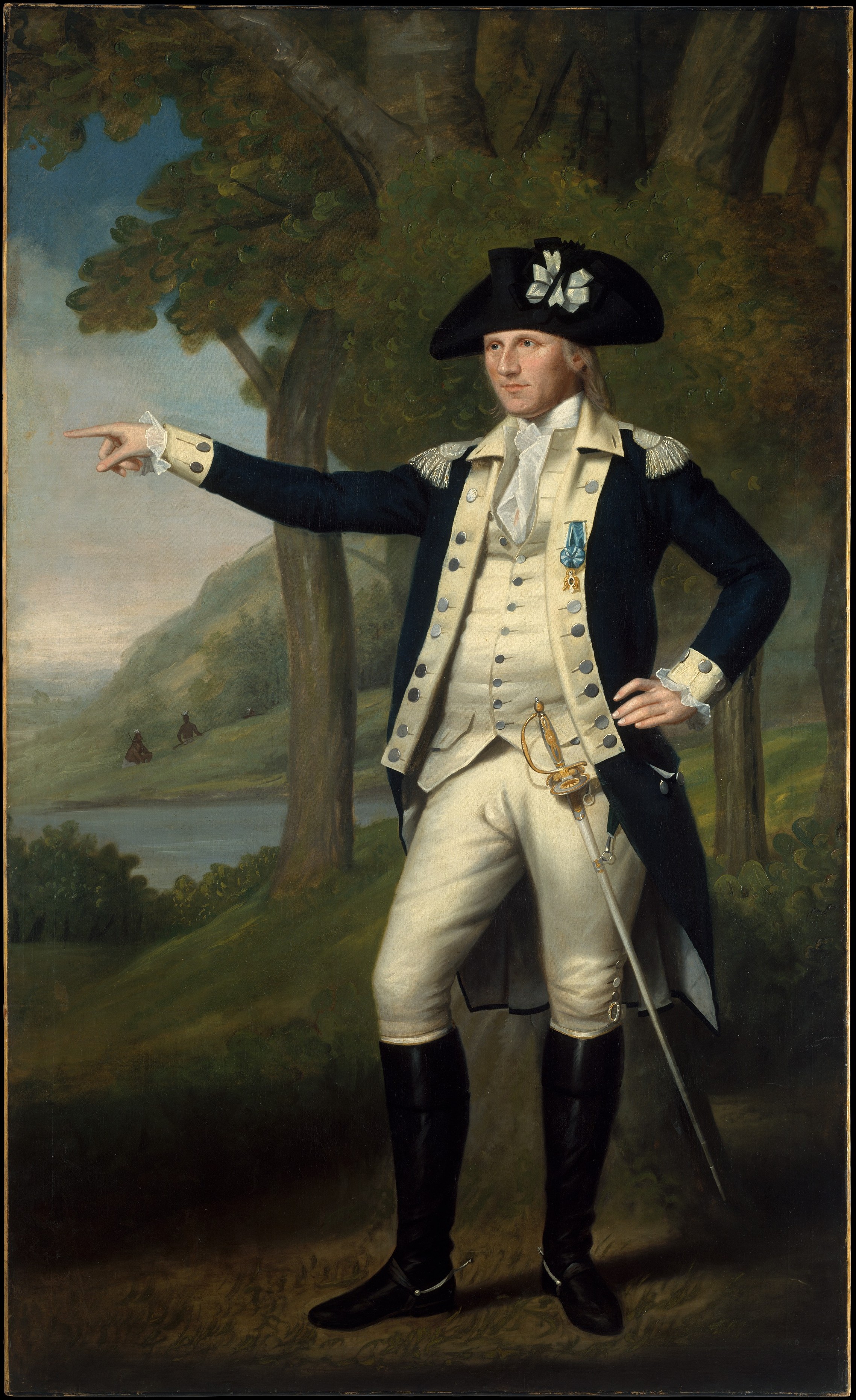
Marinus Willett via The Met

The following "Revolutionary Reminiscence" of Washington's Last Expedition tells of a brave officer facing amputation of his severely frostbitten legs. As dramatically related by "M.," the story has two heroes: the suffering warrior and the "humane Indian" who rescued him "from the amputating knife of a surgeon." The sympathetic and resourceful Indian is not named. His grateful patient was Captain Alexander Thompson (1759-1809). Then Lieutenant Thompson marched in February 1783 under Colonel Marinus Willett during the ill-fated Expedition to Oswego. Signed "M.," the "Revolutionary Reminiscence" first appeared in the Army and Navy Chronicle on March 26, 1840. Reprinted elsewhere, often without credit to any source or author, as in the Boston Weekly Magazine for Saturday, April 10, 1840 and Boston Recorder on September 11, 1840. Copied with credit "From the Army and Navy Chronicle" (including the subscribed initial "M.") in the New York Christian Intelligencer on May 16, 1840. 

REVOLUTIONARY REMINISCENCE.

In the winter of 1783, the father of the late Lieut. Colonel A. R. THOMPSON, (who fell in Florida at the head of his regiment, 25th Dec., 1837,) then a Lieutenant in the army of the Revolution, accompanied a detachment under Colonel WILLETT, with a view to surprise Fort Oswego, which was at that time in the occupation of the British. The treachery of their Indian guide, however, who led them a circuitous and roundabout way, caused, eventually, a failure in the enterprise, much to the chagrin and vexation of the American party.

The weather was excessively cold, the men and officers but poorly clad; but the soldier's duty oft compels him not only to forego the comforts of home and civilized life, but to endure summer's parching heat, and winter's piercing blast. The state of the country, also, at that period forbade repose or inactivity, while a foot of its soil was in the possession of the enemy. The deception practised by the guide, had protracted their journey, and consequently caused the endurance of much physical suffering, from the length of the route and intensity of the weather. Many of the men had their fingers, toes and ears, badly bitten by the frost. Lieutenant THOMPSON had both of his feet so severely frozen, that when the detachment arrived at the camp, he was in such a state that the surgeon in attendance deemed it necessary, in order to save his life, to amputate both his legs. Sad and heavily fell this decision upon the ears of poor THOMPSON, who, full of military ardor and zeal in his country's cause, was anxious to devote all his energies to assist in emancipating her from the tyranny of despotic power; but here he was in the vigor of youth, having entered the list with the brave and patriotic, to be rendered helpless and maimed for the rest of his life, (if he should survive the operation,) not by an honorable loss of limb in battle, from the ball of a warlike enemy, but from the amputating knife of a surgeon. The thought was painful in the extreme, and he almost wept at the prospect.

"Can nothing be done, Doctor, to save these limbs?" said the youthful officer, as he cast a look of the deepest inquiry at the surgeon, and continued, "they have not yet done half their duty. Cannot you save them, that I may yet serve my country, and participate in the honor of assisting throughout the struggle, and in consummating her entire freedom from the British yoke?"

"I can see no alternative," replied the doctor, as he bound around the ligature above the knee; "it is impossible to save them."

"Then may God give me grace to submit," said the lieutenant, placing his hand over his eyes and pressing his burning brow; and I must be sent home," he continued in soliloquy, "crippled in the service, but not in the field."

He was in this situation, with a few of his military friends around him, whose countenances bore the expression of the sympathy they felt for their beloved associate, and sad too, were his own reflections; but he summoned resolution to undergo the painful operation. At this crisis, a groupe had gathered around the tent, anxious to know the result. Among them was a friendly Indian who, hearing them say a man's legs were to be cut off, he turned, and raising the curtain, passed into the tent. Stepping up, he laid his hand upon the uplifted knife, just in the act of being used: "No!" said he, "that handsome young warrior shall not die! I will cure him!"

The surgeon said it was "impossible! that unless amputation was speedily performed, death from mortification must ensue."

"Halt! doctor," said Thompson, as his eyes turned quickly upon the Indian; "let him try, I would almost as soon die as lose my legs, now when they are so much needed as at the present."

"Let him, let him try," echoed the voices of all present; and the doctor laid down his knife and reluctantly submitted. Come, my good fellow, said they, save these legs, and you shall have a splendid rifle, and be constituted a chief.

The Indian threw off his blanket, commenced by removing the bandages, and by using friction, fomentations, poultices, &c. &c., succeeded in restoring circulation; and finally, after the patient had suffered much pain and anxiety, he recovered the use of his limbs, and was soon able to "report for duty.” 

The joy and gratitude of the young officer was unbounded; he generously rewarded the humane Indian, and often in after times, when marching in pursuit of the enemy, would he look down at his feet and bless the memory of the red man, who, under God, had been the means of saving his limbs, and perhaps his life. Mr. THOMPSON continued to serve throughout the war, with honor and reputation; and at the close of it was brevetted a Captain for his faithful and gallant conduct. 

M.

-- Army and Navy Chronicle, March 26, 1840.
https://hdl.handle.net/2027/hvd.32044097894786?urlappend=%3Bseq=211%3Bownerid=27021597765398891-221

In family correspondence, Captain Thompson himself disclosed the fact of his dangerous frostbite and hopes of recovery--without, however, describing any particulars of his successful treatment:

"We had one hundred and thirty bit with the frost, some very dangerously. I am myself one of the unfortunate number, but by frequent application I have made, my feet are much better and I flatter myself will soon be well."

-- Letter to Brother dated February 24, 1783 as transcribed in "Two Expeditions To Fort Ontario in 1783; Colonel Willett For War; Captain Thompson, For Peace" (Presented by Mr. Anthony Slosek, January 17, 1956) 19th publication of the Oswego County Historical Society, pages 1-16 at 16.

As mentioned early in the "Revolutionary Reminiscence" by "M." Captain Thompson was the father of Lt. Col. Alexander Ramsay Thompson, killed in Battle of Okeechobee during the Second Seminole War in Florida. Captain Alexander Thompson (1759-1809):

"served in the artillery during the Revolutionary war, was retained as captain in the peace establishment, and attached in 1794 to the artillery and engineer corps, and after his discharge in 1802 till his death, 28 Sept., 1809, was military store-keeper at West Point." 

-- Appleton's Cyclopaedia of American Biography

More on Capt. Thompson from The Ancestry and Descendants of John Alexander Thompson Nexsen, compiled and arranged by Samuel Emory Rogers (1925) page 16:

Colonel Thompson was the son of Captain Alexander Thompson, (1759‑1809), who enlisted for the American Revolutionary struggle at the age of eighteen in the Artillery Regiment of Colonel John Lamb. He was soon promoted to Captain of Artillery and later served as Captain of Engineers. He drew the plans for the siege of York town, which plans hang under his portrait in the United States Military Academy at West Point. He entered New York with the victorious American troops and was selected by General Washington to bear the dispatches to the frontier forts at Oswego, Niagara, and Detroit, ordering cessation of hostilities. At the close of the Revolution his company was the only company of the American army not disbanded. On October 1, 1787, Captain Alexander Thompson was promoted to First Major in Lieutenant-Colonel Sebastian Baum's Artillery. He resigned his commission as Major on October 9, 1793 in order to accept appointment as Commissary of Ordnance at West Point at the foundation of the Military Academy, which post he held until his death. He is buried at the Military Academy at West Point.

Friday, July 22, 2022

Peter Gansevoort's 1832 address to the Albany Republican Artillery

Albany Republican Artillery, NY State Militia
Regimental Color c. 1809
via New York State Military Museum and Veterans Research Center

As previously shown on Melvilliana, Harold A. Larrabee gave the true setting for Peter Gansevoort's address on the centennial of George Washington's birthday, Elisha Foot's Fort Orange Hotel at 549 South Market street.  
"On that occasion he presented to the Albany Republican Artillery at a dinner in Foot's Fort Orange Hotel a large brass drum, captured from the British at Fort Stanwix by his father, then a colonel."

In his 1934 article for New York History on Herman Melville's Early Years in Albany, Larrabee went on to quote the following "sunburst of rhetoric" near the end of Peter Gansevoort's speech:

The trophy which I present to you, is strongly associated with one of the scenes to which I have alluded, in the glorious struggle for our Independence. Its music was heard in those days of peril; it beat in unison with the war whoop and yell of the merciless savage on the bloody field of Oriskany; it sounded the charge and animated the courage of the enemy at Fort Stanwix; it also sounded his retreat, and was taken from the enemy in the hour of his flight.

On this centennial jubilee, in honor of him, whose monument is in the grateful hearts of a free and intelligent people, I present to you this trophy, as a memorial of that eventful period, when the sun of liberty, in the full effulgence of its glory, irradiated the western hemisphere, and when the first sparks were struck by the fearless asserters of the unalienable rights of man, which enkindled on the altar of freedom, that flame which is gradually illuminating the eastern hemisphere.

The Gansevoort family in Albany apparently kept a close watch on that drum donated in 1832 by Herman Melville's Uncle Peter. In 1877 Melville's cousin, Peter Gansevoort's daughter Catherine (Kate) Gansevoort Lansing procured it for the centennial celebration of the Battle of Oriskany.

... Mr. SEYMOUR exhibited the revolutionary relics. Among these was the brass snare drum, sent up from Albany by Mrs. LANSING. On the brass coat of the drum was the following inscription : 

" Presented by Peter Gansevoort, of the city of Albany, counsellor-at-law, to the Albany Republican Artillery Company, on the 22d February, 1832."

"Taken from the enemy on the 22d Aug., 1777, when the British army under Gen. St. Leger, raised the siege of Fort Stanwix, which fortress had been valiantly defended by the garrison under the command of Colonel Peter Gansevoort for 21 days."  -- The Centennial Celebrations of the State of New York (Albany, 1879) "Oriskany" page 97.
Drum Captured from St Leger - 1777 - Fort Stanwix
Photo via Civil War Badges 

A handwritten version of Peter Gansevoort's address survives in the Gansevoort-Lansing collection of the New York Public Library--in box 150, folder 2 as noted by John Bryant in the first volume of Herman Melville; A Half Known Life (Wiley Blackwell, 2021) on page 129. Peter Gansevoort's address to "Soldier Citizens" of the Republican Artillery was more of a military and after-dinner affair, rather than the main event of the civic procession that Bryant makes it. State Assemblyman Oran G. Otis of Saratoga County was selected to address all "FELLOW CITIZENS!" on George Washington's 100th birthday. The centennial oration by Oran G. Otis was later printed as No. 306 in Documents of the Assembly of the State of New York, 55th session, Volume 4 (Albany, 1832). 

On February 28, 1832 the Albany Argus announced that Peter Gansevoort's "eloquent and pertinent address" would be printed the next day:
The proceedings and toasts of the Albany Republican Artillery, on the 22nd, together with the eloquent and pertinent address of gen. GANSEVOORT, delivered on presenting to the company a brass drum, captured by his ancestor at the siege of Fort Stanwix, and the reply of capt. IGGET, we shall take a pleasure in publishing to-morrow. The toasts, &c. of the "Washington Volunteer Guards," will also appear tomorrow. 
Albany Argus - February 28, 1832

The full text of Peter Gansevoort's address is transcribed below from the Albany Argus on February 29, 1832--where it appears along with related coverage of the various toasts given at "sumptuous dinners" for the Washington Volunteer Guards (front page) and the Albany Republican Artillery (page 2). To clarify, "dinner" here means the midday meal, customarily served around 1 or 2 o'clock in the afternoon. Toasts at the "Long Room" in Crosby's Hotel by the Washington Volunteer Guards are reluctantly omitted, for now. 

BIRTH OF WASHINGTON -- CENTENNIAL ANNIVERSARY

The military and civic procession having been dismissed by a salute of 100 guns from the artillery, and a feu de joie by the infantry, the respective corps sat down to most sumptuous dinners prepared for the occasion—the 89th and 246th regiments at Crosby’s Long Room, and the Albany Republican Artillery at Foot’s Fort Orange Hotel.

WASHINGTON VOLUNTEER GUARDS.

...

ALBANY REPUBLICAN ARTILLERY.


This elegant and well disciplined company, after performing the arduous duties allotted them by the committee of the day, in a manner highly creditable to them as soldiers, celebrated the centennial anniversary, by partaking of a dinner at the “Fort Orange Hotel;” and it is but justice to say, that Mr. Foot, the proprietor of this establishment, furnished the table not only with every thing that heart could wish but in a style corresponding with the glorious occasion. 

The company were honored with the presence of a number of the members of our Legislature and citizens. 

The following toasts were drank, accompanied with martial music.

STANDING TOASTS.

  1. The Centennial Anniversary--Century on century may roll away, yet the name of Washington shall perish but with time.
  2. The Compatriots with Washington, in the cabinet and in the field--The present anniversary calls to memory, the men who "filled the measure of their country's glory."
  3. The President of the United States--Honor unto whom honor is due.
  4. The Vice President and National Legislature--When their labors shall have ceased, the People will weigh their actions in the balance of truth, and pronounce a verdict of approval or condemnation.
  5. The Governor and Lieut. Governor of the State of New-York.
  6. The State of New-York--In war, the sheet anchor of our country--the terror of our enemies--In peace--the friend of Union and dignified asserter of State Rights. 
  7. Internal divisions--however painful political conflicts and political defeats on either side, let all this day remember, that here Liberty dwells, and that this is their country.
  8. The Legislature of New-York--Although divided into parties hostile to each other, when they cast their eyes on the majestic form of Washington, which decorates their Hall, may they remember that he represented in all his public acts, the interests of the people alone.
  9. Internal improvements.--Liberally promoted and in a spirit of patriotism, they are monuments of state and national prosperity.
  10. The Militia--The strong bulwark against King-craft, Priest-craft, and all the crafts of an enemy. It is the impregnable fortress of American freedom.
  11. Church and State--Priest ridden sycophant, and luke warm Americans talk of a union. Patriots and unshaken republicans stand ready with blood and treasure, to prevent the unhallowed bans of matrimony.
  12. The oppressed nations of the earth--Before another century shall have closed, may to each of them be born a Washington, who will rise in his majesty--break asunder the chains that fetter the human mind--and proclaim civil and religious liberty to the world of mankind. 
  13. The Fair Sex--May they frown upon all maccaronis and coxcombs--civil and military; and wed plain, honest, and dignified republicans. 

VOLUNTEERS.

By Capt. Iggett. Gen. Jackson riding on a rail road at the rate of sixty miles per hour--The Albany Republican Artillery volunteer to carry cannon balls, and protect the baggage waggons on the journey.

By Lieut. Strain. John Mills--The mention of his name will cause every member of this republican corps to render his memory a soldier's, a citizen's, and a patriot's respect.

By Lieut. Sears. Washington--The brightest  star in the western hemisphere--there are will o' the wisps that would dim the brilliancy of his glory, but they will sink into the bogs whence they arose, and be remembered no more.

 By James B. Spencer, (of the assembly). The Albany Republican Artillery--While such brave and patriotic troops defend our soil, it will never give bread to a tyrant.

By a guest. The two Albany companies who have deserted their colors--whether their military pride for their own city is enhanced in the eyes of Troyans or Albanians is a moot point.

By Sarg't Strain. Gen. Root--Truly the Root of democracy, from whence springs branches that bear better fruit than enemies to republicanism.

By Lieut. H. Merchant, a guest. The members of the legislature--Their patriotism on this glorious anniversary, is a pledge that as men and as representatives, they love their country.

By John C. Buckabee. The rejection of Martin Van Buren--it will be the ejection of his corrupt and federal opponents from the confidence of a free people. 

By Engineer Hilton. I have known this company in its infancy under the command of Mills, and rejoice that its manhood is covered with republican glory.

By Wm. C. Locherty. The Militia of the 89th and 246th--May they always follow the example of the militia of '76.

By D. Clemishire. The Albany Volunteers and City Guards--Patriotism requires their presence in honor of the day and duty to their country--henceforth let them be called The Flying Guards.

By C. B. Vanderzee. The Cabinet explosion--Like an honest boiling pot--it throws the scum sky high, and retains merit and worth in their proper places.

By Thos. A. Beekman. Church and State--The Christian may peddle his books, and the Jew pray him out of the market in welcome.

By A. F. Van Buskirk. Martin Van Buren--The pride of his native state, and envy of selfish and mad partizans.

By Wm. Simpson, jr. The Drum which we had the honor of receiving from Gen. Gansevoort--May we never receive a drum from less patriotic hands.

By Ab'm Austin. The infamous Slanderers of Washington--This day may they eat the bread of heaviness and drink the waters of bitterness. 

By Mr. H. Yates (a guest). The Albany Republican Artillery--Their principles are not built on sand or Clay hills: they rally round the Hickory tree.

By Corporal Buel. The Man who filled the Measure of his Country's Glory--First in war, first in peace, and first in the hearts of his countrymen.

By Mr. Foot (the host). The American Fair--May they never forget that one of them was the mother of Washington.

By Serjeant Doris. Martin Van Buren--In the firey ordeal the dross will burn away, and he will come out like gold twice refined.

By Engineer Morrell. Washington--The highest compliment we can pay him is, to say that a fanatical priest slandered him.

By Thos. J. Eagleston (Fife Major). Should the alarm of war be sounded upon our shores, and we republican artillerists be summoned to surrender, the answer will be found inscribed upon our drum, in the letters "N. O."!

By James Strain. Peter Gansevoort, esq.--The distinguished donor to the Republican Artillery of one of the trophies of his father's victories--prosperity and honor attend his march through life.

By J. H. Strain. The Memory of Col Peter Gansevoort, the Hero of Fort Stanwix--He would be and was a patriot.

By A. Vanderzee. Gen. Jackson--There is no trouble in extracting all the bullets his enemies can plant in his Herculean frame. 

* * * 

Peter Gansevoort, Jr.
Maria Louisa Wagner, Public domain, via Wikimedia Commons

Next appears the formal address by Peter Gansevoort and the reply of Captain Iggett--both printed, like the preceding toasts, on page 2 of the Daily Albany Argus for February 29, 1832:

The following address was delivered by gen. PETER GANSEVOORT, on the 22d inst., on presenting to the Albany Republican Artillery a Brass Drum, captured by his father, col. PETER GANSEVOORT, at the siege of Fort Stanwix:--

Citizen Soldiers--I present to the officers and privates of the Albany Republican Artillery Company, and to their successors, a trophy of the revolutionary war--a large brass Drum, taken from the enemy on the 22d day of August, 1777, the day on which gen. Barry St. Leger raised the seige of Fort Stanwix. That fortress had been regularly invested by St. Leger's army for twenty-one days, and was, during that time, valiantly and successfully defended by the garrison under the command of Colonel Peter Gansevoort.

The year 1777 forms an important epoch in the annals of our country's glory; the brilliant triumphs of the American arms, during that year, gave liberty and independence to these United States.

The British were in possession of the city of New York, and elated by the successes of the preceding year, opened the northern campaign with the most favorable prospects. Their object was to obtain the command of the river and of the lakes, so as to effect a free communication between the city of New York and the Canadas. Burgoyne, with the main army from Canada, advanced on Lake Champlain, and St. Leger, with a large force, by the way of Lake Ontario. Sir Henry Clinton, with a chosen army, accompanied by a strong armament, from the bay of New York, was forcing his way up Hudson's river, to effect a junction with Burgoyne and St. Leger, at or near this city.

If that junction, so confidently anticipated, had been formed, the hopes of liberty and independence would have been extinguished forever. Burgoyne and St. Leger, with their hordes of Indian allies, would have spread fire and carnage in this fair city of our fathers, and carried devastation into the surrounding country. The union of their forces with those of Sir Henry Clinton, who had stormed and carried Stoney Point and reduced Kingston to ashes, would have brought the combined armies in combination with Sir William Howe, in his bloody conflicts with Washington on the banks of the Delaware. Congress had the second time fled from Philadelphia, and that city had become a British garrison. Washington was obliged to risk a general action, and lost the battle on the Brandywine.

Our affairs were in the most disastrous condition--our army was without money and without clothing; and it is a matter of history, that at the close of the campaign, when Washington marched his army into winter quarters at Valley Forge, they might have been tracked by the blood of their feet, in marching without shoes or stockings on the hard frozen ground.

If at this hour of extremity the union of the British forces had been effected, Washington, the great and the good, would not have been distinguished as the Father and the Saviour of his Country: He, and the other patriots and statesmen of the Revolution, "the giants of those days," would have been branded as traitors and punished as rebels.

How different would have been our condition from that, which, as republican citizens, we now enjoy. How vastly different that of our free and happy and beloved country. But I will not indulge the painful reflection. It is enough to say, that we should not have been permitted, on this day, to celebrate, as freemen, the centennial anniversary of the birth of our illustrious Washington--of him, whose services claim a nation's gratitude; and whose character stands unrivalled before the world, as "the first in war, the first in peace, the first in the hearts of his countrymen."

But, by the aid of Almighty God, who sustained our fathers in the dark days of our country's peril, the union of the British armies was prevented.

The victory obtained by General Stark, at Bennington, and the obstinate and successful resistance made at Fort Stanwix, under the most appalling circumstances, gave a new impulse to the revolution. These brilliant events infused fresh ardor into our troops, animated the drooping spirits of our countrymen, invigorated the hopes of patriotism, and stimulated our army at Saratoga to the most noble daring. The system of evacuating and retreating was abandoned. Our army attacked the enemy in his entrenchments, even on his vantage ground, and forced him to a capitulation.

The triumphant march of Sir Henry Clinton was arrested, and our northern and western frontiers were relieved from the invading armies. This, in the language of history, was the hinge on which the Revolution turned.

The trophy which I present to you, is strongly associated with one of the scenes to which I have alluded, in the glorious struggle for our Independence. Its music was heard in those days of peril; it beat in unison with the war whoop and yell of the merciless savage on the bloody field of Oriskany--it sounded the charge and animated the courage of the enemy at Fort Stanwix;--but, it also sounded his retreat, and was taken from the enemy in the hour of his flight.

On this centennial jubilee, in honor of him, whose monument is in the grateful hearts of a free and intelligent people, I present to you this trophy, as a memorial of that eventful period, when the sun of liberty, in the full effulgence of its glory, irradiated the western hemisphere, and when the first sparks were struck by the fearless asserters of the unalienable rights of man, which enkindled on the altar of freedom, that flame which is gradually illuminating the eastern hemisphere. 

The Albany Republican Artillery Company, were volunteers in the second war of our independence. They were honored with the confidence of the patriotic Tompkins, who in 1813, presented them with two brass six pounders.

To you, the successors of those brave volunteers; to the successors of Mills and Clark, who fell in battle, while gallantly resisting the invasion of a foreign foe, I present this Drum, with the hope, that it has sounded its last retreat; and that when its beat shall call the Albany Republican Artillery Company to arms in the service of their country, they will inscribe on their banner, the deeply rooted sentiment of the soldiers and statesmen of the Revolution--  

We prefer liberty to life, and death to dishonor.

After receiving the Drum, capt. IGGETT replied as follows:--

Sir: In the reception of this inestimable relic of the "times that tried men's souls," rest assured that, to the munificent donor will always be rendered upon the part of the Albany Republican Artillery, a soldier's gratitude and a soldier's respect and remembrance.

Respect to the memory of the noble ancestor of him who has this day presented the trophy that beat the retreat as well as the advance of a hostile invader, who when summoned to surrender Fort Stanwix by a superior and powerful British force, indignantly replied, "that being by the United States entrusted with the charge of the garrison, he was determined to defend it to the last extremity, against all enemies whatever, without any concern for the consequences of doing his duty."

And actuated by the remembrance, sir, that such was the language of an American republican and an American patriot. "When the drum beats to arms," not a citizen soldier belonging to this company will hesitate to pursue the path of duty, and to permit no slave's hostile foot to leave a print upon the shores of our native state, hallowed as it is by being the last resting place of a SCHUYLER, a CLINTON, a GANSEVOORT, a WILLET, a VAN CORTLANDT, and a VAN SCHAICK.

Receiving this drum as we do, sir, from the hands of him who filled the measure of the glory of his native state, permit me to say, upon the part of every man who belongs to the Republican Artillery, that whether in private or in public life, in every member of this corps you will find a freeman who will at all times "render honor unto whom honor is due," and to none other.

-- Albany Argus, February 29, 1832; found on fultonhistory.com.

Update 07/23/2022

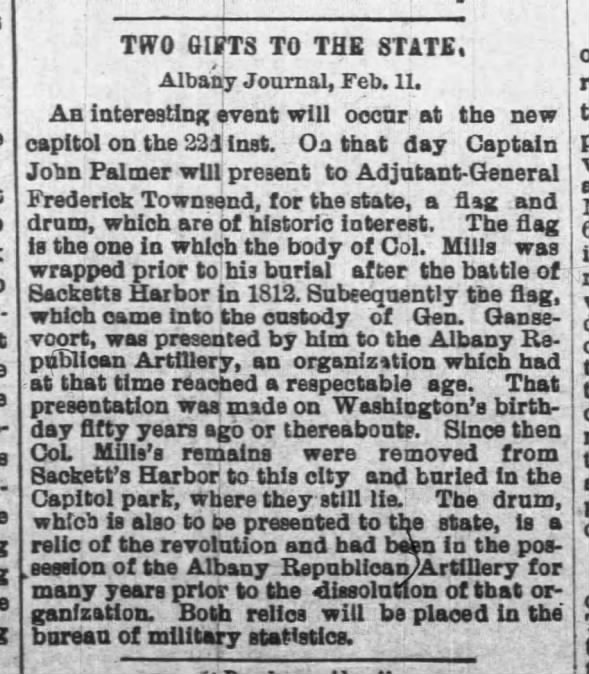
Whatever happened to the trophy-drum once possessed by Herman Melville's grandfather Peter Gansevoort (aka The Hero of Fort Stanwix) and ceremoniously bestowed by the Hero's son, Melville's Uncle Peter Gansevoort, on the Albany Republican Artillery Company? Re-gifted exactly fifty years later to the State of New York, as announced in the Albany Journal on February 11th, reprinted in the Buffalo Weekly Courier on February 15, 1882:

TWO GIFTS TO THE STATE.

Albany Journal, Feb. 11.

"An interesting event will occur at the new capitol on the 22d instant. On that day [February 22, 1882] Captain John Palmer will present to Adjutant-General Frederick Townsend, for the state, a flag and drum which are of historic interest. The flag is the one in which the body of Col. Mills was wrapped prior to his burial after the battle of Sacketts Harbor in 1812. Subsequently the flag, which came into the custody of Gen. Gansevoort, was presented by him to the Albany Republican Artillery, an organization which had at that time reached a respectable age. That presentation was made on Washington's birthday fifty years ago or thereabouts. Since then Col. Mills's remains were removed from Sackett's Harbor to this city and buried in the Capitol park, where they lie still. The drum, which is also to be presented to the state, is a relic of the revolution and had been in the possession of the Albany Republican Artillery for many years prior to the dissolution of that organization. Both relics will be placed in the bureau of military statistics."

The presentation ceremony "in the assembly chamber of the old capitol" was promptly and elaborately reported in the Albany Times for Wednesday Evening, February 22, 1882. In his lengthy public address, Captain Palmer quoted as follows from Peter Gansevoort's address to the Republican Artillery Company, fifty years before: 

"Its music was heard in those days of peril; it beat in unison with the war whoop and yell of the merciless savage on the bloody field of Oriskany--it sounded the charge and animated the courage of the enemy at Fort Stanwix;--but, it also sounded his retreat, and was taken from the enemy in the hour of his flight. To you, the successors of those brave volunteers; to the successors of Mills and Clark, who fell in battle, while gallantly resisting the invasion of a foreign foe, I present this Drum, with the hope, that it has sounded its last retreat; and that when its beat shall call the Albany Republican Artillery company to arms in the service of their country, they will inscribe on their banners the deeply rooted sentiment of the soldiers and statesmen of the revolution: 'We prefer liberty to life, and death to dishonor.' "

Later drum update, August 2022: Found it! On display at the NYS Military Museum in Saratoga Springs...

Related posts:
  • Drum update
    https://melvilliana.blogspot.com/2022/08/drum-update.html

Saturday, June 17, 2017

Daniel Webster on the Bunker Hill Monument as orator

View of Bunker Hill & Monument, June 17: 1843
via Library of Congress
Speaking in 1852 at the annual Printers' Banquet, Melville's friend Dr. John W. Francis opened by recalling what Daniel Webster famously had said about the Bunker Hill Monument:
WHEN the great defender of the Constitution delivered the oration at Bunker Hill, he pointed to the just completed monument and exclaimed, “There stands the Orator of the Day.”  --Reminiscences of Printers, Authors, and Booksellers in New-York
Dr. Francis paraphrased and condensed, making one great line out of the well-known passage in which Webster personified the Bunker Hill Monument as "itself the orator of this occasion." As reported by Richard Frothingham and painted in oil by an unknown hand, Webster dramatically gestured to his superior when he said,
"The powerful speaker stands motionless before us."
Daniel Webster, 1843 Speech at Bunker Hill Monument
via Gallery 76 Americana & Folk Art
Herman Melville made a similarly humble move when he dedicated Israel Potter to the Bunker Hill Monument:


Your Highness will pardon me, if, with the warmest ascriptions on this auspicious occasion, I take the liberty to mingle my hearty congratulations on the recurrence of the anniversary day we celebrate, wishing your Highness (though indeed your Highness be somewhat prematurely gray) many returns of the same, and that each of its summer's suns may shine as brightly on your brow as each winter snow shall lightly rest on the grave of Israel Potter.

Your Highness'
Most devoted and obsequious,
THE EDITOR.

JUNE 17th, 1854.  --Herman Melville - Israel Potter
For background and context, here is a fuller selection from Daniel Webster's 1843 Address, his second Bunker Hill oration. (The first of Webster's famous Bunker Hill Monument speeches was delivered on June 17, 1825 at laying of the corner-stone of the Bunker Hill Monument at Charlestown, Massachusetts.) The text of the 1843 speech would have been available to Melville in (for one example) the first volume of The Works of Daniel Webster (Boston, 1851).
The Bunker Hill Monument is finished. Here it stands. Fortunate in the high natural eminence on which it is placed, higher, infinitely higher in its objects and purpose, it rises over the land and over the sea; and, visible, at their homes, to three hundred thousand of the people of Massachusetts, it stands a memorial of the last, and a monitor to the present and to all succeeding generations. I have spoken of the loftiness of its purpose. If it had been without any other design than the creation of a work of art, the granite of which it is composed would have slept in its native bed. It has a purpose, and that purpose gives it its character. That purpose enrobes it with dignity and moral grandeur. That well-known purpose it is which causes us to look up to it with a feeling of awe. It is itself the orator of this occasion. It is not from my lips, it could not be from any human lips, that that strain of eloquence is this day to flow most competent to move and excite the vast multitudes around me. The powerful speaker stands motionless before us. It is a plain shaft. It bears no inscriptions, fronting to the rising sun, from which the future antiquary shall wipe the dust. Nor does the rising sun cause tones of music to issue from its summit. But at the rising of the sun, and at the setting of the sun; in the blaze of noonday, and beneath the milder effulgence of lunar light; it looks, it speaks, it acts, to the full comprehension of every American mind, and the awakening of glowing enthusiasm in every American heart. Its silent, but awful utterance; its deep pathos, as it brings to our contemplation the 17th of June, 1775, and the consequences which have resulted to us, to our country, and to the world, from the events of that day, and which we know must continue to rain influence on the destinies of mankind to the end of time; the elevation with which it raises us high above the ordinary feelings of life, surpass all that the study of the closet, or even the inspiration of genius, can produce. To-day it speaks to us. Its future auditories will be the successive generations of men, as they rise up before it and gather around it. Its speech will be of patriotism and courage; of civil and religious liberty; of free government; of the moral improvement and elevation of mankind; and of the immortal memory of those who, with heroic devotion, have sacrificed their lives for their country. 
--Daniel Webster on the Completion of the Bunker Hill Monument (June 17, 1843).
In Monumental Melville: The Formation of a Literary Career Edgar A. Dryden quotes extensively from the 1843 Address, including Daniel Webster's depiction of the monument as "orator" and "powerful speaker." In Dryden's view, Israel Potter gives Melville's "antithetical version of the national myth that not only destabilizes Webster's vision of the monument supporting the myth of the nation, but demystifies both public and literary monumentality." For the freshest discussion to date, check out John Hay's article in the June 2016 New England Quarterly, titled Broken Hearths: Melville's Israel Potter and the Bunker Hill Monument. Rightly estimating Dryden's reading as "persuasive," Hay nevertheless offers a welcome counterbalance to the constant and by now wearisome valorizing of irony in Melville criticism.