The Hendricks House edition of Melville's Pierre; or, The Ambiguities is Google-digitized and accessible online courtesy of HathiTrust Digital Library. Here below, one of three University of Michigan volumes, all reprints, currently available there.
Another copy of the 1949 Hendricks House Pierre (also a reprint, 1957) is accessible via the great Internet Archive:

Original research and riffs on Herman Melville, authorship, and nineteenth-century American literature.
Tuesday, May 14, 2019


Monday, May 13, 2019
Clams, boats, and footnotes in PIERRE
 |
| via The New York Public Library Digital Collections |
The passage quoted above occurs near the start of the last "Book" (XXVI) of Herman Melville's Pierre; or, The Ambiguities. In a footnote to this passage, the editors of the 2017 Norton Critical Edition of Pierre inform their target audience of undergraduate readers that Melville's word steamers means "Clams" (page 344).BOOK XXVI."Come, Isabel, come, Lucy; we have not had a single walk together yet. It is cold, but clear; and once out of the city, we shall find it sunny. Come: get ready now, and away for a stroll down to the wharf, and then for some of the steamers on the bay. No doubt, Lucy, you will find in the bay scenery some hints for that secret sketch you are so busily occupied with—ere real living sitters do come—and which you so devotedly work at, all alone and behind closed doors." --Pierre, Book 26
A WALK; A FOREIGN PORTRAIT; A SAIL; AND THE END.
I.
Clams or boats? Does it matter? Sometimes I think nobody really gives a flip about footnotes except me and one or two librarians in the basement annex. Not to alarm my fellow sub-subs, but it has occurred to me before now that scholarly footnotes--especially the short informative kind, as distinct from more luxurious interpretive and argumentative varieties--may already be obsolete in the era of smartphones, like print yellow pages and street-maps.
 |
| City of New York by Charles Parsons, 1856 via Library of Congress |
 |
| Cape Cod Steamers via WeNeedaVacation.com |
Indeed, Eater NY has a whole article on
- A Clam Lover's Guide to New York City by Robert Sietsema
Off the Hook in Astoria, Queens, presents pots of steamed softshell clams, known as "steamers," and so does London Lennie’s in Woodhaven, Queens.In chapter 15 of Moby-Dick, Ishmael and Queequeg enjoyed two kinds of chowder at the Try Pots on Nantucket island, one with clams. New York connoisseurs rave about the steamer clams at Pearl Oyster Bar, located at 18 Cornelia Street in Manhattan's West Village. Steamers on Cornelia get us to the right place, after all, since the unnamed "city" in Melville's Pierre is modeled on Manhattan.
Right place but wrong century I guess for steamers to mean clams. Melville's "steamers on the bay" are vessels in New York Harbor, ferry boats and ocean steamers. For context, here's a relevant description from 1853 by Cyrus Redding, writing for the London New Monthly Magazine under the pseudonym "J. W. Hengiston":
Back in Book 26 of Pierre, a detour brings Pierre, Isabel, and Lucy to an upstairs art gallery. Unfortunately, nobody mentions stopping for clams afterward. Instead, they get on a ferry boat quite like those encountered at "slips on both sides, towards the Battery" by Redding/Hengiston.
The waters are covered by their small ferry steamers, running in all directions—over to Jersey on one side, or over to Long Island on the other —while the larger ones up the Hudson, or East River, dash through the water like floating palaces, and at a speed beyond all others in the world; while to and from the Atlantic, the great ocean steamers, along their own shores or to Europe, join all the best qualities of sea-going ships to increased size and beauty of form; but it is their numbers which are still more astonishing. The waters and the wharves are alive with them; and the stir, the crowds, the cargoes, and loads, and stacks of merchandise for ever piled on the slips, loading and unloading by thousands of carts and drays, which are darting in every direction, which gives one so overwhelming an idea of the magnitude of the commerce and riches of the States—even our city, and our wharves, and our docks, are sleep and idle in the comparison. This swarming scene borders the city, on both sides, for two miles; on the East River side lie all the fine sailing ships by hundreds; on the Hudson side the steamers most; but both sides are crammed and jammed in by both sorts at every slip, so full, that the schooners, sloops, smacks, fishing-boats, &c., can often hardly find room to poke their noses in. The slips on both sides, towards the Battery, are reserved for passage steamers, and ferry ditto, canal boats, and coasting craft. It is curious to see the tug-steamers start up the Hudson with a flock of canal-boats fast to her, like a hen and chickens, for Albany, where they take the Erie canal. --J. W. Hengiston [Cyrus Redding] on "New York—Its Hotels, Waterworks, and Things in General" in The New Monthly Magazine Vol. 97 (London, 1853) page 87
In the midst of all these mental confusions they arrived at the wharf; and selecting the most inviting of the various boats which lay about them in three or four adjacent ferry-slips, and one which was bound for a half-hour's sail across the wide beauty of that glorious bay; they soon found themselves afloat and in swift gliding motion.As Henry A. Murray observed seventy years ago in one of the "Explanatory Notes" for the 1949 Hendricks House Pierre:
"It seems that Pierre and his companions are at the Battery, New York City, and have selected a Staten Island ferry boat for a ride across the harbor."
Related posts
- Missing Table of Contents
https://melvilliana.blogspot.com/2019/01/missing-table-of-contents.html
- Melville's illy
https://melvilliana.blogspot.com/2019/01/melvilles-illy.html
- Sops for hell-hounds in Pierre
https://melvilliana.blogspot.com/2020/05/sops-for-hell-hounds-in-pierre.html
- Where Pierre shot Glen Stanly
https://melvilliana.blogspot.com/2020/05/where-pierre-shot-glen-stanly.html
Monday, May 6, 2019
Gansevoort Melville, friends and foes
Here are some more extracts from Gansevoort Melville's letters to William Edward Cramer in the Augusta Melville papers, now accessible online courtesy of The New York Public Library Digital Collections. Among his friends, Gansevoort specifically commended "Mr. Nichols" as "a spirited and graceful writer & an ardent Democrat."
I had occasion to write to Mr. Croswell today in regard to the "Young Hickory Banner." It was projected and will be carried out by the same gentleman who projected & who has in the main done up all the work of the "Sober Second Thought" with which Mr. Sickles' name appears associated. The individual to whom I allude is Mr. Nichols, a spirited and graceful writer & an ardent Democrat. In editing the "Young Hickory Banner" his aim is usefulness, not profit. Pray read the Prospectus."Mr. Nichols" is Thomas Low Nichols, editor of the Young Hickory Banner. "Mr. Sickles" is Daniel Edgar Sickles, editor of the Sober Second Thought, for the Presidential Campaign of 1844.
--Letter from Gansevoort Melville to William E. Cramer, July 19, 1844
From Lockport, New York, Gansevoort instructed his friend Cramer to keep him out of Albany:
Do not let one friend add an appointment for Albany without my full previous concurrence. --Gansevoort Melville to William E. Cramer, October 9, 1844.In Herman Melville: A Biography Vol. 1, 1819-1851 (Johns Hopkins University Press, 1996) page 327, Hershel Parker attributes this request to Gansevoort's understanding of "practical Albany politics." Whatever his political motives were for staying away from Albany, Gansevoort apparently had strong personal "reasons" as well. Writing from Syracuse, Gansevoort reminded Cramer:
"Recollect - No appointment for me in Albany. I have my reasons." --Gansevoort Melville to William E. Cramer, October 12, 1844.
 |
| Gansevoort Melville to William E. Cramer - October 16, 1844 Augusta Melville papers via The New York Public Library Digital Collections |
Again -- as to the many carpers, that you say I have at Albany -- let them carp. I care not one straw for all their carping. With the blessing of God I'll yet live to be a buckler to my friends and an edged weapon to my foes. Still I would avoid obtruding myself on their attention, and therefore in the gentlest manner possible would suggest to you that it may perhaps be prudent entirely to abstain from mentioning my name in general conversation -- & even in particular conversation with your intimates male & female unless in cases where you have a special object in so doing & even then rarely. --Gansevoort Melville to William E. Cramer, October 16, 1844.Manuscripts and Archives Division, The New York Public Library. "Melville, Gansevoort" The New York Public Library Digital Collections. 1844 - 1845. http://digitalcollections.nypl.org/items/635b4bb0-4711-0136-3d52-1755ec1b20d8
Related posts:
Saturday, May 4, 2019
Allan Melville gets Gansevoort's ticket to the ball

This is one of the letters from Gansevoort Melville to William Edward Cramer in the Augusta Melville papers, now accessible online courtesy of The New York Public Library Digital Collections. I like Gansevoort's expressions "gall and wormwood" and "unmitigated dulness"; and the latinity at the end. Dated January 9, 1845 when Herman Melville (not mentioned here) was also in New York City. Seymour is Horatio Seymour. Foster is Henry Allen Foster.
New York. January 9th 1845.
Astor House. Thursday
Private & Confidential
Friend Cramer. Your letter of Saturday and Monday found me on a sick bed to which with the exception of a single interval of a couple of hours I had been confined for several days. This morning I am sitting up, but am very much debilitated and do not expect to be permitted to leave my room for some days to come. The news of Seymour's election as Speaker reached me at the same time with your letter. I was not surprised at it and from certain givings-out had anticipated the result of the contest. That result must be gall and wormwood to certain gentlemen in Albany who were active in the effort to defeat him. The majority in caucus - 5 - was small but still enough --enough for Seymour-- but not enough to place another Oneida man --Foster-- out of danger.
The Tammany ball last night went off with a good deal of eclat, as I understand from Allan, who (I being unable to attend) had the benefit of my ticket. In case I hear of any opening of the kind you mention I will inform you at once, in compliance with your request--but I do not think it probable that things of that kind of a desirable character are apt to turn up without being sought.
The little that I have written has been with some effort--excuse its unmitigated dulness and pray enliven my sick chamber with a daily epistle de omnibus rebus et multis aliis.
Yours Truly
Gansevoort Melville
Peter A. Cowdrey late Corporation Counsel is another applicant for the anticipated vacancy on the bench of the Circuit Court. He is a respectable man and a lawyer of fair standing.Manuscripts and Archives Division, The New York Public Library. "Melville, Gansevoort" The New York Public Library Digital Collections. 1844 - 1845. http://digitalcollections.nypl.org/items/58ffefc0-5c82-0136-14dd-194ba775773e
 |
| Astor House, Broadway, 1867 via The New York Public Library Digital Collections |
Thursday, May 2, 2019
Augusta Melville papers, digitized
 |
| Business sign for Allan Melvill (Herman Melville's father) via NYPL Digital Collections |
- NYPL catalog ID (B-number): b21572615
- MSS Unit ID: 24415
- Archives collections id: archives_collections_24415
- Universal Unique Identifier (UUID): ed569050-41b1-0136-a355-75fa5fcadf17
- https://digitalcollections.nypl.org/collections/augusta-melville-papers
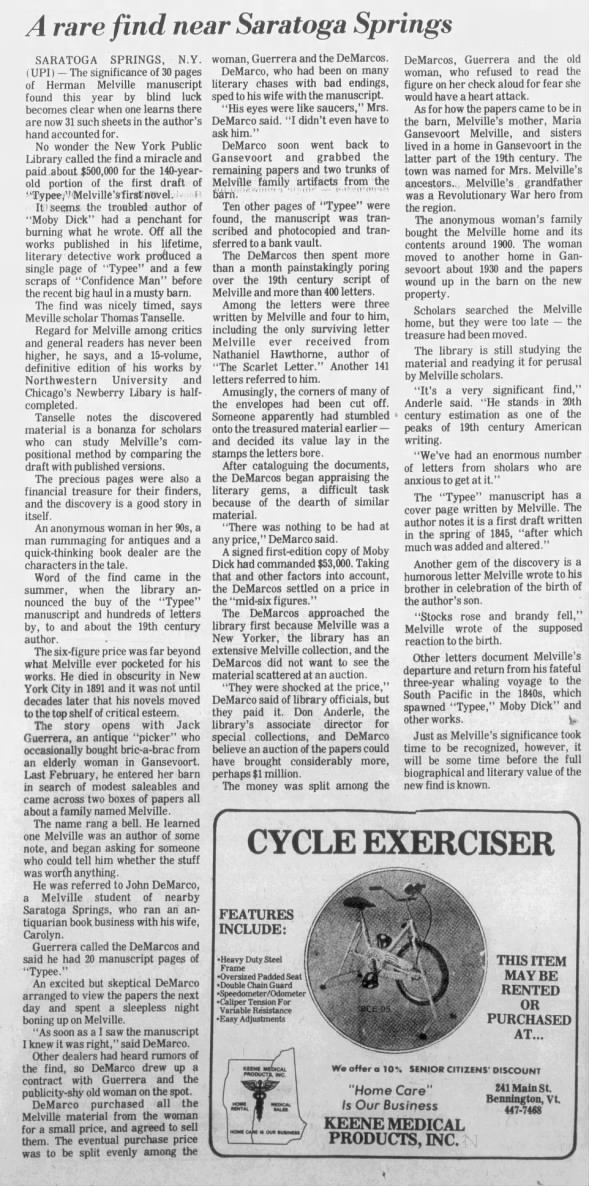 Sat, Nov 5, 1983 – 7 · Bennington Banner (Bennington, Vermont) · Newspapers.com
Friday, April 26, 2019
Boston lecture on The South Seas, advertised as "South Sea Adventures"
Found at GenealogyBank among items added "within 1 week":
 |
| Boston Courier - January 31, 1859 |
MECHANIC APPRENTICES' LECTURES.
The Ninth Lecture of this course will be delivered
in TREMONT TEMPLE, MONDAY EVENING, Jan. 31st, by
HERMAN MELVILLE, Esq., of Pittsfield.
Subject--"South Sea Adventures."
Single tickets 25 cents each, for sale at the door.
Doors open at 6 1/2 o'clock. Lecture commences at 7 1/2 o'clock.
SYLVANUS COBB, Jr. delivers the tenth lecture.Reviewed the next day in the Boston Traveler:
 |
| Boston Daily Traveler - February 1, 1859 |
MECHANIC APPRENTICES' LECTURES.--The ninth lecture of the Mechanic Apprentices' course was delivered last evening by Herman Melville, Esq., of Pittsfield. He announced as his subject "The South Seas," and commenced by giving an extended account of the origin of the name, South Seas, which was but another name for the Pacific. He felt, in lecturing upon the South Seas, like one embarking on an exploring expedition. He might confine his lecture to the fish of those seas--the sword-fish, unlike the fish of that name in our waters, after stabbing vessels and leaving his sword broken off in the ship, or at other times withdrawing it, leaving an open wound, to the infinite terror of the seamen--the devil-fish--or he might occupy whole hours about the birds, or the whaling voyages of those seas or the Polynesian Islands.Fuller reconstructions of Melville's South Seas lecture are available in Melville as Lecturer by Merton M. Sealts, Jr.; and the Northwestern-Newberrry Edition of The Piazza Tales and Other Prose Pieces, 1839-1860.
The lecturer dwelt at some length upon the great beauty of these, in many respects, superior to any yet discovered in the world. He wondered why Englishmen, who went yachting in various waters in Europe, did not sail among the Polynesian islands of the South Seas. He then went on to speak of the vast extent of the Pacific, covering, it was estimated, over a hundred millions of square miles, and said that the modern explorations had not dispelled the mystery which had hung about it. Various matters connected with his own experience in those waters were given, and the lecture abounded with numerous anecdotes and facts of great interest.
The hall was not more than half full. It was announced that Sylvanus Cobb, Esq., would deliver the next lecture.
Related posts:
Wednesday, April 24, 2019
The Later Season in Harper's Bazar, June 1870
By George William Curtis?
We know Herman Melville went to Washington in March 1861, seeking a diplomatic appointment. In May 1870 Melville was working six days a week in the New York Custom House--and getting his portrait painted by Joel Oriel Eaton, as Hershel Parker relates in Herman Melville: A Biography Vol. 2, 1851-1891 (Johns Hopkins University Press, 2002), pages 702-704. Though Melville never visited the U. S. capital that "garden month of May," he could have read about it in the June 25, 1870 issue of Harper's Bazar. In "The Later Season," if he did happen to see it, Melville the poet might have found hints for some of the floral prose and verse we find in the posthumously published collection, Weeds & Wildings, with a Rose or Two. And Clarel (1876), then Melville's work in progress.
In any case, George W. Curtis definitely liked to spice his own writing with allusive bits from Melville's. For example, references to Bartleby in Prue and I (and earlier, Sea from Shore in Putnam's for July 1854). Before 1895, Google Books and HathiTrust Digital Library give only two hits in searches for "infinite blueness": describing sky in "The Later Season," and sea in Moby-Dick, Chapter 134, The Chase — Second Day.
I'm not sure Melville or anybody could better this riff on roses:

For further reading:
 |
| Geo Wm Curtis Brady-Handy photograph collection, Library of Congress, Prints and Photographs Division. |
In any case, George W. Curtis definitely liked to spice his own writing with allusive bits from Melville's. For example, references to Bartleby in Prue and I (and earlier, Sea from Shore in Putnam's for July 1854). Before 1895, Google Books and HathiTrust Digital Library give only two hits in searches for "infinite blueness": describing sky in "The Later Season," and sea in Moby-Dick, Chapter 134, The Chase — Second Day.
I'm not sure Melville or anybody could better this riff on roses:
| Harper's Bazar - June 25, 1870 |
... But till boulevards and fountains come, and if they never come, every spring-time the roses will; will bud and bloom and hang their heavy heads—such roses as do not grow out of Paestum; roses that Sappho and that Hafiz Sang of, as the poets' dream; roses fit to crown Anacreon; deep red roses that seem to burn in the sun; delicate tea-roses with a petal like some perfect cheek; damask and blush and moss roses, the queenly Lamarque, the tiny, faultless Scotch, the pungent sweet-brier; roses that are almost black, so purply crimson is their richness; roses that are spotless white, all of them, without speck, long-stemmed, in generous clusters—and all making the air about them an intoxication of delicious odor. For one brief month it is politics and power set down in paradise; and sometimes as strangely out of place as the serpent there."The Later Season" is unsigned, as customary in Harper's Bazar:
The Harpers have an objection to crediting articles in their periodical publications to their authors, as is the custom with Fields, Osgood & Co., and it is a principle with them that the contributor should be subordinated to the publication. I cannot therefore furnish you with a full list of the writers for either the Bazar or Weekly, but most of them are persons already known to the public. --Springfield Republican (Springfield, MA), April 6, 1870.Here is the complete article, transcribed from Harper's Bazar for June 25, 1870:
THE LATER SEASON.
IT is a singular circumstance that nearly all the pleasure-seekers at the National Capital should make their resort thither in the chilly winter days, and never in the spring-time—the springtime, which there is something out of the land of dreams. In the winter the climate of the place is often, if not so keenly cold as the more northern climate, yet much more penetratingly so, with a disagreeable dampness in addition that brings about a hundred rheumatic aches and ails; and so high do the winds blow that, at the beginning of a storm, clouds of dust frequently rise to meet the clouds of snow that descend, already mud, upon your sleeve. But in the spring a delightful balm seems to fall upon the air and fill it; soft showers cool any fervent heat of the Sun, and keep the sod and sward as green as “freshly broken emeralds;” the sky seems to soar away in its infinite blueness with a life of its own; and the sunbeams pour over dome and obelisk and pillared lines of marble till they shine with dazzling lustre through their light screens of waving greenery, hardly developed into summer lushness yet, until one, experiencing an hour of all this, must needs declare the month of May in Washington to be all that ought to be demanded, either for the pride of the eye or the delight of the flesh.
It is probable that the wintry throngs are drawn to Washington largely—outside of the purely political gathering—in view of the ball-room gayeties before Lent; but the gayeties after Easter are quite as attractive—if one did but know it. There is quite as much opportunity of admiring and of displaying lovely faces and toilettes, and many of the enjoyments are of a healthier order both for body and soul, requiring the rounds of no physician with his poison bottles to sting into one the life and strength thrown away in the reckless abandonment of midnight revel.
For the tournaments of fashion during this later season, which follows with every long session of Congress, the reception of the President's wife presents a perfect Field of the Cloth of Gold, and all the rank and grace and beauty of the town, arrayed in purple and fine linen, adorn the scene—a scene more interesting and satisfying to behold than any of the winter receptions, as the thick velvets and silks, which give such sameness and heaviness to any large assembly, being discarded now, the lighter and airier fabrics are found floating round maid and matron, tissues capable of being transformed into various guises, each more delicate and exquisite than the other, and all giving the effect of works of art in their combinations of lace and net and flowers and jewelry, like cobwebs strung with dew, and all to be seen in rooms full of sunshine, whose open windows, letting in the outside fragrance, and songs of birds, and glimpses of charming landscape, add a lustre to every thing that neither the glow of wax-light nor the glare of gas can ever shadow forth; while, so long as the session lasts, as the corps of correspondents, the diplomats, and aids-de-camp linger, there are sure to be enough carpet knights to brighten or darken the picture according to its exigencies and their uniform.
Then, between the receptions and the few evening parties prized now for their rarity, and always made rich and rare to compensate for their lateness, as the popular prejudice runs, there come the riding-parties to the Falls, where fine equestrianship may do its best, and last night's Sylph be to-day's Amazon; the moonlit boating where the Potomac narrows between steep and romantic banks of a sylvan wildness; picnics to Rock Creek, a region of fabulous beauty, where the woods abound in blossoms, the purple lupine and the pink azalea, and the great white dogwood boughs stretch away into the darkness like a press of moonbeams; and excursions down the river to Mount Vernon, among its blooming magnolias and rosy Judas-trees, where the great tomb stands open to irreverent eyes, and where, with their mementoes, with Eleanor Custis's harpsichord, and the wonderful mantle-piece of carved Siena marble, the quaint old rooms and their verandas invite the guest, and the garden shelters wandering lovers, who tread down the wild hyacinths in the grass, between its breast-high hedges of spicy box. All day, too, the halls of Congress are open, with the drama there growing livelier as the adjournment draws nearer; and every evening the drives are thronged with splendid equipages winding down the Fourteenth Street way, out by the Soldiers' Home, across the Long Bridge into Virginia, or up the Anacostia branch and the wild hill roads, where wide stretching views open between the forest trees at every turn, and where sometimes one sees, with its two rivers, one red and turbid, one shining like silver, the city lying far away, much of its outline gone, and the color of its baked brick and stone and marble mellowed in the distance, till through the quivering air and amidst all its embowering trees it looks only and exactly like a vision of ancient temples in the midst of gardens of flowers.
Twice a week, too, the Marine Band blows out stirring music in the President's Grounds, and in the Capitol Park late in the afternoon; and it is a point of gentility for every one then to promenade in gala attire beneath the trees and over the shady slopes of the pleasant grounds till the music ceases in twilight; and many a long-delaying love affair, kindled beneath the winter lamps, culminates then as the stars come out and the perfumed wind casts down great shadows from the swinging branches overhead, and indulgent dowagers gossip on oblivious of decorum, dew, and mortal aches, since they have been there themselves. Finally, the festivities of this almost ideal spring season, where the world of fashion and the world of nature meet at their best, come to an end with Decoration day—the last day ere the spring brightens into the blaze of summer—a day that robs death of its terrors, and seems to carry one back to that primeval period when the old death-defying Egyptians made their festival with flowers, as we stand in that desolation of the dead on the heights of Arlington, and see the billows of graves stretching away to the horizon, wave after wave, crested with the line of white headstones, and every mound heaped with flowers that have been scattered to the tune of singing children's voices; while, below, the peaceful river floats out broadly, and far across its stream, over all the terraces whose turf was lately purple with violets, and above the tossing tree-tops that hide the arched and columned bases of its snowy splendor, the dome of the country's Capitol rises—a shining guardian of the slumbers of the dead.
And meantime the squares, the triangles, the gardens of the city are all a miracle of verdure, of spotless deutzia and golden laburnum, honeysuckle and Cape jasmine; half the houses are draped in ivy and in grape-vines; the Smithsonian grounds surround their dark and castellated group of buildings in a wilderness of bloom and leaf; Lafayette Square and the Capitol Park are dense and shadowy; and even the market-sheds are picturesque at night with a hundred torches flaring in the wind over the heads of mules and donkeys, of vendors and higglers, piles of crisp salads and heaps of strawberries. And since the place is so beautiful now, with its enormous tent of sky, one is lost in imagining what it may become when all the great avenues have been boulevarded with double rows of trees, and, the old love of and belief in the town returning to the people the country over, each one in all the land shall have given pennies more or less to plant the place with fountains, and the Potomac itself shall pause upon its seaward flight to shoot a hundred crystal columns in the air, setting their changing, shimmering shapes amidst the sculptured colonnades and façades of Treasury and Patent and Post offices and their embosoming trees. But till boulevards and fountains come, and if they never come, every spring-time the roses will; will bud and bloom and hang their heavy heads—such roses as do not grow out of Paestum; roses that Sappho and that Hafiz Sang of, as the poets' dream; roses fit to crown Anacreon; deep red roses that seem to burn in the sun; delicate tea-roses with a petal like some perfect cheek; damask and blush and moss roses, the queenly Lamarque, the tiny, faultless Scotch, the pungent sweet-brier; roses that are almost black, so purply crimson is their richness; roses that are spotless white, all of them, without speck, long-stemmed, in generous clusters—and all making the air about them an intoxication of delicious odor. For one brief month it is politics and power set down in paradise; and sometimes as strangely out of place as the serpent there. But let who will make holiday in Washington for the sake of the garish early season of January, the wise one, whom chance has ever given a glimpse of the other, will wait for the later season there and the garden month of May.The June 4, 1870 issue of Harper's Bazar (so, three weeks before publication of "The Later Season" in the same volume) contains one explicit reference to Melville and Moby-Dick in "Manners upon the Road: A Spring Travel," written by George William Curtis in the guise of "An Old Bachelor."
Some morning I throw open the blinds and put out my head to smell an apple blossom—for I am sure that 'twas only yesterday that what Herman Melville, in “Moby Dick,” would have called a perfumed whiteness lay lightly on all the orchards as we passed; and behold! instead of a lovely flower, here is a solid, straw-colored Porter apple.The apple-blossom "whiteness" pictured by Curtis verbally evokes Melville's chapter on The Whiteness of the Whale. In Moby-Dick, however, "perfumed" only occurs once, in Chapter 29, Enter Ahab; to Him, Stubb. In a string of adjectives, "perfumed" there describes deliciously mild days at sea, compared to
"Persian sherbet, heaped up—flaked up, with rose-water snow."
 |
| Black Cherry Rose Water Sherbet via Olive to Eat |
- "George William Curtis" in Appleton's Journal Vol. 10, No. 34 (September 13, 1873), pages 321-2:
In addition to "The Easy Chair" and the political editorials in the Weekly, Mr. Curtis is the author of the charming series of papers in Harper's Bazar entitled "Manners upon the Road," in which, under the signature of" An Old Bachelor," he treats principally social topics of current interest. These articles were commenced in the first number of the Bazar, in January, 1868, and were continued weekly until he was obliged, as stated above, temporarily to lay aside his pen. They exhibit the same traits of versatile thought, graces of style, and refined culture, which characterize the "Easy Chair." (322)
- Edward Cary, George William Curtis. Google-digitzed volumes are also accessible courtesy of HathiTrust Digital Library.
- Richard Bridgman, Melville's Roses in Texas Studies in Literature and LanguageVol. 8, No. 2 (Summer 1966), pp. 235-244. <https://www.jstor.org/stable/40753898>
- Billy Budd, Sailor and Other Uncompleted Writings, ed. Harrison Hayford, Alma A. MacDougall, Robert A. Sandberg, and G. Thomas Tanselle; Historical Note by Hershel Parker. Northwestern University Press, 2017.
Subscribe to:
Posts (Atom)