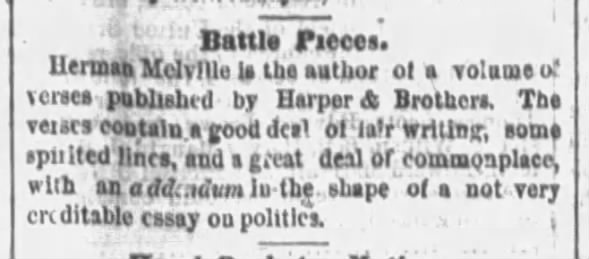
Herman Melville is the author of a volume of verses published by Harper & Brothers. The verses contain a good deal of fair writing, some spirited lines, and a great deal of commonplace, with an addendum in the shape of a not very creditable essay on politics.
Untitled and unsigned, this poem appeared in the Troy Sentinel on February 20, 1824, almost two months after the anonymous first printing of Moore's "Account of A Visit from St. Nicholas" on December 23, 1823. The two poems may have been composed around the same time. There was in fact a snowstorm in New York City on Saturday, December 21, 1822, a few days before Christmas. The speaker in both poems is a father with his "children" nearby (asleep in "Visit" while sugarplum visions "danc'd in their heads"; awake in "Lines" while snowflakes "dance upon the air"). Significant verbal parallels with "Visit" include the shared beds/heads
rhyme, the simile with the trigram "as the snow," as well as forms of the words children, dance, vision, and winter's. Presumably the person or persons (Harriet Butler and Sarah Sackett, according to different reports) who furnished editor Orville L. Holley with a copy of Moore's "Visit from St. Nicholas" also provided Moore's lovely little snow poem. In the 1844 volume Poems by Clement C. Moore it appears on pages 80-82 under the title, "Lines / Written after a Snow-Storm."
Come dearest children look around,
And see how soft and light
The silent snow has clad the ground,
In robes of purest white.
The trees are deck'd by fairy hands,
Nor need their native green;
And every breeze now seems to stand,
All hush'd, to view the scene.
You wonder how these snows were made
That dance upon the air;
As if from purer worlds they stray'd,
So lovely and so fair.
Perhaps they are the summer flowers,
In northern stars that bloom;
Wafted away from ivy bowers,
To cheer our winter's gloom.
Perhaps they are feathers of a race
Of birds, that live away
In some cold wintry place,
Far from the sun's warm ray.
And clouds perhaps are downy beds,
On which the winds repose;
Who, when they move their slumbering heads,
Shake down the feathery snows.
But see, my dearlings, while we stay
And gaze with such delight,
The fairy scene now fades away,
And mocks our raptur'd sight.
And let this fleeting vision teach
A truth you soon must know —
That all the joys we here can reach,
Are transient as the snow.
New York Evening Post - December 23, 1822
via GenealogyBank
Numerous corrections and changes were made in revision of this poem for publication in Moore's 1844 Poems. My favorite example is "ivy bowers" in the 1824 printing, corrected by Moore to "icy bowers" in the later book version. The copyist's or printer's error of "ivy" for "icy" nicely illustrates why "original" printings, including first printings in newspapers, do not necessarily offer the most accurate and reliable textual readings. Here's the 1824 version again, but this time with 1844 changes shown in brackets:
Come dearest children [1844: children dear, and] look around, [1844: semicolon],
And see [1844: Behold] how soft and light
The silent snow has clad the ground, [1844: end comma deleted]
In robes of purest white.
The trees are [1844: seem] deck'd by fairy hands [1844: hand],
Nor need their native green;
And every breeze now seems [1844: now appears] to stand,
All hush'd, to view the scene.
You wonder how these [1844: the] snows were made
That dance upon the air; [1844: end comma]
As if from purer worlds they stray'd,
So lovely [1844: lightly] and so fair.
Perhaps they are the summer flowers, [1844: end comma deleted]
In northern stars that bloom; [1844: end comma]
Wafted away from ivy bowers [1844: icy bowers], [1844: end comma deleted]
To cheer our winter's gloom.
Perhaps they are [1844: they're] feathers of a race
Of birds, [1844: comma deleted] that live away,
In some cold wintry place, [1844: cold dreary wintry place,]
Far from the sun's warm ray.
And clouds perhaps are downy beds, [1844: And clouds, perhaps, are downy beds]
On which the winds repose;
Who, when they move [1844: rouse] their slumbering heads [1844: slumb'ring heads],
Shake down the feathery [1844: feath'ry] snows.
But see, my dearlings [1844: darlings], while we stay
And gaze with such [1844: fond] delight,
The fairy scene now [1844: soon] fades away,
And mocks our raptur'd sight.
And let this fleeting vision teach
A truth you soon must know —
That all the joys we here can reach, [1844: end comma deleted]
Are transient as the snow.
And here's the book version that appears in Moore's 1844 Poems:
1844 version, transcribed below:
LINES
WRITTEN AFTER A SNOW-STORM.
COME children dear, and look around;
Behold how soft and light
The silent snow has clad the ground
In robes of purest white.
The trees seem deck'd by fairy hand,
Nor need their native green;
And every breeze appears to stand,
All hush'd, to view the scene.
You wonder how the snows were made
That dance upon the air,
As if from purer worlds they stray'd,
So lightly and so fair.
Perhaps they are the summer flowers
In northern stars that bloom,
Wafted away from icy bowers
To cheer our winter's gloom.
Perhaps they're feathers of a race
Of birds that live away,
In some cold dreary wintry place,
Far from the sun's warm ray.
And clouds, perhaps, are downy beds
On which the winds repose;
Who, when they rouse their slumb'ring heads,
Shake down the feath'ry snows.
But see, my darlings, while we stay
And gaze with fond delight,
The fairy scene soon fades away,
And mocks our raptur'd sight.
And let this fleeting vision teach
A truth you soon must know —
That all the joys we here can reach
Are transient as the snow.
We know not to whom we are indebted for the following description of that unwearied patron of children—that homely, but delightful personification of parental kindness—SANTE CLAUS, his costume and his equipage, as he goes about visiting the fire-sides of this happy land, laden with Christmas bounties; but, from whomsoever it may have come, we give thanks for it. There is, to our apprehension, a spirit of cordial goodness in it, a playfulness of fancy, and a benevolent alacrity to enter into the feelings and promote the simple pleasures of children, which are altogether charming. We hope our little patrons, both lads and lasses, will accept it as proof of our unfeigned good will toward them—as a token of our warmest wish that they may have many a merry Christmas; that they may long retain their beautiful relish for those unbought, homebred joys, which derive their flavor from filial piety and fraternal love, and which they may be assured are the least alloyed that time can furnish them; and that they may never part with that simplicity of character, which is their own fairest ornament, and for the sake of which they have been pronounced, by authority which none can gainsay, the types of such as shall inherit the kingdom of heaven.
For the Sentinel.
ACCOUNT OF A VISIT FROM ST. NICHOLAS.
’Twas the night before Christmas, when all thro’ the house,
Not a creature was stirring, not even a mouse;
The stockings were hung by the chimney with care,
In hopes that St. Nicholas soon would be there;
The children were nestled all snug in their beds,
While visions of sugar plums danc’d in their heads,
And Mama in her ’kerchief, and I in my cap,
Had just settled our brains for a long winter’s nap—
When out on the lawn there arose such a clatter,
I sprung from the bed to see what was the matter,
Away to the window I flew like a flash,
Tore open the shutters, and threw up the sash.
The moon on the breast of the new fallen snow,
Gave the lustre of mid-day to objects below;
When, what to my wondering eyes should appear,
But a miniature sleigh, and eight tiny rein-deer,
With a little old driver, so lively and quick,
I knew in a moment it must be St. Nick.
More rapid than eagles his coursers they came,
And he whistled, and shouted, and call’d them by name:
“Now! Dasher, now! Dancer, now! Prancer, and Vixen,
“On! Comet, on! Cupid, on! Dunder and Blixem;
“To the top of the porch! to the top of the wall!
“Now dash away! dash away! dash away all!”
As dry leaves before the wild hurricane fly,
When they meet with an obstacle, mount to the sky;
So up to the house-top the coursers they flew,
With the sleigh full of Toys—and St. Nicholas too:
And then in a twinkling, I heard on the roof
The prancing and pawing of each little hoof.
As I drew in my head, and was turning around,
Down the chimney St. Nicholas came with a bound:
He was dress’d all in fur, from his head to his foot,
And his clothes were all tarnish’d with ashes and soot;
A bundle of toys was flung on his back,
And he look’d like a peddler just opening his pack:
His eyes—how they twinkled! his dimples how merry,
His cheeks were like roses, his nose like a cherry;
His droll little mouth was drawn up like a bow,
And the beard of his chin was as white as the snow;
The stump of a pipe he held tight in his teeth,
And the smoke it encircled his head like a wreath.
He had a broad face, and a little round belly
That shook when he laugh’d, like a bowl full of jelly:
He was chubby and plump, a right jolly old elf,
And I laugh’d when I saw him in spite of myself;
A wink of his eye and a twist of his head
Soon gave me to know I had nothing to dread.
He spoke not a word, but went straight to his work,
And fill’d all the stockings; then turn’d with a jirk,
And laying his finger aside of his nose
And giving a nod, up the chimney he rose.
He sprung to his sleigh, to his team gave a whistle,
And away they all flew like the down of a thistle:
But I heard him exclaim, ere he drove out of sight—
Happy Christmas to all, and to all a good night.
When the Sentinel reprinted the Christmas piece in 1829, editor Orville L. Holley knew who wrote it. Holley described its previously unidentified author as a modest "scholar" and "writer" who was a native and resident of New York City. Holley's 1829 remarks, also accessible now via NYS Historic Newspapers, allude to the poet and seminary professor Clement C. Moore. Playfully emphasizing the word more, Holley puns on the surname of the unnamed but not unknown author:
Santa Claus.--A few days since, the Editors of the N. Y. Courier,
at the request of a lady, inserted some lines descriptive of one of the
Christmas visits of that good old Dutch saint, St. Nicholas, and at the
same time applied to our Albany neighbors for information as to the
author. That information, we apprehend, the Albany editors cannot give.
The lines were first published in this paper. They came to us
from a manuscript copy in possession of a lady in this city. We have
been given to understand that the author of them belongs, by birth and
residence, to the city of New York, and that he is a gentleman of more
merit as a scholar and a writer than many of more noisy pretensions. We
republish the lines in a preceding column, just as they originally
appeared, because we still think of them as at first, and for the
satisfaction of our brethren of the Courier, one of whom, at least, is
an Arcadian.
In the Troy Library copy, the printed text of "A Visit from St. Nicholas" on page 2 is gone; somebody carefully clipped the poem from this issue (January 20, 1829) of the Troy Sentinel.
As Holley later revealed in print, he actually learned who wrote "The Night Before Christmas" only a few months (not years) after its first publication in the Troy Sentinel. Holley's 1836 comments are transcribed below from the Ontario Repository and Freeman which he then edited in Canandaigua, New York:
SANTA CLAUS, WITH HIS CHRISTMAS GIFTS.
The following lines appeared in print for the first time—though
very often copied since—in the Troy Sentinel of December 23, 1823, which
paper we then conducted. They were introduced, on that occasion, with
the following remarks; which, as they continue to be a true expression
of our opinion of the charming simplicity and cordiality of the lines,
as well as of our unchanged feelings toward the little people to whom
they are addressed, we repeat them, only observing that although when we
first published them, we did not know who wrote them, yet, not many
months afterwards we learnt that they came from the pen of a most
accomplished scholar and and estimable man, a professor in one of our
colleges....
--found at NYS Historic Newspapers. This item was reprinted the following week in the Auburn Journal and Advertiser onWednesday, January 4, 1837.
In 1837, Moore submitted four poems for publication in The New-York Book of Poetry, including "A Visit from St. Nicholas." Two 1840 anthologies of American poetry also credit Moore as the author of "A Visit from St. Nicholas":
The Poets of America, edited by John Keese, credits "C. C. Moore" with authorship of "A Visit form St. Nicholas."
Selections from the American Poets, edited by William Cullen Bryant, reprints "A Visit from St Nicholas" under the name of "Clement C. Moore."
After a mistaken attribution to Joseph Wood was printed in the Washington National Intelligencer, Moore contacted Norman Tuttle, former publisher of the defunct Troy Sentinel. Only Tuttle's reply is extant (because Moore and his family saved it). As Seth Kaller notes,
Moore, evidently prompted by the false attribution recently published in the influential National Intelligencer, must have asked Tuttle about the circumstances of the poem's first publication in Troy. Presumably Moore wondered if Wood or anyone else had ever claimed authorship. Norman Tuttle's reply to Clement Clarke Moore is dated February 26, 1844 (Museum of the City of New York. 54.331.17b). Tuttle states he eventually learned of Moore's authorship and does not mention any other claim. Possibly without waiting to hear back from Tuttle, Moore then directly and unambiguously asserted his claim to authorship in a published letter to the editor of The New York American. Re-asserted, rather, considering Moore's prior submission of "A Visit from St. Nicholas" aka The Night Before Christmas with three other poems for publication in the 1837 New-York Book of Poetry. Dated February 27, 1844, Moore's letter to Charles King appeared in the American on March 1, 1844.
Clement C. Moore on the authorship of "A Visit from St. Nicholas"
New York American, March 1, 1844
LINES TO ST. NICHOLAS.--The following note from our friend C. C. Moore,
the author of those lines which every child among us delights to hear,
about Christmas, and which parents with not less delight recite, brings
to our notice, one of the boldest acts of plagiarism of which we have
any recollection. We ask the National Intelligencer to have the goodness
to insert Mr. Moore's note--and if possible to elucidate the mistake,
if such it be, or fraud attempted in respect of such well known lines.
New York, Feb. 27, 1844
Dear Sir--My attention was, a few days ago, directed to the following
communication, which appears in the National Intelligencer of the 25th
of December last.
"Washington, Dec. 22d, 1843.
Gentlemen--
The enclosed lines were written by Joseph Wood, artist, for the National
Intelligencer, and published in that paper in 1827 or 1828, as you may
perceive from your files. By republishing them, as the composition of
Mr. Wood you will gratify one who has now few sources of pleasure left.
Perhaps you may comply with this request, if it be only for 'auld lang
syne.'"
The above is printed immediately over some lines, describing a visit
from St. Nicholas, which I wrote many years ago, I think somewhere
between 1823 and 1824, not for publication, but to amuse my children.
They, however, found their way, to my great surprise, in the Troy
Sentinel: nor did I know, until lately, how they got there. When "The
New York Book" was about to be published, I was applied to for some
contribution to the work. Accordingly, I gave the publisher several
pieces, among which was the "Visit from St. Nicholas." It was printed
under my name, and has frequently since been republished, in your paper
among others, with my name attached to it.
Under these circumstances, I feel it incumbent on me not to remain
silent, while so bold a claim, as the above quoted, is laid to my
literary property, however small the intrinsic value of that property
may be.
Moore graciously made handwritten copies of the poem for admirers. Four "unquestionably authentic" copies of "A Visit from St. Nicholas" in Moore's distinctive hand are known to exist still, according to Seth Kaller. One surviving manuscript copy at The New-York Historical Society is accompanied by a key witness letter
(from a cousin of Henry Livingston, Jr.) dated March 15, 1862, strongly affirming Clement C. Moore's authorship, and providing a brief explanation of how his poem got to Troy in the first place. Addressed to the
Librarian of the Historical Society, the letter from T. W. C. Moore was first published in The New York Historical Society Quarterly Bulletin 2.4 (January 1919) pages 111-115. Digitized volumes, accessible online:
"The tortoise is both black and bright," but one notes for what it is worth the entertaining implication that the bright side is not the right side; to see it you have to turn your tortoise upside down, and to maintain it you must keep him upside down.
<https://www.jstor.org/stable/304437>
Sketch First of The Encantadas, or Enchanted Isles
in Putnam's Monthly Magazine, March 1854
1856 book version of "The Encantadas" can be found in
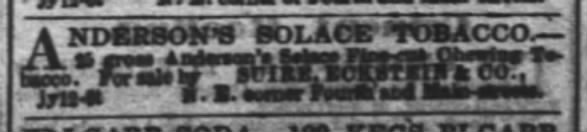
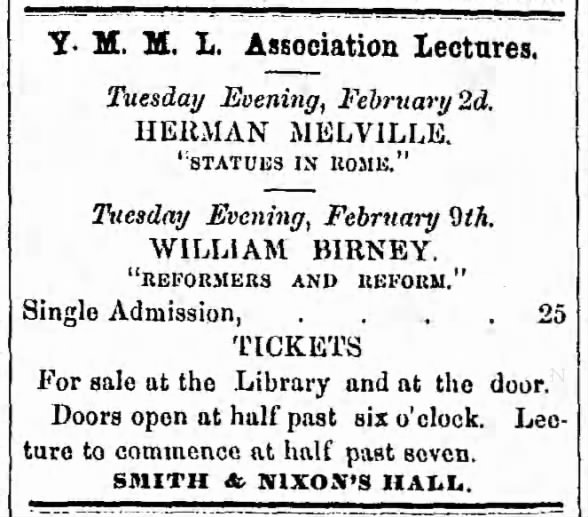
Chewing tobacco, the brand Herman Melville bought for 10 cents in Louisville, Kentucky. Melville was on the way to Cincinnati, Ohio where he lectured on Statues in Rome (February 2, 1858 in Smith and Nixon's Hall) for the Young Men's Mercantile Library Association.
The entry "Solace — (Anderson's) 10" appears in Melville's Memoranda of Travel Expenses 1857-58, as transcribed by Merton M. Sealts, Jr. in Melville as Lecturer (Harvard University Press, 1957), page 192.

 Mon, Oct 15, 1866 – 2 · The Brooklyn Union (Brooklyn, New York) · Newspapers.com