Sunday, April 8, 2018

521 matches

Restricting searches for "Herman Melville" on Newspapers.com to the period of his lifetime, and only for items "added in the past month" yields today:

521 matches

added in the past month×
1819 - 1891×
"herman melville"
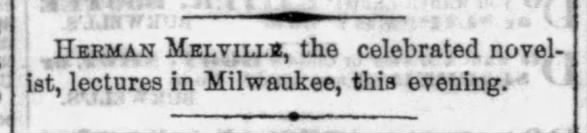
A great many of the 521 mentions appear in booksellers' ads. Not all though: here's one promoting Melville's lecture on The South Seas, from the Wisconsin State Journal of February 25, 1859:
HERMAN MELVILLE, the celebrated novelist, lectures in Milwaukee, this evening.
· Fri, Feb 25, 1859 – 2 · Wisconsin State Journal (Madison, Wisconsin) · Newspapers.com

Many of the recently added archives are British including images from London newspapers
  • The Examiner
  • The Morning Chronicle
  • The Morning Post
  • The Pall Mall Gazette
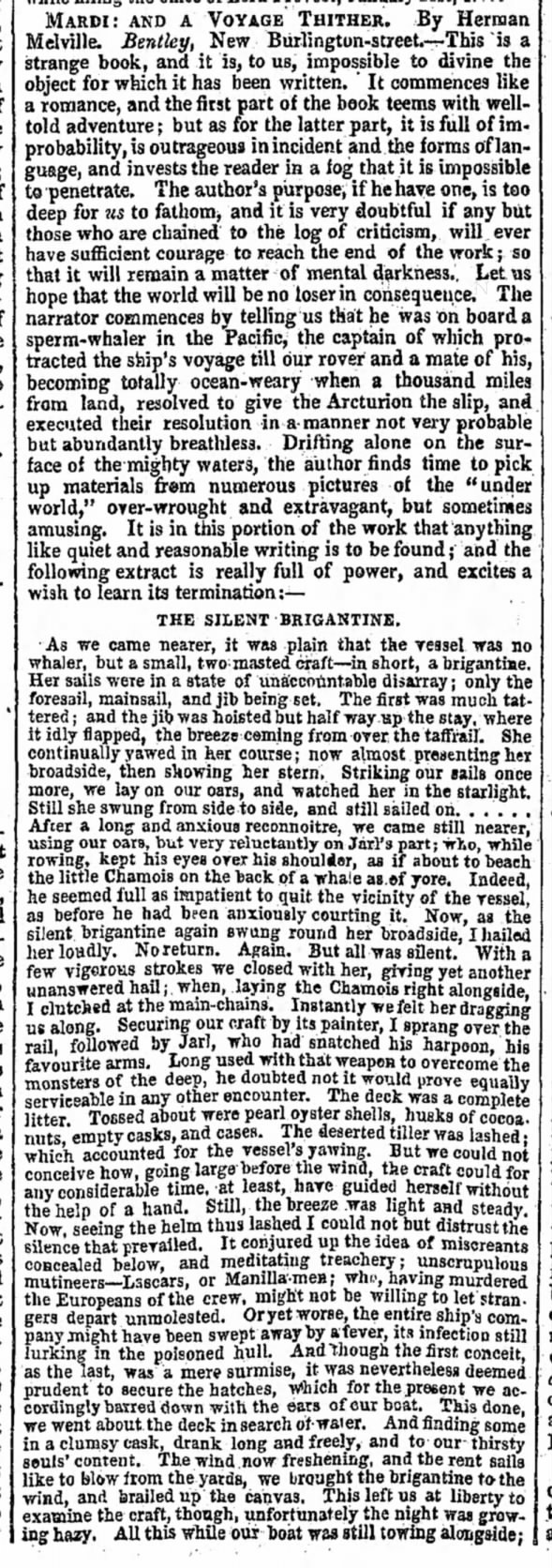
Herman Melville: The Contemporary Reviews, edited by Brian Higgins and Hershel Parker (Cambridge University Press, 1995; and 2009 in paperback) has the major British reviews. Not in Contemporary Reviews: the notice of Mardi in Lloyd's Weekly Newspaper on April 1, 1849. The notice in Lloyd's Weekly closely paraphrases the earlier, longer review of Melville's Mardi published in the London Athenaeum on March 24, 1849. The extract from Mardi in Lloyd's Weekly is the same one offered in The Athenaeum.

· Sun, Apr 1, 1849 – 8 · Lloyd's Weekly Newspaper (London, Greater London, England) · Newspapers.com

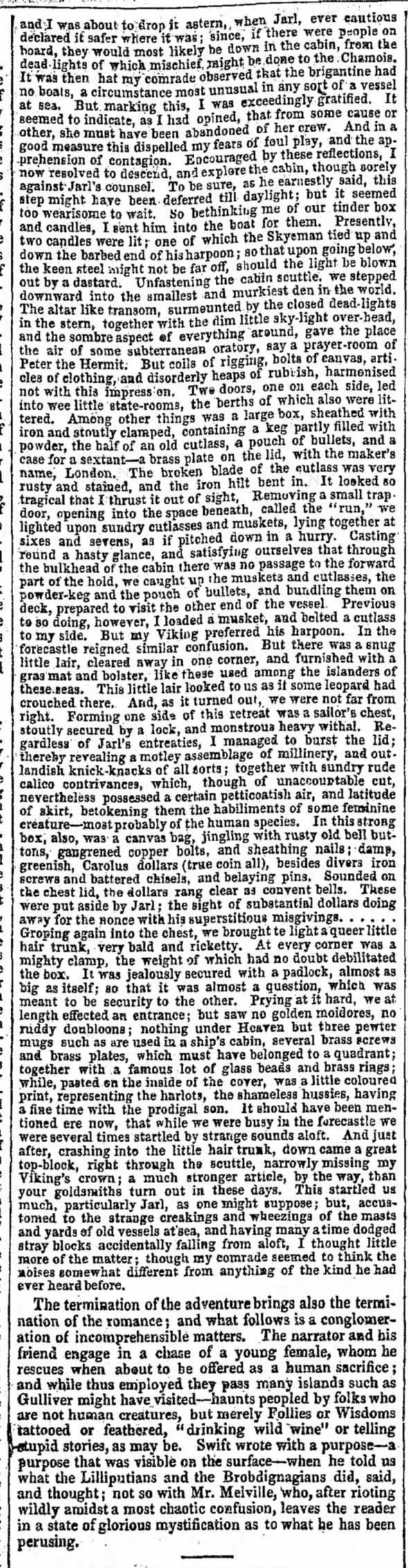
· Sun, Apr 1, 1849 – 8 · Lloyd's Weekly Newspaper (London, Greater London, England) · Newspapers.com

MARDI: AND A VOYAGE THITHER. By Herman Melville. Bentley, New Burlington-street.--This is a strange book, and it is, to us, impossible to divine the object for which it has been written. It commences like a romance, and the first part of the book teems with well-told adventure; but as for the latter part, it is full of improbability, is outrageous in incident and the forms of language, and invests the reader in a fog that it is impossible to penetrate. The author's purpose, if he have one, is too deep for us to fathom, and it is very doubtful if any but those who are chained to the log of criticism, will ever have sufficient courage to reach the end of the work; so that it will remain a matter of mental darkness. Let us hope that the world will be no loser in consequence. The narrator commences by telling us that he was on board a sperm-whaler in the Pacific, the captain of which protracted the ship's voyage till our rover and a mate of his, becoming totally ocean-weary when a thousand miles from land, resolved to give the Arcturion the slip, and executed their resolution in a manner not very probable but abundantly breathless. Drifting alone on the surface of the mighty waters, the author finds time to pick up materials from numerous pictures of the "under world," over-wrought and extravagant, but sometimes amusing. It is in this portion of the work that anything like quiet and reasonable writing is to be found; and the following extract is really full of power, and excites a wish to learn its termination:--

THE SILENT BRIGANTINE.
[ Excerpt from volume 1, chapter 19 of Mardi: And A Voyage Thither from "As we came nearer, it was plain…." to "... superstitious misgivings"; and from "Groping again into the chest...." to ... somewhat different from anything of the [that] kind he had ever heard before."]
The termination of the adventure brings also the termination of the romance; and what follows is a conglomeration of incomprehensible matters. The narrator and his friend engage in a chase of a young female, whom he rescues when about to be offered as a human sacrifice; and while thus employed they pass many islands such as Gulliver might have visited--haunts peopled by folks who are not human creatures, but merely Follies or Widsoms tattooed or feathered, "drinking wild wine" or telling stupid stories, as may be. Swift wrote with a purpose--a purpose that was visible on the surface--when he told us what the Lilliputians and the Brobdignagians did, said, and thought; not so with Mr. Melville, who, after rioting wildly amidst a most chaotic confusion, leaves the reader in a state of glorious mystification as to what he has been perusing.
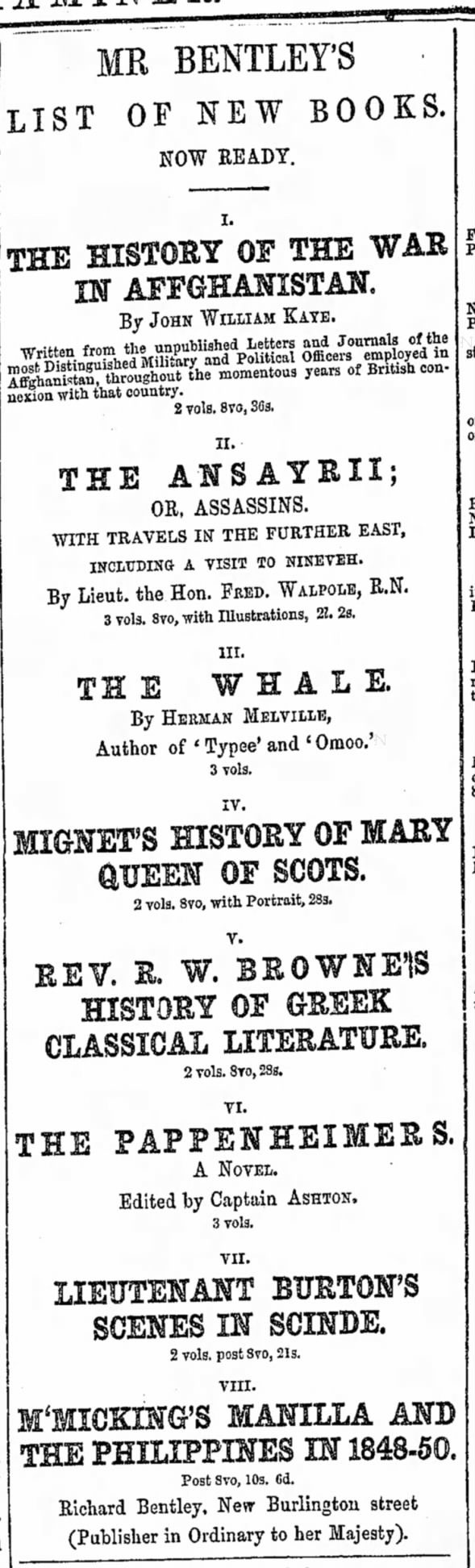
Below, the publisher's advertisement from the London Examiner on November 1, 1851 presents Melville's The Whale as number three in "Mr Bentley's List of New Books," in between The Ansayrii and Mignet's History of Mary Queen of Scots.

· Sat, Nov 1, 1851 – 16 · The Examiner (London, Greater London, England) · Newspapers.com

Saturday, April 7, 2018

[Postcard] | Pivot to Digital, by Jesse Coburn | Harper's Magazine

2017 Harper's blog post on Tom Tryniski.

Another, more recent profile of Tom Tryniski and his great Fulton History archive is by Alexandria Neason, writing in the Columbia Journalism Review on February 6, 2018:
How Tom Tryniski digitized nearly 50 million pages of newspapers in his living room
http://bit.ly/2FUgZgm
Fultonhistory.com is an incredibly valuable resource that deserves generous support.
http://www.fultonhistory.com/Donation%20paypal.html

Friday, April 6, 2018

Henry Livingston Jr on hemp

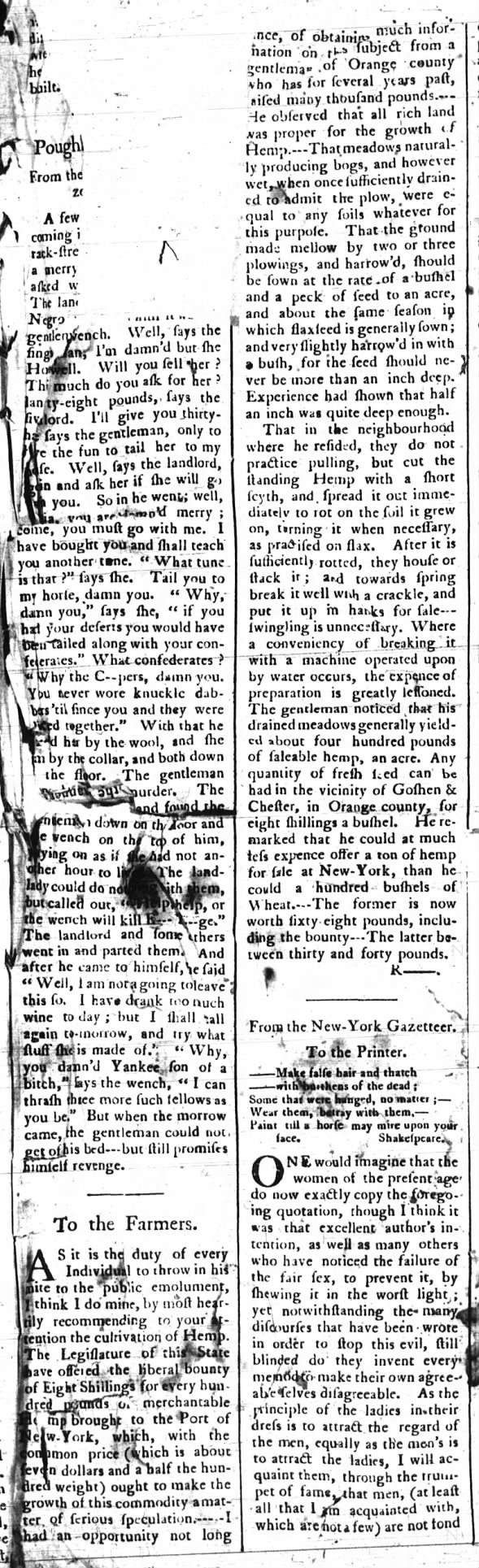
Signed "R——." and printed under the heading "To the Farmers," a letter commending the cultivation of hemp was published in The Country Journal and the Poughkeepsie Advertiser on October 13, 1785.

· Thu, Oct 13, 1785 – Page 3 · Poughkeepsie Journal (Poughkeepsie, New York) · Newspapers.com
The writer addresses area farmers with evident knowledge and experience of their concerns. Along with the farmer's perspective, the writer's style also resembles that of Henry Livingston, Jr. as demonstrated in extant letters to family members. For instance, in the first sentence the writer embraces "the duty of every Individual to throw in his mite to the public emolument." The figure of contributing, more specifically throwing one's "mite" occurs in Henry's January 1819 letter to his grandson Sidney Breese:
The day may come when the Breeses & the Livingstons would throw in no inconsiderable mite into the treasury of Occidental population.--Letters of Major Henry Livingston
Transcribed below from the The Country Journal and the Poughkeepsie Advertiser, October 13, 1785; found on Newspapers.com:

To the Farmers.


As it is the duty of every Individual to throw in his mite to the public emolument, I think I do mine, by most heartily recommending to your attention the cultivation of Hemp. The Legislature of this State have offered the liberal bounty of Eight Shillings for every hundred pounds of merchantable Hemp brought to the Port of New-York, which, with the common price (which is about seven dollars and a half the hundred weight) ought to make the growth of this commodity a matter of serious speculation.--- I had an opportunity not long since, of obtaining much information on the subject from a gentleman of Orange county who has for several years past, raised many thousand pounds.--- He observed that all rich land was proper for the growth of Hemp.---That meadows naturally producing bogs, and however wet, when once sufficiently drained to admit the plow, were equal to any soils whatever for this purpose. That the ground made mellow by two or three plowings, and harrow'd, should be sown at the rate of a bushel and a peck of seed to an acre, and about the same season in which flaxseed is generally sown; and very slightly harrow'd in with a bush, for the seed should never be more than an inch deep. Experience had shown that half an inch was quite deep enough.

That in the neighbourhood where he resided, they do not practice pulling, but cut the standing Hemp with a short scyth, and spread it out immediately to rot on the soil it grew on, turning it when necessary, as practised on flax. After it is sufficiently rotted, they house or stack it; and towards spring break it well with a crackle, and put it up in hanks for sale---swingling is unnecessary. Where a conveniency of breaking it with a machine operated upon by water occurs, the expence of preparation is greatly lessoned. The gentleman noticed that his drained meadows generally yielded about four hundred pounds of saleable hemp, an acre. Any quantity of fresh seed can be had in the vicinity of Goshen & Chester, in Orange county, for eight shillings a bushel. He remarked that he could at much less expence offer a ton of hemp for sale at New-York, than he could a hundred bushels of Wheat.--- The former is now worth sixty-eight pounds, including the bounty---The latter between thirty and forty pounds.
 R——.

Samuel Johnson on female happiness, plagiarized in Poughkeepsie

From The Rambler No. 128 - June 8, 1751
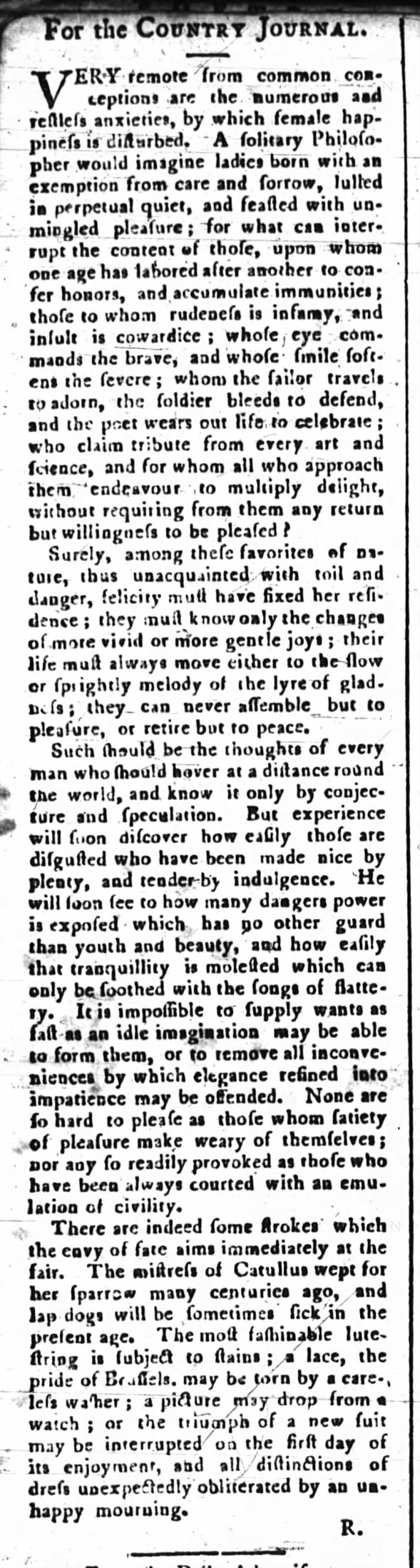
Rather, unhappiness. A long, only slightly modified excerpt from Samuel Johnson's essay in The Rambler No. 128 (June 8, 1751) was published over the signature "R." in the Poughkeepsie Country Journal and Dutchess and Ulster County Farmer's Register of October 14, 1788. Otherwise uncredited, the item from "R." appeared under the heading "For the Country Journal." The Poughkeepsie contributor omits the general, "universal" application of the moral argument that concluded Johnson's 1751 essay:
"Such is the state of every age, every sex, and every condition: all have their cares, either from nature or from folly: and whoever therefore finds himself inclined to envy another, should remember that he knows not the real condition which he desires to obtain, but is certain that, by indulging a vicious passion, he must lessen that happiness which he thinks already too sparingly bestowed."  --The Rambler No. 128. Anxiety universal

· Tue, Oct 14, 1788 – Page 2 · Poughkeepsie Journal (Poughkeepsie, New York) · Newspapers.com

By virtue of the signature "R." this item is listed with other prose writings attributed to Henry Livingston Jr on the Livingston website, there transcribed under the title, Female Happiness. In a footnote to the second chapter of Who Wrote "The Night Before Christmas"? (page 177 note 18), MacDonald P. Jackson quotes Livingston on Catullus without acknowledging the source in Samuel Jonson's Rambler.

Related post:

Thursday, April 5, 2018

The Teniers of American poets

A pastoral landscape with a herdsman playing a pipe near a waterfall
David Teniers the Younger, Public domain, via Wikimedia Commons
Alfred Billings Street, again. Charles Fenno Hoffman called Albany's forgotten poet Alfred B. Street "the Teniers of American poets" in the short lived Excelsior. In the same vein, reviewing the same 1845 volume The Poems of Alfred B. Street, Henry T. Tuckerman in the United States Magazine and Democratic Review praised his Albany friend as "a true Flemish painter." So then: two friendly critics of Alfred B. Street's 1845 Poems, both of whom would become friends of Melville's, compared Street and his authentic verse descriptions of nature to Flemish painters and their style of genre painting --thirty years before Melville likened Street's poem The Old Garden to
"a flower-and-fruit piece by some mellow old Fleming." --Herman Melville's Correspondence, ed. Lynn Horth (Evanston and Chicago: Northwestern University Press and The Newberrry Library, 1993), page 463. 
Carstian Luyckx - Still Life Of A Basket Of Fruit, Flowers In A Gilt Vase, A Nautilus Shell And Other Objects On A Draped Table Near An Open Window
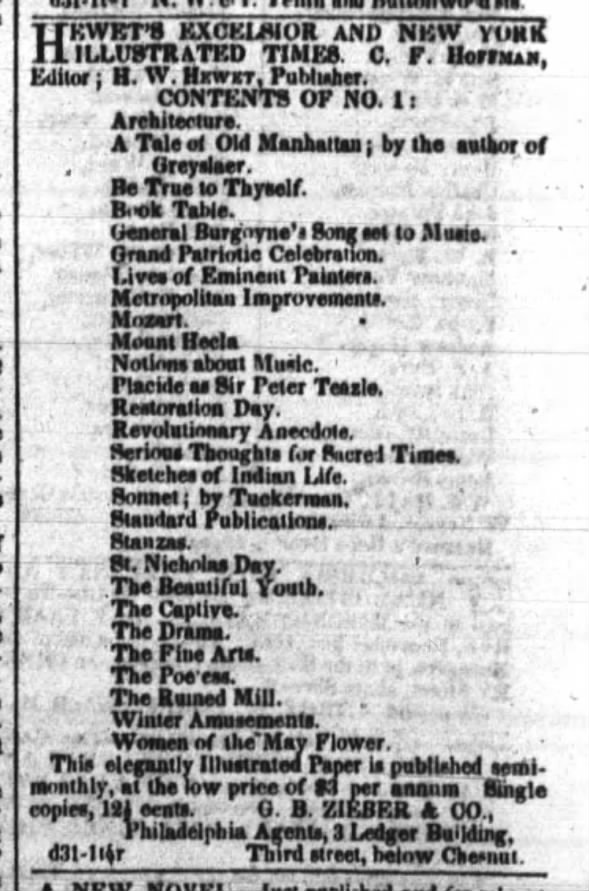
Hewet's Excelsior and New York Illustrated Times was conceived as an American version of the London Illustrated Times. Editor Charles Fenno Hoffman's generous (though qualified) estimation of Street's poetry was reprinted in the March 1846 Knickerbocker:
WE were about to indite a short review of our esteemed friend and correspondent's very beautiful volume, when the following notice of the same work, from the capable pen of Mr. C. F. Hoffman, in 'Excelsior,’ (a most gentlemanly journal, 'too early lost,') met our eye, and we at once decided that we could do nothing half so felicitous as to say 'ditto to Mr. BURKE,' and make the notice 'ours by adoption:'
Mr. STREET is the TENIERS of American poets. Perfect in his limited and peculiar range of art, as is LONGFELLOW in his more extended and higher sphere, STREET is the very daguerreotype of external nature. And yet his portraits are not mere mechanical copies of her features, so much feeling as well as truth is there in his microscopic delineations. He has not indeed the fervid minstrel power of WHITTIER ; the high meditative philosophy of BRYANT; the fine lyric inspiration of HALLECK; the beautiful and luminous sentiment of LONGFELLOW; nor is there the vivid creative power, the sparkling fancy and impassioned grace, which divided among some of our female poets, is as yet blended upon the page of neither sex, in our still nursing literature. Yet that characteristic still remains to him, without which all these others are as nothing; and which, possessed to the full degree in which it fills the soul of Street, makes him a true poet; namely, feeling—an intense feeling and appreciation of his subject; a devotion like that of a lover to his mistress; a love for nature unaffected, enthusiastic, unceasing; a love vigilant as a mother's for her offspring; reverential as that of a child for its parent. He watches her every look and feature, with no end save the tender delight of thus watching; he worships her every expression, with no motive save the gratification of his full feeling of homage. And if the issues of social life chance at times to blend with the accidents of his theme, the flow of inspiration from such sources is wholly subordinate to the natural tides of his song. With the pedantic or superficial reader, Street might still be left as the maker of mere descriptive verses, which had no merit save a kind of Chinese fidelity to purely physical realities; but he who, impelled by the true love of Nature, shall look more curiously into his song, will find STREET's poetry, like the face of the divinity herself, full of suggestiveness. As an instance of this, we may mention that we have before us an illustrated London publication, in which one of his poems (regarded by matter-of-fact people here as characteristically matter-of-fact,) has suggested to a spirited artist two of the most striking sketches that the season has produced."  --The Knickerbocker
Below, contents of the first number of Hewet's Excelsior and New York Illustrated Times, as advertised in the Philadelphia Public Ledger on New Year's Eve, 1845:

· Wed, Dec 31, 1845 – Page 2 · Public Ledger (Philadelphia, Pennsylvania) · Newspapers.com


Related post

Tuesday, April 3, 2018

T. W. C. Moore and William I. Street, son of Henry Livingston's "good friend" Randall S. Street

In 1862 Livingston cousin T. W. C. Moore wrote a key witness letter attesting to Clement C. Moore's authorship of "A Visit from St Nicholas" aka The Night Before Christmas. T. W.C. Moore testified in writing to Clement C. Moore's authorship of the Christmas poem after a personal "interview" with the author himself. Addressed to the Librarian of the Historical Society, the 1862 letter from T. W. C. Moore accompanied a manuscript copy of "Visit" in Clement C. Moore's distinctive handwriting. T. W. C. Moore's letter was published in The New York Historical Society Quarterly Bulletin 2.4 (January 1919) pages 111-115, along with a reproduction of the manuscript copy made by Clement C. Moore.

This T. W. C. or Thomas William Channing Moore was a son of John Moore and Judith Livingston Moore. His mother Judith was a first cousin and former neighbor of Henry Livingston, Jr. of Poughkeepsie. So T. W. C. Moore and Henry Livingston, Jr. were first cousins, once removed.

In addition to the family tie through his mother Judith Livingston Moore, T. W. C. Moore was also connected to Henry Livingston, Jr. through Moore's aunt, Cornelia Livingston (1751-1820)--his mother's sister, another daughter of James Livingston and Judith Newcomb Livingston. T. W. C. Moore's widowed aunt Cornelia Livingston married Andrew Billings, veteran of the Revolutionary War and later a well-regarded jeweler and silversmith in Poughkeepsie.
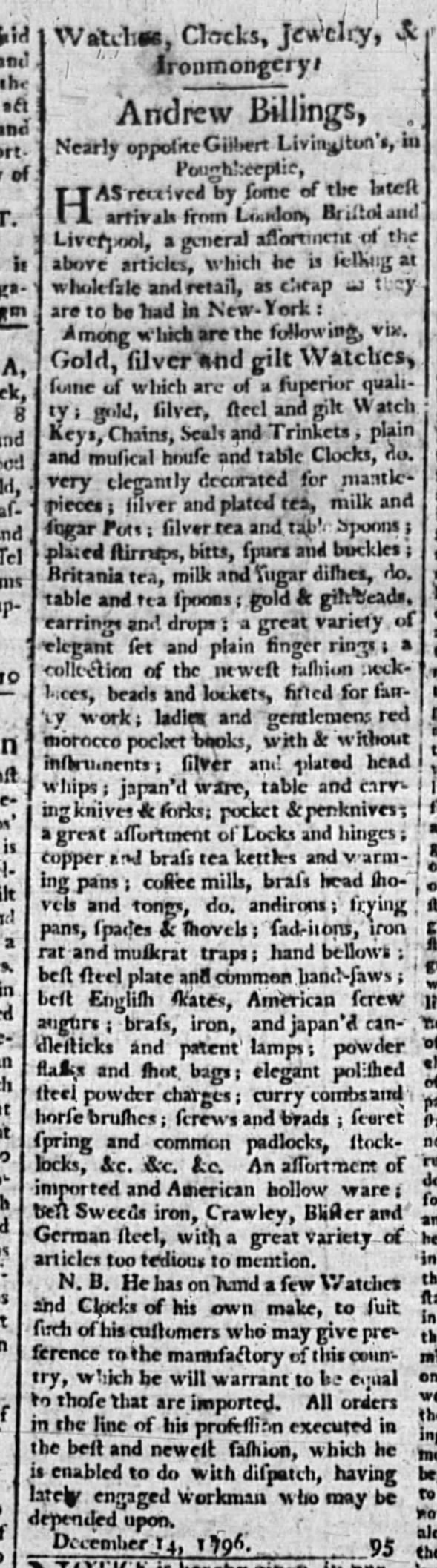
· Wed, Mar 15, 1797 – Page 4 · Poughkeepsie Journal (Poughkeepsie, New York) · Newspapers.com
Esteemed as "a man of genius," Andrew Billings reportedly invented a pair of wings that worked for him but not his father-in-law James Livingston:
Major Billings was no ordinary man: nay more, he was a man of genius. Independent of his talents as a soldier and writer, he possessed great mechanical invention. He constructed a pair of wings, and, being a small man, actually succeeded with them in flying short distances. Relative to this matter a story is told by B. Davis Noxen, Esq., the celebrated lawyer of Syracuse, and formerly a resident of Poughkeepsie. Major Billings gave notice that he intended trying his wings at a certain hour in the market place of the village. The inhabitants assembled; he mounted a low pillar, extended his wings, and, to the amusement of the village, flew to a considerable distance. Sheriff Livingston, thinking to "follow in the footsteps" of his son-in-law, then mounted the pillar, fitted the wings and sprang. Being, however, a heavy man, and not knowing the trick of waving his pinions, he tumbled ingloriously to the dust, amid the laughter of his townsmen.  --Albany Evening Journal, May 25, 1864
Daughter Cornelia Billings married Randall Sanford Street (1780-1839). Remembered in William Hunt's American Biographical Panorama as "an eminent lawyer and accomplished gentleman," Randall S. Street was Henry Livingston's "good friend" and for a while the employer of Livingston's son Edwin.

Edwin George Livingston (1798-1863) studied law with Randall S. Street. In 1821 Edwin was formally admitted as attorney in 1821, as announced in the New York Evening Post on November 7, 1821. In 1824 he began practicing law in Fishkill.
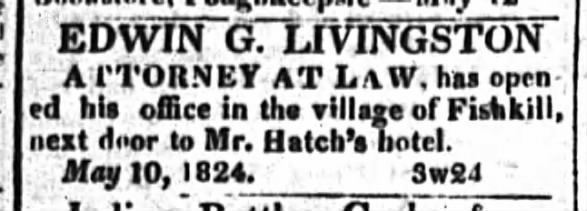
· Wed, May 26, 1824 – Page 4 · Poughkeepsie Journal (Poughkeepsie, New York) · Newspapers.com
After the death of Henry Livingston, Jr. in 1828, Edwin and his brother Sidney were able to serve as executors for the estate. Henry's "good friend" Randall Sanford Street had also been named in the will as one of the executors:
"I name and appoint as executors of this my last Will and Testament my beloved wife, Jane, my 3 sons Charles, Sidney & Edwin and my good friend Randal S. Street Esq."
--Will of Henry Livingston Jr, transcript via Mary S. Van Deusen's Henry Livingston site
T. W. C. Moore stayed in touch with grown children of his cousin Cornelia Billings and Randall S. Street, as revealed in a note Moore wrote about a curious gift he got from one of Cornelia's sons, William Ingraham Street (1807-1863). After Street gave Moore souvenir locks of George Washington's (and Martha's) hair, T. W. C. meticulously recorded the provenance in a written statement made in New York City, dated March 24, 1857:

WASHINGTON AND WIFE'S HAIR, JUNE, 1783.
The locks of hair below is part of that which was sent to Major Billings of Poughkeepsie, inclosed in a letter, of which the following is an exact copy. The original is in possession of the Major's grandson, W. J. Street, counselor at law, of this city, who gave me the hair.
Inveterate antiquarian that he was, T. W. C. Moore also took the trouble to make "an exact copy" of the authenticating letter from George Washington to Andrew Billings, at the time still owned by William I. Street (whose middle initial "I" for Ingraham or Ingram was sometimes misprinted as "J"). Transcribing Moore's 1857 note in The Century Magazine for May 1890, Edith Robertson Cleveland calls it "an odd affidavit of the present of two locks of hair from the heads of Mr. and Mrs. Washington, with the hair itself curiously preserved."

Speaking of Poughkeepsie Streets, William I. Street's brother Alfred became a poet of considerable repute in Herman Melville's time. In the 1840's, Alfred Billings Street had a law office in Albany. Somehow he knew Herman's sisters. Once in Pittsfield, Alfred B. Street felt hurt when Herman did not ask him over to Arrowhead for a social visit. Hershel Parker tells all about it in the second volume of Herman Melville: A Biography (Baltimore: Johns Hopkins University Press, 2002), page 139. That was in late September 1852. Twenty-five years later Melville highly complemented one of Street's poems, in a letter to his cousin Kate and her husband Abraham Lansing:
... I have just been reading in a copy of Frank Leslie's Illustrated paper "The Old Garden" by Mr Street. How beautiful, and poetically true to nature it is! It is like a flower-and- fruit piece by some mellow old Fleming.  --Herman Melville, August 14, 1877 letter to Catherine Gansevoort Lansing and Abraham Lansing; reprinted in the Northwestern-Newberry Edition of Melville's Correspondence, pages 459-463.
Melville's comparative view of the poet as painter, "some mellow old Fleming," echoed the tribute by Henry T. Tuckerman thirty years before. In a friendly review of the 1845 volume The Poems of Alfred B. Street, Tuckerman had praised Street as "a true Flemish painter":
We have wandered with him on a summer's afternoon, in the neighborhood of his present residence, and stretched ourselves upon the greensward beneath the leafy trees, and can therefore testify that he observes con amore, the play of shadows, the twinkle of swaying herbage in the sunshine, and all the phenomena that makes the outward world so rich in meaning to the attentive gaze. He is a true Flemish painter, seizing upon objects in all their versimilitude. As we read him, wild flowers peer up from among brown leaves; the łoń. the partridge, the ripple of waters, the flickering of autumn light, the sting of sleety prow, the cry of the panther, the roar of the winds, the melody of birds, and the odor of crushed pine-boughs, are present to our senses. In a foreign land, his poems would transport us at once to home. He is no second-hand limmer, content to furnish insipid copies, but draws from reality. His pictures have the freshness of originals. They are graphic, detailed, never untrue, and often vigorous; he is essentially an American poet. --Unsigned notice of The Poems of Alfred B. Street [by Henry T. Tuckerman] in The United States Magazine and Democratic Review for January 1846.
In this 1901 obituary of Alfred's sister Frances Mary Street, the highest honor the writer could think to bestow on her late brother the poet was to make him "a contemporary and friend of Longfellow."
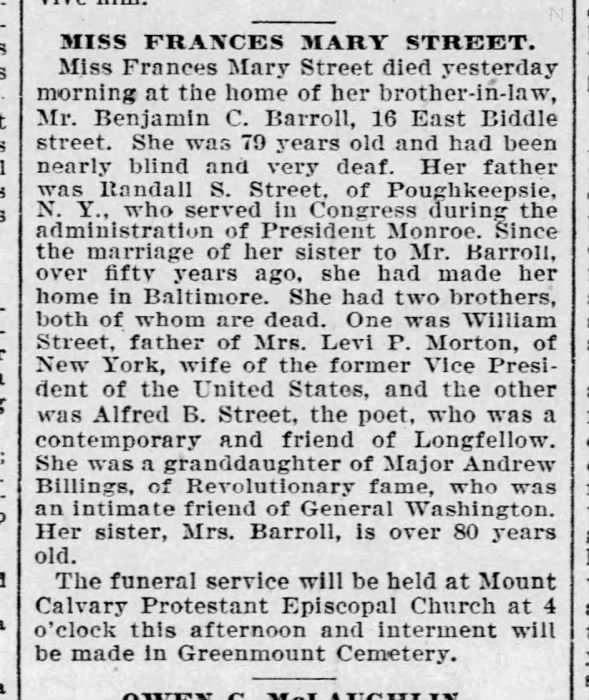
· Sat, Mar 30, 1901 – 7 · The Baltimore Sun (Baltimore, Maryland) · Newspapers.com
From the Memoir of Alfred B. Street as published in Bentley's Miscellany (London, 1849):
The Hon. Randall S. Street, father of the author of " Frontenac," was the lineal descendant of these two eminent clergymen. He removed, with his father, in early life, into the State of New York, and this branch of the family has continued to reside there ever since; the other branch continued in Connecticut, and is still represented by Augustus Russell Street, Esq., who resides at Newhaven. Randall S. Street studied law at Poughkeepsie, married Miss Cornelia Billings, and settled there for the succeeding thirty years of his life. Such was his standing at the bar, that whilst still young, he was appointed attorney of the district composed of the counties of Wayne, Ulster, Dutchess, Delaware and Sullivan, under the old organisation of districts, and subsequently he represented the county of Dutchess in Congress. He was an eminent lawyer and accomplished gentleman, and among the recollections of the writer, is one of a day spent more than thirty years ago at the residence of General Street, when it was the home of hospitality and elegance. In 1824, General Street removed to Monticello, Sullivan county, New York, where he died in 1839.

The maternal grandfather of our author was Major Andrew Billings, who married Cornelia, daughter of James Livingston, of the well known family of that name in New York. Cornelia, the daughter by this marriage, who became the wife of General Street, was the mother of the poet....


Related posts:

Sunday, April 1, 2018

Apostrophe of Rispah, 1788

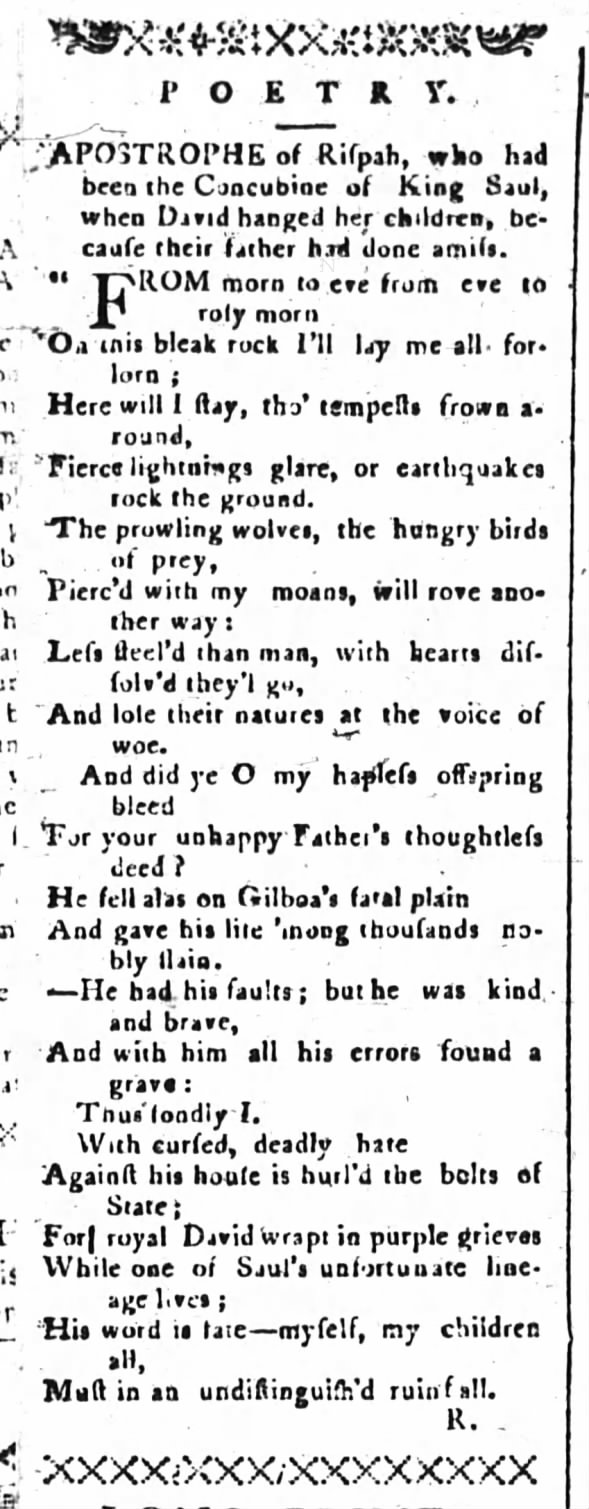
Signed "R," this verse "Apostrophe of Rispah" was published in the Country Journal and Poughkeepsie Advertiser on June 10, 1788. As featured on Mary S. Van Deusen's great Henry Livingston website, a manuscript version of Rispah appears in the book of manuscript poems attributed to Henry Livingston, Jr.

· Tue, Jun 10, 1788 – Page 4 · Poughkeepsie Journal (Poughkeepsie, New York) · Newspapers.com
Where the Poughkeepsie Country Journal and all printed versions found so far read "Saul's unfortunate lineage," Henry Livingston's manuscript version has "Saul's unhappy lineage." Currently the Livingston web page for All Henry Poetry gives 1794 as the date of this poem, based on the reprinting in the New York Weekly Museum for July 19, 1794.

The following week (June 17, 1788) an unsigned poem titled "Dying Indian" appeared in the Country Journal and Poughkeepsie Advertiser under the heading "Poetry / For the Poughkeepsie Advertiser." "Dying Indian" is credited to Joseph Warton in volume 4 of Robert Dodsley's A Collection of Poems in Six Volumes (London, 1763).

"Rispah" enjoyed a good run in early American newspapers. The poem was reprinted below the heading "Poetics" in the New York Independent Journal, June 14, 1788 and frequently thereafter, for example:
  • Elizabethtown, New Jersey Journal, June 18, 1788 [signed "R" as in the Poughkeepsie Country Journal]
  • Pennsylvania Packet (Philadelphia, Pennsylvania) June 23, 1788
  • Salem Gazette, June 10, 1794
  • Philadelphia Independent Gazeteer, June 21, 1794
  • Kline's Carlisle Weekly Gazette, July 9, 1794
  • New York Weekly Museum, July 19, 1794
  • Lexington, Kentucky Gazette, August 16, 1797
  • New Bedford, Massachusetts Medley, November 23, 1798.
Philadelphia, Pennsylvania Packet - June 23, 1788