 · Thu, Oct 13, 1785 – Page 3 · Poughkeepsie Journal (Poughkeepsie, New York) · Newspapers.com
The writer addresses area farmers with evident knowledge and experience of their concerns. Along with the farmer's perspective, the writer's style also resembles that of Henry Livingston, Jr. as demonstrated in extant letters to family members. For instance, in the first sentence the writer embraces "the duty of every Individual to throw in his mite to the public emolument." The figure of contributing, more specifically throwing one's "mite" occurs in Henry's January 1819 letter to his grandson Sidney Breese:
The day may come when the Breeses & the Livingstons would throw in no inconsiderable mite into the treasury of Occidental population.--Letters of Major Henry LivingstonTranscribed below from the The Country Journal and the Poughkeepsie Advertiser, October 13, 1785; found on Newspapers.com:
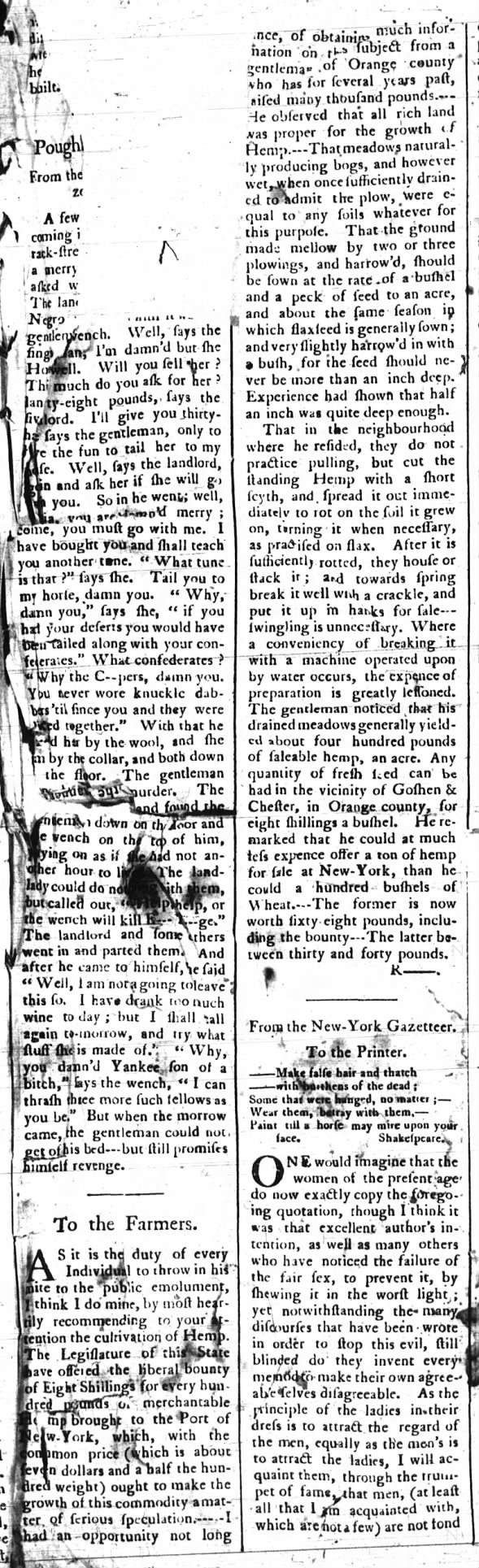
To the Farmers.
As it is the duty of every Individual to throw in his mite to the public emolument, I think I do mine, by most heartily recommending to your attention the cultivation of Hemp. The Legislature of this State have offered the liberal bounty of Eight Shillings for every hundred pounds of merchantable Hemp brought to the Port of New-York, which, with the common price (which is about seven dollars and a half the hundred weight) ought to make the growth of this commodity a matter of serious speculation.--- I had an opportunity not long since, of obtaining much information on the subject from a gentleman of Orange county who has for several years past, raised many thousand pounds.--- He observed that all rich land was proper for the growth of Hemp.---That meadows naturally producing bogs, and however wet, when once sufficiently drained to admit the plow, were equal to any soils whatever for this purpose. That the ground made mellow by two or three plowings, and harrow'd, should be sown at the rate of a bushel and a peck of seed to an acre, and about the same season in which flaxseed is generally sown; and very slightly harrow'd in with a bush, for the seed should never be more than an inch deep. Experience had shown that half an inch was quite deep enough.
That in the neighbourhood where he resided, they do not practice pulling, but cut the standing Hemp with a short scyth, and spread it out immediately to rot on the soil it grew on, turning it when necessary, as practised on flax. After it is sufficiently rotted, they house or stack it; and towards spring break it well with a crackle, and put it up in hanks for sale---swingling is unnecessary. Where a conveniency of breaking it with a machine operated upon by water occurs, the expence of preparation is greatly lessoned. The gentleman noticed that his drained meadows generally yielded about four hundred pounds of saleable hemp, an acre. Any quantity of fresh seed can be had in the vicinity of Goshen & Chester, in Orange county, for eight shillings a bushel. He remarked that he could at much less expence offer a ton of hemp for sale at New-York, than he could a hundred bushels of Wheat.--- The former is now worth sixty-eight pounds, including the bounty---The latter between thirty and forty pounds.
R——.