Showing posts with label Parke Godwin. Show all posts

Wednesday, January 23, 2019

Parke Godwin on Melville and Typee

The Author of "Our New President" [Parke Godwin]
Putnam's Monthly Vol. 4 - October 1854

Two 1915 columns by Elisha Jay Edwards record interesting reminiscences about Herman Melville by Parke Godwin. According to Edwards in the first article below, Godwin at 80 (so, on or after February 28, 1896) thought Melville, along with Richard Henry Dana and Francis Parkman, excelled at writing factual narratives of personal experience. In the second article, "When the Government Encouraged Authorship," Parke Godwin says that he talked with Melville beforehand about his plans to make a book of his Marquesan adventures. Melville was "doubtful" but Godwin, as quoted by Edwards, assured him of its certain popularity.
"When he [Herman Melville] returned to New York I [Parke Godwin] met him, and he told me that he was going to narrate these experiences, although he was somewhat doubtful about finding a publisher for the book. I was satisfied that he would find no difficulty in obtaining readers and in that judgment I was correct. He called his book 'Typee,' and it was published in the same year that Parkman started out upon his adventures across the continent, which he described in a very successful book, now a classic, which he called 'The Oregon Trail.'" --E. J. Edwards, When the Government Encouraged Authorship in the Raleigh, North Carolina News and Observer, August 28, 1915.
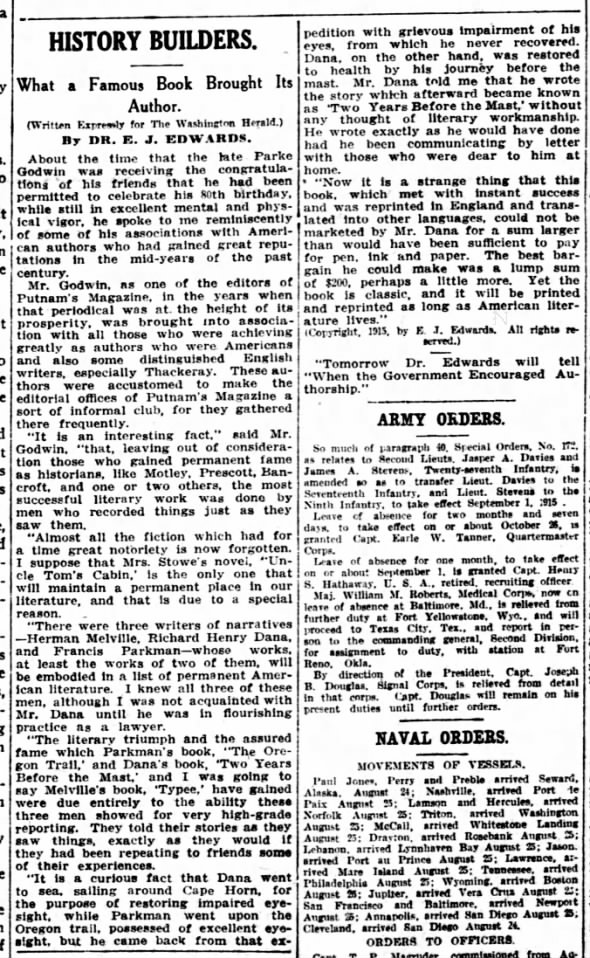
Parke Godwin at 80 remembers Melville with Dana and Parkman for their Parke Godwin at 80 remembers Melville with Dana and Parkman for their "high-grade reporting." Fri, Aug 27, 1915 – Page 4 · The Washington Herald (Washington, District of Columbia, United States of America) · Newspapers.com
... Mr. Godwin, as one of the editors of Putnam's Magazine, in the years when that periodical was at the height of its prosperity, was brought into association with all those who were achieving greatly as authors who were Americans and also some distinguished English writers, especially Thackeray. These authors were accustomed to make the editorial offices of Putnam's Magazine a sort of informal club, for they gathered there frequently.

"It is an interesting fact," said Mr. Godwin, "that, leaving out of consideration those who gained permanent fame as historians, like Motley, Prescott, Bancroft, and one or two others, the most successful literary work was done by men who recorded things just as they saw them.

"Almost all the fiction which had for a time great notoriety is now forgotten. I suppose that Mrs. Stowe's novel, "Uncle Tom's Cabin,' is the only one that will maintain a permanent place in our literature, and that is due to a special reason.

"There were three writers of narratives--Herman Melville, Richard Henry Dana, and Francis Parkman--whose works, at least the works of two of them, will be embodied in a list of permanent American literature. I knew all three of these men, although I was not acquainted with Mr. Dana until he was in flourishing practice as a lawyer.

"The literary triumph and the assured fame which Parkman's book, "The Oregon Trail,' and Dana's book, 'Two Years Before the Mast,' and I was going to say Melville's book, 'Typee,' have gained were due entirely to the ability these three men showed for very high-grade reporting. They told their stories as they saw things, exactly as they would if they had been repeating to friends some of their experiences...." --E. J. Edwards, "History Builders / What a Famous Book Brought its Author" in the Washington, D. C. Herald, August 27, 1915.
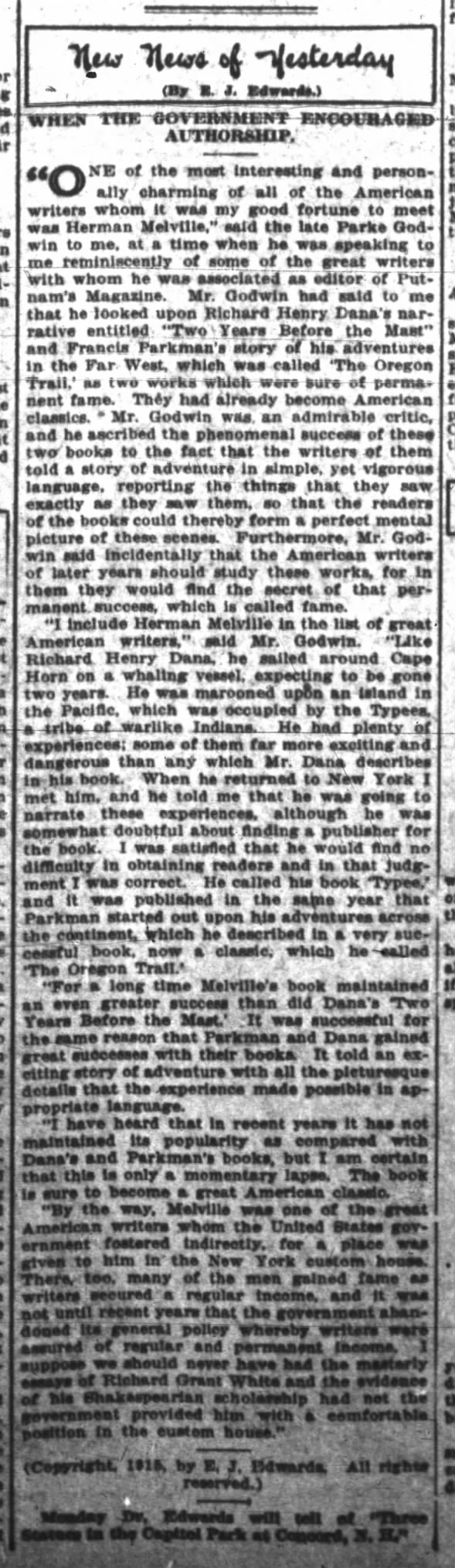

Parke Godwin on Herman Melville, as quoted by Elisha Jay EdwardsParke Godwin on Herman Melville, as quoted by Elisha Jay Edwards Sat, Aug 28, 1915 – Page 4 · News and Observer (Raleigh, Wake, North Carolina) · Newspapers.com

New News of Yesterday

(By E. J. Edwards)

WHEN THE GOVERNMENT ENCOURAGED AUTHORSHIP.

"One of the most interesting and personally charming of all of the American writers whom it was my good fortune to meet was Herman Melville," said the late Parke Godwin to me, at a time when he was speaking to me reminiscently of some of the great writers with whom he was associated as editor of Putnam's Magazine. Mr. Godwin had said to me that he looked upon Richard Henry Dana's narrative entitled "Two Years Before the Mast" and Francis Parkman's story of his adventures in the Far West, which was called "The Oregon Trail," as two works which were sure of permanent fame. They had already become American classics. Mr. Godwin was an admirable critic, and he ascribed the phenomenal success of these two books to the fact that the writers of them told a story of adventure in simple, yet vigorous language, reporting the things that they saw exactly as they saw them, so that the readers of the books could thereby form a perfect mental picture of these scenes. Furthermore, Mr. Godwin said incidentally that the American writers of later years should study these works, for in them they would find the secret of that permanent success, which is called fame. 
"I include Herman Melville in the list of great American writers," said Mr. Godwin. "Like Richard Henry Dana, he sailed around Cape Horn on a whaling vessel, expecting to be gone two years. He was marooned upon an island in the Pacific, which was occupied by the Typees, a tribe of warlike Indians. He had plenty of experiences; some of them far more exciting and dangerous than any which Mr. Dana describes in his book. When he returned to New York I met him, and he told me that he was going to narrate these experiences, although he was somewhat doubtful about finding a publisher for the book. I was satisfied that he would find no difficulty in obtaining readers and in that judgment I was correct. He called his book 'Typee,' and it was published in the same year that Parkman started out upon his adventures across the continent, which he described in a very successful book, now a classic, which he called 'The Oregon Trail.' 
"For a long time Melville's book maintained an even greater success than did Dana's 'Two Years Before the Mast.' It was successful for the same reason that Parkman and Dana gained great successes with their books. It told an exciting story of adventure with all the picturesque details that the experience made possible in appropriate language.  
"I have heard that in recent years it has not maintained its popularity as compared with Dana's and Parkman's books, but I am certain that this is only a momentary lapse. The book is sure to become a great American classic. 
"By the way, Melville was one of the great American writers whom the United States government fostered indirectly, for a place was given to him in the New York custom house. There, too, many of the men gained fame as writers secured a regular income, and it was not until recent years that the government abandoned its general policy whereby writers were assured of regular and permanent income. I suppose we should never have had the masterly essays of Richard Grant White and the evidence of his Shakespearian scholarship had not the government provided him with a comfortable position in the custom house." --E. J. Edwards, When the Government Encouraged Authorship in the Raleigh, North Carolina News and Observer, August 28, 1915; accessible via Newspapers.com and GenealogyBank.
In a letter to the editor of The People's Journal dated July 17, 1847 Parke Godwin confirmed "the real existence of Mr. Herman Melville" for skeptical Brits:
"... let me say that I saw him in Albany the other day as large as life, where he and his family are well known, and his narratives bearing a little artistic ornament, are held to be perfectly authentic. The writer under no assumed name, but under his own veritable Christian and patronymic designation. It is no unusual thing, by the way, for our young men of fortune to go as sailors, to the South Seas, in quest of adventure."  --The People's Journal v. 4


Related post:

Monday, January 15, 2018

A rare hater of Israel Potter in Putnam's

Most newspaper critics who bothered to notice Melville's story of Israel Potter in Putnam's magazine liked it. Not in Buffalo, however. Reviewing the January 1855 number of Putnam's, a reviewer in the Buffalo Commercial Advertiser used the "interminable" narrative of adventure and exile to illustrate the lackluster content of the whole issue.

Found on Newspapers.com
... This is the dullest number of all we have had: the articles are not up to the standard of the magazine. As this is eminently an American publication, it has many friends and none of them will be satisfied with any indication of drowsiness; or what is more, and carelessness in its editors or managers. There is hardly an article of any interest in this number. The apparently interminable story, called "Israel Potter," is continued, and is like to continue, for aught that can be seen, for some time to come; it is excessively stupid and the publishers would have done better to have left the space blank. Kill off "Israel," we beg of you, gentlemen, or wind him up forthwith—the trouble of cutting the leaves is not repaid by the matter of the article. Subscribers and publishers will expect a brilliant number in February, to reward them for the defects of this and the last preceding Putnam.— Wake up, gentlemen, or you will fall too far behind to bring up with your vigilant competitors in the race for fame. --Buffalo Commercial Advertiser, December 27, 1854
The year before, the same Buffalo paper unreservedly loved Putnam's. In a long, glowing review of the November 1853 issue, the first installment of Melville's "Bartleby" received brief but positive mention as one of several "well written, amusing papers," and "admirably told":
"The American Ideal Woman," "The life of a Dog," and "Bartleby, the Scrivener, a tale of Wall street," are all well written, amusing papers. The latter is the first part of a tale and is admirably told." --Buffalo Commercial Advertiser, November 5, 1853
Early in April 1854 the Buffalo Commercial Advertiser still happily awaited "charming romances" by Herman Melville in the pages of Putnam's Monthly Magazine:
When Longfellow with his poetry, Melville with his charming romances, Taylor with his knowledge of other lands, and other writers equally as gifted, come to us each month with an offering from the storehouse of their good things--what more can the most fastidious taste hope for or desire?  --Buffalo Commercial Advertiser, April 11, 1854
What happened?

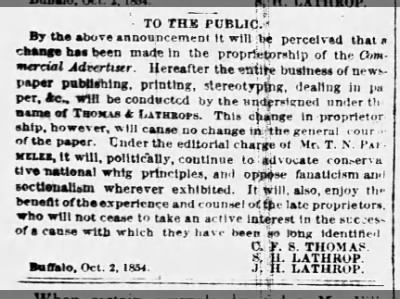
Possibly the new hostility to Putnam's in general and Melville in particular reflects the change in ownership of the Buffalo Commercial Advertiser that occurred in October 1854.


"... in 1854 the whole establishment was sold to Calvin F. S. Thomas, Solon H. Lathrop and Jedediah H. Lathrop. Theodore N. Parmelee was employed as editor. On the 4th of April, 1857, the plant and business passed again to Mr. Jewett and Doctor Foote, the latter acting as editor." --Our County and Its People ed. Truman C. White


On the other hand, no major change of editorship occurred, since according to the Troy Daily Whig (October 6, 1854), Thomas Nelson Parmelee had been serving as "working editor" since June 1851, when Thomas Moses Foote left for Albany to run the Daily Register (Buffalo Christian Advocate, June 19, 1851):
T. N. PARMELEE, the working editor of the paper for four years past, continues in charge of the paper under the new arrangement. (Troy Daily Whig, October 6, 1854)
Ironically, back when Thomas M. Foote was editor the Buffalo Commercial Advertiser (July 1, 1846) had saved Herman Melville's reputation for veracity by publishing a letter from his shipmate "Toby" Greene. Foote, as Hershel Parker says in the first volume of Herman Melville: A Biography (page 435), "knew how to package a story."

Found on Newspapers.com
A few months before the ownership change in 1854, the "political editor" of the Buffalo Commercial Advertiser (August 4, 1854) hesitated to overstep by offering literary criticism:
"Perhaps it is not within the scope of a political editor's duties to criticise the purely literary contributions to the Magazines…." (August 4, 1854)
It could be that with new proprietors of the Commercial Advertiser and his newly formalized title of editor (no longer merely "political editor"?), Parmelee felt empowered to speak his mind on literary matters, too. In any case, the first blast at Melville's Israel Potter in the Buffalo Commercial Advertiser happened on Thomas Nelson Parmelee's watch, only a few months after the sale to Thomas and Lathrops.

The Buffalo Commercial Advertiser did not mention Melville by name in connection with "Israel Potter." But the hating on "this long batch of twaddle" continued in the notice of Putnam's for February 1855: 
Putnam for February has more merit than the last number. To those who read this magazine as a matter of course, the notice following the last installment of "Israel Potter" will be gratifying. It assures them that this long batch of twaddle which has occupied so much room in many of the late numbers will be concluded in the next issue. Good.
Nobody could have been gladder to see Israel Potter go. After one episode of "Miss Charter," the Buffalo hater dismisses the new series as
another story which promises to be as stupid as "Israel Potter." --Buffalo Commercial Advertiser, January 25, 1855
In January 1855 the Buffalo Commercial Advertiser devoted two columns headed "Putnam's Monthly—Cursive and Discursive" (January 12, 1855) and "Putnam's Monthly—Cursive and Discursive—Again" (January 16, 1855) to an extended critique of Putnam's and its editors, George W. Curtis and Parke Godwin. (The newspaper headings mock the "Cursive and Discursive" segments in some of Curtis's "Editorial Notes" for Putnam's.) No mention of Melville appears in either column. But Melville probably would have agreed with the Buffalo editor's estimation of Curtis:
If we are at liberty to judge from Mr. Curtis's published writings, his attainments are not such as to render him a profound critic; not such as to qualify him for the polemics of literature or art, and not such as to enable him to estimate accurately the relative merits of the literary men of the time.— In turning to the Editorial Notes of Putnam, particularly those which are most evidently from Curtis's pen, the reader will often discover an affectation of knowledge, and a slashing ex cathedra dictum in the place of extensive erudition and deliberative judgment. Curtis in his own proper department is inimitable, but beyond that nos judicibus quite vulnerable.
As for Curtis's colleague at Putnam's magazine, the Buffalo editor acknowledges Parke Godwin as "a man of solid acquirements and sharp, acrid intellect." Noting Godwin's "ultra radical" politics, the Buffalo Commercial Advertiser particularly objects to the intrusion in Putnam's magazine of his "strong bias towards political abolitionism." The second part of the two-part critique helpfully summarizes the chief complaints:
The objections we make to Putnam's Monthly may be summed up substantially as follows:

1st. It is not mainly a magazine of art and literature—using the latter word in its primary sense, but it manifests an ambition to exercise political influence.

2d. Its pages are chiefly occupied by common-place controversy and didactics.

3d. Its editorial columns are blemished by ill considered obiter dicta in the various departments of criticism.

4th. Its literary merit is of a negative character—its articles as a general rule exhibit neither obvious faults nor high excellence.  --Buffalo Commercial Advertiser, January 25, 1855
Reviewing the March 1855 number of Putnam's magazine, T. N. Parmelee (unavoidably implicated by the editorial we) claimed,"We are not alone in our opinion of the steadily decreasing merit of Putnam's Magazine." Once again, Melville's "Israel Potter" served to illustrate the "trash" in Putnam's:
... The very respectable and influential proprietors of Putnam should strive to change its character, and we beg them to do so, not upon our opinion of its merit, but upon that of other persons learned from the press, and from conversation, which is entitled to respectful consideration. The present number cannot be condemned by wholesale, there is a pretty thing or two in it; but the authors of "Israel Potter," and "Miss Chester," it is hoped will not consider it necessary to inflict upon a suffering public any more trash such as that which we are given to understand is now furnished [finished?]. The sentence announcing the fact, is the most interesting portion of these articles. Thank your stars, reader, and hope better things for the future. --Buffalo Commercial Advertiser, February 27, 1855


The book version of Israel Potter was published in 1855 by G. P. Putnam & Co. The standard scholarly edition is available via Northwestern University Press.

As shown above, the Buffalo Commercial Advertiser under editor Thomas N. Parmelee named "Miss Chester" with "Israel Potter" as especially bad "trash." For the curious, here are links to the two installments of "My Three Conversations with Miss Chester" in the fifth volume of Putnam's Monthly Magazine (1855):
Who wrote it? Frederic Beecher Perkins:
  • https://archive.org/stream/mythreeconversat00perk
In later years T. N. Parmelee wrote anecdotal sketches for Harper's titled "Recollections of an Old Stager," and "Desultory Sketches" signed "T. N. P." in The Galaxy. The Harper's series included Parmelee's account of the Somers mutiny from the perspective of an insider in the administration of John Tyler, published in the April 1873 issue of Harper's New Monthly Magazine.

Offended by the treatment of Zachary Taylor in another installment of the Harper's series (September 1873), one writer in the United States Army and Navy Journal denounced Parmelee's "Recollections of an Old Stager" as "more distinguished for poverty of resource and vulgarity of taste, than for literary merit or artistic excellence."

As generally known, Parmelee once had been employed by James Gordon Bennett as Washington correspondent for the New York Herald. Seldom if ever remembered is Bennett's claim that he fired Parmelee "for his indolence and incompetence," as announced in the New York Herald on December 31, 1842.

After Parmelee sued for libel, Bennett elaborated in the Herald of July 10, 1845:
This Parmelee was for several years in our employment, and was specially engaged as a correspondent at Washington during the first years of Mr. Tyler's administration, and at the Extra Session. His conduct was not satisfactory to us, and we discharged him from our employment. Soon afterwards he obtained an appointment from Mr. Tyler to an Inspectorship on the frontier, which he has since that period enjoyed, unless he has been removed by the present administration, as we have heard stated, and is very likely. Soon after his discharge by us, some most violent and personally abusive articles appeared in a paper published in this city, called the Aurora, long since defunct. These articles brought up the case of Parmelee, and made some direct charges against the proprietor of this paper, which we at the time rebutted, and certainly disproved, by extracts from the letters of Parmelee himself. Out of this defence of our character and reputation, Parmelee undertook, two years and afterwards, to found a civil action for a libel suit, which he soon afterwards abandoned; and now, after a lapse of three years, has obtained an indictment against us before a grand jury who could know nothing of the merits of the case, and were out of the venue, and who ought not, in justice and equity, to have for a moment entertained the complaint.

The indictment has, however, been obtained, and on the trial, we will present a defence, which will certainly be not a little interesting to the public at large. We have in our possession, between sixty and eighty letters, written by Parmelee, in Washington, during the extra, and subsequent session of Congress, which will make developments, relative to this matter, extremely lucid and rich, perfectly satisfactory to us, and to all who may have seen the original statements. In fact, this correspondence, will be, in political developments, what that of Chevalier Wickoff was in the theatrical world, amusing, original, and interesting in the extreme, and perfectly vindicatory of our reputation against the paltry attack of this individual. Enough of the case for the present.
Here is the obituary of Theodore N. Parmelee from the Middletown, Connecticut Daily Constitution of Monday, July 6, 1874; found in the archives of Historical Newspapers at GenealogyBank.

DEATH OF THEODORE N. PARMELEE.

Mr. Theodore N. Parmelee, a well-known journalist, died at the Montowese House, Branford, Friday [July 3, 1874], aged 70. He had suffered about a year with an acute chronic disease. The New Haven Register gives the following interesting biography:— 
He was born in Durham, Middlesex county, and learned the printing business in the office of the old Middlesex Gazette—of which, at mature age, he became the editor. During the administration of President Van Buren, he became the Washington correspondent of the New York Herald, and perhaps of other metropolitan journals, and was one of the earliest, if not the ablest, of what has since grown to be a powerful class in the country. Of rare conversational powers, pleasant address, and genial manner, he became a favorite with the leading men in Congress, and in office—and during the administration of John Tyler, he was on most intimate terms at the White House. No man whom we have ever met had so extensive a remembrance of men and things at Washington as Mr. Parmelee. Those who have pursued [perused] his very readable articles in Galaxy, Harper's Magazine, etc., within the past five or six years under the head of "Recollections of an Old Stager," will readily believe that, in his demise, the political literature of the country has suffered a great loss. He wielded a graphic and trenchant pen; and when he "bound him to the task," had few equals in force or style of composition. In later life he was connected with the editorial department of the Buffalo (N. Y.) Commercial, and had a thorough knowledge of the men and politics of that state. Later he was associated with the late Hon. Dean Richmond, as friend and secretary, but since the death of that gentleman he has resided in Branford or this city, mainly occupied with his pen.
Daily Constitution (Middletown, Connecticut)
July 6, 1874

Tuesday, August 19, 2014

More thoughts and facts about Christopher Freeburg's "major intervention"

So for light summer reading I bought Christopher Freeburg's book Melville and the Idea of Blackness (Cambridge University Press, 2012) and Johnathan Cook's Inscrutable Malice (Northern Illinois University Press, 2012) but I kind of bogged down and still had to finish The False Heir and Zanoni, and Corinne (in progress, still). One positive result from reading Freeburg already is my identification of Parke Godwin as the author of several unsigned articles related to Manifest Destiny in Putnam's Monthly Magazine. Allan Moore Emery and others have discussed the articles but nobody recognized the hand of Godwin. 
 
Yay for Google Books!

Before trying to finish Corinne and start another of Bulwer's novels (probably The Last Days of Pompeii), I have a few more thoughts on Freeburg's book. One chapter of which, on "The Encantadas," comes highly recommended as the 2012 winner of the Hennig Cohen Prize.

To start with, my favorite passage is from the chapter on blackness in Moby-Dick which does not so much end as erupt in this eloquent protest:
Critics interested in racial difference in this novel too often limit Melville's disquieting critique to various idolators of white supremacy. What I submit about the pitfalls of mastery is not relevant only for advocates of imperialism and slavery; it also suggests that all advocates for antiracist progressivism and abolitionism should come to grips with their own human frailty, weakness, selfishness, and potential to be consumed by the Truth they espouse, which no political or social paradigm has yet been able to traverse.
-- Christopher Freeburg, Melville and the Idea of Blackness page 60.
Freeburg's volcano blast at hitherto unassailable agendas and criticism to me is the best part of his recent book, along with fine insights into the associations in Melville's writings of blackness with existential panic and, crucially, the problem of self-mastery. In other words, it's not always or just about race.  Freeburg sees how Melville's game is bigger than many politicizing critics imagine. The welcome focus on self-mastery reminds me of Melville's own notion, thinly veiled in Mardi as a "voice from the gods":
"Thus, freedom is more social than political. And its real felicity is not to be shared. That is of a man's own individual getting and holding. It is not, who rules the state, but who rules me."
-- Mardi; and a voyage thither
Freeburg pursues his theme of self-mastery and agency in the chapter on "Benito Cereno" ("Thwarting the 'Regulated Mind'") where he argues in part against "social death" theorists and for the shocking idea that so-called "slaves" might have been human beings who could not be so totally controlled (by other human beings who were not, after all, God) as some academic commentators think. Now get this. On exactly this point, Leviathan reviewer Jeannine Marie DeLombard complains, albeit gently. According to DeLombard, Freeburg needs to engage scholarship after Orlando Patterson "on the legal culture of slavery." Especially, DeLombard counsels, Freeburg needs to learn the legal terms, so he won't confuse legal person-hood with humanity and mistakenly think that, legally speaking, persons are necessarily real people.

But guess what? Freeburg gets that, and more. It's just that he does not necessarily or uncritically accept the primacy of law and legalese:
Scholars discuss how despite designating slaves as property, in order to ensure masters' interests slaves also had to be recognized as people. Interestingly enough, this "double character" does not produce two separate stable categories of "human" and "property," both under the master's total control. In my view, once the law acknowledges the "human" in the slave in order to protect the masters' economic, social, and political interests, the enslaved "property" is marked as someone who cannot be rendered effectively under another's total control; the law contains an antagonism that undermines the very notion of the power it authorizes. -- Melville and the Idea of Blackness, page 99
In support of her mild critique, DeLombard cites the calculated exploitation of a mother's loving attachment to her children as recognition of her humanity. Honestly that idea struck me as evilly sick, leading me to think I must be missing something. What better example of men and women as merchandise? But then I find pretty much the same claim from similar-sounding evidence made in the introduction to DeLombard's book, In the Shadow of the Gallows: “Far from dismissing blacks’ affective ties on purely ideological grounds, masters and mistresses manipulated these human relationships so as to maximize slaves’ tractability and profitability.” Notice DeLombard's focus, which is absolute control over slaves (however regarded) by masters. Absolute control, considered in beautifully calm scientific detachment. DeLombard's review and book intro actually bear witness to Freeburg's point that
"even with the abundance of scholarly arguments affirming slaves' agency, Patterson's social death model still thrives under various guises as a viable sociological, theoretical, and historical concept." (98)
What DeLombard seems not to grasp is what Freeburg nails, how distressing and discomfiting Melville's revolutionary blackness can be.

DeLombard thus chooses to fault Freeburg for one of his best and strongest arguments.

Well! In my roundabout way I am starting to get what William Gleason means--or could mean, or maybe should mean--by favorably designating Freeburg's Melville and the Idea of Blackness "a major intervention in Melville studies."

Intervention is sorely needed, particularly in the arena of academic criticism dogmatically driven by theoretical and political agendas. I say nothing here of scholarship. Freeburg seems content with the honorable role of Critic and makes no pretensions to scholarship in this book. Its real weakness is not the failure to comprehend any special critical bias or revelation.

No, the great and glaring weakness of this book is Freeburg's astounding failure to quote Melville's words correctly. I want to say it's a scandal. Here I may be wrong, having been out of the game so long. What is this? Vast to the point of being laughable carelessness in a new expensive book from the Cambridge University Press? I'm thinking the only way it's not a scandal is if everybody gets to do it now. Whatever you want to call it, nearly every longer quotation from Melville's writings is wrong somewhere--as are most of the shorter ones. A couple of examples for now. . . .

Freeburg quotes Melville on Silence:
All profound things and emotions of things are preceded by Silence. What a silence is that with which the pale bride precedes the responsive I will, to the priest's solemn question, Wilt thou have this man for thy husband? In silence, too, the wedded hands are clasped. Yea, in silence the child Christ was born into the world. Silence is the general consecration of the universe. Silence is the invisible laying on the Divine Pontiff's hands upon the world. Silence is at once the most harmless and the most awful thing in all nature. It speaks of the reserved forces of Fate. Silence is the Voice of our God.  (--as quoted by Christopher Freeburg on page 127)
Melville, from page 204 of the cited Northwestern University Press text of Pierre:
ALL PROFOUND THINGS, and emotions of things are preceded and attended by Silence. What a silence is that with which the pale bride precedes the responsive I will, to the priest's solemn question, Wilt thou have this man for thy husband? In silence, too, the wedded hands are clasped. Yea, in silence the child Christ was born into the world. Silence is the general consecration of the universe. Silence is the invisible laying on of the Divine Pontiff's hands upon the world. Silence is at once the most harmless and the most awful thing in all nature. It speaks of the Reserved Forces of Fate. Silence is the only Voice of our God.
Freeburg's quotation omits Melville's italics and key capital letters; and also drops words in three different places: "and attended"; "of"; and "only."

Freeburg also quotes from the pamphlet of Plinlimmon in Pierre:
That in things terrestrial (homological) a man must not be governed by ideas celestial (chronometrical); that certain minor self renunciations in this life his own mere instinct for his own every-day general well-being will teach him to make, but he must by no means make a complete unconditional sacrifice of himself in behalf of any other being (like Christ), or any cause, or any conceit. 
The cited Northwestern-Newbery text of Melville's Pierre:
That in things terrestrial (horological) a man must not be governed by ideas celestial (chronometrical); that certain minor self-renunciations in this life his own mere instinct for his own every-day general well-being will teach him to make, but he must by no means make a complete unconditional sacrifice of himself in behalf of any other being, or any cause, or any conceit.
Here Freeburg's faulty transcription makes "homological" out of Melville's "horological" and adds an explanatory comment in parentheses that is not in the original.

At page 32 Freeburg incorrectly and misleadingly applies what is stated conversationally and hypothetically about any misanthrope as a statement about the "Indian-Hater" Moredock:
Melville's description of Moredock's final moments fully exposes the effects of his relentless Indian hating. Melville paints this moment in dark terms: Moredock is "alone, at the dead of night," besieged "by fusillades of thunder" (158). Under assault in total darkness, he feels naked to the elements.
Not true. Moredock gets forwarded in Melville's book as paradoxical proof of something else, "that nearly all Indian-haters have at bottom loving hearts; at any rate, hearts, if anything, more generous than the average." The lines Freeburg quotes are from dialogue in which Melville's cosmopolitan, as a professed lover of mankind, wonders hypothetically how a misanthrope feels:
"What sort of a sensation is misanthropy?"

"Might as well ask me what sort of sensation is hydrophobia. Don't know; never had it. But I have often wondered what it can be like. Can a misanthrope feel warm, I ask myself; take ease? be companionable with himself? Can a misanthrope smoke a cigar and muse? How fares he in solitude? Has the misanthrope such a thing as an appetite? Shall a peach refresh him? The effervescence of champagne, with what eye does he behold it? Is summer good to him? Of long winters how much can he sleep? What are his dreams? How feels he, and what does he, when suddenly awakened, alone, at dead of night, by fusilades of thunder?" --The Confidence-Man
Freeburg mishandles Moredock elsewhere, when for example he asserts (employing added italics for emphasis) at page 31:
His antisocial reality, despite his confrontations with Indians, becomes his own oblivion. Moredock drowns within "straggling vapors that droop in from all sides. . . . An intenser Hannibal, he makes a vow, the hate of which is a vortex from whose suction scare the remotest chip of the guilty race may reasonably feel secure. . . . "

Melville's twice-repeated word in The Metaphysics of Indian-Hating chapter from The Confidence-Man is "troop" not "droop"; and Melville wrote "scarce" not "scare."

(Moredock is himself the metaphorical vortex that drowns others, Moredock's vortex figuratively drowns Indians his victims. I would feel bound to make that explicit first, before attempting the finer sort of "Myself am hell" claim for Moredock as victim of his own hatred.)

Freeburg does not mishandle only Melville's words. Even that preferred chapter on The Encantadas erroneously gives Parke Godwin's phrase "savage and intractable race" as "savage and untraceable race."


What makes things worse there is that Freeburg's wrong reading "untraceable" subtly enhances (unintentionally and unnecessarily, to be sure) his claims for unhistorical, non-progressive "timelessness" as a theme in the writings of Manifest Destiny champions. Furthermore the contrast Parke Godwin draws between warlike enemies and "stationary" friends would undermine Freeburg's argument--if he had not glossed over what the writer most likely means by "savage and stationary tribes who are nearest to us."

Hopefully that's enough to show the embarrassing unreliability of Freeburg's quotations. Let me know if you need more.

So far, the Leviathan review and early blurbs make me think readers have sailed over so happily and fast they missed seeing all these wrecks of quotations littering Melville and the Idea of Blackness.

O! what a shame the author did, too. I am praying hard for a second edition.

Related post:

Friday, August 15, 2014

Parke Godwin on intractable not untraceable Indians

 
We won't bow down
Not on that ground . . . 
 
Finally I'm reading Christopher Freeburg's provocative and mind-expanding book Melville and the Idea of Blackness. Here's a correction to pencil-in now, and later (hopefully) incorporate in the next edition:

At page 140, the quoted phrase from the article on "Annexation" in Putnam's Magazine should read "savage and intractable race," substituting the correct word "intractable" for the unfortunate error of  "untraceable":
"This picture of irredeemable African rule before European intervention shares the same historical perspective as depictions of the Indians in the Americas before the arrival of Europeans. Consequently, in another Putnam's article pushing for the United States to annex Africa, Indians are commonly referred to as a stationary, uncivilized, "savage and untraceable race." --Melville and the Idea of Blackness, 140.
Here is the whole sentence, transcribed from the 1854 source:
A small, but savage and intractable race suddenly surrounded in the Providence of God by a powerful and civilized people, whose laws and customs it cannot or will not accept, but whose vices are readily spread among them, has no other destiny but to die of its corruptions, to perish in arms, or to be removed by gentle methods to some more remote and untroubled hunting grounds.  -- Annexation, Putnam's Monthly Magazine (February 1854) page 189.

Freeburg's readers will want to know also that veteran New York journalist and editor Parke Godwin wrote the unsigned article on "Annexation," which is collected with other of his topical contributions to Putnam's and published in book form as Political Essays. By Parke Godwin. (New York: Dix, Edwards & Co., 1856).

Another quotation, oddly ascribed by Freeburg to "Putnam's on Cuban annexation," is from Godwin's essay titled What Impression Do We, And Should We, Make Abroad? in the October 1853 issue of Putnam's Monthly Magazine, reprinted as "Our Foreign Influence and Policy" in Godwin's collected Political Essays. Here too we find mistakes in Freeburg's transcription needing correction. The original reads:
"We must be the masters of our own destinies, and not mere ciphers in the world, like the savage tribes of our western wilderness, or the remote, feeble, degraded despised islanders of the Pacific."  -- Putnam's October 1853 page 349
Freeburg makes a singular "master" where Godwin wrote "masters" and leaves out one of Godwin's alliterating adjectives, "despised."

Update: Uh-oh, reading on in this prize-winning chapter I see the long quotation from the Hunilla sketch as printed on pages 159-60 of Freeburg's book is only distantly related to the cited text from the Northwestern Newberry edition of Melville's Piazza Tales. Do I have to do all the work around here?

Still later: Wow! Most (all?) of the longer quotations from Melville's works in Freeburg's book are wretchedly transcribed. Really messed up, like this bit from Moby-Dick (The Castaway):
Wisdom, revealed his hoarded ships; and among the joyous, heartless, ever-ever juvenile eternities. . . --Christopher Freeburg, Melville and the Idea of Blackness page 52.
Actually I sort of like the poetical ring of "ever-ever," but I miss Melville's heaps.

While I'm at it, the phrase "primitive families in the wilderness" that Freeburg quotes at page 141 is from the Putnam's article on Bancroft in the March 1853 Putnam's, page 302. Only the second quote in Freeburg's sentence, "stationary tribes" is from the footnoted Putnam's essay on "Annexation." Freeburg's footnote properly credits "Annexation," but this and another quotation of "stationary" from "Annexation" make me think Freeburg does not understand the term "stationary" as Godwin employs it. In this particular context, "stationary" primarily means "settled." Godwin following many writers before him wants to distinguish peaceful, friendly, settled tribes from warlike, hostile, nomadic peoples.  This is important to get because Godwin regards the stationary tribes, dwellers in villages, as well on their way to being civilized, hence not backwards or frozen in un-progressive "timelessness." By contrast, Godwin would have perceived roving hunters of the plains, of the great Sioux and Comanche nations for example, as the warlike and intractable ones.
We won't bow down
Not on that ground . . .
Son-in-law of William Cullen Bryant and at one time a passionate Fourierist, Godwin dedicated his volume of Political Essays to friend Charles Sumner.

Godwin once publicly vouched for HM as a real and mostly truthful person.


Writing from New York on July 17, 1847 Parke Godwin confirmed to the editor of The People's Journal that he had personally seen Herman Melville "in Albany the other day as large as life, where he and his family are well known, and his narratives bearing a little artistic ornament, are held to be perfectly authentic."

via Wikimedia Commons
Related post: